
Merchants dealing in charging products that come into contact with the EU market will, in all probability, encounter three regulations with “environmental protection” attributes: RoHS, REACH, and WEEE. Many people’s first reaction is, “Aren’t they all about regulating hazardous substances? Isn’t compliance with one enough?” In fact, these three regulations govern completely different stages of the product’s entire life cycle, with vastly different requirements, scopes of application, and liability logic. Getting them wrong can result in products being removed from platforms at best, or goods being detained and fined at worst.
In this article, we take consumer-grade chargers, USB/USB-C cables, power adapters, and charging connectors as core samples to clearly explain the differences between the three regulations, applicability determination, and key practical points. From beginner-level understanding to semi-proficient judgment, you will be able to conduct basic compliance assessments on your own after reading it.
First, Understand What Each of the Three Regulations Governs
First, let’s position the three regulations in the most plain language, combined with the scenario of charging products:
• RoHS regulates “no toxic materials in production and material selection”: It is specifically targeted at electrical and electronic products, restricting the concentration of 10 categories of toxic and hazardous substances in materials. Products exceeding the limits cannot be placed on the market.
• REACH regulates “the risks of all chemicals”: For any product entering the EU, regardless of whether it is an electronic product, as long as it contains chemical substances (in reality, no product is free of them), the higher the risk, the more obligations must be fulfilled, ranging from information disclosure to market entry prohibition.
• WEEE regulates “recycling after end-of-life”: When electrical and electronic products are broken and discarded, the cost and responsibility for recycling are borne by the producers who sell the products, and cannot be entirely passed on to taxpayers.
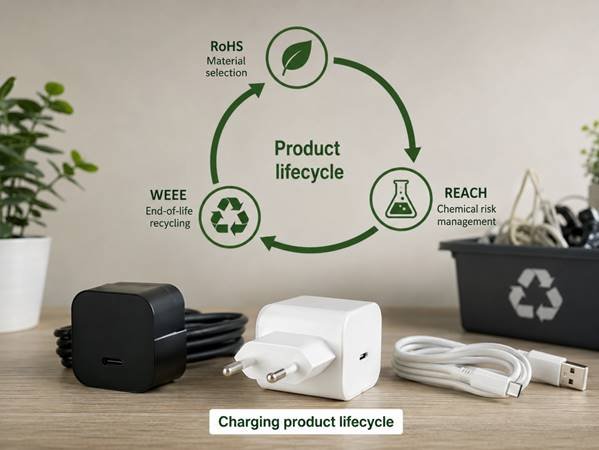
Why do charging products usually need to comply with all three regulations? There are three core reasons:
First, they cover the entire life cycle of electrical and electronic products — from the restriction of toxic substances during material selection (RoHS), to the risk management of chemicals in materials (REACH), and then to recycling and treatment after end-of-life (WEEE), all three stages are covered.
Second, the material composition of charging products is complex. Plastic jackets, metal plating, solder, adhesives, and ink labels are all high-risk parts that are likely to involve restricted substances, easily triggering the regulatory requirements of multiple regulations.
Third, most charging products are electrical and electronic equipment (EEE), which is the prerequisite for the application of RoHS and WEEE. At the same time, REACH, as a general regulation, already covers all products, so all three apply simultaneously.
Before the formal comparison, let’s unify several basic standards to avoid understanding deviations later:
When we refer to charging products later, we default to consumer-grade chargers, USB/USB-C cables, power adapters, and charging connectors. In terms of legal nature, RoHS and WEEE are EU directives — the EU only sets the general framework, and each member state must transpose them into their own national laws, so details may vary. REACH is an EU regulation, which is directly and uniformly applicable across the entire EU, with completely consistent rules. At the beginner stage, you only need to know that the core regulation number of RoHS is 2011/65/EU and its subsequent amendments, and you don’t need to memorize it by rote.
Applicability Determination: Does Your Product Need to Comply?
You don’t have to comply with all three regulations right away. First, go through three checkpoints for determination, and you can clarify which rules you need to follow.
First checkpoint: First, see where you sell. If your products are only sold to markets outside the EU/European Economic Area (EEA), such as Southeast Asia, North America, and the Middle East, you don’t need to comply with any of the three regulations and can pass directly. As long as the products are placed on the EU/EEA market, whether it is B2B wholesale, B2C retail, or cross-border direct mail to individual consumers, you must proceed to the next checkpoint.
Second checkpoint: Determine whether your product is **electrical and electronic equipment (EEE)**. The core is not whether it is “sold separately”, but first to judge according to the legal definitions in RoHS and WEEE: whether the product relies on electric current or electromagnetic fields to achieve at least one intended function, or whether it is equipment used to generate, transmit, or measure electric current or electromagnetic fields; at the same time, it is also necessary to check the rated voltage range, scope of application, and legal exclusions. For components, supporting cables, and bundled accessories, specific obligations must also be determined in combination with whether they constitute part of another EEE and the transposition rules of the target member state.
For charging products, the typical determination results are very clear: separately sold chargers and data cables with circuits (such as USB-C fast charging cables with E-Marker chips) usually belong to EEE; passive cables, pure connectors, separate decorative accessories, etc., cannot be directly concluded just by “passive” or “accessory”. It must be confirmed case by case in combination with whether they are used to transmit electric current or electromagnetic fields, whether they are placed on the market separately, whether they are part of another EEE, and the specific rules of the target member state. For charging accessories bundled with main devices such as mobile phones and laptops, the attribution of WEEE responsibility shall be in accordance with the rules of the target country’s Producer Responsibility Organization (PRO, the local agency responsible for recycling affairs), which may be the responsibility of the main device brand or borne by the accessory supplier.
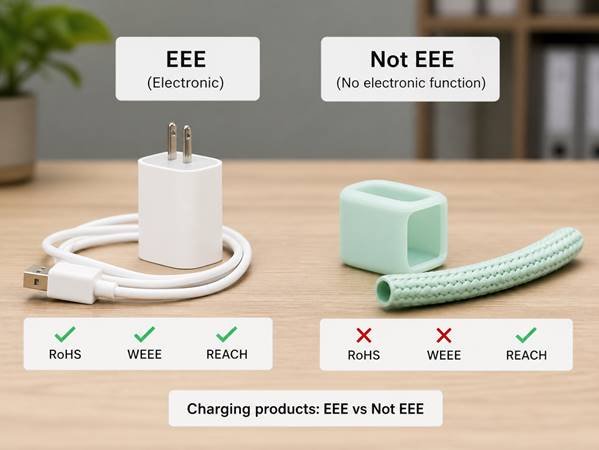
After passing the first two checkpoints, the third checkpoint can directly correspond to specific regulations. If it is determined to be EEE, then all three of RoHS, WEEE, and REACH must be assessed; if it is not EEE, such as a purely decorative silicone cover for a charging head or a braided cable protective cover without any electronic functions, then only REACH needs to be complied with, and RoHS and WEEE do not need to be considered. In addition, second-hand products for personal use, such as reselling a used charger to an individual in the EU, do not require enterprise-level compliance.
Finally, a special scenario is mentioned: if your charging product comes with a battery, you must additionally comply with the EU Battery Regulation; products with radio communication functions such as Bluetooth, Wi-Fi, NFC, or with radio determination functions should assess the applicability of the RED (Radio Equipment Directive). Pure wireless power transmission itself does not automatically apply to RED, and must be judged according to specific functions. These are not within the scope of this comparison, so do not confuse them.
Core Rules of Individual Regulations (Applicable to Charging Products)
After determining the scope of application, we will break down the core requirements of the three regulations respectively, all targeting common scenarios of charging products.
RoHS: The Red Line for Restriction of Toxic Substances in Electrical and Electronic Products
The core positioning of RoHS is to restrict toxic substances in electrical and electronic products during the production and material selection stage, and it is part of CE compliance — that is to say, products must first meet RoHS requirements before they can bear the CE mark.
Its regulatory objects are 10 categories of restricted substances/groups, namely lead, mercury, cadmium, hexavalent chromium, polybrominated biphenyls, polybrominated diphenyl ethers, and 4 categories of phthalates.
Many people are confused about how the concentration of RoHS is calculated. Here, you must remember the core rule: the calculation basis is **homogeneous material**, that is, a single material that cannot be split into finer parts by mechanical means such as screwdrivers and pliers. For example, the plastic shell of a charger is a homogeneous material, and you cannot grind the shell, pins, and circuit board to calculate the average concentration. In terms of limits, the upper limit for cadmium is 0.01% (100ppm), and the other 9 items are all 0.1% (1000ppm). Of course, there are also exemption clauses. For example, solder for some special purposes can be exempted from the lead restriction, but they must be verified item by item and cannot be applied by default.
For charging products, the high-risk parts are mainly solder (prone to contain lead), plastic jackets (prone to contain phthalates), metal plating (prone to contain hexavalent chromium), plug rubber cores, and ink labels. These parts should be inspected with emphasis.
The RoHS compliance process is roughly as follows: first collect risk evidence of all materials, then implement production process control, and finally compile the EU Declaration of Conformity (DoC) before the CE mark can be affixed to the product. It should be noted here that CE compliance also involves multiple directives such as Low Voltage (LVD) and Electromagnetic Compatibility (EMC). We only compare RoHS here, so do not equate CE with RoHS.
REACH: EU Full Life Cycle Regulation of Chemicals
Many people’s biggest misunderstanding of REACH is that “it regulates chemical factories and has nothing to do with me who sells finished products”. In fact, this is completely wrong. REACH is a general regulation that controls all chemicals entering the EU (including chemicals contained in products). Whether you are a chemical factory, electronics factory, or cross-border seller, as long as the product contains chemical components, it may trigger obligations.
REACH obligations are layered, ranked from low to high in terms of trigger difficulty:
The most basic is **Substances of Very High Concern (SVHC) information transfer**: If the concentration of SVHC in a single article exceeds 0.1% (by weight), you need to transfer safe use information to downstream buyers;
Next is the consumer response obligation: if a consumer inquires about SVHC information in the product, you must respond free of charge within 45 days;
More stringent is **SVHC notification**: It is usually triggered when the concentration of a candidate list substance in an article exceeds 0.1% (by weight) and the total amount of the substance in the relevant articles of the producer or importer exceeds 1 ton per year; however, if it can be excluded that the substance is exposed to humans and the environment under normal or reasonably foreseeable use conditions, including during disposal, or the substance has been registered for that use by an EU manufacturer or importer, then notification exemption may apply;
The strictest is **Annex XVII restricted substances**: This part stipulates clear restriction conditions. As long as the requirements of the corresponding entries are not met, the product cannot be placed on the EU market. In addition, substances included in the authorization list in Annex XIV may also require authorization in cases related to placing on the market, use, or incorporation into articles produced within the EU.
The calculation basis of REACH is **single article**. The “article” here does not simply refer to “a component with independent functions that can exist alone”, but refers to an object that is given a specific shape, surface or design during production, and these characteristics determine its function more than its chemical composition. In complex products, as long as the assembled components still retain this attribute, they usually still need to be evaluated as separate articles, and the average concentration of the entire product cannot be used to dilute — for example, if the hexavalent chromium in the pin plating exceeds the standard, you cannot rely on the low concentration of the shell to pull the average of the whole unit below the qualified line.
The REACH high-risk parts of charging products are mainly PVC jackets, adhesives, metal plating, flame retardants, and recycled plastics (which have many impurities and are prone to contain restricted substances).
There are two boundaries to clarify here: First, the inclusion of SVHC in the candidate list does not mean it is prohibited. It mainly triggers obligations such as information transfer, notification, and SCIP for articles; Annex XVII stipulates specific restriction conditions, and Annex XIV sets authorization requirements for the relevant placing on the market and use of substances included in the authorization list, which should be judged according to the list the substance is in and the specific entries. Second, the EU Waste Information Database (SCIP) obligation that people often hear about is a requirement of the Waste Framework Directive, not a provision of REACH itself, so do not confuse them.
WEEE: Extended Producer Responsibility for E-Waste
The core of WEEE is **Extended Producer Responsibility (EPR)** — simply put, “whoever produces and sells is responsible for recycling”, requiring legal producers to bear the responsibility and cost of recycling and treatment of electrical and electronic products after end-of-life.
The “producer” here does not only refer to factories. Manufacturers in the EU, importers, own-brand OEMs, and even cross-border distance sellers (such as Chinese sellers directly doing EU e-commerce retail) are all legal producers and must bear responsibility.
The core obligations of WEEE include: completing producer registration in the target member state where you sell, and bearing the obligations of recycling, treatment, financing, and declaration in accordance with the country’s system through individual performance or participation in compliance schemes, PROs, etc. Whether it is mandatory to join a certain PRO shall be subject to the laws and registration system of the target country. In addition, the product must be affixed with the crossed-out wheeled bin mark, which is required to be conspicuous and not easy to fall off; in addition to this mark, the product shall also bear a date identification mark that can clearly indicate that it was placed on the market after August 13, 2005, which can usually be implemented in accordance with EN 50419, and the transposition requirements of the target country shall be checked.
The judgment logic of WEEE is completely different from the previous two: it usually requires declaring the category and weight of EEE placed on the market in accordance with the regulations of the target country, and the relevant costs and financing arrangements are determined in combination with B2C/B2B attributes, new waste or historical waste, performance methods, and target country rules; it is not based on whether the materials are toxic or whether the concentration exceeds the standard — even if you use all degradable materials, as long as it is electrical and electronic equipment, you still need to fulfill the corresponding recycling responsibility.
Two important boundaries: First, there is no EU-unified WEEE registration number. If you sell to Germany, you must register in Germany; if you sell to France, you must register in France, and each member state handles it separately; second, the recycling financing arrangements for B2C and B2B, and the division of responsibilities for new waste and historical waste, are all implemented in accordance with the rules of each member state, and there is no EU-wide unified standard.
Quick Comparison of Core Dimensions
After explaining the three regulations separately, you may still mix them up. We will highlight the core differences in a comparative way so that you can see them clearly at a glance.
| Comparison Dimension | RoHS | REACH | WEEE |
| Legal Nature | EU Directive (transposed by member states, with differences in details) | EU Regulation (uniformly applicable across the EU) | EU Directive (transposed by member states, with differences in details) |
| Regulatory Objective | Reduce toxic substances in electrical and electronic products | Regulate the full life cycle risks of chemicals | Reduce e-waste pollution |
| Scope of Application | Electrical and electronic equipment that meets the EEE definition and is not excluded | All products containing chemical substances | Electrical and electronic equipment that meets the EEE definition, is not excluded, and is placed on the EU market |
| Regulatory Object | 10 categories of restricted substances | Chemical substances (SVHC, restricted substances, etc.) | Recycling process of end-of-life EEE |
| Judgment Basis | Concentration in homogeneous materials | Concentration in single article / annual volume placed on market | Product category, weight and financing arrangement declared in accordance with target country rules |
| Responsible Entity | EU importer/manufacturer | EU importer/manufacturer | Legal producer (including distance sellers) |
| Compliance Documents | EU Declaration of Conformity (DoC), technical documentation, test reports | SVHC compliance declaration, restricted substance declaration, notification certificate (if required) | Target country registration certificate, PRO payment certificate, declaration records |
| Update Frequency | Exemptions and substance lists are revised irregularly | SVHC is usually updated twice a year, Annex XVII is updated irregularly | Member state rules are adjusted irregularly |
The Most Easily Confused Concentration Thresholds
All three regulations have percentage thresholds, but the calculation bases are completely different. Do not apply them incorrectly:
• RoHS limits: at the homogeneous material level, cadmium ≤ 0.01%, and the other 9 items ≤ 0.1%;
• REACH SVHC information transfer threshold: 0.1% at the single article level;
• REACH notification threshold: SVHC in the article exceeds 0.1%, and the relevant total amount exceeds 1 ton/year; if exposure during normal or reasonably foreseeable use, including disposal, can be excluded, or the substance has been registered for that use, then notification exemption may apply.
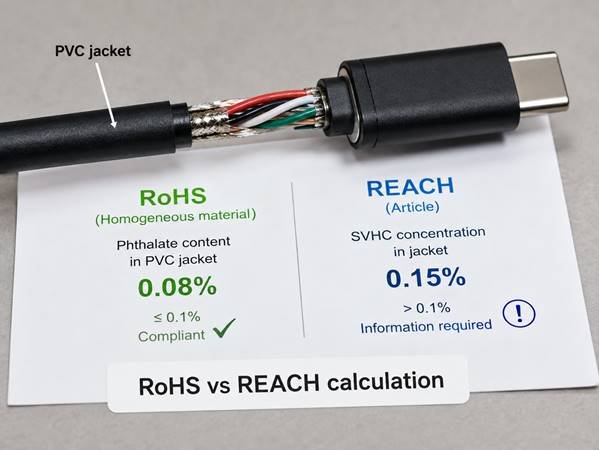
Take a simple example: if the phthalate content in the PVC jacket (homogeneous material) of a USB-C cable is 0.08%, then it meets RoHS requirements; but if the concentration of a certain SVHC substance in this jacket (single article) is 0.15%, then the REACH information transfer obligation needs to be fulfilled — the calculation bases and regulatory logic of the two are completely different.
Core Relationship Between the Three
Many people ask, “If I comply with one, can I ignore the other two?” The answer is no. The three are complementary. As long as the applicable conditions are met, they must be complied with simultaneously, and there is no substitution relationship. Among them, REACH has the widest coverage, regulating whether it is an electronic product or not; RoHS and WEEE are only for electrical and electronic equipment products. The same substance (such as phthalates) may appear in both the RoHS restricted list and the REACH regulatory list. In this case, the requirements of both sides must be met at the same time, and not just one.
Key Conditions Affecting Compliance Conclusions
Whether it is applicable in the end and how much work needs to be done mainly depends on 5 conditions:
1. Product attribute: If it is not EEE, you only need to comply with REACH, and do not need to consider RoHS and WEEE;
2. Sales model: Cross-border distance sales need to bear WEEE responsibility in the destination country, and the responsible entities for B2B and B2C may be different;
3. Sales country: The WEEE rules and law enforcement standards of different member states are different, but the underlying rules of RoHS and REACH are unified across the EU;
4. Material content: Determines the level of REACH obligations — whether only information disclosure is required, notification is required, or market entry is directly prohibited;
5. Sales region: As long as the products are not sold to the EU/EEA, none of the three regulations need to be complied with.
Practical Guide for Charging Products
After explaining the rules, let’s move to specific charging product scenarios and provide you with directly applicable operation methods.
Scenario 1: 65W USB-C GaN Charger (with Detachable Cable)
First, conduct applicability determination: This product is electrical and electronic equipment, so it must comply with all three regulations.
• RoHS compliance: First sort out the complete Bill of Materials (BOM), collect risk evidence of all materials, and conduct layered verification of high-risk components such as solder, plastic shells, and metal plating — you can first use XRF equipment for rapid screening, and send them to a third-party laboratory for testing if there are doubts. Finally, compile the EU Declaration of Conformity and organize the technical documents for inspection.
• REACH compliance: Check SVHC and Annex XVII restricted substances one by one according to single articles (such as pins, shells, circuit boards, data cable jackets, etc.). For those exceeding the corresponding thresholds, fulfill the corresponding obligations of information transfer, notification, or rectification; for Annex XIV substances, it is also necessary to confirm whether authorization requirements are involved.
• WEEE compliance: Complete producer registration in the target member state where you sell, fulfill the obligations of recycling, treatment, financing, and declaration in accordance with the country’s system through individual performance or participation in compliance schemes, PROs, etc. Affix the crossed-out wheeled bin mark on the product as required, and adopt a date identification mark that can clearly indicate that the product was placed on the market after August 13, 2005.
Scenario 2: Compliance Judgment of Boundary Products
Many people are stuck on “whether my product counts as EEE”. Here are the conclusions for several common boundary products:
• Separately sold USB-C cables with circuits (such as fast charging cables with E-Marker chips): usually belong to EEE and must comply with all three regulations;
• Pure passive braided cables cannot be directly excluded just because they are “passive”: it depends on whether they are used to transmit electric current or electromagnetic fields, whether they are placed on the market separately, and whether they are part of another EEE. Finished USB charging cables sold separately usually should be assessed for RoHS, WEEE, and REACH;
• Purely decorative charging head covers usually do not belong to EEE and only need to comply with REACH;
• Chargers bundled with mobile phones: The attribution of WEEE responsibility is confirmed in accordance with the PRO rules of the target country. It may be borne by the mobile phone brand or required to be borne by the charger supplier, which needs to be verified in advance.
Key Points for Checking Supplier Compliance Qualifications
Many sellers ask suppliers for compliance documents and only check whether there are certificates, which is easy to fall into pitfalls. The inspection focuses of different regulations are different:
• RoHS: Check the product model or unique identification, manufacturer information, applicable regulations, and signing information in the EU Declaration of Conformity (DoC) to confirm that the document has been updated in accordance with the regulations; at the same time, check the technical documents, applicable exemption clauses, and test reports of high-risk materials. Do not mistake the test report period or the supplier’s commitment period as the legal validity period of the RoHS DoC;
• REACH: Check which version of the list is used in the SVHC screening report (SVHC is updated every year, and the latest version should be used), whether the judgment basis for single articles is reasonable, and there should also be a compliance declaration for Annex XVII restricted substances;
• WEEE: Check whether the registration number of the target country is valid, whether there is a PRO participation certificate, and the records of annual declaration and payment.
Pitfall avoidance tip: Do not only look at the cover picture of the certificate. Be sure to check that the product model, materials, and processes in the document are completely consistent with the products you actually purchase. Many suppliers use reports of other models to make up the numbers.
Compliance Evidence Chain and Change Management
Compliance is not a matter of getting a report and being done. You must understand the validity boundary of each document:
• The supplier’s material declaration is only a self-declaration and cannot replace a third-party test report;
• Third-party test reports are only responsible for the submitted samples. Ensure that the report covers the high-risk materials you use for mass production, not specially made “submitted samples”;
• The WEEE registration number only proves that the registration is completed, and cannot replace the subsequent declaration and payment obligations. Failure to declare on time will also result in fines.
If the following situations occur, compliance must be reassessed:
• Changing materials, changing suppliers, adjusting production processes;
• Regulation updates, such as new substances added to SVHC, adjustment of RoHS exemption clauses, changes in WEEE rules of a member state;
• Adding new member states for sales, or adding new functions or components to the product.
Beginner-Level Compliance Self-Inspection Process
If you are a novice who has just entered the EU market, you can conduct a basic self-inspection according to this four-step process:
1. Confirm basic information: your sales region, placement method, product type, and your role in the supply chain (factory, importer, or cross-border seller);
2. Use the three-checkpoint determination method above to confirm which regulations your product needs to comply with;
3. According to the requirements of each regulation, check one by one whether the corresponding obligations have been fulfilled and whether the documents are ready;
4. Keep all compliance evidence, conduct regular reviews according to change trigger conditions, and it is recommended to check regulation updates at least every six months.
Common Misconceptions and Pitfall Avoidance Guide
We have sorted out 6 pitfalls that beginners are most likely to fall into. Avoiding them in advance can save a lot of trouble.
First pit: **Having the CE mark = compliance with all three regulations**
Wrong. The CE mark only covers some EU directives such as RoHS, LVD, and EMC. REACH and WEEE are not within the scope of CE compliance. Don’t think that everything is fine just because the CE mark is affixed.
Second pit: **REACH only regulates chemical factories**
Wrong. REACH regulates all chemical substances entering the EU, including chemicals contained in finished products. The SVHC information disclosure obligation that sellers most often encounter is targeted at finished product sellers.
Third pit: **WEEE only requires the wheeled bin mark**
Wrong. Labeling is only one of the requirements of WEEE. You also need to complete producer registration in the target country and fulfill obligations such as recycling, financing, and declaration in accordance with local systems. Only labeling without registration can easily lead to products being removed from platforms or goods being detained.
Fourth pit: **With a RoHS report, you don’t need to care about REACH**
Wrong. RoHS only regulates 10 categories of restricted substances, while REACH regulates a much wider range of substances (there are more than 200 SVHCs alone), and the calculation bases of the two are also different (RoHS is homogeneous material, REACH is single article), so they cannot replace each other.
Fifth pit: **The SVHC list is fixed**
Wrong. The SVHC candidate list is not fixed. When checking, be sure to use the latest version published by ECHA. If historical data is cited, the exact date must also be indicated: the candidate list had 240 items on January 23, 2024, and increased to 241 items on June 27, 2024. Checking with an outdated list is equivalent to checking in vain.
Sixth pit: **SVHC are prohibited substances**
Wrong. SVHC are “Substances of Very High Concern”. Being included in the candidate list itself does not mean they are prohibited. It mainly triggers obligations such as disclosure, notification, and SCIP; REACH Annex XVII stipulates specific restriction conditions, and substances in Annex XIV may involve authorization requirements. You cannot think that the product must not be sold as soon as you see SVHC exceeding the standard, nor can you think that all market access requirements have been fully checked just by looking at Annex XVII.
Judgment Methods for Two Easily Confused Points
Finally, here are two practical judgment formulas that you can directly apply when you are unsure:
First, are hazardous substances regulated by RoHS or REACH?
First, check whether the product is EEE: if not, it is all regulated by REACH; if it is EEE, then check whether the substance is one of the 10 categories of RoHS restricted substances. If yes, it is regulated by RoHS, otherwise by REACH; if it is in both lists (such as phthalates), then the requirements of both sides must be met at the same time.
Second, how to determine the responsible entity for non-EU sellers?
• RoHS: The EU importer bears primary responsibility and can appoint an authorized representative to assist, but this is not mandatory in all scenarios;
• REACH: EU importers or manufacturers bear the obligations for articles. Non-EU enterprises cannot be exempted from responsibility only by appointing a responsible person. The importer is always the first responsible person;
• WEEE: Cross-border distance sellers must complete WEEE registration in the member state of destination for sales; according to the WEEE Directive, if they are not registered in that country, they shall register through an authorized representative in that country. The specific registration procedures and authorized representative requirements must also be checked against the transposition law of the destination country.
Summary
After reading this article, you should be able to distinguish the core positioning, regulatory stages, and legal nature differences of the three regulations RoHS, REACH, and WEEE, use the three-checkpoint determination method to judge which specific regulations your charging products need to comply with when entering the EU, and also distinguish the differences between RoHS’s homogeneous material limits, REACH SVHC’s article thresholds, and notification conditions.
More importantly, you can complete a beginner-level compliance assessment according to the practical steps, check the basic qualifications of suppliers, recognize the 6 most common compliance pitfalls, and know which conditions will affect the final compliance conclusion.
EU environmental compliance is not a one-time job, but a process of continuous adjustment along with product changes and regulation updates. As long as you master the core judgment logic, you don’t have to be led by various new terms.