
Whether you are a seller of charging products targeting the North American market, or a consumer who usually buys chargers and charging cables, you have most likely seen the three marks UL, ETL, and CSA. Many people feel confused when they first encounter them: what are the differences between these three certifications? Is UL more authoritative and safer? Is CSA mandatory for the Canadian market? In fact, all three are related to North American product safety certification, but they are different certification bodies and certification marks, and the differences are far less great than people think. Today, we will explain these three certifications clearly from basics to practical operation, especially for products such as chargers, USB cables, and power adapters, to help you choose the right certification and avoid common pitfalls.
First, Understand: What Exactly is NRTL?
Many people think NRTL is a specific certification mark, but it is not. The full name of NRTL is Nationally Recognized Testing Laboratory, which is a recognition program of the U.S. OSHA (Occupational Safety and Health Administration) for third-party product safety certification bodies with capabilities in specific scopes. You can think of it as an “officially recognized safety examination room” — but this recognition is not unlimited. Which standards, product types, test locations, and certification programs a body can cover depend on its specific recognized scope.
Its core function is: for workplace products that are subject to OSHA regulations and require NRTL recognition, after being certified by a body within the applicable scope and correctly affixed with the mark, the product can meet relevant OSHA requirements. Safety assessments of charging products usually focus on risks such as electric shock, overheating and fire, insulation failure, and structural damage.
It should be noted that NRTL is not a government that directly issues certificates for products, nor is it a single certification mark, but a group of recognized bodies. UL, ETL, and CSA are all bodies or certification brands that people frequently contact. However, when targeting the U.S. consumer retail market or the Canadian market, whether third-party certification is required, which standards apply, and what regional marks are needed still need to be verified separately against product use, applicable regulations and electrical codes, local Authorities Having Jurisdiction (AHJ), retailers, customers, and platform rules.
Many people confuse NRTL with other certifications. Let’s clarify the boundaries first:
• Difference from FCC: NRTL product safety certification and FCC’s radio frequency and electromagnetic compatibility regulations belong to different systems. Whether chargers, devices with digital circuits, cables, etc. are subject to FCC requirements should be confirmed item by item according to FCC equipment classification, functions, and exemption clauses, and cannot be generalized.
• Difference from CE: CE is the access requirement of the European Union, and NRTL is a program of the U.S. OSHA to recognize third-party bodies, with different covered regions and standards.
• Difference from energy efficiency certification: NRTL is not equivalent to energy efficiency certification. Whether energy efficiency requirements such as DOE, CEC, and NRCan apply needs to be confirmed separately according to specific product categories.
Before the formal comparison, let’s unify the premises of the comparison to avoid understanding deviations: all comparisons are for conventional charging products in the core U.S. and Canadian markets (wall chargers, USB-C charging cables, power adapters, etc.), and compare single-model safety certifications, excluding non-safety requirements such as performance, energy efficiency, wireless compliance, and chemical environmental protection.
Finally, let’s give you a reassurance first: UL, ETL, and CSA can all carry out product safety certification within their respective recognized scopes. As long as the certification is completed according to the same applicable standard and the same version, the technical requirements shall be subject to that standard, and there is no hierarchical difference of “which is safer”. Their differences are mainly in brand awareness, specific service processes, project coverage, and market adaptability, rather than safety levels.
What Are the Backgrounds of the Three Bodies?
Although technical requirements depend on applicable standards, the backgrounds and characteristics of the three bodies are indeed different, and the applicable scenarios are also different.
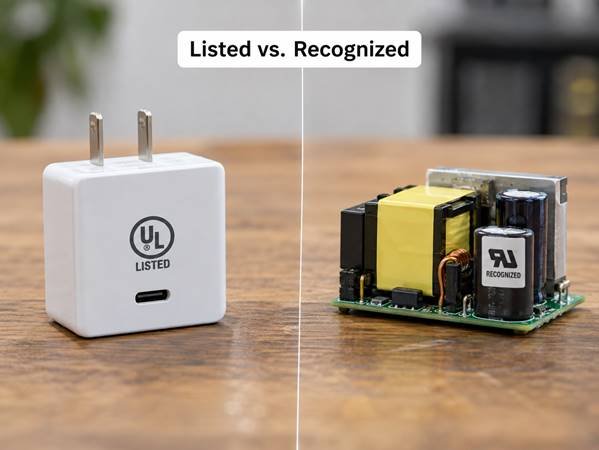
UL (UL Solutions, formerly Underwriters Laboratories) is one of the oldest NRTLs in North America, with a history of more than 100 years. UL has participated in the formulation or maintenance of many charging-related safety standards, such as the well-known UL9990 data cable standard, and UL62368-1 safety standard for audio/video, information and communication technology equipment. It has two common marks: UL Listed is the listing certification for complete machines, and UL Recognized is the recognition certification for internal components. UL’s biggest advantage is the highest awareness among C-end consumers, and the strongest acceptance in high-end offline channels.
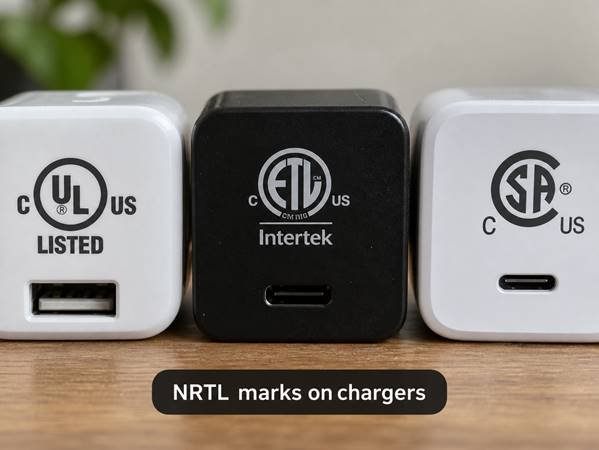
ETL is a certification brand under Intertek, and is also one of the earlier NRTL brands recognized by OSHA. Unlike UL, ETL is not mainly characterized by independently formulating product safety standards, but conducts testing and certification according to applicable existing standards. Its common marks are ETL Listed (U.S.-only certification) and cETLus (U.S.-Canada dual certification). ETL is often used by e-commerce sellers and small and medium-sized brands.
CSA (CSA Group, Canadian Standards Association) is a non-profit non-governmental standards organization recognized by SCC that engages in standard formulation and product certification, and some of its standards may be adopted by Canadian regulations or codes at all levels. CSA Group also holds relevant U.S. NRTL qualifications. Its mark carries regional suffixes: those with “C” are Canada-only certification, those with “US” are U.S.-only certification, and those with “c/us” are U.S.-Canada dual certification. CSA has a relatively high awareness in the Canadian market, and can also provide certification programs covering both the U.S. and Canada.
Item-by-Item Comparison of Core Dimensions
To help you quickly understand the differences, we have first compiled a core comparison table, and then we will explain details and precautions for each dimension one by one:
| Comparison Dimension | UL | ETL | CSA |
| U.S. Market Related Qualifications | Can carry out certification within its OSHA NRTL recognized scope | Can carry out certification within its OSHA NRTL recognized scope | Can carry out certification within its OSHA NRTL recognized scope |
| Canadian Market Adaptability | It shall be confirmed that the specific certification program has applicable SCC recognition and uses Canadian applicable marks | It shall be confirmed that the specific certification program has applicable SCC recognition and uses Canadian applicable marks | It shall be confirmed that the specific certification program and mark cover Canadian requirements |
| Standard and Program Coverage | The recognized standards, product categories, and location scope of the body shall be verified | The recognized standards, product categories, and location scope of the body shall be verified | The recognized standards, product categories, and location scope of the body shall be verified |
| Core Awareness Advantage | High awareness among U.S. C-end consumers, relatively common in high-end offline channels | Widely used in e-commerce and small and medium-sized brands | High awareness in the Canadian market |
Next, we will talk about the details of each dimension and common pitfalls.
First is the recognition boundary of the U.S. and Canadian markets. In the U.S., if a product falls within the scope of applicable OSHA workplace regulations, the certification completed by an OSHA-recognized NRTL within the corresponding standard scope can be used to meet relevant requirements. However, whether it is necessary to meet other federal, state, local codes, AHJ requirements, or retailer and platform rules still depends on the specific product and sales scenario.
Canada does not follow the OSHA NRTL system. For the Canadian market, it shall be confirmed that the certification body and its specific programs have applicable SCC recognition, and that the product is certified according to applicable Canadian standards and uses a certification mark that includes Canadian coverage. Bodies such as CSA, UL, and Intertek may all provide Canadian product certification within their recognized scopes; the process, quotation, and cycle shall be confirmed according to specific projects, rather than only looking at whether the body is CSA.
Then there are the standards used as the basis for testing. It should be emphasized again here: as long as it is the same applicable standard number and the same version, the certification shall be carried out according to the technical requirements of that standard, and there is no general statement that “UL’s testing is stricter”. The standards, product categories, certification locations, and programs that different bodies can cover are not exactly the same, so before applying, it shall be verified case by case whether the selected body covers the standards and product categories you need under OSHA NRTL (U.S.) and SCC or other applicable recognition (Canada). Standard conversion arrangements, whether existing materials are accepted, and the project cycle shall all be subject to the written plan provided by the body.
Next is the type of certification, which is the most common place for pitfalls. All three provide two types of core certifications: one is complete machine listing (Listed), which is applicable to finished products that can be directly sold to consumers, such as finished chargers and some finished cable assemblies; the other is component recognition (Recognized), which is only applicable to internal components such as power modules and wire connectors, and cannot be directly used to prove the compliance of the complete machine. In addition, a simple test report is only the test result of a specific sample, which is not equal to a continuously valid NRTL certification — many merchants will promote “compliant with UL standards”, but this is completely different from “obtained UL certification”. It is necessary to confirm the actual certification type and coverage scope of the product.
Certification cycle, cost, series rules, factory inspection, and change management also cannot be simply judged directly by the three names UL, ETL, and CSA. They are affected by product standards, product risks, factory conditions, sample and document quality, test rectification, target country, series coverage rules, and certification programs. The safest approach is to obtain a written quotation and project plan for the product, factory, target market, and applicable standards from the selected body, and then compare after clarifying the test scope, rectification rounds, initial and follow-up factory inspections, change declarations, annual fees, and U.S.-Canada joint certification arrangements.
Mark usage requirements are also very important, and many people fail here. The certification marks of UL, ETL, and CSA all have different regional coverage and label rules. For example, an ETL mark with “c” usually indicates Canadian coverage, and without “c” it does not indicate Canadian coverage; a CSA mark with “US” indicates U.S. coverage, and without “US” it cannot be confirmed to have U.S. coverage based on the mark. If the product is too small to print the full mark, be sure to confirm the special requirements with the body in advance, otherwise the cost of modification after mass production will be very high.
It should be particularly noted that whether file numbers, control numbers, Issue Numbers, or other traceability codes must appear shall be subject to the label rules of the body and the specific certification program. You cannot directly judge that it is a fake certificate just because a certain number is not on the product shell; conversely, the fact that the product has a number printed on it does not mean that the certification is necessarily valid. It is still necessary to verify the label artwork, product identity information, ratings, regional marks, and certification scope.
Finally, there is market awareness. U.S. C-end consumers usually recognize UL the most, after all, it has a long history and high popularity, and many high-end offline retailers are also more familiar with UL-certified products. In Canada, whether it is C-end or B-end, CSA usually has a higher awareness, after all, it is closely connected with the Canadian standard system. For e-commerce platforms such as Amazon, the specific documents and marks accepted shall be subject to product categories, sites, and platform rules, and some major customers will also specify a specific mark.
Charging Products Should Pay Attention to These Exclusive Differences
The above comparison is for general situations. For products such as chargers and charging cables, there are also some exclusive differences that should be focused on when selecting.
First are chargers and power adapters. NRTL safety certification shall cover the actual structure, rated input and output of the certified product, as well as the conditions required by applicable safety standards. USB Type-C, USB PD protocol performance, and the use of the USB-IF mark belong to another set of compliance matters, which shall be confirmed separately according to the USB-IF compliance program.
If you have already obtained USB-IF certification, or have third-party pre-test materials, whether these materials can be accepted by safety certification bodies such as UL, ETL, and CSA must be confirmed in writing by the body, and you cannot default that items can definitely be reduced or exempted. Whether Canadian energy efficiency requirements apply, whether a verification mark is required, and whether it is necessary to report to NRCan shall also be confirmed according to specific regulated product categories, and it cannot be directly presumed from CSA safety certification that energy subsidies can be obtained.
A reminder here: the rated output covered by safety certification shall be consistent with the actual certified product. As for PD protocol capabilities, USB-C functions, and related marks, they shall be verified through corresponding USB-IF compliance materials, and safety certification cannot be regarded as PD protocol certification.
Then there are USB and USB-C charging cables. If USB cable assemblies are sold as certified finished products, or if channels or customers require third-party safety certification, it shall be confirmed whether the final cable assembly itself has been certified according to applicable standards and certification programs. Recognition certification of components such as plugs and wires will not automatically cover the final cable assembly.
Whether UL9990 or other cable and assembly standards apply shall be determined according to cable structure, rated power, purpose, sales location, and channel rules. UL9990 applies to power supply cable assemblies for information and communication technology equipment within its scope, and is not a general certification standard for all USB or USB-C cables; UL62 is a standard related to flexible wires and cables, and cannot be directly used as a general finished product certification basis for USB cable assemblies.
For multi-port charging stations or car chargers, the requirements will be more complex. These products have many more test items than ordinary single-port chargers: multi-port full-load test, heat dissipation test, abnormal working condition test, and car chargers may also involve vehicle environmental conditions such as vibration and voltage fluctuation. The certification scope must cover the actual port configuration and usage scenarios, and the certificate of a single-port charger cannot be directly used. Many sellers fall into the trap here, thinking that since they are all chargers, if the single-port one passes, the multi-port one can be used, but this is completely impossible.
Finally, here are a few standard scopes that are easily misused, to help avoid direct application: UL62368-1 applies to audio/video, information and communication technology equipment within its scope; UL1310 only applies to Class 2 power units or chargers within its scope; UL9990 only applies to power supply cable assemblies for information and communication technology equipment within its scope; UL2089 only applies to portable vehicle battery adapters within its scope that are powered by a vehicle cigarette lighter socket or on-board power port and have a rated voltage of no more than 24VDC. Standards shall not be applied only based on product names such as “wall charger, car charger, data cable”. Before applying, be sure to confirm the actual applicable standards of the product and the qualification scope of the body.
How to Choose the Right Certification for You
Having talked about so many differences, in fact, you don’t have to struggle to choose a certification, just judge according to three core conditions:
First is the target market: do you only do the U.S., only do Canada, or do both the U.S. and Canada simultaneously?
Second is channel requirements: do platforms, customers, or retailers specify which certification mark must be used?
Third is project conditions: what standards apply to the product, whether the body covers the standard and product category, and whether the budget and launch time allow?
We have compiled several of the most common scenarios for charging products, you can directly match them:
• Only targeting the U.S. market, no certification specified by channels, multiple models in small batches, mainly e-commerce: you can compare the written plans of bodies such as ETL, UL, and CSA for this project, focusing on standard coverage, series rules, cost, and cycle.
• Doing high-end brands, or entering large offline retail channels, or customers explicitly require UL certification: choose UL and complete the corresponding certification according to customer requirements.
• Launching in both the U.S. and Canada simultaneously: confirm whether the same body or certification program can cover applicable U.S. and Canadian standards, regional marks, and factory follow-up requirements, then compare the overall project arrangement.
• Customers only require “compliance with UL standards” and do not specify that certification must be from UL: you can confirm whether other bodies with applicable recognition scopes can carry out certification according to that standard, but you should first obtain written confirmation from the customer or channel to avoid the mark not being accepted.
If you have already obtained certification from one body and want to switch to another, you should pay attention to several points: the certificate cannot be directly transferred, and the new body needs to re-conduct document review and factory inspection; the original test report can be used as a technical reference, and some test items can be applied for reduction or exemption, which shall be specifically evaluated by the new body; after the certification transfer, the marks and file numbers on packaging, labels, and manuals must all be updated, and the old ones cannot continue to be used.
Teach You to Verify the Authenticity and Validity of Certification
Now there are many cases of fake certificates and out-of-scope certification. Whether you do the certification yourself or source goods from suppliers, you must learn to verify. Here is a general four-step verification method:
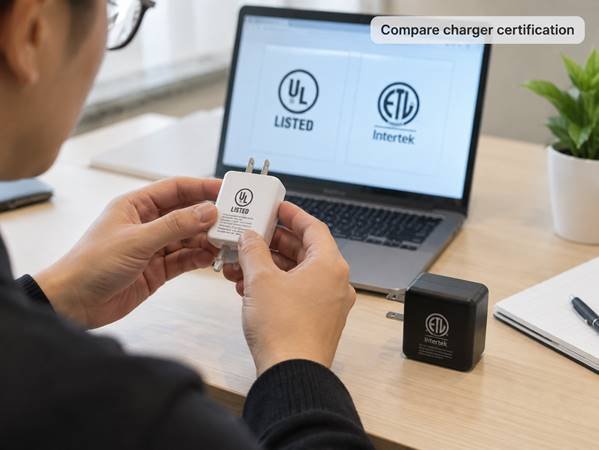
Step 1: Check the mark and label artwork. Be wary of vague expressions, such as “UL standard”, “ETL compliant”, and “meets CSA requirements”, which are not equal to formal certification. It shall be confirmed that the product uses a certification mark approved by the body, and the certification type, such as Listed or Recognized, shall be verified.
Step 2: Check regional coverage. Confirm that the mark covers the target sales market. For example, when selling to Canada, it shall be confirmed that the ETL mark has a Canadian applicable mark; the CSA mark shall also clearly include Canadian coverage. When selling to the U.S., the CSA mark shall have the “US” mark, or clearly show U.S.-Canada dual certification coverage.
Step 3: Verify product information. The product model, rated parameters, such as input and output voltage and current, as well as applicable standards and label markings, shall be consistent with the certification scope. Different models, different structures, and out-of-range ratings may cause the certification to not cover the actual product.
Step 4: Verify with the issuing body. Publicly available information can be queried through the body’s public directory; if the directory cannot be fully queried by model, or relevant records cannot be found, you should directly verify with the issuing body, rather than drawing a conclusion only based on whether a certain model is displayed on the public page.
For charging products, there are several exclusive verification points that require extra attention:
• Chargers: confirm whether the actual structure and rated input and output covered by safety certification are consistent with the product; USB PD, Type-C protocol performance, and USB-IF mark shall be verified separately according to USB-IF materials.
• Charging cables: confirm whether the final cable assembly is certified according to the requirements of channels, customers, or applicable certification programs. Component certification of plugs or wires cannot be directly regarded as compliance of the entire cable.
• Multi-port charging stations: confirm that the total output capacity of all ports, port configuration, and actual structure are within the certification scope. The certification of a two-port product cannot cover a four-port product.
Common fake and invalid certificates have the following characteristics, you can compare them: the certified model does not match the actual product model; only component certification is available but the complete machine is claimed to be compliant; the regional coverage of the mark does not match the sales market; there are obvious differences between labels, ratings, or product structure and the certified information. As for whether traceability information such as file numbers and control numbers is necessary, it shall be subject to the label rules of the body and the certification program.
Common Misconceptions and Pitfall Avoidance Checklist
Finally, we will sort out a few of the most common misconceptions, as well as exclusive pitfalls for charging products. Avoiding these can save a lot of trouble.
First, let’s talk about a few entry-level common misconceptions:
1. ETL certification is less effective than UL → Wrong. As long as the certification is completed under the same applicable standard, the same version, and the corresponding recognition scope, the technical requirements are determined by the standard itself, and there is no difference in level.
2. CSA can only be used in Canada → Wrong. CSA certification with the “US” suffix or U.S.-Canada dual certification mark can be used to meet corresponding U.S. market or workplace requirements; however, whether a specific product meets other U.S. access requirements still needs to be confirmed according to applicable regulations, codes, AHJ, and channel rules.
3. Having an NRTL mark means absolute safety → Wrong. The mark only represents that the product meets the corresponding safety standards within the certification scope. It is also necessary to verify the authenticity and coverage of the certification. Products with fake certificates or out-of-scope certification are not guaranteed.
4. UL is a mandatory U.S. government certification → Wrong. OSHA recognizes NRTL bodies and their specific scopes, and does not require manufacturers or suppliers to generally obtain NRTL certification. Whether a product requires third-party certification depends on its use, applicable regulations and codes, local AHJ, customers, retailers, and platform requirements.
Let’s talk about a few exclusive pitfalls for charging products. Those in this industry must pay attention:
1. USB-C cables only have component certification for the plug, but the final cable assembly has not been certified according to the requirements of channels, customers, or applicable certification programs → Component certification cannot automatically prove the compliance of the entire cable assembly, and the actual certification scope of the final product shall be confirmed.
2. The safety certification scope of fast chargers is inconsistent with the actual product structure and rated input and output → For example, if the rated output of the actually sold product is different from that of the certified model, it may not be within the certification coverage; PD protocol capabilities shall also be confirmed separately according to the USB-IF program.
3. Incorrect regional coverage of the mark → For example, ETL without a Canadian applicable mark is sold to Canada, which may not meet channel, customer, or local requirements.
4. The product still references old or revoked standards → You should confirm with the certification body the current status of the certification, the allowed production and change scope, and whether re-evaluation according to current standards is required; at the same time, confirm whether the certification is accepted according to the explicit requirements of the target platform, customers, and local codes. It cannot be generally considered that all old standard certificates are invalid, nor can compliance with current requirements be claimed only based on old reports.
Finally, here is a simple pitfall avoidance operation list. Following it can avoid most problems:
• Confirm the target market, channel requirements, and corresponding standards before the project starts. Don’t wait for the product to be made before making up the certification, which wastes time and money.
• Verify the authenticity and coverage scope immediately after getting the certificate, don’t just listen to what the service provider or supplier says.
• Confirm that the mark format, regional coverage, model, and rated parameters on the product fully meet the requirements before mass production. The cost of modification after printing errors is very high.
• Before changing key materials, such as transformers, main control chips, and wires, report to the certification body in advance to confirm that the validity of the certificate will not be affected.
Overall, UL, ETL, and CSA have no absolute good or bad, only suitability or unsuitability. For friends who do charging products, there is no need to blindly pursue the most well-known and most expensive UL. First clarify your target market, channel requirements, applicable standards, and certification scope, then compare the written plans given by each body for the project, and you can choose the certification that is more suitable for you. At the same time, no matter which one you choose, you must pay attention to verifying the authenticity and coverage scope of the certificate, avoid common pitfalls, and ensure that the product can smoothly enter the target market.