
Friends who take charging products to the US market are almost always stumped by FCC compliance: some say SDoC is enough, some say you must have an FCC ID to be formal, and others think SDoC is a “watered-down certification” where you just write a declaration casually. In fact, both modes are mandatory compliance paths required by the FCC officially; they only differ in applicable scenarios and processes, and there is no such thing as one being more advanced. Once you understand the logic behind it, you won’t have to ask around “which certification does my product need” — you can judge quickly by yourself, and avoid many pitfalls that other sellers have stepped into.
First, Understand the Basic Logic of FCC Compliance
Many people jump straight to comparing the differences between the two modes, but ignore the core premise: what exactly does the FCC regulate? What is the essence of the two modes? Lay a solid foundation first, so that subsequent judgments will not be wrong.
What Exactly Does the FCC Regulate? Why Do Charging Products Need to Be Compliant?
FCC is the abbreviation of the Federal Communications Commission of the United States. Its core requirements for electronic products are only two: electromagnetic compatibility and radio frequency compliance, with the purpose of preventing electromagnetic noise generated by products during operation from interfering with the wireless communication order in the United States.
Here we need to draw a clear boundary first: the FCC is usually not responsible for general product electrical safety, charging performance and energy efficiency requirements. Product safety usually involves the OSHA NRTL system, applicable state or local regulations and market requirements; external power supply energy efficiency may be subject to the rules of the US Department of Energy (DOE). Marks such as UL and ETL are common third-party testing, certification or listing marks, not government regulatory agencies — don’t confuse them.
The reason why charging products need to meet FCC requirements is that components such as switching power supplies, fast charging chips, and E-marker chips in USB-C cables generate electromagnetic noise during operation. If not controlled, they may interfere with surrounding wireless devices.
The most important core principle: **First determine the FCC Part clause applicable to the product, then select the corresponding authorization path**. You must never choose one of the two directly by the product name — for example, the statement “wireless chargers require FCC ID” is inaccurate; you have to look at its functions and applicable rules first.
The Essence of the Two Authorization Modes: Not “High or Low Level”, but “Different Division of Labor”
Many people think that SDoC is a “second-class voluntary certification” and FCC ID is a “more advanced mandatory certification”. This is the most common misunderstanding and must be corrected first:
• Both modes are mandatory compliance paths officially stipulated by the FCC. They only differ in applicable scenarios and review processes, there is no difference in authority, and there is no such thing as “one is better than the other”.
• The full name of SDoC is Supplier’s Declaration of Conformity, with the core being enterprise self-certification: after completing testing and confirming compliance with requirements, the product can be launched on the market without prior review by the FCC or an accredited body.
• Certification is an official review path: test materials need to be submitted to a third-party review body (referred to as TCB) authorized by the FCC for review. After passing, a unique FCC ID mark will be obtained.
• Clarify again: **FCC ID is not an independent certification type, it is a compliance mark after passing the Certification mode**. When we usually say “do FCC ID”, it actually refers to going through the Certification mode.
All regulated products entering the US market must complete compliance with the corresponding path, with no exceptions for brand size or sales volume.
Common FCC Applicable Rules for Charging Products
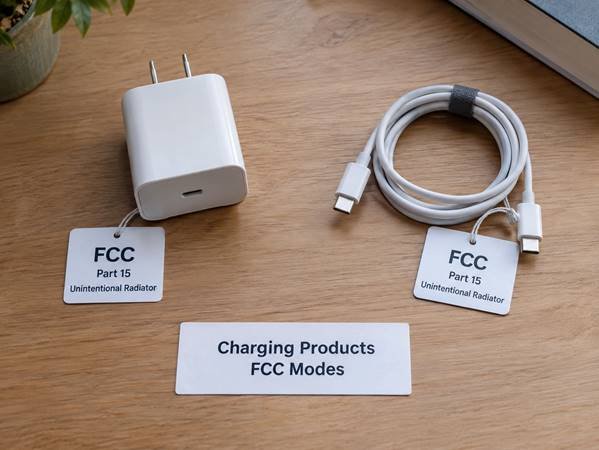
Charging products basically fall into the following categories of rules. Get a general impression first, as it will be used for later decision-making:
• **Part 15 Unintentional Radiators**: Products that are not designed to emit wireless signals, but will inevitably generate a small amount of electromagnetic noise during operation, such as ordinary wired chargers and charging cables with E-marker.
• **Part 15 Intentional Radiators**: Products designed to actively emit wireless communication signals, such as smart chargers with Bluetooth, WiFi, NFC.
• **Part 18 ISM/WPT Equipment**: Part 18 applies to industrial, scientific and medical (ISM) equipment and wireless power transfer (WPT) equipment that meet its definitions and technical conditions; wireless power transfer products may also be subject to relevant Part 15 rules, and applicable clauses should be determined item by item according to the equipment’s operating frequency, purpose, field strength or power, transmission method, and whether it includes communication transmission functions.
• **Exempt Category**: Pure passive accessories without any chips or electronic components, such as ordinary charging cables with only copper cores, do not need FCC compliance if they meet the conditions.
How to Choose a Compliance Mode for Charging Products? Apply the 4-Step Decision Method Directly
After understanding the basic rules, you can use this 4-step decision method to judge step by step, and even novices will not make mistakes if they follow the order.
4-Step Judgment Method That Novices Can Use
Step 1: Confirm whether it is an electronic product sold independently on the market
The core of the judgment is the sales form of the product: if it is a charging cable included in the mobile phone box, it is an accessory of the whole machine and does not need separate compliance; but if it is a separately sold wireless charging receiver (such as a receiver sticker attached to the back of the mobile phone), even if it is used with other products, as long as it is launched independently, it must be evaluated for compliance obligations separately and cannot be directly exempted.
Step 2: Confirm whether it is an exempt product
The simplest judgment standard is: does the product have electronic components or chips?
For example, an ordinary charging cable with a pure copper core has only wires inside and no chips, it is a pure passive accessory, meets the exemption conditions, and does not need FCC compliance. But if it is a USB-C fast charging cable with an E-marker chip, or an adapter with a protocol chip, because there are active electronic components, it cannot be exempted.
In addition, non-sale items only used for R&D, testing, and display do not need to be compliant as long as they meet the FCC’s sample exemption rules, but they must never be sold to ordinary consumers.
Step 3: Confirm whether it has active wireless communication transmission function
Active transmission here refers to actively sending wireless signals for communication purposes, such as Bluetooth, WiFi, NFC. When judging, you can look at the product’s wireless module specification sheet or function description — for example, a smart charger with Bluetooth that can connect to a mobile phone APP to adjust power, this belongs to active transmission.
It should be noted that: **pure power transmission wireless charging (only transmits electricity, does not use wireless signals for communication) does not belong to active communication transmission**, cannot be directly classified into this category, and you have to go to the next step to judge.
Step 4: Confirm whether it is a wireless power transfer (WPT) product
That is what we often call wireless charging. The judgment basis is operating frequency, power, transmission distance, and whether it has a communication function.
If the equipment is subject to Part 18, first of all, it should be judged whether it belongs to consumer or non-consumer ISM equipment: consumer ISM equipment must in principle go through Certification; non-consumer ISM equipment can choose SDoC or Certification by the responsible party. Whether Part 18 is actually applicable, and whether it is still necessary to meet the authorization requirements for Part 15 communication functions, must still be judged in combination with specific technical parameters.
If the wireless charging transmitter has communication functions such as Bluetooth and WiFi, the communication transmission function usually needs to go through Certification under Part 15, that is, obtain an FCC ID; at the same time, the wireless power supply and unintentional radiation parts of the whole machine must also confirm the applicable requirements respectively.
Compliance Path Comparison Table for Common Charging Products
For your quick reference, we have sorted out common charging products into a table:
| Product Type | Applicable FCC Rules | Compliance Path |
| Ordinary USB/USB-C chargers, power adapters (no wireless function) | Part 15 Unintentional Radiation | SDoC |
| Cables and adapters with E-marker, protocol control or other active electronic circuits | Evaluated according to actual functions, usually may involve Part 15 unintentional radiation | SDoC when applicable; pure passive cables or passive adapters are not automatically subject to SDoC just because they are marked PD/QC |
| Wired power banks without wireless function, car chargers | Part 15 Unintentional Radiation | SDoC |
| Smart chargers with Bluetooth/WiFi/NFC, wireless power banks | Communication transmission function is usually subject to Part 15 intentional radiation; other functions are evaluated separately | Communication transmission function usually requires Certification and obtains FCC ID; other parts of the whole machine still need to confirm applicable requirements |
| Pure power transmission wireless charging transmitter (no communication function) | Judge whether Part 18, Part 15 or other rules apply according to actual technical characteristics | If Part 18 applies, consumer ISM equipment must in principle be Certified; non-consumer ISM equipment can choose SDoC or Certification |
| Wireless charging transmitter with communication function | Part 15 communication function and wireless power supply function are evaluated separately | Communication transmission function usually requires FCC ID; wireless power supply and other functions are combined for compliance according to applicable rules |
| Independently sold wireless charging receiver | According to actual applicable rules | Evaluate compliance obligations separately |
3 Boundary Scenarios That Are Easy to Judge Wrongly
Many people make wrong judgments on edge products. Here are 3 of the most common ones:
1. **Ordinary charger with LED indicator**: LED is only a light-emitting indicator and does not belong to radio frequency transmitting devices, so it still follows SDoC for Part 15 unintentional radiation, and does not need FCC ID.
2. **USB-C cable with data transmission function**: Even if it is a USB 3.2 high-speed transmission cable, it is only wired digital transmission and does not actively emit wireless signals. Whether FCC compliance is required still depends on whether there is an E-marker or other active electronic circuits in the cable; you cannot draw a conclusion just because it says PD, QC or high-speed transmission.
3. **Pure wireless charging transmitter (no Bluetooth/WiFi)**: Many people think that wireless chargers must have an FCC ID, but this cannot be judged like that. First confirm whether the equipment is actually subject to Part 18, Part 15 or other rules; if Part 18 applies, consumer ISM equipment must in principle be Certified, and only non-consumer ISM equipment can choose SDoC or Certification by the responsible party.
Detailed Explanation of SDoC Mode: The Compliance Path of Enterprise Self-Certification
Many people have the deepest misunderstanding of SDoC, either thinking it is a “casual voluntary certification” or thinking it “does not need testing at all”, but neither is correct.
Core Logic: Not “Voluntary Certification”, but “Self-Certification + Post-Market Spot Check”
The core logic of SDoC is: the enterprise completes the test in accordance with FCC requirements, confirms that the product meets the rules, then declares compliance by itself, and then it can be sold on the market.
But this is definitely not voluntary — as long as it is a product under FCC jurisdiction and applicable to the SDoC path, it cannot enter the US market without completing compliance, which is a mandatory requirement just like the Certification mode.
In terms of responsibility division, SDoC requires a responsible party based in the United States to bear full legal responsibility. The FCC will not review your materials in advance, but will conduct random spot checks after the product is launched. If you cannot produce a complete set of qualified materials during the spot check, it will start law enforcement procedures, and you will face penalties such as removal from shelves and fines.
Testing and Qualification Requirements: Not “Test-Free”, but No Need to Submit for Review in Advance
SDoC does not require test reports to be submitted to the FCC or TCB for review, but **it is definitely not that no testing is required**. You must complete all electromagnetic compatibility and radio frequency related tests in accordance with the Part clause applicable to the product to ensure that the product meets the requirements.
There is no mandatory requirement that the testing institution must be an FCC-recognized laboratory, as long as the institution has the testing capability for the corresponding Part clause. The FCC itself does not endorse any laboratory or test report. But note: if the testing institution’s capability does not meet the requirements of the corresponding clause, the report will not be recognized, which means it is done in vain.
Materials and Labels: No Official Certificate, the Compliance Proof is This Set of Materials
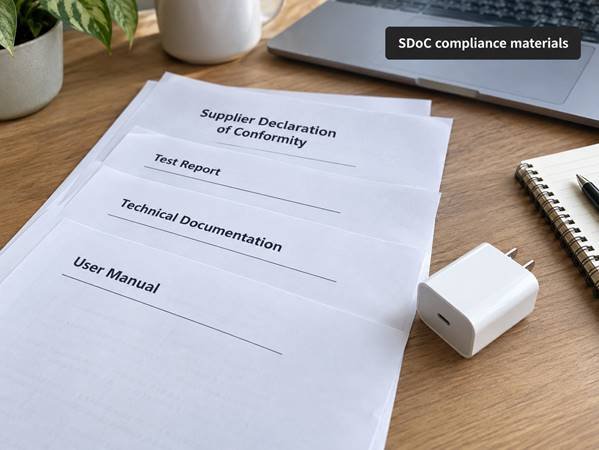
Under the SDoC mode, the FCC will not issue any official certificate. Your compliance proof is the complete set of materials kept by the enterprise itself, including:
• Complete test report corresponding to the Part clause
• Declaration of conformity signed by the enterprise
• Product model configuration control document (to ensure that mass production is consistent with the test sample)
• Information of the US-based responsible party
Label requirements also do not have a general mandatory FCC mark, and the specific implementation should be based on the Part clause applicable to the product. For example, Part 15 products need to be marked with relevant interference statements, but it is not necessary to print the FCC logo. Many sellers think that SDoC also needs a “certificate” to be compliant, which is actually a misunderstanding — as long as you keep a complete set of qualified materials, you meet the requirements.
Detailed Explanation of FCC ID Mode: The Compliance Path of Official Review
Compared with SDoC, everyone is more familiar with FCC ID, but there are also many misunderstandings, such as thinking it is a “more advanced certification”, or thinking that as long as there is an ID number, there is no problem.
Mode Essence: FCC ID is a Compliance Mark, Not an Independent Certification
First of all, emphasize again: FCC ID is not an independent certification type, but **a unique compliance mark issued by the FCC after passing the Certification mode**.
The process of the Certification mode is: you need to submit the test materials to a third-party review body (TCB) officially authorized by the FCC. After the TCB reviews and confirms that it meets the requirements, it will assign a unique FCC ID to the product, and at the same time enter the compliance information into the FCC’s public database. It is equivalent to the official endorsing you in advance, and the public can check the compliance information of this product on the FCC official website.
As long as the product is applicable to the Certification mode, it must obtain a valid FCC ID before it can be sold on the market, which is also a mandatory requirement.
Which Charging Products Need FCC ID?
For charging products, the typical scenarios that need to go through the Certification mode (get FCC ID) are the following categories:
1. Smart chargers and charging sockets with active wireless communication functions such as Bluetooth, WiFi, NFC
2. Wireless charging transmitters with communication functions
3. Power banks with wireless functions, charging accessories with NFC
4. High-power or specific frequency wireless power transfer products that must go through Certification according to Part 18 rules
Simply put, as long as the product has an active wireless communication transmission function, this transmission function usually requires an FCC ID; but composite devices cannot use “having FCC ID” to summarize all obligations. Unintentional radiation functions such as digital circuits and switching power supplies in the device, as well as wireless power supply functions, must still be evaluated according to applicable rules respectively.
Application Process and Required Materials
The requirements for applying for FCC ID are stricter than SDoC. The required materials and qualifications include:
• **Subject Qualification**: There must be a US-based certificate holder (called Grantee in FCC), and you must first register the FCC’s FRN code and Grantee Code (certificate holder code)
• **Test Materials**: Test reports must be issued by FCC-recognized laboratories, including radio frequency tests, electromagnetic compatibility tests, and RF exposure assessment when applicable. Intentional transmitting devices must prove compliance with applicable RF exposure requirements; whether routine RF exposure assessment or testing is required should be judged according to the device frequency, output power, use distance and applicable exemption conditions.
• **Product Materials**: Product appearance and internal photos, label location diagram, user manual, antenna and wireless module specification sheets, etc.
The overall process is: first complete the test in an FCC-recognized laboratory, then submit the complete set of materials to the TCB for review. If there are problems, they need to be corrected. After the review is passed, the TCB will issue the FCC ID and enter the information into the FCC’s public database.
How to Check Public Information? What Should Be Paid Attention to When Verifying?
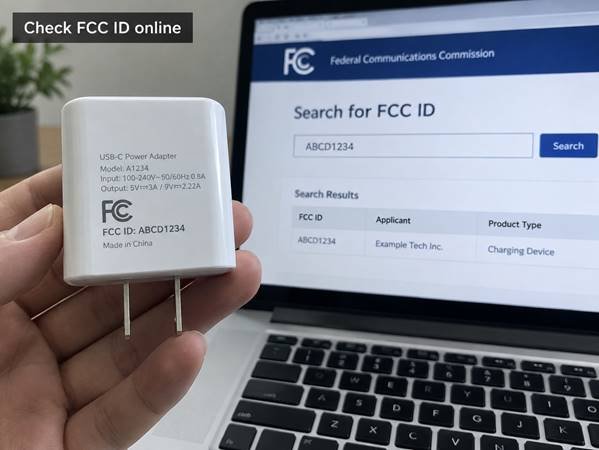
FCC ID information is public, anyone can query it on the FCC official website, but you should pay attention to what can be checked, what cannot be checked, and the key points of verification:
• **Usually Queryable Information**: The FCC Equipment Authorization Database can usually query FCC ID, grantee, equipment category, authorization status and some technical information in the authorization record. The public scope of attachments such as test reports, antenna materials, and internal photos shall be subject to the specific application record and FCC confidentiality processing results.
• **Information That Can Be Applied for Confidentiality**: Internal circuit diagrams, core component parameters, appearance of unlisted products, etc., can be applied for non-disclosure as long as they meet the FCC’s confidentiality rules.
• **Information That Cannot Be Checked at All**: Product electrical safety, charging speed, energy efficiency and other non-electromagnetic compliance items, because the FCC does not regulate these.
When verifying the FCC ID, you should look at it from these dimensions: first, whether the ID is real, second, whether the brand, model, and wireless function match the product, and also pay attention to whether it is the ID of the whole machine or the ID of the module — you cannot pass off the module FCC ID as the FCC ID of the host whole machine itself.
In addition, the FCC ID does not have a general fixed validity period. The product must be consistently consistent with the authorized version; products changed without proper evaluation and authorization shall not be sold relying on the original authorization. The FCC may withdraw, restrict or terminate equipment authorization when it complies with rules and procedures, and the specific authorization status shall be verified through the FCC database.
Core Comparison: 6 Key Differences Between SDoC and FCC ID
After talking about the details of the two modes, we will make a comparison from 6 key dimensions to help you distinguish the differences more clearly. First look at a simplified comparison table:
| Comparison Dimension | SDoC | FCC ID (Certification) |
| Core Logic | Enterprise self-certification, post-market spot check | Official pre-review, public filing |
| Applicable Products | Unintentional radiation equipment, some Part 18 equipment | Intentional radiation equipment, Part 18 equipment requiring Certification |
| Review Requirements | No need to submit official review in advance | Requires TCB review and approval |
| Testing Laboratory | Just select an institution with capability according to the clause | Must be an FCC-recognized laboratory |
| Labeling Requirements | No general mandatory FCC mark, implemented according to the corresponding Part | Must be marked with standard format FCC ID |
| Public Query | Materials are kept by the enterprise and not disclosed | Authorization information can be checked on the FCC official website |
Next, we will talk about the details and precautions of each dimension:
1. Applicable Product Scope
The applicable scope of the two modes is determined according to the FCC’s equipment classification rules, not according to the “grade” of the product:
• SDoC is applicable to unintentional radiation equipment that can be self-certified, as well as some Part 18 equipment that meets the conditions
• FCC ID (Certification) is applicable to intentional radiation equipment that requires official review, as well as Part 18 equipment that must go through Certification according to the rules
If a product has multiple attributes, such as a wireless charger with Bluetooth, which has both active communication transmission and wireless power transmission, it is necessary to determine the rules for each function separately. If necessary, it needs to meet both requirements at the same time, and you cannot simply “follow the higher requirement” to cover the lower one.
2. Responsible Subject and Application Requirements
• SDoC: It can be initiated as long as there is a US-based responsible party, no official pre-review is required, and the responsibility is fully borne by the enterprise and the US responsible party
• FCC ID: There must be a US-based certificate holder (Grantee), and it will take effect only after TCB review and approval after application
The common requirement for both is: overseas sellers must have a US-based responsible subject, and cannot do compliance directly in the name of an overseas company.
3. Testing and Review Requirements
For conventional charging products with the same configuration:
• SDoC only needs to select a testing institution with corresponding capabilities according to the applicable Part clause, complete the test and keep the report, no need to submit it to the FCC or TCB for review
• FCC ID must be tested by an FCC-recognized laboratory, and the test report must be submitted to the TCB for review and approval to be valid
The common variable for both is: the more complex the product function, the more interfaces or wireless frequency bands, the greater the test workload, and the cost and cycle will increase accordingly.
4. Budget and Schedule Variables
It should be specially noted here: the FCC has never stipulated a statutory certification price or fixed cycle, all costs and cycles are market behaviors, and the differences between different products and different institutions will be very large.
The core variables that affect the budget and schedule include: the number of test items, the number of wireless frequency bands or antennas, the power and transmission distance of wireless charging, the requirements of RF exposure assessment, the maturity of prototypes, the number of rectifications, etc.
Generally speaking, for simple wired charging products going through SDoC, the schedule will be shorter and the cost will be lower, but this is only a reference, not a fixed standard.
5. Labeling and Public Query
• SDoC’s label and accompanying materials requirements are implemented according to the corresponding Part clause, there is no general mandatory FCC mark, all compliance materials are kept by the enterprise itself and are not disclosed to the public
• FCC ID must be marked with a standard format FCC ID on the product (format is “Grantee Code + Product Code”), and the authorization information is publicly available on the FCC official website
The common requirement for both is: the label must correspond to the product’s model and configuration, and you must never use the ID of other products or false labels.
6. Supervision and Change Requirements
• SDoC is post-market supervision: the FCC will conduct random spot checks after the product is launched. If the enterprise cannot provide a complete set of qualified materials, it will start law enforcement procedures. If the product changes, the enterprise needs to evaluate whether it needs to be retested by itself.
• FCC ID is pre-review + post-market supervision: it has been reviewed by TCB before listing, and after listing, the FCC will verify the validity of the ID and the consistency of the product. If there is a core change in the product, it needs to be submitted to TCB for review according to the classification, and cannot be changed casually by yourself.
Violations under both paths may lead to law enforcement, including cessation of marketing, confiscation, withdrawal or restriction of equipment authorization, and fines; specific measures and amounts depend on the facts of the violation, applicable laws and law enforcement procedures.
Finally, we need to talk about the variable premises of several comparison conclusions, not all products need to choose one of the two:
• If it is an exempt product (such as a charging cable with pure passive and no chip, test samples that meet the requirements), neither mode needs to be processed
• If the product uses a wireless module that has obtained FCC ID, if it meets the original manufacturer’s use conditions, the whole machine certification process can be simplified
• If the product has undergone core changes (affecting electromagnetic or radio frequency performance), the original compliance conclusion will be invalid and needs to be re-evaluated
Advanced Pit Avoidance: Changes, Module Integration and Listing Verification
After understanding the basic differences, we will talk about some pitfalls that are easy to step on in actual operation, as well as advanced issues such as product changes and module integration, to help you avoid detours.
4 Most Common Pitfalls of SDoC
1. **Failure to keep a complete set of materials**: Many sellers think that SDoC is just writing a statement by themselves, not even a test report. Once spot-checked by the FCC, they can’t produce materials at all, and directly face penalties.
2. **Testing institution’s capability does not meet the requirements**: Find a random laboratory to do the test, but the laboratory does not have the testing capability for the corresponding Part clause, the report is not recognized by the FCC, which means it is done in vain.
3. **No US-based responsible party**: There is no valid US-based responsible party information on the declaration of conformity, the declaration is directly invalid, which means no compliance has been done.
4. **Failure to re-evaluate after core product changes**: For example, changing the switching power supply scheme, adding a charging port, but not re-evaluating the compliance, the original SDoC has actually become invalid.
5 Most Common Pitfalls of FCC ID
1. **Fraudulent use/borrowing of ID, or misuse of module ID**: Of course, it is not allowed to directly use the ID of other people’s products. It is also not allowed to pass off the module FCC ID as the FCC ID of the host whole machine itself. If a wireless module with modular authorization is used and fully meets its authorization conditions, the host product can be marked with “Contains FCC ID: Module FCC ID” as required, and it may not be necessary to obtain a separate whole machine FCC ID just because of this module; but it is still necessary to evaluate the host’s label, co-location, antenna and installation conditions, as well as unintentional radiation compliance.
2. **Mass-produced products are inconsistent with certified samples**: The certification uses one set of configurations, but during mass production, core components are changed and PCB is modified, which is different from the certified sample, so the ID is invalid.
3. **ID label format error**: For example, missing the grantee code (prefix), the font size is too small to meet the requirements, all belong to label violations.
4. **Using the certified module beyond the use conditions**: For example, the original module requires an antenna with a specific gain, but you change to a higher gain one, or modify the power supply voltage, remove the shielding cover, which exceeds the use conditions of the module certification, the compliance of the whole machine is not valid.
5. **Still selling when the authorization status is abnormal**: For example, the equipment authorization has been withdrawn or restricted, or the product is inconsistent with the authorized version, and it is still being sold, which is a violation.
Do You Need to Redo Compliance When the Product Is Revised?
Many sellers don’t know whether they need to redo the certification when revising the product. In fact, there is only one core judgment standard: **whether the change will affect the tested electromagnetic/radio frequency performance and the worst working condition of the product**.
For the SDoC mode, these changes usually require re-evaluation of compliance: changing the switching power supply scheme, transformer, PCB board, key filter components; changing power levels, adding or reducing charging ports, etc.
For the Certification (FCC ID) mode, changes are divided into four categories, with different handling methods:
• **No-impact Change**: For example, only changing the product color, packaging, non-electrical structural parts, which does not affect the electromagnetic/radio frequency performance at all, no need to report.
• **Class I Permissive Change**: The change shall not degrade the performance characteristics reported in the original authorization; no need to submit a permissive change application to the FCC or TCB. The responsible party shall still retain sufficient evaluation basis to prove that the change does not affect compliance.
• **Class II Permissive Change**: Applicable to changes that will degrade the performance characteristics reported in the original authorization but still meet the conditions for permissive change; an application must be submitted and the required test data provided, which will be handled by the TCB or FCC according to the rules.
• **New Certification Application Required**: If the change does not meet the permissive change conditions, a new Certification application shall be submitted according to applicable rules; whether a new FCC ID is assigned shall be determined according to the application type, grantee and FCC equipment authorization rules.
If a Wireless Module with FCC ID Is Used, Does the Whole Machine Still Need to Do It?
Many people think that if a wireless module with FCC ID is used, the whole machine does not need to be compliant, but this is not the case. Using a certified wireless module can simplify the process, but there are prerequisites:
First of all, the module itself must have obtained a valid FCC ID, and you must fully comply with the use conditions specified by the original manufacturer when using it. The conditions to be verified include: antenna type and gain, module installation method, power supply voltage, shielding structure, whether there are other co-located transmitters in the product, label requirements of the host product, etc.
Secondly, **even if a certified module is used, the whole machine still needs to evaluate the overall electromagnetic compatibility compliance**, and cannot be directly exempted. Because after the module is installed in the whole machine, it may interact with other circuits, resulting in excessive overall electromagnetic noise, so the Part 15 unintentional radiation part of the whole machine still needs to be evaluated.
What Materials Should Be Prepared for Listing and Import?
Whether it is SDoC or FCC ID, you need to be able to provide these documents when encountering regulatory authorities or platforms requesting materials after listing:
• Complete test report for the corresponding model
• Declaration of Conformity (SDoC) or FCC ID certification documents
• Information of the US-based responsible party
• Product model configuration list (to prove that mass production is consistent with the test sample)
If it is the import of test samples or exhibition display, it must meet the FCC’s sample exemption conditions, must not be sold to consumers, and must be clearly marked with “For Testing / Not for Sale” on the product.
In addition, mass-produced products must be consistent with the core configuration of the test/certified samples. If you change the core supplier or key components, you must re-evaluate the compliance, don’t take chances.
Summary: After Learning, You Can Independently Judge These 3 Things
After reading this content, you should be able to independently handle most of the FCC compliance judgment problems for charging products. The core is these 3 things:
First, **can distinguish the core differences between the two modes**: SDoC is a mandatory compliance path for enterprise self-certification, and FCC ID is a compliance mark after passing the Certification mode. Both are required by the FCC officially, and there is no difference in authority. Also remember: the FCC only regulates electromagnetic compatibility and radio frequency compliance, and does not involve general product electrical safety, charging speed, energy efficiency and other indicators, don’t confuse it with other certifications.
Second, **can choose the right compliance mode for charging products**: Don’t choose one of the two according to the product name at the beginning. First use the 4-step decision method to judge the applicable FCC Part clause, then select the corresponding authorization path. For common boundary scenarios such as wireless chargers, charging cables with chips, and module integration, you can also accurately judge the compliance requirements.
Third, **can avoid high-frequency compliance pitfalls and do basic verification**: When doing SDoC, remember to keep a complete set of materials, confirm that the testing institution’s capabilities meet the requirements, and must have a US-based responsible party; when doing FCC ID, you cannot fraudulently use other people’s IDs, product revisions should evaluate the impact of changes according to classification, and you can use the FCC official website to verify the authenticity and matching degree of the ID.
FCC compliance looks complicated, but the core logic is very clear: first understand the applicable rules, then choose the right path, do a good job of material retention and mass production consistency, and there will be no major problems.