
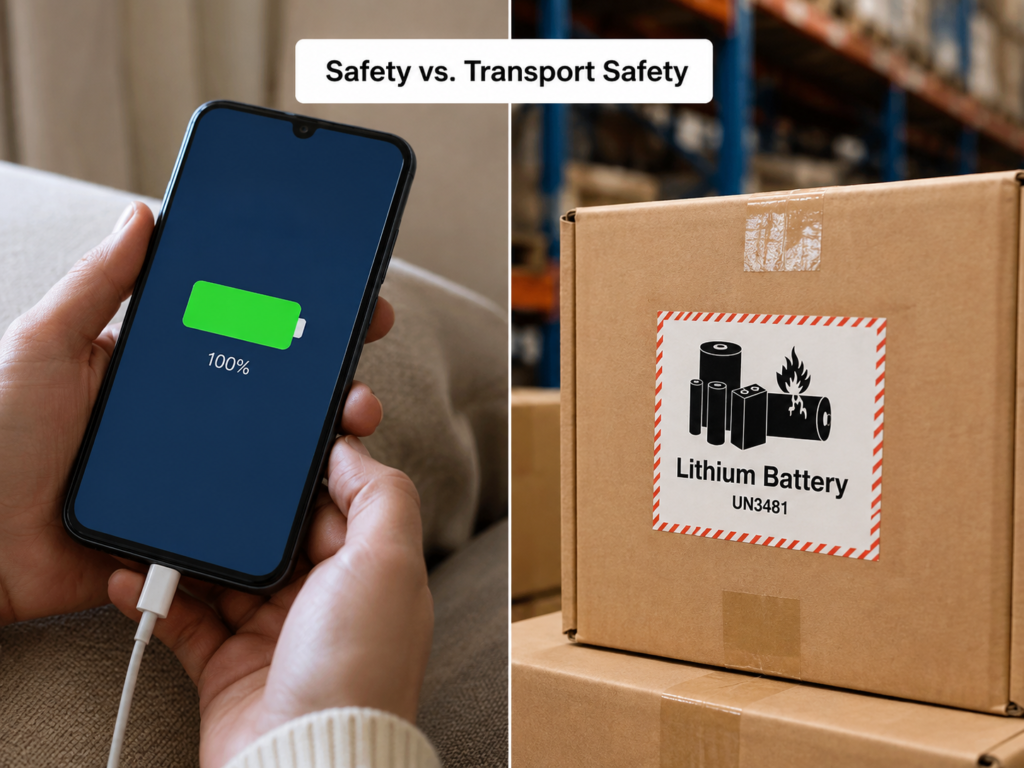
If you engage in cross-border sales or logistics of charging products, or simply purchase battery-powered charging accessories via overseas shopping, you have most likely seen the two designations IEC 62133 and UN38.3. Many people confuse them, either assuming both are safety certifications, or believing that having one is sufficient. In fact, the core positioning of the two is completely different: one governs **safety during daily product use**, and the other governs **safety during cargo transportation**; they are complementary but cannot replace each other. More importantly, ordinary battery-free chargers, USB-C data cables and similar products have nothing to do with either of these two standards.
First, Understand: What Category Does Your Product Belong To?
Before explaining the two standards in detail, let us first classify common charging-related products. You can match your product accordingly to avoid wasting time on irrelevant content:
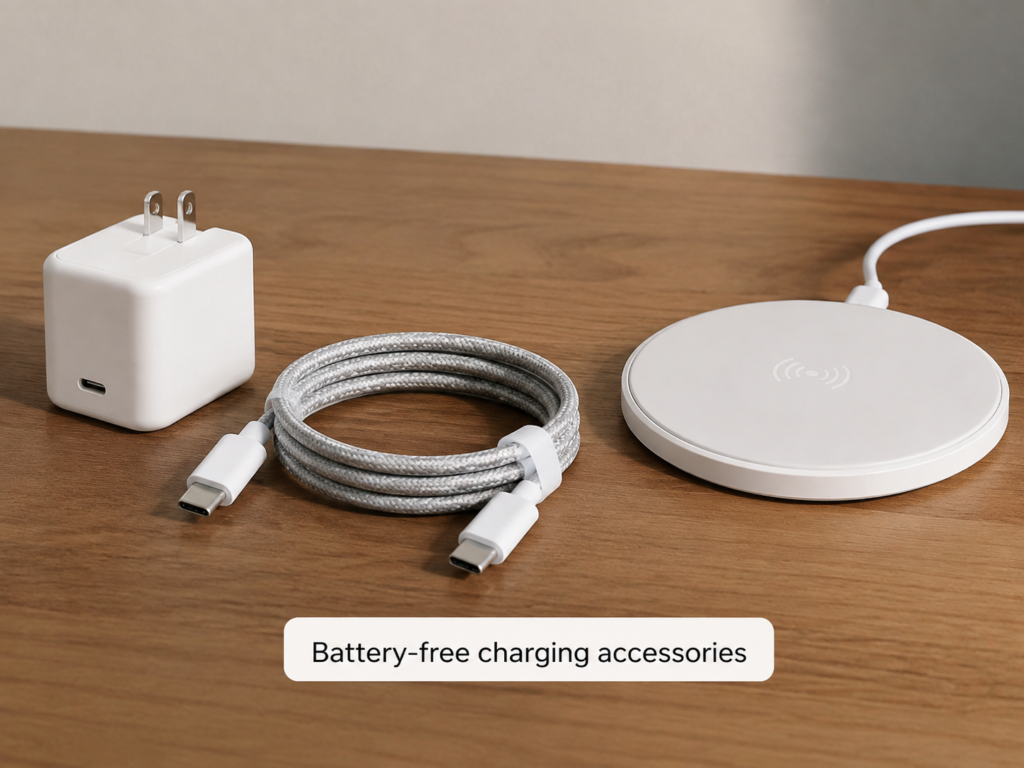
The first category is **battery-free charging accessories**, such as ordinary USB-C chargers, braided data cables, and wireless charging bases without built-in batteries — these products do not contain any lithium batteries themselves, and the two standards discussed later have nothing to do with them, so there is no need to waste time on verification.
The second category is **lithium battery cells**, which are the smallest units of lithium batteries. For example, the pouch batteries and 18650 cylindrical batteries found when disassembling a power bank fall into this category. There are two types of cells: rechargeable lithium-ion/lithium-polymer cells, and disposable lithium-metal cells.
The third category is **lithium battery packs**, usually composed of one or more cells connected in series, parallel, or other configurations, and may be equipped with shells, terminals, markings, protection devices, battery management systems (BMS) and other components required for use. For example, the entire battery module inside a power bank is a common battery pack. The specific definition may vary depending on the applicable standard or transportation regulations.
The fourth category is **lithium battery-containing charging equipment**, that is, finished products with built-in battery packs, such as commonly used power banks, portable chargers with batteries, and wireless charging bases with built-in non-removable batteries, all of which belong to this category.
In addition to the product type itself, the transportation form of lithium batteries is also key to determining requirements. The United Nations Dangerous Goods Regulations divide lithium battery transportation into three core forms:
The first is **transported separately**, meaning cells or battery packs are packaged and shipped on their own, not placed together with equipment, such as a separately purchased spare power bank battery.
The second is **packed with equipment**, meaning the battery and the equipment are in the same package but not installed on the equipment, such as a set where a charger comes with a spare lithium battery.
The third is **contained in equipment**, meaning the battery is fixedly installed inside the finished product, such as a finished power bank, where the battery is already installed inside and ready for use out of the box.
Basic Positioning of the Two Standards
IEC 62133: Use Safety Standard for Portable Lithium Batteries
You can think of IEC 62133 as the **reference use safety standard for portable rechargeable lithium batteries**.
This standard is formulated by the International Electrotechnical Commission (IEC, the most authoritative standardization body in the global electrical engineering field). Its core focus is whether portable sealed rechargeable lithium batteries (and a small number of nickel-based batteries) will pose dangers such as fire, explosion, and electrolyte leakage under normal use and reasonably foreseeable misuse. For example, if the battery is accidentally overcharged or short-circuited, whether the protection circuit can activate to prevent accidents — these are all contents verified by IEC 62133.
It should be noted that IEC 62133 only covers safety, and does not address performance indicators such as whether the battery has sufficient capacity, charging speed, or cycle life, nor does it cover requirements such as the electrical safety of the whole machine or electromagnetic compatibility (EMC) — it only targets the use safety of the lithium battery itself.
The version commonly used for charging products now is IEC 62133-2, which is the part specifically for lithium-ion batteries. As for whether it is a mandatory requirement, it depends on whether the target country/region for sales has incorporated this standard into local market access regulations (commonly referred to as “standard adoption”). Some countries impose mandatory requirements, while others use it as a reference; there is no unified mandatory attribute.
UN38.3: Transportation Safety Test Requirements for Lithium Batteries
The positioning of UN38.3 is completely different: it is a **transportation safety test verification for lithium batteries**.
This requirement is formulated by the United Nations Committee of Experts on the Transport of Dangerous Goods, derived from Section 38.3 of the . The manual is updated regularly, and dangerous goods regulations for global air, sea, and land transport basically reference the requirements of this section.
Unlike IEC 62133, lithium cells and batteries in regular commercial transport must generally be of a type that has passed the applicable design tests of UN38.3, regardless of whether they are portable, and even disposable lithium-metal batteries are included. Its core purpose is to verify whether lithium batteries will have safety problems when subjected to various stresses during transportation, such as high-altitude low pressure, sudden temperature changes, jolting, impact, and short circuit, and whether they will catch fire or explode, so as to prevent safety accidents during transportation. For special situations such as low-volume or prototype products, waste/recycled batteries, damaged or defective batteries, corresponding exceptions, packaging requirements, or competent authority approval procedures shall be adopted in accordance with applicable transport regulations.
Many people think UN38.3 is a type of certification, but it is not. Its core delivery document is the **test summary**; the complete test report is generally kept by the manufacturer or testing laboratory and does not need to be provided externally. Moreover, UN38.3 is not a market access requirement, but a requirement in the transportation link: carriers, freight forwarders, and cross-border e-commerce platforms may require you to provide this summary, but customs does not audit it in all cases, depending on the regulatory requirements of the destination.
Comparison of Core Dimensions
To make the difference between the two clearer, we have organized the core dimensions into a comparison table, uniformly targeting lithium cells/batteries and based on common scenarios of charging products:
| Comparison Dimension | IEC 62133 | UN38.3 |
| Attribute Positioning | Product use safety standard, focusing on safety protection for daily use/misuse | Transport compliance test requirement, focusing on transport risk prevention and control |
| Applicable Scope | Only covers portable rechargeable lithium/a small number of nickel-based cells and battery packs; lithium-metal batteries and non-portable batteries are not applicable | Covers lithium batteries that need to be transported in regular commercial transport, including disposable lithium-metal batteries, not limited by portability; special situations may be subject to exceptions or special procedures |
| Test Logic | Focuses on the effectiveness of the protection circuit (BMS) in protecting against use and misuse scenarios | Focuses on the safety performance of batteries after experiencing transport-related abuse, environmental and mechanical stresses |
| Applicable Stage | Use safety compliance after the product is launched on the market; whether it is mandatory depends on the target market | Lithium battery cargo transport access, which is the basic requirement of dangerous goods regulations for various transport modes |
| Document Form | Deliverables include test reports, CB certification certificates, etc. | Core deliverable is the test summary; the full report is kept by the manufacturer/laboratory |
The two also have two very important commonalities: First, their core goal is to prevent lithium battery fire, explosion, electrolyte leakage, and dangerous rupture; Second, whether a report or test summary can cover another model cannot be judged only by the model name or appearance; it is necessary to verify whether it belongs to the same tested type, the model or series range listed in the document, and the corresponding coverage basis. For changes that constitute a “new type” under UN38.3, applicable tests must be re-conducted.
Specifically, for UN38.3 test items, not all items need to be tested: common ones include T1 Altitude Simulation, T2 Thermal Cycle, T3 Vibration, T4 Shock, T5 External Short Circuit, etc. Among them, T7 is a test for rechargeable batteries, T8 is a test for cells, and the test method and applicable object of T6 also need to be determined according to the type and size of the cell, so it is not necessary to conduct all items.
Here is a special reminder: passing the UN38.3 test only meets the most basic requirements for lithium battery transportation, and does not mean you can ship goods casually. The entire transport compliance is divided into three layers:
The first layer is basic testing, that is, the cell/battery is of a type that has passed the applicable UN38.3 tests, proving that it meets the basic safety requirements for transportation.
The second layer is implementation according to the rules of the transport mode: different transport modes have their own dangerous goods regulations. For example, air transport must follow IATA DGR (International Air Transport Association Dangerous Goods Regulations) or ICAO TI (International Civil Aviation Organization Technical Instructions for the Safe Transport of Dangerous Goods by Air), and sea transport must follow IMDG Code (International Maritime Dangerous Goods Code). These regulations specify the UN number of the goods, packaging requirements, marking and labeling, declaration procedures, transport quantity limits, battery state of charge (SOC) limits, etc. For example, as commonly seen, lithium-ion batteries transported separately use UN number UN3480, and lithium-ion batteries contained in equipment or packed with equipment use UN number UN3481 — these are requirements of this layer.
The third layer is additional requirements: platforms, freight forwarders, and carriers may impose stricter acceptance requirements than general rules. For example, some freight forwarders require that the battery state of charge cannot exceed 30%, and some platforms require additional letters of guarantee.
Whether the goods can be accepted for transport ultimately depends on the actual carrier and the regulatory rules of the destination; passing UN38.3 does not mean everything is settled.
How to Choose for Charging Products? 5-Step Decision-Making Method
After explaining the basic definitions and differences, you may still ask: which one do I need to complete for my product? Below is a set of 5-step decision logic; follow it and you can figure it out:
Step 1: First determine whether the product contains lithium cells or battery packs — if it is a battery-free charging accessory, skip directly, and neither of the two standards needs to be considered.
Step 2: Determine the type of demand: is it compliance for product sales and daily use, or compliance for cargo transportation and logistics delivery? The former requires IEC-type safety standards, and the latter requires UN38.3-related requirements.
Step 3: If it is a transport demand, clarify the transport form of the battery: is it transported separately, packed with equipment but not installed, or already installed in the equipment? Different forms correspond to different UN numbers and packaging requirements.
Step 4: Clarify the target market and transport mode: is it air transport, sea transport, or land transport? Which country/region is the destination? Requirements vary for different markets and transport modes.
Step 5: Match the corresponding requirements: for use compliance, look for the lithium battery safety standard of the target market (such as IEC 62133 or the local adopted version); for transport compliance, confirm that the cell or battery is of a type that has passed the applicable UN38.3 tests, make the test summary available or submit it according to the requirements of the supply chain and carrier, then prepare the corresponding transport compliance documents.
For your quick reference, we have organized high-frequency scenarios of charging products into a decision matrix:
| Product Type | Sales/Use Compliance Requirements | Transport Compliance Requirements |
| Battery-free charging accessories | Check electrical safety, EMC and other whole-machine requirements, irrelevant to the two standards | Neither of the two standards is required |
| Separate rechargeable lithium cells/battery packs | Determine lithium battery safety requirements according to target market and application scenarios | Confirm that they are of a type that has passed applicable UN38.3 tests, and make the test summary available or submit it as required + corresponding transport compliance documents |
| Finished charging products with built-in lithium batteries (including non-removable) | Target market lithium battery safety standards + whole-machine compliance | Confirm that they are of a type that has passed applicable UN38.3 tests, and make the test summary available or submit it as required + corresponding transport compliance documents |
| Charging equipment + battery packed together not installed | Check the compliance requirements of the equipment and the battery separately | Confirm that they are of a type that has passed applicable UN38.3 tests, and make the test summary available or submit it as required + corresponding transport compliance documents |
Supplementary Explanations for Several High-Frequency Scenarios
First, charging products with lithium batteries, such as power banks and wireless charging bases with batteries. If they are sold locally and used daily, they need to comply with the lithium battery safety standards specified in the target market, and also meet the regulations on the electrical safety and electromagnetic compatibility of the whole machine; it is not enough to just pass IEC 62133. For cross-border transport or international express delivery, confirm that the cells or batteries are of a type that has passed the applicable UN38.3 tests, make the test summary available or submit it according to the requirements of the supply chain and carrier, then complete the full process of compliance such as classification, packaging, marking, labeling, and declaration in accordance with transport regulations. Whether the summary must be submitted for a specific shipment shall be subject to the carrier and applicable transport regulations. If such products are imported via overseas shopping, they must not only meet the lithium battery safety requirements of the destination market, but also have UN38.3-related documents for transport and customs clearance.
Then there is the case of transporting lithium cells or battery packs separately. If they are disposable lithium-metal cells/batteries, they only need to meet the transport requirements of UN38.3, and IEC 62133-2 is not applicable, because IEC 62133-2 covers rechargeable lithium-ion batteries. For rechargeable lithium cells/battery packs, in regular commercial transport, they must generally also be of a type that has passed the applicable UN38.3 tests; for special situations such as low-volume or prototype products, waste/recycled batteries, damaged or defective batteries, corresponding exceptions, packaging requirements, or competent authority approval procedures shall be adopted in accordance with applicable transport regulations. For sales, it depends on the regulations of the target market.
Another point of particular concern: what is the relationship between carrying a power bank on a plane and UN38.3? Personal carry-on power banks are subject to passenger baggage rules, which are different from the packaging and declaration rules for freight; but the lithium batteries carried must still be of a type that meets UN38.3 requirements. The general rule is: power banks can only be carried in hand luggage, not checked in; those with a rated energy of 100Wh or below can usually be carried directly. Capacity and quantity limits are subject to the regulations of the airline and the departure place, and different airlines may have slight differences. For bare-terminal or spare batteries, measures such as original packaging, insulated terminals, or protective bags shall be taken to prevent short circuits.
Finally, a reminder: UN38.3 applies to all stages of transport in the supply chain, whether it is from the factory to the warehouse, or from the warehouse to the store, as long as it is cargo transport, it counts; it is not only required for the final delivery to the consumer.
Semi-Proficient Skill: Quickly Verify Report Validity
If you already have IEC 62133 or UN38.3 documents, how do you judge whether they are valid?
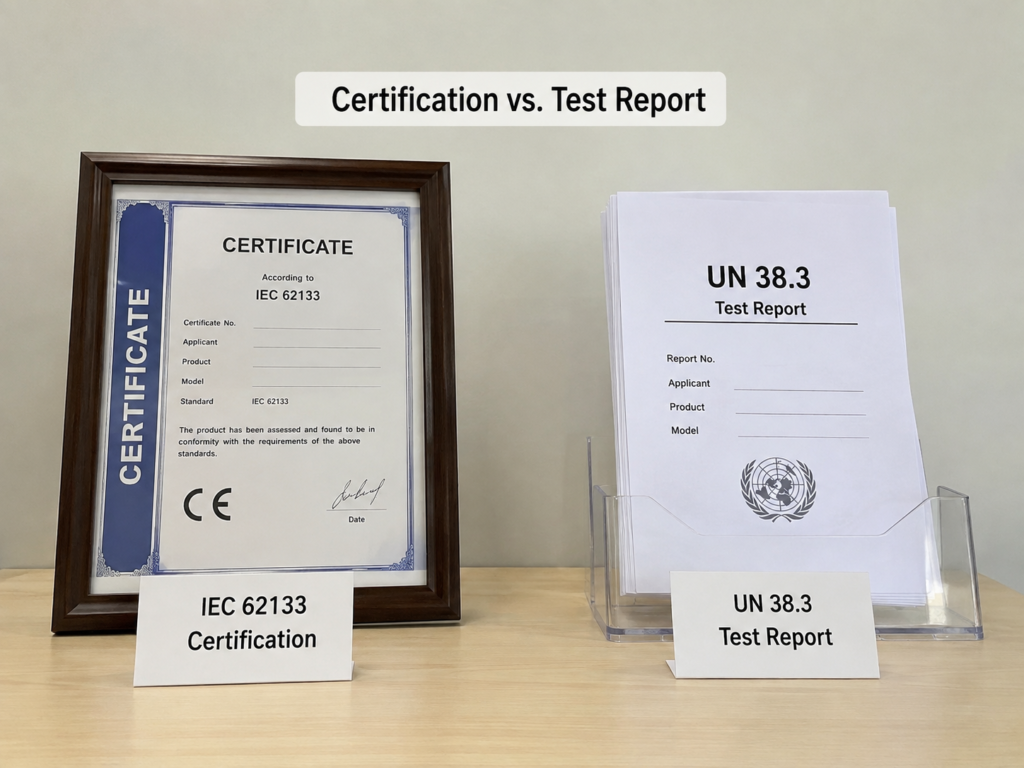
You do not need to fully understand the test data, just check a few core points, which is also a practical skill for supply chain compliance.
First, check core matching, that is, whether the document matches your actual goods:
First is subject information: the manufacturer, applicant, and brand owner of the cell/battery must have written evidence of the corresponding relationship with the actual goods. For example, if it is OEM/ODM production, there must be an OEM agreement or authorization certificate; you cannot just use a report from another manufacturer.
Second is product information: the model/series range, rated voltage, capacity/Wh value, number of cells, and chemical system in the report must all be within the coverage of the report. For example, if your battery is 10000mAh, but the report only covers 5000mAh, that is not acceptable.
Then there are the required fields of the document. If these are missing, the document is most likely invalid:
If it is an IEC 62133 report or certificate, it must include testing laboratory information, report number, test date, applicable standard version, test items and results. All of these must be present; you cannot just have a blurry certificate image.
If it is a UN38.3 test summary, it must include the applicable UN Manual version, the name and address of the testing laboratory, and the report number and date. These are the keys to traceability.
There are also several common signs of invalid reports, which you should be alert to when encountered:
• For example, the model and parameters on the report do not match the actual product at all, and there is no official coverage explanation;
• For example, there is only a blurry certificate image, with no traceable information such as report number or testing institution;
• For example, other documents such as CE, RoHS, and MSDS are used to pass off as UN38.3 documents — these documents are completely different from UN38.3;
• For example, the key design and materials of the product have been changed, but no re-evaluation has been conducted. When standards or transport regulations are updated, the effective date, transitional provisions, certification schemes and carrier requirements of the target market or transport regulations should also be checked; the release of a new version does not automatically invalidate existing reports;
• Another very common pitfall: directly using the cell report as the compliance certificate for the finished product. For example, if the cell has passed UN38.3, it is claimed that the battery pack made with this cell has also passed UN38.3 — this is incorrect. The test results of the cell do not automatically cover the battery pack composed of it, and the battery pack needs to be evaluated separately.
Speaking of this, we should also mention the “new type” determination of UN38.3: if the product has the following changes, it is necessary to re-evaluate whether it belongs to a new type, and the old test summary cannot be used directly: for example, the manufacturer or model of the cell has been changed, the series-parallel configuration has been modified, the rated energy has changed, the design of the protection circuit has been changed, and other key design changes. The specific determination shall be evaluated by the manufacturer or laboratory in accordance with the rules of UN38.3.2.2, and the old report cannot be continued to be used just because the appearance looks the same.
Common Misconceptions to Avoid
We have compiled the five most common misconceptions to help you avoid 90% of the pitfalls:
First misconception: **Charging products with UN38.3 are safer to use**. Many merchants promote their products as “having passed UN38.3 certification”, which sounds impressive, but UN38.3 targets transport safety and cannot replace IEC 62133 or the whole-machine use safety assessment. Its tests include external short circuit (T5), and for applicable rechargeable batteries, also overcharge (T7), but this does not mean that the product is safe under all daily use and reasonably foreseeable misuse conditions. If you only look at UN38.3 when purchasing products, you may buy products with failed overcharge protection and use safety hazards. To judge use safety, you still need to look at IEC-type lithium battery safety standards and the compliance of the whole machine.
Second misconception: **Products with IEC 62133 can be sent by international express casually**. IEC 62133 is a use safety standard, which is a separate matter from transport compliance. Before cross-border transport, confirm that the cells or batteries are of a type that has passed the applicable UN38.3 tests, and make the test summary available or submit it according to the requirements of the supply chain and carrier; then complete requirements such as classification, packaging, marking, labeling, and declaration in accordance with transport regulations. Whether the summary must be submitted for a specific shipment shall be subject to the carrier and applicable transport regulations.
Third misconception: **All charging products must have these two marks to be qualified**. Many merchants use “the whole series has passed both standards” as a selling point, but in fact, only products containing lithium batteries need to comply with these two standards accordingly. Ordinary battery-free chargers, data cables, and battery-free charging bases have nothing to do with these two standards at all, and there is no need to pay extra for this gimmick.
Fourth misconception: **Both standards are valid only with official certification certificates**. IEC 62133 can be used for CB certification or national adopted standard certifications, and there are certificates, but UN38.3 is not a certification system where the United Nations issues certificates. The test summary that meets the requirements of 38.3.5 and its correspondence with the actual cells/batteries shall be verified; commercial or laboratory documents named “certificate” cannot alone replace the test summary, and whether they are accepted shall be subject to the carrier and applicable rules.
Fifth misconception: **The report is valid forever once completed, or must be redone every year**. In fact, neither IEC 62133 nor UN38.3 has a unified validity period, nor is there a mandatory requirement to redo it every year. After changes to the key design or materials of the product, it shall be evaluated whether it constitutes a new type under UN38.3, or whether it affects the coverage of the IEC report or certificate. When standards or transport regulations are updated, the effective date, transitional provisions, certification schemes and carrier requirements of the market or transport regulations shall be checked; the release of a new version does not automatically invalidate existing reports.
Clarify the Boundary with Other Compliance Requirements
Finally, we need to clarify a boundary: both of these standards are only part of lithium battery compliance, not the whole.
IEC 62133 is only the safety standard for the lithium battery part, not the entirety of certifications such as CE, FCC, and UL. A charging whole machine with lithium batteries must also meet the regulatory requirements of the whole machine in terms of electrical safety, electromagnetic compatibility (EMC), wireless charging protocols, environmental protection, etc., before it can be legally sold on the market.
UN38.3 is only a test requirement in the transport link, and cannot replace the product’s market access compliance at all. Even if you have passed UN38.3, if the product does not meet the safety regulations of the target market, it still cannot be sold.
The adoption of standards varies in different markets: the European Union needs to be checked against the Battery Regulation, as well as safety, EMC, wireless, environmental protection and other regulations applicable to the whole machine; in North America, lithium battery safety standards such as UL 2054 and UL 1642 are commonly used, and IEC 62133 can be used as a reference; for other markets, it shall be subject to local official regulations, product categories, and retailer requirements.
As for battery-free charging accessories, although these two standards are not applicable, they still need to comply with corresponding regulations such as electrical safety and EMC; it is not that there are no requirements at all.
Overall, the core difference between IEC 62133 and UN38.3 is the difference between “use safety” and “transport safety”: the former governs the safety of lithium batteries under daily use and reasonable misuse, and the latter governs the safety of lithium batteries during transportation; the two are complementary but cannot replace each other. Just remember three core judgment points: battery-free charging accessories involve neither of the two; for products with lithium batteries, look for IEC-type standards for use compliance, and look for UN38.3 for transport compliance; the core document of UN38.3 is the test summary, and after confirming that the product is of a type that has passed the applicable tests, you also need to complete the full process of compliance in accordance with transport regulations — this can basically handle the lithium battery compliance judgment of most charging products.