
Whether you’re taking a power bank on a plane when studying abroad or traveling, sending power bank samples for cross-border e-commerce, or mailing a spare power bank to family and friends, many people will encounter the unfamiliar requirement of “UN38.3” — what exactly is UN38.3? Is it required for all air transport? Do individuals need to present it when carrying one? Will it be confiscated if you don’t have it?
We have compiled full-scenario rules from personal carry-on to commercial freight, from basic judgment to pitfall avoidance and verification. After reading this, you can handle most compliance issues for power bank air transport on your own.
Core Conclusion Quick Answers
First, a direct answer for those in a hurry; you can match it to your own scenario:
1. **Air freight scenario (all air express/freight, whether personal or commercial)**: Power banks with built-in lithium batteries must pass the UN38.3 test, and a valid test summary must be provided when requested. The form of the summary is very flexible: printed paper copies, QR codes on packaging, electronic versions verifiable on the official website, or summaries attached to shipping documents are all acceptable. Without compliant documents, the carrier or platform will directly reject the shipment. These requirements are based on the rules of the International Civil Aviation Organization (ICAO), and specific implementing airlines, freight forwarders, and platforms may set stricter requirements.
2. **Passenger carry-on scenario (taking a power bank on a plane yourself)**: You usually do not need to proactively present the UN38.3 test summary, and the responsibility for ensuring the product meets requirements lies with the manufacturer. However, you must still comply with the passenger baggage regulations of the departure location, transfer location, and operating airline. Security check or airline staff may verify capacity, quantity, labeling, appearance, and safety conditions in accordance with applicable rules, and have the right to refuse carriage. For example, flights within China prohibit carrying power banks without 3C marking, with unclear 3C marking, or that belong to recalled models or batches.
3. **Checked baggage scenario**: The vast majority of airlines explicitly prohibit checking power banks, which has nothing to do with whether they have UN38.3. The reason is simple: the cargo hold is unattended, and if a power bank catches fire, it cannot be dealt with immediately, which poses an extremely high risk. Even if you are asked to check your luggage temporarily at the boarding gate, be sure to take out the power bank and carry it with you.
4. **Applicability boundary reminder**: The above rules only apply to portable power banks with built-in lithium-ion batteries, and only apply to air transport scenarios; rules for sea and land transport need to be checked separately.
First, Understand the Basics: What Exactly is UN38.3?
Many people think UN38.3 is a complex professional certification when they hear it, but its logic is very simple:
It is a test standard specifically for transport safety
UN38.3 is a lithium battery transport safety type test standard formulated by the United Nations. To put it simply, it simulates various extreme situations that lithium batteries may encounter during transport, testing whether they will catch fire, leak, or explode, to ensure they do not pose safety risks to transport.
It is not a product conformity certification and cannot replace documents such as CE, FCC, or MSDS (Material Safety Data Sheet). CE is a conformity mark for applicable EU regulations, which may involve requirements such as safety, electromagnetic compatibility, and radio equipment; FCC mainly involves US radio frequency/electromagnetic emission compliance. The purposes of these documents are all different from lithium battery transport tests. UN38.3 only guarantees basic safety during transport, does not promise that the power bank will never catch fire, and does not cover product performance such as charging speed or service life.
What Does the Test Cover
The UN38.3 test items are divided into 8 items from T1 to T8, covering three types of transport risks: environmental (high altitude simulation, temperature cycling), mechanical (vibration, shock, impact and crush), and electrical (external short circuit, overcharge, forced discharge). However, not all cells or batteries need to undergo all items; it depends on the type and specification of the battery.
What we usually call “UN38.3 documents” refers to the **test summary**; there is no need to provide a thick full technical report, as long as the summary contains key test information.
Why Are Power Banks Subject to Particularly Strict Air Transport Controls?
They are both lithium batteries, so why are the rules for power banks stricter than those for mobile phones and laptops? The core reason is different classification:
In the dangerous goods classification for air transport, power banks belong to **stand-alone lithium-ion batteries**, with the corresponding UN number UN3480 — that is, lithium batteries transported separately, not installed in equipment. Built-in batteries installed in mobile phones and laptops belong to UN3481, which have relatively lower risks due to the protection of the equipment casing.
Coupled with the special environment of air transport: low pressure at high altitude, large temperature changes, and possible turbulence and collision during flight, all of which can easily trigger thermal runaway of lithium batteries; if it is in the cargo hold, no one can deal with a fire in time, and the consequences will be very serious, which is why the air transport rules for power banks are particularly strict.
How Is the Rule Hierarchy Structured?
The rules for power bank air transport are not decided by a single party, but have a hierarchy from foundation to implementation:
• The bottom layer of foundation is UN38.3, which specifies what tests lithium batteries must pass and how to write the test summary;
• Above that are the Technical Instructions of the International Civil Aviation Organization (ICAO) and the Dangerous Goods Regulations (DGR) of the International Air Transport Association (IATA), which specify the specific operational requirements for air transport;
• The top layer consists of the implementation rules of national civil aviation authorities, specific airlines, and freight forwarders. These rules can be stricter than international rules, and the final requirements are subject to the carrier you choose.
Three-Step Logic for Judging Compliance
Once you understand the basics, you can use a simple three-step method to judge the compliance requirements for any power bank air transport by yourself, without having to search for a long time every time:
1. **Step 1: First distinguish the scenario**
Do not judge by “whether it is for commercial use”, but by the mode of transport: as long as it is sent via air freight or air express (even if you personally send a power bank to a friend), it counts as a freight scenario; if you carry it with you on a plane yourself, it counts as a personal carry-on scenario.
2. **Step 2: Confirm the transport attribute**
No matter what else a power bank is shipped with, as long as it is a stand-alone lithium battery not installed in equipment, it falls under the UN3480 classification, with stricter rules than built-in batteries in equipment.
3. **Step 3: Find the corresponding requirements**
For freight scenarios, check the requirements for documents, packaging, declaration, and state of charge; for personal carry-on scenarios, check the requirements for capacity, quantity, and carrying method.
Here are two priority tips that can help you avoid detours:
• Freight scenario: first confirm whether it can be shipped (UN3480 usually cannot be transported in the cargo hold of passenger aircraft, only in cargo aircraft), then check the specific compliance requirements;
• Personal carry-on scenario: first check whether the rated energy and carrying quantity exceed the limit, then confirm the carrying method and additional rules of the airline.
Detailed Rules by Scenario
You can jump directly to the scenario corresponding to you for details:
Scenario 1: Air Freight (personal parcels/commercial goods/samples/after-sales all count)
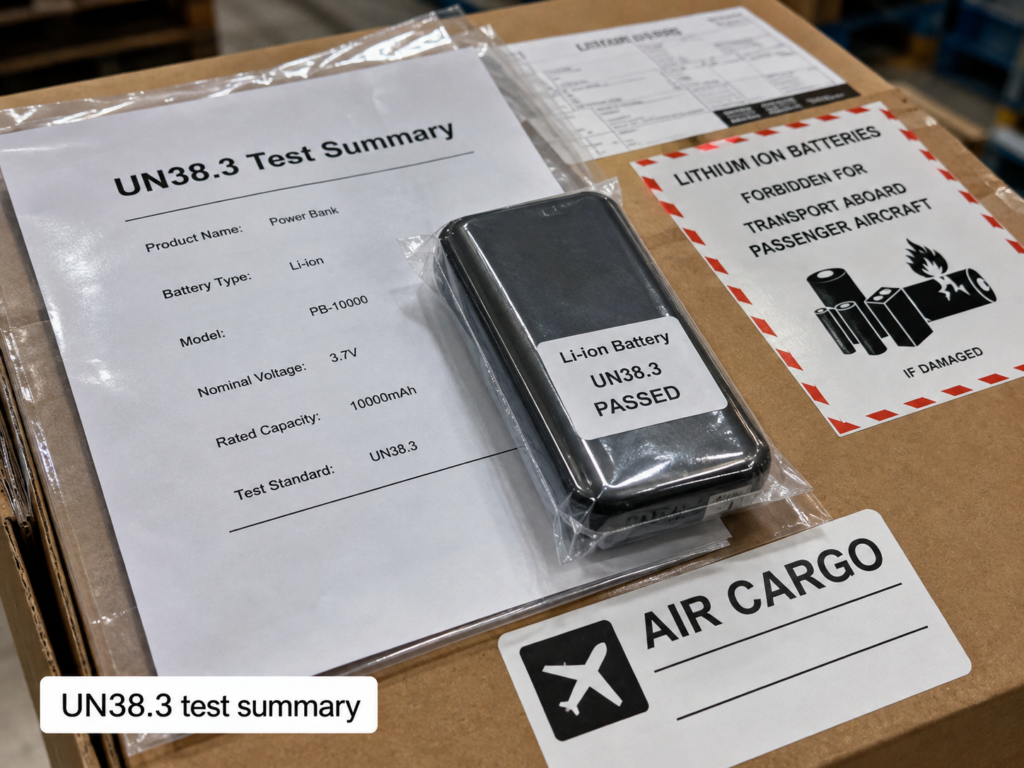
All power banks transported by air, whether they are spare power banks sent by individuals to family and friends, or samples, bulk goods, or after-sales returns sent by merchants, fall under this scenario, with unified rules:
• **Transport restrictions**: Stand-alone lithium batteries of UN3480 category are usually prohibited from being transported in the cargo hold of passenger aircraft, and need to be operated in accordance with the PI965 rules for cargo aircraft (PI965 is the operational specification for cargo aircraft transport of stand-alone lithium batteries formulated by IATA).
• **Special circumstances require special approval**: If they are prototype batteries, low-volume custom batteries, waste batteries, batteries with a state of charge exceeding 30%, or if you must apply for transport on passenger aircraft, you need to go through a special approval process, which is very troublesome, so plan as far in advance as possible.
Scenario 2: Passenger Carry-On (taking it on a plane yourself)
This is the scenario most commonly encountered by ordinary users. The rules are actually very clear. We have compiled them based on the 2026 ICAO baseline rules:
First Check if the Rated Energy Meets the Requirement
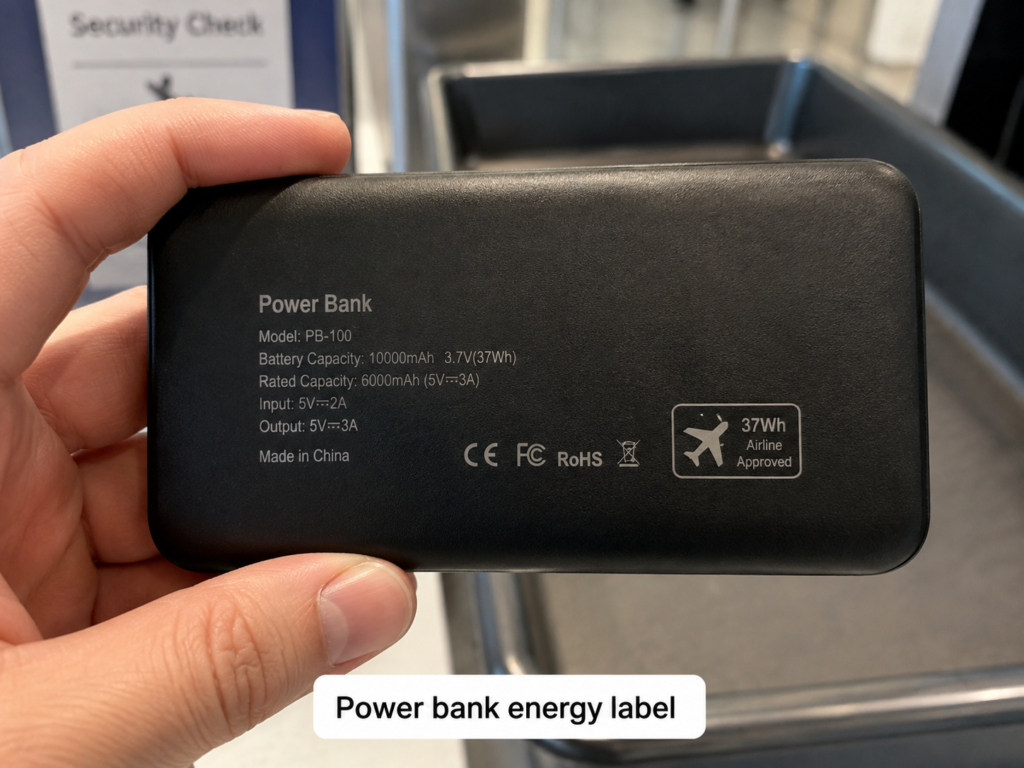
Whether you can bring it depends mainly on the **rated energy (unit: Wh)** of the power bank, with three threshold levels:
• ≤100Wh: usually can be carried on board, no additional approval required;
• 100Wh–160Wh: requires prior approval from the airline before carrying;
• >160Wh: completely prohibited as passenger baggage, whether carry-on or checked.
Many power banks are marked in milliampere-hours (mAh), you can use this formula to convert it yourself:
**Wh = mAh × nominal voltage ÷ 1000**
For example: a common 10000mAh power bank with a nominal voltage of 3.7V converts to 10000×3.7÷1000=37Wh, which is far below 100Wh and completely fine; a 20000mAh, 3.7V one is 74Wh, which also meets the requirements. If it is a large-capacity outdoor power supply with a nominal voltage of 12V and 20000mAh, that is 240Wh, which exceeds the upper limit.
You can find the clearly printed rated energy mark on the back of the power bank casing. If the mark is blurry or missing, it may be refused carriage by security check or the airline.
Carrying and Usage Restrictions
Even if the capacity meets the requirements, there are several usage rules to follow:
• Power banks ≤100Wh should be limited to the quantity for personal use; the IATA passenger baggage baseline for spare batteries is usually a maximum of 20 per person. If exceeded, operator approval is required, and airlines and countries may set stricter limits;
• Power banks exceeding 100Wh but not exceeding 160Wh must be approved by the airline, and each person may carry a maximum of 2;
• In accordance with the applicable 2026 ICAO/IATA regulations, power banks may not be charged on board, nor may power banks be used to charge personal electronic devices; stricter restrictions that may be added by the airline must also be complied with.
Other Notes
• Carrying requirements: can only be placed in carry-on baggage, absolutely cannot be checked; interfaces must be protected against short circuits, for example, put in an insulating bag, use the original protective cover, do not mix with metal objects such as keys and coins; power banks that are bulging, damaged, or whose rated energy cannot be identified may be refused carriage by security check or the airline. Whether they will be disposed of by the passenger themselves, stored temporarily, or detained in accordance with the law shall be subject to the on-site procedures of the airport, competent authority, and airline.
• Labeling requirements: Passengers usually do not need to proactively present the UN38.3 test summary, but must comply with the regulations of the departure location, transfer location, and operating airline. For example, flights within China prohibit carrying power banks without 3C marking, with unclear 3C marking, or that belong to recalled models or batches.
• Transfer reminder: If there is a transfer, be sure to confirm the rules for all flight segments, especially for code-share flights, which shall be subject to the requirements of the **actual operating airline**, not the one that sold the ticket.
• Rule change reminder: The 2027 IATA Dangerous Goods Regulations (DGR) may adjust relevant requirements, and the time when different countries adopt new rules and the enforcement standards of different airlines may vary. It is best to check the latest requirements of the operating airline again before departure.
Scenario 3: How to Handle Special/Abnormal Products
For the following special situations, the ordinary rules do not apply:
• **Free samples, gifts**: There is no exemption; they must also comply with all lithium battery transport rules. Don’t think that just because it’s a sample, you can send it casually.
• **Damaged/abnormal products**: If the power bank is bulging, damaged, water-damaged, or abnormally hot, passengers are advised not to carry it with them, and security check has the right to directly refuse transport; for freight, it cannot be declared as ordinary UN3480, and you need to find professional dangerous goods transport personnel to confirm the transport plan.
• **Recalled/defective products**: Batteries with known or suspected defects or damage that pose a risk of dangerous overheating, fire, or short circuit shall not be carried as passenger baggage. For recalled products, first check the safety notices of the manufacturer and competent authority and the airline’s rules; flights within China prohibit carrying power banks of recalled models or batches. For freight, a special approval process is required, operated by professionals, and cannot be sent casually.
How to Judge Whether a UN38.3 Document is Valid
Whether you are checking a supplier’s report before shipping freight, or want to confirm whether the power bank you bought is compliant, you can use the following methods to verify:
First Check the Required Fields of the Test Summary
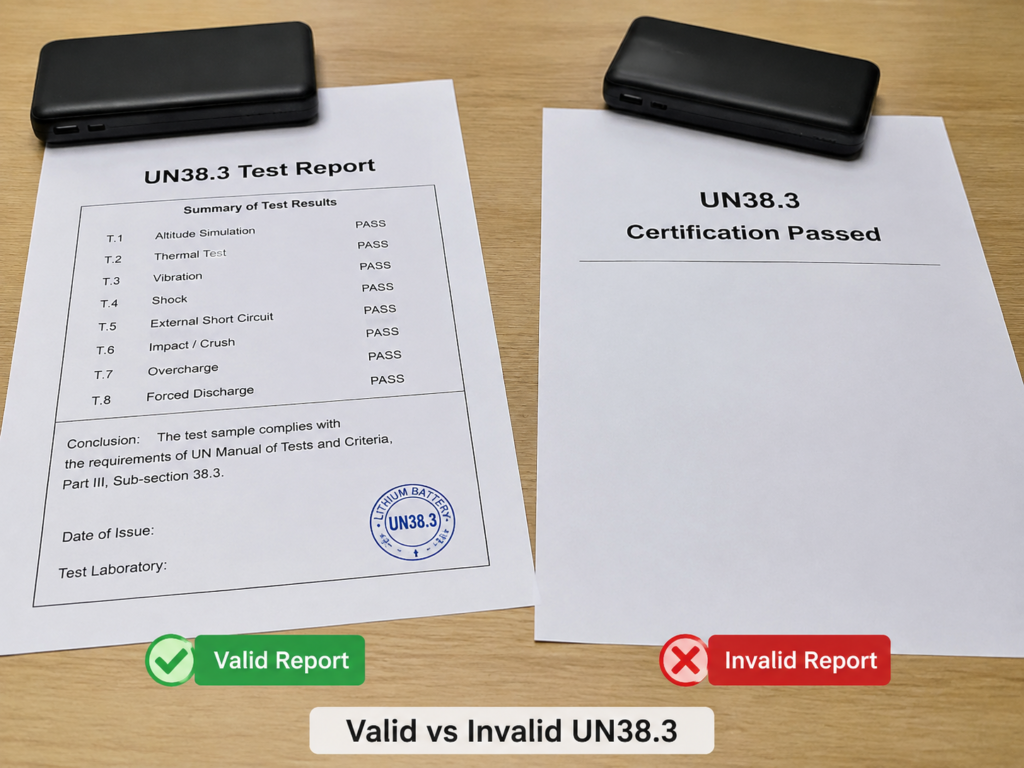
A valid UN38.3 test summary must meet the requirements of UN38.3.5 and contain the following core information:
• Name and contact information of the manufacturer and test laboratory;
• Unique report identification number, test completion date;
• Detailed description of the battery: chemical system, weight, rated energy, model, etc.;
• Applicable test items and results; for assembled batteries, there must also be corresponding test instructions;
• Version of the UN38.3 manual on which it is based;
• Name and position of the signatory.
If there is only a fancy certificate printed with “UN38.3 Certification Passed” without the above standardized summary content, it is invalid.
Then Check if the Model Matches
Prioritize verifying the test summary corresponding to the **finished power bank (battery pack)**. You cannot directly use the cell test report to replace the finished product report — because a power bank is composed of cells plus a protection board and casing, testing only the cells does not mean the finished product meets the requirements.
How to Check Validity Period: Four-Question Change Method
Many people ask whether the validity period of the UN38.3 report is 1 year or 3 years? In fact, there is no unified fixed validity period. The core depends on whether the product has undergone **substantial design changes**, that is, whether it will affect transport safety. After a design change, it shall be judged in accordance with UN38.3.2.2 whether it constitutes a new battery type, or whether the change may cause the existing test to fail; when these conditions are met, retesting shall be conducted. The manufacturer shall form and retain the corresponding technical judgment basis. The core can be judged from four dimensions:
1. Have the chemical system and internal structure of the cell changed?
2. Have the series-parallel connection method of the cells and the design of the BMS protection board changed?
3. Have the rated energy and core electrical parameters changed?
4. Will changes to the casing and key safety components affect the test results?
Pure brand or appearance changes should also be confirmed at the same time to not affect model identification, manufacturer information, and the carrier’s requirements for summary matching.
Laboratory Qualification Requirements
UN38.3 itself does not mandate that test laboratories must have specific qualifications, but in actual operation, the regulatory authorities of the destination country, carriers, and e-commerce platforms may require laboratories to have CNAS, ILAC and other accreditation qualifications. Therefore, it is best to confirm the requirements clearly in advance to avoid the report not being recognized.
Common Characteristics of Invalid Documents
If you encounter the following situations, directly judge them as invalid and do not use them:
• Using other documents such as CE, FCC, MSDS to replace the UN38.3 test summary;
• The model, capacity, and battery type on the report do not match the actual product;
• Claimed to be a “universal report” that can cover a bunch of unrelated models;
• No standardized summary content, only promotional certification certificates.
3-Step Quick Judgment Method for Individual Users
If you just take a power bank on a plane yourself, you don’t need to go through all this complexity. You can do it in three steps:
1. Check the rated energy: take the clearly printed Wh mark on the power bank body as the standard; do not bring one without a mark;
2. Confirm the quantity and carrying method: Power banks ≤100Wh should be limited to the quantity for personal use. The IATA baseline is usually a maximum of 20 spare batteries per person, and operator approval is required if exceeded; power banks exceeding 100Wh but not exceeding 160Wh are limited to 2 per person and must obtain airline approval. All power banks must be carried on board and protected against short circuits;
3. For those exceeding 100Wh, apply for approval from the airline in advance, and confirm the rules for all flight segments if transferring.
These Supporting Requirements Should Also Be Noted for Air Freight
For friends who ship via air freight, having only the UN38.3 test summary is not enough. There are several core supporting compliance requirements, otherwise the goods will still be detained:
1. Declaration Must Be Truthful
Must be declared as **stand-alone lithium-ion battery UN3480**, and absolutely must not be falsely declared as ordinary electronic products, chargers and other general cargo. Once false declaration is found, the light consequence is cargo detention and fines, and the serious consequence may face more serious legal liabilities. Never take chances.
2. State of Charge Must Be Controlled
The baseline of international rules is: the state of charge (SoC, that is, the ratio of remaining power to rated capacity) of the power bank must not exceed 30%. If it exceeds 30%, approval from the civil aviation authorities of the country of origin and the country of the operator is required, and the process is very complicated. Therefore, be sure to reduce the power to below 30% before shipping.
3. Prepare Materials by PI965 Section
The PI965 rules are divided into different sections according to the energy, quantity, and net weight of the battery, and different sections have different requirements:
• Section IA and Section IB shall be prepared in accordance with current provisions respectively: Section IA usually uses UN performance packaging, and is equipped with Class 9 lithium battery hazard label and cargo aircraft only label, usually no lithium battery mark is required; Section IB applies to the packaging conditions specified in its provisions, and must use lithium battery mark, Class 9 lithium battery hazard label and cargo aircraft only label. Both shall complete dangerous goods declaration and waybill information in accordance with applicable provisions;
• Section II: requirements are relatively simplified, no dangerous goods declaration form and performance packaging are required, but still must meet requirements such as labeling and short circuit protection.
Lithium battery marks, hazard labels and cargo aircraft only labels all have standard patterns and applicable conditions specified by ICAO/IATA; first determine the marks and labels that must be used according to the corresponding section of PI965, then check whether the carrier has additional requirements.
Two Common Cases of Transport in the Same Box
Many people are confused about whether the classification will change if a power bank is shipped with other things? Here are two common examples:
• Power bank + charger/data cable in the same box: still belongs to UN3480, because the risk of stand-alone lithium battery is brought by the power bank, and shipping with ordinary accessories will not change the classification;
• Power bank + mobile phone with battery already installed in the same box: still managed according to UN3480. As long as there is a stand-alone power bank in the package, it is calculated according to the highest risk classification.
Rules Are Flexible
ICAO and IATA rules are only the international minimum requirements. Regulatory authorities of various countries, airlines, and freight forwarders can all set stricter rules. Therefore, before shipping, be sure to confirm with your freight forwarder and carrier the specific requirements of the country of origin and destination country, and do not only prepare according to the international minimum standard.
7 Most Common Pitfalls
We have compiled the most common mistakes people make. Avoiding them in advance can save a lot of trouble:
Misconceptions About Function
1. **“With UN38.3, you can ship by air casually”**: Wrong. UN38.3 is only the most basic test requirement. You also have to meet a bunch of requirements such as packaging, declaration, state of charge, and transport mode. It’s not that you can send casually with a report.
2. **“UN38.3 is a quality certification”**: Wrong. It only targets transport safety, and has nothing to do with the power bank’s charging speed, service life, or quality.
Misconceptions About Scenarios
3. **“Freight of power banks below 100Wh does not need UN38.3”**: Wrong. In freight scenarios, regardless of capacity, as long as it is a lithium battery power bank, a UN38.3 test summary is required; there is no capacity exemption.
4. **“Individuals need to bring a UN38.3 certificate when carrying a power bank”**: Wrong. Passengers usually do not need to proactively present the UN38.3 test summary, but must still comply with the baggage regulations of the departure location, transfer location, and operating airline; security check or airline staff may verify applicable labels and safety conditions. For example, flights within China require power banks to have a clear 3C mark and must not belong to recalled models or batches.
5. **“With UN38.3, you can check the power bank”**: Wrong. The vast majority of airlines completely prohibit checking power banks, which has nothing to do with whether they have UN38.3. The core reason is that a fire in the cargo hold cannot be dealt with in time.
Misconceptions About Products and Documents
6. **“Power banks with USB ports count as general cargo”**: Wrong. Power banks belong to UN3480 stand-alone lithium batteries. Falsely declaring them as general cargo will result in cargo detention and fines, and in serious cases, legal liability will be borne.
7. **“Doing UN38.3 once can be used for all upgraded models”**: Wrong. After a design change, it shall be judged whether it constitutes a new battery type, or whether it may cause the existing test to fail; only when these conditions are met is retesting required, not that any parameter change will necessarily require retesting.
Quick Verification Checklist
For your convenience to quickly check before departure or shipping, we have compiled two checklists. Going through them can avoid most problems:
7-Item Verification Checklist for Air Freight
1. **Attribute**: Declare as UN3480, prioritize cargo aircraft transport; transport on passenger aircraft requires special approval;
2. **Documents**: Have a valid UN38.3 test summary for the corresponding model, and complete the carrier’s pre-review in advance;
3. **Section**: Confirm the corresponding section of PI965, and prepare packaging, labels, and declaration documents as required;
4. **Product**: Has clear model and rated energy marks, no abnormalities such as damage or bulging;
5. **State of charge**: State of charge ≤30%; if exceeded, go through approval procedures in advance;
6. **Packaging**: Provide short circuit protection, meet the packaging requirements of the corresponding section;
7. **Confirmation**: Verify the specific requirements of the country of origin, destination country, and carrier, do not only follow international rules.
Passenger Carry-On Verification Checklist
1. **Capacity**: ≤100Wh usually can be carried; 100–160Wh requires airline approval; >160Wh is prohibited from being carried;
2. **Rule check**: Confirm the requirements of the operating airline (including transfer and code-share flights), and recheck before departure; also check the labeling requirements of the departure location and transfer location, such as 3C marking and recall restrictions for flights within China;
3. **Carrying requirements**: Power banks ≤100Wh should be limited to the quantity for personal use. The IATA baseline is usually a maximum of 20 spare batteries per person, and operator approval is required if exceeded; power banks of 100–160Wh are limited to 2 per person and must be approved by the airline. All power banks should be carried on board, protected against short circuits, and absolutely not checked;
4. **Appearance and usage**: Has a clear Wh mark, no damage or bulging; power banks may not be charged during flight, nor may power banks be used to charge other personal electronic devices, and comply with any additional restrictions that may be imposed by the airline.
Frequently Asked Questions
1. **Is UN38.3 mandatory for power banks shipped by air?**
It depends on the scenario: it is mandatory in air freight scenarios, regardless of capacity, personal or commercial use; in passenger carry-on scenarios, individuals usually do not need to present it, but the product itself needs to meet UN38.3 requirements, and the responsibility lies with the manufacturer.
2. **Do individuals need to present UN38.3 when bringing a power bank on a plane?**
Usually no need to proactively present it. But you must comply with the passenger baggage rules of the departure location, transfer location, and operating airline. Security check or airline staff may verify capacity, quantity, labeling, appearance, and safety conditions. For example, flights within China prohibit carrying power banks without 3C marking, with unclear 3C marking, or that belong to recalled models or batches.
3. **Can power banks below 100Wh be shipped by freight without UN38.3?**
No. There is no capacity exemption in freight scenarios. As long as it is a lithium battery power bank, a valid UN38.3 test summary is required.
4. **Can power banks be checked in?**
The vast majority of airlines explicitly prohibit checking power banks, which has nothing to do with whether they have UN38.3. The reason is that the cargo hold is unattended, making it difficult to deal with fires. When checking luggage temporarily at the boarding gate, be sure to take out the power bank and carry it with you.
5. **How long is the validity period of the UN38.3 report?**
There is no unified fixed validity period. The core depends on whether the product has undergone substantial design changes. After a design change, it shall be judged in accordance with UN38.3.2.2 whether it constitutes a new battery type, or whether the change may cause the existing test to fail; when these conditions are met, retesting shall be conducted. The manufacturer shall retain the corresponding technical judgment basis.
6. **Is a power bank shipped with a charger still a lithium battery?**
Yes, it is still managed as a UN3480 stand-alone lithium battery. Shipping with ordinary accessories will not change the classification.
7. **Can a 10000mAh power bank be brought on a plane?**
Usually yes. A common 10000mAh power bank with a nominal voltage of 3.7V has a rated energy of 37Wh, which is far below the 100Wh threshold. It is usually fine to carry it on board, but it must also meet the requirements of the departure location, transfer location, and airline regarding quantity, labeling, and in-flight use.
Overall, the core of the UN38.3 requirement for power bank air transport is “judging by scenario”: it is a hard requirement in freight scenarios, which must have a valid test summary, and must also cooperate with a series of requirements such as declaration, packaging, and state of charge; in personal carry-on scenarios, you usually do not need to submit documents yourself, but in addition to capacity, quantity, and carry-on method, you also need to check the labeling, safety, and in-flight use restrictions of the departure location, transfer location, and airline; checked baggage is basically a restricted area, which has nothing to do with whether you have UN38.3.
After reading this article, you should be able to easily distinguish the core requirements between freight and personal carry-on, quickly judge whether your power bank can be brought on the plane, also identify the validity of UN38.3 test summaries and avoid fake reports, and check core compliance risks before shipping to avoid the trouble of cargo detention and return. No matter which scenario it is, remember the most reliable principle: the final requirements are subject to the carrier (airline, freight forwarder, platform) and the applicable regulations of the departure location and transfer location. Confirming in advance before departure or shipping can save a lot of detours.