
Many cross-border sellers who sell USB charging products, as well as ordinary overseas consumers, often encounter the term “USB-IF certification” — some say that selling USB-C cables and PD chargers must pass this certification, otherwise it is illegal; others say it is just an industry gimmick with no practical use. Is USB-IF certification mandatory after all? Let’s first give the core conclusion directly:
USB-IF certification **is not a statutory mandatory requirement**, nor is it a statutory access condition for charging products in global markets. What products really need to meet before going on the market are statutory compliance requirements such as safety, electromagnetic compatibility (EMC, simply put, means that the product does not randomly emit electromagnetic interference to others, nor will it be affected by external interference and fail to work normally), and energy efficiency of the sales region. However, there are 3 types of scenarios that are “de facto quasi-mandatory” — although there is no explicit legal requirement, it is almost impossible to advance business or guarantee experience without doing it. In addition, it should be clarified that: **the failure to obtain USB-IF certification itself usually does not constitute an illegal act; but unauthorized use of the USB-IF trademark or certification logo, or false or misleading publicity about certification status, TID, or applicable models, may trigger trademark, advertising, consumer protection or other compliance liabilities, subject to the laws of the sales region.**
The scope of this article mainly targets USB charging/transmission products such as charging cables, USB-C/A data cables, PD chargers, and power adapters. The content only involves USB-IF’s industry compliance and trademark rules, and cannot replace the statutory compliance requirements of your sales region.
Legal Boundaries: Core Differences from Statutory Compliance
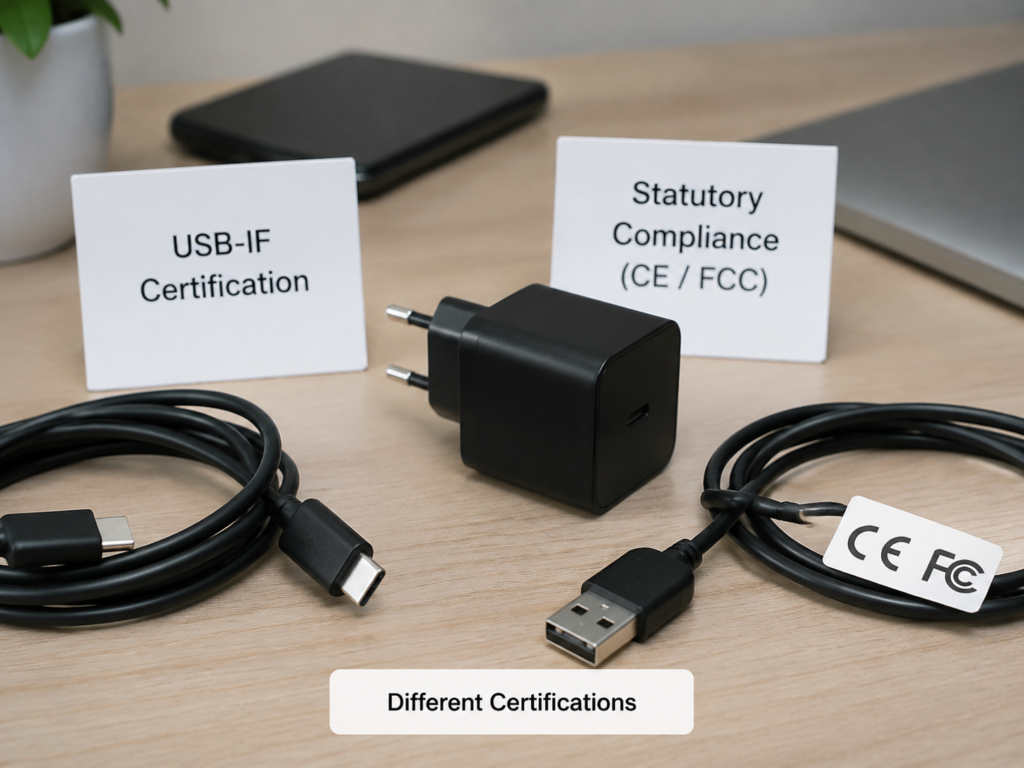
Many people confuse USB-IF certification with statutory compliance such as CE and FCC, but the two are fundamentally different in nature. We can make a quick comparison through a table:
| Comparison Dimension | USB-IF Certification | Statutory Compliance |
| Initiating Entity and Nature | Initiated by an industry association, belongs to industry self-regulatory norms, no mandatory enforcement power | Initiated by government/regulatory authorities, belongs to legal requirements, has the power to impose penalties |
| Consequences of Non-Compliance | Cannot use the official logo, restricted access to some commercial channels, no legal penalties | Cannot be sold legally, may be subject to goods seizure, fines, and mandatory recall |
| Core Test Focus | USB-specific performance such as fast charging compatibility, data transmission stability, and interface matching | General compliance items such as safety, electromagnetic compatibility (EMC), energy efficiency, and environmental protection |
| Examples of Common Market Markings | USB-C and USB PD certification logos with ® | EU CE (conformity assessment mark of EU regulations, includes self-declaration route, not equivalent to a single third-party certificate); US FCC (electromagnetic interference compliance requirement for digital circuit equipment, not a safety certification); UL/ETL are third-party safety certification marks, not a unified federal statutory access mark, whether they are required depends on specific products, local competent authorities, channels or contract requirements |
In addition to the different nature, special attention should be paid to a common misunderstanding: **statutory interface/protocol requirements are not equivalent to mandatory USB-IF certification**. For example, the familiar EU common charger rule requires that devices listed in the annex of the regulation and capable of wired charging be equipped with a usable USB-C port and can be charged with cables compliant with EN IEC 62680-1-3:2021; only when the device can be charged via wired connection at conditions higher than 5V, 3A or 15W, it must integrate USB PD and ensure that other charging protocols do not hinder the full functionality of USB PD. This regulation does not mandate that enterprises must obtain USB-IF certification; enterprises can self-verify that their products meet relevant standards. If other markets have similar interface requirements, you should also check the original regulation text separately, and cannot directly equate it with mandatory USB-IF certification.
Then, what situations related to USB-IF certification may trigger legal risks? **Unauthorized use of USB-IF’s registered trademarks** — including graphic logos, specific text combinations, etc., may constitute trademark infringement; false or misleading publicity about certification status, TID or applicable models may also violate advertising, consumer protection or other compliance liabilities. The key to the problem is not “not having certification” itself, but whether specific publicity and sales behaviors violate the laws of the sales region.
Practical Method: 3 Steps to Verify the Authenticity of USB-IF Certification
Since certification has certain value, how to judge whether the USB-IF certification advertised by merchants is real or fake? You can follow these 3 steps:
Step 1: First Clarify the Certification Caliber of the Promotion
Many promotions play word games, so pay attention to three distinctions: first, distinguish between “finished product certification” and “only using certified chips/connectors” — certification of parts does not mean the entire product has passed certification; second, distinguish between “certification of the currently sold model” and “certification of other models in the same series” — USB-IF certification corresponds to specific brands, specific models, and specific revision versions. Passing certification for other models in the same series does not mean the model you are buying has passed; third, distinguish between “USB-IF official certification” and “compliant with USB standards” — a product claiming to comply with USB standards on its own does not mean it has passed USB-IF’s official certification.
Step 2: Product Markings Are Only for Preliminary Reference
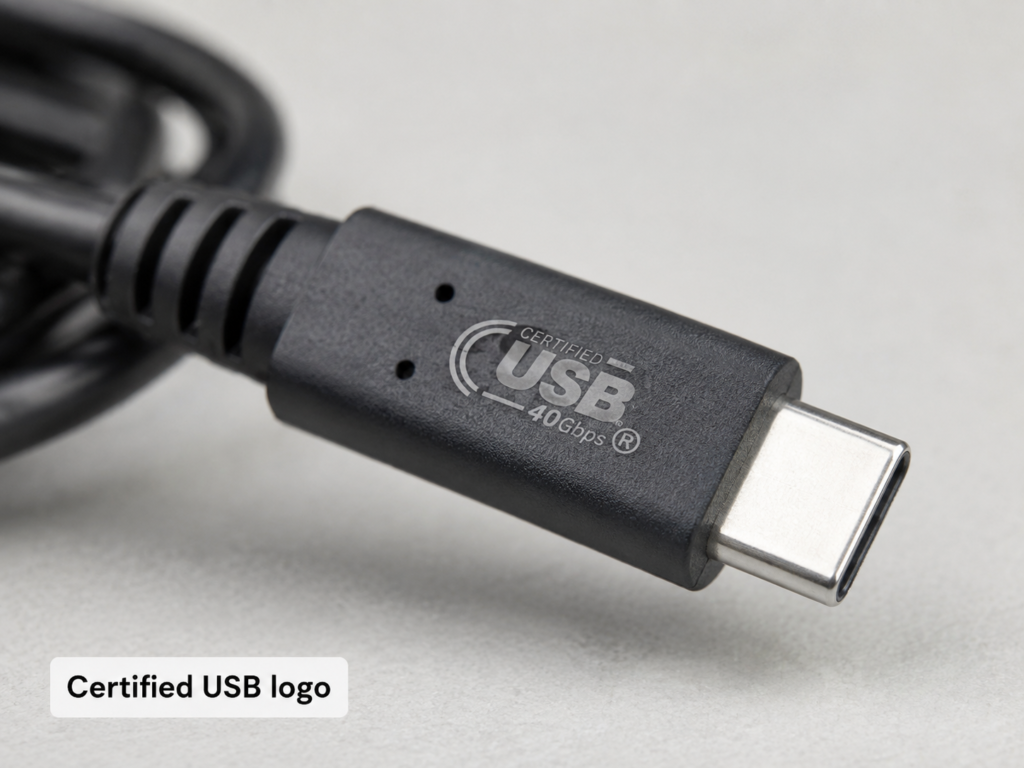
If the product is printed with the official certification logo with ®, normally it should correspond to valid certification and trademark license, and forging the logo constitutes trademark infringement. Conversely, you cannot conclude that a product is not certified just because it has no logo on it — whether to display the logo depends on the product category and the current rules of USB-IF, and some certified products may also not print the logo. In addition, the power and rate marked on the product should be consistent with the information registered in the official database; if there is a large discrepancy, you should be alert to false publicity.
Step 3: Query and Verify via the USB-IF Official Database (Most Accurate)
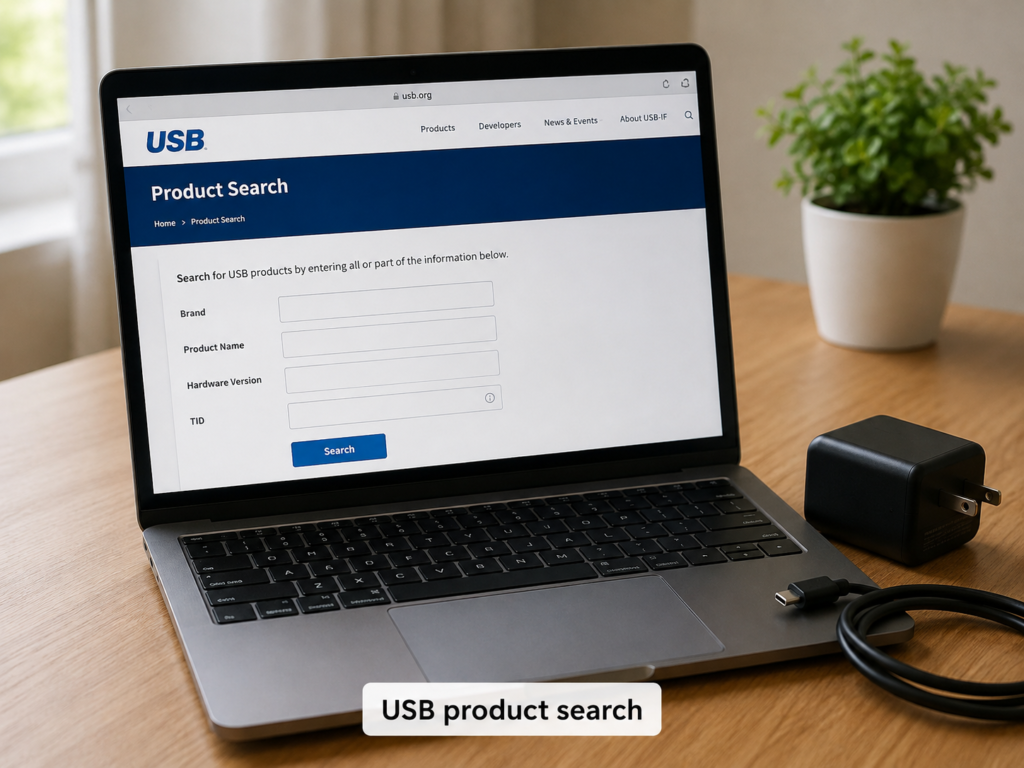
You can log in to the Product Search entry on the USB-IF official website (usb.org), and enter the product’s brand, full model, hardware version or TID number to search. After finding the results, prioritize checking information such as the brand, product name/model, TID, certification date, and product category visible in the public records. USB-IF certification is for specific names, models and revision versions; if the public record does not show the revision version or capability statement, you cannot judge the certification as invalid just because of missing fields. You should request the corresponding TID, version and certification materials from the brand, and confirm with USB-IF if necessary.
It should be noted that the official database only displays certification records from the past two years by default. If it is an earlier certification, you need to confirm that the currently sold version you are buying is consistent with the version registered at that time — an early certification date does not mean automatic invalidation; the key depends on whether the product version has changed and whether it meets current compliance requirements.
There are three common fake certification scams: first, directly forging TID numbers, with no corresponding records found on the official website; second, using certification of other models in the same series to impersonate the certification of this product; third, claiming full certification when only partial test items have been passed.
Judgment Logic for Different Roles
After learning so much, how should different roles judge whether to apply for certification or choose products with certification?
Compliance Path for Manufacturers/Sellers
First, clarify the capability claims of your product — such as maximum charging power, data transmission rate, whether it supports video output or expansion functions, these determine the test scope of certification.
Then, first identify all statutory compliance requirements of the sales region, including safety, EMC, energy efficiency, environmental protection, labeling requirements, etc. This is the bottom line for product launch and must be met first.
Then evaluate whether to apply for USB-IF certification: if your product needs to use the official logo, needs to enter mid-to-high-end channels, or is a high-power or high-speed product, it is recommended to apply; if it is an affordable white-label product, does not use any official markings, and only has basic charging functions, you can also choose not to apply.
Finally, be sure to establish a mass production control process to ensure that mass-produced products are consistent with the test samples. If materials are changed, the certification must be re-evaluated. When promoting, you must also comply with USB-IF’s trademark usage rules to avoid infringement.
Purchase Logic for Ordinary Consumers (By Priority)
The first layer is the bottom line: first confirm the compliance information of the product and the traceable responsible entity. In the EU market, for products subject to CE according to law, check the CE mark and information of responsible entities such as manufacturers and importers; do not regard CE as a mandatory mark for all USB cables. In the US market, check the clear brand, model and responsible entity, and pay attention to applicable FCC, energy efficiency and safety requirements according to product category; do not use the presence or absence of FCC mark or FCC ID as a unified compliance or safety judgment for all charging cables and chargers. The core is to have a clear responsible entity and after-sales channels, and try not to buy unbranded and unmarked “three-no” products.
The second layer is core demand: match the actual capability of the product. When buying a charging cable, check the rated current/power, whether it supports data transmission, and whether the length is sufficient; when buying a charger, check the input and output specifications and whether the PD power levels are compatible with your device; when buying a docking station, check whether the interface type, data/video rate, and power supply capability can meet your needs.
The third layer is USB-IF certification, which is an added bonus. If you need fast charging for high-power devices, high-speed data/video output, or frequently use multiple devices across brands, prioritize products with certification; if you only need ordinary charging for your phone, are buying a spare short cable, only use it for basic charging, and have a limited budget, you don’t need to fret over whether it has certification.
Core Summary
Finally, let’s recap the core content:
USB-IF certification is an industry voluntary compliance and trademark license, not a statutory mandatory requirement. The absence of certification itself usually does not constitute an illegal act; but misuse of the USB-IF trademark or certification logo, or false or misleading publicity about certification status, TID and applicable models, may trigger corresponding liabilities.
There are 3 types of de facto quasi-mandatory scenarios: need to use the USB official logo, clear requirements from commercial partners, and high-power/high-speed products that need to assess cross-brand interoperability risks.
You should be able to distinguish the core differences among USB-IF certification, statutory compliance, and statutory interface requirements, and not confuse them.
If you want to verify the authenticity of certification, you can query via the USB-IF official database, and avoid common scams such as forged TIDs, impersonation with same-series models, and claiming full certification when only partial tests have been passed.
Whether you are selling or buying, you will not go wrong if you judge according to the priority of “statutory compliance → product capability → USB-IF certification”.