
Friends who do cross-border procurement of charging products have most likely run into pitfalls with certifications: either you get a “certificate” stamped with a red seal from the supplier, only to have the goods detained by customs when they arrive at the port; or the product is taken off the platform just a few days after listing, and you have to pay a fine. Many people think certification just means “having a piece of paper”, but in fact, from the authenticity of the documents to their coverage scope, pitfalls can be hidden at every step. Today, we will explain the entire process of verifying suppliers’ certification documents from beginner to advanced level, so even if you are a novice, you can follow along step by step.
First, Understand: 4 Types of Compliance Documents That Are Most Easily Confused
Many novices, when receiving a pile of documents from suppliers, can’t tell which are useful and which are not, and even mistake system certifications for product compliance certificates. Let’s first clarify the 4 most common types of documents with a table:
| Document Type | Plain Explanation | Core Function | Can It Be Directly Used as a Market Access Credential? |
| Product Certification/Listing Certificate | A “compliance ID card” issued by a third-party authoritative body for specific models, usually including regular factory supervision | Proves that specific model products meet corresponding safety, electromagnetic compatibility and other standards | Can be used as important compliance evidence; whether it constitutes a legal market access condition must be confirmed according to product category, sales region regulations, usage scenarios and platform rules |
| Third-Party Test Report | An “exam report” issued by a laboratory for submitted samples | Proves that the submitted samples meet the test standards | No (only responsible for the submitted samples) |
| Declaration of Conformity (DoC/SDoC) | A “compliance declaration” issued after completing applicable conformity assessment and having corresponding technical documents and compliance evidence; the responsible subject is determined according to specific systems | It is the core compliance document under the self-declaration mode in most markets | Yes (requires a complete technical document chain as support) |
| System Certification (e.g. ISO9001) | A “standard certification” for factory management processes | Proves that the factory’s quality management system meets standards, and can reflect management capabilities related to design, production and consistency control | No (cannot replace compliance documents for specific products) |
Why Must You Spend Time Verifying Certification Documents?
For charging products, certification verification is by no means a procedural step—it directly relates to whether you will lose money:
First, avoid customs detention. For example, EU customs will check the CE mark and supporting documents, and US customs will check FCC compliance. If the documents are incorrect, the goods will be directly detained or even returned, resulting in losses not only of freight costs but also the opportunity cost of missing the sales season.
Second, avoid e-commerce platform penalties. Currently, mainstream cross-border platforms have increasingly strict compliance requirements for charging products. For example, many categories on North American sites require NRTL (Nationally Recognized Testing Laboratory, such as UL, ETL) listing. Non-compliant products will be directly removed from the shelves, and in serious cases, accounts will be frozen.
Third, reduce safety risks. Chargers and high-power USB-C cables are products with high voltage and large current. Products with fake certifications are likely to be shoddily made, which may burn devices in mild cases, or cause fires and safety accidents in severe cases. The compensation liability you will bear at that time will be far greater than the procurement cost.
Fourth, prevent supplier fraud. Many suppliers will use PS-ed fake documents, borrowed certificates from other companies, or even expired certificates to fool novices. The probability of falling into a pit without verification is very high.
Quick Check of Compliance Requirements for Major Global Markets
Compliance rules vary completely across different markets. You don’t need to memorize them by rote; just match them to the market you sell in:
| Market | Mandatory Compliance Requirements | Common Misconception Reminder |
| European Union | CE mark + EU DoC (EU Declaration of Conformity) + complete technical documents. Only specific high-risk regulations require a Notified Body (NB, a third-party body officially recognized by the EU) certificate | Not all CE certificates need to be issued by an NB. Most ordinary wired charging products adopt the self-declaration mode |
| United Kingdom | A distinction must be made between Great Britain and Northern Ireland. Great Britain still recognizes the CE mark for most relevant product regulations, and UKCA is also applicable; CE is usually applicable in Northern Ireland, and UKNI is also involved in specific cases | Do not treat the entire UK as having the same set of marking paths. The required declarations and marks should be confirmed according to the applicable product regulations and actual sales region |
| United States | The FCC path must be confirmed according to device function classification. Devices with intentional transmission communication functions such as Wi-Fi and Bluetooth usually need to go through Certification and obtain an FCC ID; wireless charging/WPT devices may be subject to Part 15 and/or Part 18, and the authorization procedure may be SDoC or Certification; whether ordinary wired chargers are subject to Part 15B SDoC should also be confirmed according to specific categories | Do not confuse SDoC with FCC ID, and do not assume that all wireless charging products must have an FCC ID |
| Japan/South Korea/Australia | Japan and South Korea shall confirm according to PSE and KC rules respectively; Australia shall confirm according to EESS and state/territory rules. For equipment included in the EESS scope, it is necessary to verify the responsible supplier registration, equipment registration and/or valid conformity certificate according to the risk level, and verify the conditions for using the RCM mark | Do not equate SAA commercial certificates with Australia’s unified statutory access documents |
| Voluntary Qualifications | USB-IF certification is usually not a legal market access requirement | When using the USB-IF certification logo, it should be verified that the product has passed the corresponding compliance procedures, is listed in the applicable directory, and has trademark permission; when using names or trademarks such as USB-C, USB Type-C, USB PD, etc., verification should be carried out in accordance with applicable trademark and naming rules; simple functional claims should also have matching technical evidence, but this does not necessarily mean that USB-IF product certification must be obtained |
4 Cognitive Misconceptions That Novices Are Most Likely to Fall Into
Before starting verification, first correct these most common misconceptions, which can help you avoid 80% of the pitfalls:
1. **Having a seal and certification mark means true compliance**: The cost of PS-ing a document with a seal is extremely low. You must verify the records through official channels and check the complete document chain.
2. **Compliance documents are valid for life**: Certification standards will be updated, certificates may be suspended or revoked, and changes in product parameters may also cause the original documents to become invalid. You must verify the current status.
3. **Suppliers having compliance documents = all products are compliant**: Any compliance document only covers the models, specifications, and manufacturing factories listed on it. It is not that if a supplier has one certificate, all their products can use it.
4. **System certification equals product compliance**: System certifications such as ISO9001 cannot prove that a specific model has met the product regulations or certification requirements of the target market, and cannot replace product compliance documents; however, the quality management system they reflect can be related to design, production and consistency control. Don’t be fooled by suppliers using this.
Preparations Before Verification: Clarify the Core Premises First
Many people rush to check the number as soon as they get the document, only to find after a long time that the product model is wrong and the market requirements are not clear, which is a complete waste of effort. Do these 5 preparations before verification:
1. Clarify the Accurate Information of the Procured Product
The more detailed the better, it should at least include: product type (charger/power adapter, or USB-C charging cable/interface accessory), specific model specifications (power, cable length, interface type, etc.), key parameters (charger output levels, cable rated current, whether it has an E-Marker chip—the small chip used to transmit power information in high-power USB-C cables), plug version (US/EU/UK, etc., which must match the target market).
2. Determine the Regulatory Boundaries of the Product
Products with different functions and attributes are subject to completely different regulations, which should be clarified in advance:
• Whether it has wireless functions: Wi-Fi, Bluetooth, and wireless charging may involve RF (radio frequency) or other wireless power transmission-related compliance requirements. The specific path should be confirmed according to product functions.
• Product attributes: whether it has a built-in battery, whether it is an external power supply, and whether the plug is detachable will all affect the applicable standards.
• Specifications and parameters: single-port or multi-port, rated power, output levels, and rated current of the cable—these parameters directly determine whether the certification can cover the product.
• Sales form: whether it is sold separately or in a set, whether it is sold with the main unit; if it is a set, all components must be compliant.
• Claim content: whether names or trademarks such as USB-IF, PD, QC are used; when using relevant certification logos or trademarks, verification should be carried out in accordance with applicable rules.
• Channel information: which country to sell to, which platform to use, and when it is planned to be listed—rules may vary across different platforms and different times.
3. Clarify Sales Market and Platform Requirements
Remember a core principle: **Compliance requirements are judged by the place of sale, not the place of production**. Even if the product is produced in China, if it is sold to the EU, it must follow EU rules, regardless of the standards of the place of production.
It is also necessary to distinguish between mandatory regulatory requirements and additional platform requirements: for example, FCC requirements at the US federal level need to be confirmed according to the actual product category, while NRTL safety listing is an additional requirement of many e-commerce platforms, and does not constitute a unified federal pre-market certificate requirement for all consumer charging products. But if you want to list on the platform, you must meet it, and the specific rules shall be subject to the current rules announced by the platform.
If it is sold as a set, such as a combination of a charger and a charging cable, the compliance requirements of all components must be met at the same time. You cannot only check the charger and ignore the cable.
4. Correctly Request Documents from Suppliers
Many novices just say “send me your certifications” when asking suppliers for documents, and end up receiving useless system certificates and documents for other models. The correct approach is:
• Provide the supplier with a clear requirement template, clearly marking the product model you want, the corresponding sales market, the required document type, document number, and issuing body.
• Materials that must be requested include: color scanned copies of documents, document numbers, full names of issuing/responsible subjects, core pages of test reports, and DoC documents.
• Don’t use vague questions. For example, don’t say “give me your certifications”, but say “please provide the applicable FCC compliance documents, UL listing information and core pages of the corresponding test report for this 65W US standard GaN charger (model XXX) for the US market”.
5. Prepare a Verification Checklist in Advance
Make a simple verification checklist to avoid missing items. The content includes: type of document to be verified, corresponding market, product model/parameters/brand, issuing/responsible subject, document number, current status, official query entry, query result record, and document chain integrity check items.
Novices Can Follow Directly: 4-Step Beginner Verification Method
After the preparations are done, you can verify step by step according to these 4 steps. Even novices can get started directly and screen out the vast majority of unqualified documents.
Step 1: Preliminary Surface Screening, Check the Matching Degree of Basic Information
First do the most basic information comparison, and screen out obviously mismatched documents first, so you don’t have to waste time checking their authenticity.
First, check **product information**: the model and parameters on the document must be consistent with the product you are purchasing, or be in the officially published coverage list. For example, for chargers, you need to check power, input and output voltage, and plug version; for USB-C cables, you need to check rated current, interface type, and supported functions. You can compare the product nameplate with the certification document side by side, and every item must match.
Then check **subject information**: the manufacturer and certificate holder on the document must correspond to the supplier subject you are dealing with. If the supplier is a trader or a subsidiary of a group, they must provide proof of subject relationship and the authorization chain of the certificate holder to prove that they have the right to use this document. Also pay attention to whether there are spelling errors in the company name and address, which must be completely consistent with the subject on the contract.
Finally, check **document type**: whether it meets the mandatory requirements of the target market and the additional requirements of the platform. For example, when selling to the EU, you cannot only provide FCC documents; when listing on North American platforms, you need to confirm whether the platform requires NRTL listing.
Step 2: Official Authenticity Verification, Use Corresponding Query Channels According to Document Type
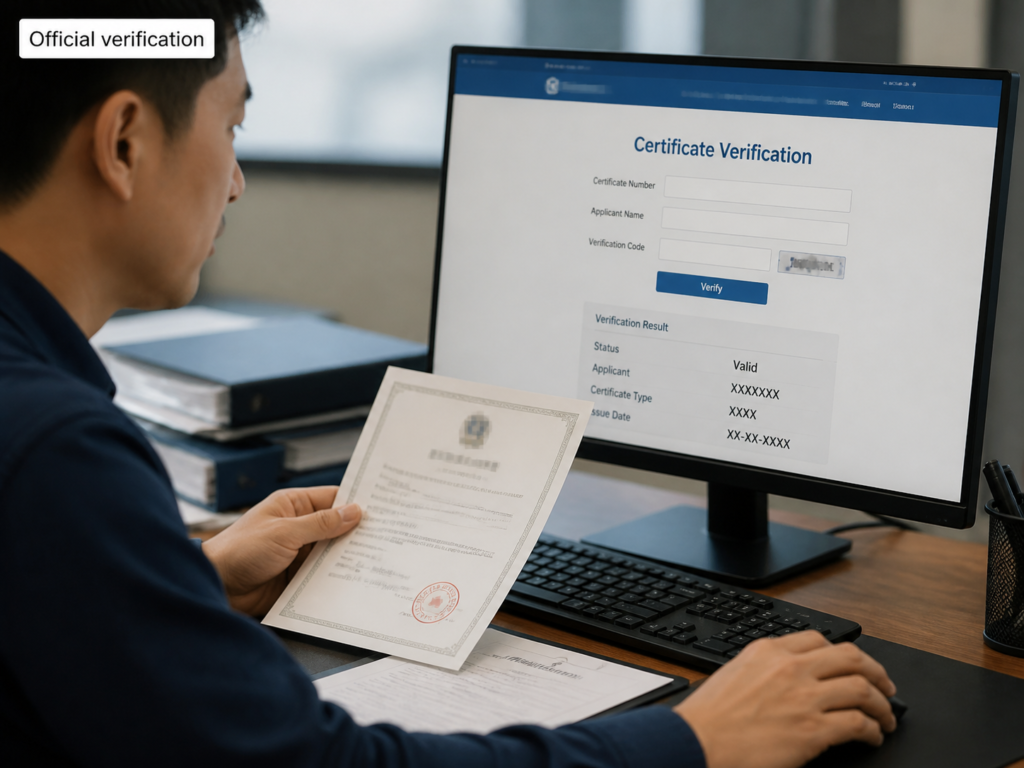
If the surface information matches, the next is the most core step: verify the authenticity through official channels, don’t just look at the seal. Different types of documents have completely different query channels:
• **FCC ID (usually applicable to devices with intentional transmission communication functions such as Wi-Fi and Bluetooth)**: Go to the official US FCC ID query system, enter the FCC ID, and you can find the corresponding filing information.
• **FCC SDoC or other FCC authorization paths**: Must be confirmed according to the specific functions of the product. Wireless charging/WPT devices may be subject to Part 15 and/or Part 18, and the procedure may be SDoC or Certification; ordinary wired charging products cannot be concluded to be subject to Part 15B SDoC just because they are “wired charging”. For the SDoC path, there is no public FCC ID database to query, and it is necessary to verify the consistency of test reports, responsible subject information, DoC documents and product labels.
• **NRTL listing (North American safety standards such as UL/ETL)**: Go to the listing query page on the official website of the corresponding issuing body, enter the document number or company name and product model to query.
• **CE/UKCA**: Prioritize verifying the applicable standards, technical document list, and responsible subject information on the DoC document, because most ordinary charging products adopt the self-declaration mode, and not all have Notified Body certificates.
• **USB-IF**: If the product uses the USB-IF certification logo, go to the qualified product list on the USB-IF official website to check whether the brand, model, and claimed functions are all listed, and confirm relevant trademark permissions; for simple functional claims, focus on verifying the technical evidence matching the claims and applicable trademark rules.
• **Other certifications (PSE/KC/Australian EESS, etc.)**: Operate in accordance with the query rules officially published by the local authorities.
A special reminder here: **Not being able to find it does not mean the document must be fake**. There are several common reasons: the number is entered incorrectly, the query channel does not match (for example, if you take FCC SDoC to check the FCC ID database, you will definitely not find it), different issuing bodies have different database update rules (some may take one or two months to synchronize), and self-declaration documents do not have public query entries at all, so the technical document chain needs to be verified. If you encounter a situation where you cannot find it, you can ask the supplier to provide the official query link and official reply certificate of the issuing body. Do not directly assume it is fake, and do not easily believe the verbal statement that “the database has not been updated”. Everything shall be subject to the official reply of the body. In addition, the acceptance notice cannot replace the formal qualification document, which should be kept in mind.
Step 3: Check Coverage Scope and Status Validity
Just because the document is real does not mean it can be used. It also depends on whether its coverage scope and current status meet your needs.
• **Specification scope**: Low-power documents cannot cover high-power products. For example, the certification of a 20W charger cannot be used to cover a 65W one; if parameters are changed, it is necessary to confirm whether they are within the coverage scope of the document. For example, if the original certification only covers single-port products, and you are purchasing multi-port ones, it will not work.
• **Regional scope**: Compliance documents of Country A cannot be used in the market of Country B. For example, US FCC documents cannot be used to sell in the EU. This is basic, but many people get it wrong when they are in a hurry.
• **Model scope**: Products of the same series must also be in the officially published list of covered models. The supplier’s verbal statement that “our entire series has passed” does not count. There must be an official written list or listing record.
• **Factory scope**: The manufacturing factory marked on the document must be consistent with the factory that actually ships the goods to you. If the supplier says “we have two factories, the certificate is for the old factory, and the new factory is the same as the old one”, this is invalid. The factory on the certificate must match the shipping factory.
• **Status and change verification**: Check the issuance/revision date of the document, the applicable standard version, the current supervision status, and whether there is a regulatory transition period. For example, certificates of old standards can be used during the regulatory transition period, and become invalid after the transition period. The specific status shall be subject to the official information of the issuing body and the regulations of the sales region.
Step 4: Closed-Loop Verification of the Document Chain
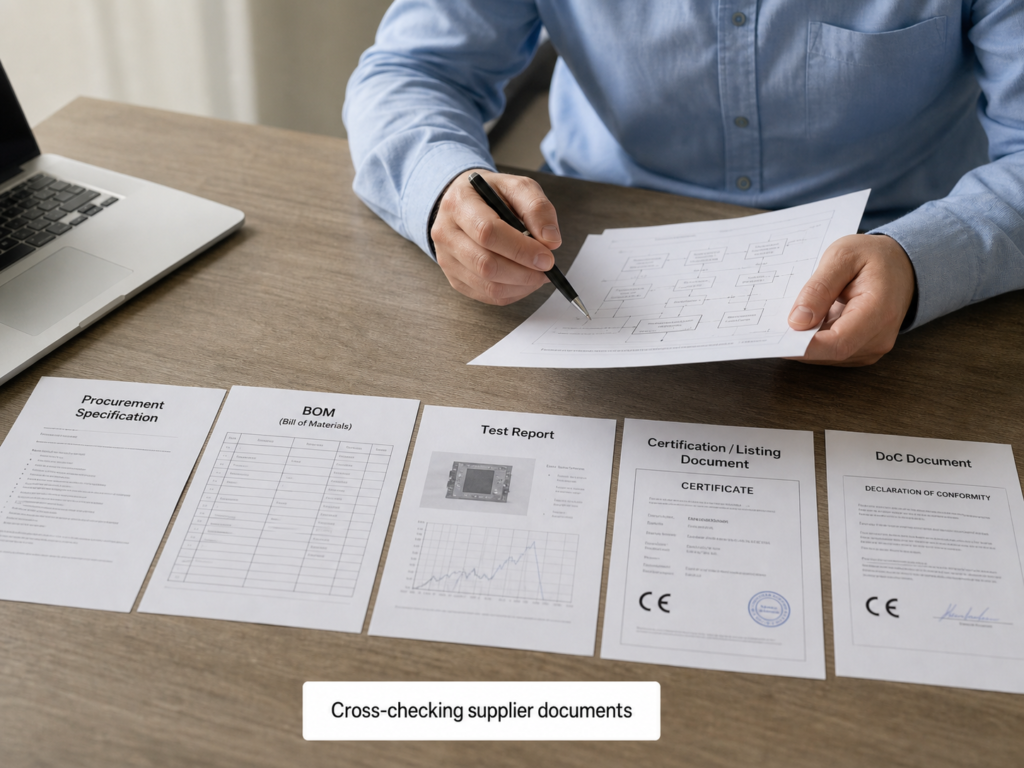
The last step is to string all documents together for verification to ensure that the entire document chain is closed-loop and there are no contradictions.
The minimum compliance evidence package includes: procurement specification, BOM (Bill of Materials, i.e. the list of core product components), test report, certification/listing document, and DoC document. You need to check the product model, power, manufacturing factory, brand and its authorization or listing relationship in these documents to ensure that they are consistent with the approved scope required by the applicable certification scheme.
As long as any link does not match, suspend the use of this document first and ask the supplier to supplement the corresponding supporting materials. You cannot have the mentality of “it’s almost okay”, otherwise if there is a problem during customs clearance or platform review, you will be the one who suffers the loss.
Advanced Pitfall Avoidance: Authenticity Judgment and Risk Identification
If you can already proficiently complete the above 4 steps, you can next learn these advanced skills to help you identify more hidden pitfalls and reach a semi-proficient level.
Red Flag Signals That Can Be Identified at a Glance
When you get the document, first check if there are these signals. High-risk ones are directly questionable, and medium-risk ones require the supplier to supplement proof:
• **High-risk red flags (directly triggering doubt)**: The document has obvious PS traces (such as inconsistent fonts, blurred official seals, abnormal numbers, altered model traces), the issuing body does not have the authorization qualification for the corresponding region, and records cannot be found through official channels and no official certificate of the body can be provided.
• **Medium-risk red flags (supplementary proof required)**: The document issuance date is earlier than the company’s establishment date (may be due to name change or merger, relevant proof and authorization need to be supplemented), there are slight differences in subject/model/factory information but no change explanation, the applicable standard version has expired and there is no transition period compliance certificate, and the parameters on the test report and certificate are inconsistent.
8 Key Points to Understand Test Reports
Many novices turn to the end of the test report to read the word “qualified”. In fact, a lot of information in it can help you judge risks. You don’t need to understand professional test items, just check according to these 8 key points:
1. Basic report information: whether there is a unique report number, revision version number, and clear issuance date. Reports without even a number basically don’t need to be read.
2. Laboratory qualification: Prioritize verifying whether the laboratory has accreditation or authorization matching the test scope, such as CNAS in China, A2LA in the US, etc.; however, whether it is necessary to use an accredited laboratory shall be confirmed according to applicable regulations, conformity assessment modules, certification schemes and platform requirements. Under the self-declaration path, focus should also be placed on verifying test methods, equipment, records and responsible subjects.
3. Subject information: whether the names and addresses of the entrusting party, manufacturer, and production factory are clear, and whether they correspond to the supplier you are dealing with.
4. Sample information: whether there are sample photos and clear model specifications and parameters; if multiple models of the same series are tested together, whether there is a description of model differences to prove that all models have test representativeness.
5. Test basis: what standard and which version are used, which must be completely consistent with the standards required by your target market. Reports using old versions of standards may be invalid.
6. Test conclusion: whether it is clearly stated as qualified, whether test deviations or exemptions are marked; if there are deviations, it is necessary to confirm whether they meet regulatory requirements.
7. Key components: whether the models and suppliers of core components are clearly listed, such as the switch tube in the charger and the E-Marker chip in the USB-C cable, which will later correspond to the product’s BOM.
8. Finally, remember: the test report is only responsible for the submitted samples. Even if the report is real, it does not mean that the bulk goods meet the market access requirements. It must be verified in combination with other documents.
3 Easily Confused Compliance Boundaries
Many suppliers will play edge balls on these boundaries, and you must be able to judge by yourself:
1. **Test report ≠ certification/conformity assessment**: The test report is only the result of the submitted samples. Certification/listing may also include factory supervision and subsequent spot checks. Self-declaration documents require corresponding technical evidence as support, but they are different things in themselves.
2. **Self-declaration (DoC/SDoC) ≠ writing casually**: Many people think that self-declaration is just a piece of paper written by the manufacturer themselves, but this is not the case. It must be made after completing the applicable conformity assessment and having corresponding compliance evidence and technical documents. Test reports are usually important evidence, but whether they are necessary and whether they must be issued by a third party shall be determined according to applicable regulations and certification schemes; the responsible subject shall also be confirmed according to specific systems, and FCC SDoC is the responsibility of the responsible party defined by law.
3. **Same series listing ≠ universal for all models**: Suppliers often say “our entire series has passed certification”, but in fact, as long as the power, interface, or key components change, it may exceed the coverage scope of the original certification. There must be an official coverage list or change certificate, and verbal promises do not count.
In addition, there is the validity of private label documents: if it is an OEM/ODM private label product, it is necessary to verify at the same time whether the procurement brand, model, label and manufacturing location have been approved in accordance with the private label, multiple listing or authorization procedures of the corresponding certification body, and confirm whether the product structure and key components are consistent with the approved scope.
Additional Verification Methods for High-Risk Scenarios
When encountering these high-risk scenarios, don’t just do basic verification, add an extra step:
• Large orders or high-power products (such as chargers above 65W, 100W PD cables): conduct a full review of the test report, don’t just look at the certificate.
• Large-value or long-term cooperation orders: verify the authenticity of the supplier subject, such as checking the official website, confirming the corporate email, checking the registered address, and if necessary, you can request a video factory inspection.
• If you have doubts about the documents: find a professional third-party compliance service provider to do document verification, spend a small amount of money to avoid big losses.
• Before bulk procurement: be sure to get samples first, check whether the certification marks on the sample body are consistent with the document information, to avoid the bulk goods being different from the samples.
• Long-term cooperative suppliers: regularly review the document status, for example, check every six months, to avoid not knowing that the document has expired or been revoked.
Exclusive Verification Key Points for Charging Products
Since we mainly deal with charging products, here we list the exclusive verification key points for different categories separately to help you check faster:
Chargers/Power Adapters
• Power verification: the total power of single-port/multi-port and the output power of each level must be consistent with those on the document. You cannot pass just because the total power matches.
• Plug and input voltage: the plug type must match the target market, and the input voltage range must cover the local mains voltage. For example, the US standard is 120V, and the EU standard is 230V.
• Wireless functions: if the product has functions such as wireless charging and Bluetooth, additional verification of applicable FCC, RF or wireless power transmission-related compliance documents and authorization paths shall be carried out according to its actual functions.
• Fast charging claims: if the USB-IF certification logo is used, it is necessary to verify product certification, directory listing and trademark permission; if names or trademarks such as USB-C, USB Type-C, USB PD, QC, etc. are used, verification shall be carried out in accordance with applicable trademark rules. Simple functional claims should have matching technical evidence, but this does not necessarily mean that USB-IF product certification must be obtained.
USB-C/Charging Cables/Data Cables
• Current and function: rated current and supported functions (such as charging-only or data transmission) must be consistent with the document.
• High-power cables: For USB Type-C cables with a rated current of 5A, and cables that require electronic marking according to USB Type-C/USB PD specifications, it is necessary to verify whether the current, voltage, power and data capabilities declared by the E-Marker are consistent with the product’s claims.
• Key components: For cables with E-Marker chips, the chip model must be within the coverage of the test or certification.
• Impact of specification changes: if the cable length or conductor material changes, it is necessary to confirm whether the original test report is still representative. For example, if the original test was for a 1-meter cable and now you are selling a 2-meter one, re-testing may be required.
• Claim requirements: when using the USB-IF certification logo, verify product certification, directory listing and trademark permission; when using names or trademarks such as USB-C, USB Type-C, USB PD, etc., verify in accordance with applicable trademark rules. Simple functional claims should have matching technical evidence, and those without relevant claims can be verified according to mandatory requirements.
OEM/ODM Private Label Products
• Listing verification: verify whether the purchaser’s brand, private label model, label and manufacturing location have been approved in accordance with the private label, multiple listing or authorization procedures of the corresponding certification body, rather than just checking whether the purchaser’s brand appears on the certificate.
• Authorization requirements: What kind of proof is accepted shall be subject to the certification body’s database, authorization mark documents or its formal written confirmation and applicable scheme rules. Do not only accept the form of “certificate holder authorization letter”.
• Consistency verification: the product structure, key components, and production factory must be consistent with the approved scope on the original document. If there are changes, it is necessary to confirm whether re-testing is required.
• Label verification: the product labels and packaging after private labeling must meet the labeling requirements of the target market.
Charging Sets (Charger + Cable)
• Verify the full set of compliance documents for the charger and cable respectively, not just one of them.
• Check that the parameters and marks on the set packaging are consistent with the document information of each component.
• If the platform requires the submission of documents for the entire set, prepare a traceable combined document package, organize the documents of the two components together, and clearly mark the corresponding relationship.
Practical Tips for Platform Procurement
If you sell on cross-border platforms, these practical tips can help you avoid a lot of detours:
Boundaries of Platform Document Review
Remember: the platform’s label review and compliance label review are only preliminary reviews and cannot replace your own verification. Even if the platform passes you, if it is later found that the documents are fake or non-compliant, you will still be responsible.
The review scope and standards of B2B and e-commerce platforms will be adjusted with policies, so be sure to follow the current official rules. Before listing, check clearly the requirements of the target site, corresponding category, and specific ASIN/SKU. It is best to save the rule pages and communication work orders to avoid being unable to explain clearly when the rules change later.
Prevention and Control of Compliance Risks in Platform Transactions
• Take the verified compliance documents as attachments to the order or contract, and keep the communication records with the supplier, which can be used as evidence in case of problems.
• The contract must include compensation clauses for fake compliance: for example, if customs detention or platform penalties are caused by non-compliant documents, all losses shall be borne by the supplier, and clauses such as refunds and liquidated damages can also be agreed.
• For the first order, be sure to get samples first, verify the consistency between the documents and the actual goods, and place a bulk order only after there is no problem. Don’t order tens of thousands of yuan worth of goods at the beginning, it will be too late if you fall into a pit.
Compliance Document Archive Management
Don’t just store documents in chat records, do a good job of classified archiving:
• Classify according to the structure of “supplier – product model – sales market”, which is very convenient to find.
• The saved content includes: scanned copies of documents, official query screenshots, supplier confirmation letters, sample photos, authorization documents, and all relevant materials should be stored properly.
• Set reminders for document status and validity period, and notify the supplier to update the documents 1-2 months in advance to avoid finding out that the documents have expired after the fact.
Precautions for Preparing Platform Listing Documents
• Submit documents in the format and resolution required by the platform. Don’t be rejected due to incorrect format or blurred images, which wastes time.
• The brand and model on the document must be completely consistent with your listing. Even a difference of one letter or one symbol may result in rejection.
• For set products, upload the compliance documents of all components at the same time, not just one.
How to Handle Common Abnormalities
It is inevitable to encounter various problems during the verification process, just handle them according to the following methods:
What to Do If the FCC ID/Certificate Cannot Be Found
First investigate the common reasons mentioned earlier: incorrect number entry, mismatched query channels, delayed database updates, etc. In particular, first confirm whether the product should actually follow the FCC ID, SDoC or other authorization paths. You cannot take SDoC documents to check the FCC ID database. If these are ruled out, ask the supplier to provide the official query link, official reply certificate, and official contact email of the issuing body. If it still cannot be verified, directly mark it as high risk and do not use this document for the time being.
What to Do If Certification Is Still in Progress
Require the supplier to provide an acceptance notice stamped by the issuing body, marked with the acceptance date and product model. Do not believe the verbal statement that “it is already being processed”. You can also directly inquire about the processing progress from the official email of the issuing body, and do not use the transfer contact information provided by the supplier.
Key reminder: The acceptance notice cannot replace formal documents and cannot be used for customs clearance or listing. Be sure to agree on the certification completion time in the contract. If you don’t get it by the due date, you can cancel the order or reject the goods.
How to Judge Validity When Documents Expire
There is no unified validity period rule for compliance documents. It should be judged in combination with the document type, the rules of the issuing body, and the regulations of the sales region:
• Listing documents (such as UL, ETL NRTL listing): there is no fixed validity period, as long as the current status is valid (not suspended or revoked) when checked on the official website of the body.
• Self-declaration documents (such as DoC): there is no fixed expiration date, but if the product changes, applicable standards are updated, or regulations change, compliance must be re-evaluated, and if necessary, re-testing and updating the DoC are required.
• Another common question: the document was valid when the product was produced, can it still be sold now that the document has expired? There is no unified answer to this. It shall be subject to the current rules of the customs and platform of the sales region. It is best to keep the product’s production certificate for verification.
How to Handle Suspected Fake/Non-Compliant Documents
If you suspect there is a problem with the document, follow these four steps:
Step 1: Immediately suspend the use of this document. Do not list it, do not clear customs, and do not make any compliance claims.
Step 2: Raise a written question to the supplier, give a clear deadline, and require supplementary supporting materials.
Step 3: Directly contact the official channel of the issuing body to verify. Do not use the transfer phone or email provided by the supplier. Go to the official website of the body to find the official contact information yourself.
Step 4: Make decisions according to the risk level: if it is low risk, such as typesetting errors or translation errors, it can continue to be used after the supplier makes corrections; if it is medium risk, such as differences in model or address, wait until the supplier supplements the authorization or change certificate before judging; if it is high risk, such as not being found officially or having obvious tampering traces, directly suspend cooperation and cancel the order, do not take chances.
Trigger and Handling of Sales Stop/Recall
When it is confirmed that the document is forged, the certification listing is revoked, the key model/factory is not within the coverage scope, or the actual goods are seriously inconsistent with the document, you should immediately stop listing, shipping and compliance claims, isolate the already produced inventory, and notify the supplier and the corresponding platform.
Whether subsequent reporting, rectification, sales suspension or consumer recall is required shall be evaluated according to the regulations of the sales region, product safety risks, quantity sold, and platform or regulatory requirements. Corrective measures in some cases may be supplementary testing and rectification, stopping sales, or correcting subsequent production; if the product has been officially recalled, it shall not be sold further.
Summary: Core Principles and Competence Self-Check
Finally, we distill the core logic of the entire verification into 3 principles. Remember these 3 points, and you will not make directional mistakes:
First, **Don’t look at the seal, look at the official verification result**: Seals can be PS-ed. Only those found through official channels and with a closed-loop document chain are real.
Second, **Don’t look at system certifications, look at product compliance documents**: System certifications such as ISO9001 cannot prove that specific models have met the product regulations or certification requirements of the target market, and cannot replace product compliance documents.
Third, **Don’t look at verbal promises, look at the document chain and coverage scope**: No matter how well the supplier says it, it’s useless. Everything is subject to written, official documents and coverage scope.
If you are a beginner, you are considered qualified if you can meet these 3 requirements: you can list the compliance documents required for charging products according to product functions and target markets; you can independently complete the 4-step basic verification and identify common high-risk red flags; you can correctly request a full set of compliance documents from suppliers to avoid vague communication.
If you want to reach a semi-proficient level, you also need to: be able to judge whether the coverage scope and status of compliance documents match your procurement needs; be able to review test reports according to 8 key points, identify high-risk scenarios and take additional verification measures; be able to handle abnormal situations during the verification process and make procurement and listing decisions according to risk levels.
Certification verification seems complicated, but in fact, as long as you follow the process step by step, even novices can do it well. After all, compared with the losses of customs detention and platform delisting, spending some time to verify the documents clearly is definitely a profitable thing.