
Friends who run cross-border businesses for charging products or engage in overseas procurement have most likely heard of the CB report – it is said that with it, you can skip safety tests in many countries, saving both money and time. But when you actually need to use it, a bunch of questions often pop up: Which countries’ certifications can CB actually be converted to? Can it be used in all CB member countries? Can my charger, data cable, and car charger be converted via CB? Will there be pitfalls?
Today we will thoroughly explain the matter of CB certification conversion, from basic common knowledge to specific paths for each market, as well as feasibility judgment and practical pitfall avoidance. After reading, you will be able to judge whether the CB you have can be used and how to use it.
I. First, Grasp the Core Common Knowledge of CB Certification Conversion
Before talking about specific countries, we must first clarify the essence of CB and the logic of certification conversion. This is the basis for all judgments and also the place where pitfalls are most likely to occur.
1. What Exactly Is a CB Report
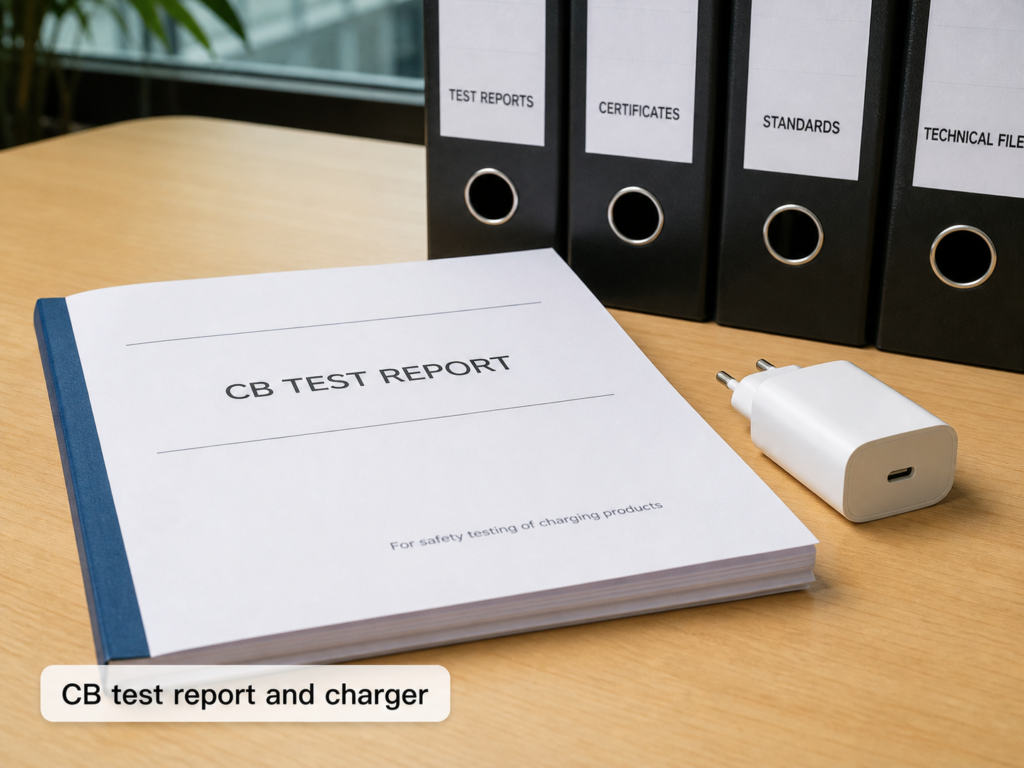
Simply put, CB is **the “universal report card for international safety tests” issued by the IECEE CB System (an electrical safety mutual recognition system participated in by many countries around the world)**, and it is the basis for mutual recognition of test results among member countries.
It should be noted that **the CB test certificate is the official document of the CB System; when applying for certification of the target country, the accepting body usually also requires a complete CB test report to verify the model, key components, standard version, and national differences.** Its coverage is not unlimited; it must be subject to the product category, adopted IEC standard, specific model, and test scope listed on the certificate. If it exceeds the scope, it cannot be used. Its core function is to reduce repeated testing of IEC standard items listed in certificates and reports among member countries, so that there is no need to test from scratch in every country. The IECEE CB System may also cover some EMC standards within the applicable scope, depending on the standards listed in the CB certificate and report, as well as the authorization scope of the body.
2. “CB Certification Conversion” Is Not Direct Certificate Replacement
Many people think that CB is a “globally universal certification” and that you can directly exchange it for certificates of various countries once you get it. This is the biggest misunderstanding.
The so-called CB certification conversion **essentially means using the CB report to offset the test items already covered by the target country, and then obtaining local compliance documents after supplementing the local unique difference requirements.** CB is mainly used to prove the safety requirements covered by the IEC standards listed in its certificate and report; the IECEE CB System may also cover some EMC standards within the applicable scope. Whether a certain CB document includes EMC items shall be subject to the certificate, report, and requirements of the target country; even if the report includes relevant EMC items, it is usually still necessary to complete the EMC compliance assessment required by the target market. As for access requirements such as radio frequency, energy efficiency, and environmental protection, they may also need to be done separately.
As for how much money and time can be saved, there is no fixed ratio. It depends on the size of the target country’s differences, whether the standard version matches, whether rectification is required, whether factory inspection is needed, and whether the body’s schedule is tight. You cannot arbitrarily say “save half”.
3. Which Situations Are Suitable for CB Certification Conversion
CB is not cost-effective in all scenarios. Usually, CB has the highest cost-performance ratio in the following three types of situations:
• Cross-border sellers and foreign trade purchasers of charging products who are laying out 3 or more overseas markets at the same time;
• Those who already have a valid CB report and need to quickly launch new overseas platform sites;
• Those who want to reduce the testing cost and time cost of multi-country compliance and do not want to do a full set of tests separately for each country.
4. The 3 Most Common Misconceptions for Beginners
Here we will first nail down the most common wrong cognitions to avoid detours later:
First, **CB ≠ a global universal sales certificate**. Even for CB member countries, it is necessary to judge whether conversion is possible based on product category and national differences; not all products can use it.
Second, most countries require obtaining local compliance documents (either official certificates or self-declaration of conformity) before legal marketing. CB is only part of the application materials and cannot be directly used for sales.
Third, only in very few special scenarios such as customs clearance and filing can CB be used temporarily for assistance. For formal sales, all local compliance requirements must be completed.
II. CB Utilization Paths for Charging Products in Major Markets
First, a core premise: **No single CB can be exchanged for all global certificates, and CB member state status does not mean automatic certification conversion**. The following is a compilation of common utilization paths for charging products (chargers, data cables, power adapters, etc.). The final result must be subject to the written confirmation of the local accepting body and the current mandatory catalog.
Asia-Pacific Region
China
Products within the CCC mandatory catalog can apply for conversion with a CB; regulatory requirements for products such as USB cables and passive accessories are relatively special and require separate verification. Among charging products, most wall-plug mains adapters fall within the mandatory CCC scope, and CB can be used to convert to CCC.
Supplementary requirements: It is necessary to supplement difference tests for Chinese standards, provide Chinese labels and manuals, and factory inspections are required in some cases.
The latest requirements can be verified through the official website of CNCA and CCC certification bodies.
Japan
Products subject to the can apply for PSE certification with a CB; USB cables and passive accessories shall be verified according to product classification to confirm whether they are within the regulatory scope. For charging power adapters, it is necessary to determine whether they are regulated electrical appliances and whether diamond-shaped or circular PSE applies based on METI’s specific product name, structure, and rated parameters, and cannot be judged solely by the name of “charger” or “adapter”.
Supplementary requirements: Supplement difference tests for Japanese standards, provide Japanese labels and manuals, and complete filing with the Ministry of Economy, Trade and Industry.
Verification can be done through the official website of Japan’s Ministry of Economy, Trade and Industry and PSE certification bodies.
South Korea
Products within the KC safety supervision scope can apply with a CB; passive data cables and purely mechanical accessories do not need KC. For charging products, safety and EMC requirements shall be verified first, and those that meet the requirements can be converted to KC.
Supplementary requirements: Supplement difference tests for Korean standards, conduct additional EMC tests if necessary, and provide Korean labels.
Verification can be done through the official website of the Korea Agency for Technology and Standards (KATS) and KC certification bodies.
Australia/New Zealand
For chargers with mains input, CB can be used to support electrical safety compliance; low-voltage cables require separate verification of regulatory requirements. Australia shall determine registration, certificate, and RCM requirements according to the EESS product scope and risk level; New Zealand shall determine approval, SDoC, and labeling requirements according to its electrical product safety system.
Supplementary requirements: EMC responsibilities and labeling requirements must also be verified according to the respective rules of Australia and New Zealand. Not all charging products need to complete registration according to Australia’s EESS or must use the RCM mark.
Verification can be done through the official website of Australia’s EESS and the official website of New Zealand Energy Safety Service.
Taiwan, China
Products within the BSMI regulatory catalog can apply with a CB; accessories shall be verified according to classification for the regulatory scope. If charging products are within the mandatory catalog, they can be converted to BSMI certification.
Supplementary requirements: Supplement difference tests for Taiwan standards and provide Chinese labels.
Verification can be done through the official website of the Bureau of Standards, Metrology and Inspection (BSMI) of the Ministry of Economic Affairs of Taiwan.
Southeast Asia
The competent authorities, mandatory catalogs, and labeling requirements of Southeast Asian countries vary greatly, and must be confirmed country by country, and cannot be generalized. Currently, within the regulatory catalogs of Thailand’s TISI, Malaysia’s SIRIM, and Singapore’s PSB, most charging products can apply with a CB; ordinary chargers in Vietnam are verified according to safety regulations, and wireless products are under the jurisdiction of MIC.
Specific requirements can be verified through the official websites of national regulatory authorities and local certification bodies.
European Region
EU/European Economic Area
The CB report can be used to support the technical documents of the LVD (Low Voltage Directive, the EU’s electrical safety regulation); the applicability of low-voltage USB cables and accessories requires separate verification. Mains adapters for charging usually meet the applicable scope of the LVD, but it should be noted that **CE is a self-declaration mark, and there is no such thing as an official “CE conversion certificate”**. CB is only a supporting material in the technical documents.
Supplementary requirements: EMC testing, RoHS compliance, and energy efficiency testing are also required, and the EU Declaration of Conformity (DoC) and complete technical documents shall be compiled.
Verification can be done through the EU EUR-Lex regulation database and accredited notified bodies (if required).
United Kingdom
CB can support the safety part of the UK’s low-voltage electrical regulations, and low-voltage accessories require separate verification. The core of compliance for charging products is self-declaration of conformity and technical documents, and there is no mandatory unified UKCA certificate.
Supplementary requirements: It is necessary to meet EMC compliance, compile the UKCA DoC and technical documents, and provide English labels.
Current requirements can be verified through the UK Office for Product Safety and Standards (OPSS), the UK Department for Business and Trade (DBT), relevant regulation databases, and accreditation body channels.
Switzerland
CB can support the safety compliance of low-voltage electrical products, and low-voltage accessories require separate verification. Switzerland’s SEV mark is voluntary, and it is necessary to verify the requirements of low-voltage regulations, conformity documents, and local responsible entities.
Supplementary requirements: A local responsible entity is required, a declaration of conformity shall be compiled, and multilingual labels shall be provided.
Verification can be done through the official website of the Swiss Federal Energy Office (SFOE).
Norway/Iceland/Liechtenstein
These three countries follow the logic of the EU CE. CB can support the safety part of the LVD, and the accessory rules are consistent with the EU. Charging products need to comply with the corresponding CE regulations, and some countries have additional local registration requirements.
Supplementary requirements: Consistent with EU requirements, plus local registration requirements (if any).
Verification can be done through the official websites of the corresponding national regulatory authorities.
Russia/Eurasian Economic Union
CB can only be used as reference material for EAC certification, **and cannot be directly converted**. Charging products need to be re-evaluated according to local technical regulations to complete EAC certification.
Supplementary requirements: It is necessary to determine whether to adopt EAC declaration or certificate, test evidence requirements, whether production audit is required, and Russian-language documents according to applicable technical regulations, product lists, and certification schemes; overseas manufacturers usually need to be handled by applicants or authorized representatives within the Eurasian Economic Union.
Verification can be done through the official website of the Eurasian Economic Commission.
Americas Region
United States
CB can be used as the basis for NRTL (Nationally Recognized Testing Laboratory, regulated by OSHA) listing to reduce safety testing; low-voltage cables have no mandatory NRTL requirements. It should be noted that there is no unified mandatory safety certification at the US federal level, but state/local regulatory agencies, e-commerce platforms, and large retailers usually require NRTL listing.
Supplementary requirements: It is necessary to supplement difference tests for North American standards, meet labeling requirements, and conduct factory inspections according to NRTL requirements.
Verification can be done through the official website of US OSHA (to check the NRTL directory) and the official websites of various NRTL bodies.
Canada
CB can be used as the basis for safety certification, and is usually linked with US NRTL; accessories shall be verified according to provincial requirements. Charging products shall be verified according to provincial electrical safety supervision and the rules of accreditation bodies.
Supplementary requirements: Supplement difference tests for Canadian standards and provide bilingual labels in English and French.
Verification can be done through the official website of the Canadian Standards Association (CSA) and provincial electrical regulatory authorities.
Mexico
Products within the NOM regulatory catalog can apply with a CB; accessories shall be verified according to classification for the regulatory scope. If charging products are within the mandatory catalog, they can be converted to NOM certification.
Supplementary requirements: Supplement difference tests for Mexican standards, provide Spanish labels, and have a local representative.
Verification can be done through the official website of the Mexican Ministry of Economy and NOM certification bodies.
Brazil
Products within the INMETRO regulatory catalog can use CB to reduce some tests; accessories shall be verified according to classification. Charging products need to be processed if they are within the mandatory catalog, and some products require local testing.
Supplementary requirements: Some items require local testing, Portuguese labels are provided, and factory inspection is required.
Verification can be done through the official website of Brazil’s INMETRO.
Argentina
Products within the S-Mark regulatory catalog can apply with a CB; accessories shall be verified according to classification for the regulatory scope. If charging products are within the mandatory catalog, they can be converted to S-Mark.
Supplementary requirements: Supplement difference tests for Argentine standards and provide Spanish labels.
Verification can be done through the official website of Argentina’s IRAM.
Middle East/Africa Region
Saudi Arabia
Products within the IECEE control list can apply for a recognition certificate with a CB; accessories shall be verified according to the list. The applicability of charging products shall be subject to the control list and the requirements of the SABER customs clearance system.
Supplementary requirements: It is necessary to register in the SABER system, provide Arabic labels, and have a local representative.
Verification can be done through the official website of Saudi SABER and the official website of SASO.
United Arab Emirates
Products within the regulatory catalog can apply for safety certification with a CB; accessories shall be verified according to classification. Charging products shall be verified for access requirements by category, and EQM is not a universal mandatory certificate.
Supplementary requirements: Supplement local standard difference tests, provide Arabic labels, and complete local registration.
Verification can be done through the official website of the Emirates Authority for Standardization and Metrology (ESMA).
Other GCC Countries (Qatar/Kuwait/Bahrain, etc.)
These countries require country-by-country verification of regulatory catalogs and CB recognition rules, and cannot be judged generally. Charging products shall be verified one by one according to the safety certification requirements of each country.
Supplementary requirements: Each country may impose requirements on difference testing, importer or local registration, and Arabic or bilingual labels, but shall be confirmed item by item according to the target country, product category, and current mandatory catalog.
Verification can be done through the official websites of the corresponding national regulatory authorities.
South Africa
Products within the SABS/LOA regulatory catalog can apply with a CB; accessories shall be verified according to classification for the regulatory scope. If charging products are within the mandatory catalog, they can be converted to LOA authorization.
Supplementary requirements: Supplement difference tests for South African standards, provide English labels, and have a local representative.
Verification can be done through the official website of South Africa’s SABS.
3 Reliable Channels for Quick Query
If the market you want to enter is not mentioned above, or if you want to confirm the latest requirements, you can query through these three channels:
1. Check the official CB System member state directory of IECEE to confirm whether the target country belongs to the CB System;
2. Check the compliance requirement page of the target sales platform, such as the rules of Amazon’s various sites. The platform’s requirements are often more specific than local regulations;
3. Directly provide your CB report, product category, and target country to the certification body and apply for pre-verification, which is the most accurate way.
A special reminder: A country joining the CB System does not mean that all charging products can be converted. The final result depends on whether the product category matches and whether the standard version is consistent.
III. How to Judge Whether Your CB Can Be Used for Certification Conversion
Now that you know which markets can use CB, the next thing to judge is: Can the CB report in your hand actually be used for certification conversion? This needs to be verified from multiple dimensions such as the document itself, product matching degree, and target country requirements.
1. First Verify the 8 Core Fields of the CB Document
When you get the CB report, first look at these fields. If any one does not match, it must be submitted to the accepting body for evaluation, and you cannot make a decision on your own:
• **Certificate number**: It is the unique identifier of the CB, which can be verified for authenticity on the IECEE official website; fake reports are completely useless;
• **NCB (National Certification Body)**: That is, the body that issues the CB certificate, which should be a body within the IECEE System and accredited within the relevant product category and standard scope; the target country’s accepting body will then decide whether to accept it;
• **CBTL (CB Testing Laboratory)**: That is, the laboratory that conducts the test, which should be authorized by IECEE within the relevant product category and standard scope; items beyond the authorization scope need further confirmation by the accepting body;
• **Applicable IEC standards and versions**: When the standard version is old, it cannot be simply assumed that it cannot be used. The version adopted by the target country and transition requirements shall be verified, and supplementary evaluation or testing shall be carried out if necessary;
• **National difference coverage**: You should check the CBTR, National Differences related appendices or attached reports, and cannot assume that the report has covered all national differences;
• **Model and rated parameters**: Models and parameters not listed in the report cannot be directly applied;
• **Key components and structure list**: For core components such as transformers, fuses, and PCBs, if there are changes, safety needs to be re-evaluated;
• **Applicant/manufacturer/factory information and revision records**: The relationship between this information and the product to be certified shall be verified, and the right to use the report, certificate or DoC holder qualification, and factory consistency shall be confirmed according to the target country’s procedures; when the subject changes, holder authorization, new application, or change evaluation may be required.
2. Three Basic Requirements for a Valid CB Report
To sum up, a valid CB report must meet all of the following:
• Issued by an IECEE-recognized CBTL, with the CB test certificate issued by the corresponding NCB;
• The product category and standard version match the product you want to convert and the requirements of the target country;
• Hold both the CB test certificate + complete test report (including all appendices, difference pages, and key component lists).
3. The Product Must Be Within the CB Coverage Scope
The product to be converted must completely fall within the coverage scope of the CB report. If there are the following changes, be sure to submit to the body for difference evaluation, and absolutely cannot apply it just because you feel it is “almost the same”:
• Changes in model, rated input/output parameters, for example, a 20W CB cannot be used to convert a 65W product;
• Changes in plug/pin specifications, PCB, transformer, fuse, Y capacitor, and shell flame retardant grade;
• Changes in cable specifications, interface types, and E-Marker chips (if any);
• Changes in label and manual content.
Even for products of the same series, they must be explicitly listed in the model list of the report, and a CB cannot be shared just because of similar appearance.
4. Differences of the Target Country Must Be Compensable
Not all differences can be supplemented. The following are common types of compensable differences:
• **Pin specification differences**: As long as they meet the size and safety requirements of the target country, just supplement the corresponding test items;
• **Voltage/frequency differences**: As long as the CB test covers the grid parameters of the target country (such as 120V 60Hz), it is okay; if not covered, just supplement the test;
• **Special safety requirements**: For differences such as USB-C fast charging, flame retardancy, temperature rise, and protection functions, the accepting body shall assess whether the requirements can be met through supplementary testing, document review, key component changes, or re-type evaluation; it cannot be assumed that they can be solved only by supplementary testing;
• **Label/manual differences**: Just redo them according to the target country’s language, warning content, and mark position requirements.
5. You Must Have the Legal Right to Use the CB
Many procurement friends easily overlook this point: the CB report has a holder, and you cannot use it just because you have the paper version.
• If you purchase finished products, you need the original supplier to issue a legal use authorization for the CB report, otherwise you cannot use the report to apply for your own certificate;
• If the brand or manufacturer changes, the right to use the report, certificate or DoC holder qualification, and factory consistency shall be confirmed according to the target country’s procedures, and holder authorization, new application, or change evaluation may be required;
• If the production factory changes, the validity of the report must be re-evaluated, and it cannot be directly used, because the production process and quality control level of different factories may be different.
Quick Self-Check List
You can quickly self-check against the following 8 items. If all are met, the feasibility of certification conversion is relatively high, and you can further find a body for confirmation:
1. The CB certificate + complete report are complete, issued by an accredited CBTL and issued by an NCB;
2. The product to be converted is within the category and model scope covered by the CB report;
3. The IEC standard version adopted by the CB is a valid version recognized by the target country’s accepting body;
4. The difference items of the product have been initially sorted out and can be submitted to the body for evaluation;
5. Prioritize verifying whether the target country’s accepting body accepts the CB document according to the CB System or its own national procedures; even if the target country is not a CB member or does not provide CB certification conversion, you can also ask whether it accepts CB as part of the technical evidence;
6. Have obtained the legal use authorization of the CB report (scenario of purchasing finished products);
7. Can cooperate to complete requirements such as difference testing and material supplementation;
8. Have initially confirmed that the target sales platform accepts the corresponding compliance documents.
IV. CB Adaptation Rules for Segmented Charging Products
The above are general rules, but there are many segments of charging products, and the adaptability of different products is different. Don’t apply the wrong one.
1. AC Power Adapters (Charging Heads with Mains Input)
When purchasing, you should ask the supplier for: CB certificate + complete report, key component list, product specification sheet, and use authorization letter.
Special reminder: It does not cover all power and all pin versions by default, nor can it be directly converted to certifications of all member countries.
2. Car Chargers
Car chargers have low-voltage input (12V/24V cigarette lighter), so it is necessary to first verify whether they are within the coverage of the corresponding IEC standard. Not all CBs include automotive products. It is also necessary to separately verify according to the target country’s automotive electronics, EMC and other requirements.
When purchasing, ask for: CB report of the corresponding product category, input and output parameter description.
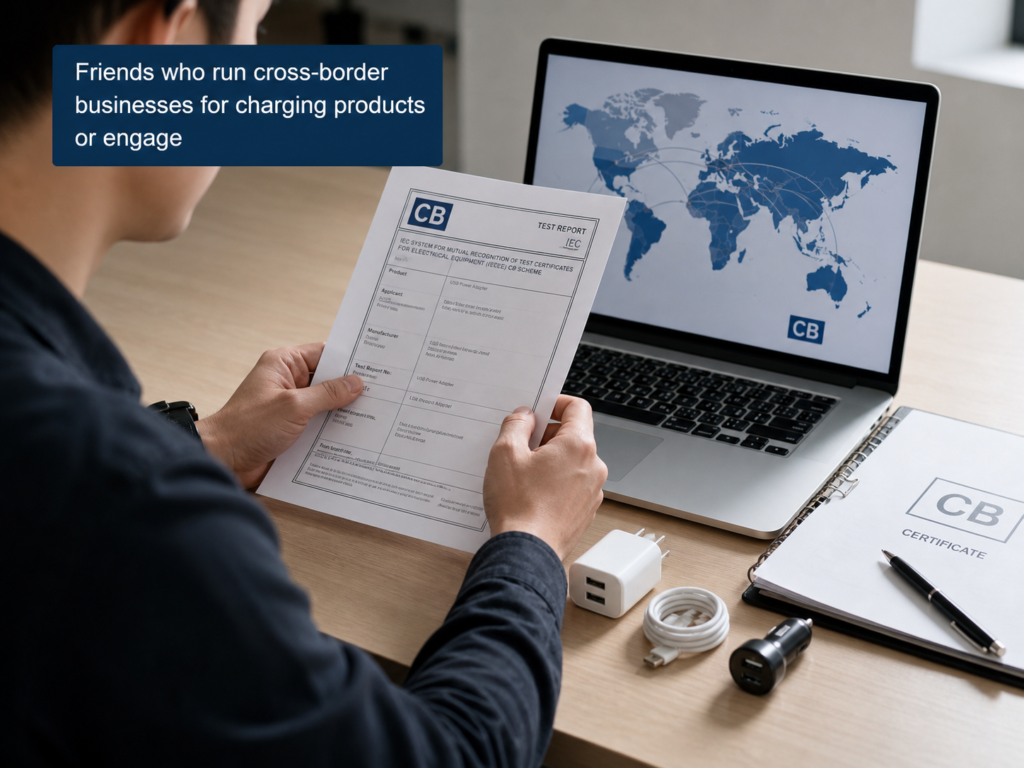
Special reminder: Car chargers cannot share the same CB report with mains adapters, and not all countries have mandatory certification requirements for car chargers.
3. USB/USB-C Charging Cables/Data Cables
The situation of this type of product is quite special: passive USB cables usually do not necessarily require independent safety certification; if they are part of an adapter set, it shall be verified whether they are already within the scope of accessories or key components of the adapter report, or whether the target country requires separate evaluation according to cables, components or other categories. Whether independent CB documents can be used depends on the specific product and applicable standards. Some countries have separate regulatory requirements for cables with fast charging and data functions, which need to be verified separately.
When purchasing, ask for: If the cable has an independent CB, ask for the independent report; if it is a set accessory, confirm whether it is within the CB coverage of the adapter.
Special reminder: Having a CB for the charger does not mean that you can convert the certification of the cable; fast charging cables do not necessarily need to be converted via CB, depending on the regulatory requirements of the target country.
4. Adapter + Cable Sets
If sold as a set, it shall be verified whether the adapter and supporting cables have been covered by the CB report as product components, accessories or key components; if not covered or the product differences are large, supplementary evaluation shall be carried out according to the requirements of the target country. It cannot be automatically assumed that the entire set is covered just by the adapter’s CB. Each component of the set must meet the corresponding regulations separately, and the labeling must also meet the requirements for set sales.
When purchasing, ask for: Complete CB report corresponding to the set, and component list.
Special reminder: Having a CB for the adapter does not mean that the entire set can be converted; if the cable is sold separately, the set’s CB cannot be used.
5. Wireless/Communication-Enabled Charging Devices
Charging devices with Bluetooth, WiFi, cellular or other radio transmitting modules need to be separately verified and meet applicable radio regulations, as well as applicable EMC, energy efficiency and other requirements. Whether wireless chargers are subject to FCC equipment authorization, CE RED or KC radio requirements shall be judged country by country according to their working mode, frequency band, power and communication functions, and cannot be generally judged just because the name contains “wireless charger”.
When purchasing, ask for: CB report for the safety part, test report for the wireless part (if any).
Special reminder: Having a CB does not mean meeting all access requirements, and compliance with wireless communication functions and other applicable regulations must be confirmed separately.
6. Charging Adapters/Connector Accessories
Active live accessories (such as adapters with circuits) require corresponding CB support; passive accessories do not necessarily require independent certification, but plugs, conversion plugs, sockets, connectors and cable assemblies may be products separately regulated by the target country, which shall be verified according to whether they contact mains electricity, rated parameters, product structure and local catalog.
When purchasing, ask for: Corresponding CB report for active accessories, product function description.
Special reminder: Not all adapters can be converted via CB, and passive accessories do not mean there are no regulatory requirements at all.
V. Full Practical Process of CB Certification Conversion
If you have confirmed that the CB in your hand can be used, how should you operate it specifically? Just follow the steps below.
Step 1: First Judge Whether Using CB Is Cost-Effective
You can sort it out by yourself according to this decision tree first:
1. First look at the product type: products with mains input follow the electrical safety CB path, and low-voltage products (such as car chargers, cables) first verify the applicability of low-voltage standards;
2. Then look at additional functions: those with wireless, Bluetooth, WiFi need additional wireless compliance, and CB only covers safety;
3. Then look at the sales form: if sold as a set, confirm that all components are within the CB coverage;
4. Then look at the target country requirements: for those within the mandatory certification catalog, verify whether CB is recognized by the local accepting body;
5. Then look at the platform requirements: also meet the additional compliance rules of the target sales platform;
6. Comprehensive judgment: If all the above are met, you can apply for a pre-evaluation to see the specific cost and cycle.
Step 2: Initial Screening to Eliminate Obvious Non-Conformities
Check item by item against the previous quick self-check list, and first eliminate obvious non-conforming situations, such as incomplete CB report, product out of scope, no use authorization, etc., to avoid wasting time.
Step 3: Core Link – Apply for Written Pre-Assessment
This is the most critical step. Don’t make random judgments by yourself. Directly find the accepting body or authorized channel of the target country, submit CB documents and product materials, and apply for a written pre-assessment. Be sure to get written confirmation to avoid oral promises not counting later.
The following things should be confirmed clearly in the pre-assessment:
• Whether they recognize the standard version of your CB, and the qualifications of the NCB and CBTL;
• Which national difference test items need to be supplemented, and what materials need to be prepared;
• Whether local testing, factory inspection, local agent or importer are needed;
• What are the holder requirements for the certificate/DoC, and what are the label language requirements;
• What are the estimated cost and cycle, and whether there are subsequent supervision requirements (such as annual audit).
Step 4: Prepare Application Materials
After the pre-assessment is passed, you can prepare the formal application materials, which usually include the following categories:
• Basic materials: CB test certificate and complete test report can usually be provided in English, but you should confirm with the target country’s accepting body whether you need to submit local language translations, abstracts or other translation materials, and product specification sheets;
• Difference materials: product difference description (if there are changes), samples for difference testing (if needed);
• Local compliance materials: labels/manuals in the target country’s language, local agent/importer information (if required);
• Procurement supplementary materials: CB use authorization letter issued by the supplier, key component list.
Step 5: Submit Application and Obtain Certificate
Submit the application according to the requirements of the body, and cooperate to complete difference testing and document review. After passing the review, you will get a local certification certificate, or supporting documents for the Declaration of Conformity (DoC).
Here we emphasize again: For self-declaration compliance such as CE and UKCA, you need to compile technical documents and DoC yourself. CB is only a supporting material among them, and there is no such thing as “exchanging CB for a CE certificate”.
Step 6: Distinguish Between Platform Listing and Customs Clearance Requirements
Many people confuse the requirements of platforms and customs. In fact, they are two different things and cannot replace each other. They need to be prepared separately:
• Platform audit usually requires: local certificate/DoC, test report, product label pictures, model correspondence, manufacturer information;
• Materials required for customs clearance vary by importing country, product, tariff preference and regulatory status, and may include importer information, conformity documents, commercial documents, and certificate of origin when applicable; they shall be subject to the requirements of the importing country’s customs and product regulatory authorities.
Maintenance Points After Obtaining Certificate
Getting a certificate is not once and for all. You also need to pay attention to the following points:
• If the product structure or key components change during the validity period, you must report to the body for re-evaluation, and cannot continue to use it after changing it by yourself;
• The model and manufacturer information in the platform listing documents must be exactly the same as the actual product, otherwise the product will be delisted;
• Regularly pay attention to the target country’s standard updates and regulation transition arrangements, and prepare for renewal or change in advance.
Communication Checklist for Procurement Scenarios
If you are looking for suppliers to purchase products, when communicating with suppliers and certification bodies, you can directly ask for information according to this list, and nothing will be missed:
• Ask the supplier for: CB certificate + complete report (including all appendices), product specification sheet, key component list, use authorization letter;
• Confirm with the certification body: CB recognition, difference items, cycle and cost, certificate holder, change rules, platform/customs clearance adaptability.
VI. Pitfall Avoidance Guide: 90% of People Have Made These Mistakes
High-Frequency Conversion Judgment Errors
1. **Misconception 1: CB member state = inevitable conversion**. Reality: Whether to accept, the type of conversion, and supplementary test requirements are determined by the target country’s NCB, product category, and standard version. Not all products can be converted just because the country is a CB member.
2. **Misconception 2: Charger CB can be directly converted to cable/adapter certification**. Reality: CB has a clear product scope, and uncovered categories cannot be applied. The charger’s CB only covers the charger.
3. **Misconception 3: CB certification conversion requires no testing at all**. Reality: Conversion may require supplementary national difference testing, document review, or label and structure adjustments; if the CB report has covered relevant national differences and the product is consistent, the target body may not require new tests. The specific result shall be subject to the evaluation of the accepting body.
4. **Misconception 4: Only holding the first page of the CB certificate is sufficient for use**. Reality: All core fields of the complete report need to be checked, and those with missing pages or mismatched information cannot be used.
5. **Misconception 5: Models with similar appearance can apply the CB**. Reality: Changes in power, pins, key components, etc. may exceed the coverage scope, and must be submitted to the body for evaluation.
6. **Misconception 6: No evaluation is required when changing factory/brand/key components**. Reality: Changes in production factories or core components may make the existing CB report no longer cover the actual product, or affect the validity of the local certificate; change evaluation, revision, supplementary testing or new application shall be carried out according to the procedures of the CB certificate holder and the target certification body.
7. **Misconception 7: CB can be submitted to the platform as a CE/UKCA certificate**. Reality: CE and UKCA are self-declaration systems, and there are no official certificates. CB cannot replace the DoC, technical documents and compliance with all applicable regulations required by CE/UKCA; however, whether the platform accepts CB certificates or reports as test certificates, supporting documents or upload materials shall be subject to its specific rules.
8. **Misconception 8: Prepare documents for markets such as Saudi Arabia/Australia based on old experience**. Reality: The regulatory catalogs and regulations of various countries are constantly updated. You must check the latest official requirements and cannot rely on old experience.
Common Scenario Applicability Judgment
Here are the 5 most frequently asked scenarios, you can directly match them:
1. **Already have CB for the EU market**: It can support CE-LVD compliance (if it meets the voltage range of the LVD), but it also needs to meet EMC, RoHS, energy efficiency and other regulations, compile the EU DoC and technical documents. There is no such thing as “converting to a CE certificate”.
2. **Already have CB for the Japanese market**: Power adapters that meet the classification requirements can apply for PSE with CB, reducing safety tests; it shall be judged according to the and METI’s specific product name, structure, and rated parameters, confirm whether diamond-shaped or circular PSE applies, and accessories such as cables need separate verification.
3. **Already have CB for the Korean market**: Products within the KC safety supervision scope can apply with CB, reducing safety tests; safety, EMC, and RF requirements shall be verified according to product category, and passive accessories do not need KC.
4. **Already have CB for the Saudi market**: Products within the IECEE control list can apply for a recognition certificate with CB; they need to access the SABER customs clearance system, and specific requirements are subject to the latest control list.
5. **Already have CB for the Chinese market**: Products within the CCC mandatory catalog can apply for conversion with a compliant CB; it is necessary to check the latest CCC catalog, NCB qualification, and supplement Chinese difference tests.
Conversion vs Direct Local Certification: How to Choose?
Not all situations are suitable for CB conversion. Here is a simple judgment standard for you:
• **Prioritize CB conversion**: When laying out 3 or more target markets at the same time, the CB is valid and matches the product, and there are few product differences. In this way, more money and time can be saved;
• **Prioritize direct local certification**: When only doing 1 target market, the CB version is expired/the product does not match, and the difference test cost is close to that of a new certification. In this way, doing it directly is more cost-effective.
Final Verification Checklist for Listing/Export
Finally, here is a final verification checklist. Check it before shipment and listing, and there will basically be no major problems:
1. The product model, classification, and rated parameters completely match the coverage scope of the CB report;
2. The applicable regulations and mandatory certification catalog of the target country have been verified through official channels;
3. The IEC standard version adopted by the CB is recognized in writing by the target country’s accepting body;
4. The difference test items, costs, and cycles that need to be supplemented have obtained written confirmation from the body;
5. Local certification certificate/Declaration of Conformity (DoC) and technical documents are complete;
6. Product labels and manuals meet the target country’s language, labeling, and warning requirements;
7. Local importer/responsible entity information has been implemented (if required by the target country);
8. The upload materials required by the target sales platform have been prepared completely and comply with the rules;
9. The consistency of key components and structure between mass-produced products and CB test samples is guaranteed.
Overall, the CB report is a “universal key blank” for multi-country compliance – it can help you skip repeated basic safety tests, but whether it can open the door to the target market depends on whether the product, standards, and differences match, and whether local special requirements are supplemented. Don’t deify CB, nor waste its value. Self-checking in advance and finding a professional body for pre-assessment are the keys to using CB correctly and effectively.