
For friends in the cross-border charging product business, when encountering certification renewal issues for the first time, they will most likely search “how long before certificate expiration do I need to renew”. But you won’t find a unified answer even after going through all regulations — because the rules for different types of compliance documents vary greatly: some clearly state the expiration date, some don’t even mark a validity period but are not permanently valid, and some are declarations issued by the enterprise itself, which cannot be called “renewal” at all.
Here are two core conclusions first, for friends in a hurry:
First, there is no unified statutory renewal period applicable to all charging products; the specific period shall be determined according to the document type and rules.
Second, if you hold a certificate with a clear expiration date, you can set “start verification 6 months before expiration, confirm renewal path 3 months before expiration, complete document and platform updates 1 month before expiration” as a conservative procurement SOP reference within the enterprise, rather than an industry-wide or statutory baseline. The specific start time still needs to be calculated backward based on the certificate term, institution requirements, product changes, testing or rectification cycle, sales plan, and platform time limit. For documents without a fixed expiration date, validity needs to be maintained according to supervision requirements, change situations, and authorization rules.
Next, we will sort through everything from the beginning, explaining the rules of different documents, how to calculate the time, and how to avoid pitfalls. After reading this, you will be able to accurately calculate the start time on your own and avoid the pitfall of compliance gaps.
First, Understand 4 Easily Confused Basic Concepts
Many people who are new to compliance treat “annual audit” and “recertification” as “renewal”, but they are completely different things. Let’s clarify the concepts first so that we won’t get confused later:
• **Narrow-sense renewal**: Refers to applying for an extension of the validity period before a certificate with a clear validity period expires. As long as the product and applicable standards have not changed, the process is much simpler than applying for a new certificate.
• **Annual audit/factory follow-up**: It is a routine supervision where the certification body verifies production consistency according to continuous supervision, factory inspection, fee, and change control rules, not renewal. The inspection frequency, whether sampling is required, and fee arrangements shall be subject to the specific institution, product category, and contract or follow-up service procedures, and cannot be uniformly understood as “an annual audit once a year”.
• **Recertification**: When a product or standard undergoes major changes and the original certificate can no longer cover it, the full process must be followed to re-apply, which is equivalent to doing a new certification.
• **Test report**: It is only the test result of a single sample submission, and usually has no unified statutory expiration date. However, it can only be used as technical evidence when the covered samples, models, configurations, applicable regulations, and test basis are still applicable, and the product remains consistent. After changes in regulations, standards, products, key materials, production conditions, or platform requirements, it is necessary to re-evaluate whether the report is still usable, and conduct supplementary testing or updates if necessary.
5 Types of Compliance Documents With Completely Different Maintenance Rules

To judge how to maintain a document, you cannot only look at the certification mark printed on it; you must make a comprehensive judgment combined with the terms of the issuing body, product scope, target market regulations, and requirements of the listing platform. Common compliance documents for charging products can be divided into 5 categories according to their maintenance mechanisms:
| Category | Core Feature | When Maintenance Is Required | Common Examples for Charging Products |
| Category A: Third-party certificates with fixed validity period | Marked with a clear expiration date, application for extension is required upon expiration | Proactively apply for extension before expiration | Some Japanese diamond PSE (specified electrical appliances, subject to the terms of RCAB of Japan’s Electrical Safety and Environment Research Institute), some South Korean KC safety certifications |
| Category B: Supervised safety listings with no fixed expiration date | No fixed expiration date, listing validity must be maintained according to institution rules | During continuous supervision, factory inspections, fee payment, and product change reporting | North American UL, ETL, cTUVus and other NRTL (U.S. Nationally Recognized Testing Laboratory) safety listings |
| Category C: Regulatory self-declarations and supporting technical documents | Compliance commitments issued by the enterprise itself, no fixed validity period from third-party issuance | When products/regulations/standards/responsible entities undergo changes that affect compliance | CE DoC (Declaration of Conformity), UKCA DoC, eligible U.S. FCC SDoC (Supplier’s Declaration of Conformity), Japanese circular PSE |
| Category D: Regulatory equipment authorizations | Equipment authorizations issued by regulatory bodies, validity must be maintained in compliance with regulatory requirements | Re-evaluation/reporting when products change, standards are updated, or regulatory rules are adjusted | Wireless charging/WPT (Wireless Power Transfer) equipment authorizations determined by equipment function and authorization path; communication functions involving Part 15 Certification may correspond to FCC ID |
| Category E: Industry interoperability certifications / trademark licenses | Compliance verification and trademark licenses issued by industry associations, maintained according to association rules | When products change, specifications are upgraded, licenses expire, or membership status changes | USB-IF compliance certification, Qi wireless charging certification (WPC (Wireless Power Consortium) system) |
Regardless of the category of document, you need to verify its validity from two dimensions: first, the status on official channels (such as query results on the institution’s official website or regulatory platform); second, the coverage scope of the document itself (model, parameter, factory, brand). After maintenance is completed, corresponding evidence must also be retained: for Category A, keep the original certificate with validity period and official website query records; for Category B, keep screenshots of valid listings on the official website, factory inspection and payment vouchers; for Category C, keep the declaration of conformity and a full set of supporting technical documents (including test reports); for Category D, keep query records and authorization documents from the regulatory body; for Category E, keep listing records on the association’s official website and trademark authorization certificates.
Common Consequences of Invalid Compliance Documents
Many people think “if it’s invalid, just make it up”, but the cost is not small:
• **Platform side**: May trigger product removal, promotion restrictions, or account penalties, subject to platform rules.
• **Regulatory side**: May be detained by customs, subject to regulatory fines, and shall not use certification marks for publicity in violation of regulations.
• **Supply chain side**: The remedy cycle after invalidation is usually much longer than normal maintenance. Affected by rectification, institution scheduling, and platform rules, it may be delayed for several months.
• **Inventory judgment**: Whether already placed inventory can be sold cannot only depend on the certificate status; it needs to be comprehensively judged in combination with regulatory requirements, product consistency, and platform rules.
How to Calculate the Start Time for Compliance Maintenance

There is no unified statutory advance time. Enterprises can adopt two sets of reference standards internally: one for projects with clear expiration dates or maintenance deadlines, implemented according to the conservative procurement SOP of “6 months for verification → 3 months for path confirmation → 1 month for update completion”; the other is applicable to all projects, calculating the required time backward from the planned sales or restocking listing date.
Critical Path Backward Calculation Method
The core logic of backward calculation is very simple: you need to ensure that all compliance documents are valid when the product is listed or imported, so you need to set aside time for the entire process in advance.
The normal serial process includes: data verification → change determination → sample submission for testing → rectification and retesting → certificate/listing update → platform review → production scheduling switch → transportation and warehousing.
Of course, not all links have to wait for the previous one to be completed: for example, data verification and change determination can be carried out in parallel with supplier sample preparation; platform review can also be partially parallel with production and logistics, which can save a lot of time. To be on the safe side, it is recommended to add a 10%-20% buffer on the basis of the total duration — this is an internal industry experience value, not a commitment from institutions or regulations, after all, no one can say for sure whether there will be temporary problems.
Time References for Three Types of Charging Product Procurement Scenarios
For the procurement of charging products, we can refer to three types of scenarios according to the complexity of changes:
• **No-change scenario** (same model, same factory, same standard): Start 1-2 months in advance. The main work is to verify the document status and follow up with suppliers for payment or cooperate with continuous supervision.
• **Minor change scenario** (non-critical parameter/component change): Start 2-3 months in advance. The first step must be to confirm with the issuing body whether reporting or supplementary testing is required, and you cannot make a decision on your own.
• **Critical change scenario** (power change/main control chip change/factory change/standard upgrade, etc.): Start 3-6 months in advance, and conduct change testing or even recertification as required. For example, if a 65W USB-C charger for the U.S. station changes its main control chip, you must first obtain a written change conclusion from the NRTL institution to confirm whether supplementary testing is required before proceeding with the compliance process. You cannot think “it’s fine as long as the appearance is the same”.
Compliance Check Focuses by Market
Different target markets have different compliance requirements, and the focus of maintenance is also different:
• **U.S. market**: In terms of safety, there is no unified federal requirement that consumer-grade chargers must have NRTL listing, but platforms, large purchasers, or local regulators may have additional requirements; for FCC compliance, first classify according to equipment attributes (Part 15/Part 18/exempt). Ordinary wired chargers generally belong to Part 15 unintentional radiators, and eligible EMC can go through SDoC; wireless charging or wireless power transfer (WPT) equipment requires separate judgment of charging function and communication function. WPT equipment with operating frequency higher than 9 kHz needs to obtain corresponding equipment authorization according to Part 15 and/or Part 18; if information is transmitted between the transmitter and the powered device, the communication function is usually handled according to Part 15 intentional radiator rules, and generally requires Certification, that is, FCC ID. Charging functions only applicable to Part 18 may be eligible for Certification or SDoC, which must be determined according to equipment structure, operating mode, and FCC rules.
• **Canadian market**: Electrical safety rules are formulated by province, and must also be judged in combination with product categories and recognized certification marks. Platforms or customers may also have additional requirements, and U.S. rules cannot be directly applied.
• **EU/UK market**: The core evaluation regulations for ordinary chargers include LVD (Low Voltage Directive), EMC (Electromagnetic Compatibility), RoHS (Restriction of Hazardous Substances), energy efficiency/ecodesign. For those with wireless functions, RED (Radio Equipment Directive) must also be evaluated. Most CE and UKCA are enterprise self-declarations, and there is no such thing as “certificate renewal” at all. Only when products, regulations, or standards change, re-evaluation and update are required. Only special high-risk products require notified body participation, and ordinary charging products do not need to default to requiring a notified body number.
• **Asia-Pacific Japan and South Korea market**: Japanese PSE is divided into diamond and circular types. Diamond PSE belongs to specified electrical appliances, and the validity period and maintenance rules are confirmed according to the specific terms of RCAB; circular PSE corresponds to non-specified electrical appliances, in principle, the business operator confirms conformity by itself, and does not implement the suitability inspection of registered inspection institutions for diamond PSE. After product changes, it is necessary to reconfirm whether it still belongs to the original product category or type, whether it complies with current technical standards, update inspection records, technical materials, and labeling, and fulfill applicable obligations such as notification. South Korean KC is also divided into KC safety certification, safety confirmation, and supplier’s conformity confirmation. Different product categories and certificate terms have different maintenance rules, which shall be subject to the specific instructions on the certificate.
• **Global industry agreement category**: USB-IF, Qi, etc. belong to Category E. It is necessary to focus on verifying the product listing on the association’s official website, trademark license validity period, and specification version. If there is a product change, be sure to confirm the rules with the association in advance.
Key Variables Affecting the Maintenance Cycle
The above times are basic references. In actual operation, they need to be adjusted in combination with several key variables, which is also the core judgment ability from beginner to proficient.
Impact of Product Changes
Many people think “I just changed a small part, no need to tell the institution”, which is completely wrong. The change dimensions that need to be verified include electrical parameters (power, charging protocol), key components, internal structure, production factory, brand, etc.
For third-party certification or supervised listing projects, changes in products, factories, key parts, marks, or brands shall be subject to the change procedures of the certificate holder and the issuing body, and the required written conclusion or approval shall be obtained before implementation: if the institution says the existing certificate can cover it, it can be directly used; if filing is required, follow the institution’s change process; if supplementary testing is required, additional testing time shall be added; if it cannot be covered and a new application is required, calculate according to the cycle of a brand-new certification.
For self-declaration projects such as CE and UKCA, the manufacturer or responsible entity shall conduct a written conformity assessment and update the technical documentation and DoC according to applicable requirements. If necessary, you can entrust a laboratory or conformity assessment body to assist in the assessment, and you cannot directly apply the change process of third-party certification projects to all self-declaration documents.
Impact of Standard/Regulatory/Platform Rule Updates
When encountering rule updates, judge in this order: first confirm the effective date and transition period of the new rules, and whether they cover the charging products you sell; then evaluate whether existing documents can be covered through gap assessment, and whether supplementary testing is required; finally confirm whether the issuing body and target market platform have clearly required the implementation of the new version. In this case, it is recommended to reserve an additional 2-4 months of buffer according to the update magnitude; if there is no transition period and full retesting is required, the time will be longer.
Compliance Judgment of Sales and Inventory
Many people can’t figure out “the certificate has expired, can the previously produced inventory still be sold”? In fact, just ask four questions:
1. What is the product import time and the time of first placement on the market/platform listing?
2. What is the valid status of the compliance document at the corresponding node?
3. Are there any regulatory transition periods, recall/sales ban measures?
4. Does the target platform have additional inventory sales restrictions?
Only when all four conditions are met can the inventory continue to be sold, and you cannot judge that there is no problem only based on the first launch time.
Boundary of Certificate Holder and Authorized Use Right
When verifying a certificate, you cannot only check that the certificate is real; you also need to confirm that the certificate holder, production factory, product model/parameter, and trademark brand are all within the coverage scope.
If the purchaser’s brand, manufacturing location, or sales entity is not covered by the certification, listing, or trademark license document, the certification mark or listing number cannot be used directly. Formal authorizations for brand or private label, manufacturing location, licensee, mark use, etc. shall be handled first according to the rules of the certification body or association. The authorization letter issued by the supplier can only be used as supplementary evidence and cannot replace the formal authorization required by the issuing body, listing directory, or trademark license.
Many people have fallen into this pit: the supplier’s certificate only covers its own brand, but the purchaser sells private label products without completing the brand or mark use authorization according to the corresponding system. This is a violation of the use of certification marks and will be punished if found.
Additional Impacts of Institutions/Platforms/Supply Chains
There are also several easily overlooked external factors:
• **Institution scheduling**: The end-of-year stock-up season, before Black Friday, and the standard switching period are peak seasons for certification. The scheduling of institution testing and audit will be very long, so it is recommended to reserve an additional 1-2 months.
• **Platform/customer requirements**: Requirements may vary for different sites, categories, and power segments. Products such as high-power chargers and wireless chargers are usually subject to stricter reviews.
• **Supply chain cooperation level**: If the supplier has poor cooperation, or you need to replace the supplier, an additional 2-3 months of time shall be reserved.
Overseas Platform Practice: Compliance Document Upload and Appeal
Many people obviously have compliance documents but are still rejected by the platform, mostly because they did not pay attention to upload details or the handling process is wrong.
Platform Document Upload Verification Checklist
Before uploading, you can check against these four points, which can greatly improve the pass rate:
1. **Category matching**: Meet the current requirements of the corresponding site, category, and power segment. For example, the requirements for 65W wireless chargers and 10W wired chargers on the U.S. station may be different.
2. **Information matching**: The product model, manufacturer, and production address on the document must be completely consistent with the listing of the product being sold; even a single letter difference may result in rejection.
3. **Valid status**: Queryable on the official website of the issuing body/association, with valid status, no suspension, revocation, or expiration records.
4. **Document format**: Include necessary parameter pages, test scope pages, stamp/signature pages, and meet the language and resolution requirements of the site.
General Handling Process for Platform Compliance Cases
If you really encounter platform compliance review, follow this process and you won’t get confused:
First, locate the policy, check the specific policy terms that triggered the review and the scope of documents required to be submitted, and don’t randomly upload a bunch of useless materials. Then upload the documents as required to ensure that all information is completely consistent with the listing. After that, pay attention to the supplementary document deadline and supplement missing materials or explanations within the specified time.
The common reasons for failing the review are nothing more than three: information mismatch, invalid/unrecognized qualification, or incomplete document. Just adjust accordingly. If an appeal is required, in addition to compliance documents, you can also supplement materials such as official website query screenshots, authorization letters, and production consistency certificates to improve the pass rate. Finally, be sure to remember that all submitted documents, communication records, and review results must be retained for future reference and not deleted.
Procurement Practice: Implementation Methods for Compliance Time Control
Knowing the rules and time, you also need to implement them into the procurement process, otherwise it is easy to forget things and lead to compliance gaps.
Full Verification Method for Procurement Documents
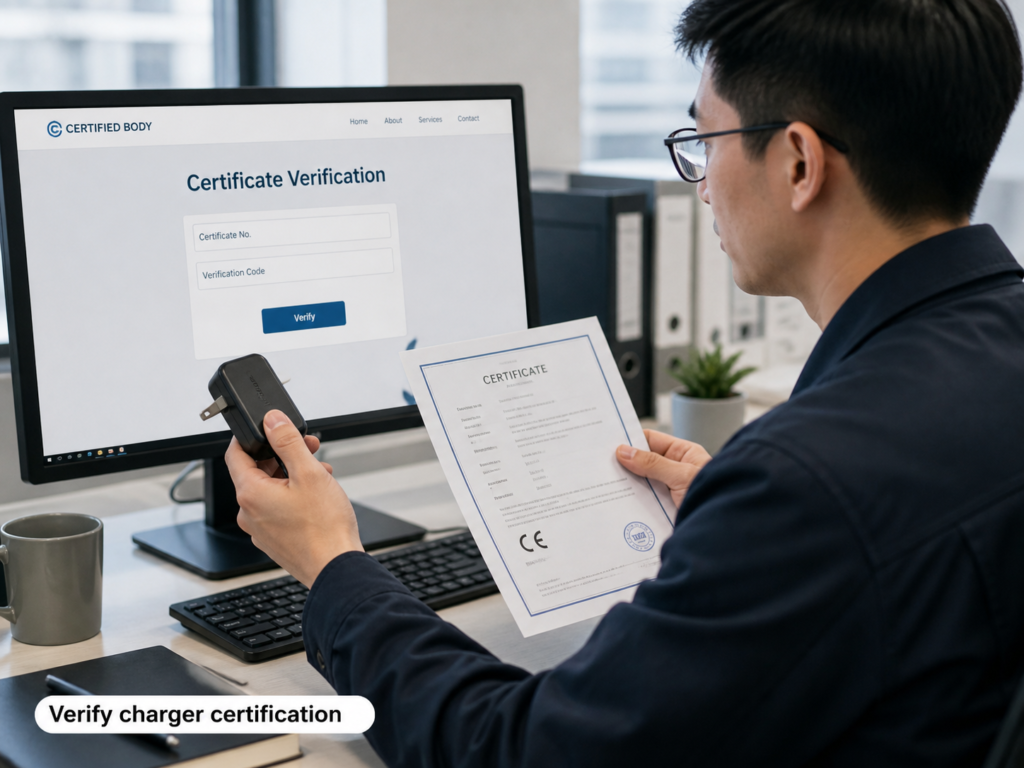
When purchasing, you can’t just trust the scan sent by the supplier; you must conduct full authenticity verification:
• **Authenticity verification method**: Request the document number and check the status through the official website of the issuing body/association. Don’t trust scans or verbal promises.
• **Scope verification**: Check that the product model, rated parameters, and factory address covered by the document are completely consistent with the product to be purchased.
• **Authorization verification**: Confirm the certificate holder and brand coverage scope. If the purchaser’s brand, manufacturing location, or sales entity is not formally covered, handle brand or private label, manufacturing location, licensee, or mark use authorization according to the rules of the certification body or association; the supplier’s authorization letter can only be used as supplementary evidence. For Category E industry certifications, the validity of trademark licenses must also be additionally verified.
• **Traceability verification**: Check the BOM key part version, production batch, label photo, rated parameters, and date code, and sample inspection to confirm consistency with bulk goods.
Finally, organize all materials into a procurement evidence package for archiving, including original certificates/reports or verifiable links, dated official website query screenshots, model parameter pages, label photos, etc.
Batch Procurement Compliance Buffer Period Calculation
If you are stocking up in bulk, especially bulk sea freight goods, you must calculate the compliance buffer period well, otherwise the certificate will expire while the goods are still at sea, and you will be stuck with all the goods. This buffer period **only applies to Category A documents with a clear expiration date**, and the calculation formula is:
Minimum compliance buffer period = inventory sales cycle + platform review reserved time + logistics cycle
Take the conventional sea freight stock-up of charging products as an example: the inventory sales cycle is 6 months, plus 1 month reserved for platform review, plus 1 month for sea freight, then the certificate must have at least 8 months of validity remaining before arranging the production of this batch of goods. This is an internal industry reference value, and the specific adjustment shall be combined with the actual requirements of the platform and customers.
Procurement Contract Compliance Responsibility Agreement
Be sure to write compliance responsibilities into the procurement contract to prevent suppliers from shifting responsibility when issues arise. The core points to be agreed are as follows:
• **Subject and scope**: Clarify the identity of the certification holder and manufacturer, as well as the factory, product model, and parameter scope covered by the compliance document.
• **Delivery and notification obligations**: Suppliers shall provide valid compliance documents before supplying goods; 1-2 months’ written notice is required before changes in standards, factories, or key materials.
• **Cooperation obligation**: When the platform conducts random inspections or customs conducts verifications, the supplier shall promptly provide supplementary materials and cooperate with rectification.
• **Authorization agreement**: Clarify the authorization scope of certificate brand use to avoid authorization disputes in private label sales.
• **Responsibility boundary**: Losses caused by supplier reasons (false documents, over-scope, failure to maintain in time) shall be borne by the supplier.
• **Safeguard clauses**: Agree on verifiable loss calculation methods, the purchaser’s right to suspend shipments, and alternative supply solutions.
Internal Compliance Maintenance SOP
You can build a simple internal compliance maintenance SOP with reminders by time node, which is not easy to miss:
• **Category A (certificates with fixed validity period)**: 6 months before expiration, remind the supplier to confirm the feasibility of renewal and inventory product/factory changes; 3 months before expiration, confirm the renewal progress and request the institution’s acceptance receipt; 1 month before expiration, obtain the new document and complete platform upload and internal ledger update.
• **Category B/C/D/E (documents without fixed expiration date)**: Trigger nodes include annual maintenance date, factory inspection date, membership payment date, standard switching date, and the next batch of bulk goods listing date. Verify the document status 1-2 months in advance to confirm whether an update is required.
• **Change trigger**: As long as the product, factory, or applicable standard changes, immediately start the compliance assessment. Don’t wait until expiration to deal with it, otherwise it is likely to be too late.
Pitfall Guide: 6 Most Common Counter-Intuitive Misconceptions
Time Judgment Misconceptions
1. **Misconception 1: It’s okay to handle it 1 week before expiration** — Wrong. Institution scheduling, supplementary testing, and platform review all take time, which can easily lead to compliance gaps. By the time you get the new certificate, the goods are already stuck in the warehouse and cannot be sold.
2. **Misconception 2: It’s still too late to wait for platform notification to handle** — Wrong. Platform compliance review is dynamically triggered and has no fixed warning time. By the time you receive the notification, the product may have been removed from the shelf.
Rule Cognition Misconceptions
3. **Misconception 3: Documents without an expiration date are permanently valid** — Wrong. For example, Category B UL listing, although there is no fixed expiration date, still needs to be maintained according to the issuing body’s continuous supervision, factory inspection, fee, and change control rules. Inspection frequency, sampling requirements, and fee arrangements vary by institution, product category, and follow-up service procedures, and cannot be simply understood as just “passing an annual audit once a year”.
4. **Misconception 4: Renewal/maintenance definitely does not require testing** — Wrong. Some certifications may require random testing or supplementary testing during renewal or change, and if unqualified, rectification is required. It is not just a matter of paying a fee to renew.
Procurement Practice Misconceptions
5. **Misconception 5: You can use a real certificate casually** — Wrong. The certificate must match the holder, factory, model, and brand at the same time; if the brand, manufacturing location, or sales entity is not formally covered, corresponding authorization must be handled according to the rules of the certification body or association. A unilaterally issued authorization letter from the supplier may not be sufficient, and you may still be punished for illegal use of marks if found.
6. **Misconception 6: Charging products with the same appearance can share certificates** — Wrong. The same appearance does not mean that certification materials can be shared. When there are differences in power, interface, internal structure, or key parts, you must check whether the certificate or listing clearly covers the model and parameters, and confirm according to the issuing body’s rules whether it is a covered variant, requires filing or supplementary testing, or must be newly applied; sharing without confirmation is not allowed.
Quick Self-Check and Summary
Finally, here is a 1-minute compliance maintenance start time self-check list. When encountering problems, go through it first:
1. First determine the document type: is it Category A certificate with validity period, Category B supervised listing, Category C self-declaration, Category D regulatory authorization, or Category E industry license?
2. Are there any changes to the product, factory, or applicable standards? What category does the change belong to?
3. What are the compliance requirements of the target market, platform/customer?
4. What is the planned sales/restocking time? Is it currently the peak certification season?
5. Do the document authorization scope and inventory status meet the requirements?
After going through it, determine the start time according to the three-step decision logic:
Step 1: Confirm the type of compliance document, current valid status, and authorization scope;
Step 2: Evaluate whether there are changes or standard updates, and confirm the required process (verification only/change reporting/supplementary testing/new application);
Step 3: Combine sales plan, inventory status, institution scheduling, and platform review time to calculate the internal start time backward.
After reading this article, you should be able to distinguish 5 different types of compliance documents, and no longer confuse concepts such as renewal, continuous supervision, recertification, and self-declaration; you can also calculate a reasonable compliance maintenance start time on your own according to the type of charging products you sell, target market, and sales plan; you can also verify the validity, coverage scope, and authorization qualification of documents during procurement, and avoid the risk of compliance gaps through contract and node control.