
Many new sellers and purchasers engaged in charger exports will ask as their first reaction: Is there a globally applicable core certification that allows selling all over the world once obtained? Let’s give the answer directly: There is no so-called globally unified core certification — regulatory rules of each country are independent. The specific certifications to obtain must be selected in combination with the market you want to enter, the rules of the target country, and even the sales channel. However, the core priority of all compliance is consistent: electrical safety is always the first priority, and on this basis, requirements such as EMC (Electromagnetic Compatibility), energy efficiency, and labeling are matched.
Core Selection Logic for Two Types of Scenarios
For multi-market layout, the CB system is prioritized, provided that it is confirmed that the target country accepts CB certificate conversion; if you only operate in a single or a small number of markets, it is more worry-free to directly obtain local mandatory certifications plus meet channel requirements.
All the rules we talk about today mainly cover wall-plugged charging products such as conventional USB wall chargers, power adapters, and fast charging heads; car chargers usually use low-voltage DC on-board power input, which may not be applicable to safety regulations or test paths for mains input products; however, it is still necessary to verify applicable requirements such as product safety, EMC, and on-board electrical environment according to the target market and usage scenarios, and it cannot be concluded that safety compliance is not required based on this. As for products with special functions such as wireless chargers, smart chargers, and multi-port GaN chargers, in addition to basic safety, compliance requirements for corresponding functions must be added, for example, wireless chargers require additional wireless charging-related tests.
Core Foundation for Multi-Market Layout: CB System
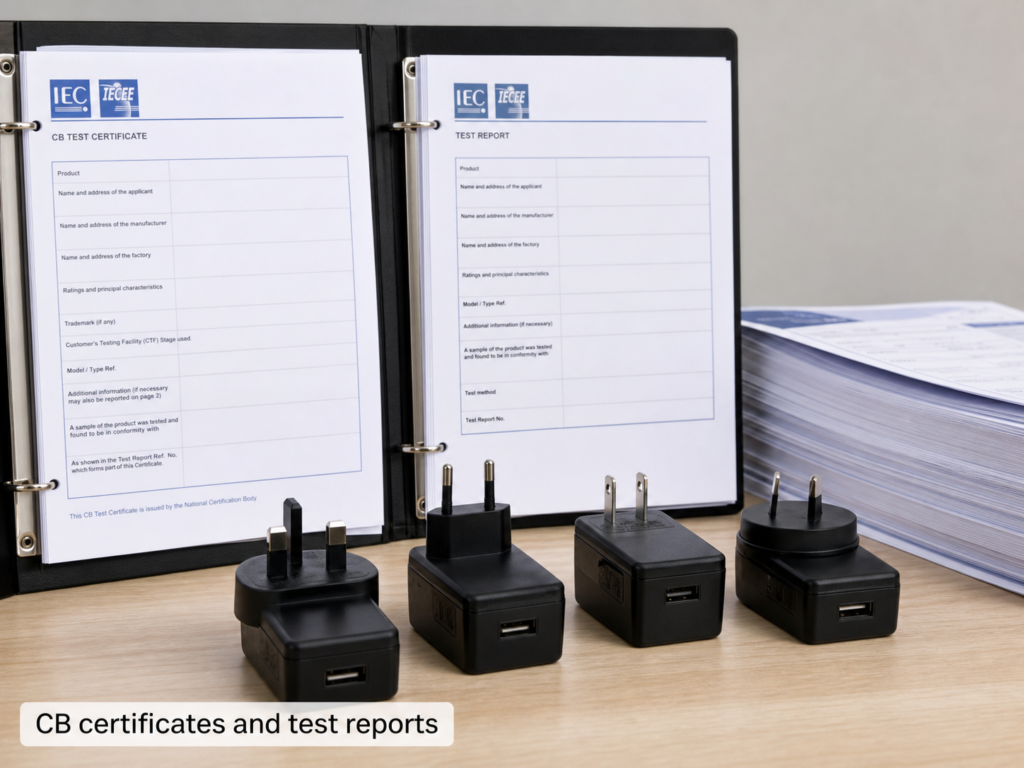
Many people think CB is a globally applicable certification, but it is not. It is more like a “globally applicable test report card” that can be used to exchange for “admission tickets” of various countries.
What Is the CB System
The CB system is a mutual recognition system for conformity assessment of electrical and electronic products launched by IECEE under the International Electrotechnical Commission, covering multiple approved product categories and IEC standards. Conventional IT/AV chargers are often evaluated in accordance with IEC 62368-1, but the applicable standards shall be determined based on the actual product category and target market requirements. Its core function is **the basis for certificate conversion**, not a license that allows direct global sales.
Applicable Prerequisites and Scope
Only National Certification Bodies (NCBs) of IECEE member states participate in the mutual recognition, and it only covers the testing of electrical products within the scope of applicable IEC standards. Specifically, whether a certain country accepts it, whether a certain type of product is included, and whether there are local special requirements (that is, “national differences”, such as plug shape and voltage requirements) must be confirmed with the certification body of the target country in advance, and cannot be taken for granted.
Core Value
The biggest advantage of CB is that it reduces repeated safety tests and document preparation, and lowers compliance costs. For example, if you first obtain a CB report, when you later convert it to EU CE or Japan PSE, many safety items that have already been tested do not need to be retested, and you only need to supplement local difference items, which saves money and time compared to doing it separately for each market. However, it should be noted that whether it is test-exempt, supplementary test, or full retest during certificate conversion is up to the certification body of the target country; having a CB does not necessarily mean test exemption.
Applicable Scenarios
Two situations are most suitable for applying for CB:
1. Sellers or suppliers that plan to lay out multiple markets and these markets all accept CB certificate conversion.
2. Purchasers who have not yet determined the final sales market for the time being and want to make safety reserves first, and then convert the certificate after the market is determined, without having to test from scratch.
Practical Boundaries
Don’t think CB is all-powerful; it has clear limitations:
• It is not an access certificate for the final market, and you cannot sell directly in most countries with a CB report.
• When converting certificates in most countries, in addition to supplementary difference tests, you also have to pay fees such as local registration and local representative fees; it is not a free conversion.
• CB certificates and test reports can be used as test basis for applying for national certification or approval from the NCB recognized by the target country; whether local certificates, registration, labeling, importer/representative or other documents are still required must be confirmed item by item in accordance with the regulations of the target country and the acceptance scope of the NCB.
Core Documents for Certificate Conversion
During certificate conversion, the CB certificate shall be matched with the corresponding CB test report; if there are national differences in the target country, it shall be confirmed whether the differences have been covered in the original CB report, or whether supplementary evaluation, testing or documents are required by the NCB recognized by the target country. If the model to be converted is different from the model in the CB report, a product difference description shall also be provided to prove that it is only a minor change and the core structure has not changed, otherwise the conversion may not be possible.
Procurement Practice: Certification Validity Verification Steps
Many purchasers do not know how to check the authenticity and usefulness of the certificates provided by suppliers. Following these six steps can avoid 90% of the pitfalls.
Step 1: Clarify Your Own Needs
First sort out your own needs: where is the core sales market, on which platform to sell, what is the product form; also confirm the specific product parameters: power, number/type of interfaces, whether there are special functions (such as wireless charging, smart power off). Different parameters correspond to different compliance requirements.
Step 2: Request Complete Compliance Documents
Don’t just take one certificate; ask the supplier to provide a full set of documents:
• Certification certificates or declarations of conformity corresponding to the target market.
• Test reports completely consistent with the purchased model; if it is CB, the corresponding CB certificate and CB test report shall be provided, and it shall be confirmed whether the national differences of the target country have been covered, or whether supplementary evaluation is required.
• Supporting documents: product labels, packaging, manuals, list of covered models, authorization letter from the certificate holder, and BOM (Bill of Materials) reported for certification.
Step 3: Quick Verification of Six Consistencies
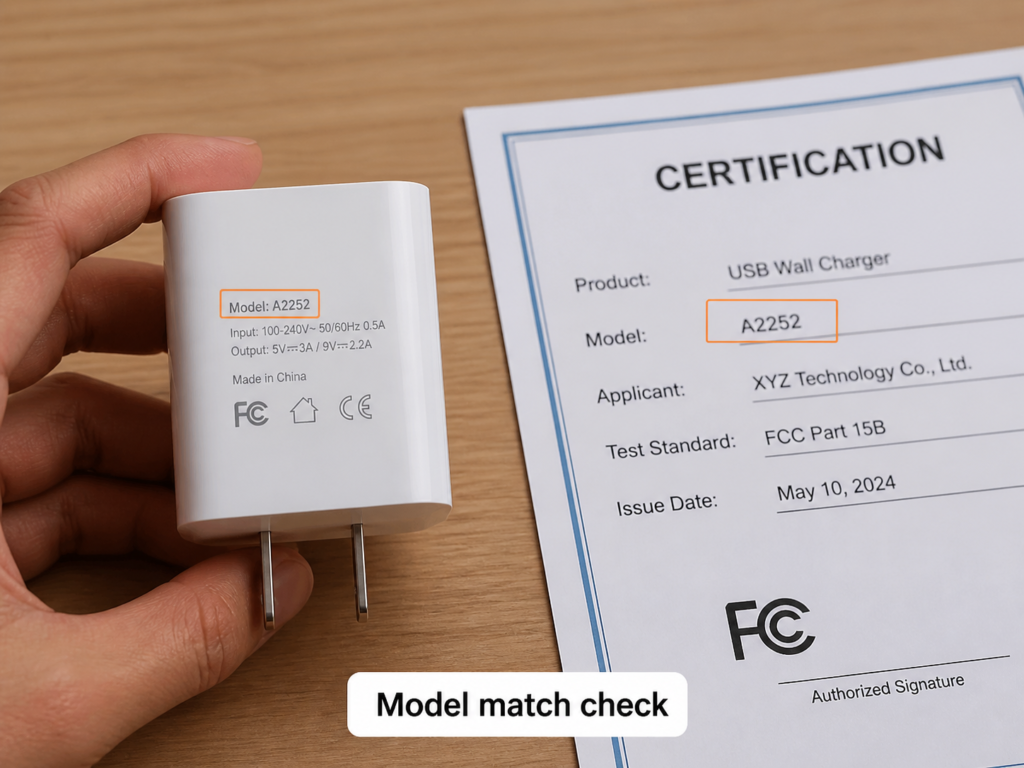
This step can filter out 80% of invalid certifications, just check against the table:
| Verification Item | Verification Content | Common Pitfall |
| Model Consistency | The model on the certification document must fully correspond to the purchased SKU | Suppliers use certifications of other models to make up the number |
| Parameter Consistency | Input and output voltage, power, number/type of interfaces are fully consistent with the purchased product | Use 30W certification as 65W certification |
| Structure Consistency | No obvious differences in plugs, shells, wires, and core functions | Products with US certification are sold as EU-compliant just by replacing EU plug pins |
| Market Consistency | The applicable scope of certification covers the countries/regions planned for sales | Use EU CE certification to sell in the US |
| Entity Consistency | The manufacturer and production factory on the certification match the information provided by the supplier | Certification from Factory A but goods from Factory B, which is certificate misappropriation |
| Standard Consistency | The standard version and national differences used for certification meet the current requirements of the target market | Certification made with obsolete old standards |
Step 4: Verify the Authenticity and Status of the Certification
Don’t believe it as soon as you get the certificate; go to the official website of the issuing body and enter the certificate number to query. Those with blurry documents and unsearchable numbers are most likely fake; also confirm that the certificate is in valid status, not suspended, revoked, or expired.
Special attention should be paid here: when a supplier says “our factory has XX certification”, it does not mean that the specific model you purchase has the certification. Be sure to check whether the model is within the coverage of the certification.
Step 5: Confirm Additional Channel Requirements
For high-power chargers or products with composite functions (such as chargers with power strips), additional certifications may be required; for special channels such as offline supermarkets, certifications from designated bodies may be required. For example, some large chain supermarkets only recognize reports from specific NRTL bodies, not any random one.
Step 6: Check Certificate Holder Authorization and Mass Production Consistency
• The certificate holder shall authorize the corresponding brand, model, and factory to use the certification, otherwise infringement complaints may be filed during sales.
• The key components of the product (such as power IC, transformer, optocoupler) shall be consistent with the BOM reported for certification, and cannot be replaced at will.
• The nameplates, packaging, and manuals of mass-produced products shall be consistent with those in the certification documents, and the content cannot be modified at will.
• If the product is subsequently changed (such as replacing the shell, modifying the circuit board), the applicable regulations, standards, and test coverage shall be re-evaluated first; if the product is controlled by a third-party certificate or listing, it shall be handled in accordance with the change procedure of the certificate-holding body. For manufacturer’s self-declaration of conformity systems such as CE, the manufacturer shall update the conformity assessment, DoC, and technical documents, rather than generally understanding it as filing with the issuing body.
Reference for Export Procurement Decision-Making
Finally, we have sorted out a simple decision table for you, just choose according to your own situation:
| Decision Dimension | Specific Situation | Recommended Solution |
| Number of Export Markets | Single/small number of markets | Prioritize obtaining local statutory mandatory certifications + certifications required by sales channels |
| Number of Export Markets | Multi-market layout | First evaluate the feasibility of CB certificate conversion in the target country, then decide whether to apply for CB first |
| Target Country’s CB Acceptance | All accept CB certificate conversion | Prioritize applying for CB, then convert to local certifications in various regions to reduce repeated test costs |
| Target Country’s CB Acceptance | Some markets do not accept | Obtain local certifications separately for markets that do not accept, and use CB conversion for markets that accept |
| Sales Channel | Public channels such as e-commerce platforms/offline supermarkets | Must meet the additional requirements of the channel; for the US, it is also necessary to verify whether NRTL listing or approval is required according to usage scenarios, AHJ, and state/local regulations |
| Sales Channel | Own channels/small-batch wholesale | Based on statutory mandatory requirements, supplement other certifications as needed |
By now you should have figured out the core certification logic for charger exports: you can not only quickly judge which compliance documents your products need, but also independently verify the authenticity, validity, and coverage of suppliers’ certifications, avoid most common compliance pitfalls, and greatly reduce the risks of procurement and export.
In the final analysis, there is no so-called “world’s number one certification” for charger exports. The core logic is always “follow the market, follow the channel, and safety is always the first priority”. Choosing the right compliance path that suits you is much more reliable than blindly pursuing an “all-purpose certification”.