
Friends who do cross-border charging product business have almost all had this anxiety: the goods are about to arrive at the port, and you suddenly worry: will customs check the certification? What if they are detained? Do customs of every country inspect? Today we will explain this thoroughly, from the most basic definitions to practical pitfall avoidance. After reading this, you can judge the risk yourself without asking around.
First, let’s offer you partial reassurance, and then a warning: **Customs authorities of all countries do not inspect certifications for every shipment and every type of product, but as long as you import goods for sale, compliance responsibility is valid throughout the entire process**. Port inspection is only the first pass of compliance; there are subsequent market supervision random inspections and platform review. These three links are independent, and problems in any one will lead to accountability. Inspections are not random; they are generally carried out in combination with factors such as mandatory conformity assessment requirements, product safety risks, label issues, declaration abnormalities, and special law enforcement.
Many people have a misunderstanding about “customs checking certifications”, thinking that it is just customs opening boxes to count quantities and check product names. The **customs compliance qualification inspection** we are talking about today is an inspection by customs at the border to verify whether imported goods meet the mandatory compliance requirements of the destination country. Product compliance verification focuses on applicable regulations, labeling, and technical/compliance documents, but is usually carried out in combination with customs risk information such as product name, classification, goods value, and declaration materials; the specific handling is done by customs, market supervision authorities, or both in collaboration, varying by country and product.
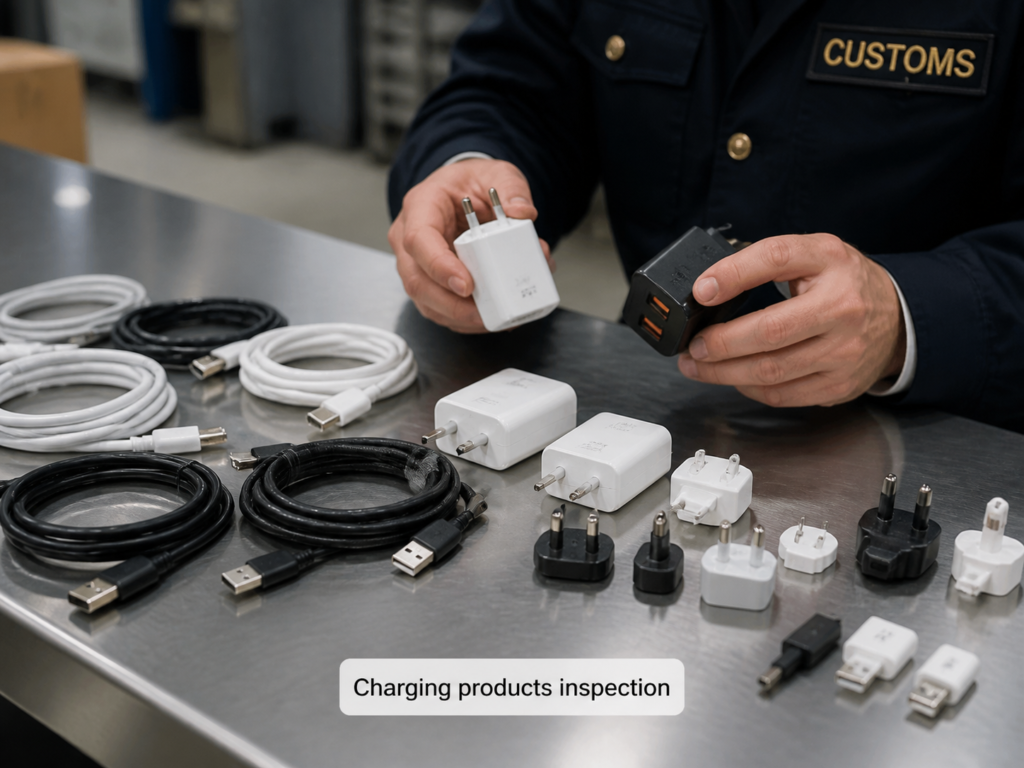
Take the products we often deal with, such as charging cables, USB/USB-C data cables, chargers, power adapters, and interface connectors, the inspection focus varies greatly by category:
• Mains-connected chargers and power adapters: Usually need to confirm electrical safety, electromagnetic compatibility (commonly known as EMC, which refers to the requirement that products do not interfere with other devices and are not interfered with when operating), and energy efficiency/ecodesign requirements according to the destination country and specific product; whether energy efficiency labels, registration, declarations, or specific test documents are required cannot be generalized;
• Cables with active electronic components such as E-Marker: Whether EMC, product safety, or other requirements apply shall be judged based on their functions and destination country regulations; only when the product has radio transmission/reception functions does it need to further check radio frequency/radio regulations;
• Purely passive ordinary charging cables and data cables (the kind with no chips, no electronic control circuits, just a few copper wires): Still need to confirm labeling, environmental protection, product safety, or other basic requirements according to the destination country, rated voltage, purpose, and applicable regulations, and cannot assume there are no compliance requirements just because they are passive.
First, let’s clarify that all rules mentioned in this article only apply to the charging-related products mentioned above; toys, unrelated home appliances, and the like are not within the scope, so do not apply them directly.
How to Judge the Level of Inspection Risk? Look at These Four Factors
After figuring out what requirements you need to meet, you must want to know: what is the probability that my goods will be inspected? Will they be detained? The selection and inspection rules and weights of ports in various countries are not unified, but risk screening is usually carried out in combination with the following factors, which you can compare and evaluate by yourself:
1. Maturity of the Destination Country’s Regulatory System
Developed markets such as Europe, the United States, Japan, South Korea, Australia, and New Zealand have developed compliance systems for decades, and the systems are very mature. So does that mean niche markets don’t need to be considered? Of course not. Niche markets may not require you to do mandatory certification in advance, but that does not mean there are no requirements. Safety, labels, import licenses, etc. may still be randomly inspected during import. If non-compliance is found, goods may still be detained or returned.
2. Product Risk Characteristics (Exclusive to Charging Products)
Different charging products are subject to different scopes of regulations, and the focus of competent authorities also varies:
• **Mains-connected chargers and power adapters**: Usually require verification against more applicable regulations, and may become the focus of risk screening in some markets;
• **Cables with active electronic components, accessories with wireless/radio frequency functions**: For example, 100W E-Marker fast charging cables and wireless chargers, applicable requirements shall be judged based on product functions and destination country regulations respectively;
• **Purely passive charging cables and chip-free data cables**: Applicable requirements may be relatively different, but may still involve labels, environmental protection, chemical substances, product safety, or other local rules.
A special reminder here: you cannot use a unified “high, medium, low risk” or “highest inspection probability” to judge the port rules of all countries. **Whether a product is selected for inspection shall be judged based on specific circumstances such as the destination country, product attributes, declaration materials, and regulatory developments; not being inspected does not mean compliance is not required.** Even if customs does not inspect, if you sell the product on the market and are sampled by market supervision, you may still be punished, and compliance responsibility is valid throughout the entire process.
3. Import Method and Declaration Status
Commercial bulk imports usually involve more commercial declaration and regulatory requirements than small items for personal use. In addition, if there are problems with your declaration, such as vague product names (only writing “electronic accessories” without specifying whether it is a charger or a charging cable), undervaluation of goods, or incorrect HS code classification, may increase the likelihood of being selected for customs control.
4. Importer’s Compliance Record and Regulatory Developments
Importer history, declaration quality, product risks, and special law enforcement actions may all affect the risk screening of competent authorities. However, there is no unified automatic weighting rule applicable to all countries, and it cannot be simply assumed that the first large order of a newly registered importer will definitely be subject to key inspection.
In addition, if the destination country is just carrying out special rectification of charging products, for example, focusing on checking charger safety for a certain period, the possibility of related categories being noticed or selected for control may temporarily increase during that period.
Customs Compliance Inspection Process and Consequences of Failure
If you are really selected for inspection, what is the general process for customs? What are the consequences if you fail? We will explain clearly taking bulk commercial import of charging products as an example:
Routine Inspection Process
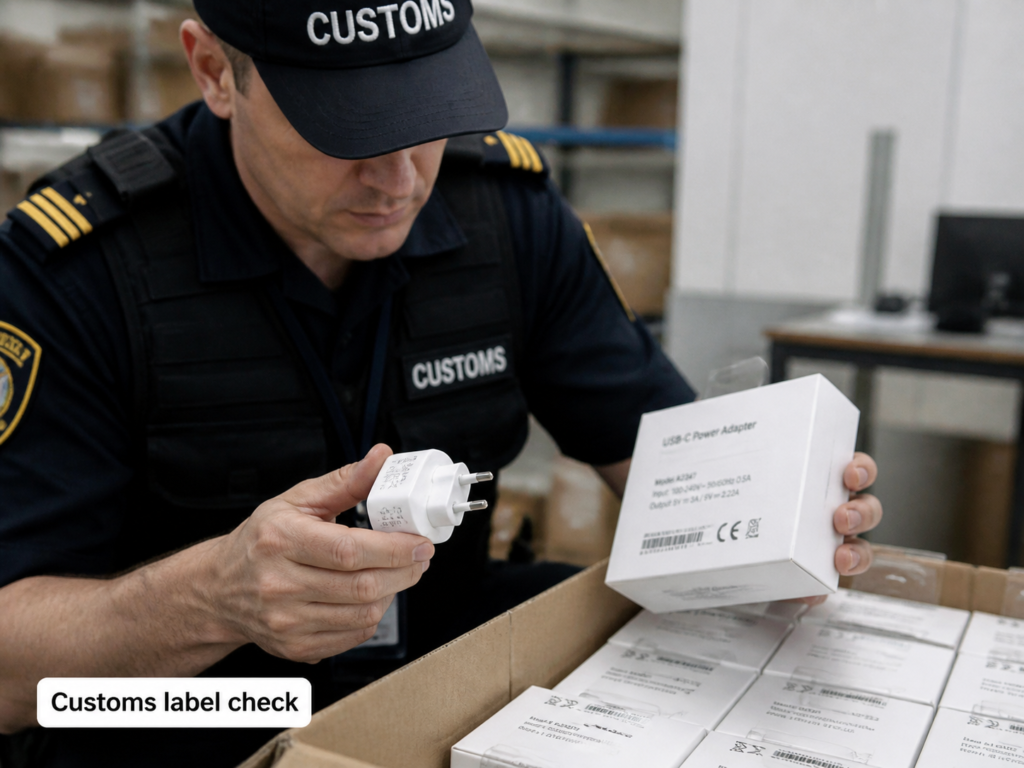
Procedures vary from country to country. When selected for control, the competent authority may verify the following:
1. **Declaration documents**: After the goods arrive at the port, the authority may review the declaration materials, and verify the declared product category, classification, goods value, and corresponding compliance requirements;
2. **Product labeling and responsible party information**: May check whether compliance marks, labels, model numbers, manufacturer or importer information on the product and packaging meet requirements;
3. **Compliance documents**: May require provision of declarations of conformity, certification certificates, test reports, registration materials, or other applicable documents;
4. **Sampling, suspension of release, or transfer**: If there are still doubts, samples may be taken for testing in accordance with local procedures, release may be suspended, or the case may be transferred to the market supervision department for handling.
These steps are not a fixed sequence adopted by all countries. Declaration documents, product labeling, responsible party information, and technical documents may be verified in parallel.
Consequences of Failed Inspection and Countermeasures
The disposal result of failed inspection is not fixed. It may be release after supplementary materials, or detention of goods for rectification. In serious cases, goods may be returned, destroyed, or even fined. The specific situation depends on the law enforcement agency, product risk level, and severity of the violation.
If you receive an inspection notice, you must submit materials within the specified time limit, do not delay. There is a red line that must never be crossed: **Submitting forged, tampered, or irrelevant documents is prohibited**. Otherwise, what may have been a small problem will become a serious violation, and the penalty will be much heavier. Moreover, once a violation record is left, subsequent goods may be more likely to be noticed or selected for inspection, which is not worth the loss.
Practical Tips to Avoid Pitfalls in Cross-Border Procurement Compliance Inspections
After talking about so many rules, how can we try to avoid goods being detained and fined in actual operation? Here are some practical pitfall avoidance suggestions:
1. Confirm Applicable Requirements of the Target Market Before Placing Orders
Before placing an order, you must confirm the latest requirements through official channels according to the four dimensions of “destination country + product electrical type + sales method + import method”. Don’t just listen to the supplier say “we have certification” — the supplier may not even know which country you are selling to, and the certification provided is for another market.
2. Request Verifiable Compliance Document Packages from Suppliers
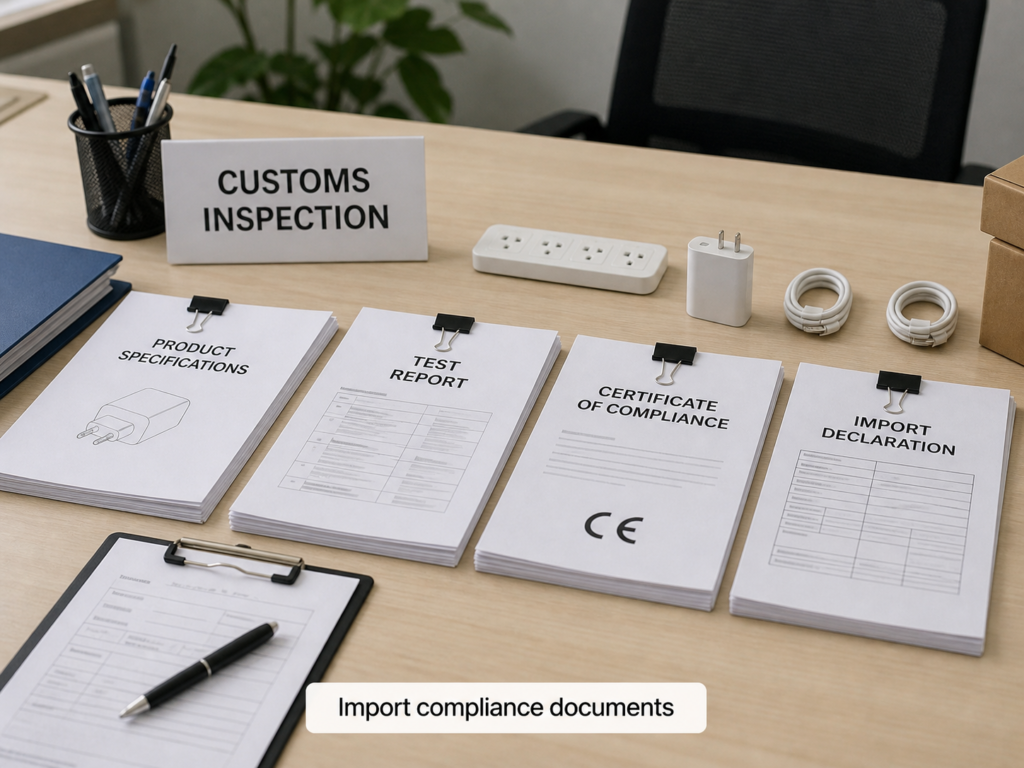
When asking suppliers for materials, don’t just say “give me certification”. Ask for a full set of verifiable document packages, including: product specifications, complete model list, photos of physical labels/packaging, all compliance documents corresponding to the target market (declarations, certificates, test reports, registration certificates, etc.), manufacturer name and address, and traceable batch information.
3. Complete Declaration and Document Review Before Shipment
Before shipment, you must check again by yourself:
• Commercial invoices, packing lists, and waybills shall be declared truthfully. Do not use vague product names, do not undervalue or conceal information, and ensure accurate HS code classification;
• Confirm that compliance marks and responsible party information have been printed on the product and the minimum sales packaging as required;
• Prepare electronic versions of all compliance documents in advance, so that they can be provided immediately if supplementary documents are needed for customs clearance;
• Ensure that importer, responsible party, tax/registration information are consistent with traceable materials, and avoid information mismatches.
4. Precautions for Different Import Scenarios
Different import scenarios have different points of attention:
• **Small-batch trial orders (express): Affix compliance marks in advance and prepare electronic documents; whether a single shipment is classified as non-commercial import shall be judged based on the destination country’s definitions of conditions such as quantity, value, and purpose;
• **Large-batch sea/air freight**: Prepare a full set of compliance documents, and prioritize agents familiar with customs clearance of electronic and electrical products, which can save a lot of detours;
• **Personal use**: Goods for personal use and not for resale may be subject to different procedures or exemptions from commercial placement on the market in some countries, but definitions, quantity/value thresholds, product categories, and safety control requirements vary by country; you should still check the rules of the destination country’s customs and product regulatory authorities before import.
In addition, high-risk products in some markets can go through official pre-clearance or pre-shipment inspection to speed up customs clearance, but there is no globally applicable pre-clearance channel, which depends on the regulations of the destination country.
5. Coordinate Procurement and Platform Compliance
Another point that is easily overlooked: compliance on the procurement side and the platform side must be coordinated. The procurement contract must clearly state: compliance requirements, model/BOM locking, document delivery list, change notification obligation, sampling inspection right, and return and compensation clauses for non-conforming products. If these clauses are clearly written, you can hold the supplier accountable if problems arise later.
When listing products on e-commerce platforms, you will be required to submit corresponding documents (such as DoC, test reports, label photos, third-party certification, etc.), but remember: **platform review does not replace legal responsibility**. Even if the platform passes the review, if the subsequent market supervision department finds that the product is unqualified, the obligations of document preservation, labeling, traceability, sales suspension/recall, and cooperation with law enforcement that manufacturers, importers, authorized representatives, distributors, and platform operators shall bear respectively shall still be determined in accordance with the laws of the destination country and actual roles.
Clarification of Common Misconceptions
Finally, let’s clarify a few most common misconceptions to avoid pitfalls:
Misconception 1: One certification/mark is globally applicable
Clarification: Each country has an independent compliance system, and one mark only corresponds to the requirements of a specific country/region. For example, China’s 3C certification only applies to China, and the EU’s CE mark cannot be directly used in Japan; there is no “globally applicable” certification.
Misconception 2: Having compliance documents/never having been inspected before means you won’t be selected for inspection
Clarification: Compliance is a prerequisite for import and sale, but customs may still conduct random inspections. The inspection probability is affected by various factors such as regulatory rules, special rectifications, and importer records. Having documents does not mean you will definitely not be inspected, and never having been inspected before does not mean you will not be inspected in the future.
Misconception 3: Charging cables are low-voltage products, so no country inspects them
Clarification: Whether purely passive cables require certification, declarations, marks, or other documents shall be judged based on the destination country, rated voltage, purpose, whether they are supporting components of electronic and electrical equipment, and applicable regulations; it should not be presumed that there are no compliance requirements at the port or sales link just because they are “low-voltage” or “passive”. Cables with active electronic or wireless functions also need to be judged separately based on actual functions and local regulations, and cannot be generalized.
Misconception 4: Customs only inspect paper documents and do not check product labeling
Clarification: During inspection, customs or relevant competent authorities may simultaneously verify declaration documents, marks and labels on products or minimum sales packaging, responsible party information, and technical documents. Non-compliant labeling itself may lead to disposal, but this does not mean that technical documents do not need to be verified in all cases, nor does it mean that supplementary correction in accordance with the law is definitely not allowed.
Misconception 5: Passing customs/being deliverable via express equals product compliance
Clarification: Customs clearance only means that no problems were found in that import. Subsequent market supervision, platform review, and consumer complaints may all trigger re-inspection. Customs clearance or platform review does not exempt the obligations of various economic operators under applicable regulations. The allocation of responsibilities among manufacturers, importers, authorized representatives, distributors, and platform operators shall be determined in accordance with the laws of the destination country and actual roles.
Quick Judgment Process and Core Summary
At this point, some people may think there is a bit too much content. It doesn’t matter, you just need to remember the three-step quick judgment process, and follow this when you encounter problems:
Three-Step Quick Judgment Method
Step 1, **Judge applicability**: Use the four-question method of “destination country + product electrical type + sales method + responsible party” to first confirm which compliance requirements your product needs to meet and what documents to prepare;
Step 2, **Verify documents**: After receiving the supplier’s documents, check whether they are authentic and valid, whether they cover the products you actually purchase, and whether they meet the requirements of the destination country;
Step 3, **Evaluate risk**: Combine the import method, declaration status, importer’s compliance record, and destination country’s regulatory developments to roughly assess the inspection risk and make preparations in advance.
The core principle is actually very simple: **Don’t just ask “will customs inspect”, first confirm “do I need to comply with regulations and what documents do I need to import and sell this product”**. After all, compliance is the bottom line. If you are inspected, it is a direct loss, and if you are not inspected, it does not mean there is no problem.
After reading this article, you should be able to do three things independently: use the “four questions of applicability” to judge the scope of compliance requirements for charging products in the corresponding country and corresponding sales method; verify whether the compliance documents provided by the supplier are authentic and can cover the products you actually purchase; reduce the compliance risks of port detention, return, and fines by preparing materials in advance and standardizing declarations.
In cross-border business, compliance is never a multiple-choice question of “whether to do it”, but a must-answer question of “how to do it well”. If you do enough preliminary work, you don’t have to worry about goods being detained every day, and you can sell goods with peace of mind.