
Many new Amazon sellers and purchasers in the charging category will ask: I’m doing global selling, can one set of certifications work for all sites? Do all products have to be certified to be sold on Amazon? There is no one-size-fits-all answer to this question, but the core logic is very clear: **There is no unified certification requirement for all sites and all categories, nor is there a single set of certifications that works for all sites. Specific requirements need to be comprehensively determined in combination with multiple dimensions.**
This article mainly focuses on interface accessories such as charging cables, chargers, and power adapters, targeting entry-level Amazon sellers and purchasers. It only covers judgment methods at the platform access and procurement practice level, and does not involve specific test processes or interpretation of standard provisions. For charging products, regardless of the market, compliance requirements basically revolve around four directions: electrical safety, electromagnetic compatibility, environmental protection and recycling, and interface specifications. Among them, products with mains input, voltage conversion function, and wireless function are the focus of supervision and have more requirements.
First Clarify the Two Most Common Entry-Level Misconceptions
Many novices tend to go to two extremes when they first come into contact with Amazon compliance. Let’s clarify these two misunderstandings thoroughly first, so that the following content can be better understood.
The first misunderstanding is “you must get certification to sell on Amazon”. In fact, not all products have mandatory safety certification requirements. For example, pure passive ordinary charging cables do not have mandatory safety certification thresholds in many markets, but this does not mean they can be sold casually. They may still need to comply with applicable legal obligations such as environmental protection, product safety, and labeling; interface physical specifications and protocol compatibility usually belong to industry standards or commercial requirements, and only specific markets and specific product categories may have statutory interface requirements.
The second misunderstanding is “one certification works for all sites”. The certification systems and responsible entity requirements of different markets are completely different. For example, CE in the EU, FCC in the US, and PSE in Japan cannot replace each other. Even for the same charger, the required documents and the responsible entities are different when selling in the US and Japan. There is no such thing as “getting one certification to sell globally”.
Basic Concept Literacy: Don’t Confuse Various Compliance Documents
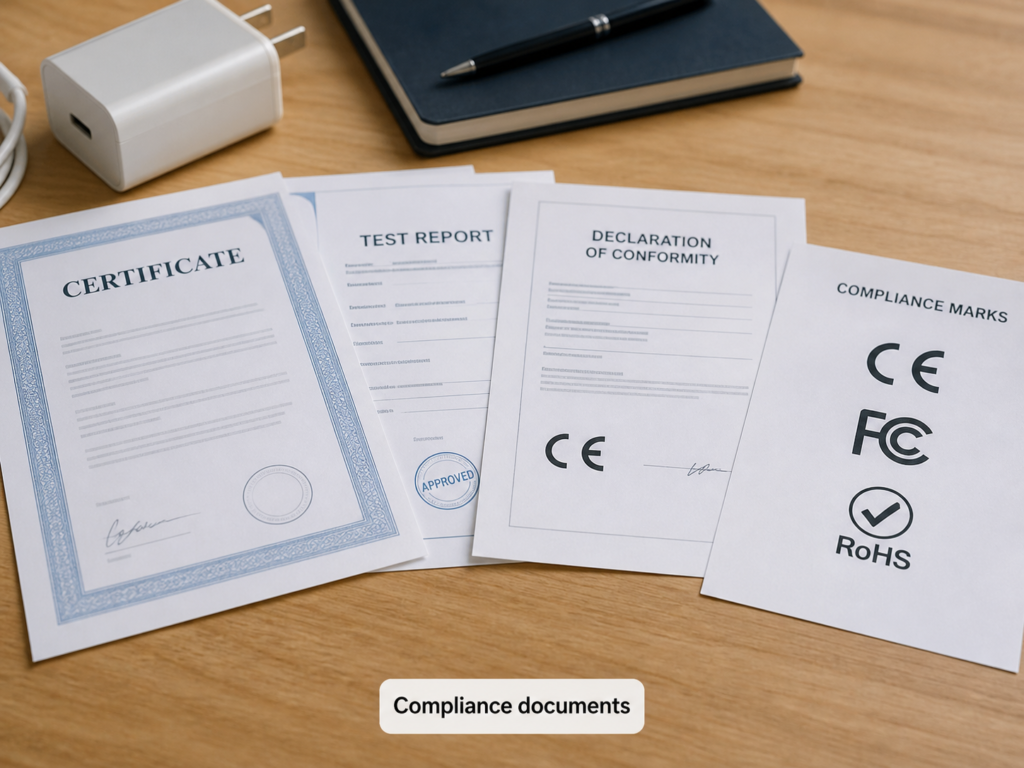
Many novices confuse certificates, reports, marks, and declarations when they first come into contact with compliance. In fact, they belong to different links and have completely different functions. First, we need to understand the underlying difference between the two types of requirements: one is **mandatory regulatory requirements**, which are stipulated by local governments and customs. Without corresponding documents, you may not be able to clear customs, or even be suspected of breaking the law; the other is **platform rules**, which are Amazon’s access requirements, and are often stricter than local regulations. The two types of requirements for charging products have a high degree of overlap, and the platform may additionally require submission of documents for review.
The core differences between the 6 common types of compliance documents can be explained in one sentence:
• **Statutory certification / conformity assessment documents**: Some mandatory access products must be assessed by a legally registered or recognized conformity assessment body and obtain corresponding certificates. For example, Japan’s “specified electrical appliances and materials” must be assessed by a registered conformity assessment body, and then the product must be marked with the diamond PSE as required.
• **Conformity mark**: A market access mark that can be used after the product meets the corresponding standards, such as the CE mark. It is a result mark after compliance, and is not equivalent to a certificate issued by a third-party organization.
• **Test report**: Sample test results issued by a laboratory, which is usually one of the important technical evidences for the compliance path of many products. However, specific systems may also require technical documents, risk assessment, production consistency control, factory inspection, registration or other supporting materials; this shall be determined in accordance with applicable regulations and platform requirements.
• **Declaration of conformity**: A written commitment issued by the brand owner or importer on its own, declaring that the product complies with local regulations, and is a self-certification document of the responsible entity.
• **Registration / EPR obligations**: For example, WEEE producer registration and recycling responsibilities belong to extended producer responsibility. RoHS is a requirement for the restriction of hazardous substances in products, which is usually proved to be compliant through technical documents, conformity assessment and EU declaration of conformity, and is not a unified EPR registration like WEEE.
• **Platform review requirements**: Amazon’s access and random inspection rules for specific ASINs or categories are requirements at the channel level, not certifications at the regulatory level.
These documents are not isolated, but a complete compliance chain: test reports are usually important technical evidence, statutory certifications, conformity assessment documents and conformity marks may constitute market access requirements, declarations of conformity are the commitments of the responsible entity, and registration/EPR is the legal obligation of the entity. Different markets and different products may require one or a combination of several of them, and may also require technical documents, risk assessment, production control or other materials.
In addition, special attention should be paid: **Voluntary certification is not equal to mandatory requirements**. USB-IF certification is usually a voluntary industry certification; MFi is an Apple authorization/licensing program, and the use of MFi marks, controlled technologies or making MFi-related claims must meet the requirements of Apple’s program. USB PD compatibility shall obtain verifiable technical evidence in accordance with applicable specifications and promotional content, and cannot be generally referred to as a unified certification. Whether to do it or not, and whether to submit proof, depends on the product’s interface type, function, your promotional content in the listing, and the ASIN notification of the specific site. Voluntary certification can indeed improve product competitiveness, but it is not a mandatory access threshold, so you don’t have to do all of them at the beginning.
4 Core Judgment Dimensions That Determine Compliance Requirements
After understanding the basic concepts, you can judge the compliance requirements of a product from four dimensions, all of which are indispensable.
Dimension 1: Target Sales Market (Not the Seller’s Place of Registration)
The target sales market is the primary factor in judging product regulations. For example, if you use a global selling account registered by a Chinese company, you must follow the US requirements when selling to the US, and follow the EU requirements when selling to the EU. “Global selling” only means that the account can open multiple sites, and does not mean that compliance requirements are universal. For the same charger, the documents required for selling in the US and Japan may be completely different.
However, the place of establishment of sellers, manufacturers, importers and economic operators cannot be completely ignored, because it will affect the identification of responsible entities, registration, authorized representatives and labeling obligations. You can’t just look at the place of sale; you also need to confirm who imports the product, who acts as the local responsible entity, and who bears the corresponding registration responsibility.
Dimension 2: Product Technical Attributes (Corresponding to Specific Model and BOM Version)
You can’t generally say “what certifications do chargers need”; it must be judged corresponding to the specific product model and BOM (Bill of Materials) version.
• Core check items: Whether the product is connected to mains, what the input voltage range is, and whether it has voltage conversion function – wall chargers with voltage conversion are the most strictly regulated, and pure cables without conversion have the least requirements.
• Supplementary check items: Whether it contains a wireless module and whether it has a lithium battery. Both of these will add additional compliance requirements.
• Cable-specific check items: Whether it is a pure passive cable, whether it has an E-Marker or protocol chip, and whether it has adapter or hub functions – if a fast charging cable with a chip is advertised as PD fast charging, it may be required to provide corresponding compatibility proof.
• Other check items: Whether it is a car charger or a set product. The requirements for these two types are different from ordinary wall chargers, so they need to be checked separately.
Dimension 3: Amazon Category and ASIN Rules
Amazon’s compliance requirements are not one-size-fits-all by category. Some sensitive categories require submission of documents for review in advance before they can be listed, while some categories are open for listing but are subject to random inspections. Even in the same category, different ASINs may have different requirements due to different parameters and promotional content. Everything shall be subject to the system prompts in your backend. In particular, if you write sensitive promotional words such as “fast charging”, “fireproof”, and “USB-IF certified” in the listing, it is likely to trigger additional review by the platform, requiring you to provide corresponding proof.
Dimension 4: Operation Scenarios and Responsible Entities
Regardless of whether you use FBA, self-shipment or local warehouse, products shall not be exempted from applicable regulations and platform obligations due to the fulfillment method. Don’t think that changing the shipping method can avoid compliance. However, the specific identification of responsible entities such as importers, economic operators, and warehouse parties still needs to be judged in combination with the flow of goods, inventory location and transaction arrangements.
The trigger of review may come from platform notifications, event registration requirements, or compliance prompts from account health. There is no fixed trigger rule. As long as you are selling, you must be ready with compliance documents at any time.
Check Directions and Non-Applicable Boundaries for Major Markets
The compliance systems of different markets vary greatly. Below, we sort out the core check directions and common misunderstandings according to the sites that everyone often operates, to help you avoid detours. All markets follow the same general logic: **The higher the product risk, the stricter the supervision**.
North America Sites (US/CA/MX)
• **US site**: The key points of check are FCC compliance scope, electrical safety, and environmental protection requirements. The responsible entity shall be confirmed separately in accordance with applicable regulations: imported products usually need to clarify the responsible party for import; if FCC SDoC applies, it also needs to meet the FCC’s requirements for responsible parties within the US. It cannot be generally assumed that all charging products must be held responsible by US local importers or brand owners. There are three common misunderstandings: FCC is not an electrical safety certification, it mainly involves radio frequency emission, emission limits of unintentional radiation and corresponding equipment authorization; it is generally not equivalent to a complete EMC certification that includes immunity requirements. UL/ETL are not statutory mandatory certifications for all chargers, but may be required by some states or platforms; whether a wireless charger needs an FCC ID depends on its working method, the applicable part of the FCC rules and the corresponding equipment authorization procedure, and cannot be judged only by power. It should be confirmed whether it belongs to Part 18 consumer ISM equipment that requires certification, applies to other authorization procedures, or meets specific exemption conditions.
• **Canada site**: The key points of check are ISED radio frequency compliance, electrical safety standards, and local importer requirements. The responsible entity is a local Canadian responsible party. A common misunderstanding is that all electronic products require mandatory safety certification. There is no single national risk classification conclusion in Canada that can be directly applied to all electronic products. Electrical safety approval, labeling and sales or installation requirements shall be confirmed according to the sales province or region and product category; products with wireless functions shall also be confirmed in accordance with the applicable rules of ISED.
• **Mexico site**: The key points of check are the NOM mandatory safety catalog, labeling requirements, and local importer qualifications. The responsible entity is a local Mexican compliance responsible person. A common misunderstanding is that all charging products require NOM, and only products in the NOM mandatory catalog need it.
Europe Sites (EU + UK)
• **EU sites**: The key points of check are the CE regulations applicable to the product, RoHS, and WEEE producer obligations; the USB-C universal charger requirement is only checked when the product belongs to the equipment categories listed in Annex IA of the EU Radio Equipment Directive, and cannot be applied to all charging accessories. The responsible entity must be an economic operator within the EU. Two of the most common misunderstandings must be avoided: CE is not a certification certificate issued by a third-party organization, it is a mark affixed by the enterprise itself after the product meets the EU directives. Don’t treat the CE test report issued by a third party as a “CE certificate”; WEEE is a registration obligation for the recycling of waste electronic equipment, which belongs to the category of environmental protection and recycling, not a product safety certification.
• **UK site**: The rules are slightly complicated due to Brexit. The UK mainland (GB region) currently still recognizes the CE mark for most products, and also has the UKCA mark; Northern Ireland (NI region) applies the CE/UKNI mark, which needs to be checked separately. The responsible entity is a responsible person within the UK. A common misunderstanding is that UKCA is the only solution for charging products to enter the UK. In fact, most electronic products in the GB region can still use CE at present, so there is no need to rush to do UKCA. It depends on the product type and the latest rules.
Asia-Pacific Sites (JP/AU/NZ/Southeast Asia)
• **Japan site**: The key points of check are the PSE statutory catalog (divided into diamond and round types), labeling requirements, and importer responsibilities. The responsible entity is a local Japanese importer or business operator. A common misunderstanding is that all USB charging cables belong to the category of round PSE. In fact, only products in the statutory catalog require it. Among them, AC/DC adapters (wall chargers) are key supervision objects, and ordinary charging cables do not necessarily require it.
• **Australia/New Zealand sites**: The key points of check are the scope of application of RCM, electrical safety level, and local supplier registration requirements. The responsible entity is a local Australian or New Zealand supplier. A common misunderstanding is that all electronic products require RCM. Australia and New Zealand shall separately judge whether the product is subject to electrical safety, EMC or radiocommunication rules. Taking Australia as an example, EESS Level 1 usually does not require a certificate or registration, but still must meet safety requirements; RCM marking and supplier registration obligations shall be confirmed in accordance with applicable product regulations and local supply arrangements, and cannot be simply judged as “low risk does not require RCM”.
• **Southeast Asia sites (Singapore/Thailand, etc.)**: Each country has different mandatory safety catalogs, plug standards, and local importer requirements, which need to be checked country by country. A common misunderstanding is that there is a unified general rule for Southeast Asia. In fact, the differences between countries are very large and cannot be generalized.
Emerging Sites (Middle East/South America/India, etc.)
The key points of check for these sites are the mandatory certification catalogs of each country, whether they accept the conversion of mainstream documents to local certifications, and the requirements of local responsible parties. The responsible entities are all local compliance responsible persons of each country. There are two common misunderstandings: first, thinking that there are general certification rules for emerging sites, but in fact each country is different; second, thinking that all emerging markets accept the conversion of CE or FCC to local certification, but in fact some countries accept it and some do not, so it must be checked country by country.
SKU Compliance Classification for Charging Products (By Product Form)
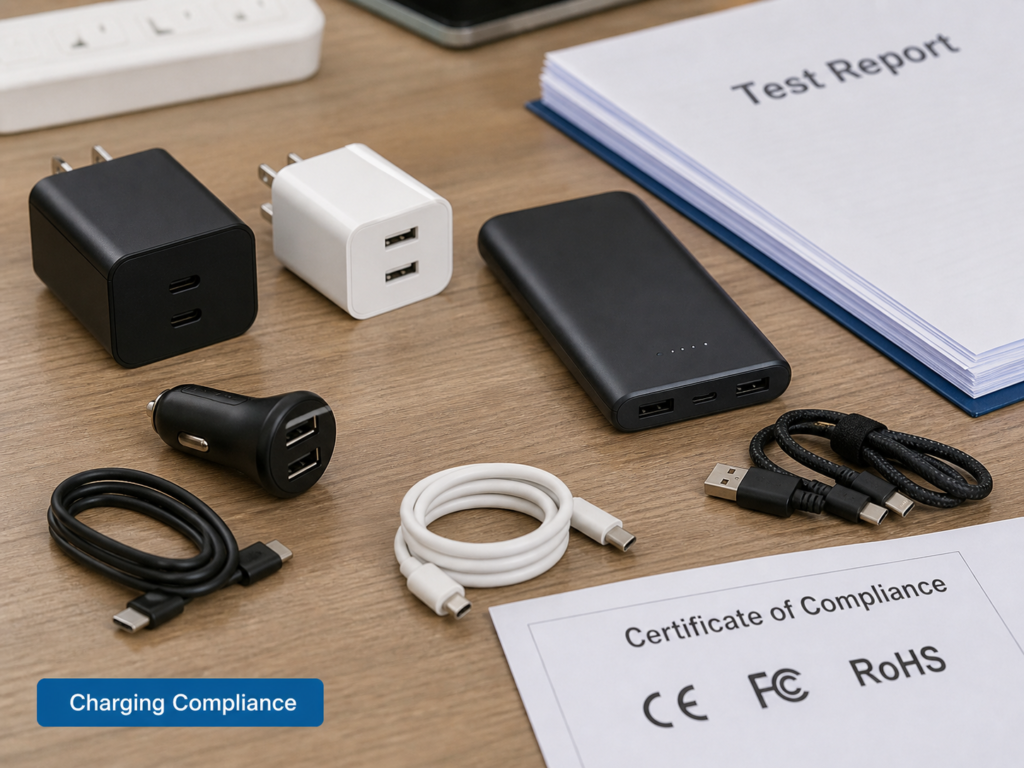
The compliance requirements for charging products of different forms vary greatly. Below, we sort out the key check points according to common SKU types, which can be directly corresponded during procurement or product selection.
• **Wall-mounted chargers / power adapters**: These have mains input and voltage conversion, and are the focus of supervision. The key check points are mains input safety, electromagnetic compatibility, local plug standards, and label information; for products with multiple interfaces and multiple powers, it is necessary to confirm that the test report covers all output specifications and combinations, and not only test the maximum power of a single port.
• **Car chargers**: The input of car chargers is 12V/24V DC from the vehicle, and there is no mains input. The compliance requirements are different from wall chargers. The key check points are input voltage range, output safety, and electromagnetic compatibility.
• **Wireless chargers**: The applicable path of wireless chargers shall be judged according to the sales market and functions, which may involve electrical safety, EMC, and wireless power transmission or radio frequency rules applicable in some jurisdictions; if it also has wireless communication functions such as Bluetooth and Wi-Fi, the corresponding radio equipment requirements need to be checked separately. Wireless chargers with different powers and functions have different applicable rules, which shall be judged according to specific products.
• **Pure passive charging cables / data cables (no chip)**: They have no voltage conversion function, and generally have fewer safety certification requirements. The key check points are material environmental protection requirements and interface physical specifications.
• **Charging cables with E-Marker / protocol chip (including USB-C fast charging cables)**: The key check points are interface specification compliance, protocol compatibility, and verifiability of promotion; if PD fast charging or USB-IF certification is advertised in the listing, corresponding supporting documents must be provided, and some sites may require official USB-IF certification.
• **Charging-related adapters / docking stations**: The key check points are the safety, electromagnetic compatibility, and interface specification requirements corresponding to interface conversion; products with data/video conversion functions have more compliance requirements than simple charging adapters.
• **Charging products with batteries (such as power banks)**: In addition to electrical safety, battery safety and transportation compliance must also be checked. Lithium batteries are dangerous goods, and there are additional rules for transportation and storage.
• **Set products (such as charger + charging cable)**: All components in the set and the entire set configuration shall have applicable compliance basis; if a single test report, certificate or technical document clearly covers the set and all components, it can be used as evidence for the set. Documents that only cover a single product and do not cover the set configuration shall not be used to replace the overall compliance certificate.
Common Trigger Scenarios for Amazon Compliance Requests
Many novices think that they will only be required to provide compliance documents when listing. In fact, there are many trigger scenarios, which may be encountered at any time.
The first is **triggered by listing and listing changes**: For example, creating a new ASIN, editing product attributes or categories, adding variants, and modifying sensitive promotional words may trigger system review. The requirements for different products in the same category may be different, and everything shall be subject to the system prompts of the specific ASIN.
The second is **triggered by platform compliance verification**: For example, random inspections, compliance requests on the account health page, and requirements to submit compliance questionnaires. In this case, you must submit within the specified time limit, otherwise it may affect ASIN sales or even be removed from the shelf.
The third is **triggered by complaints and supervision**: For example, consumer complaints about safety issues, reports from competitors, and notifications from customs or local regulatory authorities. In this case, more complete compliance chain documents are usually required, and the review is stricter.
The fourth is **triggered by other operation scenarios**: For example, brand registration, signing up for some platform activities, and being found to have inconsistent variants/brands/models may require the provision of compliance documents. There is no unified mandatory requirement for this, and it shall be subject to official notifications.
Here, you must remember a core reminder: **Being able to list does not mean meeting the requirements**. Many Amazon categories are listed first and then randomly inspected. If the subsequent verification fails, the ASIN will be removed from the shelf and inventory will be stranded in mild cases, and the account will be restricted in severe cases. Moreover, even if the platform does not find out, you must comply with the legal obligations of the place of sale, otherwise you may face local legal responsibilities, such as fines and goods being detained by customs.
Entry-Level Practice: 5-Step Compliance Judgment and Check Process
After talking about so many rules, many novices may still not know where to start. Follow these 5 steps to complete basic compliance judgment and checking, which is suitable for entry-level sellers and purchasers to use directly.
Step 1: Clarify 2 Types of Core Basic Information (Corresponding to Specific SKU)
You can’t generally say “I sell chargers”. You must sort out two types of information corresponding to specific SKUs: one is product information, including specific category, model, BOM version, power, function, interface type, and plug specification; the other is site information, which must be specific to the country/region. You can’t just say “Europe site”, but also clarify the shipping mode and the corresponding responsible entity.
Step 2: Query Accurate Requirements Through Official Channels
For sellers who have already opened a store, the most accurate basis is the system prompt in the seller’s backend, and the requirements for each ASIN are subject to the backend. Sellers who have not yet opened a store can refer to the category compliance guide on Amazon Global Selling’s official website and the public rules of local competent authorities. Never copy the configuration of other sellers. Products of the same category with different parameters may have completely different requirements.
Step 3: Request and Check Compliance Documents from Suppliers
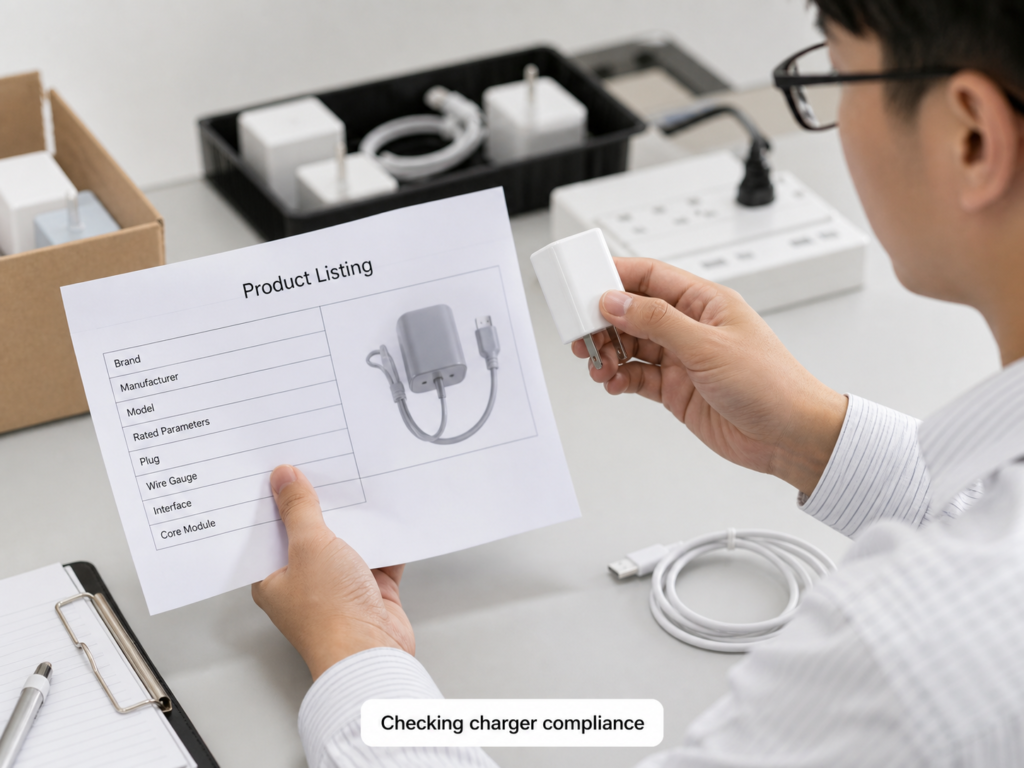
The documents that need to be requested from suppliers include: test reports or certification certificates for the corresponding model, photos of labels or nameplates, descriptions of applicable markets, and corresponding qualifications if a local responsible entity is required.
There are three core points for checking: first, the brand, model, specification, and key components must be consistent with the products you sell; second, the applicable market must cover your target sales area; third, the issuing laboratory or organization must have corresponding qualifications. The most important thing is to achieve **three consistencies between sample – mass production – listing**: brand, manufacturer, model, rated parameters, plug, wire gauge, interface, core module – these points must be consistent between the sample, the bulk goods and what is written in the listing, otherwise even if there are documents, they are useless.
Step 4: Pre-Procurement Compliance Decision (Red-Yellow-Green Light Principle)
Before procurement, you can quickly judge the risk according to the red-yellow-green light principle:
• **Red light (not suitable for large-scale procurement)**: There is no basic compliance data for the corresponding model, the model or BOM is inconsistent with the report, and the responsible entity cannot be determined. Such products have extremely high risks, so do not rashly purchase large quantities.
• **Yellow light (suspend sales and shipping to the target market)**: When there is basic data but the market applicability, mandatory labeling or local registration obligations have not been confirmed, sales and shipping to that market should be suspended; document verification, sample evaluation and responsible entity arrangement can be completed without placing the product on the market. After confirming that there are no unmet mandatory obligations, then decide to purchase or sell.
• **Green light (can be procured normally)**: The regulatory path, platform requirements, document matching, labeling and responsible entity are all checked correctly, and procurement can be carried out normally.
Also note that if the product is upgraded, the chip is changed, the plug is modified, or the power is adjusted, you must reconfirm the validity of the compliance documents, and cannot directly use the old documents.
Step 5: Processing Flow When Receiving Platform Compliance Requests
If you receive a compliance request, don’t rush to upload documents. First, confirm the requirements clearly: what type of document is required, what is the scope of application, how long is the submission deadline, and which ASIN it corresponds to. When submitting, they should correspond one by one according to ASIN – model – document, with clear naming, and do not upload irrelevant materials.
If the submission is rejected, you can investigate from the following directions: Is there a mismatch in model, parameters, or market? Are the documents missing pages or the organization’s qualifications are not compliant? Is the sample inconsistent with the mass-produced product? Is the promotion of the listing beyond the scope of the document? You must never cover up real compliance problems by modifying listing pictures or deleting promotional words. Such operations will be punished more severely if found out.
Common Pitfall Avoidance Guide and Cost & Time Reference
Finally, let’s talk about a few pitfalls that novices are most likely to fall into, as well as references for cost and time, to help you spend less money and avoid detours.
Pitfall of Document Fraud / Mismatch
Some suppliers will provide fake certification reports, or use reports of other models to make up the number. You must be careful about this. The consequences of fraud are very serious: in mild cases, ASINs are removed from shelves, accounts are restricted, and funds are frozen; in severe cases, you may face local legal responsibilities.
You can first query the certificate in the official public database of the issuing organization, for example, when the organization provides query service, then directly verify the document through the official contact information of the organization; at the same time, check the issuance scope, product model, key components or BOM, applicable market, valid status and report completeness. Test reports may not have a public number query entry. Even if the document number is found, it does not mean that it must cover the current mass-produced products and the actual sales market.
Common mismatches include: the certified model is inconsistent with the sold model, the applicable market is mismatched, and the certification documents are not updated after the key components are changed. These must be carefully checked.
Common Misconceptions About Cost Control
More certifications are not always better. Prioritize completing the mandatory compliance requirements of the target market. Voluntary certifications such as USB-IF and MFi can be supplemented as needed later according to sales conditions. In the small-batch trial sales stage, do not do all-site certification in advance. Just cover your one or two core sales markets first.
Compliance fees vary greatly, and are related to product power, function, certification type, laboratory qualifications, and whether rectification is required. You must ask a laboratory or service provider for a quotation in advance, and do not make a budget based on guesswork.
Common Misconceptions About Time Planning
Different test, rectification, registration, and certificate paths have very different time consumption, and there is no unified fixed cycle. You must first get a written cycle and quotation from the organization, and don’t believe it when others say “the certificate can be issued in two weeks”. Be sure to reserve enough buffer time for retesting, data correction, and platform review. Don’t start the compliance process until you are about to list, which will delay sales if you can’t make it in time. If the product model, specification, or target market changes, the time must also be re-evaluated, and cannot be directly calculated according to the previous cycle.
Compliance Strategy for Multi-Site Expansion
It is recommended to prioritize mandatory compliance in core markets such as the US and the EU, and then evaluate emerging markets after you get established. Some emerging markets support the use of mainstream compliance documents (such as CE, FCC) for local certification or registration, which can reduce costs, but you must confirm local rules in advance and cannot take it for granted. When expanding to a new market, you must recheck the local compliance requirements, and never directly copy the compliance configuration of existing sites, otherwise it is easy to fall into pitfalls.
Summary
In general, Amazon does not have unified certification requirements for all sites and all categories, nor does there exist a set of certifications that works for all sites. Compliance is a matter that requires comprehensive judgment in combination with specific markets, specific products, and specific platform rules. The core judgment logic can be summarized into three steps: first define the boundaries, clarify your specific sales market, product model and technical attributes; then check the rules, confirm regulatory obligations and platform ASIN requirements through Amazon’s official channels and public information of local regulatory authorities; finally check to ensure that the documents, products, and listings are consistent, and the responsible entity is clear.
After mastering these contents, you can independently sort out the technical attributes of charging products and clarify the core dimensions of compliance checking; you can query the compliance requirements of specific ASINs and sites through Amazon’s official channels; you can check the authenticity and matching degree of compliance documents provided by suppliers; you can make basic pre-procurement compliance decisions using the red-yellow-green light principle; and you can avoid common pitfalls such as document fraud, excessive investment, and time misjudgment. Compliance is not a one-time thing. It needs to be re-evaluated when products are updated and markets expand. Only by preparing in advance can unnecessary losses be avoided.