
Sellers who export charging cables and chargers and operate in both the EU and UK markets almost always face this critical question: are UK REACH and EU REACH requirements the same? After all, the same set of rules applied before Brexit, so many people assume they are still interchangeable now to save compliance costs. Today we will explain this thoroughly from basic concepts to practical judgment. After reading this, you will be able to judge which process your products should follow on your own, without getting confused by various professional terms.
Let’s put the core conclusion first to save you time: **The two sets of regulations apply separately and are updated independently; in particular, registration, statutory notification, and regulatory systems are not automatically mutually recognized.** For sellers of ordinary charging cables and chargers, the applicable substance control lists, supply chain roles, and legal obligations should be confirmed separately for the EU/Northern Ireland and Great Britain, and the differences may gradually expand in the future. But the good news is that underlying material testing data can be reused; if a document covers both regions, the regulatory basis, scope of application, and list version must be clearly specified for each respectively.
Must-Know Basics: REACH Fundamentals and Scope of Control for Charging Products
Many sellers who are new to compliance treat REACH as a type of “certification”, thinking that paying for a certificate and affixing a mark is all that is needed, but that is completely not the case.
What exactly is REACH?
REACH is essentially a set of market access rules for controlling chemical safety; it is not a mandatory certification, nor does it have a unified official mark. Its full name corresponds to four core modules: Registration, Evaluation, Authorisation, and Restriction.
For ordinary finished charging products that do not contain substances intended to be released under normal or reasonably foreseeable conditions of use, registration of substances in articles is usually not triggered; authorisation obligations mainly apply to the use or placing on the market of substances, which need to be judged based on specific substances, uses, and supply chain activities. For daily compliance, focus should generally be placed on “Restriction” and “Substances of Very High Concern (SVHC)”.
Why are charging cables and chargers subject to control?
REACH controls not only pure chemical raw materials, but also chemical substances contained in finished products (called “articles” in the regulation). Even if an article unintentionally releases chemical substances during normal use, the restrictions of Annex XVII and SVHC information communication obligations may still apply; only when an article intentionally releases a substance under normal or reasonably foreseeable conditions of use may the registration judgment under Article 7(1) be further triggered.
The high-risk components of charging products are mainly concentrated in the following parts, which can be prioritized during inspection:
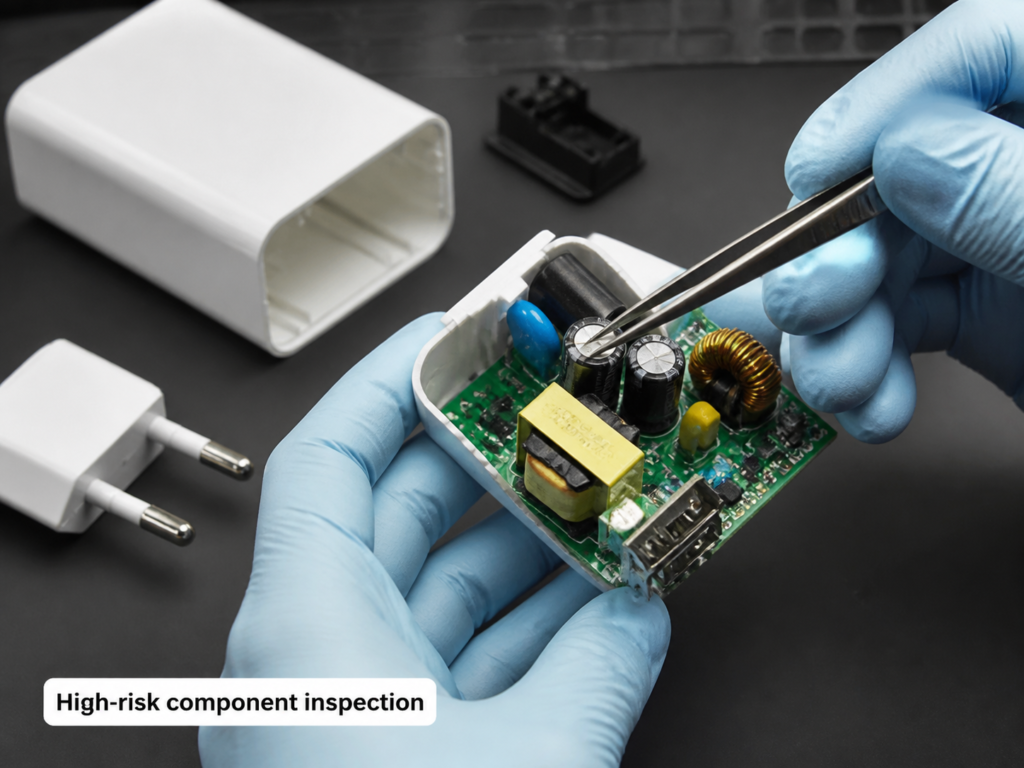
• Cable jackets and insulation layers made of PVC/TPE: may contain phthalates and short-chain chlorinated paraffins
• Plastic housings of chargers: may contain specific restricted flame retardants and heavy metal SVHCs
• Metal contacts and plating: hexavalent chromium should be checked first according to RoHS, and supplementary checks should be made if specific REACH entries are involved
• Solder: prioritize checking RoHS lead limits and exemptions, and correspond to REACH restriction entries simultaneously
• Adhesives and label inks: screen according to specific ingredients; not all are restricted
Ordinary charging cables and chargers, if they do not contain chemical substances intended to be released under normal or reasonably foreseeable conditions of use, are usually managed as “articles” and generally do not trigger registration of substances in articles.
Priority of control requirements
REACH obligations vary in weight. You don’t have to check all of them at once; just follow the priority order:
1. **Restriction List (Annex XVII)**: This is a mandatory market access condition, but applicable substances, uses, scope of articles, limit or migration requirements, effective dates, and exemption conditions must be checked item by item. If an applicable restriction is not met, the product may not be manufactured, placed on the market, or used under the conditions covered by that restriction.
2. **SVHC Candidate List**: When the content in a single article exceeds 0.1%, it may trigger notification, communication, or SCIP obligations, but being included in the candidate list does not mean a ban on sale.
3. **Authorisation List (Annex XIV)**: Authorisation requirements should be judged based on specific substances and their uses; relevant supply chain activities cannot be left unchecked just because the product is an ordinary finished charging product.
4. **SCIP Notification**: This is an independent SVHC information submission obligation under the EU waste framework. When placing products on the EU market and the Northern Ireland market where relevant EU rules apply, it is necessary to judge whether submission is required when the article contains more than 0.1% (by weight) of candidate list substances and the entity does not fall under applicable exceptions.
5. **Article 7(2) Notification**: This needs to be assessed by the article manufacturer or importer. In addition to the SVHC content in each article exceeding 0.1%, the total amount of the substance in articles per year must also exceed 1 ton, and no statutory exemption applies, before notification may be required.
Here we specifically mention the **SVHC information communication obligation** that everyone is most likely to confuse: for complex articles, each “article” within it should be identified in accordance with Article 3(3) of REACH, and whether the SVHC content exceeds 0.1% (by weight) should be judged for each article separately; the total weight of the entire complex article cannot be used to dilute the proportion.
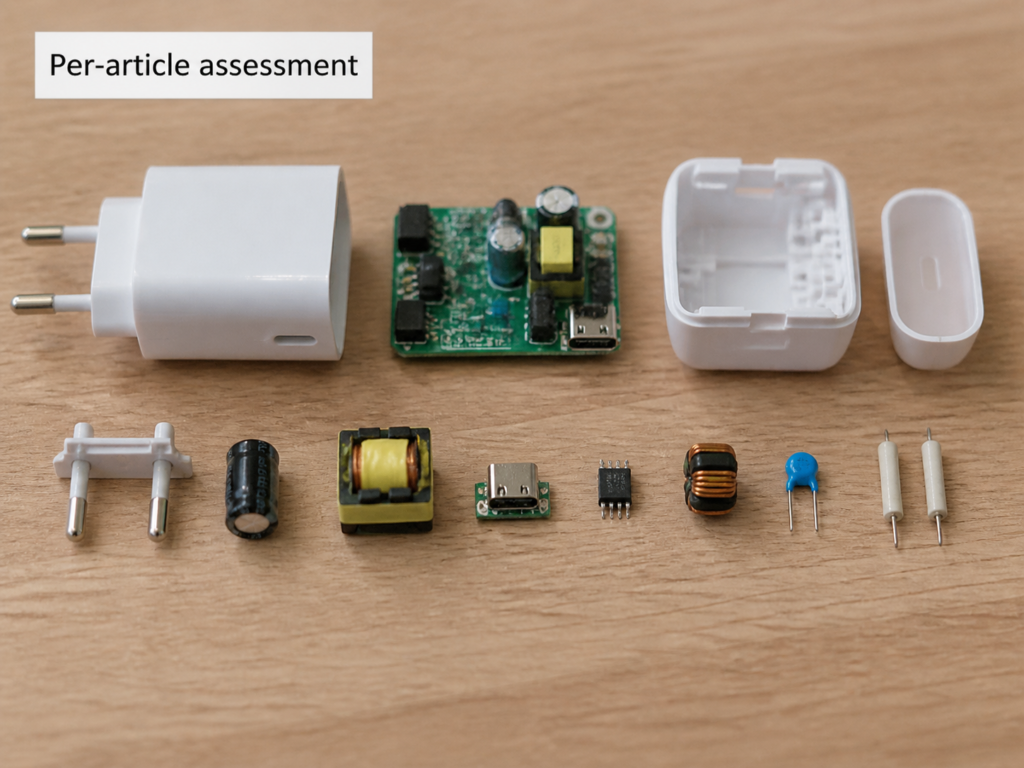
For example, for a charging cable, you cannot simply regard the PVC jacket as an independent article just because it exists; instead, its boundary must be judged in combination with the definition of “article” under REACH. After determining the article boundaries, if phthalates in one of the articles account for 0.2% of the weight of that article, corresponding obligations may be triggered. You cannot include the weight of the entire cable, copper wires, or metal contacts to lower the proportion.
Once triggered, Article 33 requires suppliers to provide information sufficient for safe use, including at least the name of the SVHC; information on the article containing it, usage recommendations, list version, and traceability data can also be supplemented according to risks and customer requirements. For professional buyers (distributors, platforms, etc.), relevant information should be proactively communicated; when ordinary consumers make inquiries, a free reply must be provided within 45 days. Relevant materials should also be kept together with BOMs and test reports for future inspection.
Another key concept is **responsible entity**. Article manufacturers and importers shall assess the registration or notification obligations that may be involved under Article 7; every article supplier in the supply chain, including applicable distributors and retailers, shall fulfill the information communication obligation under Article 33. Who is the importer, manufacturer, or supplier cannot be judged solely by the product label, but should be determined based on the actual place of establishment, flow of goods, contracts, and market placement arrangements.
Many people ask whether they need to find an “Only Representative (OR)”. An OR is an arrangement related to REACH registration, which can be appointed by manufacturers of substances, mixtures, or articles outside the relevant jurisdiction under applicable conditions to perform the registration obligations originally borne by the importer. For ordinary finished charging products without intentionally released substances, it is usually not necessary to appoint an OR due to the article information obligation under Article 33; don’t be tricked into spending extra money.
Origin and Regulatory Boundaries of the Two REACH Regimes
After understanding the basics, let’s talk about why there are two REACH regimes. The UK officially left the EU at the end of 2020. Starting from January 1, 2021, EU REACH no longer applies to Great Britain (England, Scotland, Wales), and the UK launched its own UK REACH — the initial rules were based on the EU REACH at that time, but since then the two sides have applied separately and been revised independently. Now obligations should be confirmed according to their respective effective rules.
The regulators and scope of application of the two sets of rules need to be viewed separately:
• **EU REACH**: ECHA is responsible for relevant scientific, technical, and administrative management, and the competent enforcement authorities of member states are responsible for specific implementation. EU REACH applies to the 27 EU member states; although Northern Ireland is UK territory, relevant EU REACH rules also apply there, not UK REACH. When goods from Northern Ireland enter Great Britain, judgment should be made based on whether the goods are qualifying Northern Ireland goods and specific product rules; qualifying Northern Ireland goods in principle enjoy unfettered access to the Great Britain market, and it cannot be assumed that they must re-meet all GB access arrangements.
• **UK REACH**: HSE assumes the function of the competent authority, and specific enforcement is carried out by the corresponding enforcement authorities in Great Britain according to their duties. It only applies to Great Britain (England, Scotland, Wales).
Dimensional Comparison: Similarities and Core Differences for Finished Charging Products
We have sorted out the core differences between the two sets of rules into a table specifically from the perspective of ordinary charging product sellers, covering only the article-related obligations that everyone frequently encounters, excluding registration details for pure chemical raw materials:
| Comparison Dimension | Similarities | Differences | Core Impact on Charging Product Sellers |
| Core control logic and basic thresholds | The four-module framework is consistent; the underlying logic of article-related obligations is the same; the logic of the 0.1% SVHC trigger threshold for information communication is consistent | The rules on both sides are updated independently, with different revision rhythms and effective dates | You don’t need to re-learn the basic logic, but you must check according to the latest rules of the sales region |
| Substance control lists | The initial lists at the end of the Brexit transition period in 2021 were completely identical | Each is updated independently, and entries, limits, and exemptions may gradually diverge | High-risk substances for ordinary charging products (phthalates, short-chain chlorinated paraffins, specific flame retardants) currently have a high degree of overlap, but separate compliance is required for substances with differences |
| Applicable markets and responsible entities | Obligation entities shall be confirmed based on actual supply chain roles, contracts, import arrangements, and flow of goods | The scope of applicable regions is different; obligations such as registration and statutory notification cannot be automatically replaced across jurisdictions | When selling to both markets simultaneously, applicable regulations, supply chain roles, and legal obligations should be confirmed separately |
| Compliance process and system interoperability | The core logic of restriction compliance and SVHC information communication is consistent; testing methods are universal, and underlying material testing data can be reused | Notification and registration systems are not interoperable (the EU uses the ECHA system, the UK uses the HSE system); registration rules and transition arrangements are independent of each other | Costs can be saved for testing and drafting information communication content, but separate processes are required when notification/registration is needed; ordinary finished charging products usually do not trigger registration |
| Enforcement and penalties | Both are subject to random inspections by local market regulatory authorities, and non-compliance carries risks such as delisting and recall | Enforcement bases and penalty standards are different, and there is no unified penalty amount | As long as you are compliant, you don’t have to worry; if problems do arise, they will be handled according to the rules of the sales region |
To help everyone quickly correspond to their own sales markets, we have also sorted out the core points of cross-market compliance decision-making:
| Sales Region | Applicable Regulation | Responsible Entity | Basic Obligations | Additional Requirements |
| EU 27 member states / Northern Ireland | EU REACH; relevant EU REACH rules apply in Northern Ireland | Determine manufacturer, importer, or article supplier based on actual supply chain roles | Restriction compliance + SVHC information communication | When the article contains more than 0.1% of candidate list substances, assess whether SCIP information must be submitted and whether entity exceptions apply |
| Great Britain (England/Scotland/Wales) | UK REACH | Determine manufacturer, importer, or article supplier based on actual supply chain roles | Restriction compliance + SVHC information communication | No SCIP required |
| Iceland, Liechtenstein, Norway | REACH framework incorporated into the EEA Agreement | Local responsible entities | According to local requirements | Local enforcement, supporting requirements, and SCIP applicability shall be verified separately |
Practical Judgment: Which REACH Regime Applies to Your Charging Products
After talking about the differences, let’s discuss how to specifically judge which process your products should follow. For ordinary finished charging products, just follow these three steps.
Step 1: Determine the regulation based on the first placing on the market
Here is the core judgment principle for everyone: **Judgment should be based on the supply chain arrangement where the product is first manufactured, imported and then supplied, or otherwise provided to a third party in the relevant jurisdiction market**, and cannot be judged solely by the location of the warehouse. The location of the final consumer may be one of the relevant facts, but it cannot replace the judgment of import, place of establishment, contracts, and actual flow of goods.
• Sold to the EU/Northern Ireland: EU REACH applies; relevant EU REACH rules apply in Northern Ireland
• Sold to Great Britain: UK REACH applies
• Sold to Iceland, Liechtenstein, Norway: the REACH framework incorporated into the EEA Agreement applies, and local enforcement and supporting requirements should still be verified
• Sold to both markets simultaneously: confirm applicable lists, supply chain roles, and legal obligations separately, but underlying testing data can be reused
Step 2: Judge the obligation level based on product form and supply chain role
First confirm the product attributes: ordinary charging cables and chargers, as long as they do not contain chemical substances intended to be released under normal or reasonably foreseeable conditions of use, usually belong to “articles”. The basic work is to comply with applicable restriction list requirements and fulfill applicable SVHC information communication obligations. For the EU and the Northern Ireland market where relevant EU rules apply, it is also necessary to judge whether to make a SCIP submission when conditions such as the article containing more than 0.1% of candidate list substances are met.
More obligations need to be assessed only when the following advanced conditions are met:
1. The SVHC content in each article exceeds 0.1%, and the total amount of the SVHC in articles per year by the article manufacturer or importer exceeds 1 ton, and statutory exemptions such as already registered for this use or exposure can be excluded do not apply: it is necessary to assess article SVHC notification.
2. The product contains chemical substances intended to be released under normal or reasonably foreseeable conditions of use, and reaches the corresponding tonnage threshold: it is necessary to assess substance registration.
Let’s emphasize the responsible entities again: article manufacturers and importers shall assess Article 7 obligations; article suppliers in the supply chain shall also fulfill applicable Article 33 information communication obligations. Ordinary finished charging products without intentionally released substances usually do not need to appoint an OR due to article information obligations.
Step 3: Method for quickly checking the control list
You don’t have to check all hundreds of SVHCs at once. It is most efficient to start with the high-risk components of charging products: cables → plastic housings → metal contacts/plating → solder → adhesives/inks.
• Check EU REACH: go to the ECHA official website to find the latest SVHC candidate list and restriction list
• Check UK REACH: go to the HSE official website to find the corresponding latest list
When checking, be sure to look at the latest version, because the lists on both sides are updated irregularly. Also, don’t forget to simultaneously check the RoHS of the corresponding region; REACH and RoHS are independent regulations and cannot replace each other.
Notes for Compliance Implementation of Charging Products
REACH and RoHS shall be checked in parallel and cannot replace each other
REACH and EU/GB RoHS are two completely independent sets of regulations, with different control logics, scopes, and limits. Chargers and charging cables with electronic components need to meet the requirements of both types of regulations at the same time. For example, lead, cadmium, hexavalent chromium, and some phthalates are subject to both types of control, but REACH testing cannot be used to prove RoHS compliance, and vice versa.
Rules for Reusing Testing Evidence
Many sellers care about whether they can save testing fees. Here is a clear statement: **Testing data for underlying materials and target substances can be reused, but general “REACH compliance” conclusions cannot be directly applied across regimes.**
• Prerequisites for reuse: materials, models, formulas/batches, target substances, and testing methods are consistent, and the control lists on both sides have not been updated
• Testing methods must be selected according to target substances and base materials: XRF is usually only suitable as a screening tool for some elements; organic plasticizers, flame retardants, etc. can be quantified using validated methods such as GC-MS; metal elements can be tested using applicable ICP methods after digestion; for speciation or valence state items such as hexavalent chromium, specialized methods that can distinguish the target speciation must be used. Screening results cannot replace quantitative confirmation of applicable items
• No unified validity period: recheck is triggered when materials/BOMs/suppliers change, lists are updated, or customers have requirements
Key Points for High-Risk Component Inspection
Don’t miss these easily overlooked points:
• Cables (PVC/TPE jacket/insulation layer): check phthalates and short-chain chlorinated paraffins separately; cannot use the whole product average
• Plastic housings of chargers: check specific restricted flame retardants and heavy metal SVHCs
• Metal contacts/plating: check hexavalent chromium first according to RoHS, and make supplementary checks if specific REACH entries are involved
• Solder: simultaneously check RoHS lead limits (including exemptions) and REACH restriction entries
Key Points for Long-Term Compliance Monitoring
You don’t have to check every month, but you need to do these things well:
• Subscribe to official list update notifications from ECHA and HSE, and recheck in time when there are changes
• When suppliers change materials, formulas, batches, or colors, require them to re-provide material declarations
• Pay attention to official notifications on registration transition policies and enforcement rules, especially the time-sensitive arrangements of UK REACH, which shall be subject to the latest HSE notifications
Common Misconceptions and Pitfall Avoidance Guide
We have sorted out the most common pitfalls people fall into, and you can check against them to see if you have made any mistakes:
Misconceptions about Regulation Cognition
1. **Misconception**: EU REACH compliance automatically applies to UK REACH
Fact: The two sets of regulations apply separately and are updated independently; registration, statutory notification, and regulatory systems are not automatically mutually recognized. Material data can be reused, but applicable lists, supply chain roles, and legal obligations should be confirmed separately; if the same document covers both regions, the respective regulatory basis and version must be stated.
2. **Misconception**: UK REACH applies to the entire UK
Fact: Relevant EU REACH rules apply in Northern Ireland, and only Great Britain uses UK REACH.
3. **Misconception**: REACH is an official certification with a unified mark
Fact: It is a compliance obligation with no mandatory official mark; just ensure compliance and keep relevant materials properly.
4. **Misconception**: The CE mark covers REACH requirements
Fact: The two are completely independent, and the CE mark does not mean compliance with REACH.
5. **Misconception**: REACH and RoHS are the same thing, and one test report works for both
Fact: They are independent regulations with different control scopes and limits, and need to be judged separately.
6. **Misconception**: Inclusion of an SVHC in the candidate list equals a sales ban
Fact: Inclusion in the candidate list itself usually triggers information communication, and possible notification or SCIP obligations, and does not automatically result in a sales ban; Annex XVII restrictions must be judged based on the substances, uses, scope of articles, limit or migration requirements, dates, and exemption conditions of specific entries.
Misconceptions about Obligation Judgment
1. **Misconception**: Notification is mandatory as long as SVHC exceeds 0.1%
Fact: First judge the Article 33 information communication obligation. Article 7(2) notification also requires simultaneous satisfaction of conditions such as the content in each article exceeding 0.1%, the total amount of the substance in articles per year by the article manufacturer or importer exceeding 1 ton, and no statutory exemption applying.
2. **Misconception**: SCIP notification is the same as SVHC notification
Fact: They are two independent obligations. SCIP is information submission under the waste framework, while SVHC notification is a REACH regulatory requirement.
3. **Misconception**: Registration is required if the annual export of finished charging products exceeds 1 ton
Fact: Registration applies to substances, mixtures, or substances in articles that are intended to be released under normal or reasonably foreseeable conditions of use. Ordinary finished charging products usually do not trigger registration of substances in articles due to their sales volume, but judgment still needs to be made based on actual products and supply chain conditions.
4. **Misconception**: Cross-border sellers must appoint an OR
Fact: An OR is an arrangement related to REACH registration, which can cover substances, mixtures, and articles with intentionally released substances under applicable conditions; ordinary finished charging products without intentionally released substances usually do not need to appoint an OR due to article information obligations.
5. **Misconception**: The 0.1% SVHC threshold is calculated based on the total weight of the whole product
Fact: Each article in a complex article should be identified according to the REACH definition and calculated one by one; the weight of the entire complex article cannot be used to dilute the proportion.
Practical Pitfall Avoidance Reminders
1. Don’t perfunctorily use a general “REACH compliance statement”; the statement must indicate the applicable market, list version, and covered product models; if it covers the EU/Northern Ireland and Great Britain at the same time, the regulatory basis and scope of application should be stated separately for each.
2. Don’t only check the charger main body and ignore the cable; the cable is a high-risk component and needs to be checked separately according to the article definition and specific materials.
3. Don’t use a REACH test report to replace a RoHS compliance certificate; the two sets of regulations require corresponding separate documents.
4. Not all flame retardants and heavy metals are in the REACH restricted list; judgment should be made in combination with BOMs, material declarations, and specific entries; don’t waste money testing substances that are not required.
Quick Summary: 4-Step Checklist
Finally, we have sorted out a 4-step quick checklist for you, which you can follow step by step when doing compliance:
1. **Confirm the market**: Clarify the supply chain arrangement where the product is first supplied or provided to a third party in the relevant market, distinguish between Great Britain, Northern Ireland, the EU, and EEA-related markets, and select the applicable regulation accordingly.
2. **Confirm supply chain roles**: Confirm who are the article manufacturer, importer, and article supplier; manufacturers and importers assess Article 7 obligations, and article suppliers in the supply chain fulfill applicable Article 33 information communication obligations. Ordinary finished products without intentionally released substances usually do not need to appoint an OR due to information obligations.
3. **Fulfill basic obligations**: First complete the inspection of applicable restrictions and SVHC information communication; judge SCIP, SVHC notification, or registration obligations as needed.
4. **Check RoHS in parallel**: Simultaneously complete RoHS compliance for the corresponding region, and recheck in time when materials or control lists are updated.
Overall, although UK REACH and EU REACH have the same origin, they are now rules that apply separately and are updated independently. For ordinary charging product sellers, the basic compliance logic is similar, so there is no need to redo all material testing from scratch twice; but you cannot automatically apply EU conclusions to Great Britain, or vice versa. As long as you grasp the core of “confirming obligations separately according to market and supply chain roles, reusable underlying data, and clear scope of application and version in documents”, you can avoid many detours.