
Sellers of charging and USB products entering the Chinese market almost always encounter the question of SRRC: Do fast chargers with Bluetooth need it? Do ordinary wireless chargers need it? Even charging cables with NFC leave people hesitating for a long time. Many people think that any product with the word “wireless” requires certification, while others believe that low-power products do not. In fact, neither of these perceptions is accurate. Today we will clarify this matter thoroughly, from basic concepts to judgment methods, to quick checks for charging products and practical issues for overseas sellers. After reading this, you will be able to make a fairly accurate judgment on your own.
Core Conclusions First
First, here is the most straightforward conclusion: **Not all products with wireless functions require SRRC certification**.
The core logic for judgment only has three conditions, all of which must be met for certification to be required:
1. The product is manufactured, imported, sold, or used within the territory of mainland China;
2. The product is a device that “actively transmits radio signals”;
3. It does not fall under the official exemption from type approval.
SRRC generally refers to Type Approval for Radio Transmission Equipment. The validity period of the type approval certificate is subject to what is stated on the certificate, which in principle is no less than 2 years and no more than 5 years; except where otherwise required due to adjustments to radio frequency planning or the term of the frequency use license.
If you don’t want to go through the details step by step, there is a dedicated three-step judgment method and a quick reference table for charging products later that you can check directly.
A quick reminder: The consequences of non-compliance are not minor. If at the manufacturing/import stage, products are sold or used without approval, you will be ordered to make corrections, and may also be fined between 50,000 and 200,000 yuan; if at the sales stage, you sell unapproved devices or fail to complete sales filing, there will be corresponding penalties; e-commerce platforms may also request the certificate based on category rules or risk control requirements, and failure to provide it may result in the risk of product delisting.
Three-Step Judgment Method: Check It Yourself
Once you understand the basic concepts, we can use a three-step judgment method for quick self-check, and almost all wireless products can be preliminarily judged using this method. If you are afraid you won’t remember it, you can first memorize a simple mnemonic: **Sold in China, has transmission function, not exempt = usually required; not sold in China / no transmission function / meets exemption requirements = not required**.
Step 1: First Confirm the Sales and Usage Scenarios
First of all, you need to figure out whether your product will enter the territory of mainland China for circulation or use.
Scenarios that require SRRC assessment include: manufacturing in mainland China, offline sales, listing on e-commerce platforms, corporate procurement, import and distribution, and shipping from bonded warehouses to consumers — all of these fall within the scope of domestic sales and use.
Scenarios that do not require assessment at all: products that are only exported to other countries, only sold in Hong Kong, Macau, and Taiwan regions, and have no relation to the mainland China market — you don’t need to worry about China’s SRRC requirements.
There is also a special scenario: if the product enters the country temporarily, such as samples for participating in electronics exhibitions in China, prototypes for testing, or scientific research equipment, you need to apply for temporary approval, and cannot bring them in and use them directly. The specific requirements will be explained in detail in the FAQ later.
Step 2: Confirm Whether There Is Active Radio Transmission Function
This step is the easiest to make mistakes on. Many people think that “my promotional page doesn’t mention wireless functions” or “I turned off Bluetooth in the software” means it doesn’t count, but that’s actually wrong — the judgment standard is **whether the product’s hardware and firmware themselves have transmission capability**, which has nothing to do with whether you promote it or turn off the function.
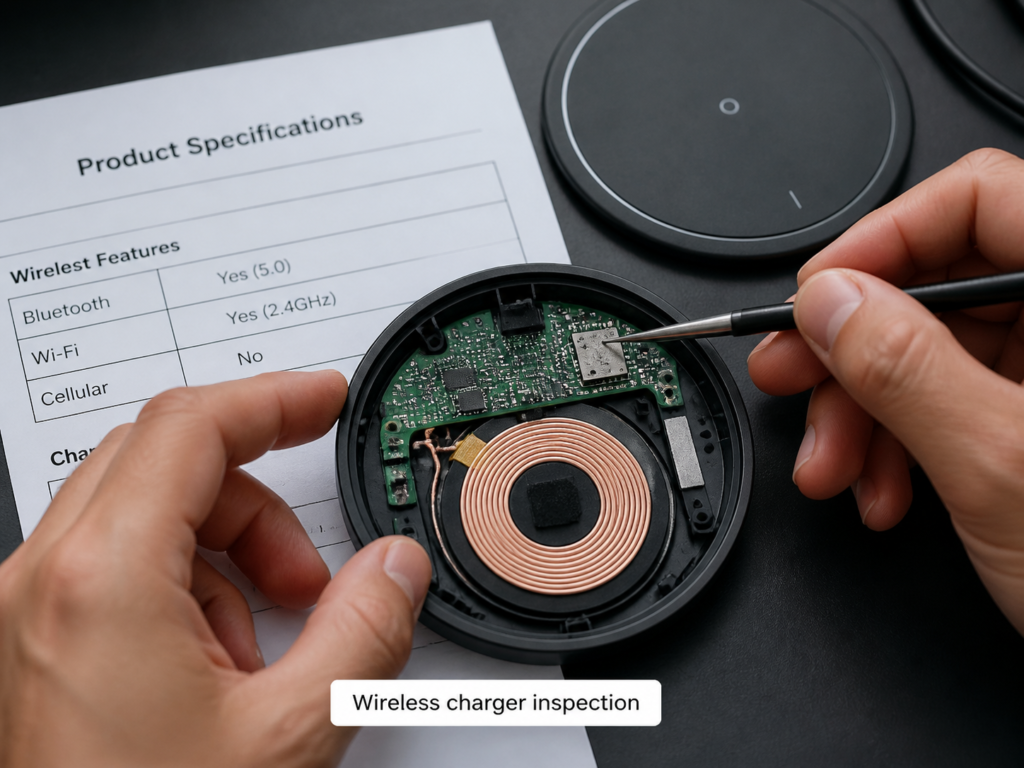
Self-check can start from three aspects:
1. Check the product specification sheet to see if wireless parameters such as Bluetooth, Wi-Fi, and cellular are marked;
2. Confirm whether there are transmission-related hardware components inside the product, such as antennas, wireless modules, and SIM card slots;
3. Verify the firmware configuration to see if there are hidden wireless transmission functions.
For charging products, there is a key point to avoid pitfalls: ordinary wireless charging devices are non-radio equipment that radiates radio waves. The wireless charging (power transmission) part that complies with the does not require type approval, but still must evaluate technical indicators, application scenarios, labeling, and manual requirements in accordance with the special provisions; if the wireless charger has additional Bluetooth or Wi-Fi, for example, allowing users to adjust charging power or view charging data via a mobile phone APP, then this part of the information transmission radio unit needs to be judged separately.
Step 3: Confirm Whether Type Approval Is Required
Not all products with active transmission functions require SRRC. First, we must exclude the cases of exemption from approval:
The first type is products that fully comply with the official and all its technical requirements; due to low power and low interference, they do not need to apply for type approval;
The second type is wireless charging equipment that complies with the , which also does not require SRRC.
It should be particularly noted that conventional 2.4GHz Bluetooth technology devices are not eligible for the Category F exemption clause in the , and should usually be assessed in accordance with type approval requirements; if you claim that other clear exemption provisions apply, you must prove compliance with those provisions item by item.
After excluding the exemption cases, if your product’s operating frequency band and product category fall within the official type approval scope, then you need to apply for SRRC.
Here we first mention a pitfall many people fall into: don’t think that just because the wireless module used has an SRRC certificate, the whole device doesn’t need it — the module certificate only covers the module itself. After being installed in the whole device, because the antenna, power, software, and even usage scenarios may change, it does not automatically exempt the whole device from the approval obligation. We will talk about this in detail in the common misconceptions section later.
Common Misconceptions and Pitfall Avoidance
Even with the judgment method and quick reference table, many sellers still fall into some cognitive pitfalls, especially overseas sellers who are unfamiliar with China’s regulatory rules and can easily be misled. We have compiled the 7 most common misconceptions to help you avoid pitfalls.
Misconception 1: All Products with the Word “Wireless” Require SRRC
This is the most common misunderstanding. In fact, only products that actively transmit radio signals and do not meet the exemption conditions require certification. For example, wireless charging devices purely used for power transmission and products with only receiving functions do not need SRRC.
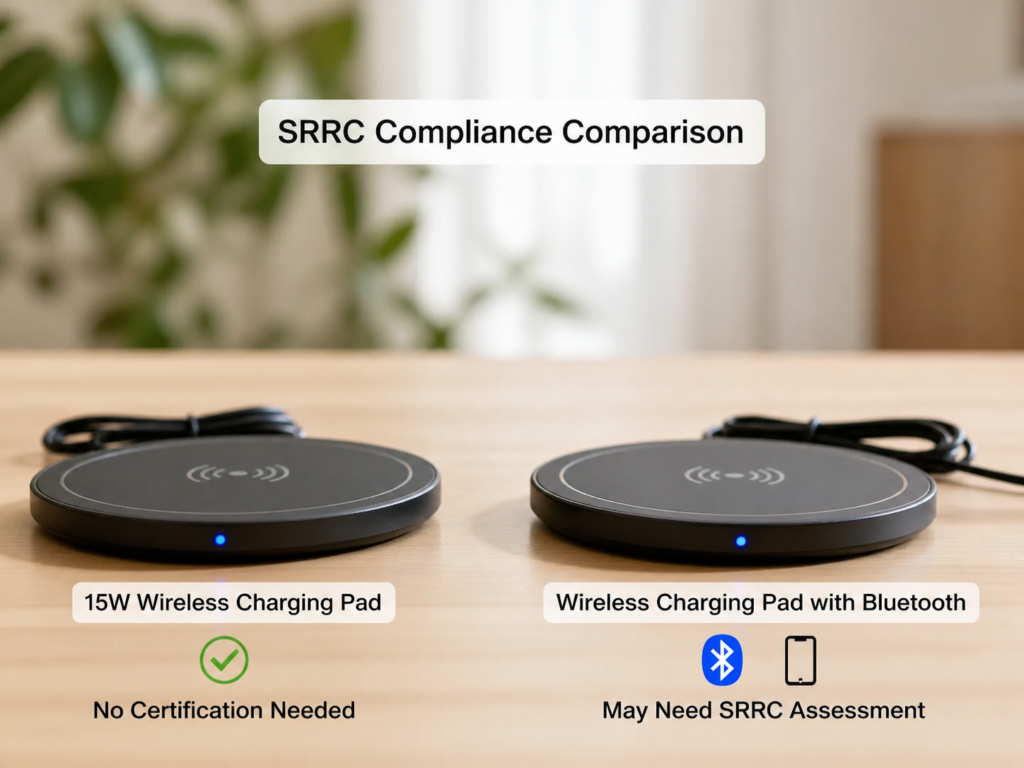
For example: an ordinary 15W wireless charging pad does not need certification, but a wireless charging pad with Bluetooth that allows power adjustment via APP requires assessment of whether the Bluetooth part needs certification.
Misconception 2: Low-Power Wireless Products Definitely Do Not Need SRRC
Many people think that “low power means no interference, so no approval is needed”, but that’s actually wrong. The standard for judging whether it is mandatory is [attributes of the transmission device + whether it meets exemption conditions + whether it is within the approval scope], not simply based on power level. Only products that fully comply with all technical requirements of the official (including frequency band, power, modulation method, usage scenarios, etc.) can be exempted; missing even one condition is not allowed.
For conventional 2.4GHz Bluetooth technology devices, special attention should also be paid: they are not eligible for the Category F exemption clause in this catalogue, and cannot be deemed exempt from type approval just because “Bluetooth power is low”.
Misconception 3: Overseas Wireless Certifications Such as FCC and CE Can Replace SRRC
SRRC is a local mandatory access requirement in China, and overseas certifications such as FCC and CE cannot directly replace it. As for whether test reports issued by overseas laboratories can be used as supporting materials for the application, this must be confirmed by the institution undertaking the SRRC test, and cannot be used directly.
Misconception 4: SRRC and 3C Certification Are the Same Thing, Only One Is Needed
These two are completely different access requirements, with different regulatory targets, and cannot replace each other. SRRC governs the compliance of radio spectrum use, and only targets devices that actively transmit radio signals; 3C certification (CCC) governs product safety and electromagnetic compatibility, and its applicable scope is confirmed according to the officially released catalogue and parameters. Some products may only need one of them, and some need both. For example, ordinary wired fast chargers may need 3C but not SRRC, while smart sockets with Wi-Fi may need both.
For charging products, note: whether a charger with wireless transmission needs 3C certification must be judged separately according to the 3C catalogue, and has nothing to do with SRRC.
Misconception 5: If the Wireless Module Has an SRRC Certificate, the Whole Device Does Not Need It
This is a big pitfall that many sellers have fallen into. The SRRC certificate of the module only covers the module itself. After being installed in the whole device, because the antenna used by the whole device may be different, the transmission power may change, and the software configuration may also be adjusted, the module certificate does not automatically cover the whole device.
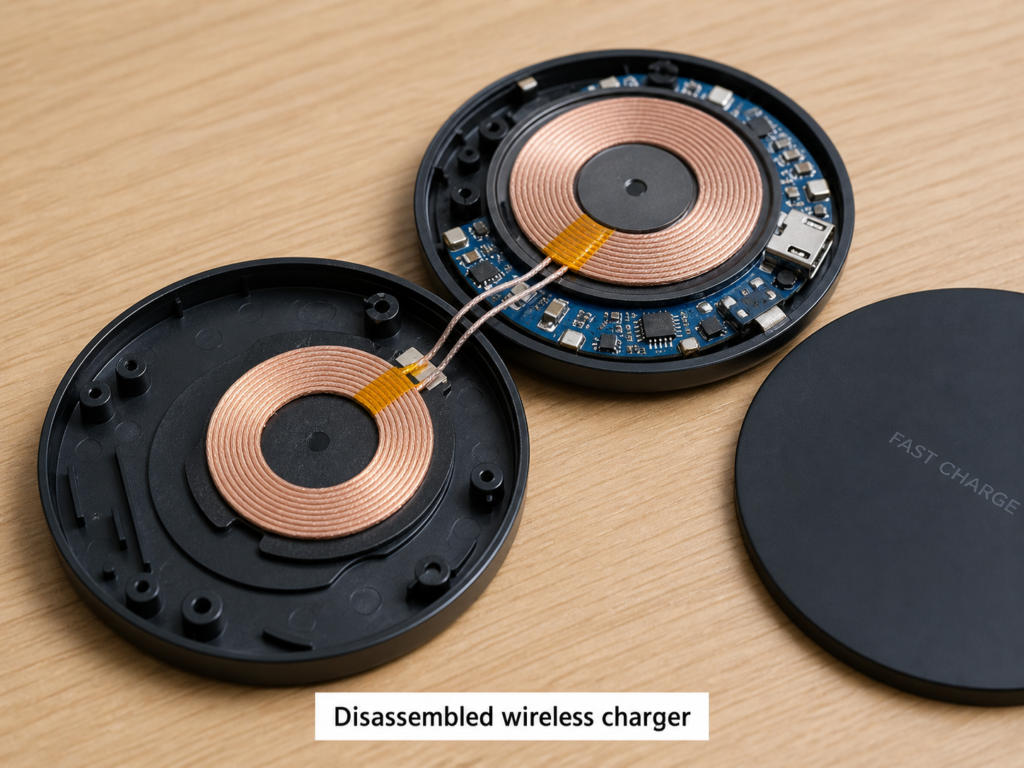
When judging, you should distinguish the module type and conduct a comprehensive assessment combined with the whole device’s antenna, power, software, and usage scenarios. In practice, it is recommended that when purchasing modules, you must ask the supplier for the certificate and the clear scope of certification. It is best to conduct a special assessment before the product goes on the market, and don’t take it for granted that having a module certificate means everything is fine.
For example: you purchase a Bluetooth module with an SRRC certificate and install it in your own fast charger. Because the fast charger uses a self-designed antenna, the final transmission power is different from that when the module is tested alone. In this case, the module certificate cannot cover the whole device, and you still need to assess whether the whole device needs SRRC.
Misconception 6: You Can Sell Directly After Obtaining the SRRC Certificate
The SRRC certificate only meets the requirement of type approval, and does not mean that all compliance work is completed. For example, you also need to complete sales filing in accordance with regulations; if the product is within the 3C catalogue, you also need to obtain the 3C certificate first before selling. In addition, the SRRC certificate is only valid within the territory of mainland China, and is useless outside of China.
Misconception 7: Network Access License (CTA) and SRRC Are the Same Thing
Many people confuse these two, but in fact their applicable scopes are completely different. The Network Access License (abbreviated as CTA) targets terminal devices that access public telecommunication networks, such as mobile phones and routers with SIM cards; SRRC targets all devices that actively transmit radio signals (except those exempt from approval).
For charging products, ordinary charging products are usually not subject to Network Access License. For products with cellular communication functions, whether CTA is required should be verified by checking both whether they access public telecommunication networks and whether they are included in the current catalogue of devices requiring Network Access License, and cannot be judged solely by whether they have a 4G card inserted.
Final Summary
Let’s sort out the core content again for your quick review:
3-Step Self-Check List
1. Step 1: Confirm whether the product is manufactured, imported, sold, or operated within the territory of mainland China — if not, no assessment is needed;
2. Step 2: Check whether the product has an active radio transmission function — if not, no application is needed;
3. Step 3: First exclude cases that comply with official exemption provisions; for the remaining ones, if they fall within the type approval scope, an application is required.
Core Conclusion in One Sentence
Only active radio transmission equipment that is manufactured or imported, sold, and used within the territory of mainland China, and does not comply with exemption provisions, requires SRRC certification.
After reading this article, you should already be able to distinguish whether common charging and USB products fall within the SRRC regulatory scope, use the three-step method to preliminarily judge whether your product needs to apply, avoid the 7 cognitive pitfalls that overseas sellers most often fall into, understand the basic path for overseas brands to apply for SRRC, and know what compliance actions are needed after obtaining the certificate. If you are unsure about borderline cases, it is recommended to find a professional service agency for a special assessment to avoid pitfalls.