
Charger sellers and foreign trade manufacturers operating in the South Korean market almost all ask the same question: Is KC certification mandatory for chargers exported to South Korea? This question seems simple, but many people have actually fallen into the pitfalls of “thinking a KC mark is enough to sell” and “no need for KC if you have CE”. In mild cases, goods are detained and fined; in severe cases, stores are delisted and brands are shut out of the market.
We will first give you a core conclusion for quick judgment, then break down the rules, self-inspection methods and pitfall avoidance points step by step. Even beginners who are entering the South Korean market for the first time can follow along to figure out whether their products need certification and what to do.
Quick Judgment of Core Conclusions
Which Chargers Directly Apply to General Rules
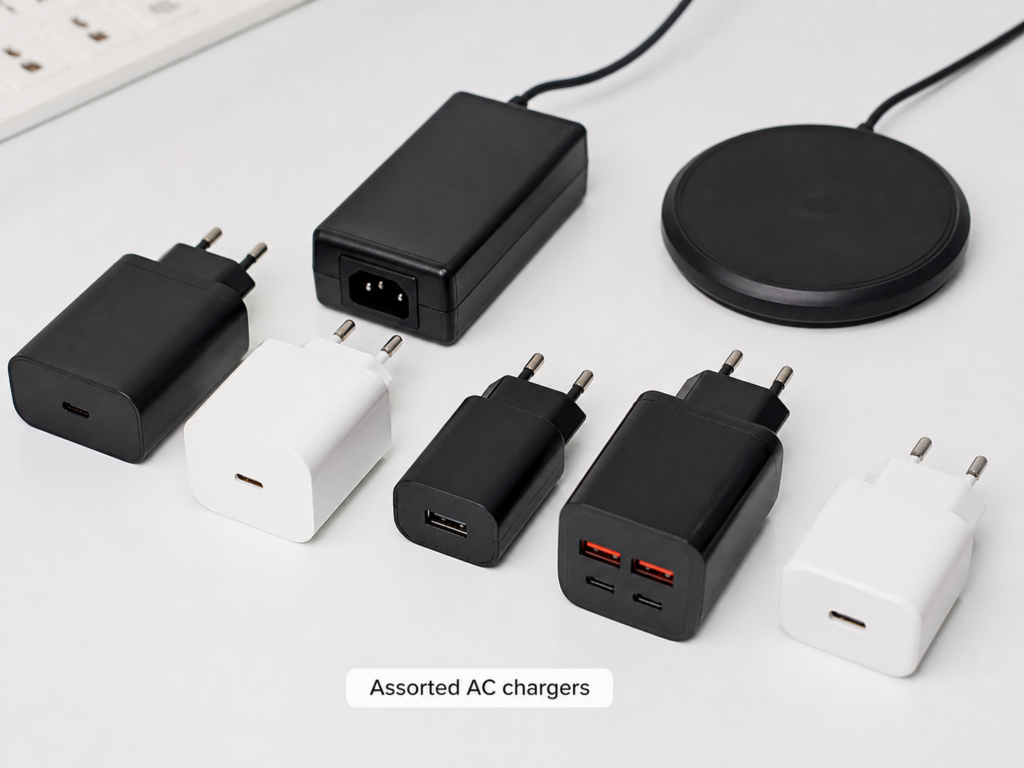
Products directly connected to household AC mains power basically fall into the scope of regular compliance requirements, including common wall chargers, travel chargers, external power adapters, USB-C PD chargers, multi-port GaN chargers, and the mains-side part of mains-powered wireless charging pads.
Which Products Cannot Directly Apply and Require Individual Judgment
Products that only rely on low-voltage DC input, such as car chargers, power banks, as well as pure data cables, passive adapters, and active cables, have different classifications from AC-DC chargers. They need to be individually screened against the official South Korean item catalog, and cannot directly apply the rules for wall chargers.
Preliminary Judgment Conclusion for Ordinary AC-DC Chargers
Ordinary AC mains input chargers sold, imported or manufactured for the South Korean market usually need to meet two sets of independent mandatory requirements at the same time:
The first set is safety certification under electrical safety management, and most of these products are classified under the “DC power supply devices” item;
The second set is the electromagnetic compatibility (EMC) suitability assessment under the , and most consumer-grade and commercial models follow the “suitability registration” path.
If the charger has wireless communication modules such as Bluetooth, Wi-Fi, NFC, etc., an additional suitability assessment for wireless functions is required.
Special note: There is no universal “KC certificate” in South Korea. The finally applicable systems and requirements shall be subject to the actual structure and use of the product, as well as the current catalog of the competent authority.
Quick Exemption Reminder
Exemptions or exceptions cannot be simply judged by “commercial” or “non-commercial” nature. They must be checked respectively against the specific legal categories, uses, quantities, whether they are sold or circulated, whether they are re-exported within a time limit, and whether prior confirmation is required, as stipulated in the electrical safety and Radio Waves Act regulations. Personal carry-in for self-use, internal factory testing, R&D samples, exhibition display, etc., are only some potentially applicable scenarios and do not constitute a complete list.
However, commercial samples, marketing gifts, chargers bundled with complete machines, and products temporarily imported for re-export **cannot be assumed to be exempt**. Be sure to confirm with the official or a qualified service provider in advance.
Common Consequences of Non-Compliance
If products enter the South Korean market without completing compliance as required, common consequences include customs detention, return of goods, and fines; products listed on e-commerce platforms such as Coupang and Gmarket will be delisted or even banned from sale; if the certification mark is fraudulently used or forged, additional penalties will be imposed, affecting the brand’s subsequent market access.
Many people think that “KC certification” is a unified certificate, but in fact, it is a collective term used by the public for the market access compliance of South Korea’s electronic and electrical products, similar to the familiar China 3C and EU CE. However, South Korea’s system structure and mutual recognition rules are different from these, and the core is two completely independent compliance systems that cannot replace each other. We will first clarify the basic concepts so that subsequent judgments will not be wrong.
Basics of South Korea KC Compliance
Two Independent Compliance Systems
South Korea’s electronic and electrical product access is governed by two different laws and supervised by two different departments. The requirements are completely independent and cannot replace each other.
1. Electrical Safety Management System
The legal source of this system is the , supervised by the Korean Agency for Technology and Standards (KATS). Its core is to manage the electrical safety of products, such as whether they will cause electric shock or fire. According to the risk level of products, there are three types of management systems, with requirements from high to low:
| Management System | Factory Inspection Required? | Application Method | Post-approval Management Requirements |
| Safety Certification | Yes | Certificate issued after official audit testing and factory inspection pass | Regular follow-up supervision |
| Safety Confirmation | No | Submit test report from accredited laboratory for declaration | Accept spot checks as required |
| Supplier’s Conformity Confirmation | No | Enterprises keep test reports on file for inspection | Only applicable to items explicitly listed by law; enterprises shall not expand the scope of application on their own |
Ordinary mains-input wall chargers and external power adapters are mostly classified as “DC power supply devices” and are subject to the highest-level “safety certification”, subject to the official catalog.
2. Radio Wave Suitability Assessment System
The legal source of this system is the , supervised by the National Radio Research Agency (RRA) of South Korea. Its core is to manage electromagnetic compatibility (EMC) and wireless communication functions — simply put, the product must not randomly emit electromagnetic waves to interfere with surrounding mobile phones and routers, and must also be able to withstand external electromagnetic interference and work normally.
There are four statutory assessment paths: suitability certification, suitability registration, self-conformity confirmation, and provisional certification. Ordinary chargers generally do not involve provisional certification. Most consumer-grade AC-DC power supplies follow the “suitability registration” path.
How to Identify and Query Compliance Marks
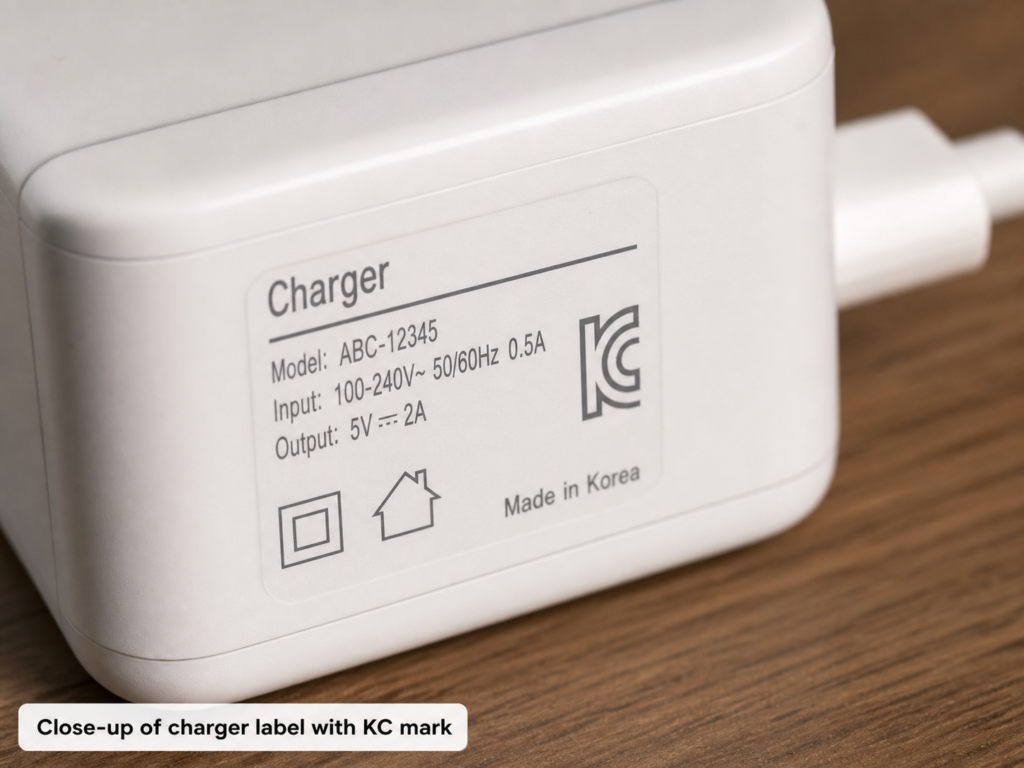
Many people only check whether there is a KC mark on the product, but in fact, electrical safety and Radio Waves Act suitability assessment are independent obligations. Usually, it is necessary to obtain corresponding safety certification, declaration or suitability assessment results respectively, and mark the corresponding identification numbers in accordance with their respective rules. Both can use the same unified national KC mark, so just seeing the KC graphic itself cannot prove that the product has met both sets of systems at the same time.
Electrical Safety Marks
Safety marks shall in principle be marked on the product body. Only in legal exceptions such as small products and components can some unmarked items be marked on hang tags or packaging in accordance with the rules. The content and format of the mark shall meet the requirements of the corresponding system, including an exclusive identification code.
For inquiries, you can go to Safety Korea, the South Korean product safety information portal, and cross-check with the certification/confirmation number, model, and manufacturer information. The results shall be subject to KATS rules and system registration.
Radio Waves Act Suitability Assessment Marks
The Radio Waves Act suitability assessment mark shall be marked on the equipment or packaging, and the identification code shall be marked in accordance with the requirements of the corresponding assessment path. If eligible electronic labels are used, corresponding prompts shall be provided on the packaging or manual in accordance with the electronic label rules; the manual cannot be generally used to replace the statutory marking on the product or packaging.
For inquiries, go to the official system of the National Radio Research Agency (RRA) of South Korea, and cross-check with the assessment number and model information.
Easily Confused South Korea Related Compliance Items
Many people confuse other South Korean certifications with KC access. Here is a clarification:
• **”KCC Certification”**: This legal name no longer exists. It corresponds to the suitability assessment under the , which is uniformly managed by the RRA.
• **KC RF Certification**: It is only required for products with wireless communication functions such as Bluetooth and Wi-Fi, and is not a mandatory item for all chargers.
• **KS Industrial Standard Certification**: This is a voluntary industry standard, not a mandatory market access requirement.
• **Energy Efficiency Requirements**: Some external power adapters need to meet the requirements of standby power consumption and conversion efficiency, but this is a separate regulation and does not fall under the category of KC safety or the Radio Waves Act.
Differences from Certifications of Other Countries/Regions
Overseas certification certificates such as EU CE and US FCC/UL **cannot directly replace** South Korea’s statutory compliance requirements.
If you have CB reports or overseas compliance test reports, you can submit them as technical references. If they meet the requirements of South Korean institutions, they may be accepted to reduce some repeated testing. However, the specific applicability and extent of use shall be subject to the written confirmation of the accepting institution.
After understanding the basic rules, you can follow the three-step method below to make a preliminary judgment on the compliance obligations of your product by yourself, so you don’t have to find a service provider and waste money at the very beginning.
Self-Inspection Method for Charger South Korea Compliance
Prepare 6 Items of Information Before Self-Inspection
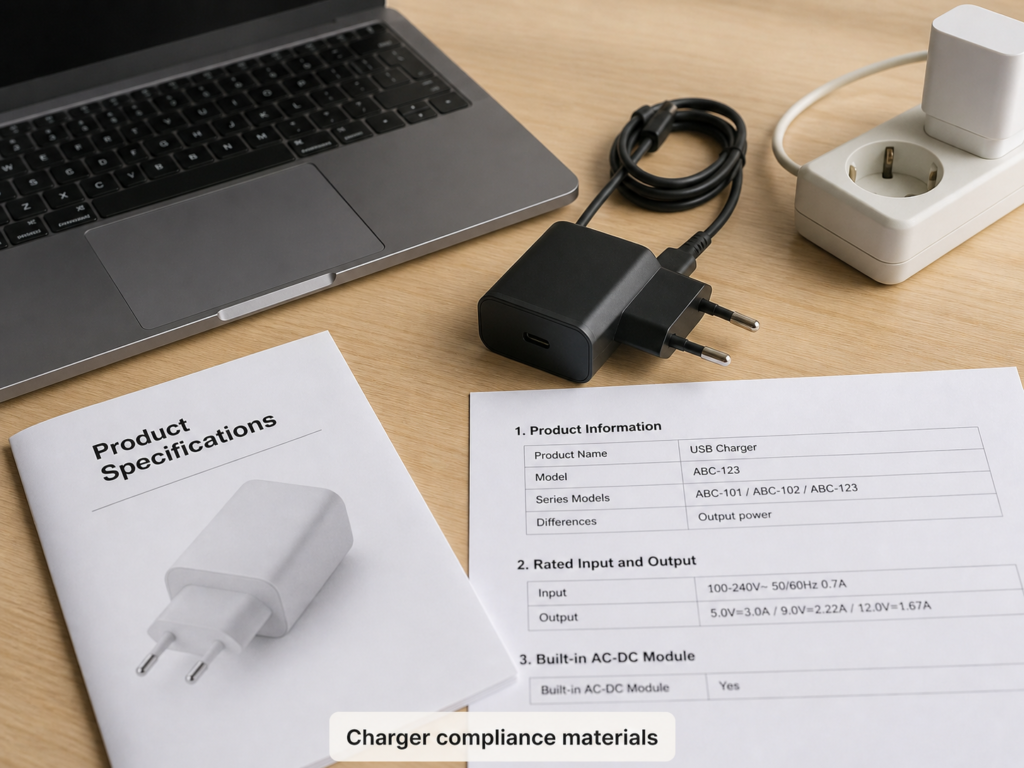
Before starting the judgment, prepare these materials first to avoid detours:
1. Korean/English product name, model, and difference description of different models in the same series;
2. Rated input and output parameters;
3. Whether the product has a built-in AC-DC power conversion module;
4. Whether it has wireless communication functions such as Bluetooth, Wi-Fi, NFC;
5. Sales method in South Korea: separate retail, bundled with complete machines, used as repair parts, or samples, gifts;
6. Sales channel: offline, e-commerce platform, or cross-border direct mail.
Step 1: Preliminary Judgment of Basic Obligations by Product Form
First, based on the power supply method and function of the product, preliminarily judge the compliance direction that needs to be checked:
• **AC-DC chargers/adapters directly connected to AC mains**: Need to check both electrical safety and EMC suitability assessment requirements;
• **Products with only low-voltage DC input**: Such as car chargers, do not apply to the general judgment logic of AC-DC chargers, and need to be checked against official items separately;
• **Wireless charging products**: Need to check item classification, safety and EMC requirements as a complete product. Note that “wireless power transmission” is not equal to “communication RF requirements”, do not confuse them;
• **Pure data cables/passive adapters/active cables**: Judge separately based on actual functions and official items, and cannot directly apply the rules of chargers.
Here are some preliminary judgment examples of common products, for reference only, and the final decision shall be subject to the official catalog:
• 65W USB-C GaN wall charger (AC input, no wireless function): Usually safety certification + EMC suitability registration;
• AC input wireless charger (no Bluetooth/Wi-Fi): Check safety + EMC requirements as a complete product;
• Wireless charger with Bluetooth App control: Need to meet safety + EMC + wireless function suitability assessment;
• Car charger with only 12/24V DC input: Does not apply to the judgment logic of AC-DC DC power supply devices, need to check official items separately;
• Battery chargers with output voltage exceeding 50V: The EMC path may be different, and it is necessary to focus on checking the applicable conditions of self-conformity confirmation.
Step 2: Judgment of Sales/Import Scenarios and Exemptions
The fact that a product itself falls within the mandatory scope does not mean that certification is required in all cases. It also depends on the sales and import scenarios:
Scenarios Usually in Mandatory Scope, Cannot Be Assumed Exempt
As long as it is commercial sales to South Korean consumers, it is basically within the mandatory scope, including separate retail, bulk supply to South Korean customers, e-commerce platform listing, marketing gifts, and even cross-border direct mail to consumers. Even if there is only 1 unit, it cannot be assumed to be exempt.
Scenarios That May Apply Exemptions/Exceptions, Require Item-by-Item Verification
Exemptions or exceptions cannot be summarized by “commercial use” or “non-commercial use”, but must be judged respectively according to the specific legal categories of electrical safety and the Radio Waves Act. Personal carry-in for self-use, internal factory testing, R&D samples, exhibition display, repair parts, temporary import for re-export, etc., are only some potentially applicable scenarios; scenarios such as non-sales samples for market research and export-only equipment may also have their own conditions, and cannot be applied on your own.
Core Conditions for Exemption
Even for the potentially exempt scenarios mentioned above, several conditions must be met at the same time:
1. Meet the statutory use requirements, and meet the restrictions on whether sales, distribution or resale is allowed;
2. The quantity meets the quota requirements of the corresponding regulations;
3. For items requiring prior application, exemption approval documents from competent authorities such as the RRA have been obtained;
4. For cases involving time-limited re-export, supplementary materials such as re-export commitments and non-sale certificates can be provided.
If the boundary is blurred and you are unsure, do not make a judgment by yourself. You must verify with the official or a qualified service provider.
Step 3: Check Official Catalog to Determine Final Processing Path
Preliminary judgment and scenario judgment are only initial. The final applicable system must be subject to the current official item catalog.
You need to search two official catalogs at the same time: one is the electrical appliance safety management item catalog of KATS/Safety Korea, and the other is the radio wave suitability assessment item catalog of the RRA.
When searching, record several core pieces of information: the name of the corresponding item, the applicable system/path category, mandatory standards, applicant subject requirements, and marking rules.
If you have questions about item classification, you can apply for pre-classification to an officially recognized institution and obtain a written confirmation opinion to avoid subsequent errors.
After initially determining the items that need to be processed, we will break down the core requirements of each item so that you know what is being checked for compliance and will not be led by the service provider.
Core Compliance Requirements (Check by Item)
Electrical Safety Management (Core Mandatory Item)
System Judgment Rules
The three types of electrical safety systems are applied entirely based on the official South Korean item classification, and the final decision is subject to the current item catalog of Safety Korea/KATS. Generally speaking, ordinary mains-input wall chargers and external power adapters are mostly classified as safety certification objects under “DC power supply devices”.
Core Focus of Safety Testing
Many people think safety testing is very complicated, but the core is actually four directions:
1. **Electric shock protection**: Insulation performance meets the standard, and there will be no electric shock injury whether in normal use or in case of minor faults;
2. **Fire and overheating protection**: The temperature rise of the product, and the flame retardant performance of the shell and internal components meet the requirements, and will not cause fire;
3. **Consistency of rated parameters and safety structure**: The rated values marked on the product, the internal structure, and the insulation design must be completely consistent with the test samples;
4. **Safety under abnormal conditions**: No safety accidents will be caused in case of short circuit, overload and other abnormal conditions.
It should be noted that the compatibility of fast charging protocols such as USB PD/PPS and the current carrying capacity of cables fall into the category of performance verification, and will not be automatically guaranteed by passing KC safety compliance. Do not confuse safety certification with performance testing.
EMC Suitability Assessment Under the Radio Waves Act (Parallel Mandatory Item)
EMC is electromagnetic compatibility. Simply put, there are two requirements: the product will not emit excessive electromagnetic waves to interfere with surrounding electronic equipment when working, and at the same time can resist external electromagnetic interference and work normally.
The legal source of this set of requirements is the broadcasting and communication equipment suitability assessment under South Korea’s , supervised by the RRA. It is completely independent from electrical safety and cannot replace each other.
The statutory assessment paths include suitability certification, suitability registration, self-conformity confirmation, provisional certification, etc. The preliminary judgment reference for common products is as follows:
• Ordinary consumer/commercial AC-DC DC power supply devices: Usually suitability registration;
• Battery chargers with output voltage exceeding 50V: May apply self-conformity confirmation;
• Specific power equipment for manufacturing/production processes: May apply self-conformity confirmation;
• Products with wireless communication modules: Wireless functions are checked separately according to corresponding RF items, and are not included in ordinary EMC.
Functional Additional Requirement Matrix (Check as Needed)
If your product has additional functions, you need to add corresponding compliance items accordingly, do not miss them:
• Smart chargers with wireless communication modules such as Bluetooth, Wi-Fi, NFC: Additionally check wireless suitability assessment requirements;
• Wireless charging products: Check safety and EMC requirements separately according to the corresponding items. Do not equate wireless power transmission with communication RF requirements;
• Vehicle DC input charging products: Screen compliance requirements separately according to the official corresponding items;
• Combined chargers (with sockets, speakers, night lights and other functions): Check corresponding requirements respectively for all functions of the complete product;
• External power adapters: Additionally check energy efficiency requirements such as standby power consumption and conversion efficiency. This is a separate regulation and does not fall under the category of KC safety or the Radio Waves Act.
Statutory Marking Requirements for Products/Packaging
After compliance is completed, there are strict requirements for marking, and you cannot paste them randomly:
• Safety marks: Safety marks are in principle marked on the product body; only in legal exceptions such as small products and components can some unmarked items be marked on hang tags or packaging in accordance with the rules, and the content, format and presentation position of the marks shall be checked;
• Radio wave marks: Marked on the equipment or packaging in accordance with the requirements of the corresponding suitability assessment path, and the content, format and position of the marks shall be checked; if electronic labels are applicable, special rules for electronic labels shall also be followed;
• General additional requirements: Korean manuals and safety warnings must meet the standards of the corresponding items and the requirements of sales channels;
• Key principle: Electrical safety and Radio Waves Act suitability assessment are independent obligations, and usually must obtain corresponding results respectively and mark corresponding identification numbers in accordance with their respective rules; both can use the same unified national KC mark, so it cannot be judged that both types of compliance have been completed only by the same KC graphic.
If you are sure you need to handle compliance, we have sorted out a simplified version of basic knowledge for the most concerned questions of beginners: “who to handle it with, how to handle it, and what to prepare”, which is enough for you to avoid pitfalls when docking with service providers.
Basic Knowledge of Compliance Processing (Simplified Version)
Division of Roles Related to Processing
• **Responsible subject**: Most projects require a South Korean importer or authorized agent as the application subject, and overseas manufacturers can handle it through local subjects;
• **Electrical safety category**: Supervised by KATS, officially recognized safety certification bodies (such as KTL, KTC) are responsible for audit, and designated testing institutions are responsible for testing;
• **Radio wave/EMC category**: The RRA is responsible for the management of suitability assessment, and designated testing institutions are responsible for testing; after completing testing and document preparation in accordance with the applicable path, submit an application or registration through the e-Civil Service Center of the Ministry of Science and ICT of Korea (eMSIT);
• **Report acceptance rules**: Whether pre-test reports from domestic laboratories can be adopted by South Korean institutions must be confirmed in writing by South Korean recognized institutions in advance. Do not take it for granted.
General Processing Flow
No matter what type of compliance it is, the basic process is four steps:
1. **Product classification pre-review**: First confirm all applicable compliance items and corresponding systems/paths to avoid missing or doing extra items;
2. **Test preparation**: Prepare final finalized samples and complete technical documents, and send them to an accredited laboratory to complete the corresponding tests;
3. **Submit application**: Submit an application or declaration in accordance with the system requirements. Safety certification requires cooperation with factory inspection, and the specific requirements depend on the system;
4. **Obtain results**: After passing the test and audit, you can get the certificate or complete the registration; if you fail, you need to rectify and retest.
Typical Processing Document Package
The materials required for processing are roughly divided into four categories. Preparing them in advance can save a lot of time:
1. **Basic product information**: Model difference table, specification sheet, appearance drawing, nameplate/label draft;
2. **Technical documents**: Key component list (BOM), circuit diagram/PCB materials (provided according to institutional requirements), Korean manual and safety warning text;
3. **Testing related**: Corresponding quantity of finalized samples. Existing CB reports and EMC test reports can be submitted together as a reference to reduce repeated testing;
4. **Subject information**: Basic information of the applicant, manufacturer, and importer, provided as required.
Precautions for Cycle, Samples and Maintenance
• The test cycle, the number of samples required, and whether factory inspection is required are all subject to the final model, applicable system, and written reply of the accepting institution. There is no unified standard;
• When the product is modified, such as replacing the circuit, plug, shell, key components, or adding/removing functions, be sure to confirm in advance whether to re-apply or make a change declaration;
• If there are standard updates or regulatory adjustments, check the validity of existing certifications/assessments in accordance with official requirements. Do not think that getting the certificate is once and for all.
In addition, there are several South Korean localization points to note: The product must meet South Korea’s rated grid parameters and plug configuration requirements; Korean nameplates, manuals, and safety warnings must meet official rules; the information of the South Korean importer or local agent must be marked; mass-produced products shall be consistent with the certified or registered basic model, approved derivative models, and technical documents that have completed change procedures. Differences involving models, key components, circuits, structures, wireless modules or parameters shall be confirmed before mass production and sales in accordance with the applicable system whether they can be used as derivative models, whether change registration, supplementary testing or re-application is required. Without confirmation, the original compliance documents or numbers shall not be used.
We have sorted out the 7 most common cognitive misconceptions. 90% of compliance problems come from these places. Avoiding them in advance can save a lot of money and time.
Common Misconceptions and Pitfall Avoidance Guide
Misconception 1: CE/FCC/UL/CB can directly replace South Korea compliance
**Error point**: Overseas certification certificates cannot directly replace South Korea’s statutory compliance requirements, even CB reports are no exception.
**Supplementary explanation**: Eligible CB reports and overseas test reports may be accepted by South Korean institutions to reduce some repeated testing, but the specific applicability is subject to the rules of the accepting institution.
**Pitfall avoidance method**: Do not directly use overseas certificates as proof of South Korea compliance. Confirm the requirements with local institutions in advance.
Misconception 2: Printing a KC mark on the product means it can be launched for sale
**Error point**: The KC mark must correspond to valid compliance documents, and the information on the mark must be completely consistent with the official registration. Pasting the mark without valid documents is fraudulent use. The KC graphic itself cannot prove that the product has completed both the electrical safety and Radio Waves Act systems. It is also necessary to check the corresponding identification numbers and official records respectively.
**Consequences**: In mild cases, goods are detained and fined; in severe cases, the brand’s subsequent market access is affected.
**Pitfall avoidance method**: Paste the mark after obtaining the certificate or completing the registration. Be sure to verify the status in the two official systems of Safety Korea and RRA before launch.
Misconception 3: Products of the same series with the same appearance can share one certification
**Error point**: South Korea’s compliance is judged based on official items, key parameters and internal structure, and has no direct relationship with appearance. When there are internal differences in products, you cannot determine on your own that the original certification or assessment number can be shared; however, after meeting the similarity conditions and completing the assessment, derivative model registration or change procedures required by the certification body or RRA, some derivative models or approved changes can use the corresponding compliance results.
**Change dimensions that require key assessment**: Rated input/output parameters, insulation and creepage distance, PCB layout and EMI filter circuit, etc.
**Pitfall avoidance method**: Before adding new models or making product changes, first submit them to the certification body for assessment, confirm whether they can be used as derivative models, whether change registration, supplementary testing or re-application is required, and proceed after obtaining written confirmation results.
Misconception 4: Small changes don’t need to confirm compliance validity
**Error point**: Changes of different components and parameters have different impacts on compliance. You cannot default that compliance is still valid just because “the change is small”. Different changes may require confirmation in accordance with the applicable system whether they belong to derivative models, whether change registration, supplementary testing or re-application is needed.
The impacts of different changes are roughly divided into three categories:
• Those that may affect safety compliance: Replacement of key safety components, adjustment of circuit structure, replacement of shell flame retardant materials, change of input plug specifications;
• Those that may affect EMC/wireless compliance: Replacement of PCB layout, addition/removal of filter components, replacement of wireless modules, adjustment of RF parameter firmware;
• Those that may affect marking validity: Modification of model, manufacturer/importer information, adjustment of label format.
**Pitfall avoidance method**: Before any product change, first submit the change description to the certification body or compliance service provider, and obtain written confirmation before mass production.
Misconception 5: Cross-border e-commerce direct mail and small-batch samples don’t need compliance
**Error point**: Commercial sales to South Korean consumers, including cross-border direct mail and marketing gifts, even if there is only 1 sample order, usually cannot be exempted.
**Supplementary explanation**: Possible exceptions such as testing, R&D, exhibition, personal use, market research samples, time-limited re-export, etc., must be checked respectively according to the specific categories and conditions of safety, radio wave and customs, and are not all exempted by “non-commercial use”.
**Pitfall avoidance method**: Before listing on cross-border e-commerce platforms, be sure to confirm compliance requirements in advance. Do not take chances to evade compliance in the name of “personal parcels”.
Misconception 6: If the complete machine has KC, the bundled charger doesn’t need to be done separately by default
**Error point**: South Korea has no general rule that “if the complete machine has KC, accessories are automatically exempted”.
**Judgment basis**: It depends on whether the certification of the complete machine covers the model of this charger, and the accessories cannot be sold or circulated separately.
**Pitfall avoidance method**: Confirm with South Korean customers and competent authorities in advance, obtain written opinions, and do not assume exemption.
Misconception 7: All KC-related certifications have a unified validity period, and renewal can keep them valid forever
**Error point**: Maintenance rules vary by system and path, and there is no unified validity period.
**Correct approach**: Regularly check the registration status of the official system, and timely confirm the validity of compliance when products change or standards are updated.
**Pitfall avoidance method**: Do not apply a unified renewal time to all items. Check maintenance requirements with the service provider in advance.
If you are unsure by yourself, or want to finally confirm the compliance requirements, what are the formal channels? What should be checked before launch? We have sorted out ready-made channels and checklists, just follow them.
Confirmation Channels and Checklists
Formal Confirmation Channels
Do not trust the “general rules” on the Internet. The information from official channels shall prevail:
1. **Official dual system query**: For electrical safety, check the Safety Korea system; for radio wave suitability assessment, check the RRA official system;
2. Consult officially recognized certification bodies in South Korea, or qualified compliance service providers;
3. Directly check the latest mandatory item catalogs issued by KATS and RRA;
4. Confirm specific requirements with South Korean importers and e-commerce platform (such as Coupang) operators in advance. Different platforms may have additional requirements.
Product Information Self-Inspection Checklist
Before consulting or querying, organize this information first to improve efficiency:
• Basic information: Product name, model, brand, manufacturer/importer information;
• Electrical parameters: Input and output rated values, whether AC-DC conversion module is included;
• Function information: Whether with wireless communication, wireless charging, combined functions;
• Sales information: Whether sold separately, sales channel, whether it is bundled/sample/gift.
Pre-launch Compliance Checklist
Before formal delivery and listing, check these items one by one to avoid problems:
□ Electrical safety management items have been completed and are in valid status
□ EMC suitability assessment requirements have been met (if required)
□ Additional requirements such as wireless and energy efficiency have been met (if required)
□ Marking information on product/packaging/manual meets official and platform requirements
□ Mass-produced products are consistent with the certified or registered basic model, approved derivative models and technical documents that have completed change procedures; when involving differences in models, parameters, manufacturers, etc., confirmation or change procedures have been completed as required
Core Action Conclusions
If you still don’t know where to start, follow these four steps and you won’t go wrong:
Step 1: First confirm whether the product is an AC-DC mains input type, and exclude inapplicable objects such as pure DC input and passive accessories;
Step 2: Determine the required compliance items according to the process of “preliminary judgment by product form → sales/exemption check → official catalog verification”;
Step 3: Distinguish independent obligations of different legal sources such as safety, EMC, wireless, and energy efficiency, which cannot replace each other;
Step 4: After obtaining compliance documents, first verify the status of the official system, and confirm the validity in advance before product changes, to avoid the risks of detention, fines and delisting.
Frequently Asked Questions
How much does South Korea charger KC certification cost?
There is no unified standard for the cost, which depends on the product type, applicable system/path, test items, whether factory inspection is required, and the content of agency services.
For conventional ordinary AC-DC wall chargers, handling safety certification + EMC suitability registration usually costs several thousand to tens of thousands of RMB; if there are additional functions such as wireless charging and Bluetooth, corresponding test fees will be added.
How long is the cycle of South Korea KC certification?
There is no unified standard for the cycle, which depends on the complexity of the product, applicable system, whether the test can pass at one time, and the preparation of documents.
For the safety certification + EMC suitability registration of conventional ordinary AC-DC wall chargers, it usually takes 4-8 weeks, excluding the time for sample rectification. Safety certification requires additional time for factory inspection, and the cycle of safety confirmation and suitability registration is relatively shorter.
Do USB-C PD/GaN chargers need KC?
AC mains input USB-C PD/GaN chargers sold to the South Korean market all need to complete compliance as required.
You cannot claim exemption on your own or apply a system with lower requirements just because of GaN technology, multi-port design, or low power. The final decision shall be subject to the official items.
Can products with CE/CB certification be sold directly in South Korea?
They cannot be sold directly. CE/CB certificates themselves cannot replace South Korea’s statutory safety certification or radio wave suitability assessment.
Eligible CB reports and EMC test reports may be accepted by South Korean institutions to reduce some repeated testing, subject to the rules of the accepting institution.
Do car chargers and charging cables need KC?
Car chargers with only low-voltage DC input do not apply to the compliance logic of AC-DC wall chargers, and need to be judged separately according to the official South Korean item catalog.
Pure data cables and passive adapters are usually not within the scope of mandatory electrical safety certification.
The final decision shall be subject to the actual function of the product and the current official item catalog.
Do chargers bundled with complete machines need to do KC separately?
There is no general exemption rule. It depends on whether the complete machine certification covers the model and parameters of the charger, and the charger is not circulated and sold separately.
If the charger will be sold separately, circulated as a repair accessory, or the complete machine certification does not cover this model, you need to handle compliance separately.
It is recommended to obtain written confirmation from the South Korean competent authority or customer in advance to avoid compliance risks.
Overall, the compliance of chargers exported to South Korea is not that complicated. The core is to first distinguish whether the product is an AC-DC type with mains input, then correspond to the two independent systems of electrical safety and the Radio Waves Act. Do not believe statements such as “universal KC certificate” and “one certificate covers all”. Follow the official catalog and process, and you can successfully enter the South Korean market. If you are unsure about product classification, you must confirm with an officially recognized institution in advance. Do not take chances to ship goods, otherwise the loss of detention and return will be much greater than the compliance cost.