
Many sellers doing North American cross-border e-commerce, or friends planning to bring charging devices to live in Canada, often have a question: My product has already obtained US FCC certification, can I directly sell/use it in Canada? After all, the US and Canadian markets are close, and the rules seem similar. But the actual situation is that using FCC certification directly to list and sell products in Canada is very likely to cause problems such as customs detention of goods and platform delisting — but not all FCC documentation is completely useless; some test results can be reused to save costs. Today, we will take the most familiar products such as charging cables, chargers, and wireless chargers as examples to explain this matter thoroughly.
Let’s Clarify the Core Conclusions First
First, here is the most straightforward judgment logic: Canada’s market access does not only look at RF/electromagnetic compatibility, but requires passing four barriers at the same time: **federal ISED electromagnetic/RF requirements + provincial electrical safety requirements + labeling language requirements + matching of import/sale responsible entities**. FCC only regulates electromagnetic interference and RF emission in the US, it does not even cover electrical safety in the US, let alone meet all of Canada’s access requirements.
Many people have heard of the US-Canada Mutual Recognition Agreement (MRA) and think that FCC certificates can be directly used universally, but that is not the case: what is mutually recognized is only the qualification of the other party’s qualified laboratories and eligible test results. The FCC certificate itself will not be automatically recognized by Canada. Whether it can be reused and how much can be reused depends entirely on the product type, compliance form, and standard matching degree.
Preliminary Conclusions for Different Charging Products
We will first draw a rough scope for common charging products, and then explain the judgment details later:
• **Passive charging cables (ordinary cables without chips)**: They have no active circuits themselves, so neither FCC nor Canada’s ISED mandates EMC/RF compliance, but they must still comply with product safety and packaging labeling rules.
• **Active data cables/wired chargers**: Eligible FCC Part 15B test data may be used as technical documentation for Canada’s ICES-003 compliance assessment, but it cannot automatically replace the ICES-003 assessment. It is necessary to verify the standard version, limits, test configuration, and laboratory accreditation scope, and conduct supplementary tests and complete the Canadian Supplier’s Declaration if necessary.
• **Inductive wireless charging products (such as ordinary Qi wireless chargers)**: Applicable Canadian requirements shall be confirmed in accordance with RSS-216, RSS-Gen, and ISED’s current certification procedures. FCC test documentation may be used as a technical reference, but the Canadian regulatory form cannot be determined solely based on FCC documentation.
• **Charging products with communication functions such as Bluetooth/Wi-Fi**: FCC RF test documentation can be used as a technical basis, but corresponding authorization must be obtained in accordance with applicable Canadian rules. When using certified modules, it is also necessary to confirm whether the module authorization can be reused or whether whole-product certification is required; FCC ID cannot be directly used to replace Canada’s ISED certification number.
Regulatory Differences by Scenario
There is another very easily confused point: **a product that works normally ≠ can be legally sold/imported**.
• For **personal use, non-commercial import** (such as buying a charger and taking it to Canada for personal use), this is usually not equivalent to commercial sale, and the full commercial market access compliance process may not apply. However, applicable customs, import restrictions, and general safety regulations must still be followed, and specific requirements depend on the import method, quantity, and product category.
• For **commercial import, e-commerce sale**, all applicable Canadian requirements must be fully complied with. If only FCC certification is provided, it is very likely that the goods will be detained by customs and the product will be delisted from the platform.
How to Judge the Reusability of FCC Documentation for Charging Products?
The reusability of FCC documentation varies greatly for different types of charging products, and we will explain them one by one in order from simple to complex.
1. Passive Charging Cables (Without Active Circuits)
**Judgment method**: The cable does not contain active electronic components such as E-Marker chips, protocol control chips, or signal conversion chips, and is only used to conduct electricity or transmit basic analog signals, such as ordinary USB-A to USB-C charging cables, and basic data cables without smart functions.
• FCC rules: Usually not within the scope of EMC/RF regulation, no FCC compliance required.
• ISED rules: Usually also not within the scope of EMC/RF regulation, no ICES compliance required.
• Reusability conclusion: There is no corresponding FCC documentation in the first place, so reusability is not applicable.
• Boundary reminder: Even if EMC/RF compliance is not required, they must still meet product safety (such as insulation, tensile resistance), packaging labeling, and provincial sales requirements; they are not completely unregulated.
2. Active Data Cables/Adapter Cables (With Digital Circuits)
**Judgment method**: The cable contains digital circuits such as E-Marker, protocol control, and signal conversion, such as 100W USB-C fast charging cables with E-Marker, and Type-C extension cables with video output function.
• FCC rules: Whether Part 15B applies is judged based on emission characteristics (it applies to most ordinary consumer products), and generally follows SDoC self-declaration.
• ISED rules: If applicable, compliance with the ICES-003 standard is required, also via self-declaration; if they have wireless functions, RF requirements must be additionally assessed.
• Reusability conclusion: Eligible FCC Part 15B test data may be used as technical documentation for ICES-003 compliance assessment, but cannot automatically replace the ICES-003 assessment. The standard version, limits, test configuration, and laboratory accreditation scope shall be verified, and supplementary tests and completion of the Canadian Supplier’s Declaration shall be carried out if necessary.
3. Ordinary Wired Chargers/Power Adapters
**Judgment method**: Only have wired power supply function, no wireless emission or communication functions, such as common 20W USB-C wall chargers, laptop power adapters.
• FCC rules: Whether Part 15B applies is judged based on whether they contain digital circuits; it applies to the vast majority of household models, following the SDoC self-declaration process.
• ISED rules: If applicable, compliance with ICES-003 is required, plus provincial electrical safety certification and applicable labeling requirements.
• Reusability conclusion: Applicable FCC EMC test data can sometimes be used as supporting material for ICES-003 assessment, which may reduce repeated testing, but whether supplementary testing is required must be confirmed item by item in accordance with current Canadian requirements. Safety compliance also cannot be replaced by FCC documentation.
4. Inductive Wireless Power Supply (Qi, etc.) Products
**Judgment method**: Only have wireless power transmission function, no communication functions such as Bluetooth or Wi-Fi, such as ordinary Qi wireless charging pads, and the wireless charging part of wireless power banks.
• FCC rules: Whether official equipment authorization is required is judged based on emission characteristics.
• ISED rules: For wireless power transmission equipment within the applicable scope of RSS-216, whether ISED certification and corresponding testing are required shall be confirmed in accordance with RSS-216, RSS-Gen, and ISED’s current certification procedures. Self-declaration, technical acceptance, and certification cannot simply be regarded as universally optional paths.
• Reusability conclusion: Qualified FCC test data can be used as a technical reference, but whether it can be used for Canadian assessment and whether supplementary testing is required must still be confirmed item by item in accordance with applicable Canadian standards and equipment parameters.
5. Charging Products with Communication Functions Such as Bluetooth/Wi-Fi/NFC
**Judgment method**: Equipped with active RF communication functions, such as wireless charging bases with Bluetooth item finding, smart power strips with Wi-Fi.
• FCC rules: Products with intentional emission functions such as Bluetooth and Wi-Fi usually require corresponding FCC equipment authorization, but the specific authorization method must be judged in combination with the equipment type, modules used, and applicable regulations.
• ISED rules: Compliance with the corresponding RSS series RF standards is required; if they have digital circuits, ICES-003 must also be assessed, while meeting safety, labeling, and other requirements. Whether a new ISED certification number is required shall be confirmed based on the product’s authorization path.
• Module integration reminder: Many products use certified Bluetooth/Wi-Fi modules, but this does not mean the whole product is automatically compliant. It must be ensured that the antenna type, gain, installation position, and test conditions meet the module authorization requirements, the software does not exceed the permitted scope, and the usage scenario does not violate module restrictions. After that, it is also necessary to confirm whether the module authorization can be reused, or whether host or whole-product certification is required.
• Reusability conclusion: Qualified RF and EMC test data can be used as the technical basis for applying for corresponding Canadian authorization, with high reusability, but the Canadian certification process must still be confirmed separately, and FCC ID cannot be directly used to replace Canadian authorization.
5 Most Common Pitfalls
We have compiled the most common mistakes made by beginners, so you can check against them to avoid pitfalls:
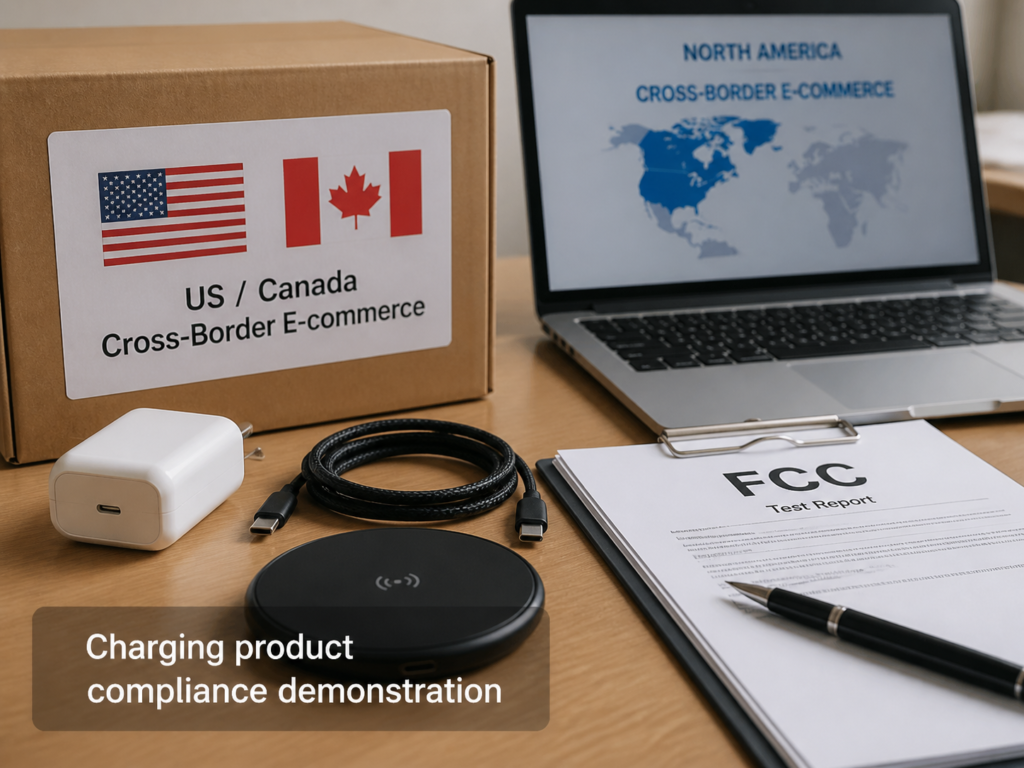
Pitfall 1: Assuming FCC covers electrical safety
Many sellers use FCC documentation to sell plug-in chargers on Amazon Canada, only to be required to provide safety certification and have their products directly delisted. Let’s emphasize again: **FCC only regulates EMC/RF, and does not cover safety issues such as electric shock, overheating, and fire at all**.
Mains-connected chargers, in commercial sale or use scenarios, usually need to comply with the electrical safety regulations of the target province, and obtain certification, listing, or other forms of recognition issued by SCC-accredited certification bodies and accepted by the provincial AHJ. The specific path to adopt depends on the province of sale or use, product structure, intended use, and connection method. SCC is an accreditation body, not a regulatory authority that directly issues unified safety certificates.
Even for personal use, products that meet applicable safety requirements should be chosen to avoid the risks of electric shock, overheating, and fire.
Pitfall 2: Assuming FCC documentation can be directly used as Canadian compliance proof
Many people casually take an FCC report or FCC ID and use it directly as Canadian compliance proof, which is completely wrong. Only test data that meets all the conditions mentioned above can be used as a reference, and the matching degree must be verified one by one. Common invalid situations include: outdated standard versions, failure to cover Canadian frequencies/limits, inconsistency between product configuration and test prototype, module certification exceeding usage restrictions, etc.
Pitfall 3: Lack of supporting Canadian labeling and responsible party information
Many products only have the FCC mark affixed, and do not have labeling and responsible party information prepared in accordance with Canadian requirements at all, which is also non-compliant.
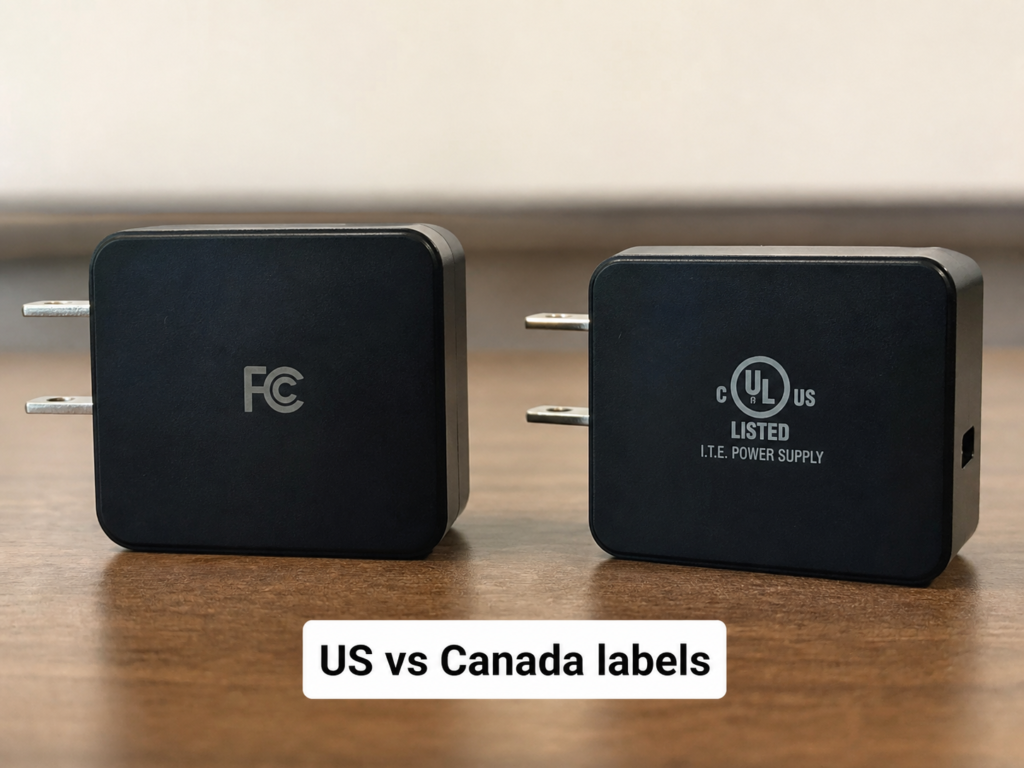
Radio equipment shall be marked with required information such as model number and ISED certification number in accordance with applicable ISED rules. Overseas certification applicants shall also confirm whether a Canadian representative needs to be designated in accordance with current certification procedures. The specific responsible party and label content depend on the equipment category, certification method, and applicable standards; manufacturer, importer, and applicant information cannot be regarded as fixed label items uniformly applicable to all ISED-regulated products.
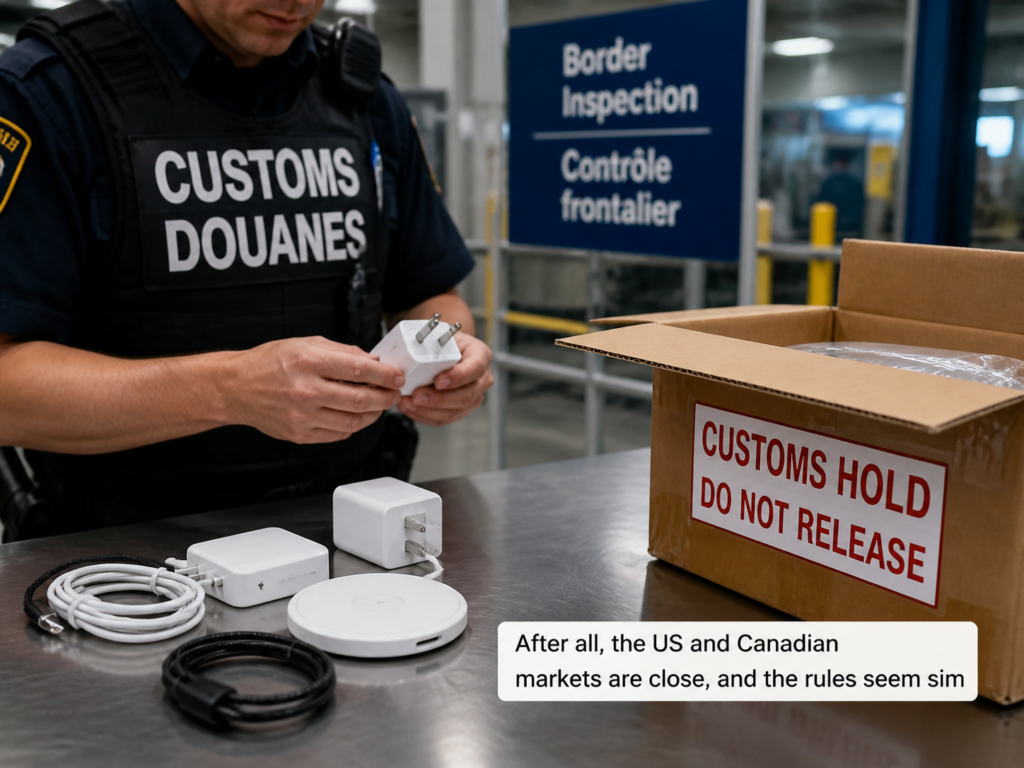
In addition, common labeling issues include: federal pre-packaged products without bilingual English-French labels, non-compliance with French labeling requirements for sales in Quebec, and radio equipment lacking applicable ISED numbers or other required information.
Pitfall 4: Scenario or product form mismatch
• Applying the low enforcement probability rules for personal use to commercial sale/e-commerce listing: being fine for personal use does not mean being fine for sale; commercial sale is subject to full regulation.
• Directly copying the compliance marks and descriptions from US e-commerce listings: US compliance requirements are different from Canada’s, so direct copying will definitely cause problems.
• Only evaluating individual components for combo sets, without assessing the compliance of the combined product: for example, when selling a “charger + fast charging cable + wireless charger” set, you cannot just list it with compliance documents for individual components; you must also assess the EMC and safety impacts of the combination.
Pitfall 5: Frequent Conceptual Misconceptions
• **Misconception 1: FCC ID can directly replace IC ID**: Clarification: These are two independent numbering systems, and their databases are not interconnected. FCC ID cannot be directly used to replace Canadian authorization numbers.
• **Misconception 2: The US-Canada MRA means FCC test reports can be used directly**: Clarification: The MRA only supports mutual recognition of qualifications and eligible test results, not all reports can be used directly; they must be verified one by one.
• **Misconception 3: All charging cables/chargers follow the same certification logic**: Clarification: Requirements vary greatly between passive and active cables, wired and wireless, and products with or without communication functions, so they cannot be generalized.
• **Misconception 4: Low-power charging products do not require any compliance**: Clarification: Whether certification is required cannot be judged solely by power. Products with intentional emission functions such as Bluetooth and Wi-Fi usually require corresponding FCC and ISED authorization; however, if certified modules are used, module authorization may be reused based on module conditions, or host/whole-product certification may be required. The final requirements must be judged in combination with frequency band, emission method, module restrictions, and applicable exemption regulations.
Quick Judgment and Official Verification
Finally, here is a 3-step quick judgment method, so you can roughly judge whether FCC documentation can be reused without hiring an agent:
1. **Check the product**: First determine which category of charging product it belongs to, and whether it has digital circuits or wireless functions.
2. **Check the documentation**: Verify whether the FCC compliance type, standard version, and laboratory qualification meet the relevant mutual recognition and Canadian assessment requirements.
3. **Check supporting materials**: Check whether there are safety certificates, compliance labels, corresponding responsible party information required by Canada, as well as applicable ISED authorization or supplier’s declaration.
After learning this, you can basically independently judge: whether the FCC documentation of your charging products can reduce EMC/RF testing costs in Canada, what compliance materials need to be supplemented to enter the Canadian market, in which scenarios FCC compliance proof cannot be used directly, and the differences in compliance requirements between personal use and commercial sale.
If you need to verify official information, it is recommended to directly check the following official portals (subject to the latest effective version):
• FCC Equipment Authorization Database: Check the validity of FCC ID
• ISED Official Website: Check current standards, ISED certification numbers, and the latest rules for ICES-003 and RSS-216
• SCC (Standards Council of Canada) Official Website: Check accredited safety certification bodies and their accreditation scopes
• Official website of the electrical safety authority of the target province: Check local safety regulatory requirements
• Official pages for Canada’s and Quebec French labeling: Check labeling requirements
Overall, FCC certification is not directly valid in Canada, but it is not completely useless either. For some consumer charging products, qualified FCC test data can be used as supporting material for Canadian EMC or RF assessment, which may reduce repeated testing costs. The key is to first clarify the product type and sales scenario, then verify the matching degree of documentation one by one, and supplement requirements such as safety, labeling, and Canadian authorization or declaration, in order to enter the Canadian market more reliably.