
Recently, many friends doing cross-border business and overseas users purchasing accessories from China have been asking: Isn’t the EU going to unify the USB-C charging port? Can chargers without USB-C no longer be sold in the EU? Will they be detained by customs or taken down by platforms?
First, let’s give everyone a reassurance: **Chargers without USB-C are absolutely not subject to a comprehensive sales ban**. Whether they can be sold never depends solely on the interface itself, but on their sales method, the products they are paired with, applicable regulations, and the time they enter the EU market. You can first remember this one-sentence judgment logic: first look at the product type and how it is sold, then look at what device it is paired with and when it enters the EU, and finally verify the applicable regulations, conformity assessment, and special interface requirements.
Here are four most common scenarios for quick matching:
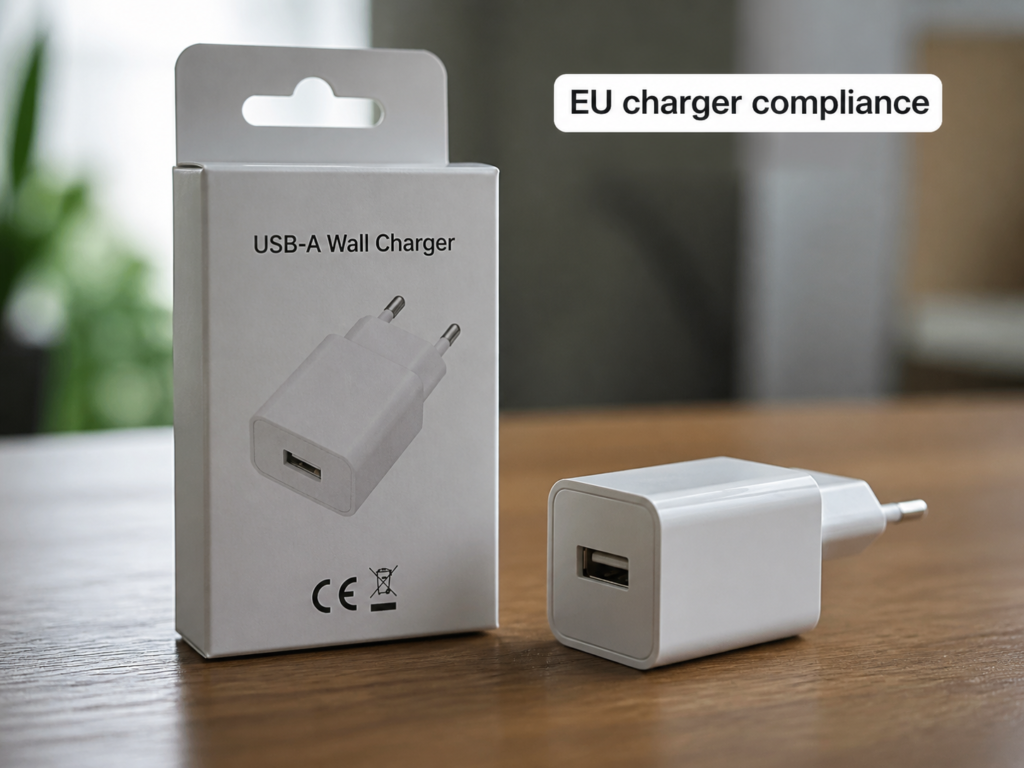
• Ordinary USB-A port chargers sold separately, as long as they are not claimed to be specifically used for regulated devices such as certain mobile phones or tablets, and comply with the EU regulations applicable to themselves, usually will not violate the unified charging interface rule just because they do not have USB-C;
• For regulated devices newly placed on the market after December 28, 2024, if the device itself supports wired charging, it must be equipped with a USB Type-C interface and meet the corresponding charging communication requirements. Whether the charger provided with the device can use USB-A output cannot be judged solely by the interface type, but also needs to verify device compatibility, supply method, and the regulations applicable to the charger itself;
• If it is a charger for industrial equipment or fixed installation equipment, and the supporting equipment is not in the regulated list of the unified charging rule, it is usually not subject to this interface rule, but still needs to meet the compliance requirements applicable to the charger itself;
• Relevant regulated radio equipment that has been legally placed on the EU market before December 28, 2024 can usually continue to be provided if it meets the transition provisions and can provide evidence; independently sold chargers should be judged according to their own applicable regulations, and the conclusion of old inventory of regulated radio equipment cannot be directly applied.
Next, we will first clarify the two most easily confused rules and several interface concepts, and then teach you to judge step by step and avoid the most common pitfalls.
First Things First to Understand: Two Types of EU Charging Rules That Are Easily Confused
Many people confuse “CE compliance” with the “unified charging port rule”. They focus on different content, but they are not two completely separate certification systems.
Let’s Talk About the Most Familiar CE Mark First
You must have seen the two letters “CE” printed on electronic products. Many people think this is a “certificate of conformity” issued by the EU government, but it is not. **The CE mark is affixed by the manufacturer after ensuring that the product complies with all applicable EU harmonized regulations and completing the corresponding conformity assessment as required.** Certain product categories or assessment procedures may require the participation of a notified body, so it cannot be simply understood that any product is just a unilateral seal by the manufacturer.
For chargers, the possible requirements include:
• **Electromagnetic Compatibility (EMC)**: Simply put, the product should not cause unacceptable interference to other electronic devices, and must also have corresponding anti-interference ability;
• **RoHS**: Restricts the use of hazardous substances such as lead and mercury in electrical and electronic products;
• **Low Voltage Directive (LVD)**: Within the applicable voltage range and product conditions, focuses on electrical safety, such as electric shock, overheating and fire risks;
• **Ecodesign**: May require external power supplies to meet energy efficiency indicators such as no-load power consumption and average active efficiency, and the specific requirements depend on the product category, rated output power and applicable version.
Therefore, you can’t just look at whether there is a CE mark on the charger shell. You also need to confirm which regulations the product actually applies to, whether the corresponding conformity assessment has been completed, and whether the technical documents and declaration of conformity are consistent with the actual model.
The CE mark itself does not use “USB-A or USB-C” as a separate judgment standard. Whether a charger has USB-C usually does not determine whether it can pass all applicable CE-related requirements; but this does not mean that it can ignore other safety, environmental protection, energy efficiency or electromagnetic compatibility requirements.
Let’s Talk About the Unified Charging Interface Rule
Everyone’s impression of “EU mandatory USB-C” mainly comes from the EU’s revision of the Radio Equipment Directive (RED). **The unified charging requirement is a special mandatory requirement under RED, directly targeting specific radio equipment in the regulatory list**, not a general rule governing all independently sold chargers.
It mainly focuses on:
• Whether the regulated device has the specified charging interface;
• Whether the device meets the corresponding charging communication and power negotiation requirements;
• Whether the device needs to be provided with a charger when sold, and the relevant information display requirements.
Regulated radio equipment needs to meet RED and other applicable regulations, complete the corresponding conformity assessment, and then use the CE mark. The CE mark cannot replace the specific USB-C interface and charging communication requirements, but the unified charging requirement is not an independent certification parallel to the CE mark.
In other words, the rule mainly regulates eligible regulated devices themselves, rather than making all USB-A chargers banned products. Independent chargers and chargers provided with devices need to be judged separately in combination with the actual supply method, compatibility and the regulations applicable to the charger itself.
Several Easily Confused Interface Concepts
Before continuing, let’s distinguish several commonly mentioned “ports”, otherwise it is easy to reverse the applicable objects of the rule:
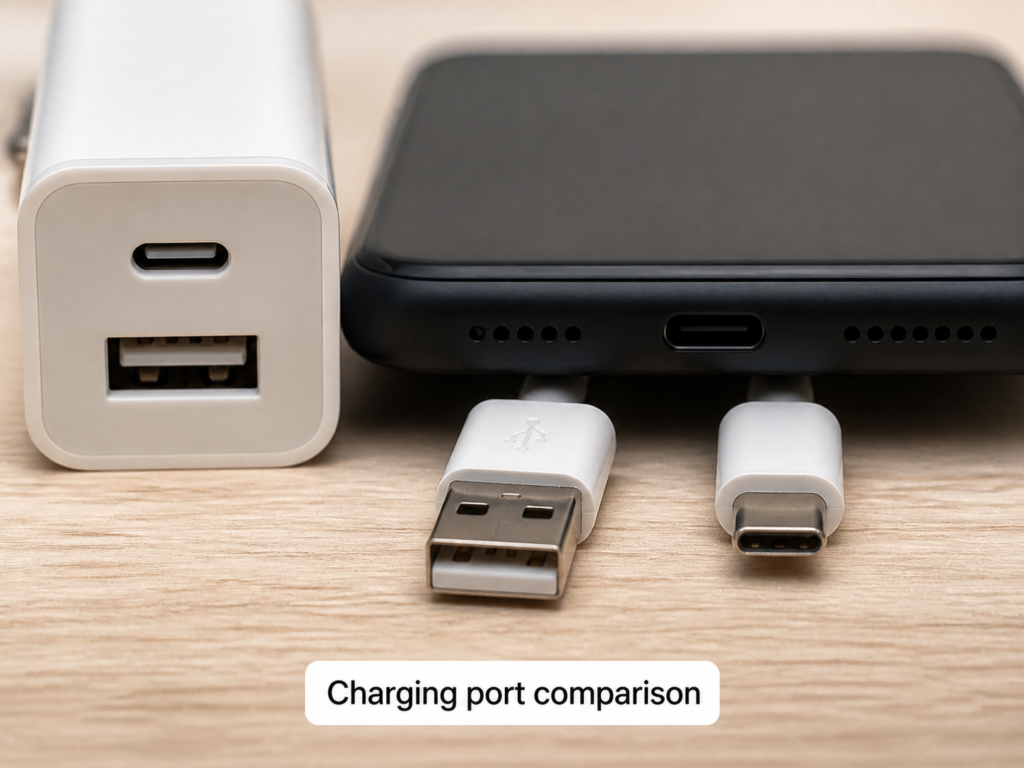
• **Charger output port**: the port on the charger body where the charging cable is plugged in;
• **Device charging port**: the port on the device being charged, such as a mobile phone or tablet, where the charging cable is plugged in. The unified charging interface rule directly focuses on this type of device port;
• **USB Type-C**: the common small oval interface that can be plugged in both directions, which can be used on chargers, devices and both ends of cables;
• **USB-A**: the old-fashioned rectangular interface that can only be plugged in on one side, which was mostly used on chargers and computers before;
• **Cable port**: the plugs at both ends of the charging cable. A cable can have C on both ends, or A on one end and C on the other.
Now pick up the charger, charging cable and mobile phone at hand, and you can distinguish these ports at a glance, so you won’t be confused when talking about the rules later.
What Exactly Does the Unified Charging Interface Rule Regulate?
To judge whether a charger without USB-C can be sold, you must first understand the applicable logic of this rule: it revolves around “regulated radio equipment” and does not directly bring all independently sold chargers into the mandatory USB-C requirements.
Which Chargers Will Be Affected by This Rule?
It cannot be simply said that “all chargers sold with regulated devices must use USB-C output”. A more accurate way of judgment is:
1. First, check whether the regulated device sold with the charger itself meets the USB Type-C interface and charging communication requirements;
2. Then check whether the charger can match the charging capacity of the device;
3. At the same time, verify the safety, EMC, RoHS, ecodesign and other regulations applicable to the charger itself;
4. If the product is advertised as a dedicated or official accessory for a regulated device, it is also necessary to ensure that the advertisement, supply method and actual compatibility are consistent.
If it is a general-purpose charger sold independently, not bound to any regulated device, and not claimed to be dedicated to a certain device, then it will not violate the unified charging interface rule just because it uses USB-A output. Of course, the charger still needs to meet the EU regulations applicable to itself.
Regulated Devices and Effective Dates
This rule targets specific radio equipment categories listed in the annex of the regulation, and relevant equipment usually must be equipped with a rechargeable battery and support wired charging. Not all products generally referred to as “portable audio devices” or “portable input devices” will automatically be in the regulated list, and boundary products should be verified in combination with radio functions, batteries, actual use and regulatory categories.
The main time nodes are as follows:
• **Applicable from December 28, 2024**: Mobile phones, tablets, digital cameras, earphones and headphones, portable speakers, portable electronic game consoles, e-readers, keyboards, mice, portable navigation devices, etc. listed in the annex of the regulation need to comply with the corresponding USB-C requirements when they meet the applicable scope and support wired charging;
• **Applicable from April 28, 2026**: Laptops.
Only devices that are in the applicable list and meet the relevant product conditions need to comply with the corresponding unified charging interface requirements.
What Are the Specific Requirements?
The focus of the rule is first on the device itself, and second on the compatibility between the device and the charging solution.
Regulated Device Side
As long as the regulated device supports wired charging, **the device itself must be equipped with a USB Type-C charging interface**.
When any of the following conditions is met for a wired charging device: charging voltage exceeds 5V, charging current exceeds 3A, or charging power exceeds 15W, it should also meet the applicable USB Power Delivery charging communication requirements. USB PD is a general charging power negotiation method, where devices and chargers can negotiate appropriate voltage and current according to each other’s capabilities.
If the device has no wired charging function at all and only supports wireless charging, then this wired interface requirement usually does not apply; but if the device supports both wireless and wired charging, the wired charging part still needs to meet the regulations.
Chargers Provided with Regulated Devices
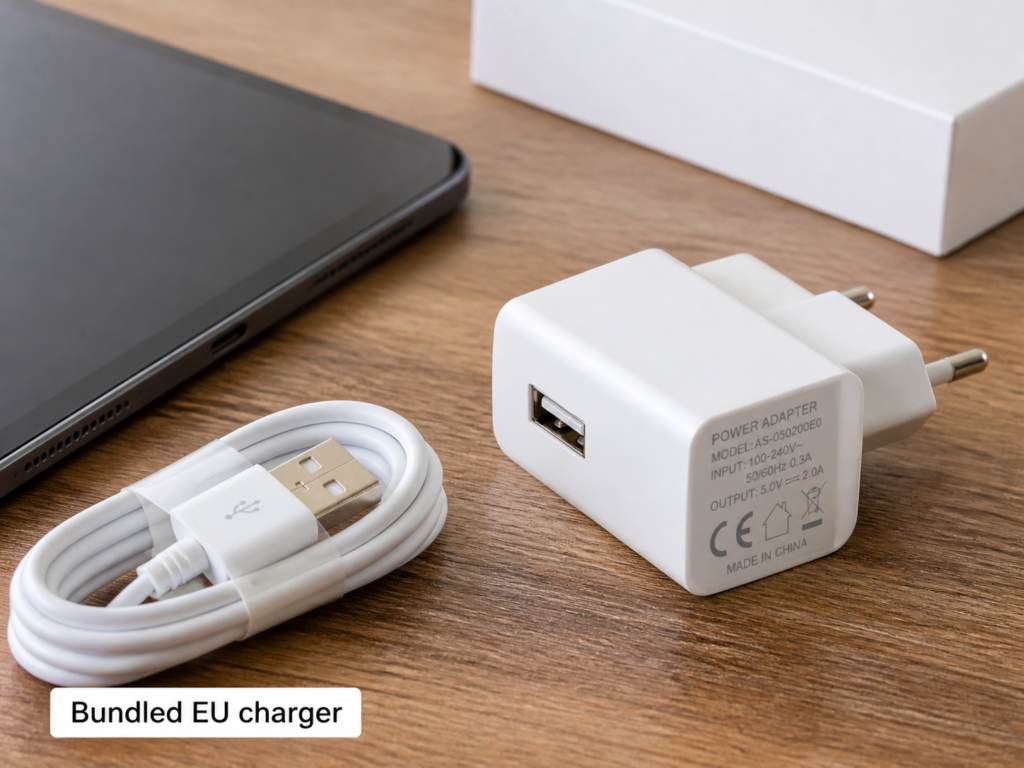
For chargers provided with the device, you can’t just look at whether the output interface is USB-C, but need to confirm whether it can charge the device safely and effectively, and match the device’s voltage, current, power and communication capabilities.
For example, if the device supports a certain USB PD charging method, the matching charger should have compatible output capability; if the device’s charging demand is low, you can’t directly assert that all matching power adapters must natively use USB-C output just based on the “must be USB-C” rule.
The charger must also meet the product regulations applicable to itself. That is to say, if the device meets the RED unified charging requirements, it does not mean that the charger has automatically completed safety, EMC, RoHS or energy efficiency compliance.
What Situations Are Usually Not Subject to the Unified Charging Interface Rule?
In addition to general-purpose chargers without USB-C sold independently, the following situations are usually not within the direct control scope of this interface rule:
1. **Matching chargers for devices not in the regulated list**: For example, some industrial dedicated power supplies and power adapters for fixed installation equipment, if the matching equipment is not in the list of regulated radio equipment, this USB-C interface requirement usually does not apply;
2. **Medical or professional equipment**: You cannot directly determine exemption just because the product is labeled “medical” or “professional”. You should verify whether the device is in the regulated list, whether it is for ordinary consumers, whether it is equipped with a rechargeable battery, and whether it supports wired charging;
3. **Matching for devices without wired charging function at all**: For devices with only wireless charging function, whether their matching power supply is subject to a certain interface requirement should be judged in combination with specific products and regulations, and the power supply of wireless charging bases cannot be equated with chargers for regulated devices;
4. **Old products that meet the transition conditions**: Relevant regulated radio equipment that has been legally placed on the EU market before the effective date of the corresponding device requirements can usually continue to be provided if it can be proved to meet the transition provisions. Independently sold chargers should be judged according to their own applicable regulations.
Step-by-Step Judgment: Can Chargers Without USB-C Be Sold in the EU?
If you have understood the basic rules above, you can follow these five steps to judge whether your charger can be sold by yourself, without asking people everywhere.
Step 1: First Confirm the Sales Form and Target Users
First, figure out how your charger is sold and who it is sold to:
• Is it a general-purpose model sold independently, a matching model sold with a certain device, or an optional accessory for the device?
• Does the packaging or detail page have words binding to regulated devices such as “designed for XX mobile phone/tablet” or “official standard configuration”?
• Are the target users ordinary consumers, or users in industrial or professional fields?
The publicity on the sales page will affect how the product is understood, but you cannot mechanically judge all legal attributes based on just one slogan. It is also necessary to confirm whether the charger is provided together with the regulated device in combination with the contract, package, packaging, delivery and actual supply method.
For example, an independently sold USB-A charger, if the detail page says “dedicated original charger for a certain regulated mobile phone”, can no longer be simply regarded as an ordinary general-purpose model; but the final judgment still needs to be combined with the actual sales arrangement, product compatibility and applicable regulations.
Step 2: Judge Whether the Matching Device Is in the Regulated List
If your charger is bound to a certain device, the next step is to check whether the device is in the applicable list:
• Not in the list: For example, some industrial dedicated power supplies and matching chargers for large fixed equipment usually do not apply the unified charging interface requirements, but still need to meet the CE-related regulations applicable to the charger itself;
• In the list: Also confirm whether the device is equipped with a rechargeable battery, whether it supports wired charging, and whether it has the radio function required by the regulation;
• Regulated devices that support wired charging: The device itself must be equipped with a USB Type-C interface; when reaching the voltage, current or power threshold, it must also meet the applicable USB PD charging communication requirements;
• Devices without wired charging function at all: This wired interface requirement usually does not apply.
What to do when encountering boundary products? Don’t just look at the product name, look at the regulatory category, actual function and main purpose. For example, a portable device for consumers, with wireless connection function and used for audio playback and calls, may belong to the regulated category of earphones or audio devices; you cannot directly determine exemption just because it has the words “medical” or “professional”.
Step 3: Verify the Time and Evidence of First Placing on the EU Market
If the matching device is in the regulated list, the next step is to check whether this batch of products has been legally “placed on the market” before the corresponding rule takes effect.
Special attention should be paid here that “first placing on the EU market” does not simply refer to the date of production, import, customs clearance or warehousing. It usually means that the manufacturer or importer first makes the product available for sale or use on the EU market. Simply producing outside the EU, storing in an overseas warehouse, completing customs clearance, or just storing goods in an EU warehouse cannot automatically prove that the product has been placed on the market.
For example, you produced a batch of USB-A chargers for mobile phones in 2023, but they have been kept in a Chinese warehouse and were first made available for sale on the EU market in 2025. This batch of products cannot automatically enjoy the old inventory treatment just because they were produced early.
On the contrary, if the product has been made available for sale or use on the EU market by the manufacturer or importer before the applicable date, and corresponding commercial documents can be provided, it may meet the transition provisions. Evidence that can be retained includes supply records, commercial invoices, logistics and delivery documents, sales contracts, warehousing and outbound records, as well as materials that can confirm that the model and product status have not changed.
Specific regulated radio equipment should be verified one by one. For independently sold chargers, the transition provisions of RED radio equipment cannot be directly applied, and they should be judged according to the regulations applicable to the charger itself.
Step 4: Check CE-Related Compliance Qualifications
Regardless of whether your charger has USB-C or not, you must verify the applicable EU regulations according to the product attributes, and complete the conformity assessment and affix the CE mark when applicable. You can’t just because the product is called a “charger”, default that all products apply exactly the same set of regulations.
When checking CE-related materials, don’t just look at whether the CE mark is printed on the product, but also verify these contents:
• Whether it covers the regulations actually applicable to the product, such as EMC, RoHS, LVD, ecodesign, etc., depending on the product parameters and category;
• Whether the product model and specifications on the Declaration of Conformity (DoC) are completely consistent with the actual product;
• Whether the correct conformity assessment has been completed in accordance with applicable regulations; certain products or assessment procedures may require the participation of a notified body;
• Whether the corresponding technical documents and test reports are true and valid, and can support the current model;
• Whether non-EU manufacturers have verified the information of EU economic operators in accordance with applicable regulations, such as importers or other applicable responsible parties. An EU authorized representative is not mandatory for all products, nor can it be simply understood that both an importer and an EU authorized representative must exist at the same time.
Step 5: Verify Sales Model and Publicity Caliber
The last step is to confirm whether there are any problems with the sales model and publicity. Many sellers step into pitfalls here:
• **Bare metal sales (device without charger)**: Regulated devices still need to meet their own USB-C and charging communication requirements; when no charger is included, the compliance issue of the charger should not be confused with the device itself;
• **Charger included in the box**: It should be confirmed that the charger can match the device’s interface, power and protocol requirements, and at the same time meet the regulations applicable to the charger itself;
• **General-purpose model sold independently**: As long as there is no inappropriate dedicated or matching publicity with regulated devices, it usually will not violate the unified charging interface rule just because it uses USB-A output;
• **Claimed to be dedicated or standard for regulated devices**: It should be judged whether it is provided together with the device according to the actual contract, packaging, delivery and publicity methods, and the respective compliance requirements of the device and the charger should be verified;
• **Separately optional purchase**: Separate display or separate ordering does not necessarily determine the legal attribute. It should be judged whether it is provided together with the regulated device in combination with the contract, package, packaging, delivery and publicity content, and the applicable regulations of the device and the charger themselves should be verified separately.
By the way, EU rules encourage device manufacturers to provide sales options without chargers, in order to reduce duplicate purchases and e-waste. But providing bare metal does not mean that the device can ignore USB-C and other applicable requirements.
The 5 Most Common Pitfalls and Non-Compliance Risks
Many people’s misunderstandings about the EU USB-C rule are concentrated in these 5 categories. Let’s clarify them one by one to avoid stepping on thunder.
Misconception 1: All Chargers Must Have USB-C
This is the most common misunderstanding. **The unified charging rule directly regulates eligible regulated radio equipment, especially the USB Type-C interface and charging communication requirements of the device itself; general-purpose chargers sold independently will not automatically violate the rules just because they use USB-A output.**
Of course, chargers provided with devices still need to be compatible with the devices and meet the applicable safety, EMC, RoHS and energy efficiency requirements.
For example, selling a general-purpose mobile phone charger with a USB-A port separately can usually be sold as long as there is no inappropriate publicity binding to regulated devices and it complies with its own applicable regulations.
Misconception 2: The Rule Only Targets Apple’s Lightning Interface, and Industrial and Medical Equipment Are All Exempt
Wrong. This rule targets specific radio equipment categories in the regulatory list. Regardless of whether the device originally used Lightning, Micro-USB or other interfaces, as long as it is within the applicable scope and supports wired charging, it needs to meet the USB Type-C requirements on the device side.
Industrial and medical equipment are not necessarily exempt either. It depends on whether they are in the regulated list, whether they are for ordinary consumers, whether they are equipped with rechargeable batteries, and whether they have a wired charging function. For example, portable medical-related audio devices for consumers, if they actually belong to the regulated category of earphones or portable audio devices, cannot be excluded from application just because of the word “medical”.
Misconception 3: All Chargers Without USB-C Will Be Taken Off the Shelves by the End of 2024, or Those Produced Before 2024 Count as Old Inventory
Both of these statements are wrong. First of all, not all chargers without USB-C need to be taken off the shelves. General-purpose models sold independently will not be restricted by the unified charging rule just because of the interface type.
Secondly, the judgment standard for old products is whether the specific regulated radio equipment was legally placed on the market before the corresponding effective date, not the production time. Matching products produced in 2023 but first made available for sale on the EU market in 2025 cannot enjoy transition treatment just based on the production date.
Production, storage in warehouses outside the EU, mere customs clearance, or simply entering an EU warehouse do not automatically equal being placed on the market. It is necessary to retain commercial documents that can prove that the product was first made available for sale or use on the EU market by the manufacturer or importer, and confirm the model and product status.
Misconception 4: With the CE Mark, It Can Be Sold, and CE Is a Unified Certificate Issued by the Government
This is also a common misunderstanding among many novices. The CE mark is not a unified certificate issued by the EU government, but a compliance mark used by the manufacturer after ensuring that the product complies with all applicable EU harmonized regulations and completing the required conformity assessment. Certain product categories may require the participation of a notified body, so you can’t just look at whether CE is printed on the product.
In addition, the CE mark does not mean that the unified charging requirements are automatically met. For regulated radio equipment, the product must also meet RED and its special requirements related to unified charging. For example, a regulated mobile phone newly placed on the market in 2025 does not have a USB-C interface itself, even if there is a CE mark on the relevant product materials, it cannot be exempted from the interface requirements on the device side.
For chargers, it is also necessary to verify potentially applicable regulations such as EMC, RoHS, LVD, and ecodesign according to their own attributes. Non-EU manufacturers should also confirm whether the information of EU economic operators required by applicable regulations is complete.
Misconception 5: Adding an Adapter or Extension Cable Counts as Compliance, and Cross-Border Small Parcel Direct Mail Does Not Need to Follow the Rules
Adapters or extension cables cannot be used to replace the USB Type-C interface that the regulated device itself must have, nor can they be used to evade the device’s charging communication requirements.
But this does not mean that the conclusion that “the included charger must have native USB-C output” can be simply drawn. Whether the charger needs to use USB-C output should be judged according to the specific product supply method, device compatibility and the regulations applicable to the charger itself.
Secondly, as long as the product is sold to the EU market, you cannot ignore applicable regulations just because you use cross-border small parcel direct mail, local warehouse or other warehousing and distribution methods. Border authorities, market regulators and e-commerce platforms may take measures in accordance with their respective powers or rules.
What Are the Consequences of Non-Compliance?
Non-compliant products may face the following risks, but specific measures are not fixed consequences necessarily arising from the unified charging rule:
• **Border stage**: May be suspended from release, returned, or required to supplement compliance materials;
• **Platform stage**: Platforms may require rectification, remove products or restrict sales according to their own rules;
• **Market supervision stage**: May be required to take corrective measures, recall products or restrict continued sales;
• **Fines and other penalties**: The specific amount, procedure and liability determination depend on the applicable EU and member state laws, the decision of the law enforcement agency and the actual illegal facts.
Novice Self-Check List: Usable for Sellers and Purchasers
The following list can be used as a preliminary verification tool, but it cannot replace the review of regulations, standards and technical documents for specific products.
Category 1: Product Positioning and Scenario Verification
• Clarify the sales form of the charger: is it sold independently, matched with the device, or an optional accessory?
• Confirm whether the matching device is in the regulated list, whether it is equipped with a rechargeable battery, and whether it supports wired charging?
• Verify the time when the specific regulated device was first placed on the EU market, and whether relevant commercial evidence can be provided;
• Confirm whether the target users are ordinary consumers, or users in industrial or professional fields;
• Check whether the sales page, packaging and contract claim that the charger is a dedicated model or standard configuration for a certain regulated device;
• Judge whether the product is provided together with the regulated device in combination with the contract, package, packaging and delivery method.
Category 2: Interface and Parameter Verification
• First distinguish the charger output port and the device charging port, don’t confuse them;
• If it is a regulated device, it should be confirmed whether the device itself has a USB Type-C interface;
• When any of the following conditions is met: charging voltage exceeds 5V, charging current exceeds 3A, or charging power exceeds 15W, confirm whether the applicable USB Power Delivery charging communication requirements are met;
• Verify whether the input and output parameters on the charger nameplate, as well as the manufacturer and applicable EU economic operator information are complete;
• Confirm that the charger can match the device’s interface, power and protocol requirements;
• Do not use extension cables or adapters to replace the USB Type-C interface that the regulated device itself must have, nor use them to evade charging communication requirements.
Category 3: Compliance Document Verification (Don’t Just Look at the CE Mark)
• Confirm the EU regulations actually applicable to the product, such as EMC, RoHS, LVD, ecodesign, etc., which are specifically judged according to the product category and parameters;
• Verify whether the model and specifications on the Declaration of Conformity (DoC) are completely consistent with the actual product;
• Check whether the technical documents and test reports are true and valid, and can support the current product model;
• Confirm whether the correct conformity assessment has been completed in accordance with applicable regulations; verify the participation of the notified body when necessary;
• Confirm whether non-EU manufacturers have provided the EU economic operator information required by applicable regulations;
• Whether the manual and packaging have the official EU language version required by the selling country;
• Confirm that the sales page publicity is consistent with the actual supply method and compliance status, and do not arbitrarily mark “dedicated” or “standard configuration”;
• For regulated radio equipment, confirm whether the USB Type-C interface, charging communication and other RED requirements on the device side have been implemented.
Final Summary
To judge whether a charger without USB-C can be sold in the EU, the core is never the interface itself, but to distinguish the respective compliance obligations of the charger and the regulated device.
As long as you master these three core abilities, you can make a preliminary judgment by yourself:
First, be able to distinguish the relationship between the CE mark and the unified charging requirement. The unified charging requirement is a special compliance requirement under RED; products need to meet all applicable regulations and complete the corresponding conformity assessment before using the CE mark. The CE mark itself cannot replace the specific USB-C interface and charging communication requirements, nor does it mean that all chargers must use USB-C output.
Second, be able to judge which requirements the product needs to verify according to the sales form, the attributes of the matching device, whether the device supports wired charging, the first launch time and the publicity caliber. The unified charging rule mainly directly regulates eligible regulated radio equipment, and independent chargers should be judged according to their own applicable regulations.
Third, be able to avoid the 5 common misconceptions mentioned above, know the border, supervision and platform risks that may be brought by non-compliance, and also know how to use the self-check list for preliminary verification.
As long as you understand these, you don’t have to be scared by the statement of “comprehensive ban on sales without USB-C”, nor will you mistakenly apply the USB-C obligation on the device side as a unified interface ban for all chargers.