
Whether you are buying chargers or data cables in the EU, doing cross-border product selection, or launching your own brand overseas, you have most likely heard two completely opposite statements: some say “if it has CE, it must comply with RoHS, no need to check separately”, while others say “CE and RoHS are two different things, and need to be done separately”. Which one is correct?
Quick Conclusion: CE Does Not Naturally Include RoHS, Most Charging Products Require Mandatory Coverage
First, let’s give a clear answer: CE certification does not naturally include RoHS regulations, but for the vast majority of charging products we come into contact with daily, formal CE compliance must cover RoHS requirements.
Many people’s first impression of CE is “an official certificate”, but that is not the case. CE is a general term for the conformity mark for EU market access, but it is not a universal compliance certificate covering all EU regulations. The CE mark indicates that the manufacturer declares the product complies with all applicable EU harmonized regulations that explicitly require the affixing of the CE mark, rather than declaring that the product meets all EU market requirements. It is also not a single certificate issued by a specific institution, but a mark affixed by the manufacturer itself after completing the applicable compliance assessment. RoHS is an environmental regulation under the CE framework that specifically restricts hazardous substances in electrical and electronic products, and is one of the requirements that may apply.
Therefore, there is no absolute conclusion that “all CE automatically includes RoHS”. Two prerequisites must be met at the same time for this to hold: first, the product itself falls within the mandatory scope of RoHS; second, the manufacturer has indeed included RoHS in the scope of the CE compliance assessment, rather than only completing other requirements such as safety and electromagnetic compatibility.
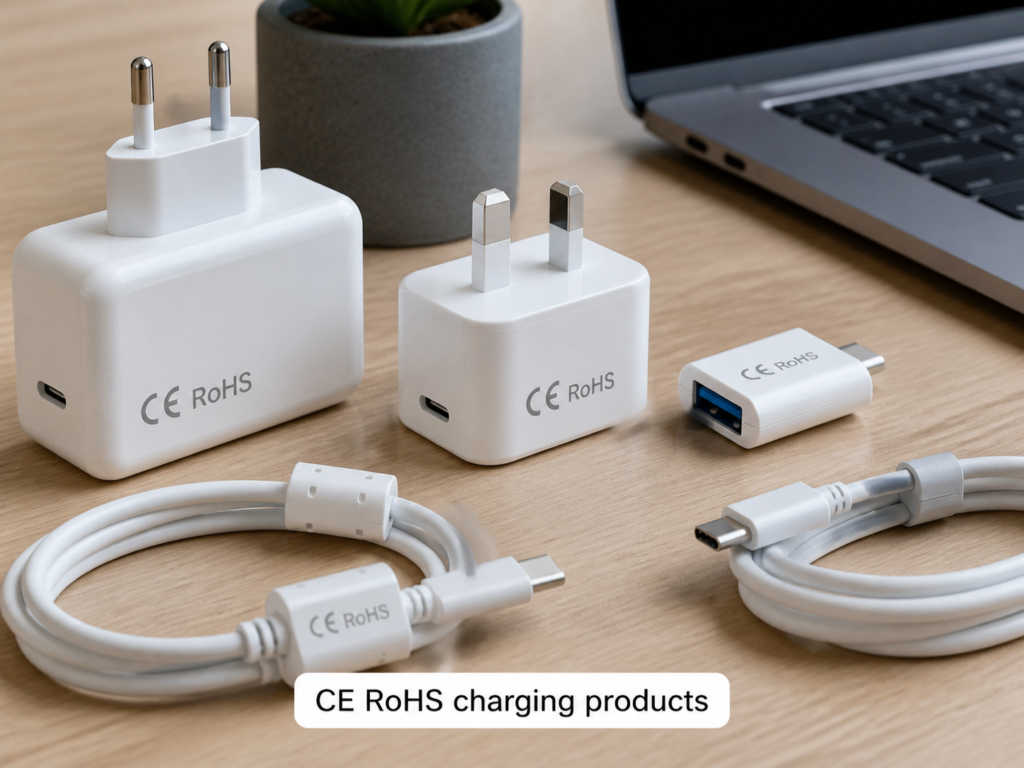
For the charging products we most commonly contact, the conclusion is clearer: for chargers, data cables with electronic components, and interface or adapter devices that clearly belong to electrical and electronic equipment, formal CE compliance usually must include RoHS. As for purely mechanical charging accessories with no electronic or metal electrical components at all — such products almost do not exist in the charging category, so CE does not need to involve RoHS.
If you want to verify as quickly as possible whether a product’s CE includes RoHS, the most direct method is to check its EU Declaration of Conformity (commonly known as DoC) to see if the RoHS directive is clearly listed in it.
Basic Concepts and Core Differences
You may still be a bit confused after reading this: what exactly are the differences between CE, RoHS, DoC, and test reports? Let’s first clarify the basic concepts, so that we won’t be confused when making judgments and avoiding pitfalls later.
The Essence of the CE Mark and RoHS Regulations
Let’s start with the CE mark. Its essence is a compliance pass mark for the EU market, affixed by the manufacturer after self-assessment that it meets the requirements. Its core function is to declare that the product complies with all applicable EU harmonized regulations that require the affixing of the CE mark. Here’s a key point: the core legal document for CE compliance is the EU Declaration of Conformity (DoC) signed by the manufacturer. Test reports or CE certificates issued by third-party institutions are only materials supporting the DoC, and their legal effect cannot replace the DoC.
For charging products, there are several common CE applicable directives: the LVD directive governing electrical safety, the EMC directive governing electromagnetic compatibility, and the RoHS directive governing hazardous substances. If the product has wireless communication functions such as Bluetooth and Wi-Fi, it usually also needs to be assessed against the RED Radio Equipment Directive; however, wireless charging itself does not automatically mean the product falls within the scope of RED, and whether it applies depends on whether the device has specific radio functions and the relevant applicable scope.
Now let’s talk about RoHS regulations. Its essence is an environmental regulation that restricts hazardous substances in electrical and electronic products, with the core of controlling 10 categories of hazardous chemical substances, including lead, mercury, cadmium, hexavalent chromium, two types of flame retardants, and 4 types of phthalate plasticizers. RoHS mainly applies to electrical and electronic equipment within the defined scope, and includes cables, spare parts, etc. that are explicitly included in the regulation. Independently sold connectors, passive components or other accessories cannot be judged only by their names, but also need to be evaluated in combination with whether they belong to electrical and electronic equipment, their specific functions, structure and sales form.
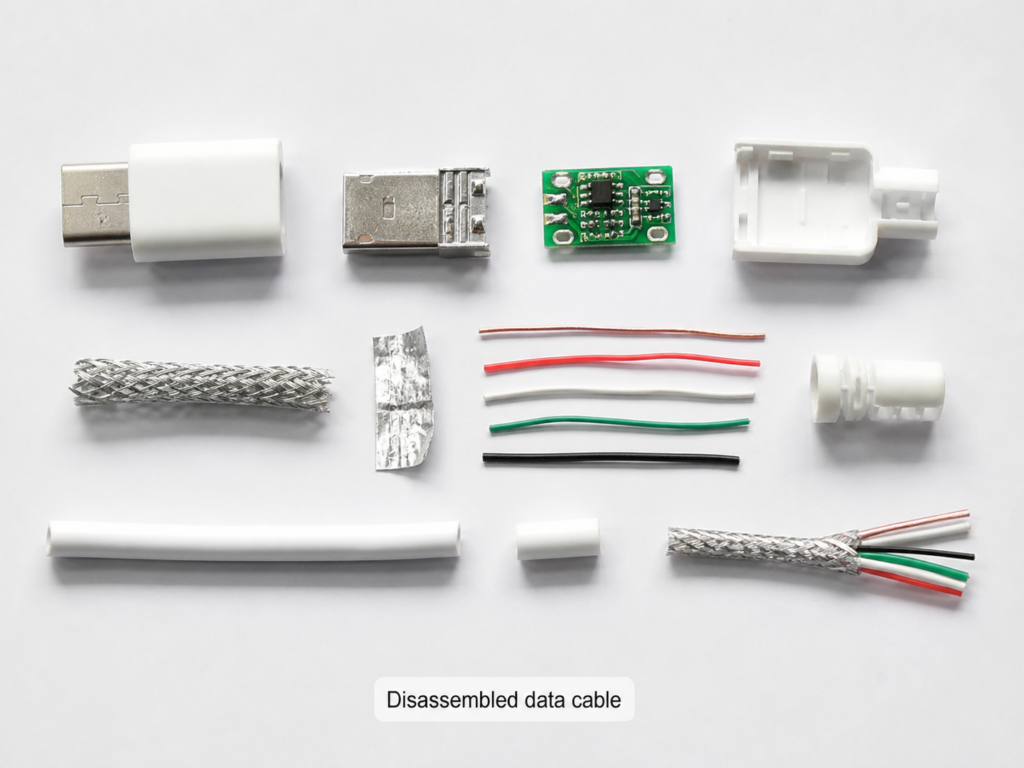
RoHS has a very special judgment standard: it is not calculated based on the average content of the whole product, but calculated separately by “homogeneous material” — the so-called homogeneous material is the smallest material unit that the product can be disassembled into, such as the plastic sheath of a data cable, the copper wire core, the terminal plating layer, and the solder on the circuit board. Each type is tested separately, and compliance is only achieved when each meets the limit.
The common limits are: the limit for cadmium is 0.01% (that is, 100ppm), and the limit for most other restricted substances is 0.1% (1000ppm). The specific limits shall be subject to the current EU RoHS version. By the way, many people confuse RoHS with another EU environmental regulation REACH. In fact, the two are completely different: RoHS mainly targets electrical and electronic equipment, cables and related spare parts within the defined scope, while REACH covers a much wider range of products, which we will not elaborate on today.
Differences Between Three Types of Common Compliance Documents
Many people easily confuse different compliance documents. Let’s use a table to clarify the three most common types of documents:
| Document Type | Issuing Party | Core Function | Legal Effect |
| EU Declaration of Conformity (DoC) | Manufacturer / EU Authorized Representative | Legal declaration that the product complies with all applicable EU directives, listing all applicable directives | Highest, the core basis for CE compliance |
| RoHS Test Report | Third-party Laboratory | Prove that the materials of the submitted sample meet the RoHS limit requirements | Only supporting material, proving the conformity of the submitted sample |
| Third-party CE Certificate | Third-party Testing Institution | Test certificate issued by the institution, indicating that the product has passed the tests of certain directives | Lower than DoC, no official unified format, only supporting material |
Core Attribute Differences
After clarifying the basic concepts, we can understand that the core differences between CE and RoHS are actually in three aspects:
First, the coverage dimensions are different. CE is a large framework covering access requirements in multiple aspects such as safety, electromagnetic compatibility, environmental protection, and energy efficiency; RoHS is just one of the individual requirements specifically governing hazardous substances in materials.
Second, the applicable products are different. CE covers most products sold in the EU market that fall within the scope of CE regulations, from industrial machinery to stationery and toys, as long as they are within the applicable scope, they must be affixed with CE; RoHS mainly applies to electrical and electronic equipment within the defined scope, as well as cables, spare parts, etc. explicitly included in the regulation, with a much smaller scope.
Third, the proof logic is different. The core of CE compliance is the DoC plus a full set of technical documents. RoHS compliance materials (such as test reports and material declarations) are only a component of CE technical documents, not independent of CE.
Why There Is a Misconception That “CE Includes RoHS”
Since the two are in a relationship of framework and individual item, why do so many people think that “CE naturally includes RoHS”? This misconception actually comes from four levels:
First, the regulatory level. After the RoHS 2 directive (i.e., 2011/65/EU) officially came into effect in 2011, RoHS was incorporated into the CE’s legally applicable directive system. That is to say, as long as the product falls within the applicable scope of RoHS, complete CE compliance must include RoHS. However, many popular science contents omit the major premise of “only applicable to electrical and electronic products”, and over time it has been spread as “all CE includes RoHS”.
Second, the market level. For electrical and electronic products, complete CE compliance originally covers the most basic requirements of LVD, EMC, and RoHS. Many testing service providers package these items as “full CE items” and directly simplify them to “CE certification” in publicity. Over time, users default that “CE certification” includes RoHS, forgetting that this is only the case for electronic products.
Third, the marking level. The EU stipulates that the style of the CE mark is unified, and specific directives complied with cannot be marked on the mark. Ordinary users cannot tell from the appearance of the product whether this CE mark only meets safety requirements or also complies with RoHS. This also gives some unscrupulous merchants an opportunity: they only complete LVD and EMC tests, but dare to claim that “with CE, it complies with RoHS”.
Fourth, the display level. The CE technical documents of electronic products originally put RoHS reports and material declarations together. Many sellers also put “CE/RoHS” side by side on the same page when promoting. Users who glance at it easily mistake them for two parts of the same certification, and naturally feel that CE naturally includes RoHS.
RoHS Applicability Boundaries for Charging Products
Since the core premise of whether RoHS is included is “whether the product is within the scope of RoHS”, let’s specifically talk about the RoHS applicability boundaries of charging products, which usually need to be done, and which are easy to confuse.
Products Usually Within the Scope of RoHS
The first category is chargers and power adapters. Ordinary chargers and power adapters usually fall within the scope of RoHS, and power and size themselves do not automatically exempt them; however, it is still necessary to check the exclusion scope of the regulation and applicable substance use exemptions.
The second category is USB/USB-C data cables with electronic components, such as fast charging cables with E-Marker chips. Because they have electronic components, they usually require RoHS assessment.
The third category is interfaces, connectors and adapter devices. Interfaces and adapter devices with active circuits or clearly belonging to electrical and electronic equipment usually require separate assessment. Purely passive connectors cannot be automatically regarded as RoHS products just because they are sold separately or have metal terminals; they should be judged in combination with their functions, structures and sales forms.
The fourth category is charging accessories with electrical functions, such as magnetic charging heads and adapters. As long as their specific functions and structures belong to electrical and electronic equipment, corresponding RoHS assessment is required.
Almost Non-existent Exemption Scenarios
In the charging category, there are not many scenarios that can truly be excluded from the scope of RoHS. Ordinary chip-free cables may also fall within the applicable scope of RoHS, and “no electronic chip” cannot be used as a basis for exemption; whether it applies should be judged based on the legal scope of electrical and electronic equipment and cables. A real exemption also needs to be confirmed based on the applicable scope of the regulation or specific exemption clauses.
There are also pure packaging materials, such as product outer packaging boxes and buffer foam. These do not belong to the product itself, so naturally they do not need to comply with RoHS, but they have no direct relationship with the compliance of the product itself.
A special reminder here: you cannot judge exemption just because the product is called “wire”, nor can you simply think that “no chip means no need for RoHS”. It should be judged in combination with whether the product relies on electric current or electromagnetic fields to work, and whether it belongs to cables or other electrical and electronic equipment explicitly included in the regulation.
Easily Confused Boundary Rules
There are also several easily confused boundary rules that everyone must clarify:
The first is **sold separately vs sold with the whole machine**: if the accessory is sold separately, such as a separately sold data cable, RoHS must be assessed separately according to its product nature; if it is provided as an accessory with the whole machine, such as a charger included when buying a mobile phone, it can usually be included in the overall compliance responsibility of the whole machine manufacturer as a component when the whole machine is placed on the market. However, the specific responsibility still needs to be determined according to the actual entity placing the product on the market, brand identification and supply chain role, and cannot be simply attributed uniformly according to “bundled sales”.
The second is **components vs whole machine**: if the connector is built into the charger, it is usually included in the material and technical document assessment of the whole machine by the charger manufacturer; but if the connector or adapter device is sold separately, it is necessary to first judge whether it belongs to electrical and electronic equipment, and then decide whether a separate RoHS compliance assessment is required.
The third is **power/size does not affect**: don’t think that “this charger has a particularly low power, it’s just a mini model, so it doesn’t need to comply with RoHS”. As long as the product belongs to electrical and electronic equipment, power and size themselves will not automatically exempt it; at the same time, it is also necessary to check the exclusion scope of the regulation and specific substance use exemptions.
Practical Judgment: 3 Steps to Confirm Whether CE Includes RoHS
After clarifying the applicable scope, the next part is the most practical: how to confirm whether a product’s CE includes RoHS in 3 steps?
Step 1: Confirm Whether the Product Is Within the Mandatory Scope of RoHS
For charging products, the quick judgment method is to first see whether it belongs to electrical and electronic equipment, cables explicitly included in the regulation, or other applicable objects. Chargers, adapters and data cables with electronic circuits usually fall within the scope of RoHS; but you cannot draw conclusions just based on “having metal terminals”, “being a small accessory” or “having no chip”.
If you are not sure, you can check the official applicable scope description of RoHS on the EU official website. Ordinary chargers and power adapters usually fall within the scope of RoHS, and power and size themselves do not automatically exempt them, but it is still necessary to check the exclusion scope of the regulation and the substance use exemptions in the annex. Don’t be misled by merchants’ claims that “low power” and “small accessories don’t need RoHS”.
Step 2: Check the EU Declaration of Conformity (DoC)
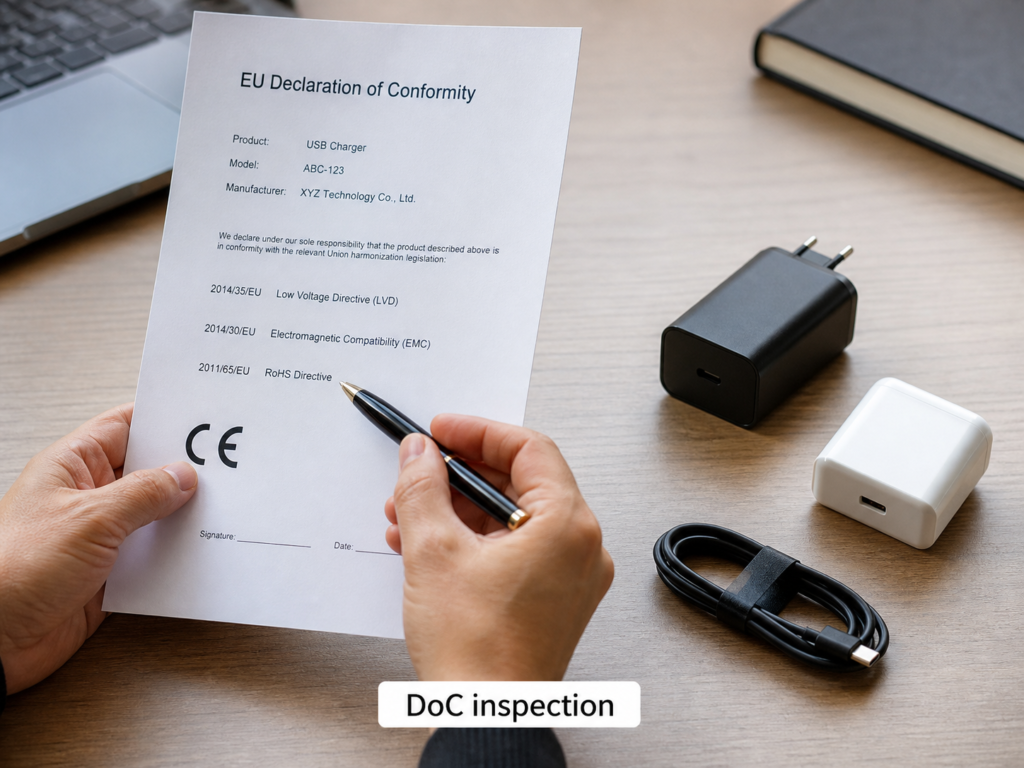
This is the most core step. The focus of the check is: whether the list of “applicable EU directives” in the DoC clearly lists the RoHS directive (such as 2011/65/EU, or a newer version).
The DoC must clearly and accurately identify the covered product models or product series, and be consistent with the actual product and technical documents. A declaration can cover multiple clearly listed models or product series, but if no specific product is indicated, or the content is inconsistent with the actual product and cannot be traced, it cannot be used as a sufficient basis.
The DoC should also be signed by an authorized person of the manufacturer or EU authorized representative, with the name, position or other identifiable information indicated. EU regulations usually do not require a company seal; the key is that the responsible subject is clear, the signatory is authorized and the signature is valid. Nor can it be concluded that the product is substantially compliant just based on a photo of the document or a formal signature.
Let me emphasize again: the DoC is the core legal document for CE compliance. Third-party CE certificates cannot replace the DoC. Don’t just look at the certificate and ignore the DoC.
Step 3: Check RoHS Compliance Supporting Evidence
If RoHS is listed in the DoC, you can further check whether the supporting materials are really valid. RoHS test reports, material declarations issued by the supply chain, risk assessments and other technical materials can all be used as supporting evidence.
XRF can usually be used for screening of some elements or initial risk screening, but XRF screening alone usually cannot cover all RoHS restricted substances, nor can it automatically meet all judgment requirements. Whether it is sufficient to support compliance depends on the test items, test methods, samples and technical documents; if necessary, appropriate chemical analysis methods are also required. No XRF screening report can be uniformly regarded as a complete RoHS proof. If the product uses exemption items, there should also be corresponding exemption item descriptions.
Invalid or insufficient evidence includes: only LVD or EMC test reports, vague “meets environmental protection requirements” words on merchant promotional pages, and general declarations without specific models or that cannot be traced to the actual product.
For charging products, you can focus on several high-risk materials during inspection: the plating layer of terminals, the solder of circuit boards, the plastic sheath of products, the wire core of data cables, and internal electronic components. These are parts that usually need attention in material compliance assessment.
Another reminder: RoHS allows manufacturers to self-declare, and there is no mandatory requirement for a test report from a third-party laboratory. However, manufacturers must establish technical documents sufficient to prove conformity, which can be combined with evidence such as material declarations, supplier information, risk assessments and appropriate tests, and cannot just make empty claims.
1-Minute Quick Preliminary Judgment Technique (Suitable for Ordinary Users / Procurement Initial Screening)
If you are only doing preliminary screening and don’t want to go through the complete process, you can use these simple methods:
• Check the channel: formal offline stores in the EU and official brand stores can be used as initial screening factors to reduce risks, but they cannot replace the verification of specific model DoCs, product markings and supply chain documents.
• Check the price: price and brand can only be used as risk screening factors, and cannot prove whether the product has completed RoHS compliance, nor can they replace the verification of specific product DoCs, technical documents and material compliance evidence.
• Check the publicity: products clearly marked “compliant with RoHS directive” are easier to further verify than those only written with “CE certified”, but the publicity slogan itself is still not a proof of compliance.
Of course, quick judgment can only be used for preliminary screening. If you are not sure, the safest way is to directly ask the seller for the DoC listing the RoHS directive and check the specific model.
Common Pitfall Avoidance: 4 Types of Common Traps
Knowing how to judge, you also need to avoid the 4 types of common traps on the market. Many people mistakenly think that CE includes RoHS or buy non-compliant products because they fell into these traps.
Verbal Trap: “Having CE Equals Complying with RoHS”
The pitfall of this statement is that it deliberately blurs the applicable scope of CE and does not mention whether the product is within the coverage of RoHS at all. For example, for a purely mechanical product, CE does not need to include RoHS originally, but when the merchant says so, users will mistakenly think that it already complies.
The way to avoid the pit is very simple: don’t just ask “do you have CE”, but directly ask “does your CE compliance include the conformity assessment of the RoHS directive”. When verifying, it must be based on the RoHS directive listed in the DoC, and verbal promises do not count.
Word Game: “The CE Certificate Includes RoHS”
Many people think that CE has an official unified certificate, but in fact there is none at all. The third-party CE certificates on the market are all issued by testing institutions themselves, which may only cover some directives such as LVD and EMC, and RoHS is not done at all. But the merchant only shows you the cover with “CE Certificate” written on it, and says it includes RoHS.
When avoiding the pit, don’t just look at the cover of the certificate. Be sure to turn to the “list of applicable directives” on the inner page. If RoHS is not written, it is not included. As the saying goes, the legal effect of the DoC is higher than that of a third-party CE certificate, so prioritize checking the DoC.
Limit Misleading: False Publicity of RoHS Compliance Standards
There are two common pitfalls: one is using “the whole product meets the standard on average” to pretend to comply with RoHS. As mentioned earlier, RoHS calculates limits separately for homogeneous materials. For example, the average lead content of the whole product is 0.1%, but the lead content of a small component may exceed the standard several times, which is not compliant. Another pitfall is confusing compliance exemptions with non-compliance, or hyping “no exemption means better quality” — in fact, the EU has an official RoHS exemption list, and eligible exemptions are legal.
When avoiding the pit, as long as you confirm that the technical documents and test data are evaluated according to homogeneous materials, and check whether the exemptions used are in the EU official list, you don’t have to be fooled by various marketing concepts.
Fake Compliance: Report Does Not Match the Product
This kind of pit is particularly common in charging products: for example, using the RoHS report of model A charger to impersonate that of model B; using the CE report of the whole machine to prove that the bundled data cable complies with RoHS — in fact, if the data cable is sold separately, it needs to be separately assessed for RoHS according to its product nature.
If the product has changed materials, suppliers, processes or structures, the representativeness and applicability of the old report should be re-evaluated, and supplementary testing should be carried out if necessary. The old report does not necessarily automatically become invalid, but there must be sufficient material, supply chain and technical document basis to prove that it is still applicable to the changed product. Conversely, if the product model name on the report is not exactly the same as the actual name, it does not necessarily mean that the report is completely invalid. The key is whether it can prove that the samples, materials and mass production configurations are representative and consistent.
The core of avoiding the pit is to establish a traceable relationship: check the products, materials, suppliers and production configurations involved in the report, and confirm that they correspond to the actual products. You cannot make an absolute judgment just based on the name on the report cover or a different field, nor can you directly apply the old report to a new product when it cannot be traced.
Practical Action Guide by Role
At this point, you should already be able to judge whether CE includes RoHS. Finally, let’s talk about what to do specifically for different groups of people:
Ordinary Overseas Consumers
Prioritize choosing charging products from formal offline channels and official brand stores. Such channels and brands are usually factors that reduce risks, but you cannot default that specific products have completed all applicable CE and RoHS compliance. If you are not sure, you can directly ask the seller for a photo of the DoC including the RoHS directive and check whether the product model is consistent.
Try not to judge only based on the CE mark, price or promotional page. Documents provided by formal merchants should also be able to correspond to specific products. You cannot skip basic verification just because the sales channel looks formal. Not only RoHS needs attention, but also the electrical safety and electromagnetic compatibility of charging products are equally important.
Cross-border Procurement / Product Selection Personnel
Clarify the requirements with the supplier in advance. Don’t just say “need CE certification”, but say “need complete CE compliance including the RoHS directive”. When requesting core documents, be sure to get the DoC listing the RoHS directive, as well as the RoHS material declaration or test report.
After getting the documents, carefully check whether the product model, brand, and parameters completely match the sample to be purchased. For documents shared by product series or multiple models, confirm whether the declaration clearly lists the coverage scope, and whether the technical data can prove the consistency between the sample and the mass production configuration.
If it is a large-volume procurement, sampling testing can be carried out based on risk. However, the sampling results only represent the scope covered by the tested samples or the established sampling plan, and cannot automatically prove the entire batch of goods or complete RoHS compliance. Sampling testing should be used in combination with supplier information, material information, risk assessment and the manufacturer’s overall technical documents.
Private Brand / Manufacturer
When doing CE compliance, follow four steps and you won’t go wrong:
Step 1: First confirm all CE directives applicable to the product. Charging products generally need to be assessed for LVD, EMC and RoHS; if they have wireless communication functions such as Bluetooth and Wi-Fi, they usually also need to be assessed for RED. Whether the wireless charging function itself triggers RED depends on the specific radio function.
Step 2: Complete the conformity assessment for each directive, including testing and technical document sorting. The RoHS part does not require a fixed form of document to be prepared. Technical documents sufficient to prove conformity can be established by combining evidence such as material declarations, supplier information, risk assessments and appropriate tests.
Step 3: Sign the DoC including all applicable directives, establish a complete technical file, which must be kept for 10 years according to EU requirements.
Step 4: After all requirements are met, affix the CE mark. Do not affix it in advance.
Core Summary
Finally, let’s refine the core content for everyone’s memory:
First, CE is a market compliance framework for applicable EU harmonized regulations, and RoHS is an individual environmental requirement for electrical and electronic equipment, related cables and spare parts, etc. There is no absolute conclusion that “CE naturally includes RoHS”. When judging, it depends on whether the product falls within the scope of RoHS and whether the manufacturer has included RoHS in the compliance assessment.
Second, for charging products such as chargers, cables with electronic components, and interfaces and adapter devices that clearly belong to electrical and electronic equipment, formal CE compliance usually must include RoHS. For boundary products such as purely passive connectors, they cannot be judged only by name, metal terminals or whether they are sold separately, but need to be evaluated in combination with their functions, structures and legal applicable scope.
After reading this article, you can not only quickly confirm whether a product’s CE includes RoHS through the 3-step method, but also avoid the 4 common types of compliance traps, and implement the corresponding operations according to your role, so you don’t have to be confused by various contradictory statements anymore.