
If you are an Amazon seller selling charging products (power adapters, USB-C cables, wireless chargers, car chargers, etc.) who has just entered the EU market, you will most likely be overwhelmed by compliance requirements such as CE and RoHS: some say you can just buy a certificate and affix the label, some say their submissions were rejected ten times, and others have had their stores directly shut down due to compliance issues.
In fact, most pitfalls arise from failing to understand the three layers of logic: “EU laws, harmonized standards, and platform requirements”, and simply equating compliance with “buying certificates”. This article is specifically for charging products, and explains the CE and RoHS submission process for Amazon EU site step by step, from basic concepts, quick judgment, material preparation, backend submission, to audit appeals and long-term compliance.
Note: This article is a popular science guide for charging product compliance and platform submission, and does not replace professional legal advice; EU regulations, harmonized standards, Amazon rules and their implementation dates are all subject to the latest official notices.
Quick Judgment: Compliance Submission Decision Tree for Charging Products
After understanding the basic concepts, you can use the four-step decision tree below to quickly determine what compliance your products need and whether you need to submit them for platform review.
Step 1: First check if the product requires assessment and if there are exemptions
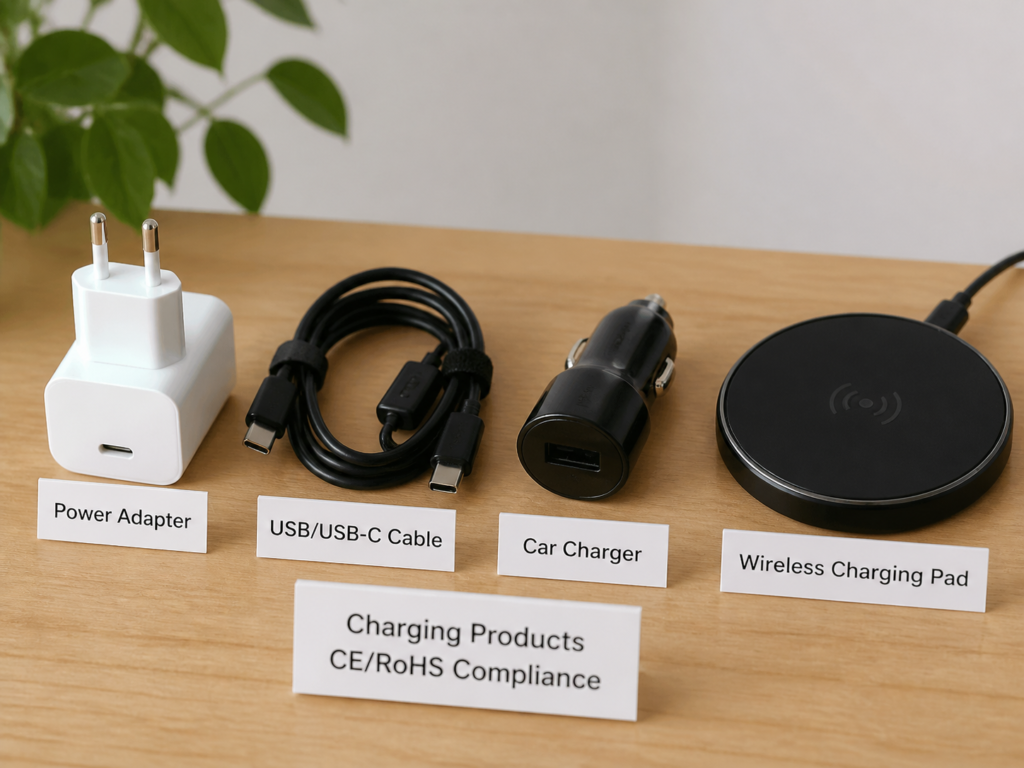
Among charging products, **categories that require mandatory CE/RoHS assessment** include: power adapters/fast chargers, USB/USB-C cables with electronic components, car chargers, and wireless charging pads.
**Completely exempt categories** are purely mechanical accessories without any electrical components, such as plastic cable winders and pure storage bags.
The most easily confused boundary is: cables with E-Marker chips, LED indicators, or control circuits cannot be treated as purely passive cables, and must undergo compliance assessment. Purely passive USB-C cables (without any electronic components) usually do not trigger the LVD, EMC, or RED directives, but still need to comply with RoHS.
As for RoHS exclusions, it cannot be generally assumed that all military or medical products are exempt. RoHS only excludes equipment or uses explicitly listed in Article 2 of the regulation, such as some specific equipment; medical devices usually still require RoHS assessment, and the specific scope should be checked against Article 2 of the regulation and the exemption clauses in Annex IV. Ordinary charging products usually do not fall into these special scopes.
Step 2: Check applicable regulations for the corresponding product
Each EU directive has clear trigger conditions, and not all products need to complete the full set. First, look at the core trigger logic of each regulation:
| Regulation | Governing Scope | Trigger Condition |
| LVD (Low Voltage Directive) | Electrical safety | Input/output voltage of 50-1000V AC, 75-1500V DC |
| EMC (Electromagnetic Compatibility Directive) | Electromagnetic interference and immunity | Electrical and electronic equipment that may generate electromagnetic disturbance or be disturbed (exclusions need to be checked) |
| RED (Radio Equipment Directive) | Radio safety, compatibility and spectrum | With radio transmission, communication, or control functions |
| RoHS | Restriction of hazardous substances | Belongs to electrical and electronic equipment and has no legal exclusions |
| ErP (Ecodesign Directive) | Product energy efficiency | Only applicable to specific energy-consuming products such as external power supplies, the applicable scope needs to be checked |
| USB-C Common Charging Rule | Common charging interface | Implemented by amending the RED, mainly applicable to specific radio equipment listed in Annex I; it should be judged according to equipment category and implementation date, and it cannot be assumed that all matching chargers are applicable |
For common charging products, there is a quick reference (only for general situations, specific cases need individual assessment):
| Product Type | LVD | EMC | RED | RoHS | ErP |
| Ordinary AC power adapter | Applicable | Applicable | Not applicable | Applicable | Conditional judgment |
| Passive USB-C cable | Not applicable | Not applicable | Not applicable | Applicable | Not applicable |
| Active USB-C cable (with E-Marker/protocol chip) | Conditional judgment | Conditional judgment | Not applicable | Applicable | Not applicable |
| Pure induction wireless charger (no wireless control) | Conditional judgment | Applicable | Not applicable | Applicable | Not applicable |
| Wireless charger with Bluetooth/NFC | Conditional judgment | Applicable | Applicable | Applicable | Conditional judgment |
| Car charger | Conditional judgment | Applicable | Not applicable | Applicable | Not applicable |
Step 3: Determine conformity assessment requirements and CE marking rules
Most low-risk conventional charging products use Module A (internal production control), which does not require the participation of a notified body, and enterprises can declare compliance on their own.
Special attention: **The CE mark can only be affixed to the product after the conformity assessment of all applicable CE regulations is completed**, and you cannot affix the mark after completing only one of them.
For example, a wireless charger with wireless functions such as Bluetooth usually should complete safety, EMC and spectrum-related conformity assessment according to the RED, and be separately assessed for RoHS; the Declaration of Conformity (DoC) should list the actually applicable regulations, and should not simply state that the LVD, EMC, and RED directives are all applicable separately at the same time.
Step 4: Check site and platform trigger rules
• **EU 27 country sites**: CE/RoHS requirements are determined according to the applicable regulations of the product; manuals and labels must be provided in the official language of the actual selling member state.
• **UK site**: For the GB market, the latest policies on UKCA and CE recognition need to be checked; the Northern Ireland site still accepts CE currently, which will be updated with policy changes later.
• **Scenarios where the platform triggers review**: Usually product category matching, keywords in titles/attributes, random platform spot checks, and consumer complaints.
• Self-check entry: Seller Central “Performance → Account Health → Manage Your Compliance”; all platform rules and entries are subject to the current backend page and notifications for specific ASINs.
3 Pre-Submission Checks: Avoid Rejection Right After Submitting
Many rejection issues can be avoided by spending 10 minutes checking before submission. The following three steps are high-frequency rejection points for charging products, so be sure to check them.
Step 1: Model and brand information are completely consistent
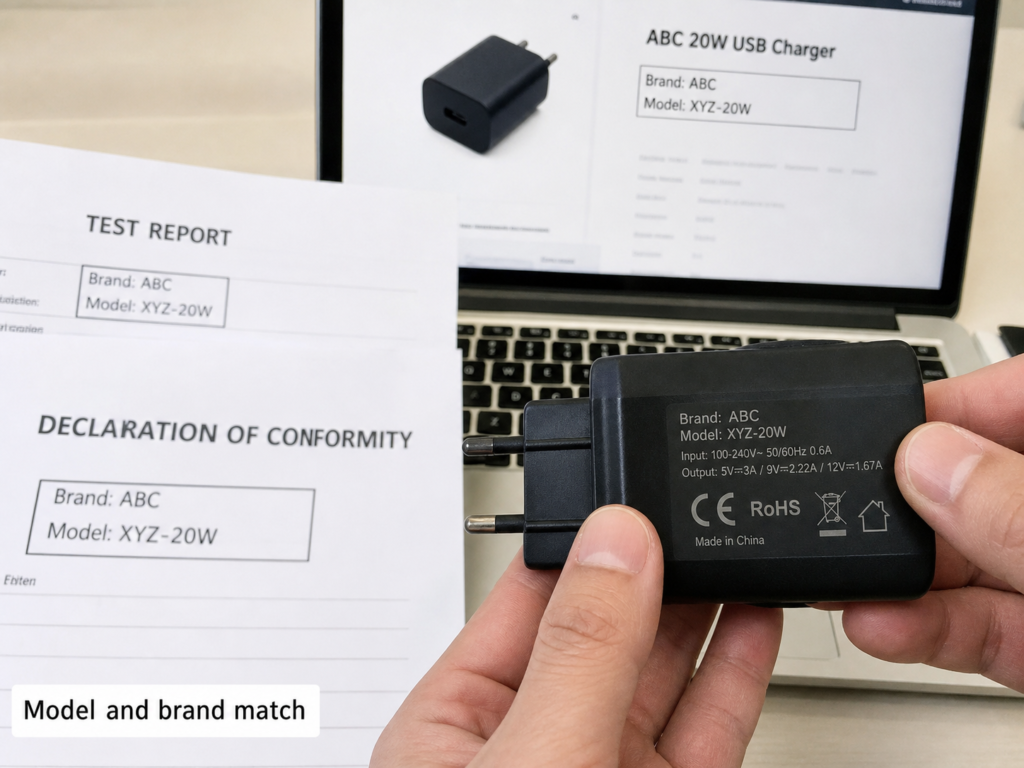
Check the model and brand in four places: test report, DoC, product label, and Listing detail page; they must be completely consistent.
If multiple models share the same report, the premise must be: same core design, same key components, same rated parameters, with only appearance differences such as color and packaging. Reports of similar models, old models, or other brands must never be used as substitutes.
Step 2: Product parameters match the test scope (exclusive to charging products)
The key check points for different charging products are different:
• Power adapters/fast chargers: Check that the input and output voltage, power, plug type, and frequency are consistent with the report; the plug must also meet the standards of the selling country.
• USB/USB-C cables: Check that the length, rated current, presence of electronic components, and data transmission capability are consistent with the report.
• Wireless chargers: For those with radio communication/control functions, check whether the RED test covers them; for pure induction charging, confirm that the applicable regulations and test scope are correct.
• Car chargers: For those designed for 12V/24V vehicle power supply, check whether the test covers the corresponding voltage fluctuation scenarios.
If key components (chips, cable cores, power supply solutions, etc.) are replaced or core parameters are adjusted, the validity of the report must be reconfirmed, and the old report cannot be directly used.
Step 3: Labels, packaging, manuals are consistent with the Listing
The markings in four places need to be checked, but the specific requirements should be judged according to applicable regulations:
• **Product body**: Requirements such as CE mark, model/batch, rated parameters, and information of the manufacturer or other economic operators should be checked according to the specific applicable regulations; this does not mean that all charging products must have the same set of fields on the body.
• **Packaging**: Brand, model, and other economic operator information should be checked according to specific applicable regulations. The CE mark should be affixed to the product first according to applicable regulations; only when the nature of the product does not allow or cannot achieve the required visible, clear, and durable marking, can it be transferred to the packaging or accompanying documents according to applicable regulations.
• **Manual**: It needs to include safety warnings, instructions for use, manufacturer/responsible person information, and the language must meet the official language requirements of the selling member state.
• **Listing detail page**: Images, parameters, and brands must be completely consistent with the submitted documents and the actual product; false promotion of compliance qualifications is prohibited.
The CE mark itself also has specifications: it must be clear, durable, proportionally compliant, and cannot be obscured; it is prohibited to use marketing terms such as “CE tested” or “CE certified” to replace the official CE mark.
If the product size is too small, or the nature of the product makes it impossible to mark on the body as required, the information should only be transferred to the packaging or accompanying documents as permitted by the corresponding regulations, and cannot be handled uniformly.
Audit Response: Handling Methods for Pass/Rejection/Removal
What to do after passing the audit?
• No need to resubmit, unless there is a change in product compliance, regulation update, or the platform issues a new notice.
• All documents should be properly kept in accordance with regulations and platform requirements, and should not be lost.
• Check the compliance portal once a quarter to avoid missing spot checks or rule update requirements.
Index of High-Frequency Rejection Reasons for Charging Products
The following are the most common rejection reasons for charging products, corresponding to the previous pre-check points, you can directly compare and rectify:
Document Information Category (corresponding to model/brand consistency check)
• Model/brand does not match the Listing: Usually the report/DoC uses an old model or another brand; the rectification method is to update the documents or correct the Listing, no supplementary testing is required.
• DoC lacks signature, applicable regulations, or signing date: This is due to non-standard DoC preparation; just re-sign a standardized DoC, no supplementary testing is required.
• The report does not have corresponding laboratory qualifications: The laboratory does not have ISO 17025 accreditation, or the accreditation scope does not match the corresponding test standard; it is necessary to replace the report with a qualified laboratory, and supplementary testing is required.
Test Scope Category (corresponding to parameter/scope consistency check)
• Missing tests for applicable regulations: For example, missing LVD, EMC, or RED tests; it is necessary to supplement the tests for the corresponding regulations, and supplementary testing is required.
• RoHS does not cover all materials: Only the shell or cable sheath is tested; it is necessary to supplement tests for all homogeneous materials, or provide traceable supply chain declarations; if supplementary testing is involved, re-testing is required.
• Product parameters are inconsistent with the report: For example, rated power, voltage, or cable specifications do not match; it is necessary to update the report or adjust product parameters; if core parameters are changed, supplementary testing is required.
Label Marking Category (corresponding to label/Listing consistency check)
• Non-standard CE mark: Wrong proportion, or using marketing terms to replace the official mark; just remake the standardized mark, no supplementary testing is required.
• Missing required marking information: Information requirements such as manufacturer, importer, model, batch or serial number, rated parameters, and EU responsible person should be checked according to specific applicable regulations; if the product body cannot carry the information due to size or nature, it can only be supplemented to the packaging or manual as permitted by the corresponding regulations, no supplementary testing is required.
• Manual language does not meet requirements: Not using the official language of the selling member state; just translate and update the manual, no supplementary testing is required.
Subject Qualification Category (corresponding to responsible subject requirements)
• Invalid responsible person information: Using a virtual address, freight forwarder address, or a subject that cannot perform statutory duties; just replace it with a qualified domestic responsible subject, no supplementary testing is required.
• Manufacturer information is inconsistent with documents: The information is inconsistent; just correct the documents or Listing information, no supplementary testing is required.
Appeal Steps After Rejection or Removal
Don’t panic if you are rejected, follow these four steps:
1. **Locate the problem**: Read the official notice carefully, clarify the specific non-conforming items, and do not blindly re-upload the same documents.
2. **Rectify materials**: Carry out targeted rectification, such as supplementary testing, correcting information, and replacing the responsible person.
3. **Resubmit**: Upload the rectified documents from the original entry, and clearly note the modification instructions.
4. **Escalate the issue**: If rejected multiple times, you can open a case to contact the compliance team and provide information such as the report number to assist the review.
Necessary materials for appeal include: screenshots of Amazon notifications, ASIN and model correspondence table, explanation of differences before and after rectification, and signed DoC.
Absolute Taboos During the Appeal Stage
• It is prohibited to repeatedly upload the same unrectified documents, which will only waste time and even be judged as malicious submission.
• It is prohibited to confuse the uses of CE and RoHS documents, for example, using a RoHS test report to replace CE compliance evidence.
• It is prohibited to use forged, altered, or fraudulently used compliance materials; once discovered, the store will be directly shut down.
Several Common Pitfall Counterexamples
• Counterexample 1: A 65W charger had its power chip replaced but still used the old test report, which was judged invalid.
• Counterexample 2: A purely passive USB-C cable only submitted a RoHS test report, but did not provide the CE DoC and marking proof corresponding to RoHS, and was rejected.
• Counterexample 3: A wireless charger with Bluetooth control only submitted LVD/EMC reports, missing RED test, and was rejected.
• Counterexample 4: A car charger was submitted with the LVD report of an ordinary household charger, which did not cover the vehicle voltage fluctuation scenario, and was rejected.
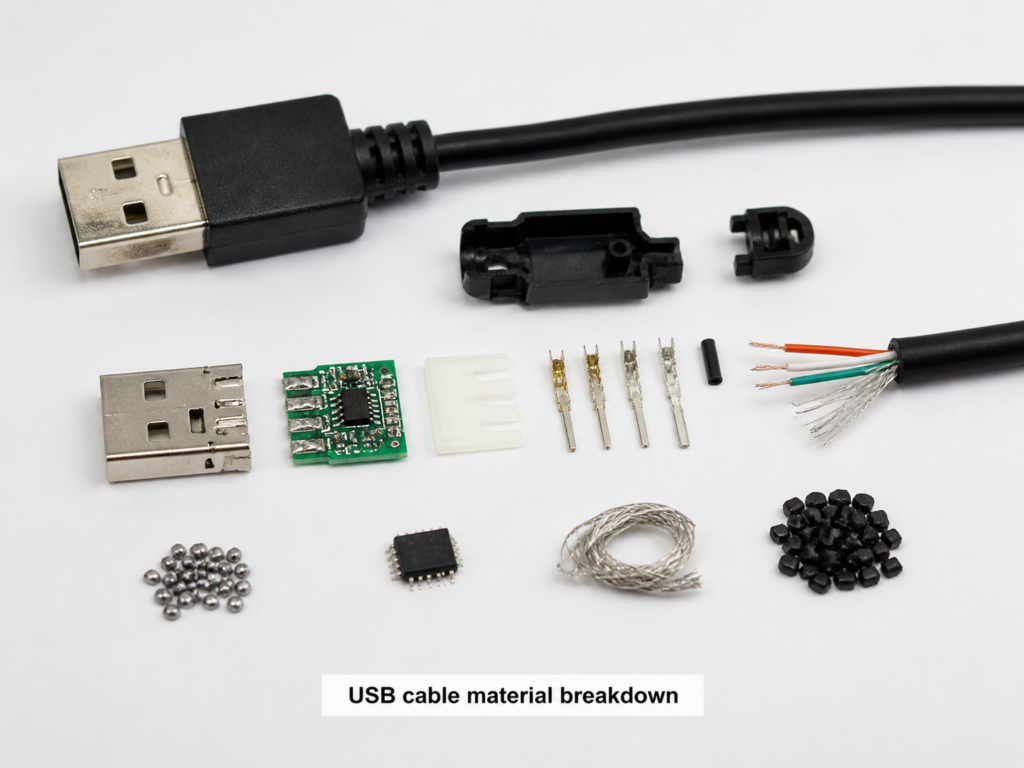
Category-Specific: Compliance Submission Key Points for Different Charging Products
The compliance requirements for different charging products vary greatly. The following focuses on common categories to avoid wasting money on extra tests or being rejected due to missing tests.
Power Adapters/Fast Chargers
• Regulation judgment: If the rated voltage is within the LVD range, LVD + EMC + RoHS are usually required; if it is below the range, other regulations need to be assessed. For adapters that fall under the definition of external power supply and are not excluded, the ecodesign requirements of Regulation (EU) 2019/1782 should also be assessed and met.
• Submission key points: This is a category with high review priority on the platform, and usually requires reports from ISO 17025 accredited laboratories; the specific requirements are subject to ASIN notifications.
• Additional tip: The USB-C Common Charging Rule is mainly applicable to specific radio equipment listed in Annex I, and should be judged according to equipment category and implementation date; it cannot be assumed that all matching chargers need to comply with it.
USB/USB-C Data Cables
• Regulation judgment: Purely passive cables (without electronic components) usually do not trigger LVD/EMC/RED; active cables (with E-Marker, LED, control circuits, protocol chips) need to assess applicable regulations according to specific circuit functions.
• Submission key points: RoHS must cover all homogeneous materials (sheath, contacts, chips, solder, cable core, etc.), and cannot only test the sheath; this is the most frequent rejection point.
Wireless Chargers/Car Chargers
• **Wireless charger**: The applicability of the RED should be judged based on whether there is intentional radio transmission/reception function for wireless communication, identification or control, the operating frequency band, and the specific product definition; the wireless charging output power itself is not a general trigger condition for the RED. Pure electromagnetic induction charging (without wireless communication, identification, or control functions) usually does not apply to the RED due to the charging function itself; those with Bluetooth, NFC, wireless control and other functions need to be assessed according to the RED directive and supplemented with corresponding tests.
• **Car charger**: For those designed for 12V/24V vehicle power supply, the test must cover the safety requirements of the corresponding voltage fluctuation scenarios, and cannot be replaced by the report of an ordinary household charger.
• Submission key points: Select applicable regulations according to actual functions and usage scenarios; do not waste costs on extra tests, nor be rejected due to missing tests.
Charger + Data Cable Combo Set
• Compliance requirements: Each individual product in the set must meet the CE/RoHS requirements of the corresponding category; it is not allowed to only test the set as a whole.
• Submission method: You can submit the test report of the entire set, or submit the compliance documents of each individual product separately.
• Boundary tip: The overall test report must cover the models, configurations, and most unfavorable working conditions of all individual products; for example, for a 65W charger and 100W cable in a set, the most unfavorable working scenario must be tested.
• Note: The set ASIN must correspond to the compliance documents of the set, and cannot be submitted with only the report of a single individual product.
Advanced Pitfall Avoidance: Long-Term Compliance and Risk Judgment
Doing business in the EU market is not a done deal after submission; long-term compliance management can help you avoid many hidden risks.
These Situations Require Reassessment of Compliance
As long as any of the following changes occur, compliance must be reassessed, and old documents cannot be directly used:
• Product hardware change: Replacement of key components (power chips, cable cores, plugs, solder, shells, etc.).
• Product parameter change: Adjustment of charging power, output protocol, length, interface, wireless function.
• Subject information change: Modification of brand, manufacturer, responsible person, product model.
• Regulation/policy update: Adjustment of RoHS substance list, update of CE directives, change of platform rules.
How to Manage Compliance Files Without Mess
• Build exclusive files by model: Each ASIN/model corresponds to a set of compliance documents, marked with version number and effective date.
• Core fields should be recorded in a single document: product model, hardware version, BOM version, test sample number, report date, applicable standard version.
• Retain historical versions: Avoid mixing old and new materials, which is convenient for regulatory or platform traceability.
• Regular review: Check the validity of documents and the update of regulations and platform rules every six months.
How to Judge Whether Test Reports and Service Providers Are Reliable
• **Qualification check**: First check whether the laboratory has ISO 17025 accreditation, then check whether the accreditation scope covers the test standards of the corresponding product — not all products can be tested with 17025 qualification.
• **Authenticity check**: You can directly contact the laboratory to verify the authenticity through the report number.
• **Trap tip**: Those that promise “guaranteed pass”, “no sample needed”, or “certificate issued in 1 day” are basically fake reports, and must never be touched.
• Selection reference: Prioritize formal institutions with experience in testing charging products to avoid platform non-recognition due to non-standard testing.
These Ongoing Compliance Obligations Exist After Launch
• Product liability: Manufacturers bear primary responsibilities for product design, manufacturing, technical documentation, and conformity according to law; the EU responsible subject performs obligations such as domestic liaison, information storage, regulatory cooperation, and corrective measures according to applicable regulations. The specific liability for damages should be judged based on the applicable product liability law and the actual conduct of all parties, and the GPSR responsible person does not automatically replace the manufacturer to bear it.
• Complaint and incident handling: All complaint and incident records must be kept, and serious incidents need to be reported to the regulatory authorities in accordance with regulations.
• Recall cooperation: If the product has safety risks, it is necessary to actively recall or cooperate with the regulatory authorities in the recall.
• Market spot check response: EU regulatory authorities may randomly inspect products, and technical documents need to be provided within the specified time; this is why documents are required to be retained for at least 10 years.
How to Check Regulation and Policy Updates (by Priority)
• First priority: Compliance notifications for corresponding ASINs in Amazon Seller Central, and prompts on the Account Health page — platform requirements directly affect your store and may be stricter than legal requirements.
• Second priority: EUR-Lex EU regulation database and the official website of the European Commission, where you can find the original text and implementation details of regulations.
• Third priority: The list of harmonized standards published in the Official Journal of the European Union, which can confirm the validity and presumption of conformity of standards.
• Fourth priority: The official website of the local regulatory authority of the selling member state, used to check local obligations such as WEEE and packaging EPR.
Quick Self-Check List and Capability Summary
Quick Self-Check List for CE/RoHS Submission of Charging Products
Check off before submission to avoid the vast majority of rejection risks:
□ The scope of EU regulations applicable to the product has been clarified, and there is no misjudgment of exemptions
□ A qualified EU domestic responsible subject has been designated as required
□ The model and brand on CE/RoHS documents are completely consistent with the Listing and the product
□ Compliance evidence covers all applicable regulations and core parameters
□ The marking information on the product/packaging/manual meets the requirements of applicable regulations
□ All documents are true and valid, and meet the platform submission requirements
□ Listing information is completely consistent with the actual product and compliance documents
□ The latest regulations and platform notifications have been checked to confirm that the requirements have not been updated
You Can Master These Capabilities After Learning
• Can quickly determine the applicable scope of EU regulations and platform submission requirements for your own charging products and corresponding sites
• Can determine the EU regulations and conformity assessment requirements applicable to products through the decision tree
• Can independently prepare compliance materials and complete Amazon backend submission operations
• Can troubleshoot document consistency issues in advance to reduce the probability of rejection
• Can identify common audit rejection reasons and complete basic appeals
• Can avoid core compliance risks such as fake reports and fake responsible persons
• Can do a good job in long-term compliance management and regulation update checks
In general, the CE and RoHS compliance for Amazon EU site is essentially “comply with regulatory requirements first, then submit evidence according to platform rules”, and cannot be muddled through by buying certificates or affixing labels. For charging product sellers, as long as you figure out the applicable regulations for your products, prepare materials and check consistency in advance, you can greatly improve the submission pass rate and avoid subsequent compliance risks. If you encounter complex situations that you are not sure about, it is recommended to consult a professional compliance service provider or lawyer.