
For sellers of charging products expanding overseas, you will definitely encounter the two compliance systems RCM and KC as soon as you enter the Australian and South Korean markets. Many people’s first reaction is, “Aren’t they just local mandatory certifications? Similar to CE.” In fact, the two are very different in logic, processes, and requirements. Making mistakes can lead to goods being detained or delisted at best, and fines or recalls at worst. Today, we will thoroughly explain the differences between the two systems from basic concepts to practical pitfall avoidance. Whether you are a new entrant to the industry or a seller looking to optimize compliance for both markets, you can use this directly.
Beginner’s Guide: Core Identities and Applicable Boundaries of the Two Certifications
Many people have a wrong first impression of these two names: they are neither the same thing nor simply “regional versions of CE”. Let’s first clarify their basic identities.
RCM: Not a Certificate, but a Statutory Compliance Mark
RCM is a compliance mark used in the Australian and New Zealand markets. To put it simply, it is more like a “compliance logo”. Enterprises must first meet applicable safety, EMC, or radio requirements before they can affix it to products in accordance with regulations. The authorities do not issue a separate “RCM certification certificate” in a unified format for all products; the specific compliance proof depends on the regulatory system and process applicable to the product.
RCM-related requirements are not handled by a single agency. In terms of electrical safety, Australian states and territories coordinate relevant systems through ERAC; EMC and radio equipment are mainly regulated by the Australian Communications and Media Authority (ACMA). New Zealand implements its own applicable electrical safety, EMC, and radio regulatory systems. Therefore, it cannot be simply understood that completing one registration automatically covers all compliance matters in Australia and New Zealand.
For charging products, power adapters and chargers with mains input usually need to be evaluated in accordance with EESS and EMC requirements. Pure low-voltage USB-C cables, including those with E-Marker chips, usually do not automatically require RCM just because they contain chips. They should be judged item by item based on specific product functions, whether they contain active circuits, and local catalogs.
KC: Not a Single Certification, but a Complete Compliance System
KC, as commonly referred to in South Korea, does not correspond to the same type of certificate for all products, but is a set of product compliance marks and institutional systems used in the South Korean market.
Electrical safety is mainly managed by the Korean Agency for Technology and Standards (KATS) and the Safety Korea system. Radio and EMC conformity assessment are mainly implemented by the Korean Radio Research Agency (RRA) in accordance with relevant radio regulations. Specific products may be subject to safety certification, safety confirmation, supplier declaration, or RRA’s EMC/radio conformity assessment, which must be judged based on product category and function.
Therefore, safety and EMC/radio are compliance modules that may apply separately. It cannot be asserted in advance that every charging product needs to obtain a KC safety certificate and a so-called “KCC EMC certificate”.
KC only applies to the South Korean market. For charging products, chargers and power adapters with mains input usually require key inspections of South Korean electrical safety, EMC, and other applicable regulations. Charging cables or connectors with fast-charging chips cannot be directly deemed to fall within the scope of KC mandatory certification just because they contain chips; they still need to be judged in combination with product structure, functions, and the latest South Korean product catalog.
How to Determine the Mandatory Boundary for Charging Products
Not all charging-related products require the same type of certification. Let’s first clarify the boundaries:
- Categories that usually require key evaluation: Wall-plug chargers, desktop power adapters, and other products with mains input;
- Categories that require individual determination: Pure passive ordinary charging cables, pure low-voltage USB-C cables, connectors, and cables with E-Marker. Whether they require a certain compliance item should not be judged solely based on “whether they have a chip”, but on whether they contain active circuits, whether they have other regulated functions, and the latest local product catalog;
- Scope excluded from this comparison: Wireless chargers and industrial-grade charging equipment. The rules for these two categories are quite different, so they will not be elaborated here for now.
In addition, note that compliance is not a one-time fix: if the product’s power increases, fast-charging or wireless functions are added, or the plug or key chips are replaced, it may trigger changes in compliance requirements and require re-evaluation.
4 Common Cognitive Pitfalls for Beginners
Almost everyone who is new to these two systems will fall into these pitfalls. Explaining them clearly in advance can save a lot of trouble:
- Assuming both are single official certificates: RCM is a mark, and the specific basis may include supplier registration, equipment registration, supplier declaration, and technical documents, etc.; KC is also not a fixed single certificate, and safety and EMC/radio may be subject to different systems respectively.
- Assuming certifications are globally valid: Both are only valid in their corresponding regions. RCM-related requirements apply to Australia and New Zealand, and KC applies to South Korea. They cannot replace each other, nor can they be directly replaced by CE or CB reports, which can only be used as a basis for evaluation or testing at most.
- Assuming all charging cables require certification: Pure low-voltage passive wires usually do not automatically fall into the mandatory scope just because they are “charging cables” or “have E-Marker”. They must be judged based on specific structure, function, and local catalog.
- Assuming marks can be printed freely: Whether it is the RCM or KC mark, the applicable compliance process must be completed first and used in accordance with regulations. Unauthorized printing or incorrect use of marks may constitute an illegal act.
Comparison of Core Access Rules: Mandatory Logic, Supervision, and Local Responsibility
After clarifying the basic identities, let’s talk about the core rule differences of “who manages, how to manage, and who is responsible”.
Mandatory Level and Covered Regions
Neither is a simple system where “one certification is directly applied to all charging products”. Power adapters and chargers with mains input usually require compliance assessments such as safety and EMC, but whether they fall into the category of mandatory certification, registration, or declaration must be confirmed in accordance with the latest local product catalog, rated parameters, and applicable regulations.
Pure low-voltage cables and connectors also require individual determination, and cannot be deemed mandatory products just because they have fast-charging chips.
In terms of coverage, RCM-related requirements involve Australia and New Zealand, but the specific safety, EMC, and radio systems of the two countries are not exactly the same; KC only covers South Korea.
Of course, there are exceptions: if the products are for personal use and purchased in small quantities via cross-border e-commerce, they may be exempted under specific conditions, subject to local customs and regulatory regulations. However, commercial sales cannot be based on personal use exemptions.
Completely Different Regulatory Logic
The regulatory ideas of the two are very different, which is also the most confusing part:
- RCM-related systems: Australian electrical equipment safety is usually managed according to EESS equipment levels and product categories. Some regulated equipment requires supplier registration or equipment registration, while other products may be subject to different declaration and document requirements. EMC and radio are managed by applicable regulatory systems such as ACMA. Not all RCM products can be simply classified into the same level or the same registration process.
- KC-related systems: South Korea includes products in mandatory safety certification, safety confirmation, supplier declaration, or other applicable product safety systems according to product catalogs and functions. Products with wireless or related digital functions may also require EMC or radio conformity assessment in accordance with the RRA system.
Take the most common ordinary 65W wired charger as an example. It usually requires key inspections of electrical safety, EMC, and applicable energy efficiency requirements in Australia, New Zealand, and South Korea. However, the specific category and whether equipment registration or a certificate is required cannot be concluded solely based on power and the name “charger”.
Both Require Confirmation of Local Responsible Party or Applicant Entity
Both require confirmation of a responsible supplier or applicant entity that meets the definition of local laws and regulations, but overseas manufacturers are not limited to applying through third-party agents in all cases.
In the Australian EESS system, the Responsible Supplier can be a manufacturer, importer, or supplier in Australia or New Zealand that meets the definition, and bears corresponding legal responsibilities. Overseas manufacturers usually need to complete relevant processes through a qualified Australia-New Zealand responsible supplier.
In South Korea, the requirements for manufacturers, importers, agents, or representatives are not exactly the same for different safety categories and RRA conformity assessment systems. Overseas enterprises usually need to handle corresponding processes through qualified local South Korean importers or representatives, but the final subject qualification must be confirmed according to product category and specific system.
Basic Adaptation Requirements Exclusive to Charging Products
For charging products to enter the local market, they must first meet the voltage, frequency, plug, socket, and product structure requirements of the sales location.
If the product claims to support USB Power Delivery (USB PD) or other fast-charging protocols, corresponding functions, output capacity, and abnormal protection should be tested; however, supporting USB PD itself is not a prerequisite for all chargers to obtain safety compliance in Australia, New Zealand, or South Korea.
The differences are mainly reflected in the following two aspects:
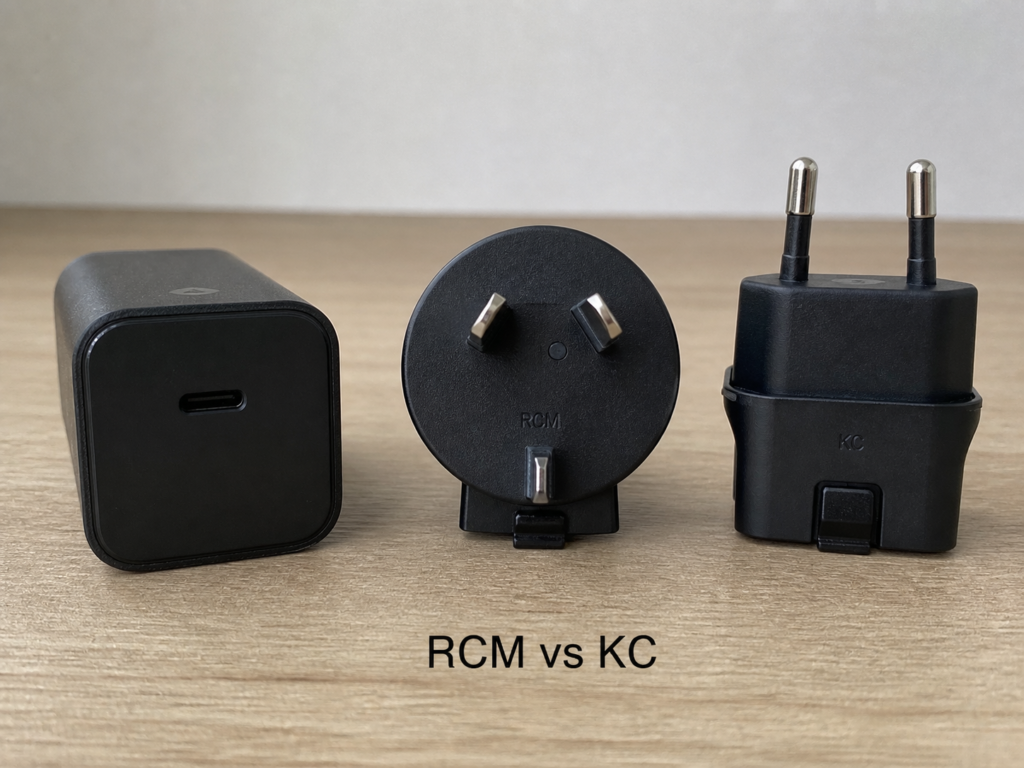
- Power grid and plug: The product must meet the applicable voltage, frequency, plug, and socket safety requirements of the sales location. Australia and New Zealand usually adopt Type I configurations that meet local standards; South Korea usually adopts 220V configurations that meet local standards. The applicable standards should be confirmed based on whether the product is wall-plug type, desktop type, external power supply, or has a replaceable plug structure.
- Label language: Instructions, safety warnings, and product markings should meet the language and information requirements of the sales location. The Australian and New Zealand markets usually require information in English; products sold in South Korea usually need to prepare qualified Korean safety warnings and instructions.
Comparison of Technical Requirements: Test Items, Standards, and CB Reuse Rules
Access rules are the general framework, and technical testing is the hard threshold. This part is directly related to whether the product can pass the evaluation and what materials need to be prepared.
Electrical Safety Testing
Electrical safety is an important compliance content for charging products. Common evaluation directions in both regions may include electric shock protection, temperature and fire resistance, insulation performance, mechanical strength, and output abnormal protection, etc. For products that support fast-charging protocols, overload, over-temperature, and other abnormal conditions under the protocol working state should also be tested according to their actual functions.
However, the specific test items depend on the product structure, input and output methods, rated parameters, applicable standards, and product category. Not all charging products can be regarded as having the same set of tests.
In terms of standards:
- Australia and New Zealand should evaluate in accordance with AS/NZS or AS/NZS IEC safety standards applicable to specific products;
- South Korea should evaluate in accordance with the current K or KS safety standards specified in the Safety Korea catalog.
Whether standards such as 62368.1 and 61558 are applicable, which version applies, and whether there are national differences must be confirmed in combination with specific products. The 62368.1 and 61558 series cannot be used as a fixed combination for all charging products.
EMC and Radio Testing
The common goal of EMC testing is to confirm that the electromagnetic interference generated by the product does not exceed the specified limits, and at the same time has appropriate anti-interference ability against external interference. Common items include emission and immunity testing, but the specific items and levels must be determined according to product category, ports, power supply methods, and applicable standards. Conducted emission, radiated emission, electrostatic discharge (ESD), and surge are not necessarily applicable to all products and all standards.
- RCM-related EMC requirements are mainly regulated by ACMA; products with wireless functions such as Wi-Fi and Bluetooth also need to be evaluated in accordance with applicable radio requirements;
- South Korea’s EMC and radio conformity assessment is mainly implemented by RRA in accordance with relevant systems; products with wireless functions may require additional radio frequency and radio testing.
Special attention should be paid here: there may be differences in EMC limits, test frequency ranges, applicable standards, and marking requirements between the two regions. Even if testing in one region has been completed, it cannot be directly assumed that the other region will automatically accept it. Whether it can be reused must be confirmed by local systems, laboratories, and certification bodies.
Energy Efficiency Requirements (Exclusive to Power Supplies)
Energy efficiency compliance is not a unified component of RCM itself, nor does the same energy efficiency requirement automatically apply to all chargers and adapters.
In addition to safety and EMC, it is necessary to separately check whether the following systems cover specific product categories:
- Energy efficiency regulatory requirements such as GEMS/MEPS in Australia;
- South Korea’s E-Standby and other standby power consumption management requirements.
Whether registration, testing, or affixing an energy efficiency label is required shall be subject to the specific product catalog and current regulations. Parameters such as output power, product use, and power supply type may affect applicability, and cannot be directly judged solely based on “charger” or power level.
CB Report Reuse Rules (Core of Cost Reduction)
When it comes to testing, we have to mention the IEC CB report. Simply put, it is an international safety test report based on the IEC standard system. When corresponding conditions are met, it may help enterprises reduce some repeated tests.
However, the CB report is not a “certificate conversion” voucher that is automatically and unconditionally accepted by Australia, New Zealand, and South Korea. Whether it is accepted, which tests are accepted, whether national differences are required, whether the laboratory has corresponding qualifications, and whether the report format and standard version meet the requirements all depend on specific regulations, product categories, standard versions, and local agency requirements.
Therefore, a more reliable understanding is:
- CB reports may be used to reduce repeated testing when they meet the corresponding standard version, scope, laboratory qualifications, and local agency requirements;
- The local responsible entity or certification body still needs to confirm whether the report can be used and whether supplementary tests or materials are required;
- CB reports cannot replace local registration, declaration, certification, or conformity assessment procedures in Australia, New Zealand, or South Korea.
Comparison of Practical Processes: Application Steps, Cycle, and Cost Reference
After talking about the hard requirements, let’s talk about the practical issues that everyone is most concerned about: how to apply, how long it takes, and how much it costs.
RCM-Related Compliance Process
RCM does not have a unified official certificate process applicable to all products. First, it is necessary to confirm whether the product is EESS regulated equipment and which equipment level it belongs to, then complete supplier registration, equipment registration, supplier declaration, or other applicable procedures in accordance with corresponding requirements.
Generally, it can be promoted in the following order:
- Determine the product category, rated parameters, and applicable safety, EMC, or radio requirements, and prepare samples and technical materials, such as circuit diagrams, BOM lists, and specifications;
- Conduct testing or evaluation in accordance with applicable standards; if there is an existing CB report, the laboratory or responsible entity shall confirm which content can be reused;
- Confirm a qualified Australian or New Zealand responsible supplier;
- For equipment within the EESS regulated scope, complete supplier registration or equipment registration according to the corresponding Level;
- Use the mark in accordance with RCM trademark and applicable regulatory requirements, and prepare and retain test reports, declarations, registration records, and change materials.
Not all products using the RCM mark need to complete equipment registration in the EESS database. EESS registration is mainly for regulated electrical equipment. The processes for Level 1, some Level 2, and other products may be different, and shall be subject to the latest EESS rules.
KC-Related Compliance Process
The KC-related process cannot also be fixed as “apply for a KC safety certificate, then apply for a KCC EMC certificate”. It is necessary to first confirm which safety category the product belongs to, and whether RRA’s EMC or radio conformity assessment is also required.
Generally, it can be promoted in the following order:
- Determine the South Korean safety classification of the product, judge whether safety certification, safety confirmation, supplier declaration, or other systems apply, and confirm whether RRA EMC/radio requirements are involved;
- Prepare samples, specifications, circuit materials, key component materials, and qualified Korean technical and safety information;
- Submit test and evaluation materials to qualified laboratories, certification bodies, or relevant systems according to the specific system; if there is an existing CB report, first confirm whether it is accepted locally and what content needs to be supplemented;
- The qualified manufacturer, importer, representative, or other applicant entity shall complete the corresponding application, declaration, or registration;
- Mark the KC mark and corresponding identification information according to the applicable system, and retain certificates, safety confirmations, supplier declarations, RRA conformity materials, and change records.
The final result may be safety certification, safety confirmation, supplier declaration, or corresponding RRA declaration/certification. Not all products obtain two fixed certificates.
Common Cycle Reference
There is no market standard for the processing cycle of RCM and KC uniformly stipulated by the competent authorities of Australia, New Zealand, or South Korea. The actual time depends on the product model and complexity, test items, whether it has wireless functions, whether the CB report can be reused, whether the materials are complete, whether rectification is required, and the scheduling of laboratories and certification bodies.
Therefore, a fixed cycle of “2–4 weeks” or “4–6 weeks” cannot be simply applied to ordinary 65W wired chargers. Before official project initiation, the laboratory, registration agency, or certification body should be asked to evaluate separately based on the following content:
- Product category and rated parameters;
- Applicable safety, EMC, radio, and energy efficiency items;
- Standard version and completeness of the CB report;
- Whether local responsible entity or agency services are required;
- Specific scheduling of testing, rectification, audit, registration, and certification issuance.
Cost Range and Core Influencing Factors
The core influencing variables of cost include:
- Product power and structural complexity;
- Whether it has wireless functions or other active circuits;
- Whether there is an acceptable CB report;
- Whether supplementary local difference testing is required;
- Whether local responsible entity, agency, or representative services are required;
- Whether it involves energy efficiency, radio frequency, registration fees, certificate fees, annual fees, and subsequent changes.
There is no unified RMB price range for RCM and KC applicable to all 65W chargers. Quotations from different agencies may also differ in test items, number of samples, document review, registration services, and subsequent maintenance. CB reports may reduce some repeated tests, but the actual savings ratio, cycle, and cost must be separately evaluated by the laboratory or certification body based on product category, standard differences, report completeness, registration or certification path, and scheduling.
Comparison of Marking, Validity Period, and Authenticity Query
After completing the compliance process, there are several very practical questions: How to use the mark? How to maintain validity? How to check if the materials are real?
Mark Style and Labeling Requirements
- RCM mark: It shall be used in accordance with RCM trademark and applicable regulatory requirements, and the specified supplier identification information shall be provided at the same time. Specifically, the supplier’s name, address, or other identification information shall be marked. It cannot be generally stipulated that the supplier registration number must be printed next to the mark;
- KC mark: The specified KC mark and corresponding identification information shall be marked according to the specific safety certification category and RRA EMC/radio conformity assessment requirements. Whether both safety and EMC modules apply shall be confirmed according to the product catalog and functions. It cannot be fixedly required to use the “KCC EMC mark” independently.
For charging products, the marking position and information on the product body, packaging, and instructions depend on the applicable system and product structure. Whether it can be marked on connectors, cables, or the minimum sales packaging shall also be confirmed according to specific marking rules. Emphasize again: unauthorized printing of marks without completing the applicable compliance process may constitute an illegal act.
Validity Period and Renewal Rules
- RCM-related compliance: There is no unified fixed validity period applicable to all products. Enterprises need to continuously maintain applicable safety, EMC, radio, and EESS requirements, and re-evaluate when products, key components, standards, or regulations change;
- KC safety items: The validity period, regular inspection, and change requirements of safety certificates or safety confirmations depend on the specific certification category and current regulations;
- RRA EMC/radio items: The continuous validity shall also be confirmed in accordance with the corresponding system, product changes, and regulatory update requirements. It cannot be simply summarized as a certification from a certain historical agency having “no fixed validity period”.
Whether in Australia, New Zealand, or South Korea, as long as the product circuit, key components, structure, plug, rated parameters, or wireless functions change, it should first be evaluated whether re-testing, change declaration, registration update, or re-obtaining relevant documents is required.
Official Authenticity Query Method
When verifying compliance information, the official system corresponding to the specific regulatory module should be used, instead of only looking at paper certificates or supplier screenshots:
- Australian safety items: For EESS regulated equipment, the responsible supplier or equipment information can be checked in the EESS system;
- Australia-New Zealand EMC and radio items: The applicable regulatory requirements and enterprise compliance documents of ACMA or New Zealand shall be checked respectively;
- South Korean safety items: Product safety certification, safety confirmation, and other information can be checked through Safety Korea;
- South Korean EMC and radio items: The corresponding conformity assessment information shall be checked through the RRA system.
When querying, focus on checking the brand, model, rated parameters, applicant entity, manufacturer, applicable product category, and current status. Do not only check a mark or number.
Advanced Pitfall Avoidance: Charging Product Compliance Judgment and Common Misconceptions
This part is prepared for friends who want to go deeper, to help you avoid common compliance pitfalls.
4-Step Judgment Method for Charging Product Compliance Path
Whether you have a new product and don’t know whether to do compliance, or want to enter a new market, you can judge according to these steps:
- Check whether it is connected to mains power: Chargers and adapters connected to mains power usually require priority judgment of electrical safety, EMC, and applicable energy efficiency requirements; pure low-voltage cables and connectors need to be evaluated separately;
- Check product structure and functions: Confirm whether it has a power conversion module, fast-charging protocol chip, wireless transmission module, or other active circuits. Having E-Marker itself cannot directly determine whether certification is required;
- Check local catalogs: Confirm which category the product belongs to by comparing with relevant EESS catalogs in Australia and New Zealand, applicable requirements of ACMA or New Zealand, and relevant catalogs of Safety Korea and RRA in South Korea;
- Confirm the responsible party and applicant entity: Confirm whether there is a qualified Australia-New Zealand responsible supplier, or a manufacturer, importer, representative, or other applicant entity that meets the requirements of South Korea’s specific system.
7 High-Frequency Pitfall Avoidance Points
- Having CE/CB reports = having RCM/KC: Wrong. CE or CB can only be used as the basis for evaluation and testing. Whether they are accepted depends on local standards, versions, laboratory qualifications, and agency requirements. Local registration, declaration, certification, or conformity assessment processes still need to be completed.
- RCM can be printed freely by oneself: Wrong. The applicable safety, EMC, or radio compliance processes must be completed first, and the RCM mark and supplier identification information must be used in accordance with regulations.
- Sales in South Korea must print both the KC safety mark and the independent KCC EMC mark: Wrong. The specified KC mark and corresponding identification information shall be marked according to the specific safety category and RRA EMC/radio system. Whether both safety and EMC modules apply shall be confirmed according to the product category.
- One certification covers the entire charging set: Wrong. Chargers, cables, and adapters may belong to different products and need to be judged separately. The E-Marker fast-charging cable in the set cannot be covered only by the charger’s compliance documents.
- Changing the brand or appearance does not affect certification: Wrong. Changes in brand, model, key components, rated parameters, structure, and functions may all require re-evaluation.
- Low-power products definitely do not need certification: Wrong. Whether mains-powered products are regulated cannot be judged solely by power level; 10W chargers may also require corresponding safety, EMC, or other compliance assessments.
- Passing certification means it’s done once and for all: Wrong. Regulatory updates, standard version changes, product changes, and key component replacements may all affect the original compliance status, requiring continuous follow-up.
Common Scenarios and Consequences of Certification or Compliance Status Invalidation
Common compliance invalidation scenarios include: failure to re-evaluate after key component changes, irregular use of marks, changes in the status of certificates or safety confirmations, failure to re-comply after regulatory updates, and inconsistency between the actual sold version of the product and the test or registration materials.
Possible consequences include customs detention of goods, platform delisting, fines, product recalls, and market supervision investigations. In severe cases, it will also affect brand reputation. Therefore, compliance documents should not only be prepared once when the product is first launched, but also maintained as products and regulations change.
Decision Guide: Certification Selection and Action List for Different Scenarios
Finally, let’s talk about compliance options and preparation points in different scenarios to help you spend less money and avoid detours.
Selection Logic for Single Market Entry
- Only entering the Australian and New Zealand markets: First confirm whether the product is EESS regulated equipment, then prepare applicable safety, EMC, radio, and energy efficiency materials separately, and confirm the RCM mark, supplier identification information, and Australia-New Zealand plug configuration requirements. Do not treat RCM as a single item that can replace all sub-items.
- Only entering the South Korean market: First confirm the safety classification of the product in Safety Korea, and at the same time judge whether RRA’s EMC or radio conformity assessment is required, and prepare Korean technical materials and plugs, labels, and instructions that meet local requirements.
Optimization Strategy for Simultaneous Entry into Both Markets
If you want to enter the Australian, New Zealand, and South Korean markets at the same time, you can consider preparing an IEC CB report first, and then let the laboratory or certification body evaluate its reusable scope in both regions.
CB reports may reduce some repeated tests, but there is no unified answer for the savings ratio and total cycle. It depends on product category, standard version, national differences, report completeness, EESS process, specific South Korean certification path, and laboratory scheduling. Whether the processes in the two regions can be carried out in parallel shall also be confirmed by the relevant agencies according to the project arrangement, and it cannot be generally promised that only a fixed number of weeks will be added.
It should be noted that there may be regional differences in plugs, instructions, labels, and some structural components. Corresponding solutions should be prepared in advance, and do not wait until the test starts to find that the sold version needs adjustment.
Pre-Certification Preparation Checklist
Preparing according to this checklist before formal application can save a lot of time:
- Product materials: Specifications, circuit diagrams, BOM lists, key component certificates, fast-charging protocol descriptions;
- Regional adaptation: Plug samples corresponding to the standards, instructions and labels in the local language;
- Qualification documents: CB report (if any), factory ISO certificate (if any);
- Local resources: Confirm in advance the qualified Australia-New Zealand responsible supplier, as well as local South Korean importers, representatives, or other applicable applicant entities;
- Compliance scope: Clarify which system manages safety, EMC, radio, and energy efficiency respectively to avoid omissions.
Pre-Market Compliance Checklist
Be sure to conduct a comprehensive inspection before the product is launched to avoid failure due to small problems:
- Mark and number: Whether the marks and identification information on the product body, packaging, and instructions are correct, and whether there are missing prints or misuses;
- Information consistency: Whether the model, brand, and rated parameters are consistent with the test report, declaration, registration, or certification information;
- Regional adaptation: Whether the plug specifications, voltage frequency, instruction language, and safety warnings meet the requirements of the sales location;
- Document retention: Test reports, declarations, registrations or certificates, change records, and supplier materials shall be retained in accordance with applicable regulations, certification bodies, and market supervision requirements. The period of “1–2 years after sales stop” cannot be uniformly applied.
Summary: Core Comparison and Quick Judgment Method
Finally, we sort out the core differences and quick judgment methods for your easy reference at any time.
Core Comparison of RCM vs KC for Charging Products
| Comparison Dimension | RCM (Australia & New Zealand) | KC (South Korea) |
|---|---|---|
| Covered Regions | Australia, New Zealand, specific systems confirmed separately | Only South Korea |
| Mandatory Logic | Managed according to EESS equipment levels, product categories, and applicable systems such as ACMA | Safety certification, safety confirmation, supplier declaration, or RRA conformity assessment applies according to product catalog |
| Regulatory Body | Australian electrical safety is coordinated by ERAC for relevant systems, EMC/radio mainly involves ACMA; New Zealand implements its own applicable systems | KATS and Safety Korea are responsible for product safety, RRA is responsible for relevant EMC/radio conformity assessment |
| Local Responsible Party | Responsible Supplier in Australia or New Zealand that meets the definition | Manufacturer, importer, representative, or other applicant entity confirmed according to specific systems |
| Official Documents | Depends on the product, may include supplier registration, equipment registration, declarations, and technical documents | Depends on product category, may include safety certificates, safety confirmations, supplier declarations, and RRA conformity materials |
| Common Cycle | Evaluated separately by laboratories, registration agencies, and product category | Evaluated separately by laboratories, certification bodies, product category, and RRA path |
| Validity | Depends on applicable systems, product status, regulations, and change management | Depends on specific safety category, RRA system, certificate or confirmation status, and product changes |
| Mark Characteristics | Used in accordance with RCM trademark and applicable regulations, and provides specified supplier identification information | KC mark and corresponding identification information are used in accordance with specific safety and RRA systems |
Applicable objects: ordinary wired chargers, USB-C cables with E-Marker, power adapters. Whether they are specifically regulated still needs to be confirmed according to product structure, function, and local catalog.
30-Second Quick Identification of Access Compliance
- Australian and New Zealand markets: First judge whether the product is EESS regulated equipment, then check applicable safety, EMC, radio, and energy efficiency requirements, and verify the RCM mark and supplier identification information;
- South Korean market: First confirm the safety category through Safety Korea, then judge whether RRA EMC or radio conformity assessment is required, and verify the KC mark and corresponding identification information.
1-Minute Official Authenticity Verification Steps
- Australian safety items: Open the EESS system, enter supplier or equipment information, and check registration status, model, and responsible entity;
- Australia-New Zealand EMC/radio items: Check the applicable regulatory requirements and enterprise compliance documents of ACMA or New Zealand respectively according to the sales location;
- South Korean safety items: Open Safety Korea to query product safety certification, safety confirmation, and other information;
- South Korean EMC/radio items: Check the corresponding conformity assessment information through the RRA system.
In general, although both RCM and KC may be important compliance requirements that charging products need to face when entering local markets, one is mainly realized through the combination of applicable safety, EMC, and radio systems in Australia and New Zealand, and the other applies safety systems and RRA conformity assessment respectively according to different South Korean product catalogs. The two cannot replace each other at all.
Whether you are doing single-market or dual-market operations, first clarify the mandatory attributes of the product, confirm the applicable catalogs and standards, find the right responsible supplier or applicant entity, and then evaluate whether the CB report can be reused, you can avoid a lot of detours.