
For anyone doing cross-border business with charging products, you will definitely encounter the PSE and KC certifications as soon as you enter the Japanese and South Korean markets. Many people ask at the beginning: Which one is stricter? Can one certification be used for both markets? Do all chargers and data cables need certification? In fact, the underlying logic of these two certifications is completely different, and forcing a comparison of “which is stricter” can easily lead to pitfalls. This article focuses specifically on charging products such as chargers, power adapters, and USB/USB-C cables, and explains everything from scope of application, application processes to pitfall avoidance tips in detail. It is easy for beginners to understand, and can also be used as a decision-making reference for business personnel.
Prerequisites to Understand Before Comparison
First of all, it should be clear that all comparisons we discuss are targeted at new, formal charging products mass-produced and sold for the Japanese and South Korean markets, covering core products such as chargers, power adapters, USB/USB-C cables, interface connectors, and detachable AC power cords. Non-charging products and voluntary certifications are not within the scope of comparison; special categories with batteries, wireless charging, or multi-port functions require separate verification as they may involve additional regulations.
Our comparison rules are also clear: we only compare statutory mandatory requirements, conduct horizontal comparisons of products with the same risk and same structure, and do not make random comparisons between different product categories. All rules are subject to the current official announcements. If you want to verify by yourself, for Japan, you can check the Electrical Appliances and Materials Directory, technical standards, PSE labeling rules, and list of registered inspection bodies of the Ministry of Economy, Trade and Industry (METI); for South Korea, you can check the safety certification directory, KC inquiry system, and relevant announcements on electromagnetic compatibility (EMC) and radio regulation of the Korean Agency for Technology and Standards (KATS).
Many people ask “which is stricter, PSE or KC” right away, but this is actually a false question, for three core reasons: First, the classification logic of the two countries is different, and the same product may be classified into different risk levels, so the requirements are naturally different; second, the coverage is different. PSE mainly targets the safety requirements of electrical appliances and materials in the directory, while KC includes multiple sets of requirements such as safety, EMC, and radio, and applicability must be judged separately; third, whether the final requirements are strict depends on your product structure, rated parameters, whether there is an active circuit, where it is sold, and whether it is in the regulatory directory. There is no unified answer to “which is stricter”.
The three most common pitfalls for beginners are stated clearly here first to avoid detours later:
First, not all charging products require certification. Whether certification is needed depends on whether the product is connected to the mains, its parameters, and whether it is in the official directory. For example, ordinary passive USB-C cables most likely do not require mandatory certification.
Second, certifications such as CE, FCC, and UL are not universally applicable. The regulations of Japan and South Korea do not mutually recognize certifications from other countries or regions. Even if you have the world’s strictest UL certification, you still need to separately comply with local requirements when entering Japan and South Korea.
Third, certification is not only the responsibility of the factory. For products in the local mandatory regulatory directory, manufacturers, importers, and other distribution entities must bear corresponding obligations in accordance with applicable systems; products not in the directory do not automatically require PSE or KC just because they are sold to Japan and South Korea. Specific responsibilities shall also be determined based on the identities of importers, manufacturers, sellers, and platforms under local laws, import methods, and sales arrangements.
Core Positioning and Regulatory Logic of the Two Certifications
After clarifying the prerequisites, we will look at the underlying logic of the two certifications so that they will not be confused.
Let’s start with Japan’s PSE system. PSE is not as simple as a “certification”; it is a mandatory compliance and labeling system under Japan’s Electrical Appliance and Material Safety Act, which only applies to products in the directory. The regulatory authority is the Ministry of Economy, Trade and Industry (METI) of Japan. Specified Electrical Appliances and Materials require conformity inspection by a registered inspection body and obtaining a certificate; Non-specified Electrical Appliances and Materials are usually subject to self-conformity confirmation by the manufacturer or importer based on technical standards, and fulfill obligations such as statutory notification, inspection record keeping, and labeling. In terms of responsible entities, domestic manufacturers, importers, and sellers shall bear corresponding responsibilities according to product categories, and entities in the distribution chain may also bear corresponding obligations. If non-compliant, the consequences are serious: customs clearance delays, platform delisting, product recall, administrative penalties, and even criminal liability in severe cases.
Now let’s talk about South Korea’s KC-related systems. Many people think KC is a single certification, but it is not. It is a collective term for multiple sets of statutory mandatory requirements in South Korea, and KC is just the national unified mark. This system includes safety requirements, EMC requirements, and radio requirements, which are regulated separately: safety-related matters are under the jurisdiction of the Korean Agency for Technology and Standards (KATS), while EMC and radio-related matters are under the jurisdiction of the broadcasting and communications authority. The two sets of requirements are independent of each other, and applicability must be judged based on their respective directories and scopes of application. The responsible entities are similar to those in Japan: domestic manufacturers, importers, and sellers bear responsibilities according to different systems. The consequences of non-compliance are also similar, including customs clearance obstruction, delisting, recall, penalties, and even criminal liability.
Does Your Charging Product Need Certification? Scope Determination Method
This part is what everyone cares about most: does the product I have need PSE or KC certification? We will explain the determination logic of the two countries separately, and then list a comparison of common products.
First, let’s look at the determination logic for Japan’s PSE, which has four steps in order:
Step 1: First check whether the product is connected to AC mains. If it is not connected at all, such as a passive USB-C cable, then most likely PSE is not required;
Step 2: Check the official METI Electrical Appliances and Materials Directory to see if your product is in the directory;
Step 3: Verify whether the product’s definition and parameters, such as power and structure, match the description in the directory;
Step 4: Confirm the corresponding applicable standards.
Products in the PSE directory are divided into two categories with different risk levels: one is “Specified Electrical Appliances and Materials”, which uses the diamond-shaped PSE mark, is high-risk, and usually requires conformity inspection by a registered inspection body and obtaining a certificate, as well as factory inspection; the other is “Non-specified Electrical Appliances and Materials”, which uses the circular PSE mark, and usually requires the manufacturer or importer to self-confirm conformity based on technical standards, and fulfill corresponding obligations of notification, inspection record keeping, and labeling.
Now let’s look at the determination logic for South Korea’s KC, which has two parallel paths that need to be checked separately:
The first is the safety system path, regulated by KATS. First check the safety certification directory, then according to the product category and parameters, it is divided into three levels: mandatory certification, self-regulatory confirmation, and Supplier’s Declaration of Conformity (SDoC). The higher the level, the stricter the requirements;
The second is the EMC/radio system path, regulated by the broadcasting and communications department. Only products that fall within the relevant directory or scope of application need to be processed, and they are also divided into different levels: mandatory certification, declaration, and self-test record keeping.
In short, for South Korea, you should separately check the Electrical Appliances Safety Management Directory and the Conformity Assessment Target Directory under the Radio Waves Act. Products only need to complete safety, EMC, or radio compliance if they are in the corresponding directory or scope of application. It cannot be generalized that all products must pass both systems at the same time.
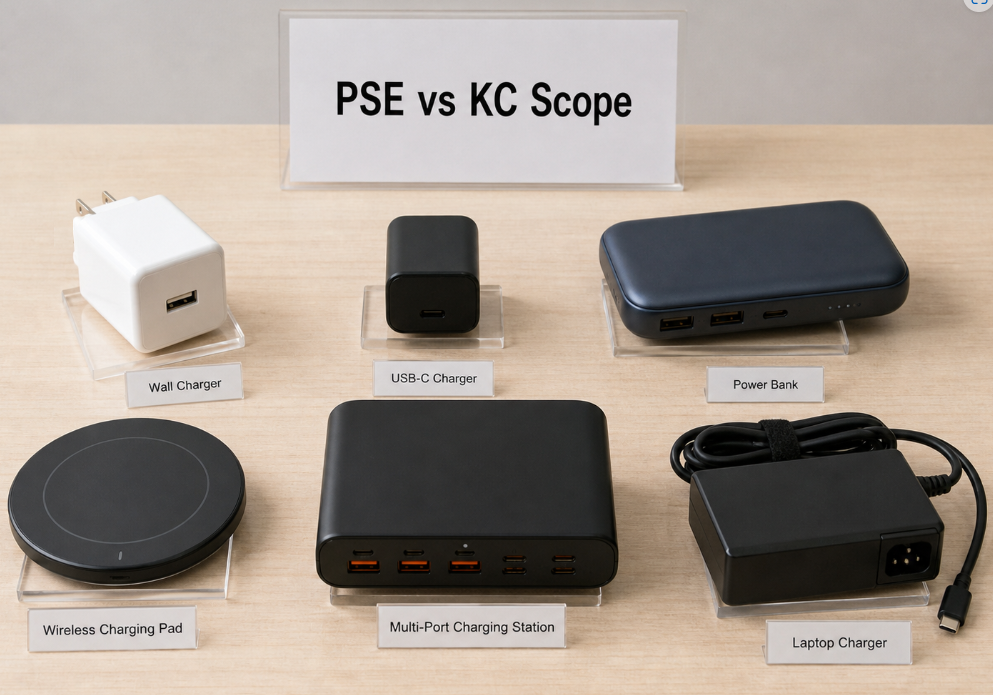
For your convenience, we have compiled the determination status of 6 types of common charging products in the two countries. Note that this is only a general situation, and the final result shall be subject to the latest official directory:
| Product Type | Japan PSE Determination | South Korea KC Determination |
|---|---|---|
| USB wall charger/AC adapter | Classified as specified/non-specified according to parameters and structure, or not included in the directory | Need to separately check safety + EMC directories to confirm the requirement level |
| Passive USB-C charging cable | Usually not included in the PSE directory | Usually no mandatory safety certification required; EMC requirements depend on structure |
| Active USB-C cable with E-Marker | Need to check the directory for confirmation combined with function and structure | Need to separately check safety + EMC directories |
| Multi-port PD charger | Determined by checking METI directory according to total power and structure | Both safety and EMC need to be checked; multi-port may increase the requirement level |
| Charger with wireless charging function | Need to check the electrical appliances and materials directory, and additionally verify radio regulations | Need to check safety + EMC + radio compliance |
| Power bank with battery | Need to check the directory, and additionally verify battery safety regulations | Both safety and EMC need to be checked; batteries may have additional requirements |
Here we also need to mention a common pitfall in set sales that many people fall into: if your product is sold as a set, such as a set of charger + AC cord + data cable, each component in the set should be separately checked to see if it is in the local mandatory regulatory directory. Components in the directory must complete corresponding compliance in accordance with applicable rules; components not regulated by the directory will not automatically require certification just because they are sold as a set. Free accessories are not automatically exempt either. Detachable AC power cords should also be judged separately based on whether they are sold separately and whether they belong to regulated cord sets or electrical appliances and materials.
Application Process, Cycle and Cost
After figuring out whether certification is needed, the next step is how to do it, how long it takes, and how much it costs.
First, let’s talk about the general application logic. Whether it is PSE or KC, it can be roughly divided into seven steps, but the requirements for different types are different:
Step 1: Preliminary product judgment. First sort out the product structure and parameters, check the official directory, determine which requirements need to be met, whether it is high-risk or low-risk, and whether EMC testing is required;
Step 2: Entity confirmation. Because both Japan and South Korea may require a local responsible entity, such as an importer in Japan and a domestic representative in South Korea, this needs to be confirmed in advance, and the specific situation shall be subject to the applicable system;
Step 3: Entrust testing. Choose a third-party laboratory with official authorization. Do not choose an unqualified one, otherwise the testing will be useless;
Step 4: Sample testing. Conduct safety or EMC testing according to corresponding standards. If it fails, rectification is required, and retesting shall be done after rectification;
Step 5: Audit or filing. For high-risk categories, factory audit cooperation is required. If there is no problem, submit materials for filing or obtain the certificate;
Step 6: Compliance labeling. Design the product nameplate and mark according to requirements, and the instruction manual must be in the local language (Japanese/Korean);
Step 7: Document archiving. Certificates and test reports must be properly stored. When the product is changed or standards are updated later, conformity shall be re-evaluated.
The process differences between different types of certification are quite large:
For Japan, diamond PSE (Specified Electrical Appliances and Materials) requires conformity inspection and factory inspection by a registered inspection body and obtaining a certificate. At the same time, the importer must fulfill obligations such as business notification to the competent authority in accordance with regulations; circular PSE (Non-specified Electrical Appliances and Materials) usually does not require certification issuance by a registered inspection body or factory inspection, but the importer must still confirm that the product meets technical standards, implement and keep required inspection records, and fulfill notification and PSE labeling obligations.
For South Korea, mandatory safety certification requires factory audit and certification issuance. If the product requires EMC testing, it can be carried out simultaneously; for self-regulatory confirmation or SDoC, factory audit is not required or simplified, and only record keeping or filing after testing is needed; the EMC process is testing plus filing or record keeping, which is parallel to the safety process. However, whether EMC is required still depends on whether the product is in the directory or scope of application of the corresponding system.
Regarding the cycle, what is given here is only a reference, not a commitment, because there are too many influencing factors: for simple scenarios, such as products that do not require rectification or factory audit, it usually takes 2-4 weeks to complete; for complex scenarios, such as requiring factory audit and simultaneous safety and EMC testing, it usually takes 4-8 weeks. Variables affecting the cycle include product category, whether factory audit is required, number of test items, sample pass rate, number of rectifications, laboratory scheduling, and completeness of materials. So if someone tells you “guaranteed to get the certificate in one week”, you should be careful.
Regarding cost, it is also only a reference, and there is no unified price. The cost mainly consists of the following parts: testing fee, factory audit fee (if any), certificate/filing fee, and agency fee (if you hire an agent). Generally speaking, under the same risk level, the simpler the process, the lower the cost; products requiring both safety and EMC testing have higher costs than those requiring only safety testing. There are also many variables affecting cost: product category, test items, whether factory audit is required, number of samples, number of rectifications, and laboratory pricing.
If you want to reduce costs, there are two practical tips: First, only under the series model or representative model rules allowed by the specific system, and after the certification body, designated body, or testing body confirms the coverage scope, can some models share test data or certificates. Changes in power, interfaces, key components, and rated parameters may require additional testing, change notification, or re-application; second, choose a laboratory authorized by both Japan and South Korea to conduct testing simultaneously, which can save time and part of the cost of repeated testing.
Technical Requirements and Testing Focus
Many people care about what is mainly tested, and what are the differences between the requirements of the two countries. We will still focus on charging products.
First are the differences in basic design, which should be considered at the product design stage:
In terms of rated voltage, Japan is 100V, 50/60Hz, and South Korea is 220V, 60Hz. If making a compatible model, the voltage range must cover both;
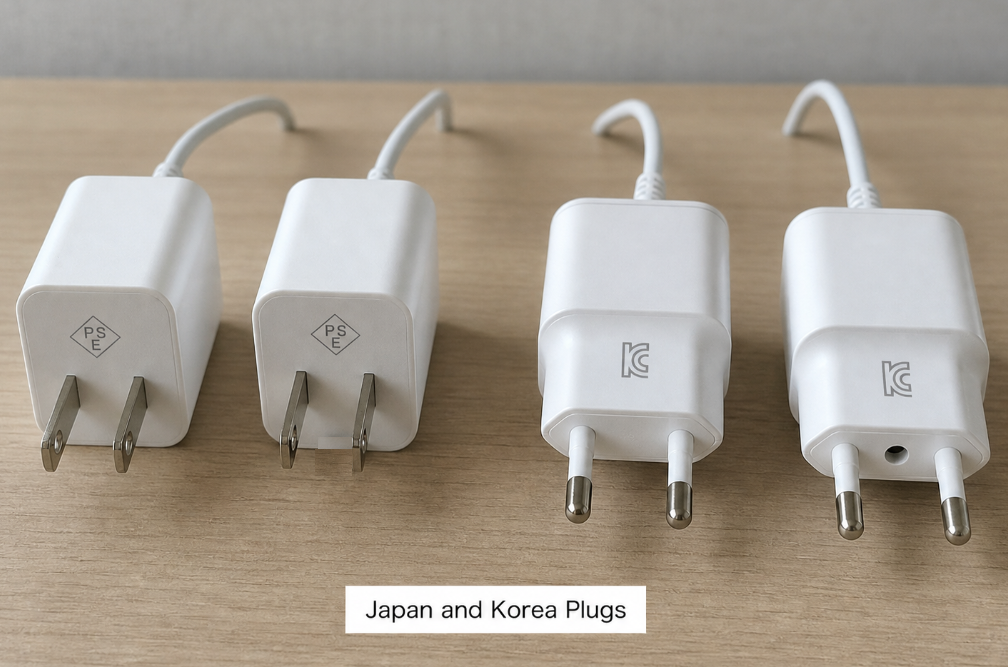
In terms of plugs, Japan commonly uses JIS system two-flat plugs and grounded plugs; South Korea commonly uses KS system two-round plugs and grounded plugs. The specific plug type shall be confirmed according to the target market, grounding requirements, and applicable standards. Note that the plug type does not determine the certification category. It is not that using a Japanese plug necessarily requires PSE; it still depends on whether the product is in the directory;
Whether the USB-C interface is subject to specific requirements shall be judged in combination with the product category, rated parameters, and applicable standards of the whole machine or cable. If the product claims to support USB PD, corresponding tests shall also be verified according to applicable safety, performance, or protocol requirements; not claiming PD does not mean that the safety and other statutory tests of the whole machine itself can be exempted.
Next is the content of safety testing. There are many common items, as well as respective focuses:
For common core test items, for adapters/chargers, they mainly test insulation withstand voltage, temperature rise, creepage distance, flame retardant performance, abnormal operation, short circuit protection, etc., which are all directly related to safety; for cables, they mainly test conductor resistance, insulation strength, bending life, and insertion/extraction force (as needed).
Special testing focuses of PSE include the dimensional accuracy of plug pins (must strictly comply with Japanese standards), electric shock prevention structure, and key components must comply with Japanese technical standards.
Special testing focuses of KC safety: products with batteries need to be tested for overcharge and over-discharge protection, as well as the mechanical strength of the enclosure (depending on the product category).
Next are EMC requirements, which is a big difference between the two countries: PSE has no mandatory EMC requirements. Japan’s EMC and radio regulations are separate and not within the scope of PSE; while KC’s EMC requirements are mandatory (as long as the product is in the directory). Pure passive low-voltage cables generally do not require EMC testing. The test content mainly includes conducted interference, radiated interference, etc., depending on the product category. If EMC testing fails, common rectification directions are: optimize the filter circuit for chargers, and improve shielding performance for data cables.
Different charging products have different testing focuses: chargers/adapters focus on input and output characteristics and abnormal operation protection; detachable AC power cords focus on plug mechanical strength and flame retardant performance; passive USB/USB-C cables focus on bending life and insertion/extraction force (if applicable); USB-C cables with active circuits (such as those with E-Marker) focus on circuit safety and power transmission stability (if claimed).
Marking, Maintenance and Change Control
After obtaining the certificate, there are still many things to pay attention to; it is not a once-and-for-all matter.
First are the marking requirements for the mark, which cannot be marked arbitrarily:
Japan’s PSE mark is divided into two types: diamond and circular. The diamond corresponds to Specified Electrical Appliances and Materials, and the circular corresponds to Non-specified ones. Only products in the directory can be marked with the PSE mark. The location and content of the PSE mark and the business operator’s name must be confirmed in accordance with the statutory labeling rules for specific electrical appliances and materials. In principle, they should be marked on the product body; only when permitted by corresponding regulations can they be marked on packaging, containers, or instruction manuals. The mark must be clear and cannot be altered.
For South Korea’s KC mark, whether it is safety compliance or EMC compliance, the KC mark can be used, but it corresponds to different types of numbers. Information such as the KC mark and certification, notification, or conformity assessment number must be marked in accordance with the applicable specific system and product category. The conditions and order of marking on the product body, packaging, or instruction manual shall be confirmed in accordance with corresponding regulations and rules of the competent authority, and cannot be uniformly handled according to risk level.
Next is the maintenance of compliance validity. Not all certifications have the same fixed validity period. The validity period, regular factory inspection, change notification, and re-examination requirements must be confirmed according to specific product categories and systems. The certificate period for Japan’s Specified Electrical Appliances and Materials is stipulated according to product category; different safety systems in South Korea also stipulate certificate validity periods or ongoing compliance obligations respectively. It cannot be generally assumed that all high-risk certifications adopt the same validity period. In addition, high-risk products may also be subject to irregular spot checks by regulatory authorities. If standards are updated, it is also necessary to re-evaluate whether the product still meets the requirements.
Next is change control, that is, whether certification needs to be re-done after the product is modified: if key safety components are replaced, circuits are modified, rated parameters are adjusted, production factories are changed, or core structures are modified, these will affect safety, and may require re-application, additional testing, or change processing. The specific situation shall be confirmed according to the applicable system; if it is just changing the outer packaging, modifying the text of the instruction manual (not involving safety content), or minor appearance adjustments that do not affect safety, these usually do not automatically trigger re-application, but change judgment records should still be kept.
Regarding series models, the cost reduction tips were mentioned earlier, and the rules are clarified here: only under the series model or representative model rules allowed by the specific system, and after the certification body, designated body, or testing body confirms the coverage scope, can some models share test data or certificates. Differences in rated input and output, power, number of interfaces, key components, enclosure, and circuits may change applicable standards or test items. Completely different products cannot be grouped into one series.
Advanced Pitfall Avoidance: Certificate Verification, Channel Compliance and Simultaneous Application Tips
If you have already done certification, or need to coordinate with suppliers, the content of this part can help you avoid many pitfalls.
First is the verification of certificates and reports. There are many fake certificates now, so you must learn how to check:
To check the authenticity of a certificate, for PSE, you can go to the METI official website or the database of registered inspection bodies to verify whether the model, responsible entity, and applicable standards are correct; for KC, you can go to KATS’s safety system or the EMC competent authority’s system to verify whether the certification number and product category are correct.
When verifying reports, pay attention to several points: first, check whether the covered models, parameters, and structure are consistent with your product; second, check whether the version of the test standard is currently valid; third, check whether the tested sample is a mass-produced version, as the engineering sample tested by the laboratory may be different from the mass-produced product. Also note that passing the test only corresponds to the submitted sample and test conditions, and does not mean compliance in all scenarios. If you modify the product later, you can no longer use the original report.
Fake certificates or invalid reports generally have the following characteristics: incorrect number format, no seal of the authorized body, not found in the official system, and parameters inconsistent with the actual product.
In addition, whether you are checking the directory or the certificate, you should record the search date, because directories and standards will be updated. Keeping good evidence can avoid unclear disputes later.
Next are the compliance requirements for sales channels. Many people think that selling on independent sites does not require compliance, but that is not the case: for products in the local mandatory regulatory directory, manufacturers, importers, and other distribution entities must bear corresponding obligations in accordance with applicable systems; products not in the directory do not automatically require PSE or KC just because they are sold to Japan and South Korea. Specific responsibilities shall be determined based on the identities of importers, manufacturers, sellers, and platforms under local laws, import methods, and sales arrangements. Offline physical stores, cross-border e-commerce platforms, independent sites, or private domains cannot use the channel itself to replace the statutory obligations that should be fulfilled; platforms may also require uploading compliance materials for review, and may delist products if they are non-compliant.
Next are the applicable scenarios for certification exemption. Many people ask “do I need certification if I send a few samples”. Here we need to distinguish two things: first confirm whether the product is in the PSE or South Korea’s corresponding regulatory directory; products not in the corresponding directory are subject to non-applicability of the system, not exemption. Whether test samples, temporary imports, or personal use can be exempted from certain requirements shall be handled in accordance with the specific regulations of the competent authorities and customs of Japan or South Korea, and shall not be used for mass sales. Mandatory requirements cannot be exempted just by labeling “sample”.
Finally, let’s talk about optimization tips for simultaneous application in both countries. If you are doing both Japanese and South Korean markets at the same time, you can operate as follows: First, choose a laboratory with official authorization from both Japan and South Korea to conduct testing simultaneously, which can save time and part of the cost of repeated testing; second, take into account the voltage, plug and other requirements of Japan and South Korea at the product design stage to make compatible models, but note that even compatible models still need to pass the tests of both countries separately. It is not that passing one means automatically passing the other; third, prioritize high-risk certifications, and for low-risk categories, under the premise of complying with rules, part of the test data can be reused to further reduce costs and improve efficiency.
Frequently Asked Questions
- Does a 20W mobile phone charger need PSE/KC? Japan: It needs to be confirmed by checking the official METI directory according to the product’s structure and parameters;
South Korea: It is necessary to check the safety directory and EMC directory separately to confirm the corresponding requirement level. - Does a passive USB-C charging cable need PSE/KC? Japan: Usually not included in the PSE directory, no need to mark the PSE mark;
South Korea: Usually no mandatory safety certification required; EMC requirements depend on the product structure. - Can CE/FCC/UL replace PSE/KC? No. The regulations of Japan and South Korea do not mutually recognize certifications from other countries or regions, and must separately comply with local mandatory requirements.
Summary
We have compiled the core differences between PSE and KC into a simple table for your quick comparison:
| Comparison Dimension | Japan PSE | South Korea KC |
|---|---|---|
| System Attribute | Safety compliance and labeling system under the Electrical Appliance and Material Safety Act | Includes multiple sets of parallel mandatory requirements for safety, EMC/radio, with KC as the unified mark |
| Classification Logic | Divided into two categories: specified (diamond) / non-specified (circular), only applicable within the directory | Divided into three safety categories + multiple EMC categories, need to check directories separately for determination |
| Responsible Entity | Requires local responsible entity to bear responsibility; distribution entities bear corresponding obligations according to applicable systems | Requires local responsible entity to bear responsibility, divided according to different systems |
| Cycle and Cost | Depends on specific product category, inspection method and applicable requirements | Depends on the actually applicable safety, EMC or radio system, cannot be generalized |
| Basic Design | Japan commonly uses JIS system two-flat plugs and grounded plugs | South Korea commonly uses KS system two-round plugs and grounded plugs |
| Validity Maintenance | Confirmed according to product category and specific regulations; need to track standard updates | Confirmed according to system and specific regulations; need to track standard updates |
After learning the content of this article, you should be able to independently judge three things:
First, the compliance requirements for your charging products in Japan and South Korea, whether there is a possibility of exemption, and which official directory to check for confirmation;
Second, the influencing variables of the application process, cycle and cost of PSE and KC, and you will not easily believe unreliable promises such as “absolute low price” and “certificate in one week”;
Third, common pitfalls in certification, verification methods for certificates and reports, and optimization ideas for simultaneous application in both countries.
Compliance is no small matter, especially since the Japanese and South Korean markets have relatively strict supervision of electrical products. Figuring out the rules in advance can avoid big pitfalls during customs clearance and sales later.