
Many charging product sellers new to Amazon US run into pitfalls when listing products for the first time: either their listings are rejected due to missing compliance documents, or they think having CE certification can get them by, and some even face class-action lawsuits for hazardous substance violations, losing a lot of money. In fact, while the market access rules for the US market seem complex, as long as you sort out the two layers of logic of regulations and platform requirements, and match them according to product type, you can avoid many detours.
Basics for Beginners: First Understand the Scope of Application and Core Logic
Which Charging Products Are Covered by This List
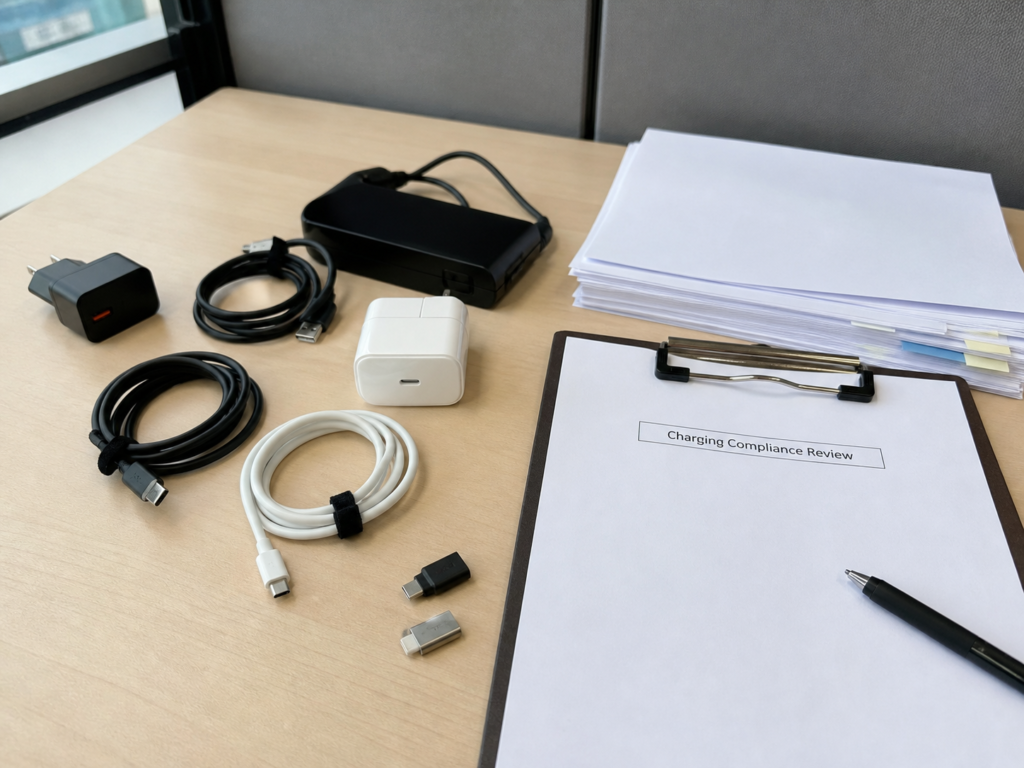
This list mainly covers common charging accessories such as USB/USB-C cables, mobile phone/laptop chargers, power adapters, and charging ports/connectors. Several types of products are not fully applicable: products with battery energy storage (such as power banks), medical/industrial dedicated charging equipment have different rules; only some general rules apply to wireless charging transmitters, which need to be checked separately for specific requirements.
The core criterion for judgment is **determined by the complete machine model, parameters, and whether it has active circuits**. Even if the appearance is exactly the same, as long as the internal configuration is different (for example, one USB-C cable with an e-marker chip and one without), the same compliance document cannot be shared.
Three Layers of Compliance Logic: Don’t Confuse Regulations and Platform Requirements
Many people think that passing Amazon’s review means everything is fine, but compliance is actually divided into three layers, with priority from high to low: **mandatory regulations > platform review requirements > value-added certifications**.
1. **US federal regulations**: Mandatory nationwide, you must comply regardless of whether you sell on the platform or not. Violations may result in cargo detention, fines, or even recalls.
2. **US state-level regulations**: The most core are California’s regulations — since Amazon US default delivery covers California, almost all sellers need to consider them. Violations may face class-action lawsuits or administrative penalties.
3. **Amazon platform requirements**: Access thresholds based on regulations. The platform only reviews the materials you submit. Passing the review does not mean full compliance, and all legal responsibilities are still borne by the seller.
Learn These 8 Terms First to Save Half the Effort Later
You don’t need to memorize them by rote. Just get a general impression first, and you can come back to check when you encounter them later:
• **FCC**: Federal Communications Commission of the United States, responsible for rules on communications, radio spectrum, as well as radio frequency emission and electromagnetic compatibility of equipment. Charging products usually involve Part 15 unintentional radiation rules; wireless products may also involve intentional radiation or Part 18 rules.
• **FCC Part 15B**: Specific rules under the FCC, governing digital devices that “are not themselves used to transmit wireless signals, but unintentionally emit electromagnetic signals when operating”. Many charging products with circuits need to be evaluated for whether such rules apply, but conclusions cannot be drawn solely based on the phrase “has a chip”.
• **SDoC**: A compliance method of the FCC, where the US responsible party is responsible for the declaration of conformity and keeping test records. Tests should be completed by a laboratory with corresponding capabilities. Unless otherwise required by specific FCC rules, SDoC should not be confused with testing that must be conducted by an FCC-recognized laboratory.
• **FCC ID**: Usually used for radio frequency transmitting equipment that requires FCC certification. Part 15 intentional radiation devices such as Bluetooth and Wi-Fi usually fall into this category; however, whether an FCC ID is required must be judged based on the specific transmission function and FCC rules, and some devices may be subject to Part 18 or other authorization arrangements.
• **NRTL**: An organization recognized by the Occupational Safety and Health Administration (OSHA) of the United States that conducts product safety certification within specific standard scopes. You need to check whether the organization covers your product and standards, not just look at the name.
• **UL Standard Test Report**: A sample test certificate obtained according to the safety standards formulated by UL (Underwriters Laboratories), which is only proof of “having been tested”, and is not equivalent to the UL official listed certification that endorses the product.
• **Prop 65**: California’s Proposition 65, which regulates whether hazardous substances in products pose exposure risks to people. Whether a warning is required should be judged in combination with the substance, exposure route, and exposure level.
• **Category Review**: Additional qualification checks conducted by Amazon on some products or ASINs, which may involve restricted products, product compliance, or safety data review. Whether it is triggered shall be subject to the notification in the seller’s backend.
Federal and State Mandatory Regulations: The Bottom Line That Must Be Followed
These are rules that you must comply with regardless of whether you sell on Amazon or not, and they are the foundation of compliance.
Federal Requirements: FCC Electromagnetic Compatibility Compliance
The FCC deals with matters such as communications, radio spectrum, radio frequency emission, and electromagnetic compatibility. Common issues for charging products are electromagnetic compatibility and equipment authorization. It is not equivalent to product safety certification, which many people confuse.
How to Judge Whether You Need It
• **Pure passive accessories**: For example, ordinary USB cables without any chips usually have no mandatory FCC equipment authorization requirements.
• **Active products with digital circuits**: For example, charging cables with e-marker chips and ordinary chargers usually need to be evaluated for Part 15B and applicable equipment authorization requirements. However, whether it is a digital device, whether Part 15 applies, whether it can be exempted, and what processing method should be adopted shall be confirmed in combination with the circuit, operating frequency, function, and FCC exemption clauses.
• **Products with wireless transmission functions**: For example, chargers with Bluetooth and Wi-Fi usually need to be evaluated according to applicable intentional radiation device rules, and the specific authorization path depends on the transmitter category and product design.
• **Wireless charging transmitter**: You cannot assume that an FCC ID must be applied for just because the name contains “wireless”. FCC Part 18, Part 15, or other applicable requirements should be evaluated based on operating frequency, power, purpose, and whether it includes communication transmission functions such as Bluetooth and Wi-Fi.
Compliance Paths and Required Documents
• **SDoC path**: Applicable to devices that comply with FCC rules and can adopt the Supplier’s Declaration of Conformity. The US responsible party is responsible for the declaration of conformity and keeping relevant test records; tests should be completed by a laboratory with corresponding capabilities, and specific requirements depend on applicable FCC rules.
• **FCC ID path**: Usually applicable to wireless radio frequency transmitting equipment that requires FCC certification. The certification needs to be completed by an FCC-recognized TCB (Telecommunication Certification Body), and the certificate number can be found in the FCC database.
• **Wireless charging products**: You should first determine whether they fall under Part 18, Part 15, or other rules, then determine the requirements for testing, certification, declaration, and labeling. You cannot directly apply the process of ordinary Bluetooth devices.
Common Misconceptions
CE is a European Union certification and cannot replace FCC; don’t think that “no antenna means no FCC is needed”, but similarly, you cannot conversely assume that as long as there is a digital circuit, you must go through Part 15B and SDoC. Pure passive accessories, certain low-frequency devices, or devices that meet exemption conditions may not require the same authorization path, and the specifics shall be subject to FCC rules and the actual circuit of the product.
Federal Requirements: DOE Energy Efficiency Compliance
DOE is the US Department of Energy, which regulates the energy efficiency level of some power supply products.
Applicability and Trigger Conditions
Only products such as “external power supplies” and “battery chargers” defined by the DOE are required. Common judgment objects include wall-mounted AC-DC chargers or adapters. However, whether it applies still depends on the product definition, power, purpose, and exemption clauses, and cannot be judged solely by appearance.
Compliance Requirements
Products that meet applicable DOE external power supply energy efficiency standards shall complete testing, manufacturer certification reports, and record keeping in accordance with DOE rules. Unless there is a clear basis, the so-called DOE “Level VI certification mark” should not be used on products or packaging. Level VI is an energy efficiency standard grade, not a certification certificate generally issued by the DOE, nor an official certification mark that can be used freely.
Common Misconceptions
Level VI is an energy efficiency grade, not a “certificate”; not all wall chargers are applicable. For example, power supplies with power below the threshold or for special purposes may be exempted, and the specifics shall be subject to current DOE rules and product definitions.
State-Level Requirements: California CEC Energy Efficiency Compliance
Many people think that after passing the DOE, you don’t need to worry about CEC, but in fact, the two are different regulatory systems.
Applicability and Trigger Conditions
As long as the product is sold to California and is in the energy efficiency control catalog of the CEC (California Energy Commission), you need to check the CEC requirements. The regulatory objects, product definitions, test methods, and effective requirements of CEC and DOE are not exactly the same, and it cannot be simply summarized that CEC is generally stricter than DOE Level VI.
Products in the catalog may also involve CEC system registration or declaration requirements, depending on the product category, applicable version, and current rules.
Common Misconceptions
Not all power supplies need CEC registration, only products within the CEC’s control scope need it; if your product is definitely not sold to California, you don’t need to meet the corresponding California requirements, but Amazon US defaults to nationwide delivery in the US, so in actual operation, it is usually necessary to evaluate the California sales scenario in advance.
State-Level Requirements: California Prop 65 Hazardous Substance Control
This is the most easily overlooked item, but one that causes large losses when you run into pitfalls. Many sellers have been sued individually or in class actions because of this.
Applicability and Trigger Conditions
All products sold to California need to be evaluated for Prop 65 risks. Whether a product requires a warning depends on whether there are relevant substances on the list and whether exposure reaching relevant levels will occur during normal or reasonably foreseeable use.
The key screening items for charging products are **lead (in solder joints)** and **phthalates (in PVC cables)**, but ultimately, you cannot just look at “whether it exists” in the material, but also consider the usage scenario and exposure route.
Compliance Methods
You should evaluate the Prop 65 exposure risk of the product during normal or reasonably foreseeable use, and take appropriate measures based on the evaluation results, for example:
• When there is sufficient basis to show that no relevant risk exposure will be caused, no Prop 65 warning is provided;
• Provide product or packaging warnings that comply with current regulations;
• When applicable, provide pre-purchase warnings for internet sales.
Arbitrary test reports or general web page prompts cannot replace the warning content, location, and display method specified by regulations.
Common Misconceptions
It is not the case that “if there are hazardous substances, labels must be affixed”; the key depends on the exposure risk and exposure level. For example, there is lead in solder joints, but people cannot touch it during normal use, which does not mean that a warning is necessarily required; it should still be evaluated in combination with the specific product and usage scenario. If you violate the rules, you may not only face individual or class-action lawsuits, but Amazon may also require you to supplement relevant warning materials.
Amazon Platform Access Review Requirements: Threshold for Listing
Federal and state-level regulations are the bottom line. To reduce platform risks, Amazon will additionally require sellers to provide proof, especially for high-risk categories such as charging products.
Basic Rules for Category Review
Among products such as mobile phone accessories, computer accessories, and power adapters, some ASINs may trigger reviews of restricted products, product compliance, or safety data. Trigger timing may include new product listing, category adjustment, platform spot checks, sudden surge in sales, or customer complaints, but not all mobile phone accessories, computer accessories, and power adapters will trigger review uniformly.
Whether you need to submit materials, what documents are required, and the processing time depend on the specific ASIN, category, sales account, product risk, and backend notification. The platform does not have a fixed 3–10 working day review period applicable to all sellers, and everything is subject to the current requirements in the seller’s backend.
Don’t Confuse Safety Documents: The Recognition of Four Types of Certificates Varies Greatly
US federal regulations do not require all charging products to obtain UL certification, but Amazon may require sellers to provide safety certificates. Whether different documents are accepted depends on the specific product, standards, certification scope, and the platform’s current review requirements.
| Document Type | Issuing Party | Key Points to Check | Can Certification Marks Be Used? | Applicability Notes |
| Ordinary standard test report | Laboratory with corresponding capabilities | Testing capability, standard version, product coverage | Certification marks cannot be used based on this | Whether it is accepted depends on the platform and product risk |
| NRTL-related test or certification documents | OSHA-recognized NRTL organization | Whether the organization covers the corresponding standards and product scope | Determined by specific certification authorization | Not all NRTL documents should be regarded as the same type of document |
| NRTL listed/certified documents | NRTL organization covering corresponding standards | Complete machine model, certification status, factory inspection and follow-up supervision requirements | Use the corresponding mark only within the authorization scope | Usually includes factory inspection and follow-up supervision, specifics determined by the certification scheme |
| Component certification | NRTL organization or other corresponding organizations | Which components and usage conditions are covered | Use only according to component authorization | Cannot replace complete machine compliance |
When selecting an NRTL, you should check whether the specific organization is recognized by OSHA, the scope of recognized standards, the complete machine model covered by the document, and the certification status. Whether Amazon accepts a certain type of document is still subject to specific review requirements.
For charging products, safety standards cannot be applied solely based on product names. **UL 62368-1** can be used for many information technology and audio/video external power supplies, but it is not the only applicable standard for all chargers; **UL 9990** and **UL 2089** can only be used when their clear applicable scope covers the product. UL 2089 is mainly for vehicle battery adapters, and is not a general safety standard for ordinary charging ports or common adapters.
Note: Only within the scope of the corresponding NRTL certification authorization can the certification mark of the corresponding organization be used. Ordinary standard test reports cannot be used to affix certification marks such as UL and ETL.
What Materials to Submit for Review
Generally, the following types of materials are required, and specifics are subject to backend requirements:
• **Compliance category**: Safety reports or certification documents, FCC compliance documents, DOE/CEC related certificates for power supply products, Prop 65 related documents.
• **Product category**: Actual photos of the product, which must clearly show the brand, model, electrical parameters, country of origin mark, and certification marks that need to be displayed when applicable.
• **Packaging category**: Actual photos of the packaging, which must show the brand, model, applicable certification marks, safety warnings, and country of origin mark.
• **Qualification category**: If it is not your own brand, you need to provide a brand authorization letter.
• **Others**: Product safety questionnaires required by the platform as needed, etc.
Product and Packaging Labeling Requirements
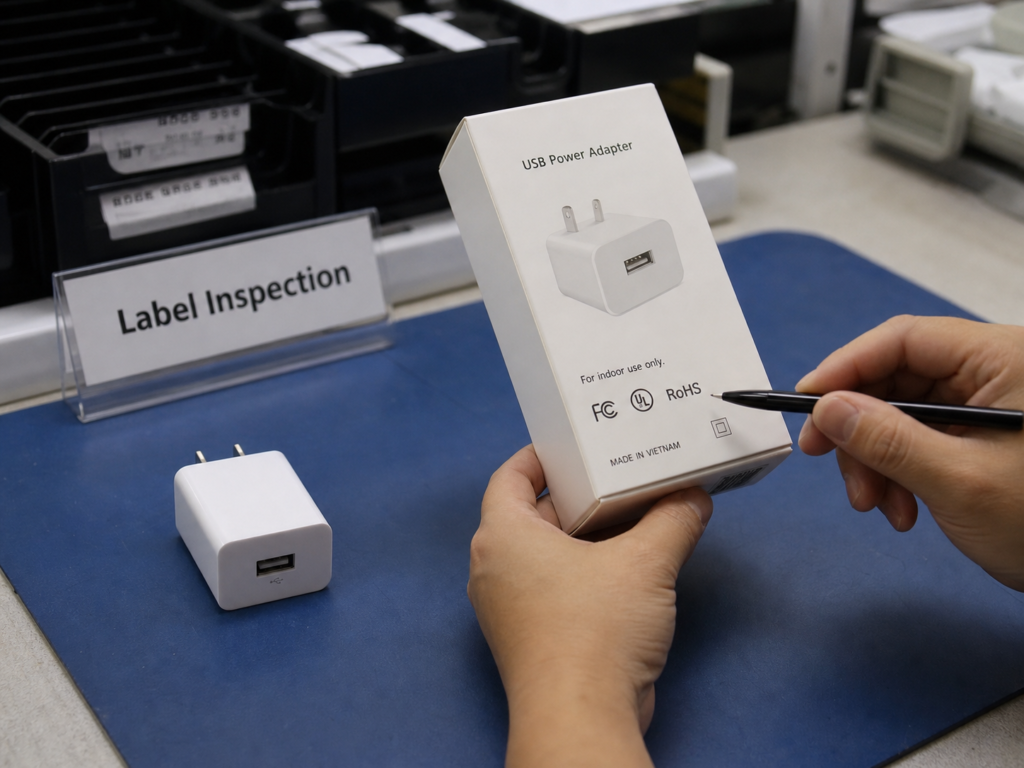
Incorrect labeling will also result in rejection, but these requirements are not a unified mandatory template applicable to all products. You should separately check FCC labels or declarations, US Customs country of origin marks, applicable safety standards, product-specific regulations, and Amazon image requirements.
• **Model, electrical parameters, and country of origin**: Whether labeling is required, the content and location of labeling shall be confirmed according to applicable regulations and product types. The country of origin mark is subject to US Customs regulations, and can usually be marked on the product or on the packaging position allowed by regulations, and is not uniformly required to be printed on the product body.
• **FCC labeling**: Devices that require FCC certification should usually be marked with an FCC ID in accordance with FCC rules, or use compliant electronic labels; FCC SDoC devices also involve specified declarations of conformity and responsible party information.
• **NRTL mark**: Can only be used within the scope of the corresponding certification authorization, and cannot be added on your own just because you have done testing.
• **Safety warnings and contact information**: The content and location shall be determined according to specific product regulations, risks, and platform requirements, and cannot be generalized as all products having a unified mandatory English warning or unified responsible party format.
All labels must be clear and wear-resistant, and unauthorized certification marks must never be printed.
Key Points for Self-Check Before Review: Tips to Avoid Rejection
Checking it yourself before submission can save a lot of time:
1. **Check the issuing party and testing capability**: FCC documents must comply with corresponding rules and authorization requirements; for safety documents, check whether the organization covers the corresponding standards and product scope, not just the organization name.
2. **Check information consistency**: The model, parameters, brand, and manufacturer on the report must be completely consistent with the listing and product labels; even a single letter difference may cause problems.
3. **Check document integrity**: The materials must be complete PDFs, with no missing pages, tampering, or irrelevant watermarks.
4. **Confirm SKU coverage**: For multi-SKU or variant products, confirm that the report covers all models. You cannot use the report of Model A for Model B, nor can you apply documents just because the appearance is the same.
5. **Confirm coverage of the complete machine**: The report must cover the complete machine, not only component reports. For example, a report only for PCBs usually cannot replace the complete machine compliance document.
Quick Self-Check Matrix for Compliance Requirements
To facilitate everyone to quickly match their products, we have compiled the compliance requirements for 8 types of common charging products. Note that this is a general reference, and specifics shall be subject to the actual product structure, applicable regulations, and Amazon backend requirements.
| Product Type | FCC Requirements | Energy Efficiency Requirements (DOE/CEC) | Prop 65 Requirements | Basic Platform Requirements | Recommended Value-Added Certifications |
| Pure passive USB/USB-C charging cable (no chip) | Usually not required | Not applicable | Exposure risk needs to be evaluated | Safety test report (e.g., UL 9990, provided the product falls within its applicable scope; whether it is accepted depends on the category), labeling compliance | USB-IF certification |
| Active charging cable with e-marker/chip | Evaluate Part 15B and applicable authorization requirements; cannot uniformly assume SDoC is required just because there is a chip | Not applicable | Exposure risk needs to be evaluated | Safety test report, FCC compliance certificate (per applicable rules) | USB-IF PD certification (when promoting fast charging/high-speed transmission) |
| Ordinary single-port AC-DC charger/adapter (no wireless) | Usually need to evaluate Part 15B and applicable authorization requirements | Check DOE requirements when meeting the definition, and separately evaluate CEC (for sales to California) | Exposure risk needs to be evaluated | Applicable safety documents, energy efficiency certificate | ENERGY STAR, USB-IF PD certification |
| Multi-port PD/Gallium Nitride (GaN) charger | Usually need to evaluate Part 15B and applicable authorization requirements | Check DOE requirements when meeting the definition, and separately evaluate CEC (for sales to California) | Exposure risk needs to be evaluated | Safety documents covering actual structures such as multi-port output and overload protection, parameters consistent with promotion | ENERGY STAR, USB-IF PD certification |
| Chargers with wireless functions such as Bluetooth/Wi-Fi | Usually involve corresponding FCC certification and FCC ID, but must be confirmed according to specific transmission functions | Check DOE requirements when meeting the definition, and separately evaluate CEC (for sales to California) | Exposure risk needs to be evaluated | FCC ID documents, wireless module matching certificate, applicable safety documents | Qi certification (for wireless charging products) |
| Wireless charging transmitter | Evaluate Part 18, Part 15, or other requirements based on operating frequency, power, purpose, and communication functions; cannot uniformly require FCC ID | Judge according to product definition | Exposure risk needs to be evaluated | Corresponding FCC documents or declarations, safety test report | Qi certification |
| Pure passive charging adapter/connector (no circuit) | Usually not required | Not applicable | Exposure risk needs to be evaluated | No unified mandatory safety report requirement, may need to supplement materials during spot checks | No general recommendation |
| Active adapter with conversion chip | Evaluate Part 15B and applicable authorization requirements | Not applicable | Exposure risk needs to be evaluated | Safety test report (UL 2089 is only used when the product falls within its applicable scope), FCC certificate (per applicable rules) | No general recommendation |
Full Compliance Processing Flow and Cost Reference
General Processing Steps
No matter what the product is, the processing flow is basically these five steps:
1. First sort out all product information and determine which compliance items need to be processed.
2. Select laboratories and certification bodies with corresponding testing capabilities or certification scopes.
3. Send samples for testing; if they fail, retest after rectification.
4. Obtain the report or certificate, prepare the declaration of conformity, and design compliant product labels.
5. Organize all materials and submit them to Amazon for review.
Private Label vs Self-Developed: Different Strategies
• **Private label/OEM products**: Be sure to ask the factory for the complete certificate chain, and carefully check the model, production factory, validity period, and authorization scope. Never use the factory’s general certificate to cover your own brand and model — this is considered certificate misappropriation, which is easy to fail during spot checks.
• **Self-developed/private mold products**: You need to conduct applicable compliance evaluations by yourself or entrust an organization. It is best to plan the budget and cycle in advance, don’t rush to do it when you are about to list.
Cost and Cycle Reference
The cost and cycle of compliance vary greatly, and cannot be judged by fixed multiples or unified prices. You should request a written quotation from the laboratory or certification body, and confirm item by item whether it includes:
• Test items and number of samples;
• Report or certificate fees;
• Factory inspection;
• Certification registration and follow-up services;
• Rectification and retesting;
• Annual maintenance or follow-up supervision;
• Expedited service and other additional fees.
NRTL listing or certification usually may also involve factory inspection, follow-up services, and certification maintenance, so it cannot be simply summarized as 3–5 times the price of ordinary test reports. The cost and cycle of ordinary cables, single-port chargers, multi-port fast chargers, and wireless products will also vary due to different standards, structures, number of samples, number of rectifications, and certification schemes. The prices, increase ratios, and days listed above have no unified official basis and cannot be used as a general market standard.
How to Choose a Reliable Laboratory
Don’t just look at the price. Pay attention to three points when choosing:
1. **Check qualifications**: Confirm that the organization has the testing capability or certification scope for the corresponding project. If NRTL certification is involved, check the recognized standards and scope in OSHA’s official information; if FCC is involved, also confirm whether it has corresponding service capabilities.
2. **Check experience**: Prioritize organizations with rich testing experience in charging products. They are more familiar with standards and platform requirements, and their rectification guidance is more professional.
3. **Check services**: Whether there are supporting services such as rectification guidance, review assistance, and certification maintenance. Otherwise, if the test fails and you don’t know how to fix it, it will cost more instead.
US Responsible Party and Record Keeping Requirements
Many new sellers tend to overlook these two points:
• **FCC US responsible party**: For devices adopting FCC SDoC, a US responsible party that complies with FCC rules shall bear the responsibility for the declaration of conformity and related record keeping. Prop 65 usually requires enterprises to control exposure risks and provide compliance warnings when applicable, but there is no unified US responsible party requirement as mentioned in this article. DOE, CEC, CPSC, and Amazon also have their own responsible entities and data requirements, and the FCC’s responsible party concept cannot be applied to all.
• **Record keeping**: The record keeping period and record subject of different regulations are different. FCC, DOE, CEC, CPSC, Amazon platform policies, and supplier contracts may respectively put forward preservation requirements, which cannot be generalized as all compliance documents must be kept for at least 5 years uniformly. They should be confirmed one by one according to specific projects, and ensure that the data can be retrieved during regulatory or platform spot checks.
Compliance Validity Judgment and Risk Response
How do you confirm whether the certification you spent money on is really usable? What should you do if you encounter review rejection or post-listing spot checks?
How to Judge Whether a Report/Certification Is Valid
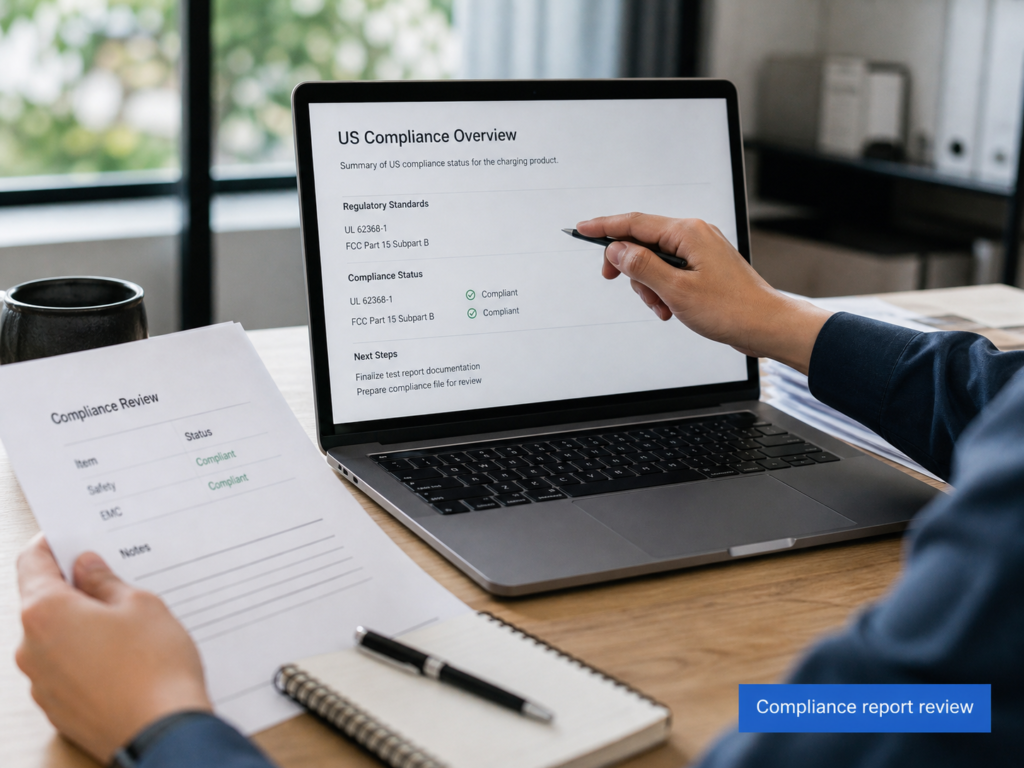
Check from four aspects:
1. **Check the issuing party’s qualifications**: Verify the organization’s authorization scope on the official websites of OSHA and FCC. When a document is claimed to be issued by an NRTL, confirm whether the organization covers the corresponding standards and product scope.
2. **Check product correspondence**: Whether the model, parameters, manufacturer, and brand on the report are completely consistent with the product you are listing.
3. **Check standard validity**: Whether the currently applicable standard is used. UL 60950-1 has been replaced by UL 62368-1, and new products should usually be evaluated against UL 62368-1 or other applicable current standards; however, whether existing UL 60950-1 certifications can still be maintained or accepted should be confirmed with the certification body and relevant platforms, and cannot be uniformly assumed that all are immediately invalid.
4. **Check certificate status**: If it is a listed or certified document, check the certificate status in the relevant official database or the issuing organization’s system, as well as whether there are records of maintenance, factory inspection, revocation, or change.
Common Invalid Certificates and Scams
You must avoid these types of pitfalls:
• **Fake certificates**: Reports or certificates made directly by Photoshop, which can be exposed by checking the number in the official database or the issuing organization’s system.
• **Certificate misappropriation**: Using reports of other models or other factories without authorization, changing the model and giving it to you. Platform spot checks can easily find this.
• **Low-price trap**: The quotation is particularly low, but does not specify the test scope, certification type, rectification and maintenance fees, and even does not conduct actual tests at all or uses inapplicable old standards.
• **Cognitive misconception**: Treating UL standard test reports as UL listed certifications. The two have different certification scopes, processes, maintenance, and mark usage rules.
What to Do If Review Is Rejected
Don’t panic, troubleshoot in this order:
1. First carefully read the specific requirements of the rejection notice, don’t blindly submit supplementary materials — for example, if they say you are missing US responsible party information, it’s useless to supplement a safety report.
2. Check whether the information on the report, product, and listing is completely consistent, and whether there are errors in the model or parameters.
3. Check the qualifications of the issuing organization and whether the standards used in the report are applicable to your product.
4. Confirm that the document covers the complete machine, not only components.
If it is due to missing materials or failed tests, submit again after retesting or supplementing materials. Never falsify, as falsification may lead to direct account suspension.
These Situations Require Re-evaluation of Compliance
Many people think that compliance is valid for life once done, but that’s not the case. You need to re-evaluate when these situations occur:
• **Product modification**: Replacing circuit boards, interfaces, core materials, or wireless modules will all affect compliance results.
• **Information change**: Changing brand, model, manufacturer, or US responsible party.
• **Standard update**: Regulations or standards are revised, and old standards lose applicability or need to be converted.
• **Platform requirement changes**: Amazon has updated category review rules.
• **Certification maintenance changes**: The certification body’s factory inspection, follow-up services, certificate maintenance, or product series rules have changed.
Reports do not have a unified validity period, but this does not mean they can be used indefinitely. Whether a report can still be used should be regularly confirmed according to the issuing organization’s maintenance rules, product and supply chain changes, effective dates of applicable regulations, and Amazon’s current requirements. There is no unified annual retest rule, nor can a conclusion of permanent validity be drawn from this.
How to Deal with Post-Listing Spot Checks
Passing the review does not mean everything is fine. A surge in sales, complaints, or regular platform spot checks may trigger re-examination. The materials that need to be submitted are similar to those for category review, and supply chain certificates may also be required.
The principle of response is: never submit fake materials, supplement whatever is missing, and appeal after completing them. It is best to organize all English compliance materials into a data package in advance so that they can be retrieved at any time, don’t look around everywhere only when a spot check occurs.
Notes on Supply Chain Changes
• If you change suppliers, you must recheck the compliance documents. You cannot directly use the original supplier’s report, as products made by different factories are different.
• If you change core materials (such as PCB, chips, cables), you need to evaluate whether supplementary testing is required. For example, changing the power chip may affect energy efficiency or electromagnetic compatibility results.
• It is recommended to regularly review regulations and platform requirements, especially pay attention to certification maintenance, regulation effective dates, and supply chain changes. Don’t just rely on fixed conclusions of “annual retest” or “no retest needed”.
7 Most Common Cognitive Misconceptions
Finally, let’s sort out a few points that everyone is most likely to get wrong, don’t step on these low-level pitfalls:
1. **No need for safety testing if you have FCC? Wrong**. FCC mainly involves communications, radio frequency, and electromagnetic compatibility, and is not equivalent to product safety certification. The US Consumer Product Safety Commission (CPSC) has the authority to handle consumer products with safety hazards, and Amazon may also require safety materials.
2. **Must have certification from UL? Wrong**. It is not necessary to limit to UL, but you must choose an NRTL recognized by OSHA and covering the applicable standards and certification scope of the product. The recognition scope, certification documents, marks, and follow-up services of different NRTLs may vary. You cannot judge solely by the organization name, nor can you say that the recognition degree of all projects is the same.
3. **Compliance is valid for life once done? Wrong**. Product modifications, supply chain changes, standard updates, changes in certification maintenance rules, and changes in platform requirements all require re-evaluation.
4. **Small accessories don’t need compliance? Wrong**. Small accessories with digital circuits may also involve FCC or other applicable requirements, but the specific authorization path cannot be directly determined solely by “having a chip”.
5. **CE can replace US compliance? Wrong**. CE is a compliance mark related to the European Union/European Economic Area, and cannot replace applicable US FCC, energy efficiency, state regulations, or safety requirements; whether it can be accepted by the platform as supplementary materials depends on specific review requirements.
6. **RoHS/REACH are mandatory in the US? Wrong**. These two are mainly requirements in the EU regulatory system. The US federal government does not have mandatory RoHS regulations uniformly applicable to all such products, but you still need to check specific state, product, and customer requirements.
7. **Passing review equals compliance with regulations? Wrong**. Amazon only reviews the materials you submit, all legal responsibilities are still borne by the seller, and relevant responsible entities are still responsible if problems are found by regulators.
Practical Tools and Summary
Practical Tools You Can Use Directly
You can organize a few simple tools by yourself, which can help you reduce many mistakes:
1. **Product Information Collection Form**: List the core information of each product such as model, parameters, whether it has a chip/wireless function, material, manufacturer, etc., to facilitate judging compliance requirements.
2. **Regulation Applicability Judgment Form**: List FCC, DOE, CEC, and Prop 65, check one by one whether they apply to the product, and tick to confirm.
3. **Report and SKU Coverage Matrix**: List all SKUs and corresponding compliance reports together to ensure that each SKU has a covered report and avoid certificate misappropriation.
4. **Label Review Checklist**: List the information that needs to be marked on the product and packaging, and check it before making labels to avoid missing or wrong labeling.
5. **Supplier Certificate Verification Checklist**: Check whether the certificate provided by the supplier is usable from four aspects: issuing party qualification, product correspondence, standard applicability, and certificate status.
6. **Amazon Submission Package Directory**: List all materials required for review into a directory, and organize according to the directory before submission to avoid missing submissions.
Four Steps to Quickly Judge Compliance Requirements
If you are new to this and can’t remember so much content, follow these four steps:
1. Clarify the product type: Is it passive or active? Does it have wireless function? Is it a charger, cable, or adapter?
2. List all legally mandatory items: First check whether FCC and DOE need to be evaluated at the federal level, then check whether CEC and Prop 65 need to be evaluated if sold to California.
3. Prepare platform review materials: such as safety reports or certification documents, actual photos of products and packaging, qualification documents, etc.
4. Choose value-added certifications as needed: For example, do USB-IF PD certification if promoting fast charging, do Qi certification if doing wireless charging. These are usually not unified mandatory requirements at the US federal level, but can be used as part of product verification or platform materials. Whether they are needed still depends on the specific scenario.
After Learning, You Can Do These Things Independently
After reading this content, you should already be able to:
• Distinguish the differences between US federal, state-level regulations and Amazon platform requirements, and know which is the legal bottom line and which is the platform access threshold.
• List the compliance items that need to be evaluated for your own charging products, without missing any, or wasting money on useless certifications.
• Judge whether the certificates or reports provided by suppliers are real, valid, and cover your own products.
• When encountering review rejection or post-listing spot checks, troubleshoot problems in order without panicking.
• Identify common compliance scams and cognitive misconceptions to avoid pitfalls.
In general, the core of electronics market access certification for Amazon US is “first abide by the legal bottom line, then pass the platform threshold, and do value-added certifications as needed”. Charging products are a high-risk category, so don’t take chances. Spend some time doing solid compliance in the early stage, so that you can avoid losses such as cargo detention, fines, delisting, or even lawsuits later. If you are not sure what your product needs, the safest way is to first find a laboratory or certification body with corresponding capabilities or certification scope to conduct a product evaluation, and then prepare materials according to requirements.