
If you do cross-border business with products like USB-C chargers, charging cables, and power adapters, you have most likely heard terms like “laboratory accreditation” and “ILAC mutual recognition”: when you find a lab to test samples, they say they have qualifications, but you do not know if it is true; when you submit reports to platforms or customs, you are told they are invalid and need retesting; you clearly spent a lot of money on testing, but you have to do it all over again when switching markets.
The core of these problems is not understanding the logic of the global laboratory accreditation system. In this article, we start from the most basic definitions, combined with actual scenarios of charging products, to thoroughly explain the world’s major accreditation systems, mutual recognition rules, verification methods, and pitfall avoidance tips all at once. Even if you are a new entrant to the industry, you can understand and use them.
First, Understand the Basics: What Laboratory Accreditation Is, and How It Relates to Charging Products
What is Laboratory Accreditation?
Many people think laboratory accreditation is an “excellence certificate issued to laboratories”, but that is not the case. Its essence is a conformity certificate issued by an authoritative third-party body for a laboratory’s specific testing capabilities—in simple terms, the third party has verified for you: when this laboratory conducts certain tests, the process is standardized, and the results have sufficient reliability and comparability.
For the charging product industry, its core function is to prove that the laboratory has the ability to complete specified tests, such as safety tests for chargers and PD performance tests for USB-C cables. But you must pay attention to its capability boundary: having accreditation does not mean that all tests of this laboratory are reliable. Only the items listed in its “accreditation schedule” have been verified; those not listed do not count.
4 Types of Easily Confused Qualifications, Stop Mistaking Them
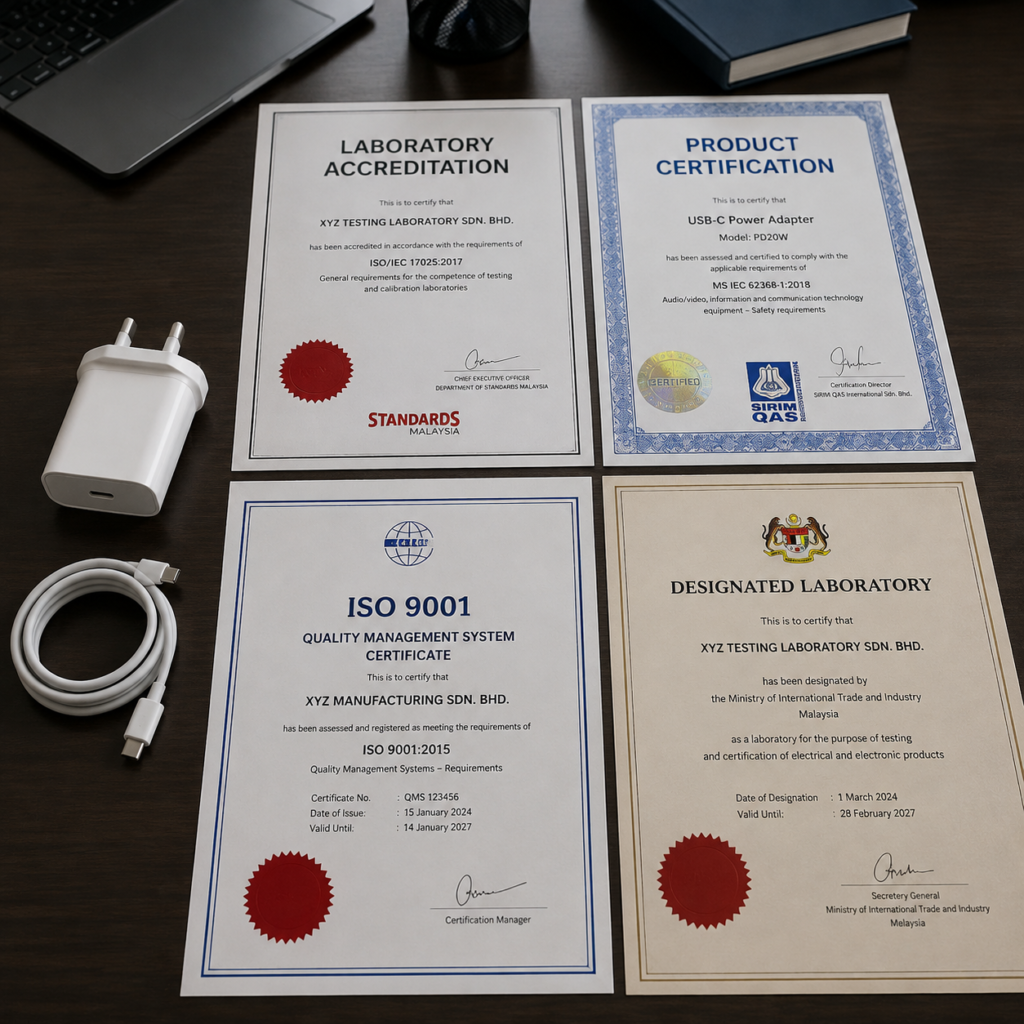
People who are new to this field most easily confuse various “qualifications”. Let’s distinguish them using charging product scenarios:
- Laboratory accreditation: Targets the testing capabilities of laboratories, for example, “this laboratory can test the safety items of chargers in accordance with the IEC 62368-1 standard”, which is a proof of “testing capability”.
- Product certification or conformity assessment: Targets specific products and their applicable regulatory requirements, such as judging whether a 20W USB-C charger meets the applicable safety, EMC, or energy efficiency requirements of the target market. It should be noted that CE is not a unified “product certification” or “CE safety standard”. In most EU regulatory scenarios, the CE mark usually indicates that the manufacturer declares the product complies with relevant EU regulatory requirements after completing the applicable conformity assessment; whether a notified body is required depends on the specific regulations and product category.
- System certification (such as ISO 9001): Only proves that the institution’s management process is standardized, such as document archiving, staff attendance, and sample management having rules, but it cannot replace the accreditation of laboratory testing capabilities.
- Government-designated qualifications: Belong to administrative access requirements. For example, mandatory certification in some countries requires testing by designated or authorized laboratories. This is an administrative threshold, not equivalent to ordinary market accreditation.
Practical Roles for Practitioners in the Charging Industry
Laboratory accreditation is not an empty qualification; it has practical value for different roles in the industrial chain:
- For manufacturers: When the accreditation body has signed the relevant scope of ILAC-MRA, the test items are within the accreditation schedule, and the target market has no additional requirements, reports are usually more easily accepted by other markets, which helps reduce repeated testing, lower certification costs, and shorten the time to market. But it cannot guarantee that one test covers all markets.
- For buyers/sellers: You can verify laboratory capabilities through the public information of accreditation bodies, reducing the risk of product listing rejection, compliance delays, or even recalls caused by insufficient testing capabilities or non-compliant reports.
- For platforms/regulators: Cross-border e-commerce platforms, national market supervision departments, and certification bodies may use laboratory reports within the accreditation scope as an important basis for compliance review, but the specific acceptance conditions still depend on the target market’s regulations, certification schemes, and platform rules.
3 Cognitive Misconceptions to Avoid for Beginners
Newcomers most easily fall into these 3 pitfalls. Remembering them in advance can save a lot of detours:
First, having an accreditation mark ≠ product conformity. Accreditation only proves that the laboratory’s testing process and capabilities meet the requirements. Just like a qualified invigilator cannot guarantee you a perfect score, whether the product is qualified still depends on the test results themselves.
Second, having qualifications ≠ all items are accredited. Be sure to check the laboratory’s “accreditation schedule”. Only the test standards, product categories, and methods listed in the schedule are within the accreditation scope. For example, a laboratory with accreditation for safety testing does not mean it can perform EMC electromagnetic compatibility testing.
Third, having an accredited report ≠ direct access to all markets. Mutual recognition is only a general rule. Some countries or certification schemes have their own mandatory requirements. For example, certain categories must be tested by locally designated, authorized, or listed laboratories. Even if the report comes from a mutual recognition system, it must comply with the specific regulations of the target market.
The Underlying Logic of Global Mutual Recognition: Why Can One Report Be Used in Multiple Countries?
Many people think “global mutual recognition” means just finding any qualified laboratory, but there is a clear three-tier structure behind it. Let’s sort it out from the top down.
Three-Tier Structure of the Global Accreditation System
The global accreditation system can be understood as three tiers from top to bottom:
- International level: International organizations such as ILAC and IAF mainly coordinate accreditation and mutual recognition arrangements and maintain relevant rules. They do not directly formulate product regulations for each country.
- Regional level: Responsible for coordinating the alignment of accreditation rules within the region, such as EA (European Cooperation for Accreditation) in Europe, APAC (Asia Pacific Accreditation Cooperation) in the Asia-Pacific, and IAAC (Inter-American Accreditation Cooperation) in the Americas. APLAC merged with PAC in 2019 to form APAC, so it can no longer be understood as an existing independent Asia-Pacific regional organization.
- National/economy level: Bodies that directly issue accreditation qualifications to laboratories, such as CNAS in China, A2LA in the United States, and DAkkS in Germany. These bodies are the main entities that directly deal with laboratories.
Core Mutual Recognition Mechanism: What is ILAC-MRA?
The core of what people often call “global mutual recognition” is ILAC-MRA (International Laboratory Accreditation Cooperation Mutual Recognition Arrangement). It can be understood as the mutual recognition of the equivalence of specific accreditation activities among accreditation bodies. For an accreditation body to become a relevant signatory, it needs to prove that its accreditation activities meet international requirements.
Test reports issued by laboratories accredited by ILAC-MRA signatory bodies within their signing scope, and that fall within the accreditation scope, can usually serve as an important basis for cross-border acceptance. However, the final acceptance is still determined by the target market’s regulations, certification schemes, regulatory authorities, platforms, or buyers; the report must also meet requirements such as the accreditation schedule, test methods, standard versions, and product information.
The ILAC official website continuously updates the number of signatories and the scope of mutual recognition. When verifying, you should refer to the current official website directory and specific signing scope, and cannot judge solely based on an outdated number of members or the slogan “covering major global markets”.
Special attention should be paid to the marking rules: the ILAC mark cannot be used by laboratories independently of the accreditation body. Different accreditation bodies have different requirements for accreditation marks, joint marks, and report statements. You should check whether the report uses the mark or accreditation statement allowed by the accreditation body, and confirm the laboratory’s identity, number, status, address, and specific accreditation scope through the accreditation body’s official website. Using the ILAC mark alone without authorization basis is a risk signal; but you cannot solely judge whether a report is valid or invalid based only on whether there is an ILAC mark on the report.
ILAC and IAF, Stop Confusing Them
Many people confuse ILAC and IAF, but the two have different focuses:
- ILAC: Mainly involves international mutual recognition of accreditation activities for laboratories, inspection bodies, etc., and is directly related to charging product testing.
- IAF: Mainly involves accreditation and mutual recognition of certification or conformity assessment activities such as management systems, products, personnel, and validation and verification. It is not equivalent to the CE system, nor can it be used to judge whether a CE-related body or certificate will definitely be accepted. CE is usually a declaration of conformity made by the manufacturer for applicable EU regulations. Whether a notified body is involved depends on the regulations and product category.
In short, laboratory testing usually depends on the relevant ILAC accreditation scope; product certification or other conformity assessment activities depend on the corresponding certification schemes and accreditation rules. You cannot simply equate IAF, ILAC, or CE.
Mutual Recognition Is Not Omnipotent: These Boundaries Must Be Clear
Although ILAC mutual recognition is useful, it is not omnipotent. There are several hard boundaries that must be remembered:
First, it only covers test items clearly specified in the accreditation schedule. Even if the laboratory is accredited by an ILAC-MRA signatory, if the item you want to test is not in its accreditation schedule, the report may still only be used as a non-accredited scope report.
Second, it does not replace the mandatory requirements of the target market. The target market may specify specific regulations, standard versions, designated laboratories, authorized bodies, or report formats. Mutual recognition cannot automatically replace these requirements.
Third, some special certifications have their own access requirements. For example, USB-IF certification uses its authorized laboratories and certification procedures; certification schemes such as Qi may also have their own laboratory directories and processes. Even if a laboratory has relevant ILAC accreditation, it does not mean it is automatically authorized by these schemes.
The Global Unified Evaluation Standard: ISO/IEC 17025 Standard
Why can accreditation bodies from different countries recognize each other within a certain scope? Because they usually use common laboratory capability requirements to evaluate laboratories, and one of the most important standards is ISO/IEC 17025.
What Exactly Is This Standard For?
ISO/IEC 17025 is the standard for the competence of testing and calibration laboratories. If a laboratory applies for accreditation of testing or calibration capabilities, it usually needs to prove compliance with ISO/IEC 17025 and the relevant requirements of the accreditation body; however, whether accreditation is mandatory depends on the target market’s regulations, certification schemes, or customer requirements. Not all laboratories that conduct testing must obtain accreditation.
Its goal is to improve the validity, reliability, and comparability of laboratory results. Whether the results of different laboratories for the same sample are consistent should also be judged in combination with test methods, sample status, measurement uncertainty, and proficiency testing results. It cannot be simply understood that all results must be exactly the same.
5 Core Dimensions for Evaluating Laboratory Capability (Charging Product Scenarios)
This standard has a lot of content. When it comes to charging product testing, the core can be understood from the following aspects:
- Personnel capability: Testing personnel must truly understand the testing methods of charging products. For example, they must know how to test the withstand voltage of chargers, and how to check USB-C cables or E-Marker related performance in accordance with applicable methods. They cannot just pull someone random to operate.
- Equipment accuracy: Testing instruments must be regularly calibrated or appropriately verified. For applicable measurement activities, a metrological traceability chain to SI units or appropriate reference standards shall be established, so that measurement results do not lose their credible basis.
- Method compliance: Applicable methods within the accreditation scope shall be used. If non-standard methods, laboratory-developed methods, or modifications to standard methods are adopted, they must be validated, confirmed, authorized, and documented as required, and it must be confirmed that the target regulations or certification schemes accept the method.
- Data traceability: For applicable measurement activities, equipment, calibration, sample, and original data records shall be retained, and the corresponding metrological traceability chain shall be established. For qualitative tests or special activities without applicable metrological references, the validity of results shall be controlled in accordance with the corresponding method requirements.
- Management standardization: There are clear processes for sample management, record keeping, and report issuance, to minimize sample mixing, missing original records, or untraceable report content as much as possible.
Common Accreditation Coverage Standards for Charging Products
For charging products, whether a laboratory can carry out the following tests must be checked item by item against the specific laboratory’s accreditation schedule, methods used, and certification schemes. You cannot just look at the test category name:
- Safety category: For example, IEC 62368-1, as well as some old versions of standards that may still be cited in specific regulations or product scopes.
- EMC electromagnetic compatibility category: Emission testing may involve CISPR 32 and FCC Part 15 related requirements; immunity usually involves CISPR 35 or other standards cited by target regulations, subject to product category and regulations.
- Performance category: Items such as USB PD and USB-C cable performance usually involve USB-IF technical specifications and certification schemes. Whether relevant laboratories are approved to carry out these items should be checked against their accreditation schedule, the methods used, and the authorization requirements of schemes such as USB-IF.
- Energy efficiency category: The US DoE and EU ErP each belong to their own energy efficiency regulatory systems, and cannot be simply regarded as two single test standards. Verification shall be carried out in accordance with specific product regulations and test methods cited by the regulations.
Several Easily Confused Related Standards
There are several other standards that are often compared with 17025. It is necessary to clarify their relationship with charging testing:
- ISO/IEC 17020: It is the standard for inspection bodies. For example, bodies that conduct factory inspections or factory audits may adopt this standard. It is not the main standard for laboratory testing capability accreditation.
- ISO 15189: It is the standard for medical laboratories, such as the clinical laboratory of a hospital, and has no direct relationship with charging products.
- ISO/IEC 17065: It is the standard for product certification bodies, targeting bodies that carry out product certification and issue certification decisions, not testing laboratories.
- ISO 9001: It is a quality management system standard, which only proves that the institution’s management system meets relevant requirements, and cannot replace laboratory testing capability accreditation.
Validity Period and Status Rules of Accreditation Qualifications
A laboratory’s accreditation qualification is not valid for life, but there is no globally unified rule of “supervision every 2 years, reassessment every 5 years” for supervision and reassessment cycles. The specific cycle is determined by the rules and accreditation schemes of the accreditation body, and shall be subject to the information published by the body.
If a laboratory wants to add new test items, expand its accreditation scope, or has status changes such as suspension, revocation, or expiration, the accreditation body will usually update the relevant information in accordance with its own rules. In case of abnormal laboratory status during the report issuance period, you should check the specific handling rules of the accreditation body for suspension, revocation, expiration, and report issuance time. Reports newly issued during the period of abnormal accreditation status usually cannot be directly claimed to be completed within the accreditation scope, but whether reports issued before suspension are affected needs to be confirmed one by one according to the accreditation body’s rules and target market requirements.
Accreditation Systems of Major Global Economies (Applicable to Charging Products)
Different countries and regions have their own accreditation bodies. We have compiled several of the most frequently contacted for charging product exports, sorted by market popularity. It should be noted first that the accreditation scope belongs to specific laboratories, specific test locations, specific methods, and standard versions. You cannot judge that a laboratory has “full coverage” solely based on the name of the accreditation body.
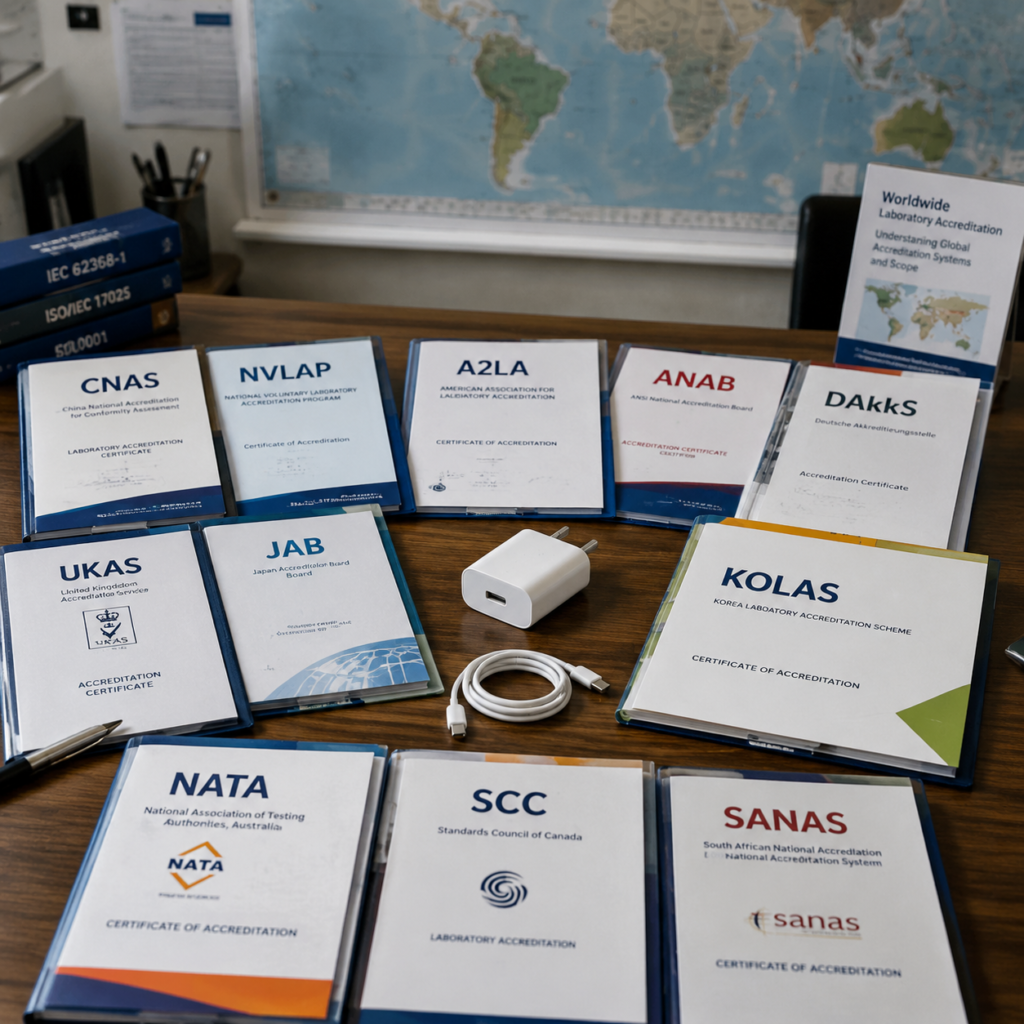
China: CNAS
CNAS (China National Accreditation Service for Conformity Assessment) is China’s national accreditation body, and provides national-level accreditation for the capability evaluation of many laboratories.
The laboratories it accredits may cover items such as safety, EMC, performance, reliability, and energy efficiency of charging products, but the specifics depend on the laboratory’s accreditation schedule. CCC designated laboratories must also meet the designation and certification implementation requirements of relevant regulatory authorities, and cannot be simply understood as “as long as there is CNAS, they automatically have CCC designated qualification”.
The cross-border acceptance of CNAS accredited reports should also be checked item by item according to the specific test scope, the signing scope of the accreditation body, target regulations, and certification schemes.
United States: NVLAP, A2LA, ANAB
The United States has multiple important laboratory accreditation bodies, each with different positioning:
- NVLAP: Full name is National Voluntary Laboratory Accreditation Program, which is affiliated with the National Institute of Standards and Technology (NIST) and has an official background. It can accredit relevant testing laboratories, but whether it covers safety, EMC, performance, or energy efficiency items of charging products must be checked against the accreditation schedule of the corresponding laboratory.
- A2LA: American Association for Laboratory Accreditation, which is a third-party accreditation body and one of the participants in relevant international mutual recognition arrangements. Its accredited laboratories may cover a variety of electrical and electronic testing items, but it is still necessary to check the laboratory, location, method, and version one by one.
- ANAB: In addition to accreditation of certification bodies, it also officially carries out testing laboratory accreditation. Whether it is suitable for a certain charging product test depends on the specific laboratory’s accreditation scope, and cannot be directly excluded because of the institution’s name or background attribute.
FCC and USB-IF also have their own accreditation, authorization, or certification requirements. For FCC projects, you should check the applicable equipment authorization procedures and laboratory conditions; for USB-IF projects, you should refer to the USB-IF authorized laboratory directory and its certification procedures. The laboratory accreditation of NVLAP, A2LA, or ANAB itself does not automatically equal USB-IF authorization.
EU and UK: Check Accreditation and Regulatory Requirements Separately
National accreditation bodies of EU member states usually carry out regional coordination under the EA framework. Germany’s DAkkS, France’s COFRAC, etc. are common representatives. The UK’s national accreditation body is UKAS, which participates in relevant international mutual recognition arrangements.
However, after Brexit, the acceptance of UKAS reports in the EU cannot be generalized, nor can it be simply understood that there is still mutual recognition covering all scenarios between UKAS and EA. CE, UKCA, notified bodies, and mandatory regulatory requirements need to be judged separately.
For charging products, relevant laboratories may cover safety, EMC, substance restriction, and energy efficiency test methods cited by EU or UK regulations in their accreditation schedules. But CE and UKCA are not single test standards, and RoHS is not a unified certification item that all related products must be completed by accredited laboratories. Specific testing and conformity assessment depend on applicable regulations, harmonized standards, product categories, and whether notified bodies or other designated bodies are required to participate.
Other Core Markets in the Asia-Pacific
In addition to China, there are three core markets in the Asia-Pacific whose accreditation bodies need to be understood:
- Japan JAB: JAB is one of Japan’s accreditation bodies, but it cannot be equated with the PSE competent authority or the PSE registration system. The testing, certification, or supplier obligations of PSE products shall be checked in accordance with Japan’s applicable regulations and product categories.
- South Korea KOLAS: KOLAS is part of South Korea’s laboratory accreditation system. KOLAS accreditation can be used as a basis for laboratory capability, but it does not automatically equal KC designation or accreditation. It is still necessary to check relevant Korean certification and technical requirements.
- Australia NATA: NATA is an important accreditation body in Australia. RCM is the compliance mark and supplier declaration framework used in Australia and New Zealand. NATA accreditation does not automatically meet all RCM requirements, and still needs to be judged in combination with applicable regulations, test methods, and supplier obligations.
Key Accreditation Bodies in Other Regions
If you do niche markets, you can also learn about the core bodies in these regions:
- Canada SCC (Standards Council of Canada): SCC is an accreditation body, not equivalent to the Canadian regulatory body for wireless and communication equipment. For related products, you should separately check the technical requirements of ISED and the specific accreditation scope of SCC or other accreditation bodies.
- Dubai DAC (Dubai Accreditation Center): Mainly serves the accreditation needs of Dubai and the UAE, and cannot be directly summarized as a unified accreditation body for the entire GCC Gulf region.
- South Africa SANAS (South African National Accreditation System): Responsible for South Africa’s national accreditation. For laboratory accreditation and product regulations in other southern African countries, you should check local bodies and requirements separately.
Practical Role of Regional Accreditation Cooperation Organizations
Many people think that regional organizations such as EA and APAC will directly issue accreditation to laboratories, but that is not the case. Their main role is to coordinate regional accreditation rules and promote mutual recognition. They do not directly issue accreditation qualifications to laboratories. Specific accreditation is usually implemented by accreditation bodies of each country or economy.
In addition, having regional membership does not mean that all test items of a laboratory can be automatically mutually recognized. For a specific laboratory, a specific test location, and a specific test, it is still subject to the accreditation schedule, accreditation status, and target market requirements.
To facilitate quick comparison, we have compiled a comparison table of accreditation systems in core markets:
| Target Market | Representative Accreditation Body | Background Attribute | Core Applicable Scenarios | Charging Product Coverage |
|---|---|---|---|---|
| China | CNAS | National accreditation body | Domestic access, export testing, some certification items | Need to check item by item according to the specific laboratory’s accreditation schedule |
| United States | NVLAP | Accreditation program under NIST | Some US regulations and laboratory accreditation items | Need to check according to the specific laboratory’s accreditation schedule and FCC requirements |
| United States | A2LA | Third-party accreditation body | US market related testing, cross-border compliance review | Need to check item by item according to the specific laboratory’s accreditation schedule |
| United States | ANAB | Accreditation body | Testing laboratory and certification body accreditation | Need to check item by item according to the specific laboratory’s accreditation schedule |
| EU | DAkkS/COFRAC, etc. | National accreditation bodies | EU regulations and related test items | Need to check according to specific regulations, laboratory schedules, and certification schemes |
| United Kingdom | UKAS | UK national accreditation body | UK regulations and related test items | Need to check according to specific regulations, laboratory schedules, and certification schemes |
| Japan | JAB, etc. | Japanese accreditation body | Laboratory capability accreditation related to the Japanese market | Need to check in combination with specific regulations such as PSE and authorization requirements |
| South Korea | KOLAS | South Korean laboratory accreditation system | Laboratory capability accreditation related to the South Korean market | Need to check in combination with specific regulations such as KC and designation requirements |
| Australia | NATA | Australian accreditation body | Laboratory capability accreditation related to Australia | Need to check in combination with RCM and specific regulatory requirements |
Beginner’s Practical Operation: 4 Steps to Verify the Accreditation Validity of Charging Product Test Reports
After talking about so many systems, the most practical thing is how to judge whether the report in hand has an accreditation basis. Checking according to these 4 steps can reduce the risk of finding problems with accreditation identity, scope, and report consistency, but cannot guarantee that all invalid reports will be identified.
Step 1: First Clarify Two Premises
Before verification, first figure out two basic questions, otherwise the check will be useless:
First, confirm your test requirements: What product are you testing? Is it a charger or a charging cable? What items are you testing? Is it safety, EMC, or PD performance? What standard and version are you using?
Second, confirm the target requirements: Which market do you want to enter? What are the regulatory requirements of the target market? Does the platform specify which kind of accredited, authorized, or listed laboratory is required? For example, for USB-IF certification, you must follow the USB-IF laboratory directory and certification procedures, and cannot only look at ILAC-related accreditation.
Step 2: Check Whether the Laboratory’s Accreditation Identity Is Valid
After confirming the requirements, first check whether the laboratory’s accreditation identity is real and valid:
First, record the accreditation body name and number on the report, then check the laboratory’s number, legal entity, address, status, and accreditation scope on the official website of the accreditation body. Different accreditation bodies have different number formats and public information rules, so do not judge the authenticity solely by the appearance of the number.
When querying, you can first confirm on the ILAC official website whether the relevant accreditation body is a signatory of ILAC-MRA and the specific scope of signing; then go to the official website of the accreditation body to query the specific laboratory, accreditation status, test location, and accreditation schedule. ILAC is not a global laboratory database containing complete records of all ILAC-MRA member laboratories. The detailed status and scope of the laboratory shall be subject to the official information of the direct accreditation body.
If the laboratory is suspended, revoked, or its accreditation status has changed, you need to further check the corresponding time, items, and handling rules of the status, and cannot only look at the seal or mark on the report.
Step 3: Check Whether the Accreditation Scope Matches Your Requirements
This is the step where it is easiest to fall into a pit. Many people think that as long as the laboratory has accreditation, it is enough. In fact, it only counts if your test requirements are within its accreditation scope. You need to check three points:
First, test standards must match: The test standard you use, such as IEC 62368-1:2022, should appear in the applicable accreditation schedule of the laboratory, and check the method, version, and applicable scope. If the schedule only lists the old version, it does not mean that the new version of the test is automatically within the accreditation scope.
Second, product categories must match: The laboratory’s accreditation scope must include the corresponding electrical and electronic or charging product categories. If its accreditation only covers other fields such as food and toys, even if the accreditation body itself is very famous, it cannot prove that the charger test is within the accreditation scope.
Third, test locations must match: Some laboratories have multiple branches, and accreditation may only cover one or some of the locations. It is necessary to check whether the test address in the report is consistent with the accreditation schedule, and also pay attention to whether there are additional requirements for on-site testing, customer on-site testing, or subcontracting items.
Step 4: Check Whether the Report Is Consistent with the Product Itself
The last step is to check whether the report is the same as your actual product:
First, product information must be consistent: The product model, parameters, and interface type on the report must be consistent with the product you actually ship. For example, if the report shows an 18W charger with a USB-A port, but the product you actually ship is a 20W charger with a USB-C port, you cannot directly regard the two as the same product.
Second, check the accreditation mark or statement: Whether the report uses an accreditation mark or accreditation statement shall be judged in accordance with the rules of the specific accreditation body. You cannot require all reports to have a certain fixed text. More importantly, it is necessary to confirm that each result in the report is indeed within the scope of the accreditation schedule.
Third, check issuance authority: Confirm whether the signatory is an authorized report issuer of the laboratory in accordance with the rules of the accreditation body. Not all accreditation bodies will provide the public with a complete and real-time list of authorized signatories; if necessary, you can request verifiable authorization information from the accreditation body or the laboratory.
3 Characteristics for Quickly Identifying Fake Accreditation
If you do not have time to check step by step, you can first look at these three risk signals:
- The accreditation information of the laboratory cannot be found through official channels, or the laboratory status shows abnormalities such as suspension, revocation, or expiration.
- The test items, product categories, test locations, or standard versions you need are not within the scope of the laboratory’s accreditation schedule.
- The report uses the ILAC mark alone, cannot provide the accreditation body’s authorization basis, or the accreditation statement on the report is inconsistent with the rules of the accreditation body.
These situations require further verification, and you cannot draw a conclusion solely based on a mark on the report.
Advanced Guide: How to Choose a Suitable Accredited Laboratory and Avoid the Pit of Invalid Reports
If you are a manufacturer or purchaser and need to choose a laboratory for testing by yourself, it is not enough to just know how to verify. You also need to know how to choose the most suitable one for you and avoid common pitfalls.
5 Comparison Dimensions for Choosing an Accredited Laboratory
When choosing a laboratory, do not just look at the price. You should make a comprehensive judgment from the following dimensions:
- Background attribute: Whether it has an official or semi-official background, or is a third-party accreditation body. The background may affect the familiarity or acceptance habits of certain markets, but does not directly determine the effectiveness of the report.
- Mutual recognition qualification: Whether the relevant accreditation body is a signatory of ILAC-MRA, and whether the signing scope covers your test type. It helps cross-border acceptance, but is not the only condition for the general use of reports.
- Charging field coverage: Whether it covers the specific test items, product categories, test locations, methods, and versions you need. This is the core judgment standard.
- Market acceptance: Whether regulatory authorities, platforms, and certification bodies in the target market accept such reports. For certification schemes such as USB-IF, you also need to check their authorized laboratory directories, and cannot use ordinary laboratory accreditation to replace special authorization.
- Cost impact: Different laboratories have different capability scopes, equipment, locations, and service models, which will affect test quotations. Do not directly equate “official background” or “higher price” with “results must be more effective”. In the end, it still depends on the scope and target requirements.
Selection Suggestions for 4 Common Scenarios
We have compiled the 4 most common scenarios for charging products to give you direct reference:
- Global multi-market layout: First confirm the regulations, certification schemes, and test items of each market separately, then select specific laboratories that are accredited or authorized within the corresponding scope. You can prioritize evaluating laboratories near the production site to reduce sample transportation and communication costs, but you cannot guarantee in advance that one test will cover all markets.
- Only doing the US market: According to the product type and target requirements, check the specific schedules of accredited laboratories such as NVLAP, A2LA, and ANAB, and separately confirm the FCC laboratory conditions and USB-IF authorization requirements.
- Only doing the EU and UK markets: Separately check the regulations, standard versions, notified bodies, or other conformity assessment requirements of the EU and the UK, then select specific laboratories with matching accreditation scopes. You cannot rely solely on the “EA member” or “UKAS” label to guarantee acceptance in all scenarios.
- Only doing the Japanese and South Korean markets: The requirements of Japan and South Korea should be judged separately. Japanese projects should be combined with specific regulations such as PSE, and South Korean projects should be combined with specific requirements such as KC, to select laboratories that are accredited or authorized within the corresponding scope.
These Special Situations Will Change the Selection Logic
The above suggestions are for general situations. If you encounter these special situations, you need to adjust the selection logic:
First, the target market mandatorily requires specific laboratories: If the mandatory certification of the target market requires local or specific listed laboratories, then ordinary international mutual recognition cannot replace this requirement.
Second, specific certifications only accept laboratories in the directory: For example, certification schemes such as USB-IF and Qi may have their own official laboratory directories and test processes. Even if the laboratory has relevant ILAC accreditation, you must first confirm whether it has obtained the authorization of the scheme.
Third, the buyer or platform has clear designated requirements: For example, a major customer specifies a certain type of accredited report, or the platform specifies a test report of a certain certification scheme, then you must implement according to the specific requirements of the other party.
The 5 Most Common Invalid Report Pitfalls
We have compiled the 5 most common invalid report pitfalls in the industry, which must be avoided:
- Using system certification to replace laboratory accreditation: The most common is to use ISO 9001 to pretend to be testing qualifications. System certification and testing capability are two different things and cannot replace each other.
- Undertaking tests beyond the accreditation scope: For example, the laboratory’s accreditation scope only covers other product categories, but it undertakes charger testing. Even if it has a certain accreditation, it cannot prove that the test is within the accreditation scope.
- Test standard version mismatch: The release of a new version of the standard does not automatically invalidate reports issued according to the old version, nor does it automatically require all products to be retested immediately. You should check the version conversion and transition period specified by the target regulations, certification bodies, or certification schemes; retesting or supplementary evaluation is only required when the old version is no longer accepted, the product has changes that affect conformity, or other specific requirements are triggered.
- Subcontracted testing not stated or not complying with rules: It is necessary to confirm whether subcontracting is approved, whether it is disclosed to the customer, whether the subcontractor has the corresponding accreditation or capability, and whether the report clearly marks the subcontracted results. Subcontracted results that are unauthorized or do not comply with the rules cannot be used as results within the accreditation scope of the laboratory.
- Changes in key product materials not evaluated: For example, the main control chip of the charger has been changed, or the conductor material of the USB-C cable has been changed. These key changes may affect the safety and performance of the product. Whether retesting is required should be judged according to the impact of the change, applicable regulations, certification schemes, and the change rules of the laboratory or certification body, and the original report cannot be directly used.
Accreditation Requirements for Special Test Modes
In addition to the conventional laboratory sample delivery test, there are two special test modes that have additional requirements for accreditation:
- Witness testing: That is, the customer conducts the test at their own site, and the laboratory personnel witness and issue results in accordance with relevant procedures. This mode requires the laboratory to have witness testing capability or accreditation arrangements for the corresponding items, and not all laboratories with ordinary test accreditation can do it.
- Customer on-site testing (CTF): That is, the laboratory brings equipment to the customer’s factory or other sites for testing. This method requires checking whether the laboratory’s accreditation scope specifically allows on-site testing, as well as specific item and location restrictions. Not all items can be carried out on site.
When Is Retesting Required?
Many people think a report can be used for a lifetime, but that is not the case. However, whether retesting is required in the following situations should be judged in combination with specific rules:
- When the applicable test standard version changes, you should check the version conversion and transition period specified by the target regulations, certification bodies, or certification schemes. Retesting or supplementary evaluation is only required when the old version is no longer accepted, or the new requirements indeed affect product conformity.
- When the key design or materials of the product change, such as replacing the power chip, transformer, interface type, etc., which may affect safety or performance, you should decide whether to retest according to the change evaluation results.
- If the laboratory is no longer within the corresponding accreditation scope when new tests or reports are issued, you should stop using it as an accredited test. Whether existing reports need to be retested shall be determined according to the accreditation body’s handling decision on suspension, revocation, or expiration, as well as the target market requirements.
- When the target sales market changes, the regulations, standards, certification schemes, or report requirements of the new market may be different from the original market. You should re-conduct a compliance gap assessment. It is not necessarily automatic retesting, nor can you directly assume that the original report must be applicable.
Final Summary
After reading this article, you should be able to handle most basic problems related to laboratory accreditation in the field of charging products. The core can be summarized into 3 things:
First, you can accurately distinguish the differences between laboratory accreditation, product certification, and system certification, understand the role and boundaries of ILAC mutual recognition, and will not be fooled by various “qualifications”.
Second, you can verify the laboratory’s accreditation identity, status, test location, and specific accreditation scope through the ILAC official website and the official websites of national accreditation bodies, and identify test reports with risks.
Third, you can select suitable specific laboratories according to your target market, regulatory requirements, certification schemes, and test needs, avoid common invalid report pitfalls, and spend less wrong money.
For cross-border charging products, product compliance should still start from the target market’s regulations and applicable conformity assessment requirements, and then be completed in combination with testing, technical documents, labeling, and necessary certifications. Laboratory accreditation can provide an important basis for the credibility of test results, but cannot replace the complete product compliance process. Understanding these logics helps reduce repeated testing and communication costs, and also reduces the risk of listing delays, fines, or even recalls caused by reports not being accepted.