
If you often buy Chinese-made fast chargers via cross-border online shopping, or work in cross-border e-commerce and want to sell USB chargers to the Chinese market, you must have seen the term “CCC certification”. What exactly is it? How is it different from the CE and UL certifications you are familiar with? What are the consequences of not having it? This article will explain CCC certification for USB chargers clearly, from basic judgment to authenticity verification, and it will be useful for you whether you are an ordinary consumer or a seller.
Basic Understanding: What is CCC, and Does It Concern You?
First, Understand the Core Position of CCC
The full name of CCC is China Compulsory Certification. For USB chargers and power adapters that are included in the scope of the current CCC catalog and certification implementation rules and are sold or imported for the Chinese market, valid CCC certification is usually required and the mark must be used as required. Whether it is applicable shall be subject to the current catalog, implementation rules and specific product judgment.
Its core control directions mainly include electrical safety and electromagnetic compatibility, with the purpose of reducing risks such as electric shock, fire, and interference with surrounding electronic equipment. Here we must first clarify the most easily misunderstood point: CCC is mainly used to confirm the safety, EMC and related technical requirements specified in applicable standards. It is not an evaluation of fast charging speed, protocol compatibility, durability or overall quality, nor does it mean that the product is superior in all performance aspects.
In addition, the scope of application of CCC is very clear: it mainly targets related products sold in the Chinese market and imported into China, and it is not a globally applicable certification.
Why Overseas Users Should Care About CCC
Even if you are not in China, you may encounter problems related to CCC, mainly in two scenarios:
First, buying Chinese-made chargers via cross-border online shopping for personal use: Goods imported in reasonable quantities for personal use may be eligible for provisions such as exemption from CCC certification. Whether certification is required shall be judged according to the import method, quantity, purpose, as well as customs and certification regulations. If a product that is subject to certification for commercial import or sale does not have valid CCC, it may face customs clearance, sales and regulatory risks. It should be noted that the absence of CCC itself does not directly prove that the product must have shoddy workmanship or safety hazards.
Second, exporting/selling to China: If your USB charger is to be sold in the Chinese market, and the product falls within the mandatory scope of the current CCC catalog and implementation rules but does not have valid CCC, it may face risks such as inability to complete normal customs clearance, sales or product listing, and may also be subject to regulatory penalties.
Core Differences from Common Overseas Certifications/Reports
Many overseas users confuse CCC with the CE and UL certifications they are familiar with. In fact, their nature and effectiveness are different, and they cannot replace each other. Here is a table to help you quickly distinguish them:
| Certification/Report Type | Region | Core Nature | Can It Replace CCC Alone | Remarks |
| CCC | China | Mandatory safety + electromagnetic compatibility access, corresponding testing, factory inspection and post-certification supervision must be completed in accordance with the applicable certification mode | Yes (it is itself a requirement of the Chinese market) | Only for products sold/imported in the Chinese market |
| CE | European Union | Conformity mark required by relevant EU regulations. The specific conformity assessment method depends on the applicable regulations and product risk level. In some cases, it can be self-declared by the manufacturer, and in some cases, the participation of a notified body is required | No | Can be used as a technical reference for CCC application |
| UL | United States | Usually belongs to voluntary third-party safety certification or listing services. Specific items may include product testing, factory inspection and follow-up supervision | No | Cannot alone replace China’s CCC requirements |
| FCC | United States | Mandatory electromagnetic compatibility requirements | No | Only covers electromagnetic compatibility, does not cover electrical safety |
| Third-party test report | General | Test results of samples submitted for a single time | No | Cannot prove the compliance of batch products, nor can it be used as a CCC certificate |
Product Boundaries Covered in This Article
This guide only targets USB charger products sold independently, specifically including: wall-plug USB-A/C single-port chargers, multi-port desktop chargers, fast chargers supporting PD/QC and other protocols, and gallium nitride chargers.
The following products are not within the scope of this article and need to be judged separately according to the corresponding categories: car cigarette lighter USB chargers, USB ports built into devices such as TVs/computers, separately sold charging cables, power banks, and wireless chargers.
Scope Judgment: First Check the CCC Catalog, Then Judge the Product Form
Many people judge whether a charger needs CCC by gut feel, which is actually very prone to mistakes. The correct logic is to first check the official catalog, then confirm combined with the product form, and do not take it for granted.
Four-Step Judgment Method (Core Logic)
If you want to make an accurate judgment, you can follow these four steps:
1. Check the current CCC product catalog: First confirm whether your product category is in the mandatory certification list;
2. Check the corresponding certification implementation rules: Find the implementation rules for power adapters, which will clearly specify applicable parameters and form requirements;
3. Confirm according to the certification unit division rules: See if the differences between different models of the same series can be classified into the same certification unit (no need to repeat certification);
4. Final confirmation combined with use and sales method: For example, whether it is sold independently or sold with the complete machine will affect the final judgment result.
Typical Products That Require Mandatory Certification
USB chargers and power adapters that use mains power as input and are sold or imported for the Chinese market, which fall within the scope of the current CCC catalog and corresponding certification implementation rules, usually require CCC. Independently sold laptop USB-C power supplies, multi-port desktop fast charging stations, etc., may fall into this category of products.
Here is a special reminder: independent sales, support for 100—240V wide voltage, use of PD or QC fast charging protocols, use of gallium nitride or traditional silicon materials, can only be used as preliminary screening information, and cannot replace catalog judgment. Whether it has mandatory certification attributes shall still be confirmed according to product category, use, technical parameters, supporting relationship and current implementation rules.
Ambiguous Situations That Require Separate Confirmation
Some products are not black and white, and conclusions cannot be drawn directly. They need to be judged in combination with specific situations:
• Car USB chargers: They are not automatically exempt just because they are powered by a DC cigarette lighter. They must be judged in combination with the supporting relationship, sales method, and catalog scope, and cannot be generalized.
• Built-in USB ports of devices: For example, the USB charging port on a TV or router, it is not that if the complete machine has CCC, this USB port will automatically meet the requirements. It depends on whether the scope of the complete machine certification includes this key component.
• Accessory chargers sold with the main product: For example, the charger given when buying a mobile phone, if it is replaceable and can be used independently, it needs separate certification; if it is non-detachable and completely covered by the complete machine certification, it does not need it.
• Non-sales samples for R&D/display/maintenance: No need for sales-type CCC, but other safety responsibilities are not exempted. If there is a problem, you still have to bear the consequences.
Special Product Judgment Tips
There are two types of products that are easily confused, which are clearly explained here:
First, USB-C products with data transmission, video, network or docking station functions shall be judged separately according to the main function, input and output structure, sales method and current catalog; they cannot be directly classified as power adapters just because they have a charging function.
Second, for chargers with replaceable multi-country plugs, as long as they include national standard pins and are sold for the Chinese market, they shall be judged as ordinary commercial products and need to meet CCC requirements.
How to Confirm the Certification Basis
If you are really unsure, there are two most reliable methods: first, check the current CCC catalog and corresponding certification implementation rules on the official website of the Certification and Accreditation Administration of the People’s Republic of China (CNCA), which are publicly available; second, consult a certification body with corresponding qualifications to obtain a written judgment opinion.
Judgment should be comprehensively confirmed in combination with the product nameplate parameters, technical specifications, and sales form, and there is no absolute “one-size-fits-all” standard.
Quick Preliminary Screening Method (Not Final Judgment)
If you just want to make a rough judgment first and don’t need to be so precise, you can use this simple method: as long as two conditions are met at the same time, it is very likely that CCC is required:
1. It is an independently sold USB charging/power adapter product;
2. It needs to be connected to mains power (including wide voltage) and is sold for the Chinese market.
But note that this is only a preliminary screening. The final judgment shall be subject to the official catalog, implementation rules or the specific conclusion of the certification body.
Core Requirements: What Safety Contents Does CCC Cover
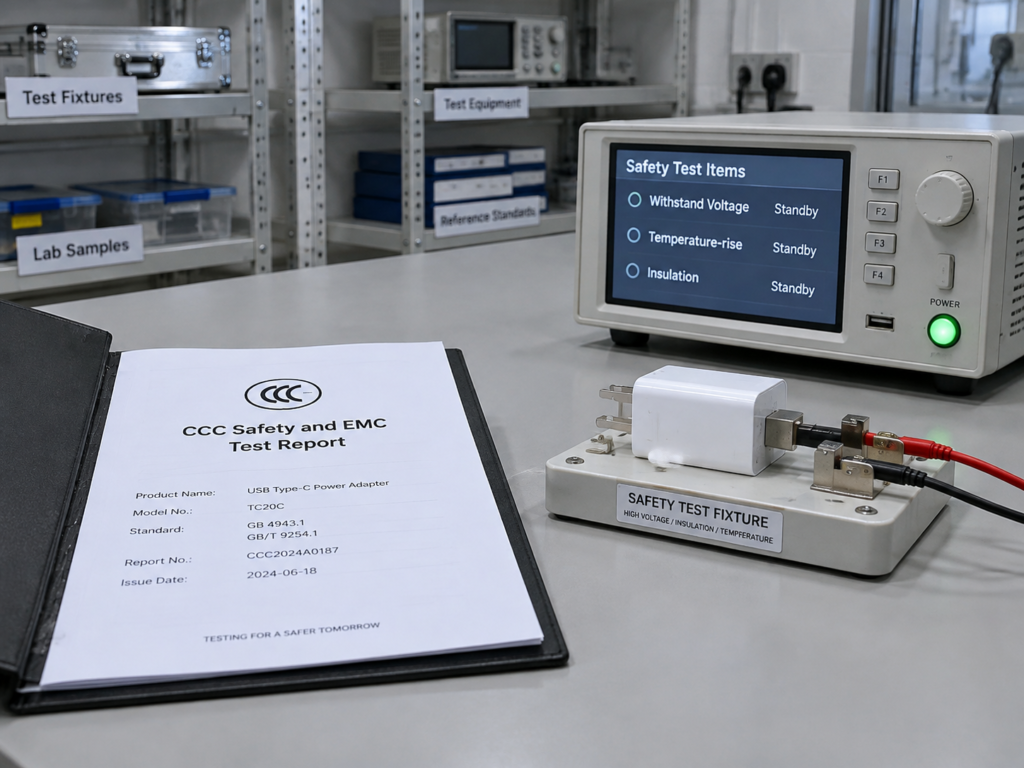
Many people think that CCC covers all quality problems, but this is not the case. It mainly covers contents related to safety, EMC and applicable standards, which are mainly divided into two categories: electrical safety and electromagnetic compatibility.
Electrical Safety (Electric Shock Prevention, Fire Prevention)
• Electric shock prevention: The certification will evaluate the insulation between input and output, accessible parts, energy and electric shock protection and other requirements in accordance with applicable standards; the specific isolation method, output limit value and normal/abnormal conditions shall be subject to applicable standards and implementation rules.
• Fire prevention and temperature rise: The flammability, flame propagation and fire isolation of the shell and internal materials shall meet the material grade and test requirements specified in applicable standards; certification does not mean that there will be no fire or spread under any fault, modification or use conditions. When working at full load, the temperature of the shell and internal components must also meet the requirements of corresponding standards.
• Abnormal protection: In case of abnormal conditions such as short circuit, overload and overvoltage, the charger shall have corresponding protection measures in accordance with applicable standards, such as limiting output, automatic power off or other safety designs, to avoid danger caused by continuous heating.
• Structural strength: The pin size shall meet applicable requirements, and cannot be unable to plug in or easy to loose; plug and unplug life, shell strength, etc. may also need to pass specified tests, and cannot crack or break pins after a drop. The specific test conditions shall be subject to applicable standards.
Electromagnetic Compatibility (EMC)
You can understand electromagnetic compatibility as “no mutual interference”, which includes two directions:
• Emission requirements: When the charger is working, it must not emit excessive electromagnetic interference, causing problems such as disconnection of nearby WiFi, noise in headphones, or screen distortion of TVs.
• Immunity requirements: Immunity tests are used to verify whether the product meets the corresponding performance criteria under the conditions of electromagnetic interference, static electricity, fast transients, surges and voltage changes specified in applicable standards; it does not guarantee that it will not be damaged in any electromagnetic environment or any power grid abnormality.
It should be mentioned here that for high-power fast charging and multi-port simultaneous operation, the design and test complexity of EMC compliance may increase. Multi-port and high-power designs may also increase the test difficulty in temperature rise and power distribution, but whether it is qualified or not shall still be subject to the certification test results.
Special Concerns for Fast Charging/Multi-Port/Gallium Nitride Products
Many people ask about the popular gallium nitride fast chargers and multi-port chargers: “Are the certification requirements different?” In fact, the certification classification of a product cannot be changed solely based on its material or protocol. Whether CCC is required still mainly depends on the product category, catalog scope and applicable rules.
However, there are several key items to pay attention to when testing such products: the safety of different output gears, the power distribution logic when multiple ports work at the same time, temperature rise control, whether the protection mechanism is reasonable, and whether EMC meets the standards.
In addition, if the key components, fast charging protocols, and control logic of such products change, it is likely to affect safety and EMC performance, and the validity of certification needs to be re-evaluated, and the original certificate cannot be used directly.
Contents Not Controlled by CCC
Finally, it must be clear that CCC is not a “quality certification”, and there are many contents it does not evaluate:
For example, fast charging speed, protocol compatibility, service life and overall quality are not part of the comprehensive evaluation of products by CCC, nor do they mean that products are necessarily better in these aspects. However, applicable standards may include safety-related mechanical strength, drop or structural tests, which are not equivalent to a comprehensive guarantee of daily durability.
In addition, China’s energy efficiency label, RoHS (Restriction of Hazardous Substances) and other requirements are separate compliance requirements, which are not part of CCC. Don’t confuse them.
Authenticity Verification: How to Check Whether CCC Certificates and Marks Are Compliant
When many people buy chargers, they think it is real when they see the CCC mark printed on the package. In fact, they also need to check the corresponding certificate. The key is not just looking at the mark, but confirming that the use of the mark, the certificate status and the product coverage match each other.
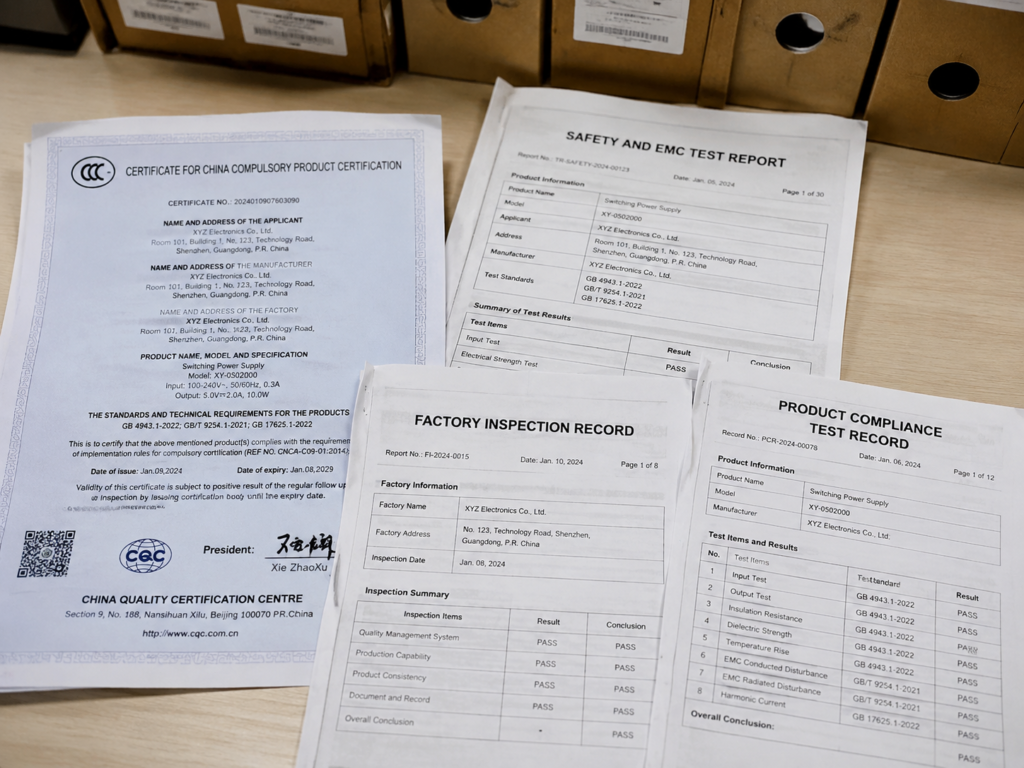
First Distinguish the Difference Between Mark, Certificate and Test Report
The effectiveness of these three things is different, don’t be confused by merchants:
• CCC mark: It is a mandatory product certification mark, which can only be used when the product has obtained corresponding valid certification and meets the mark use management requirements. The mark itself cannot replace the official certificate status and coverage verification.
• CCC certificate: It is an official document issued by a formal certification body, proving that a specific model of product has passed the corresponding certification, and has legal effect.
• Test report: It only corresponds to the test results of the samples submitted for testing, and cannot be used as a separate CCC compliance certificate, nor can it replace the certificate.
Remember: you cannot directly judge that a product has valid certification only by the CCC mark on the package. You must check the corresponding certificate.
Official Query Channels (Accessible Overseas)
To check CCC certificates, you must use the official certification information query channels announced by the CNCA or the market supervision department, or you can use the official query portal of the issuing certification body. Whether access from overseas is normal depends on the network environment and platform conditions at the time.
Third-party websites and certificate screenshots provided by merchants cannot replace official verification, and the portal shall be subject to the latest official announcement.
Detailed Verification Steps
How to check specifically? Just follow these steps:
1. Collect product information: Find the product model, manufacturer name, and CCC certificate number (if any) from the nameplate on the charger body, packaging, and instruction manual.
2. Enter the official query system: Use the fields provided by the platform such as product name, model, certificate number, manufacturer or production enterprise to search. When there is no certificate number, the model and production enterprise name can be used as clues, but they may not be able to locate accurately.
3. Check core information: Confirm that the found product name, model, manufacturer, production plant, rated input and output parameters, and interface configuration are completely consistent with the physical product.
4. Confirm certificate status and scope: Check whether the certificate status is valid and whether the product you bought is within the coverage of the certificate.
5. Check physical product identification: Check whether the CCC mark, nameplate, and Chinese label of the physical product meet the management requirements.
If the query results cannot be accurately matched, the original certificate should be further checked and confirmed with the issuing certification body. Conclusions cannot be drawn only based on the fact that the model cannot be searched or a similar model is searched.
Meanings and Boundaries of Common Certificate Statuses
There are several types of certificate statuses found, each with different effectiveness and consequences, which should be clearly distinguished:
• Valid: The model and production plant are within the coverage, and the product can usually be sold and imported into China according to the scope of the certificate.
• Suspended: Temporarily invalid, mostly due to unqualified spot checks, failure to complete relevant supervision on time, etc. Whether production, sales or use of the mark can continue during the suspension period shall be handled in accordance with the suspension decision and relevant regulations. Whether it will be resumed after rectification is qualified also depends on the specific procedures.
• Revoked: It means that the original certification certificate has been revoked, and the original certificate cannot continue to be used as a valid CCC certificate. Whether you can re-apply later, as well as the waiting period and rectification requirements, shall be handled in accordance with relevant regulations and the decision of the certification body.
• Cancelled: The enterprise takes the initiative to apply to invalidate the certificate. How to deal with products after cancellation shall be judged in combination with the cancellation time, product production batches and relevant regulations.
• During change application: The original certificate is only valid for the original certification scope. Products after change shall not be deemed to have been certified just because the application has been submitted. They must complete evaluation, testing or factory inspection in accordance with the requirements of the certification body and obtain corresponding confirmation before they can be produced and sold according to the updated scope.
Note: To judge whether it is compliant or not, it is necessary to comprehensively judge in combination with the production date, batch, change record, certificate status and the decision of the certification body. The legal consequences of different statuses are different.
Quick Identification Tips for Non-Compliance
There are several small tricks to quickly identify products that are probably non-compliant:
First, the CCC mark is printed blurry or skewed, and the corresponding valid certificate cannot be provided;
Second, the key parameters of the product, such as model, power, and number of interfaces, do not match the information on the certificate.
However, it should be noted that for mini chargers with particularly small volume, because the body area is insufficient, the CCC mark may be printed on the minimum sales package. You cannot judge that it is fake just because there is no mark on the body.
Changes and Invalidation: What Situations Will Affect the Validity of CCC
Many people think that getting a CCC certificate is a once-and-for-all thing, but it is not. If the product changes, the certificate may no longer cover the changed product. Let’s first talk about several most common effectiveness misunderstandings.
Common Effectiveness Misunderstandings
1. Having CCC = fast charging/good quality: Wrong. CCC mainly confirms the safety, EMC and related technical requirements specified in applicable standards, and does not mean better performance and quality.
2. CE/UL/test report can replace CCC: Wrong. None of them can alone replace CCC requirements, and can only be used as technical references.
3. All chargers of the same brand share one certificate: Wrong. Only models of the same series whose differences do not affect safety and EMC can share the certificate of the same certification unit after confirmation by the certification body.
4. Having CCC means absolute safety: Wrong. CCC is used to prove that a specific product has passed the corresponding conformity assessment under the specified certification scope, production conditions and applicable standards; product damage, modification, overload or improper use may still cause risks.
5. Valid certificate means complete compliance: Wrong. In addition to the valid certificate, it must also meet other market supervision requirements such as marks, nameplates, and Chinese labels.
Items That Trigger Change Evaluation
When the product changes, it shall be judged whether it will affect the validity of the certificate in accordance with the applicable implementation rules and the requirements of the certification body. Common situations include:
• High-risk changes (most likely require retesting/expansion of certificate): Change of rated power/output voltage, increase or decrease of the number of interfaces, change of circuit topology (that is, the overall circuit architecture)/isolation scheme, change of production plant, change of shell/pin structure. These changes may directly affect safety and EMC performance, and usually require corresponding procedures to be handled in advance.
• General changes (need to be reported for confirmation): Supplier change of key safety components (transformers, fuses, main control chips, etc.), adjustment of fast charging protocols, optimization of control logic. These changes do not necessarily affect the certification, but must be subject to change, filing or reporting in accordance with the implementation rules and the requirements of the certification body.
Any change in products, key components, processes, production plants or production conditions that may affect the conformity of certified products shall be subject to change, filing or reporting in accordance with the corresponding implementation rules and the requirements of the certification body. Before completing the prescribed procedures, changed products that have not been confirmed shall not be produced or sold as products covered by the original certificate.
Typical Change Cases
Here are a few common examples, and you will be clearer:
1. Single-port 20W changed to dual-port 30W: The power, number of interfaces, and circuit topology have been adjusted, which is likely to change the safety and EMC performance, exceeding the scope of the original certification unit. Usually, it is necessary to apply for change/expansion of the certificate in advance, and send samples for testing as required before production.
2. Adding national standard pins to multi-country plugs: It is equivalent to adding a sales configuration for the Chinese market, which needs to meet the CCC requirements of Chinese commercial products. First, confirm whether it falls into the catalog, and if so, apply for certification.
3. Replacing transformer supplier for the same model: The transformer is a key safety component. Changing the supplier may affect temperature rise and insulation performance. It is necessary to submit a key component change application as required, and then mass produce after confirmation by the certification body.
Common Consequences of Certificate Invalidation
For products that are legally required to be certified but do not have valid certificates, are produced or sold beyond the scope, or use marks in violation of regulations, they may be ordered to correct, stop selling or importing, removed from shelves, recalled, confiscated or fined. The specific consequences depend on the illegal facts and regulatory decisions.
Even if the safety performance of the product itself meets the standards, as long as the procedures such as change and supervision are not performed in accordance with the regulations, it may be deemed non-compliant.
Practical Guide: CCC Application Methods for Different Groups of People
Having talked so much, how should people of different identities use this knowledge? We will talk about it in three categories of people.
Ordinary Cross-Border Online Shoppers (Buying Chinese-Made Chargers for Personal Use)
If you are just an ordinary consumer, buying Chinese-made chargers via cross-border online shopping for your own use, or buying them for relatives and friends in China, you can do this:
First use the quick preliminary screening method to judge whether the product is likely to require CCC; then find the CCC mark and certificate number on the product body/package; verify through official channels that the certificate is valid and the model matches the manufacturer; for personal import, it is also necessary to judge whether regulations such as exemption from CCC apply according to the import method, quantity and purpose; try to avoid low-priced products that cannot provide valid certification information and have blurred marks; if the charger you bought is damaged or cracked, stop using it immediately, safety first.
Cross-Border Sellers/Importers (Exporting USB Chargers to China)
If you are a cross-border seller or importer and want to sell USB chargers to the Chinese market, you need to make more comprehensive preparations:
First, use the four-step judgment method to confirm whether the product requires CCC; then clarify the responsibility arrangement: overseas applicants shall designate or entrust a qualified domestic contact, agent or relevant responsible subject in accordance with CCC certification regulations; importers and sellers shall verify and ensure that products subject to certification have valid certificates, meet the certificate scope and mark requirements; e-commerce platforms shall perform the review, management and assistance supervision obligations of platform operators in accordance with the law, and the specific responsibilities shall be subject to applicable laws and regulations.
Next, prepare application materials, including enterprise qualifications, product specifications, nameplates/instructions, circuit schematics, key component lists, and relevant materials for transformers/shell materials; select a certification body with corresponding qualifications, and complete the prescribed product testing, factory inspection and post-certification supervision in accordance with applicable implementation rules. The frequency and method of supervision may include on-site inspection, sampling testing, etc., which cannot be generally described as fixed annual audit. The specific cost and cycle shall be subject to the latest requirements of the certification body.
After obtaining the certificate, you should not slack off. You must not change the product without authorization, accept post-certification supervision as required, and if there is a change, you must handle the change, filing or reporting in accordance with the regulations in advance.
Bulk Purchasers (Purchasing Chargers from China)
If you are a bulk purchaser and purchase chargers from China, you should pay attention to the following points:
Require suppliers to provide valid CCC certificates, and check that the model, production plant, coverage and the purchased products are completely matched; during goods inspection, check that the body mark, nameplate parameters, and Chinese label are consistent with the certificate; if the product has changes, require the supplier to provide the change certificate from the certification body, not just listen to verbal promises; regularly verify the certificate status to avoid purchasing while the certificate is invalid, resulting in non-compliance.
Quick Reference Tools: Frequently Asked Questions and Compliance Checklist
FAQ
1. Can I check CCC without a certificate number?
You can first use the fields provided by the official platform such as product name, model, manufacturer or production enterprise to search. When there is no certificate number, the model and production enterprise name can be used as clues, but there may be same names, model variants or entry differences, which shall be subject to the official query results, original certificate and confirmation results of the certification body.
2. Can different models of the same series share one certificate?
If the difference does not affect safety and EMC performance, after confirmation by the certification body, they can be placed in the same certification unit and share one certificate.
3. Do car USB chargers definitely not need CCC?
Not necessarily. It needs to be comprehensively judged in combination with product category, supporting relationship and sales method.
4. Can charging cables share certificates with chargers?
For supporting accessories, it depends on whether they are within the scope of the certificate; separately sold charging cables shall be judged separately according to the corresponding category.
5. Does CCC represent fast charging compatibility?
No, CCC does not evaluate the compatibility of fast charging protocols.
6. What should I do if the certificate is valid but the physical model does not match?
It is non-compliant. You can require the supplier to provide a valid certificate for the corresponding model, or replace the compliant product.
USB Charger CCC Compliance Quick Checklist
| Inspection Category | Inspection Item | Standard for Compliance |
| Certificate Category | Has valid CCC certificate | Can be found on the official platform, status is “Valid” |
| Information matching | Model, production plant, rated parameters, interface configuration are consistent with the certificate | |
| Coverage | The product is within the coverage of the certificate | |
| Mark Category | Clear mark | CCC mark is printed clearly, no deformation or blurring |
| Compliant marking | Marking position meets requirements (small-volume products can be marked on the minimum package) | |
| Chinese nameplate | Has Chinese labels such as product parameters and production plant information | |
| Product Category | No unauthorized change | Key components, structure, power, number of interfaces have not been changed without authorization |
| Process Category | Compliant status and scope | Check the certificate status, certificate coverage, post-certification supervision and mark use during product production, import and sales, and confirm the handling method of inventory products in accordance with relevant regulations |
| Has compliance certificate | Has compliance certification materials for the corresponding batch |
Core Summary
Seeing here, you should have a comprehensive understanding of CCC certification for USB chargers. You can now use the quick preliminary screening method to make a preliminary judgment, and then use the four-step judgment method to make a more accurate confirmation; you can distinguish the effectiveness differences between CCC and CE, UL, and test reports, and will not be misled by merchants’ publicity; you can also verify the authenticity, status and coverage of the certificate by yourself through official channels to buy more assured products; you also know what changes will affect the validity of CCC, and will take the initiative to handle confirmation in accordance with the implementation rules and the requirements of the certification body when encountering changes.
Whether you are an ordinary consumer, a cross-border seller or a purchaser, you can do the corresponding compliance operations according to your identity. If you encounter uncertain situations, the safest way is to directly consult the official certification body or a professional compliance service provider, don’t guess blindly, to avoid unnecessary risks.