
If you do cross-border e-commerce selling charging products in Thailand, or have bought local chargers during a trip to Thailand, you must be familiar with the term “TISI certification”. Many people think it is just a small sticker on the product, but in fact it is one of the important compliance requirements for electrical products to enter the Thai market — if the product falls within the scope of mandatory standards and is not eligible for relevant exemptions, failure to complete the required procedures may lead to customs clearance obstruction, removal from platforms, and in severe cases, fines or other regulatory measures.
In this article, we start from the most basic concepts, covering almost all TISI-related issues encountered by charging products: how to judge whether your product needs it, what items need to be tested, what the application process is, how to check the authenticity, and what pitfalls to avoid. The content is mainly introductory and easy to understand, and also includes many semi-proficient judgment methods that can be used in business. Whether you are an ordinary consumer, a purchaser, or a cross-border seller, you can find useful information.
I. Basic Understanding of the TISI Regulatory System (Must-Know for Beginners)
Core Definitions and Basic Composition
First, understand the most basic point: TISI is the Thai Industrial Standards Institute, under the Ministry of Industry of Thailand, responsible for Thai industrial standards, product certification and related mark management. It is not an ordinary industry association, but a standard and product compliance regulatory authority in the Thai government system.
The “TISI certification” we often refer to is actually a general term, not a single certificate, but a complete compliance system. It consists of 6 core links when broken down:
First is TIS standards, which are industrial technical documents formulated by the Thai government. They are divided into two categories: mandatory and voluntary. Mandatory standards must be complied with, while voluntary standards are applied for by enterprises on their own initiative;
Second is the mandatory standard catalog. TISI issues and updates the catalog in accordance with regulations. Products that fall within the scope of mandatory standards and are not eligible for relevant exemptions usually must obtain the corresponding license or complete the required procedures before they can be imported and sold;
Third is product license. Product licenses are issued by TISI in accordance with the law, and are an important compliance certificate that the product meets the corresponding requirements;
Fourth is accredited laboratory testing. Testing should usually be completed by laboratories designated or accredited by TISI and with qualifications in the corresponding scope. Whether other test reports or existing test data can be accepted shall be confirmed according to the specific TIS standard and TISI licensing scheme;
Fifth is factory/quality audit. Some products need to undergo factory inspection or production consistency check before or after obtaining the certificate, to confirm that mass-produced products are consistent with the certified samples in terms of safety design, key components, production control, etc.;
Sixth is the TISI mark, which is the compliance label used on products. It is also divided into marks related to mandatory and voluntary licenses, and cannot be printed or affixed arbitrarily.
Here is a common pitfall that is most easy to step into: A test report issued by a third-party laboratory is not equivalent to obtaining TISI certification. The test report may only be one of the materials for applying for a license. Only when a formal product license is obtained in accordance with the applicable procedures can the corresponding TISI license requirements be considered completed, and it can be used for relevant customs clearance and sales activities. It should be noted that whether a report can be adopted depends on the laboratory’s qualifications, standard scope, national differences and specific licensing schemes, and a conclusion cannot be drawn solely based on “having a report”.
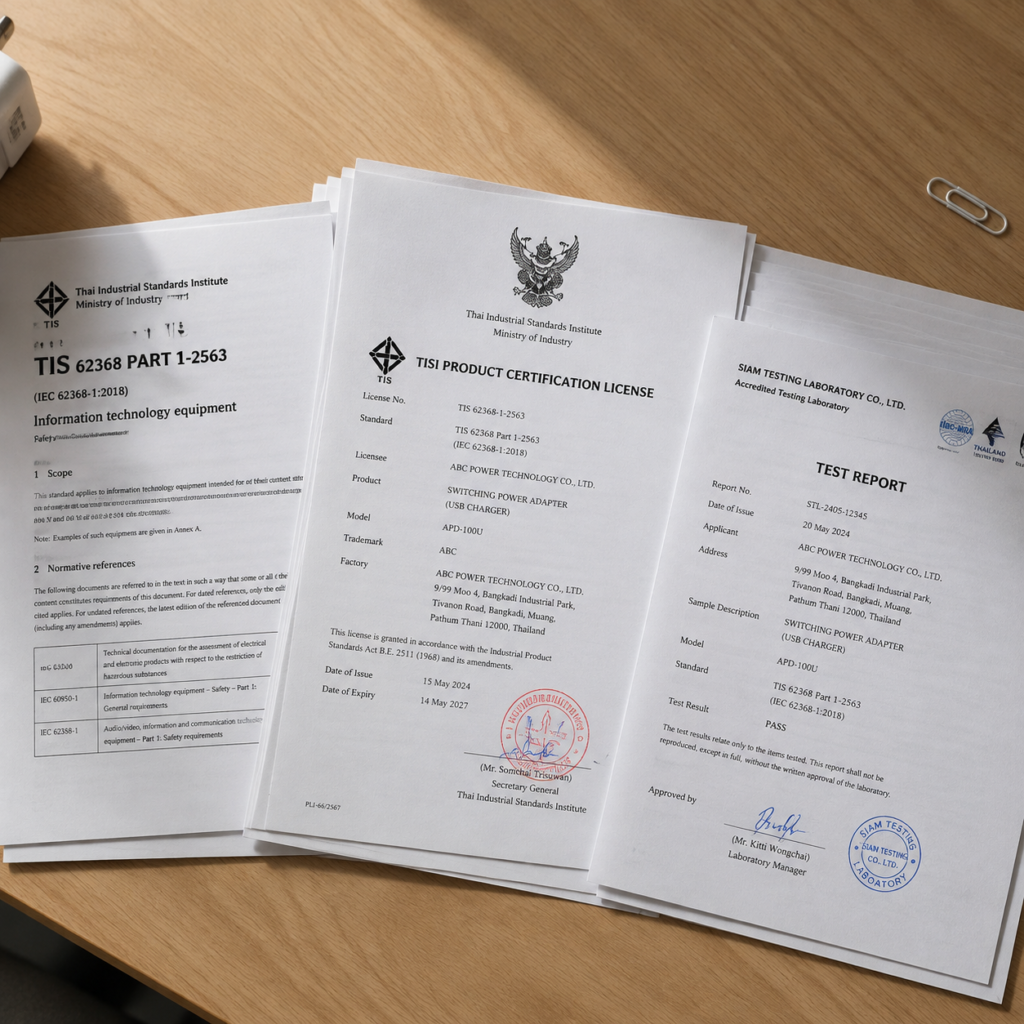
For charging products, there is no “one-size-fits-all” answer to TISI compliance. It is necessary to combine the product’s use, parameters, structure, HS code (that is, the customs commodity code, an important basis for customs clearance) and the current mandatory catalog to finally confirm whether it is subject to mandatory certification, which standard applies, and what license is required.
Value for Different Groups
For different people, the value of TISI is completely different:
If you are a cross-border seller or importer, for commercially imported products that fall within the scope of mandatory standards and are not eligible for exemptions, you usually must obtain the corresponding TISI license or complete the required procedures before importation, otherwise you may be unable to complete customs clearance normally and face law enforcement risks. Whether exemptions for samples, exhibits, personal use, maintenance or other purposes apply shall be separately confirmed in combination with the purpose of import, quantity and relevant documents.
If you are an ordinary consumer or corporate purchaser, choosing charging products that meet applicable TISI requirements helps reduce safety risks such as electric shock, fire, and equipment damage. After all, such products need to be evaluated or tested in accordance with corresponding safety requirements.
Even if your product is not in the mandatory catalog, actively applying for voluntary certification can also increase trust in local Thai channels and make it more competitive than uncertified products.
Boundaries with Other Compliance Systems
Many people ask: I have CE, CCC or CB certification, can I directly convert it to TISI? The answer is it cannot automatically replace the TISI product license. These certifications belong to different regional or international systems, and can only be used as technical data or evaluation references, and cannot be directly used as Thai licenses.
However, this does not mean that all products must undergo a complete new local test in Thailand. Many TIS standards adopt or are based on IEC standards. CB reports, reports from foreign accredited laboratories, or existing test data may be used for application evaluation when they meet the requirements of TISI accreditation scope, applicable standards and national differences. Whether supplementary testing or retesting is required shall be confirmed by TISI or the relevant undertaking agency according to the specific product.
There are two other systems that are easily confused, and the boundaries are clarified here:
One is NBTC (National Broadcasting and Telecommunications Commission of Thailand), which regulates radio and telecommunications-related products — TISI regulates electrical safety, and NBTC regulates radio frequency compliance. For example, products with wireless charging or Bluetooth functions may need to pass both TISI safety certification and NBTC radio frequency certification. The two do not conflict and cannot replace each other.
The other is the Thailand energy efficiency label, which is another independent system targeting product energy consumption requirements. Some power adapter products may need to meet both TISI safety requirements and energy efficiency label regulations, which need to be checked simultaneously.
II. Methods for Judging Mandatory Attributes and Applicable Standards
After understanding the basic concepts, the question everyone is most concerned about must be: Does my product need TISI certification? There is a standard process for this judgment. You cannot make a random guess, nor can you believe it when others say “a certain product does not need it”, because the results may be completely different due to different product structures, parameters, and even sales forms.
Complete Process for Confirming Applicable Standards
If you want to get the most accurate conclusion, you must go through the complete “evidence chain” process:
Step 1: First clarify the product definition: What is it used for? Is it an independent product sold in separate packaging, or an accessory given away with other products? Is it sold to ordinary consumers, or used for industrial equipment? All these will affect the regulatory attribute.
Step 2: Check core parameters: What is the rated input and output voltage? What is the power? Is it a USB-A or USB-C interface? Is there a built-in battery?
Step 3: Confirm structure and functions: Is there an AC-DC module (that is, a power conversion circuit that converts 220V alternating current into low-voltage direct current)? Is there communication functions such as wireless charging or Bluetooth?
Step 4: Match HS code and import classification: HS code is an important basis for customs clearance. For the same product, different import classifications may correspond to different regulatory requirements. Be sure to confirm with the importer or customs broker in advance.
Step 5: Compare with TISI’s current mandatory catalog to lock in the corresponding TIS standard.
If you are still unsure after going through these processes, you must apply for written confirmation from TISI or its accredited or designated relevant agencies. Do not guess by yourself — the cost of guessing wrong may be customs clearance obstruction for the entire batch of goods, or facing fines. Also note that TISI’s catalog and standards are updated regularly, and all rules shall be subject to the latest official release.
5-Step Preliminary Judgment Method for Mandatory Attributes
If you just want to do a quick screening first without going through such a complicated process, you can use these 5 questions for preliminary judgment — again, this is only preliminary screening, and the final result must be subject to the official catalog and confirmation:
Question 1: Is the product commercially sold or imported as an independent commodity in Thailand? If it is brought for personal use, or is a small number of samples, the customs has other rules, and there is no need to directly judge according to the mandatory requirements for commercial sales.
Question 2: Does the product have a Thai standard AC plug and is directly connected to 220V, 50Hz mains power for use? This is one of the core screening conditions, but not the only one. Some products without AC plugs may also be in the mandatory catalog.
Question 3: Does the product have a built-in lithium battery? Does it have wireless communication or charging functions? If yes, even if it is a low-voltage product itself, it may involve additional regulatory requirements.
Question 4: Is it a set product? For example, for a gift set of “charger + charging cable”, you cannot just check whether the main product has a certificate. Each component must be checked to see if it falls within the mandatory scope, whether it has been covered by the license scope, and whether a separate license is required.
Question 5: Compare with the current mandatory catalog and HS code to see if it matches the corresponding category.
Finally, a reminder: Even pure low-voltage products, such as charging cables without any AC modules, may involve other regulations such as lithium battery transportation and product quality. It does not mean that there are no requirements at all if TISI is not needed.
Checklist for 6 Types of Common Charging Products
For your convenience, we have sorted out the key check points for the 6 most common types of charging products. Each type needs to be verified item by item, and a conclusion cannot be drawn just by looking at the product name:
| Product Type | Core Features | Key Items to Check | Boundary Reminder |
| Wall-mounted Charger | AC mains input, with AC-DC module, no radio frequency function | Whether it is in the mandatory catalog, corresponding power supply TIS standard, whether the plug meets Thai standards | Those with wireless output need to additionally check radio frequency related requirements |
| External Power Adapter | AC mains input, with AC-DC module, power supply for other devices | Whether it is in the mandatory catalog, safety standard corresponding to power, whether it needs to meet energy efficiency requirements | Those with USB output need to additionally check interface safety requirements |
| Pure USB-A/C Charging Cable | Low-voltage USB input and output, no AC-DC module, no battery | Whether it is in the mandatory catalog, whether it is sold independently, whether there is a corresponding cable safety standard | Those with AC plug/charging control module shall be checked according to power supply category |
| Power Bank | Low-voltage input and output, built-in lithium battery, no AC-DC module | Product definition, battery or battery pack type, rated parameters, structure and functions, whether it is in the mandatory catalog and applicable TIS standards, transportation and import regulatory requirements | Those with AC plug shall be checked according to power supply category |
| Wireless Charger | AC/low-voltage input, electromagnetic field energy transmission, some with communication functions | Whether it is in the mandatory catalog, electrical safety standard, whether it meets NBTC radio frequency requirements | For those with only magnetic attraction/no data communication, NBTC jurisdiction shall be judged according to technical parameters |
| Thai Standard Power Strip with USB Ports | AC mains input, with AC-DC module (USB part), both socket and charging functions | Whether it is in the mandatory catalog, socket structure standard, USB power supply safety standard | Those with only USB and no AC socket shall be checked according to charger category |
For example, for products also called “wireless chargers”, those with Bluetooth pairing function and those with pure magnetic induction have different regulatory requirements, and cannot be directly applied.
Trigger Conditions for Reassessment of Boundary Categories
There are also some products with relatively vague boundaries that cannot be directly classified into the above categories. In these cases, compliance requirements need to be reassessed:
For example, travel chargers with replaceable pins shall be verified according to the pin version actually sold in Thailand. You cannot test samples with European pins and then sell versions with Thai standard pins in Thailand.
Another example is multi-port GaN fast chargers and desktop charging stations. It is necessary to check whether the power, port configuration, and overall structure are within the coverage of the corresponding standard — for example, upgrading from 2 ports to 6 ports, or increasing the total power from 65W to 200W, may require reassessment.
There are also charging cables with batteries and magnetic wireless chargers with batteries. Because of built-in batteries or wireless energy transmission, they may trigger additional safety standards, and cannot be calculated as ordinary cables or chargers.
If it is a set of charger plus cable and adapter, each component shall be checked one by one to see if it falls within the scope of mandatory standards, whether it is covered by the license scope of the main product, and whether a separate license application is required. You cannot think that everything is fine just because the charger has a certificate.
There are also cables and accessories sold only as spare parts. The regulatory requirements shall be checked according to the sales form and whether they are independently packaged — for example, spare parts sold in separate packaging and priced separately may have different requirements from spare parts given away free with the main unit.
III. Common Safety Verification Items of TIS Standards
Many people are curious: What exactly does TISI certification test? Is it just that it can charge when plugged in? Of course not. TISI’s safety verification is all around the core safety goals of “avoiding electric shock, fire, and equipment damage”. Different types of products have different test items. The following are the most common verification items for charging products — note that the specific tests shall be subject to the corresponding TIS standards and certification schemes. These are only common contents and cannot replace the standard text. The test result is an important basis for passing the product license. If it fails, it needs to be rectified and retested.
Plug and Interface Verification
This type of verification applies to charging products with Thai standard AC plugs and USB-A/C output interfaces.
Common test items include: whether the size of the Thai standard plug meets the requirements, whether the hardness of the pins is sufficient, whether the USB port has an electric shock prevention design, and whether the materials of the interface and shell are flame-retardant.
The purpose of these tests is very straightforward: to prevent poor contact and arcing caused by incorrect plug size, to prevent children or users from accidentally touching live parts inside the USB port and getting an electric shock, and to prevent the spread of fire after the shell catches fire.
Common failure reasons are also concentrated: for example, the plug size is unqualified, cannot be inserted into a Thai standard socket or is too loose after insertion; the live parts of the USB port are exposed and can be touched with a test pin; the plastic used for the shell has insufficient flame-retardant grade and catches fire easily.
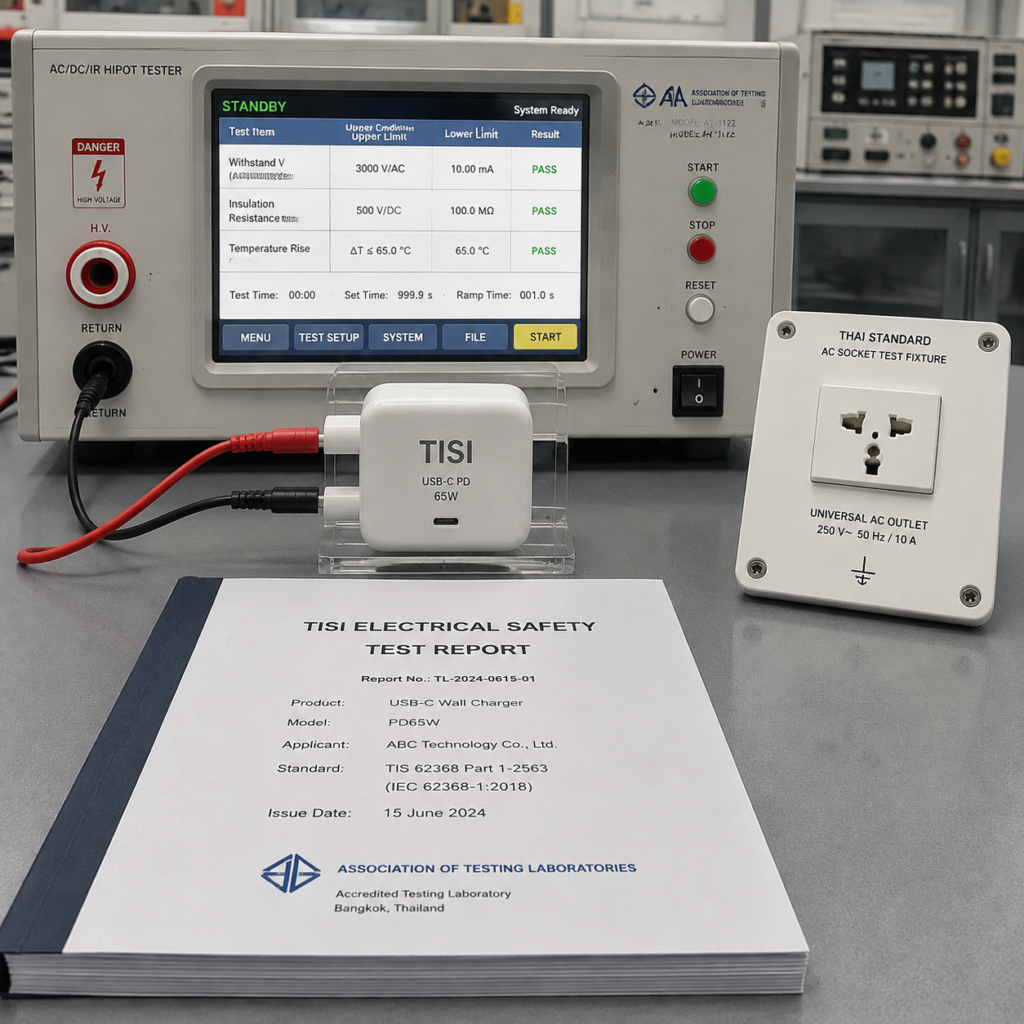
For pure cable or pure battery products without AC plugs and USB output, the corresponding AC plug or USB interface items are usually not applicable. But this does not mean that it does not need safety verification at all. It is still necessary to confirm the safety test requirements for batteries, cables, connectors and other items according to the product category and applicable standards.
Core Safety Verification of Power Conversion
This type of verification applies to all charging products with AC-DC conversion modules — such as wall chargers, power adapters, and power strips with USB ports, all fall into this category.
Common test items may include: overload protection, short circuit protection, isolation between high voltage side and low voltage side, protective conductor current, touch current, insulation and withstand voltage, and temperature rise under full load, etc. Specific terms, measurement methods and limits shall be subject to the applicable TIS standards, and all relevant currents cannot be collectively referred to as “leakage current”.
These tests are all to avoid the most serious safety risks: for example, insufficient isolation design, mains power leaks to the USB end, users will get an electric shock when plugging in their mobile phones; overload protection fails, and too many connected devices may cause fire and damage; touch current or other related currents exceed the standard limit, which may cause discomfort or safety risks when users touch the product; temperature rise exceeds the standard, and the shell may overheat under full load.
Common failure reasons include: insufficient isolation distance, shoddy overload protection devices, poor heat dissipation design leading to excessive temperature rise, and unqualified insulation or withstand voltage performance.
Pure low-voltage cables and power banks without AC-DC modules usually do not apply to this set of AC-DC power conversion items, but they still need to confirm other applicable requirements according to their respective product categories and standards.
Verification Differences of Different Products (Semi-Proficient)
For sellers with a certain foundation, understanding the verification differences of different products can help you estimate the cost and difficulty in advance:
First is the impact of power and topology: the thermal design and load verification complexity of high-power products may be higher, but it does not mean that the higher the power, the higher the certification threshold will necessarily be — it still depends on the specific circuit design, applicable standards and licensing schemes.
Then is the impact of the number of interfaces: multi-port products may need additional testing of the total load safety when multiple ports are fully loaded at the same time. For example, for a 6-port charger, when 6 ports output at the same time, will there be problems of overheating and protection failure? Whether the actual test items increase shall be subject to the corresponding standards and certification schemes.
Third is the impact of composite products: for example, a Thai standard power strip with USB ports must meet both the structural safety standard of the socket and the conversion safety standard of the USB power supply, so the process may be more complicated.
Finally, the impact of fast charging protocols: fast charging protocols such as PD and QC, as well as dynamic power distribution functions, will affect the sample configuration and test items submitted for testing, but they will not alone determine whether the product is subject to mandatory certification, nor can the certification difficulty be judged solely by whether fast charging is supported.
Labeling and Packaging Verification
In addition to hardware testing, products applying for TISI licenses usually need to undergo labeling and packaging verification. This step seems simple, but many people stumble here.
Common verification items include: whether the label on the product body is clear, whether the parameters on it are consistent with those filed, and whether there are Thai safety instructions in the packaging and manual.
The purpose is also very clear: to ensure that users can get accurate safety information, will not be misled by false parameters, and can understand basic safety precautions.
Common failure reasons include: the label is only printed on the packaging, not on the product body (unless it meets the exemption rules); the power and model printed on the product are different from those filed; there is no Thai safety instruction, all in English or Chinese.
Of course, there are exceptions: some particularly small products can be exempted from body labeling according to the rules, and the label can be printed on the packaging or manual, but it must comply with TISI regulations, and you cannot claim exemption just because you think it is small. The label content, license number and labeling position shall be subject to specific standards, license documents and current labeling rules.
IV. Rules and Procedures for TISI Product License Application
After understanding what to test, let’s talk about how to apply for a TISI product license. Many people think the application process is very complicated. In fact, it is broken down into several fixed steps. If you prepare in advance, you will not take too many detours.
Pre-Application Preparation and Subject Requirements
First is the preparation before application. There are two things to do first:
First is pre-confirmation: first verify whether your product falls into the mandatory or voluntary category. The processes and requirements of the two are different. Don’t blindly prepare materials at the beginning.
Second is to clarify the roles of the subjects: it is necessary to figure out who is the applicant, who is the manufacturer, who is the importer, and who is the license holder. The responsibilities of these roles are different and need to be determined in advance.
After preparing these, it is necessary to sort out the necessary application materials, mainly including:
Product photos, nameplates, specifications (be sure to mark clearly the core parameters such as power, interface, and plug type);
Circuit schematic diagram, PCB data, BOM (Bill of Materials), certificates of key safety components — for example, components directly related to safety such as transformers, plugs, and optocouplers must have corresponding compliance certificates;
Thai manual, factory qualification documents, information of the applicant subject and importer.
Core Full Application Process
When the materials are ready, you can go through the formal application process. There are 8 core nodes in total:
Node 1: Pre-classification assessment: reconfirm the product category, applicable standards, and mandatory attributes to avoid finding that the classification is wrong after the materials are submitted.
Node 2: Submit application and full set of materials: submit the materials to TISI, and connect with laboratories, inspection agencies and other undertaking parties designated or accredited by TISI according to the specific scheme. It should be noted that testing, inspection or evaluation agencies do not naturally have the authority to issue TISI product licenses.
Node 3: Document review: TISI or the relevant undertaking agency will first check the completeness and consistency of the materials. For example, if the power in the specification is different from that on the nameplate, it will be sent back for supplementary materials.
Node 4: Sample testing: send the samples to a qualified laboratory for testing according to the corresponding standards. Whether existing test reports or other test data can be used shall be confirmed according to specific standards and licensing schemes.
Node 5: Factory/quality audit (if applicable): not all products require it. If applicable, TISI or its designated agency will conduct factory inspection or production consistency check according to the specific licensing scheme. The content may include quality system, production process, key safety component control, inspection records, and the consistency between mass-produced products and certified samples.
Node 6: Rectification of non-conformities: if the test or audit fails, you must rectify the problems, and then retest or re-audit after rectification — so pre-testing in advance is very important, which can save a lot of time and money.
Node 7: Obtaining license and filing: after all tests and audits are passed, TISI will issue an official product license in accordance with the law and complete the relevant filing. Only then can the corresponding TISI product license be obtained.
Node 8: Post-marketing supervision: getting the certificate does not mean everything is done once and for all. TISI may conduct market spot checks and production consistency supervision in accordance with regulations. Any product changes must be declared in a timely manner, and relevant production and import records must be kept. The importer and license holder shall bear the corresponding compliance responsibilities.
Model Family Coverage Rules (Semi-Proficient)
For sellers, some certification schemes allow multiple models or variants to be covered under the same license, but this is not a unified “model family” rule applicable to all charging products, nor can it be judged solely based on appearance or a small number of parameter differences.
Whether multiple models or variants can be covered under the same license shall be confirmed item by item according to the corresponding TIS standards, TISI licensing schemes and the model scope specified in the certification documents. Changes in power, increase or decrease of ports, changes in circuits or software cannot be presumed to be covered by the same certificate based solely on general experience.
If it exceeds the coverage scope specified in the license document, or if TISI approval is not obtained, you must apply separately or handle changes as required. You cannot force them into the same certificate, otherwise the license or product compliance status may be affected.
Description of Cycle and Cost
The two most frequently asked questions by many people are: How long does it take to get TISI certification? How much does it cost? Let’s make it clear here: There is no fixed cycle and unified quotation applicable to all charging products.
The application cycle is affected by many factors: such as product complexity, applicable standards, completeness of materials, scheduling of testing agencies, whether factory inspection is required, number of rectifications, and cooperation of relevant subjects, etc. The specific cycle shall be separately confirmed by TISI or the undertaking agency according to the project. One or two months or half a year cannot be used as a general reference period for all charging products.
There are also many factors affecting the cost: such as product category, applicable standards, sample configuration, test items, whether factory inspection is required, whether there are changes or additional models, etc. Power and number of interfaces may increase the complexity of load, temperature rise and multi-port combination testing, but the actual test items and costs must be confirmed according to product category, applicable TIS standards and licensing schemes, and cannot be directly derived solely from power or number of interfaces.
If you want to know the accurate cycle and cost, you must consult TISI-accredited agencies or official channels and provide detailed product information to get a reliable quotation.
Validity Period, Renewal and Change Rules
Finally, let’s talk about the validity period, renewal and change rules of the license:
First is the validity period: the validity period of TISI licenses is not unified. The validity period may vary for different categories and different license types, depending on the period specified in the license document.
Then is renewal: you must apply for renewal in advance before the license expires. Whether retesting is required and whether factory spot checks are required during renewal shall be subject to the official current requirements. It does not mean that no testing is required for renewal.
Third is the key change rule: if the product needs to replace key safety elements such as plugs, transformers, shells, and circuit designs, you must first verify with TISI or the certification agency to see if supplementary testing or re-application for a license is required — you cannot just replace them secretly, otherwise the original license may no longer cover the changed product.
The specific content, applicable scope and time points of factory inspection or production consistency check are also determined by the license type, product standards and certification scheme, which may involve quality system, production process, key safety component control, inspection records, and the consistency between mass-produced products and certified samples.
V. TISI Mark Identification and Official Verification Methods
Whether consumers buy products or sellers check suppliers’ certificates, they must be able to identify the TISI mark and verify its authenticity — after all, the mark can be counterfeited, and only the information in the official system is real.
Basic Understanding of TISI Mark
Let’s start with the basic common sense of the TISI mark:
First, there are two types of marks: the styles of mandatory licenses and voluntary licenses are different. The specific styles are subject to TISI’s latest announcement, so there is no need to memorize them by rote.
Second, labeling requirements: the specific mark, license number and labeling position shall be checked according to the product’s applicable standards, license documents and current labeling rules. Under normal circumstances, the relevant mark may need to be labeled on the product body. Some small products can be labeled on the packaging or manual according to the rules, but they cannot be simplified or changed position arbitrarily.
Third, appearance requirements: the mark must be clear and legible, without deformation or alteration, and the information on the mark must be consistent with the filed information.
It is emphasized here: You must never judge a product’s compliance solely by the appearance of the mark, because the mark is too easy to counterfeit. You must go to the official system to query and verify.
Complete Steps for Official Authenticity Query
The official channel for querying the authenticity of TISI licenses is TISI’s official certification query system. The specific steps are:
Log in to TISI’s official query page and enter the product’s registration number or license number — note that it is the official registration number, not a number compiled by the merchant itself.
After querying the results, you should focus on checking the following core information:
First, license status: whether it is valid, whether it has been suspended or revoked — some certificates were valid before, but were later revoked due to violations. It is useless to just see that there is a certificate.
Second, product model, brand, rated parameters: whether they are consistent with the physical product in your hand. For example, if you bought a 65W charger but the query shows 20W, there must be a problem.
Third, manufacturer, production address, applicable standard, license holder: whether these information match what the merchant said.
If no result can be found, or the information does not match, immediately stop purchasing or selling, and quickly verify with the issuing agency. Do not take chances.
Summary of Official Information Verification Channels
In addition to checking the authenticity of licenses, there are several official channels that can be used to verify TISI-related information, all of which are the most authoritative:
First is the mandatory standard catalog on TISI’s official website, where you can query the latest mandatory product categories to see if your product is in it;
Second is TISI’s standard text library, where you can find the specific TIS standard content of the corresponding product. Those who want to know more can go to check;
Third is the TISI accredited laboratory directory, which can verify the qualifications of testing agencies to avoid wasting money by finding unauthorized laboratories;
Fourth is TISI’s mark rule announcement, where you can find the latest labeling requirements to avoid wrong labeling positions or incorrect formats.
VI. Common Misconceptions and Pitfall Avoidance Guide
After talking so much, we finally sorted out 8 cognitive misconceptions that everyone is most likely to fall into. Whether you are a novice or a seller who has been doing it for a while, you can check them against to avoid pitfalls.
8 High-Frequency Cognitive Misconceptions (Must Avoid for Beginners)
1. CE/CCC/CB can directly replace TISI: Wrong. These cannot automatically replace TISI product licenses. Relevant test data may be used for application evaluation when they meet the requirements of TISI accreditation scope, applicable standards and national differences; whether supplementary testing or retesting is required must be confirmed according to the specific product.
2. Low-voltage charging cables absolutely do not need TISI: Wrong. Whether TISI is required depends on whether it is sold independently, product structure, and the current mandatory catalog. Not all low-voltage cables do not need it, nor do all need it.
3. Power banks must fall into the voluntary category: Wrong. Power banks shall be confirmed according to product definition, lithium battery or battery pack type, rated parameters, structure and functions, current catalog and applicable TIS standards. They cannot be judged as voluntary solely based on whether they have AC input or battery capacity.
4. All wireless chargers need NBTC certification: Wrong. Whether NBTC is required depends on the product’s technical type and working frequency band. For example, pure magnetic induction wireless chargers may not need NBTC, and specific judgment is required.
5. Third-party test reports equal TISI license: Wrong. Test reports are only one of the application materials or evaluation data. Only when an official license is obtained in accordance with regulations can the corresponding TISI license requirements be considered completed.
6. Products with the same appearance can share one license: Wrong. Whether multiple models can be covered under the same license must comply with the corresponding TIS standards, TISI licensing schemes and the model scope specified in the certification documents. Products with the same appearance but different internal circuits and key components cannot share the license without authorization. This is the common risk of “certificate borrowing”.
7. Replacing key components does not affect compliance: Wrong. Before replacing key safety components such as plugs, transformers, shells, and circuits, you must first verify whether supplementary testing or re-application for a license is required, otherwise the original license may not cover the changed product.
8. Being able to charge normally means it is safe and compliant: Wrong. Being able to charge is only the most basic function. Safety and compliance require passing relevant tests specified in the standards, such as isolation, flame retardancy, temperature rise, insulation and withstand voltage, which cannot be seen with the naked eye at all.
Practical Pitfall Avoidance Suggestions for Cross-Border Sellers
For cross-border sellers, in addition to avoiding the above misconceptions, there are several practical pitfall avoidance suggestions, all of which are pitfalls that predecessors have stepped on:
First, be sure to complete the mandatory attribute verification before stocking, and confirm the local license-holding subject. For commercially imported products that fall within the scope of mandatory standards and are not eligible for exemptions, the corresponding licenses or required procedures should be completed in advance to avoid finding that customs clearance cannot be completed normally after the goods are produced.
Second, do sample pre-testing before submitting for testing. Find an experienced and qualified laboratory to first check the situation, see if there are obvious problems, and rectify them in advance to avoid failing the formal test and spending money and time on retesting.
Third, absolutely no certificate borrowing: do not use other people’s license numbers, and do not lend your own certificate to others. If found, the light consequence is fines and removal from shelves, and the serious consequence is facing more severe regulatory measures, which is not worth the loss.
Fourth, before going on the market, be sure to check that the brand, model, and parameters of the three places “license document – physical product – sales page” are completely consistent. Even if only one letter is wrong in the model, it may cause compliance problems.
Fifth, the display requirements of e-commerce platforms are the platform’s own rules, not legal mandatory requirements. Just follow the platform’s regulations, but don’t think that if the platform has no requirements, you don’t need to do TISI — customs and market supervision do not care about platform rules.
Sixth, during the sales process, regularly pay attention to the update of TISI’s catalog and standards. For example, products that were previously voluntary may later be changed to mandatory, and you need to make up the certificate in time; if you want to replace key components, first review the compliance before replacing.
Seventh, each component of a set product shall be checked for applicability: confirm whether it falls within the scope of mandatory standards, whether it has been covered by the license scope of the main product, and whether a separate license is required. It cannot be simply assumed that as long as the main product has a certificate, other components in the set are automatically compliant.
Eighth, in the after-sales and supervision links, keep the production and import records of each batch well, cooperate with official spot checks, and bear the corresponding recall responsibility if there is a safety problem.
VII. Practical Decision-Making Tools
Finally, we have sorted out several practical tools and checklists for you, which can be used directly whether consumers are shopping or sellers are doing compliance.
Quick Pre-Purchase Checklist for Consumers/Purchasers
Three steps can screen out most non-compliant products:
Step 1: Check the mark: according to the product’s applicable standards, license documents and current labeling rules, check the TISI mark and license number on the product body, packaging or manual. Different types of products may have different labeling positions and information requirements. You cannot take “both the mark and license number on the product or packaging” as a unified rule for all products.
Step 2: Check parameters: the brand, model, and rated parameters are consistent with the results in the official query system. Do not buy products with mismatched parameters.
Step 3: Check appearance: the plug is not loose or deformed, the interface is not loose, and the shell is not damaged or has a pungent odor.
Risk reminder: If there is abnormal heating, arcing, or burnt smell during use, stop using it immediately. Don’t think “it’s fine if it can charge normally” — safety is always the first priority.
Seller’s Compliance Check Process from Project Establishment to Launch
Follow the stages, and no items will be missed:
Project Establishment Stage: Confirm the product structure, input type, whether it is in the mandatory catalog, and whether there is a compliant license-holding subject. Don’t wait until the mold is opened to find problems.
Sample Making Stage: Fix the model, power, number of interfaces, and plug version. Do not replace key safety components casually, otherwise the samples submitted for testing may not represent the mass-produced version.
Testing Submission Stage: The submitted samples should be as consistent as possible with the future mass-produced products. The full set of application materials should be kept well for subsequent changes or renewal.
Pre-Launch: Complete the information consistency check of “license document – physical product – sales page”. The information in the three places must be completely consistent.
Post-Sales: Keep the production and import records of each batch, regularly track the update of TISI’s standards and catalog, and review the compliance before implementing any changes.
Quick Judgment Logic for Certification Difficulty (Semi-Proficient, For Reference Only)
This is a quick judgment idea for sellers who need to make a budget. The specific situation shall be subject to the agency’s assessment:
First, high-power and multi-port products may increase the complexity of load, temperature rise and multi-port combination testing, but the actual test items and costs still need to be confirmed according to product category, applicable standards and licensing schemes, and cannot be judged solely by power or number of ports.
Second, products with composite functions, such as those with batteries, wireless charging, or power strip functions, may need to meet the requirements of multiple standards or regulatory systems, the process is more complicated, and the cycle and cost may be higher.
Third, products with frequent changes of key components may require frequent supplementary testing or re-application for licenses, and the comprehensive cost will be much higher — if you focus on the Thai market, try to fix the key safety components and do not replace them frequently.
Frequently Asked Questions (FAQ)
Is TISI mandatory for selling chargers in Thailand?
It shall be confirmed item by item according to product structure, power, HS code and TISI’s current mandatory catalog. For products that fall within the scope of mandatory standards and are not eligible for exemptions, they usually must obtain the corresponding license or complete the required procedures before commercial import and sales.
Do USB-C charging cables need TISI certification?
It shall be confirmed according to whether it is sold independently, whether it has an AC module or control circuit, and whether it is in the mandatory catalog. Pure low-voltage cables still need to check the current catalog and applicable standard requirements.
Do power banks need TISI certification?
The license requirements for power banks shall be confirmed according to product definition, lithium battery or battery pack type, rated parameters, structure and functions, current TISI mandatory catalog and applicable TIS standards. They cannot be judged solely based on whether they have AC input or battery capacity.
Can CE certification replace TISI?
No. CE can only be used as technical data or evaluation reference. Whether relevant data can be used for TISI application and whether supplementary testing or retesting is required shall be confirmed according to TISI accreditation scope, applicable standards and national difference requirements.
How long does it take and how much does it cost to get TISI certification?
There is no unified fixed value. It is affected by factors such as product complexity, applicable standards, completeness of materials, testing scheduling, whether factory inspection is required, and number of rectifications. You need to provide specific product information to TISI or the undertaking agency before consulting.
How to check the authenticity of TISI certification?
Log in to TISI’s official query system and check information such as license status, model, brand, rated parameters, manufacturer, production address and license holder. Do not only look at the appearance of the mark.
Core Competence Summary
In general, after reading this content, you should be able to master the following core competencies:
First, you can use the 5-step preliminary judgment method to quickly screen the TISI mandatory attributes of charging products — of course, the final result must be subject to the official catalog and confirmation;
Second, you can fully verify the authenticity of TISI licenses through official channels and identify common mark counterfeiting risks;
Third, you can avoid 8 high-frequency cognitive misconceptions about TISI compliance for charging products and take fewer detours;
Fourth, you can preliminarily judge the certification complexity and core verification direction according to the product’s power and structure, and have a clear idea when making budget and cycle plans;
Fifth, you can master the core preparation items and full process nodes for sellers to apply for TISI licenses, instead of taking one step at a time.
TISI certification seems to have many clauses and complicated processes, but in fact the core logic is very simple: it is to control the safety of electrical products in accordance with Thailand’s safety standards. For sellers, it is an important threshold for market entry and also a part of product competitiveness; for consumers, it is an important reference for judging the safety and compliance status of products. No matter what kind of reader you are, spending more time understanding TISI will always help you avoid many pitfalls.