
Most friends doing cross-border business in Southeast Asia have probably heard of Indonesia’s SNI, but it’s easy to run into pitfalls when it comes to actual practice: some people stick SNI marks on ordinary USB cables and waste money, some think CE can replace SNI and end up with problems during customs clearance or sales, and others print the mark on the manual and think it’s compliant, only to have their products removed from e-commerce platforms shortly after. Today, we will clearly explain the SNI marking rules related to charging products from basics to practical operation. After reading this, you will be able to more systematically judge whether a product may require SNI, and how to verify and use the mark.
Basic Foundation: First Clarify Concepts and Rules
First, let’s clarify the three most easily confused terms, which many people still use interchangeably even after working with SNI for half a year.
The first is SNI Standard: these are the technical requirements for product safety and performance adopted or formulated by Indonesia, such as the insulation, structure, and electrical performance requirements related to chargers, equivalent to the exam syllabus.
The second is SNI Certification: this is the process by which a certification body tests products, reviews relevant production or technical documents, and confirms whether they meet requirements in accordance with applicable standards and certification schemes, equivalent to taking an exam and having it graded.
The third is SNI Mark: this is the mark used in accordance with current regulations, applicable licenses, and certification schemes after meeting corresponding requirements, used to convey product compliance information to consumers and regulators.
There are also several common documents that go with these three concepts, which we will also clarify by the way:
• SPPT-SNI: Under the applicable mandatory certification system, the corresponding certification document issued by a certification body in accordance with the designated SNI and certification scheme. This name was common historically, but the actual document name, issuing entity, and legal effect shall be subject to the current regulations of the competent authority, the BSN system, and the specific certification scheme.
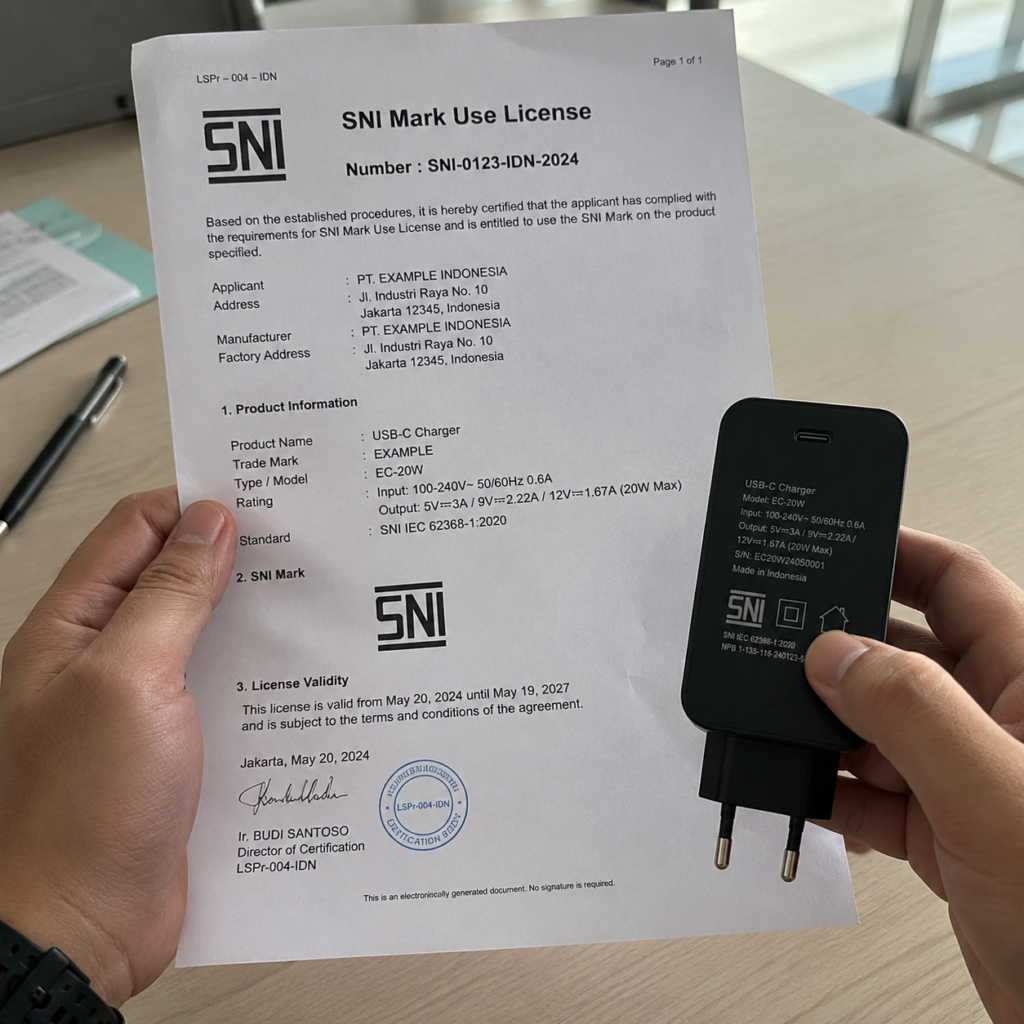
• SNI Mark Use License or Related Approval Documents: used to confirm how and within what scope the mark is used. Obtaining a certification document does not mean that the mark can be printed independently without complying with current regulations and approved schemes.
• Import License/Product Registration: some products also need to apply for additional import or circulation access documents from the competent authority.
• NPB: whether a Nomor Pendaftaran Barang (Goods Registration Number) is required must be verified item by item based on the specific product category, current Ministry of Trade regulations, and import and circulation modes, and cannot be excluded solely based on the name “charging products”.
Who Manages SNI-Related Matters?
Many people think that SNI is entirely managed by one department, but in fact it is a system with clear division of labor, and you need to contact the corresponding entity for different problems:
• BSN (National Standardization Agency of Indonesia): responsible for the national standardization system and general rules related to the SNI mark. The mark graphics, use license, and management requirements shall be subject to the current regulations of BSN.
• Industry Competent Authorities (Ministry of Trade, Ministry of Industry, etc.): responsible for issuing mandatory technical regulations and clarifying which products must implement corresponding SNI or other compliance requirements.
• KAN (National Accreditation Committee): responsible for accrediting the qualifications of conformity assessment bodies such as certification bodies and laboratories.
• LSPro (Product Certification Body): implements testing and audit in accordance with specific certification schemes, and issues corresponding certification results or certification documents. The use license and management of the SNI mark cannot be simply summarized as being uniformly issued by LSPro, and shall be handled in accordance with the current regulations of BSN, mandatory regulations of the competent authority, and specific certification schemes.
• Customs and Import License Departments: verify import declarations, licenses, and product compliance documents in accordance with applicable systems.
• E-commerce Platforms: verify the compliance of settled products in accordance with platform rules and regulatory requirements, and may take measures such as restricting sales or removing products with incomplete information or risks.
There is a very important rule to mention in advance: compliance requirements shall be subject to officially issued regulatory documents and applicable certification schemes, and attention should be paid to the hierarchical relationship between regulatory documents. Oral opinions from LSPro cannot replace formal regulations, nor can they alone constitute the basis for using the SNI mark. When encountering key issues, written confirmation from the corresponding entity should be obtained, and regulatory and document basis should be retained.
Why Attach Importance to the SNI Mark?
For products included in the scope by Indonesia’s specific mandatory technical regulations, SNI certification, marks, import licenses, or other documents may constitute part of market access. Failure to meet applicable requirements may lead to customs clearance delays or refusal of release, sales restrictions, platform removal, recalls, or administrative penalties. The specific consequences depend on the product category, applicable regulations, inspection results, and law enforcement decisions.
Therefore, although the SNI mark is a very intuitive inspection item in market spot checks, it is not the only document for all import links, nor is it a mark that all charging products must automatically use. The key is to first confirm whether the product falls within the mandatory scope, and then check whether the certification, mark, and import documents match each other.
Mandatory Scope Verification: Does Your Product Need the SNI Mark?
After understanding the basic concepts, the question everyone is most concerned about must be: does the charger or charging cable I sell need to use the SNI mark at all?
Don’t just look at the product appearance, and don’t just look at the HS code. The “six-dimensional verification method” should be used for comprehensive judgment, and conclusions cannot be drawn based on a single condition. Generally speaking, product definitions and technical characteristics in regulations take precedence over HS codes; HS codes are mainly auxiliary information for customs classification and cannot alone determine whether a product falls within the SNI mandatory scope.
The six dimensions are:
1. Product Definition and Function: first check whether the product belongs to the power adapter, charging equipment, or other product categories regulated by the regulations. Wall-mounted chargers may belong to power conversion equipment, but this still needs to be judged in combination with specific regulations.
2. Input/Output Rated Parameters: check whether parameters such as input voltage, output voltage, and rated power fall within the coverage of mandatory standards. Not all products with “charging” function automatically belong to the same category.
3. Product Structure and Active Components: focus on whether the product has the function of converting input electrical energy into other voltage or current forms, and whether it contains active electronic components. Passive data cables usually do not have this power conversion structure, but it is still necessary to confirm whether they belong to other regulated categories.
4. HS Code: as an auxiliary reference for customs classification. The same HS code may include different products, and the mandatory attribute cannot be judged solely by the code.
5. Mandatory Regulations of Competent Authorities: finally, check the product definition, parameter scope, applicable standards, and implementation date in the latest formal regulations.
6. Import/Sales Mode: applicable requirements may vary for commercial import, local production, personal use, samples, or other import modes. Import for personal use cannot of course be regarded as a general exemption.
Preliminary Screening Reference for Common Charging Products
To facilitate quick preliminary screening, the general classification of common products is listed below. However, this is only a preliminary reference, and the final conclusion must be subject to the applicable formal regulations and certification schemes.
| Preliminary Screening Category | Common Charging Products | Preliminary Judgment Logic |
| High probability of requiring key verification | Wall-mounted chargers, laptop power adapters, integrated charging cables with AC plugs, multi-port wired charging docks | May belong to power converters or other regulated categories, requiring further verification of regulatory definitions and parameter scopes |
| Low probability of belonging to the power converter category | Passive USB data cables without AC plugs and power conversion modules | Usually do not belong to the power converter category, but it is necessary to confirm whether they have built-in active components or belong to other mandatory categories |
| Multi-regulation verification | Car chargers, wireless chargers, charging products with wireless communication functions | Need to simultaneously verify potentially applicable regulations such as electrical safety, radio, or communication equipment |
Special attention should be paid that cables with AC plugs and power conversion functions may fall into the power adapter or other regulated categories. Whether certification and mark use are mandatory still needs to be confirmed based on the product definition, input and output parameters, purpose, and applicable standards of current mandatory regulations, and conclusions cannot be drawn directly based solely on appearance.
How to Judge Combined/Set Products?
For set or combined products, the judgment rules are more detailed:
• Individually sold single products shall have their mandatory attributes verified separately for each product model.
• For multi-component sets, the coverage of the certificate and specific regulations on each component, combined product, and outer packaging shall be verified. Only components that are individually included in the mandatory scope and require separate marking shall use the mark in accordance with corresponding regulations.
• Non-mandatory accessories, such as ordinary passive data cables, shall not use the SNI mark in an unauthorized manner to avoid misleading consumers.
• If it is a complete machine with a built-in charging module, such as a Bluetooth speaker with charging function, it shall be verified according to the category of the complete machine, and the SNI rules for chargers cannot be directly applied.
Correct Operation Steps for Verification
If you really need to verify the mandatory attribute, you can proceed in the following three steps:
Step 1: Sort out basic product information, including structure, function, rated parameters, interfaces, whether it is connected to mains electricity, HS code, etc.
Step 2: Query the latest mandatory technical regulations and BSN standard catalog for preliminary judgment, focusing on product definition, parameter scope, implementation date, and transition arrangements.
Step 3: If there is still doubt, consult a KAN-accredited LSPro or local compliance agency, and prioritize requesting written opinions. Written opinions cannot replace formal regulations, but can be used as one of the evidences for subsequent judgment and communication.
To avoid missing information, you can create a mandatory attribute verification form, with official basis attached to all conclusions. The form should at least include:
• Basic regulatory information: issuing authority, number, implementation date, transition period, and query link;
• Product information: structure, function, rated parameters, HS code, and classification basis;
• Compliance information: applicable SNI standard number and version, certification mode, and marking requirements;
• Conclusion column: fill in “Confirmed Mandatory”, “Preliminarily Excluded”, or “Pending Written Confirmation”;
• Evidence column: attach regulatory screenshots, product materials, query date, and verifier.
Don’t write “definitely not needed” based on guesswork. After changes in regulations or products, the original conclusion may also need to be reconfirmed.
Three Typical Verification Cases
Case 1: Same-brand single-port 18W and multi-port 65W wall-mounted chargers
Many people think that chargers of the same brand can share certification, but this is not necessarily the case. The HS codes of these two products may be initially consistent, but the core depends on the regulatory product definition, input and output power, internal structure, and the coverage of the certification document for the model family.
If the core structure is consistent and the certification document clearly covers all relevant models, the corresponding mark may be used in accordance with the certification scheme; if there are obvious differences in structure, power, or product definition, separate verification is required, and separate certification is necessary if needed. As long as the power, number of interfaces, or internal structure changes, reconfirmation is required, and general applicability cannot be directly judged based on the same brand.
Case 2: Ordinary USB-C cables and integrated fast charging cables with AC plugs
Ordinary USB-C cables are usually passive cables, without AC plugs or power conversion modules, so they usually do not fall within the mandatory scope of power converters. However, if the cable has built-in active components, or is classified as a regulated category by other regulations, re-verification is required.
Integrated fast charging cables with AC plugs and power conversion functions may belong to the power adapter or other regulated product categories. Only after confirming that they fall within the mandatory scope based on current regulations can the obligations for certification and SNI marking be further determined. Conclusions cannot be drawn solely based on the appearance feature of “cable” or “with plug”.
Case 3: Multi-port charging dock with wireless charging function
This type of product is prone to missing items. For multi-port charging docks with mains input plus wireless charging pads, the potentially applicable electrical safety, radio, or communication equipment regulations for the complete machine and its power module shall be verified separately.
Wireless charging itself is not equal to wireless communication, nor does it automatically fall within the scope of SDPPI communication equipment certification. Only when the product has regulated radio communication or transmission functions and falls within the relevant regulatory definitions and frequency band ranges, is it necessary to handle corresponding communication equipment compliance.
As for whether separate certification and separate use of the SNI mark are required, this cannot be directly determined solely by product functional modules, but also depends on the complete machine category, coverage of certification documents, and specific regulations. When the wireless charging power changes, or new wireless communication or transmission functions are added, verification of regulations and certification scope shall be conducted again.
Mark Design and Posting Requirements: How to Use It Compliantly?
After confirming that the product falls within the mandatory scope, the next stage is mark use. The SNI mark cannot be drawn independently, modified at will, nor can the mark of other products be directly copied over.
General Style Rules
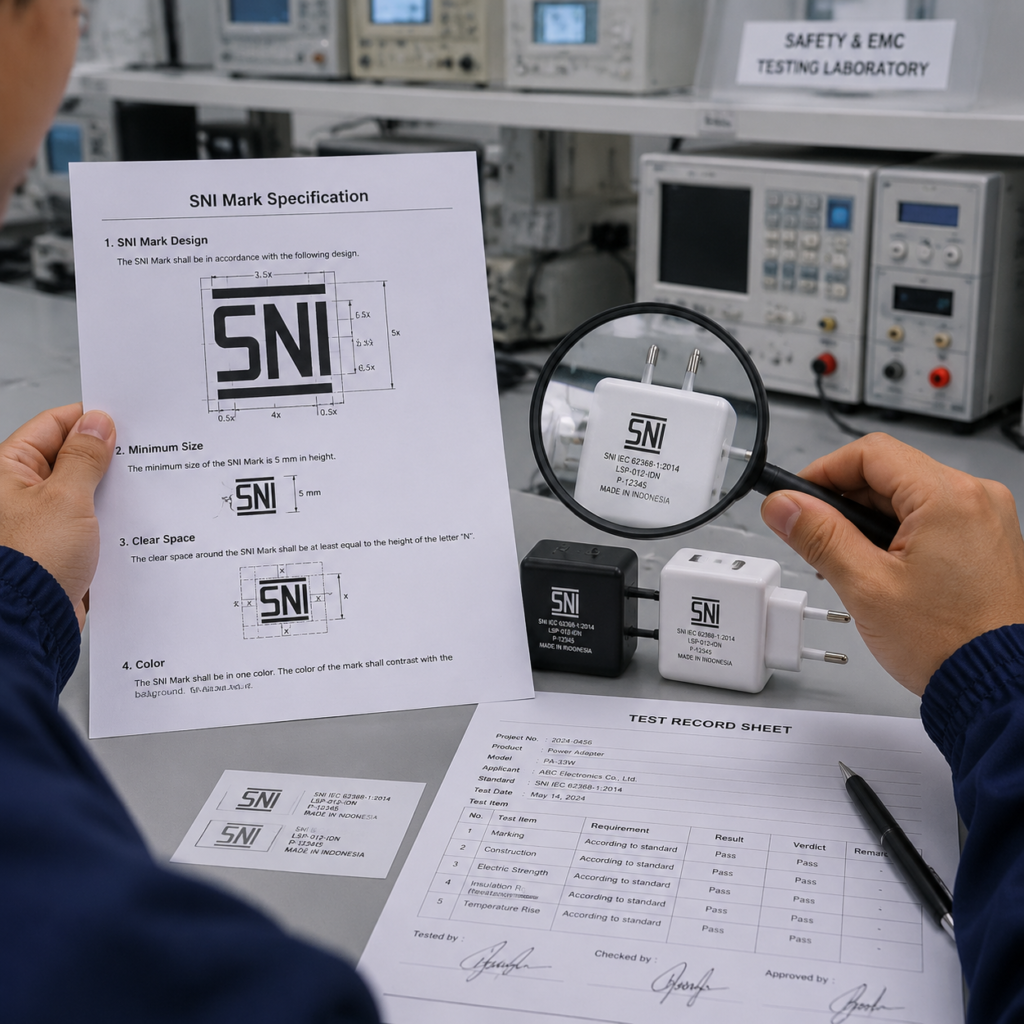
The SNI mark specified in the current BSN regulations shall be used, and the graphics, proportions, or colors shall not be changed without authorization. Whether it is necessary to add the certification body code, license number, standard number, or other identification information shall be implemented in accordance with BSN regulations, mandatory regulations of the competent authority, and specific certification schemes.
Therefore, the mark composition of all products cannot be simply summarized as “standard SNI graphic plus LSPro body code”. Different products, regulations, and certification systems may have different requirements for additional information. The mark must be clear and distinguishable, and shall not be misleading through deformation, color change, or improper combination.
Content Requirements
The brand, model, certificate holder, manufacturing factory, and rated parameters that are required by law to be marked on the product, packaging, and accompanying documents must be consistent with the certification document and license scope.
However, not all of this information is written on the SNI graphic itself. Whether other information needs to be marked next to the SNI mark shall be implemented in accordance with specific regulations and approved marking schemes. The most critical point is that the coverage relationship between the physical product, packaging, certification documents, and mark license must match each other, and there shall be no situation where the brand, model, factory, or parameters exceed the certification scope.
Posting Carrier and Size
Which carrier the mark should be used on, what size it should be, and whether the use of packaging or accompanying documents is allowed shall be subject to specific mandatory technical regulations, current BSN rules, and certification schemes. Requirements may vary for different products. “Must be pasted on the product body” cannot be used as a unified rule for all charging products, nor can it be decided independently to only paste on the outer packaging or arbitrarily reduce the mark size.
For products with small volume, special structure, or unsuitable for direct marking, specific regulations and approval schemes shall be checked in advance to confirm whether packaging, accompanying documents, or other specified carriers can be used. Judgment cannot be made solely based on experience.
Printing and Durability Requirements
Marking methods that meet the requirements of applicable regulations and approval schemes shall be adopted to ensure that the mark is clear, durable, not easy to fall off or blur, and cannot be covered by other marks.
The specific process to be used, such as silk screen printing, laser engraving, self-adhesive, or other processes, shall be determined based on product regulations, certification test requirements, and approved label schemes. Regulations may not uniformly restrict a certain process, nor can a certain material be absolutely excluded or designated without basis.
Approval and Version Management
The prerequisite for using the SNI mark is that the product has obtained applicable certification documents, and the mark use method complies with BSN regulations, competent authority regulations, and relevant licenses or certification schemes. Obtaining certification documents does not mean that the mark can be printed independently without complying with the license and approval scheme.
Whether labels, nameplates, and packaging drafts need to be reviewed separately depends on the product, the system of the competent authority, and the certification scheme. Enterprises shall verify the applicable mark use license, approval documents, and certification attachments, and establish label version management to avoid continuing to use old versions after certificate renewal, brand change, or model change.
Special Rules for Scenarios: Special Requirements for Different Situations
In addition to general mark design and use requirements, different sales and production scenarios also have different verification focuses.
Import and Sales Scenarios
• For commercial bulk import, including local warehouse delivery and commercial direct mail, it shall be verified whether the product falls within the mandatory scope, and whether the certification, mark, import license, NPB, or other documents comply with applicable regulations.
• Import for personal use may be subject to specific customs or import facilitation policies, but it cannot be generally concluded that SNI or other product regulatory requirements are exempted. Whether there are exceptions shall be judged in combination with the product category, quantity, value, import method, and purpose.
• The SNI mark, certification information, and product description on e-commerce platforms shall be consistent with the physical product, packaging, and certification documents. Information on the detail page cannot of course replace the physical or packaging marking required by regulations.
Charging Sets/Combined Products
When a set contains multiple products, the coverage and marking requirements of certification documents and specific regulations for each component, combined product, and outer packaging shall be verified.
Only components that are individually included in the mandatory scope and require separate marking need to use the mark in accordance with corresponding regulations. In some cases, certification documents may cover combined products, or allow relevant information to be marked on the packaging. The conclusion that “each component must be labeled separately” cannot be drawn directly based solely on the number of components.
Non-mandatory accessories, such as passive data cables, shall not be printed with the SNI mark in an unauthorized manner to avoid misleading consumers into thinking that the accessory has obtained certification.
OEM/ODM/Multi-brand Sales
• Certification documents shall cover the actually sold brand, manufacturing factory, product model, and key parameters.
• After changes in the brand, foundry, model, certificate holder, or core parameters, the certificate coverage shall be reconfirmed.
• It is not allowed to copy the SNI mark, license information, and certification materials of other brands or models, nor can foundry documents be used to directly prove that products of another brand are compliant.
Sample/Exhibition/R&D Scenarios
Products that have not obtained applicable certification and mark use license shall not use the SNI mark in a way that implies they have obtained SNI certification or can be sold normally.
Whether a certain mark is allowed for samples, exhibition displays, and R&D displays, and what text or form should be used, must be based on current regulations, or obtain written confirmation from the competent authority, BSN, or certification body. Adding words such as “sample/not for sale” on your own does not of course mean that the official SNI mark can be used.
Full Process of Certification Implementation: Get Compliance Done from 0 to 1
To handle SNI marking compliance from 0 to 1, it is usually necessary to first judge the mandatory attribute, and then confirm the certification and mark use requirements. The specific process may vary for different products, but it can be promoted according to the following ideas.
Division of Enterprise Responsibilities
It cannot be simply assumed that the importer is the primary responsible entity under all systems. The responsibilities of the applicant, certificate holder, manufacturer, importer, and local responsible entity shall be confirmed based on specific mandatory regulations, certification schemes, and import systems.
The actual import and sales entity shall also ensure that the product, certification documents, mark use scope, and import materials match each other, and confirm whether they are the applicant, certificate holder, or authorized entity required by regulations.
Five Steps for Certification Implementation
Step 1: Conduct mandatory attribute verification for a single product model, using the six-dimensional verification method introduced earlier, to confirm whether it falls within the mandatory scope.
Step 2: Select a KAN-accredited LSPro that meets the requirements of the applicable system, and confirm the applicable standards, certification mode, and required documents.
Step 3: Submit technical documents, send samples for testing, and cooperate with factory, production process, or document audits in accordance with the specific certification scheme.
Step 4: Obtain applicable certification documents, and confirm the use license, marking content, and applicable carrier of the SNI mark in accordance with BSN regulations, competent authority regulations, and certification schemes.
Step 5: Produce and use the mark in accordance with the confirmed marking scheme, continue to accept market supervision after the product is launched, and conduct timely re-verification when the certificate, regulations, or product changes.
Relationship Between Common Compliance Documents
When faced with a pile of documents, you can first divide them into two categories.
The first category is the basic documents that usually need to be verified for mandatory products:
• Mandatory Technical Regulations: the core basis for judging whether a product falls within the mandatory scope.
• SNI National Standard: the technical standard on which product testing and certification are based.
• Applicable Certification Documents: under the specific mandatory certification system, the corresponding documents issued by LSPro in accordance with the certification scheme; SPPT-SNI was common historically, but it cannot be assumed that all product systems use the same name or the same form.
• SNI Mark Use License or Related Approval Documents: confirm how and within what scope the mark is used.
The second category is scenario-specific or product-specific documents that are only needed in specific situations:
• Import License, Product Registration, or NPB: whether it is required depends on the specific product, Ministry of Trade regulations, and import circulation mode.
• Factory Audit Report: required for some certification modes.
• Other Compliance Documents: for example, products with regulated wireless communication or transmission functions may also need to meet the requirements of communication equipment such as SDPPI.
Special reminder: you cannot judge the compliance of the whole process based solely on a single certificate. You must check whether the certification documents, mark license, import documents, product information, and sales entity are complete and valid.
Can the Original Mark Still Be Used After Product Changes?
After a product is modified, whether the original SNI mark can continue to be used cannot be directly judged by a fixed list. Any change in design, key components, rated parameters, model, brand, certificate holder, production location, or production process shall be submitted for change evaluation in accordance with the specific certification scheme.
LSPro will judge the subsequent handling method based on applicable regulations, product standards, and certification schemes, which may involve filing, supplementary testing, certificate extension, or re-certification. Whether PCB layout, factory address, and key components constitute major changes also depends on their actual impact on safety performance and standard compliance, and cannot be uniformly categorized in advance.
The final decision shall be subject to the official written conclusion made by LSPro in accordance with applicable regulations. When the certificate expires, is suspended, or revoked, it shall also be handled in accordance with the regulations of the competent authority, certification scheme, and written notice. Do not continue to produce or import marked products that exceed the valid certification scope.
Model families also cannot share marks at will. Only when the certification document clearly covers the relevant models, and the product structure, parameters, and safety principles meet the requirements of the specific scheme, can the mark be used within the approved scope.
Common Misconceptions and Violation Risks
After talking about the formal process, let’s remind you of several common misconceptions in SNI compliance.
6 High-Frequency Cognitive Misconceptions
1. Certifications such as CE/FCC can replace SNI: usually not. For products included in the scope by the mandatory technical regulations of the Indonesian competent authority, overseas conformity assessments such as CE and FCC usually cannot replace the SNI certification or other requirements required by specific Indonesian regulations. However, SNI standards and certification are not mandatory for all products. Whether they must be obtained requires first checking the corresponding mandatory technical regulations for the product.
2. All charging cables or car chargers do not need to use SNI: wrong. It needs to be comprehensively judged in combination with product definition, parameters, structure, purpose, and other regulations. Cables with AC plugs and power conversion functions may fall into regulated categories, but must be confirmed by formal regulations.
3. Printing the mark on the manual or detail page is considered compliant: wrong. Manuals and detail pages cannot of course replace the product, packaging, or other carrier markings required by regulations. The specific implementation shall be in accordance with applicable regulations and approval schemes.
4. Products of the same series can share one SNI number: wrong. Only models, brands, factories, and parameters clearly covered by the certification document may share relevant certification and mark use methods within the approved scope.
5. The SNI mark can replace all Indonesian compliance marks: wrong. SNI only corresponds to applicable standards and regulatory requirements. Products with regulated wireless communication or transmission functions may also need to meet the requirements of communication equipment such as SDPPI.
6. Uncertified samples or pre-sale products can use the SNI mark: cannot be used in a way that implies they are certified or can be sold. The specific marking methods for samples, exhibitions, and R&D scenarios shall be based on current regulations or obtain written confirmation.
What Are the Consequences of Violations?
Violation handling may include ordering rectification, stopping sales, suspending or revoking certificates, product recalls, administrative fines, detention, or refusal of release. Whether it involves return shipment, market access prohibition, or criminal liability shall be judged based on the illegal act, product category, applicable regulations, and the decision of the law enforcement agency. Not all cases will automatically apply the same consequences.
High-Frequency Violation Scenarios That Are Easy to Fall Into
• After certificate renewal or information change, the mark template is not updated in time, and the old version is still used;
• The SNI mark on the e-commerce detail page is inconsistent with the information on the physical product, packaging, or certification documents;
• Using the certification mark of a single-port product on a multi-port product, exceeding the certificate coverage;
• The components or outer packaging of set products are not marked with the required information in accordance with specific regulations and certification schemes;
• The product is not within the mandatory scope but is mistakenly pasted with the SNI mark, or the mark is still used after the certificate is suspended or revoked.
Compliance Self-Inspection Method: You Can Check for Problems by Yourself
Just knowing how to avoid pitfalls is not enough; you also need to conduct regular self-inspections. Compliance is not a one-and-done thing after certification is completed. When products, regulations, certificates, and sales materials change, re-verification is required.
6 Dimensions of Mark Compliance Self-Inspection
1. Regulatory Compliance: the latest regulations and standards have been checked, and the mandatory attribute of the product has been confirmed.
2. Certificate Qualification: the certification document is in a valid state, the applicant or certificate holder meets the requirements, and covers the brand, model, factory, and parameters of the product.
3. Mark Management: the mark use method complies with BSN regulations, competent authority regulations, and approval schemes, and the required licenses or approval documents are complete.
4. Physical Verification: the mark on the product is clear and durable, the carrier and size meet applicable requirements, and the production batch is within the certification coverage.
5. Circulation Compliance: the importer, sales entity, and authorization relationship meet the requirements, and the customs declaration materials match the certification information.
6. Publicity Compliance: the mark information on packaging, detail pages, and advertisements is consistent with the physical product, certification documents, and license scope.
Official Verification Channels
If you want to check information or verify documents, you can focus on:
• BSN Official Website: query SNI national standards, mark graphics, and use rules;
• Official Website of Industry Competent Authorities: query mandatory technical regulations, product scope, and import circulation requirements;
• Issuing LSPro or Related Official Systems: query the validity of certification documents, product coverage, and related status.
If there is still doubt, you should consult a qualified LSPro or local compliance agency, and prioritize obtaining written opinions. For issues such as NPB, import licenses, and personal use imports, it is also necessary to simultaneously check the current regulations of the Indonesian trade competent authority and customs.
Evidence Retention and Version Management
The core evidence that needs to be retained includes:
• Regulatory Category: regulatory screenshots, official links, query date;
• Certification Category: certification documents and attachments, mark use license or related approval documents;
• Product Category: approved label drafts, mass production photos, packaging drafts;
• Change Category: change evaluation records, written opinions from LSPro or competent authorities;
• Import Category: customs documents, import licenses, product registration, or other applicable materials.
At the same time, good version management shall be done: each version of the mark and label shall be set with a unique version number, effective batch, responsible person, and review date to avoid mixing old and new versions.
If there is a compliance dispute, first retain all supporting materials, and prioritize using regulations, certification documents, and official written opinions for explanation. When questioned, first check whether the physical product, packaging, mark, certification documents, and license scheme are consistent; after confirming that there is a problem, relevant use shall be stopped in a timely manner and rectification shall be carried out.
Frequently Asked Questions
Is the SNI mark mandatory for selling chargers in Indonesia?
Not necessarily. Only for products included in the scope by the specific mandatory technical regulations of the Indonesian competent authority may SNI certification or marking become a legal obligation. Whether it needs to be used shall be comprehensively judged in combination with product structure, parameters, purpose, and current regulations.
Do ordinary USB-C charging cables need SNI?
Ordinary passive USB-C cables without AC plugs usually do not fall within the mandatory scope of power converters; if they have built-in active modules, or belong to other mandatory categories, further verification is required.
Can CE/FCC certification replace SNI?
Usually not. For products included in the scope by Indonesian mandatory technical regulations, overseas certifications such as CE and FCC usually cannot directly replace specific SNI certification or other Indonesian compliance requirements. However, SNI is not mandatory for all products, and it is still necessary to first confirm whether the product falls within the mandatory scope.
Can the SNI mark be pasted only on the outer packaging?
This cannot be generalized. The mark carrier, size, position, and whether packaging or accompanying documents can be used shall be subject to specific mandatory technical regulations, BSN regulations, and certification schemes, and cannot be decided independently.
The product model or power has changed, can the original SNI mark still be used?
It is necessary to re-evaluate whether it is still within the coverage of the certification document and mark license. When rated parameters, models, brands, production locations, key components, or designs change, a change evaluation shall be submitted in accordance with the specific certification scheme, and the final decision shall be subject to the official written conclusion.
Do chargers sent to Indonesia for personal use also need SNI?
Import for personal use may be subject to specific customs or import facilitation policies, but it cannot be generally concluded that SNI or other product regulatory requirements are exempted. Confirmation shall be made based on product category, quantity, value, import method, purpose, and whether there are exceptions for personal use.
Summary
To master SNI marking compliance for charging products, the core is three capabilities:
First, the ability to judge whether a product falls within the mandatory scope using dimensions such as product definition, parameters, structure, HS code, mandatory regulations, and import mode, without drawing conclusions based on appearance or a single code.
Second, the ability to complete mark use, carrier selection, and change management in accordance with BSN regulations, competent authority regulations, and specific certification schemes, without confusing certification documents, mark licenses, and product markings.
Third, the ability to complete regulatory queries, certification document verification, self-inspection of physical products and publicity materials, and properly retain evidence to reduce risks in customs clearance, sales, and market supervision.
Indonesia’s SNI-related regulations, standards, and certification schemes are dynamically updated. This article is only for introductory popular science reference and does not constitute legal or compliance advice. Commercial projects shall obtain written confirmation from the Indonesian competent authority, BSN, or a qualified certification body before implementation.