
Anyone engaged in cross-border trade of charging products, or purchasing third-party chargers and charging cables overseas, has most likely seen terms like “IEC standard report” and “CB certification”. Many people assume that with this report, products can be sold directly in countries around the world. As a result, their goods are either detained by customs or removed from sales platforms, causing significant losses.
In fact, the core of the problem is a failure to understand the meaning of “acceptance” — the value of IEC/CB reports is to exempt you from repeated identical safety tests, but it by no means equals direct market access qualification. This article starts from the most basic concepts, and covers up to the point where you can independently verify the validity of reports. It covers common scenarios for all categories of charging products including chargers, charging cables, power banks, wireless chargers, and thoroughly explains the global acceptance rules for IEC test reports.
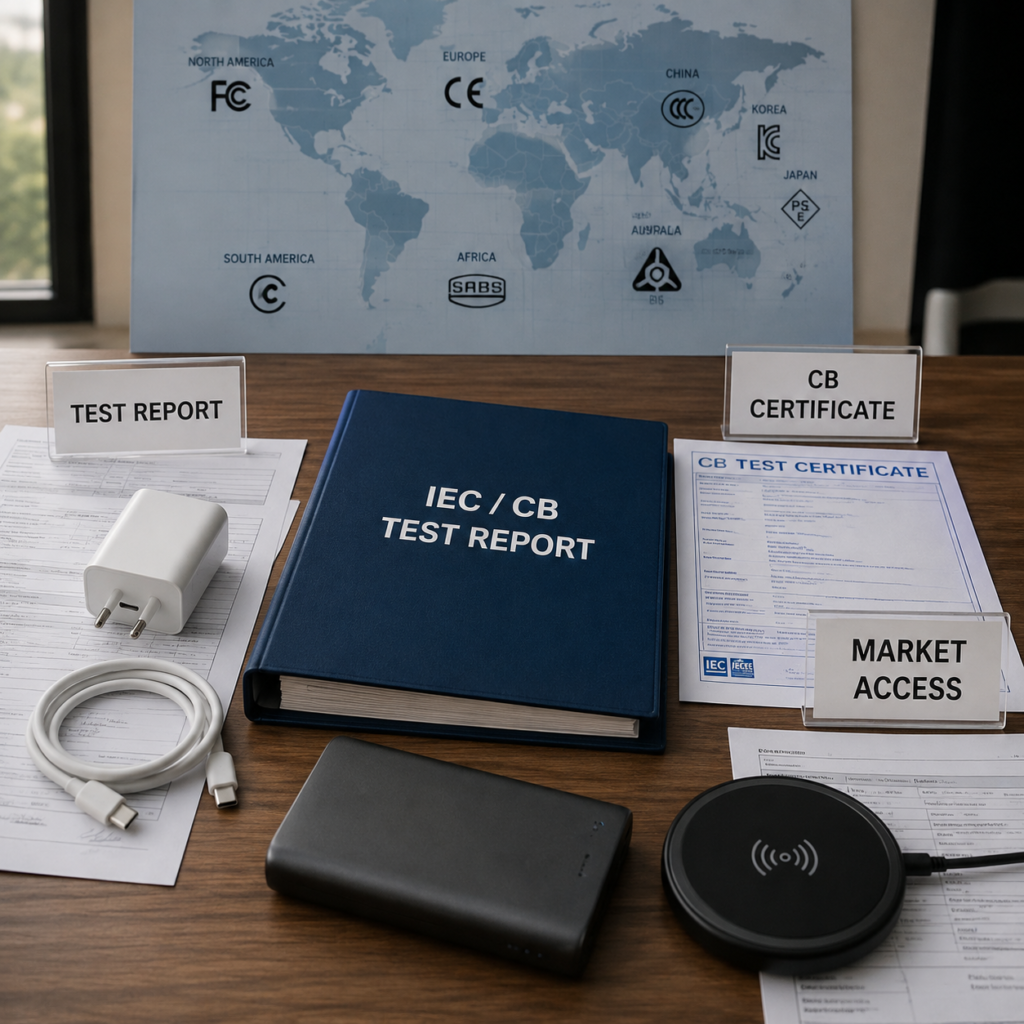
Basic Understanding: Core Concepts and Applicable Boundaries
Let’s first clarify the basic concepts that are most easily confused, so that the subsequent rules can be understood.
First, let’s talk about IEC. Many people think IEC is an institution that issues test reports, but that is not the case — the full name of IEC is the International Electrotechnical Commission, which you can think of as the “safety standard development group” in the global electrical and electronic field. IEC mainly develops international electrotechnical standards; whether each country adopts them, which version to adopt, and whether to add national differences are determined separately by each country’s regulations, standardization bodies, and certification systems. IEC itself does not conduct testing or issue any test reports.
Common documents related to IEC include test reports formed in accordance with IEC standards, IECEE CB Test Reports (CBTR for short), and CB certificates. Among them, only documents that meet the corresponding accreditation or CB system requirements have corresponding external compliance or mutual recognition purposes. Whether a report has the attribute of third-party compliance certification depends on the issuing entity, accreditation scope, and specific system, and cannot be judged solely by the presence of the word “IEC” on the report.
Currently, the charging products we frequently contact, including chargers/power adapters, USB charging cables, power banks, and wireless chargers, may involve corresponding IEC or other product safety standards.
Next, let’s explain what “acceptance” really means — this is the core concept of the entire article, and you must understand it first.
Acceptance means that the regulatory authority or certification body of a country recognizes the test results issued by another institution, and you do not need to repeat the same safety tests within the corresponding scope. It is completely different from “market access” — acceptance only recognizes that your test results can be used as a basis for assessment, not that it directly grants you a sales permit. For example, a CB report is the technical basis for certification in some countries, but having a CB report does not mean you can directly obtain market access marks such as CE, UL, or KC. You still need to meet other requirements of the target market.
For charging products, the value of the CB system is that when the target institution accepts relevant CB documents and no repeated testing is required, it can usually reduce some repeated testing, costs, and cycles. How much can actually be saved depends on the product, the difference requirements of the target country, the scope of documents, and the specific requirements of the certification body.
Many people cannot distinguish between various “IEC reports”. We have sorted out five types of common related documents, so you can understand the differences at a glance:
| Document Type | Issuing Entity | Core Function | Cross-border Mutual Recognition / Certification Conversion Eligibility |
|---|---|---|---|
| Factory self-test report | Issued by the manufacturer itself | Internal quality control | None; cannot be used as external compliance certification |
| Ordinary third-party IEC report | Third-party laboratories without mutual recognition qualifications, testing in accordance with IEC standards | Commercial technical reference | None; cannot be used for cross-border mutual recognition or certification conversion |
| IEC report from ILAC-MRA accredited laboratory | Laboratories with mutual recognition qualifications from the International Laboratory Accreditation Cooperation (ILAC) | Auxiliary reference for regulatory authorities in some countries | None; cannot replace CB qualifications for certification conversion |
| IECEE CB Test Report (CBTR) | Issued by CBTL laboratories accredited by the CB system | Records complete test data and results, serves as the technical basis for mutual recognition | Other NCBs may assess and accept within the corresponding scope in accordance with CB system rules and national requirements, but this does not represent automatic, unconditional certification conversion |
| CB Certificate | Issued by the National Certification Body (NCB) of the CB system | Certifies that test results meet CB system requirements | Used together with the CB report for cross-border certification conversion; cannot replace target country certification |
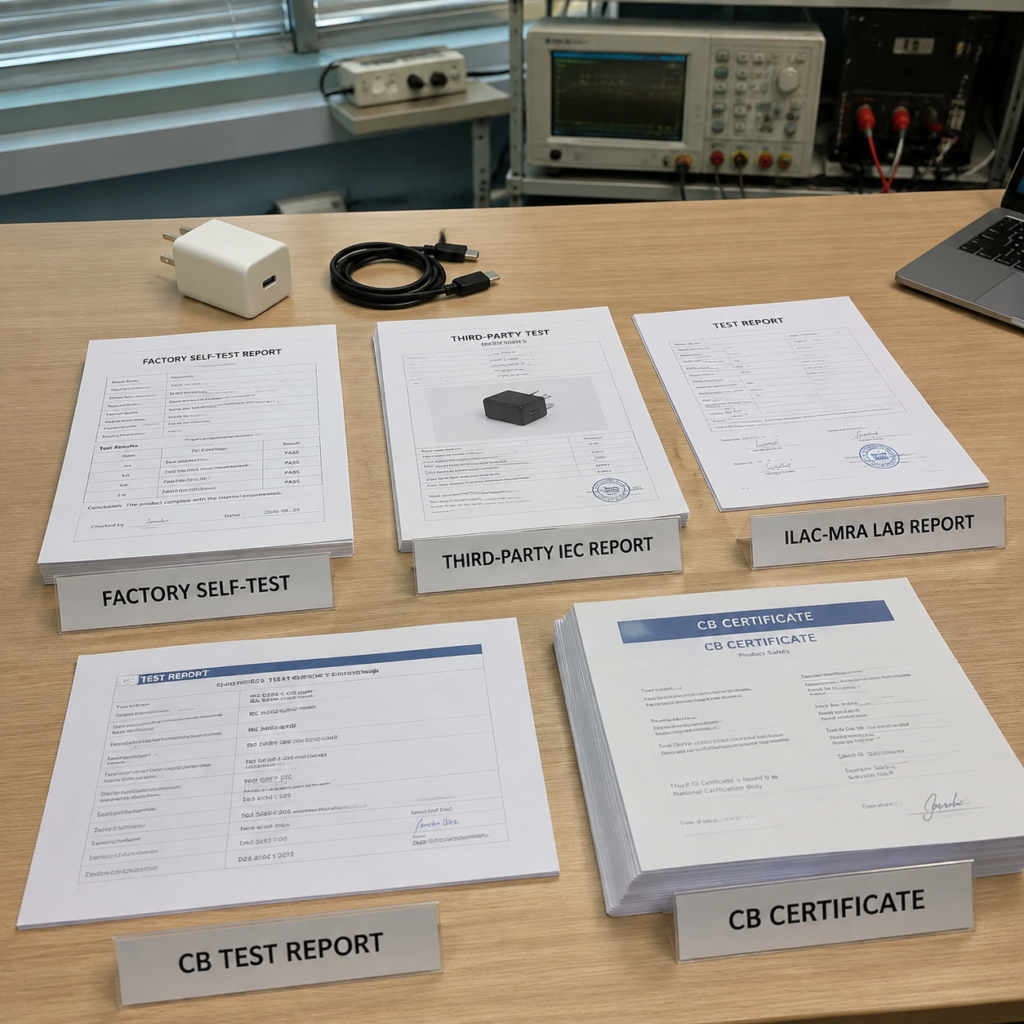
Here we need to specifically explain the difference between ILAC-MRA and CB qualifications: ILAC-MRA is the mutual recognition of the overall testing capabilities of laboratories, which is equivalent to proving that “this laboratory has corresponding testing capabilities”; while CB qualification is specifically for the IECEE mutual recognition system. Only laboratories with CBTL qualifications and whose testing scope covers relevant products and standards can issue reports that may be used for the CB mutual recognition certification conversion process. The two cannot be confused.
The entire IEC-related mutual recognition system can be understood in four layers, with clear powers and responsibilities from top to bottom:
The top layer is the standard layer: IEC formulates international electrotechnical product standards, which is equivalent to a unified “examination syllabus”, but whether and how each country adopts them is still determined by its own regulations and certification systems.
The second layer is the mutual recognition system layer: IECEE, under IEC, operates the CB mutual recognition system and formulates corresponding mutual recognition rules, which is equivalent to a “global examination result mutual recognition alliance”.
The third layer is the implementation layer: CB Testing Laboratories (CBTL for short) accredited by the CB system are responsible for conducting tests and issuing CB test reports; NCBs are responsible for nominating or managing relevant laboratories in the IECEE system. CBTLs must pass corresponding assessments in accordance with IECEE rules and conduct CB tests within the approved specific standard scope. NCBs are also responsible for issuing CB certificates.
The bottom layer is the market layer: the target market may require the CE conformity mark, the certification mark of U.S. NRTL institutions, the Korean KC mark, etc.; CB documents can sometimes be used as technical data or basis for corresponding assessments, but cannot replace the requirements of respective systems.
One more point to add here: U.S. NRTL is a category of laboratories or certification pathway recognized by the U.S. Occupational Safety and Health Administration (OSHA), not a market access mark; UL and ETL are certification marks of specific institutions.
At this point, we must first clarify the most common misconception: Having an IEC/CB report does not mean you can sell directly around the world. Acceptance only recognizes the validity of test results, not market access permission. This point must be kept in mind, and all subsequent rules revolve around this core.
Operating Logic of the IECEE CB System
To understand the acceptance rules, you must first understand how the CB system that supports these rules operates, what it can do, and what it cannot do.
The core function of the CB system is to avoid repeated identical safety tests for the same product in different countries, and reduce barriers to international trade. But its boundaries are also clear: it is only a test result mutual recognition system, not a globally unified market access system, and it only covers recognized standards and product categories within CB system member states. It is not applicable to all countries and all products.
There are three key roles in the CB system, with clearly divided powers and responsibilities. Don’t confuse them:
The first is the National Certification Body (NCB): each CB member state has a corresponding NCB. It is a certification body within the system, responsible for issuing CB certificates within the specified scope, and also participating in the nomination or management of relevant laboratories. For example, China has a corresponding NCB, and the United States also has multiple accredited NCB institutions. The specific list shall be subject to the official IECEE directory.
The second is the CB Testing Laboratory (CBTL): CBTLs must accept corresponding assessments in accordance with IECEE rules, conduct CB tests within the approved standard scope, and issue CB test reports. It is not granted a globally applicable, unlimited scope qualification by a certain NCB; instead, both its qualification and scope are managed by the IECEE system.
The third is the applicant/manufacturer: that is, the party applying for testing, who must ensure that the samples submitted for testing are consistent with the subsequently mass-produced products, and is the primary responsible party for product compliance — even if the report is genuine, if the mass-produced goods are different from the samples, the responsibility still lies with the manufacturer.
Next is what everyone is most concerned about: what are the corresponding CB test standards for different types of charging products, and which items are most likely to be missed? Whether these items must be tested shall be judged in combination with the product structure, applicable standards, certification scheme, and target market requirements. A single item cannot be generally regarded as a mandatory CB test item for all products.
First, for chargers/power adapters, including the common multi-port PD fast chargers nowadays, independent information technology equipment power supplies shall usually be checked against IEC 62368-1; if it is a charger for special scenarios, such as those matched with home appliances, it may involve IEC 61558 or IEC 60335 series standards. If the report adopts the IEC 60335 series, it shall be further confirmed whether the product belongs to household or similar-purpose appliances, as well as the corresponding specific standard. It shall not be directly judged solely by the name of the standard series.
For such products, items such as multi-port output, abnormal operation, and temperature rise shall be verified according to the product structure, applicable standards, and requirements of the target institution. USB-PD consistency or interoperability usually needs to be separately evaluated in accordance with USB-IF or special requirements of the target market, and cannot be proven solely by an IEC 62368-1 report. That is to say, IEC 62368-1 safety testing is not the same type of requirement as USB Power Delivery protocol consistency and interoperability testing.
Then there are USB charging cables. There is no single “IEC complete product standard” applicable to all charging cables. They shall select applicable cable and connector standards according to their own structure, rated voltage and current, connectors, and usage, and evaluate USB specifications or USB-IF certification according to target market requirements. Compliance cannot be judged solely by the words IEC 62368-1 or USB-IF.
Key verification points for charging cables may include temperature rise under high current, insulation and flame retardant performance, parameter consistency of E-Marker chips, bending resistance, etc., but the specific test items shall be subject to applicable standards and requirements of the target institution. Especially for high-power USB-C cables, you cannot only look at the rated power publicity, but also confirm whether the actual parameters of the wire, connectors, and electronic marker chips match.
Next are power banks: usually, both the complete product safety and the safety of the built-in cells/battery packs need to be evaluated. Whether IEC 62133-2 is applicable, and whether it shall be proved in the form of an independent report, integrated report, or other forms, shall be confirmed according to the target market and certification body requirements. The evaluation of power banks usually focuses on battery management, overcharge and overdischarge protection, short circuit protection, enclosure and capacity labeling, etc., but these items are not regarded as mandatory CB test items in all markets in exactly the same way.
Here is a special reminder: UN 38.3 is a test requirement for lithium battery transportation safety, which only involves the transportation link and cannot replace the product safety certification required for market sales.
Finally, wireless chargers. Wireless chargers shall be evaluated separately for electrical safety, EMC, electromagnetic field exposure, and radio regulations applicable when they have radio communication functions. Whether IEC 62368-1 is adopted for electrical safety shall be confirmed in combination with product functions and applicable standards. Whether FOD (Foreign Object Detection), wireless power transmission efficiency, Qi or other protocol consistency need to be tested shall also be verified according to the wireless charging specification adopted by the product, certification scheme, and target market requirements. It cannot be asserted that all countries will reject products without FOD testing.
Many people think that CB reports test everything, but that is not the case. Its testing scope has clear boundaries.
Standard CB safety reports mainly prove applicable electrical safety requirements, such as electric shock protection, flame retardancy, temperature rise, insulation strength, abnormal state testing, etc. Whether EMC, energy efficiency, RoHS, radio, transportation, and local labeling need to be separately proved shall be verified according to target market regulations and the specific report scope. Some products or separately applied schemes may include independent EMC or other special documents, but CB safety reports cannot be equated with complete EMC compliance documents.
There are also many items that usually require separate compliance or preparation of other evidence, such as complete EMC testing, energy efficiency, environmental protection requirements, radio requirements, battery transportation safety, local plug specifications, and local labeling requirements. Whether testing is required and who issues the certificate shall ultimately be subject to the regulations of the target market and the requirements of the certification body.
Finally, let’s talk about the relationship between the CB test report and the CB certificate. Many people think you must have both, but that is not the case:
The CB Test Report (CBTR) is a technical document of tens to hundreds of pages, which records test items, data, results, sample information, key component lists, and applicable national differences, equivalent to the answer sheet and detailed transcript of the exam.
The CB certificate is a certification document issued by the NCB, stating that the relevant test results have been evaluated in accordance with CB system requirements, and is an important document for subsequent certification conversion or application for local certification.
In actual use, you do not need to submit both documents in all scenarios, subject to the requirements of the target market or certification body: some institutions will focus on reviewing the CB report, while others require both the report and the certificate to be provided. Even if both documents are submitted, the target NCB or certification body may still continue to review the standard version, national differences, product consistency, factory and national regulatory requirements, and require supplementary testing or supplementary documents.
5 Core Prerequisites for IEC/CB Report Acceptance
Now that you know how the system operates, the next most critical question is: what conditions must an IEC/CB report meet to be accepted by the target market? There are 5 core prerequisites, and missing any one may affect the result.
Prerequisite 1: The issuing entity holds the corresponding CB qualification
First, the laboratory conducting the test must be a CBTL under the IECEE system, and its approved scope must cover the standard corresponding to your product. For example, if a laboratory’s approved scope only covers a certain type of charger, you cannot infer that all charging cable reports it issues have CB mutual recognition qualifications solely based on its CBTL status.
Second, the NCB issuing the CB certificate must be an institution accredited by the CB system, and whether the certification body of the target market accepts this NCB shall also be confirmed in combination with the specific system.
Here is a special reminder: when verifying qualifications, you must never only look at the CB mark or ILAC mark on the cover of the report. You must verify the information of CBTL, NCB and CB certificates through the public IECEE database. Whether the CBTR itself can be publicly queried by report number shall be subject to the verification channel provided by the relevant NCB or laboratory. Many fake reports or reports issued beyond the scope may have the CB mark printed on the cover, and problems will only be found when checking the specific qualification scope.
Emphasize again: ILAC-MRA is only the mutual recognition of laboratory capabilities and cannot replace CBTL qualifications. Having an ILAC mark does not mean that the laboratory can issue reports that can be used for CB mutual recognition.
Prerequisite 2: The version of the test standard meets the requirements of the target market
IEC standards are updated regularly, and different countries adopt new versions at different times, with possible transition periods in between. For example, there are different versions of IEC 62368-1. Some countries or certification bodies may have adopted a newer version, while others are still in the transition period. Whether the old version can continue to be used depends on the current rules of the target market.
Therefore, when checking, be sure to compare the standard number and version number marked on the report with the official announcement of the target country to confirm that the version is within the validity period. Also note that protocol specifications such as USB-C/PD and wireless charging are independent of IEC safety standards, and the testing situation needs to be checked separately. You cannot only look at the version of the IEC standard.
Prerequisite 3: The product is within the explicitly stated coverage scope of the report
When you get the report, first look at the “coverage scope” page, and check whether the brand, model series, manufacturing location, and key components are all within the scope.
It is not that only exactly the same model can be used. Different power levels in the same series, multiple production factories, and approved key component variants may be applicable as long as they are clearly listed in the report or supplementary documents and comply with the change rules of the target institution. But you must never apply this report to uncovered models or components — for example, if the report only lists a 65W single-port charger, and you use it for a 100W dual-port product, you cannot consider that both are covered by the same report.
Prerequisite 4: Test items cover the basic safety requirements of the target market
In addition to general IEC standard tests, CB reports can also include additional tests for “national differences” of different countries — that is, the local special safety requirements added by each country on the basis of IEC standards.
You should first check the national differences section in the report to see if it covers the requirements of the target country; for the remaining local requirements that are not within the scope of safety testing, such as applicable plug, socket and power cord requirements of the target sales country, label language, voltage and frequency adaptation, EMC, energy efficiency, etc., separate supplementary certification documents are required. In short: safety items covered by CB can reduce repeated testing, but uncovered local requirements still need to be supplemented.
Prerequisite 5: Document status meets verification requirements
When verifying acceptance, you don’t just look at the report and certificate. You also need to prepare supplementary documents, such as national difference reports, key component lists, and change assessment documents.
The validity of reports and certificates is affected by many factors: for example, the end of the standard transition period, product changes that have not been reported, and the revocation of the NCB’s certificate will all affect the use of the documents. Note here: IEC/CB reports do not have a globally unified validity period. You cannot assume that it is globally valid just because the report says “valid for 5 years”. It must be verified in multiple dimensions combined with the target country’s standard transition period, product changes, and certificate status.
Acceptance Rules for Charging Products in Major Global Markets
Knowing the general prerequisites is not enough. The specific acceptance rules vary greatly between different countries and regions. We have sorted out the rules for major global charging product markets, and you can quickly check according to this framework. Ultimately, it must be subject to the latest official announcements.
First, let’s talk about the general verification framework: no matter which market, check from these dimensions — what is the local mandatory access system, what role can the CB report play, which tests can be reduced, what content needs to be supplemented, and where is the official query entry. All rules shall be subject to current regulations, transition periods, and written requirements of certification bodies. Don’t trust unofficial hearsay.
European Union and European Economic Area (EEA)
The mandatory system of the EU is the CE conformity declaration system, which involves multiple regulations such as Low Voltage Directive (LVD), Electromagnetic Compatibility (EMC), Restriction of Hazardous Substances (RoHS), Radio Equipment Directive (RED), and energy efficiency.
CB reports can be used as technical support for safety compliance under the LVD directive, but they are not automatically accepted by the authorities — you have to prove that the content of the report meets the requirements of the applicable harmonized standards in the EU.
In terms of certification requirements, the LVD directive usually does not require third-party institutions to issue certificates, and manufacturers can sign the Declaration of Conformity (DoC) on their own. Products with wireless functions are subject to RED; if applicable harmonized standards are not used or do not fully cover relevant requirements, manufacturers may need notified bodies to participate in the corresponding conformity assessment procedures. Not all wireless products will automatically require the intervention of a notified body.
Content that needs to be supplemented includes: differences in EU harmonized standards, applicable plug, socket and power cord requirements of the target sales country, multilingual labels, RoHS compliance certificates, EMC test reports, energy efficiency reports, etc.
It should be noted that there is no unified household plug system applicable to all member states in the EU. Different countries use different plug and socket systems, and products shall be configured with corresponding plugs or acceptable conversion solutions according to the sales country.
The official query entry is the harmonized standards database of the EU OJEU (Official Journal of the European Union), as well as the official websites of regulatory authorities of each member state.
United States and Canada
United States
The United States does not have a unified mandatory third-party safety certification at the federal level. NRTL (Nationally Recognized Testing Laboratory) certification is triggered by usage scenarios, local electrical codes, or sales channel requirements — for example, many offline malls, workplaces, and sales channels require charging products to have NRTL institution certification. In addition, there are FCC EMC requirements and DOE energy efficiency requirements.
The role of the CB report is that it can be used as technical data for NRTL assessment, helping certification bodies determine whether repeated safety tests can be reduced. However, whether it is accepted and how to use it depends on the specific NRTL and product scheme.
Content that needs to be supplemented includes: 120V voltage adaptation, U.S.-standard plugs, EMC test reports, energy efficiency reports.
The official query entries are the NRTL directory of OSHA (Occupational Safety and Health Administration), the official website of FCC, and the DOE energy efficiency database.
Canada
Canada’s mandatory system is certification by institutions accredited by the SCC (Standards Council of Canada), which is enforced by provincial electrical codes and local AHJs (Authorities Having Jurisdiction).
CB reports can be used as the technical basis for Canadian certification bodies such as CSA, helping them assess and decide whether to reduce corresponding safety tests, but they do not equal automatic acquisition of Canadian certification.
Content that needs to be supplemented includes: Canadian-standard plugs, voltage adaptation, EMC, energy efficiency.
The official query entry is the SCC’s accredited institution directory.
Developed Asia-Pacific Regions (Japan, South Korea, Australia, New Zealand)
Japan
Japan’s mandatory system is PSE certification, which is divided into two categories: “specified electrical appliances and materials” and “non-specified electrical appliances and materials”.
Operators of relevant electrical appliances and materials must complete corresponding obligations such as business notification, conformity inspection, labeling, and record keeping in accordance with the PSE system; specific requirements depend on whether the product belongs to specified or non-specified electrical appliances and materials. Specified electrical appliances and materials may also involve requirements such as conformity inspection by registered inspection institutions. It cannot be generally understood that all importers only need to file for the record.
CB reports can be used as the technical basis for PSE certification. Whether corresponding tests can be reduced shall be judged by the relevant Japanese system and certification body according to the specific product.
Content that needs to be supplemented includes: 100V voltage adaptation, Japanese-standard plugs, Japanese labels, EMC, etc.
The official query entries are the official website of METI (Ministry of Economy, Trade and Industry of Japan) and the official website of the Japan Electrical Safety & Environment Technology Laboratories.
South Korea
South Korea’s mandatory system is the KC certification system, which is divided into three categories: safety certification, safety confirmation, and supplier’s declaration of conformity. Different categories of products have different requirements.
CB reports can be used as the technical basis for KC safety certification. Whether tests can be reduced shall be confirmed in combination with the product category, report scope, and requirements of the Korean certification body.
Content that needs to be supplemented includes: Korean-standard plugs, Korean labels, EMC, energy efficiency, etc.
Official regulations and KC system information shall be subject to official channels such as the Ministry of Trade, Industry and Energy of Korea, KATS (Korean Agency for Technology and Standards), and Safety Korea; KTC is mainly a testing and certification institution, not equivalent to the Korean standard regulatory authority.
Australia / New Zealand
Australia and New Zealand apply systems such as electrical safety, EMC, and energy efficiency respectively; RCM (Regulatory Compliance Mark) is the relevant compliance mark.
Some electrical equipment in Australia needs to complete registration or other obligations according to the EESS level, and EMC equipment also involves ACMA supplier registration; New Zealand does not replace its own requirements with Australian EESS registration. Specific obligations depend on the product category and sales location. It cannot be simply summarized that all products must first complete registration in EESS before they can be sold in Australia and New Zealand.
CB reports can be used as technical support for safety compliance, but corresponding documents and registration procedures still need to be supplemented according to local regulations.
Content that needs to be supplemented includes: Australian-standard plugs, labels, EMC, energy efficiency, local responsible supplier registration, and other local obligations.
The official query entries are official channels such as Australia’s EESS, ACMA, and New Zealand’s WorkSafe.
Emerging Markets (Southeast Asia / Middle East / South America / Africa)
The general characteristic of these regions is that the rules of each country vary greatly, there is no unified regional acceptance rule, and even the requirements of the same country may change in different periods.
Take several representative countries as examples: Thailand’s TISI (Thai Industrial Standards Institute) certification may accept CB conversion, but still needs to supplement local plugs and labels; Saudi Arabia’s SASO IECEE recognition system may require the use of CB reports and CB certificates to convert to local certification, and supplement energy efficiency and labels; Brazil’s INMETRO (National Institute of Metrology, Quality and Technology) certification recognizes CB within the scope of some products, but may still require supplementary local plugs and voltage adaptation.
To verify the rules of such markets, you must check the official requirements of the target country one by one. The first step is to confirm whether it is a member of the CB system, and then check the specific acceptance rules. Even if it is a member of the CB system, it does not mean that all products, standards, and reports will be automatically accepted.
For your convenience, you can make a general acceptance judgment matrix yourself, sorted by the dimensions of “target market, product type, mandatory system, CB reducible items, items to be supplemented, official entry, responsible subject”. Every time you make a new product or enter a new market, you can directly match the corresponding items to quickly sort out the compliance path. We take a USB-C PD charger as an example and make a simplified example:
| Target Market | Mandatory System | CB Reducible Items | Items to Be Supplemented | Official Query Entry |
|---|---|---|---|---|
| EU/EEA | CE conformity declaration (LVD/EMC/RoHS, etc.) | Basic safety tests under the LVD directive | Differences in EU harmonized standards, applicable plug and power cord requirements of the target sales country, labels, EMC, RoHS, energy efficiency | OJEU harmonized standards database, official websites of member state regulatory authorities |
| United States | NRTL certification (triggered by scenario) + FCC/DOE requirements | Basic safety tests for NRTL assessment | 120V voltage adaptation, U.S.-standard plugs, EMC, energy efficiency | OSHA NRTL directory, FCC official website, DOE energy efficiency database |
| Japan | PSE certification and corresponding business notification obligations | Corresponding safety tests for PSE | 100V voltage adaptation, Japanese-standard plugs, labels, EMC | METI official website, Japan Electrical Safety & Environment Technology Laboratories official website |
| Australia / New Zealand | RCM and local safety, EMC, energy efficiency requirements | Partial safety tests | Australian-standard plugs, labels, EMC, energy efficiency, responsible supplier registration and other local obligations | EESS, ACMA, New Zealand WorkSafe official website |
This matrix is only a general reference. For different product types, such as charging cables and power banks, the requirements will vary. Be sure to subject to the latest official announcements.
Practical Verification: 6 Steps to Judge the Acceptability of CB Reports
Now that you understand the rules, how do you judge whether a CB report can be used in the target market when you get it? You can follow these 6 steps step by step, even beginners can do it.
Step 1: Confirm that product classification matches applicable standards
First clarify your product type — whether it is a charger, charging cable, power bank, or wireless charger, and correspond to its applicable standards. For example, if you sell a 65W PD fast charger, independent information technology equipment power supplies shall usually be checked against IEC 62368-1; if the report adopts the IEC 60335 series, it shall be further confirmed whether the product belongs to household or similar-purpose appliances, as well as the specific applicable standard. It shall not be directly judged solely by the name of the standard series.
If it is a charging cable, check whether the report covers cable and connector standards that match its structure, rated voltage and current, connectors, and usage, and evaluate USB specifications or USB-IF certification according to target market requirements. You cannot default to validity just because there are words “IEC” or “USB-IF”.
Step 2: Confirm that the standard version meets the target market requirements
Find the “test basis” section in the report, and clearly see the standard number and version number, for example, whether it is IEC 62368-1:2018 (2nd edition) or IEC 62368-1:2023 (3rd edition). Then check the official announcement of the target country to confirm that this version is recognized within the current transition period.
If your product has PD fast charging or wireless charging functions, you also need to separately check whether the corresponding protocol specifications have been tested and whether the version meets the requirements. Protocol consistency or interoperability testing cannot be automatically replaced by IEC safety reports.
Step 3: Verify the validity of CBTL and NCB qualifications
This step is the key to cracking down on fakes, and must not be omitted. Verify the information of CBTL, NCB and CB certificates through the public IECEE database. Focus on confirming two pieces of information: first, whether the CBTL conducting the test has the approved scope covering the corresponding product and standard; second, whether the NCB issuing the certificate is an institution accredited by the CB system, and whether the target market accepts documents issued by this institution.
Whether the CBTR itself can be publicly queried by report number shall be subject to the verification channel provided by the relevant NCB or laboratory.
Never judge validity only by the CB mark or ILAC mark on the cover of the report. Many reports issued beyond the scope, or even fake reports, have complete marks on the cover. They must be verified through official or institutional verification channels.
Step 4: Check the consistency between the product and the report coverage scope (charging-specific items)
This step should be carefully checked in combination with the characteristics of charging products. You can’t just think the model is similar and be done.
First check the basic information: whether the brand, model series, and manufacturing location are all within the coverage scope of the report. Pay special attention to model suffixes — for example, the models are ABC-65 and ABC-65W, which look similar. If the one with the suffix is not listed in the report, it cannot be used directly.
Then check special information by product category:
- Charger: Whether the input voltage range, maximum output power, number and type of interfaces, and supported fast charging protocols are all within the coverage scope of the report. For multi-port chargers, confirm whether multi-port output, abnormal operation, and temperature rise have been evaluated in accordance with applicable standards and certification schemes. USB-PD consistency or interoperability usually needs to be separately evaluated in accordance with USB-IF or special requirements of the target market.
- Charging cable: Whether the rated current, wire core specification, E-Marker parameters, and bending resistance test are consistent with your product. For high-current cables, confirm whether applicable temperature rise assessment has been conducted.
- Power bank: Whether the model and brand of the built-in battery, rated capacity, and complete product output power are consistent with the report. Whether the built-in battery requires IEC 62133-2 testing or other certificates shall be confirmed according to the target market and certification body requirements.
- Wireless charger: Whether the supported wireless charging power, FOD function, wireless power transmission specification, EMC and electromagnetic field exposure assessment scope are consistent with the product. Whether foreign object detection, protocol consistency, etc. are mandatory items shall be judged according to the specifications adopted by the product, certification scheme, and target market requirements.
Step 5: Check the matching degree between test items and target regulations
First look at the national differences section in the report to confirm that the safety difference items required by the target country have been covered. Then check the certification documents for local requirements: for example, whether the plugs, sockets and power cords meet the specifications of the target sales country, whether the language and content of the labels meet the requirements, and whether the voltage and frequency are adapted.
Finally, confirm whether the compliance documents for additional requirements such as EMC, energy efficiency, environmental protection, radio, and electromagnetic field exposure are complete. These contents are usually not separately certified by ordinary CB safety reports. Whether additional testing or other technical documents are required shall be verified according to target market regulations, product functions, and the actual scope of the report.
Step 6: Verify document integrity and form a compliance evidence package
First, gather the necessary documents: complete CB test report (not just the cover, must include test data pages, key component list, national differences section), CB certificate, difference report (if there have been changes), and other supplementary documents required by the target market.
Then verify the status of the documents: whether the product has undergone core changes since the test, whether the status of the CB certificate is normal (whether it has been revoked or suspended), and whether the manufacturing location and key components are still within the approved scope.
Finally, organize all documents, plus your records of querying qualifications and regulations (preferably with the query date), into a complete compliance evidence package and keep it well — whether it is for customs inspection, platform inspection, or customer review, you can produce complete traceable evidence.
After completing these 6 steps, you can basically draw four types of acceptance conclusions:
The first type is directly usable: all prerequisites are met, and the test items fully cover the target market requirements, so it can be directly used for certification or compliance processes.
The second type requires a small number of supplementary documents/tests: qualifications, versions, and product consistency are all fine, but only a small number of local special documents or tests are missing. After supplementation, confirm with the target institution.
The third type requires difference assessment/supplementary testing: the product has minor changes, or some test items are missing. After evaluation by the original laboratory or target institution, the requirements can be met by supplementing a small number of test items.
The fourth type is unacceptable: core prerequisites are not met, such as unqualified qualifications, standard version exceeding the allowed range of the target market, or the product not within the coverage scope. This report cannot be directly used for this market, and the compliance path needs to be re-evaluated.
Acceptance Boundaries and Change Management
Even if the report is valid at the beginning, it is not once and for all — product changes and standard updates may affect the acceptance validity. In this part, we will explain the boundaries of acceptance and how to handle product changes.
First, the acceptance boundaries of different charging products, which many people will confuse:
- Charger/adapter report: Only covers the safety of the charger itself within the report scope, and cannot replace the compliance certification of matching charging cables and plugs — if you sell a charger with a free cable, you cannot use the charger’s report to claim that the cable is also compliant. The cable must have its own applicable standards and compliance certification.
- Charging cable report: Only covers the cable itself, and cannot prove that the matching charger or terminal equipment is compliant.
- Power bank report: Only covers the test scope listed in the report. Untested items, such as radio, EMC, or energy efficiency, need to be separately compliant according to target market requirements.
- Products with wireless and fast charging functions: Electrical safety reports cannot automatically prove that radio, EMC, electromagnetic field exposure, or fast charging protocol compatibility meet the requirements. They need to be evaluated separately according to product functions and target markets.
Next are common scenarios of restricted acceptance and invalidation, divided into two categories:
One category is insufficient coverage, that is, the report itself is genuine and in normal status, but it does not meet the requirements of the target market, so it cannot be directly used for that market. For example, charging cables do not cover applicable high-current temperature rise assessment, the report does not cover the national differences of the target country, and multi-port chargers have not been evaluated for multi-port output performance in accordance with applicable schemes. These all belong to insufficient coverage, and it is possible to pass after supplementary testing of corresponding items.
The other category is serious problems with the status or applicability of the original document, that is, it can no longer be used directly. For example, the standard version has exceeded the transition period of the target country, the core components or design of the product have been changed but no difference assessment has been done, the qualification status of CBTL or NCB has changed, and the CB certificate has been revoked. These situations may cause the original document to be unable to be directly used for the target market. The original NCB, CBTL, or target market certification body shall first conduct status and change assessment, and if necessary, supplement testing or re-apply. It should not be generally concluded that all items must be retested.
If the product has been changed, how to handle it? Here are the general change management rules:
First, which changes need to be evaluated? Any changes involving power, ports, core components, cable parameters, and production factories shall be evaluated. You cannot think it is “almost the same” and directly use the original report.
Second, the evaluation shall be conducted by the original CBTL, original NCB, or the certification body of the target market. Manufacturers or sellers cannot self-determine that the change does not affect compliance.
Finally, the evaluation results may include supplementary documents, supplementary testing of a small number of items, expansion of manufacturing locations, or re-application in case of major changes. Which method needs to be adopted specifically shall be decided by the relevant institution according to the change content and applicable rules.
Let’s take three common change cases of charging products, and you will understand:
First case: A 65W single-port USB-C charger is changed to a 100W dual-port one. This change involves power increase, port addition, and internal circuit adjustment, which is a relatively large change. The handling method is to find the original CBTL to do a difference assessment, check applicable items such as temperature rise, overload, and multi-port output; if the circuit adjustment is too large, it may be necessary to re-conduct a relatively large range of tests.
Second case: A USB-C 100W charging cable changes the supplier of the E-Marker chip, but the chip parameters remain completely unchanged. This change belongs to core component change, but the parameters have not changed. The handling method is to find the original laboratory to do a difference assessment, check the parameters and compatibility of the chip, and then the laboratory decides whether it is necessary to supplement a small number of related test items. It cannot be confirmed by the manufacturer itself.
Third case: The same model of charger adds a new production factory, but the product design, components, and production process are completely unchanged. This change is only the addition of production locations. The handling method is to apply to the original NCB or CBTL for expansion of manufacturing locations. After the original NCB evaluates according to procedures and completes the manufacturing location expansion, factory inspection, or other requirements, it may not be necessary to repeat all type tests; whether supplementary testing or documents are required shall be decided by the original NCB/CBTL.
Common Misconceptions and Pitfall Avoidance Guide
Finally, we have sorted out the four most common misconceptions to help you avoid most common risks.
Misconception 1: A CB certificate equals local market access certification
This is the most common mistake: CB is a proof of the mutual recognition system, not a market access mark, and absolutely cannot replace local certification or conformity declaration. For example: even if your charger has a CB certificate, you cannot sell it directly in the EU. You still need to do the CE conformity declaration, as well as a series of compliance work such as EMC, RoHS, and energy efficiency.
Misconception 2: High-priced, well-known internet-famous products must have compliant IEC/CB reports
Many people think that expensive and best-selling products must be compliant. In fact, there is no inevitable connection between price, popularity and compliance — many internet-famous products have not even done basic safety testing. The way to avoid pitfalls is very simple: don’t listen to the supplier’s verbal statements. Be sure to ask the other party to provide complete reports and certificates, and then check them yourself according to the 6-step verification method we mentioned.
Misconception 3: IEC/CB reports are permanently valid
Many people think that if the report says it is valid for 5 years, it can really be used for 5 years, but that is not the case. Standard updates, product changes, the end of the standard transition period, and abnormal certificate status will all cause the report to be unable to continue to be used in a specific market. The safe judgment method is: before each use, check the official announcement of the target country, the standard transition period, the applicable scope of the product, and the document status, and confirm that there is no problem before using it.
Misconception 4: IEC/CB reports for all charging products can be mutually recognized globally
Not all products can be smoothly mutually recognized, especially products with new functions, such as PD3.1 240W fast charging and new magnetic wireless chargers. The standards and requirements of various countries may be different, and some countries may also put forward additional requirements for specific products. Therefore, no matter what product, it shall be subject to the latest standards and certification rules of the target country.
Official Query Paths and Capability Summary
To verify reports and rules, you must use official channels and do not trust unofficial hearsay. The core official query paths are as follows:
The first is the official IECEE database: this is the most core query channel, which can check the qualifications of CBTL and NCB, CB certificate related information, and the member list of the CB system. Whether the CBTR itself can be publicly queried by report number shall be subject to the verification method provided by the relevant NCB or laboratory.
The second is the official website of the target country’s regulatory or certification body: check local regulations, standard transition periods, and specific certification requirements. These are the most authoritative sources of local rules.
The third is special databases in various regions: such as the EU’s OJEU harmonized standards database, the U.S. OSHA NRTL directory, Canada’s SCC accredited institution directory, Australia’s EESS and ACMA information, New Zealand’s WorkSafe, South Korea’s KATS and Safety Korea and other official channels. These can be used to check more segmented requirements.
When querying, note that it is best to record the query date, because regulations and standards will be updated. If you use it again after a period of time, you need to re-verify. You can’t check once and use it for a lifetime.
After reading this article, you should be able to independently complete these 3 things:
First, you can judge the basic acceptance qualification of an IEC/CB report, and quickly screen from the core dimensions such as the issuing institution and approved scope, standard version, and product coverage scope.
Second, you can judge the acceptance requirements of the target market, distinguish which items can use CB reports to reduce repeated testing, and which need to be separately supplemented.
Third, you can output clear acceptance conclusions, build a basic compliance evidence chain, avoid common misconceptions, and use the 6-step verification method to complete report screening in most scenarios.
The IEC and CB systems are very useful tools in cross-border trade of charging products, which can help you reduce repeated testing, but they are not master keys. The core thing to remember is: Acceptance recognizes test results, not market access. Whether it is product selection, finding suppliers, or doing compliance, verifying step by step according to the rules can help you avoid fewer pitfalls and detours.