
Have you ever had this experience: you buy a 65W PD charger from overseas, or pick a 240W USB-C fast charging cable, and the product detail page marks “IEC 63000 RoHS compliant”, but you stare at this string of characters and have no clue — is it a safety certification? Is it the same thing as the commonly mentioned RoHS regulations? Can it be used to judge whether a product is reliable?
Many people, when first encountering IEC 63000, confuse it with RoHS regulations, hazardous substance testing, or even safety certification. In fact, IEC 63000:2018 is a technical document standard for assessing restrictions on hazardous substances in electrical and electronic products, which can be used to support RoHS compliance assessments and manufacturers’ declarations of compliance. It is not the RoHS regulation itself, nor is it a unified material declaration template; the data exchange format for material declarations usually references IEC 62474. This article will thoroughly explain this standard, from beginner-level understanding to practical judgment, focusing on the products most familiar to everyone: chargers, power adapters, USB-C charging cables, and charging accessories with electronic functions.
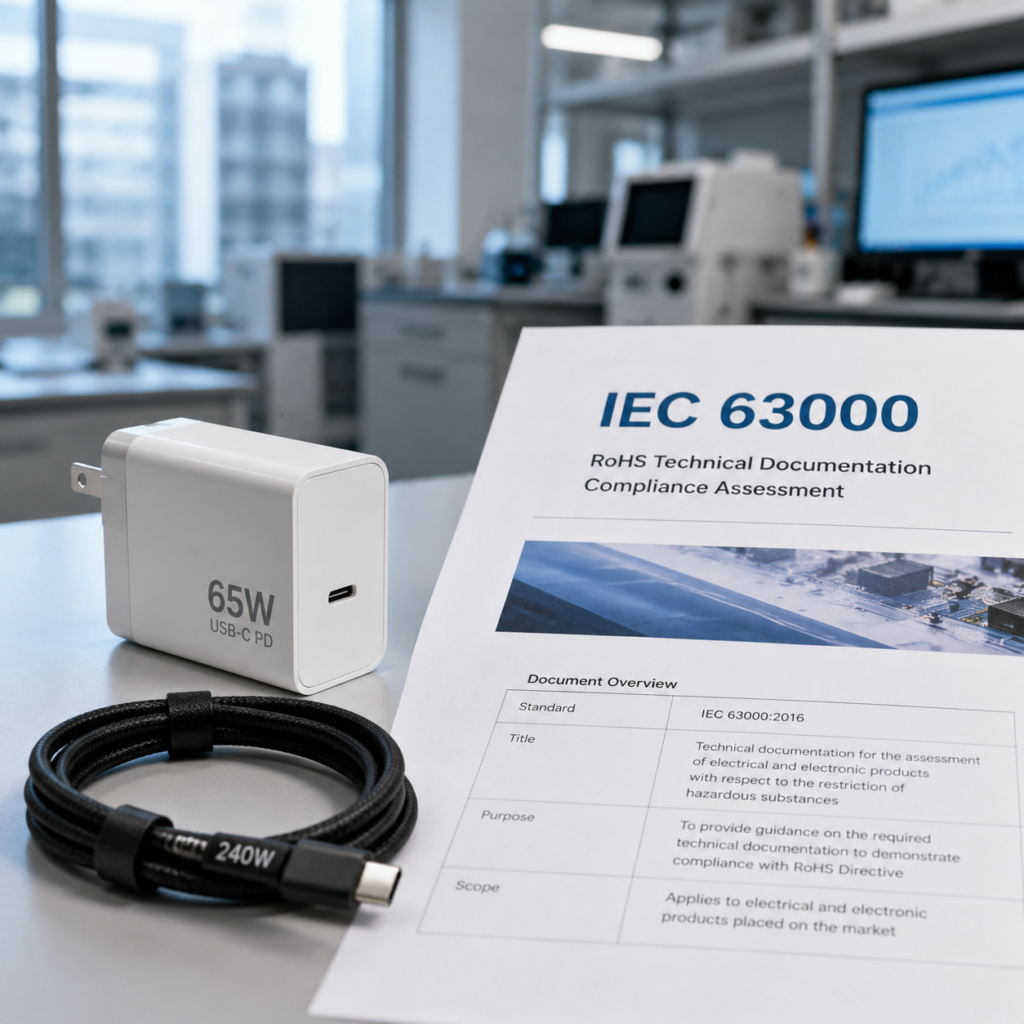
Why Should You Care About IEC 63000 When Buying Charging Accessories?
Some people might say, isn’t it just a basis for technical documents and compliance assessment? What does it have to do with me, an ordinary user? In fact, whether for ordinary consumers or for product circulation, the role of this standard is very practical, especially for charging products, where there is special necessity.
Practical Value for Ordinary Users
First, help understand compliance status: A technical document or manufacturer’s declaration can help you understand the RoHS regulation the manufacturer claims applies, the product scope, and the assessment basis. However, you cannot rely solely on the words “in accordance with IEC 63000” or “compliant with IEC 63000” to finally confirm that the product is compliant; you still need to judge by combining the specific model, the regulations of the target market, and technical materials that can support the conclusion.
Second, avoid health risks: The cable sheaths and solder of low-quality charging products may contain excessive restricted substances such as lead, cadmium, and phthalate plasticizers. When used for long-term contact or under heating conditions, material safety issues are worthy of attention. Compliance materials can help you avoid products that lack basic traceability and evidence, but RoHS compliance itself does not mean the product is “completely non-toxic” or that all health risks have been covered.
Third, easier verification for cross-border purchases: IEC 63000 can help enterprises explain the basis for RoHS assessment using a clearer technical document organization method. For consumers, this means that when viewing materials from different brands, there is an opportunity to compare by product model, applicable regulations, and technical basis, but it does not mean that all markets around the world adopt exactly the same regulatory requirements or declaration formats.
Role in Product Circulation
For merchants and platforms, the value of this standard is more direct:
First, facilitate cross-border organization of materials: Enterprises can organize RoHS-related information using a unified and clear technical document approach, and then supplement corresponding content according to the regulatory requirements of different markets.
Second, meet platform thresholds: Cross-border e-commerce platforms such as Amazon and AliExpress often require merchants to provide RoHS declarations, testing materials, or other compliance credentials among their compliance requirements for charging products. Technical documents organized in accordance with IEC 63000 may serve as supporting materials among them, but whether the platform accepts them is still subject to the specific rules of the platform at the time.
Third, reduce disputes: If there is a compliance dispute, materials that include the product scope, applicable regulations, assessment basis, and responsible entity can serve as an important basis for judgment and proof, eliminating the need for each party to stick to their own unsubstantiated claims.
Special Necessity for Charging Products
Why specifically talk about charging products? Compared with ordinary electronic accessories, they have three special characteristics that make RoHS compliance and technical documents more worthy of attention:
First, diverse material types and complex supply chain: The PVC/TPE cable sheath of charging cables, the solder of chargers, the plating of metal contacts, and the plastic interface housings may all be involved in RoHS assessment. Whether restricted substances are actually contained and what their concentrations are cannot be inferred solely from the material name; they need to be confirmed in combination with supplier materials or testing.
Second, usage scenarios require comprehensive consideration: Charging products may generate heat during operation, especially high-power fast charging products. Therefore, in addition to RoHS substance restrictions, attention should also be paid to electrical safety, thermal safety, and material contact risks at the same time. It should be noted that RoHS limits themselves are concentration requirements in homogeneous materials, and are not equivalent to migration levels, human exposure levels, or overall health and safety conclusions.
Third, multiple supply chain tiers: A charger goes through several layers of suppliers from plastic pellets, solder, PCB boards, interface modules, to final assembly into a finished product. Clear technical documents can help enterprises record the assessment basis from materials, components to finished products, facilitating traceability and review.
Core Requirements of IEC 63000: Practical Implementation Version for Charging Products
After all that, how should a set of technical materials for charging products related to IEC 63000 be organized? Let’s break it down from a practical usage perspective.
Organize Materials by Supply Chain Tier
Enterprises can organize technical materials by supply chain tiers such as materials, components, and finished products, but it should be noted that: IEC 63000 does not stipulate a fixed “three-tier declaration system”, nor does it specify material-level, component-level, and product-level as three unified declaration categories.
In practical work, common material organization methods include:
- Material-level materials: For example, the plastic raw material declaration for the PVC outer sheath of a charging cable, used by cable factories for material assessment;
- Component-level materials: For example, supplier materials for USB-C interface modules, power plugs, or cable assemblies, for reference by finished product assembly factories;
- Product-level materials: For example, the final technical documents and manufacturer’s compliance declaration for an entire PD charger or an entire USB-C charging cable, intended for purchasers, platforms, or regulatory authorities.
Regardless of which organization method is adopted, the finished product manufacturer must establish technical documents covering the applicable parts of the product, and cannot only prove that the housing meets the requirements while ignoring internal or accessory parts such as PCBs, solder, interfaces, and plugs.
Key Information to Verify in Practice
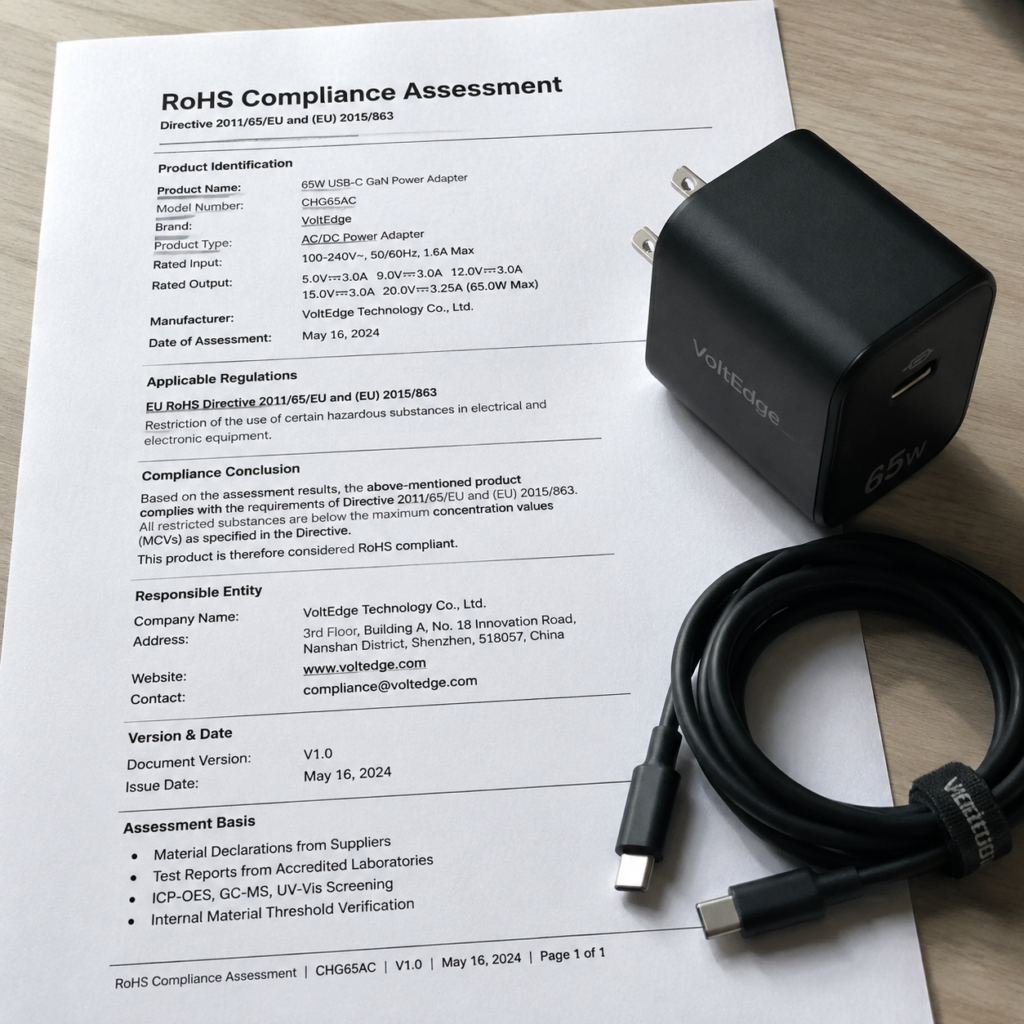
IEC 63000 does not stipulate that an external declaration must adopt a unified six-field template, nor does it require that third-party test report numbers or upstream supplier declaration numbers must be listed. However, to facilitate verification and traceability, the following information should usually be paid attention to in practice:
| Key Information | Corresponding Content for Charging Products | Function |
|---|---|---|
| Product identification | Charger model, charging cable specification, cable length, power, interface type, etc. | Confirm whether the technical materials correspond to the physical product |
| Applicable rules | Clearly mark the applicable RoHS regulation, such as EU RoHS or China RoHS | Explain the basis for compliance judgment |
| Compliance conclusion | Fully compliant, or state which legal exemptions are used | Understand the scope and conditions of the conclusion |
| Responsible entity | Information on the manufacturing enterprise, brand owner, or declaration issuer | Facilitate traceability and contact |
| Version and date | Document effective date, revision date, version number | Facilitate judging whether the materials have been updated |
| Assessment basis | Supplier material declarations, material records, calculation materials, test records, etc. | Support the compliance conclusion, rather than leaving only verbal promises |
Whether to list test report numbers, supplier declaration numbers, and other attachments shall be determined by the enterprise according to product risks, internal procedures, and target market requirements. For consumers, the most important thing is to confirm the product scope, regulatory scope, and responsible entity, rather than just looking at whether there is a certain number.
Exemption Record Rules for Charging Products
If a charging product uses a certain RoHS exemption, the enterprise shall record in the technical document:
- The applicable RoHS regulation and specific exemption clause;
- The covered product categories, uses, and parts;
- The validity period and applicable conditions of the exemption;
- Material, component, or test materials that support this judgment.
Whether the external declaration must list exemption numbers item by item shall be determined according to the target market’s regulations and declaration system. You cannot take the absence of listed exemptions in the declaration as sufficient basis to prove that all homogeneous materials meet the limit requirements.
Basic Requirements for Supporting Technical Documents
Declarations or compliance conclusions do not come out of thin air; they should be supported by technical materials matching the product, although ordinary consumers generally do not need to view all of these documents, it is good to have a basic understanding:
- Basic evidence: Upstream suppliers’ material declarations, component materials, bill of materials, and product correspondence records, to help confirm the source of materials;
- Testing or calculation evidence: According to material risks and the enterprise’s assessment methods, retain test reports, composition materials, calculation records, or other evidence sufficient to support the conclusion;
- Continuous maintenance: When regulations, exemptions, materials, designs, suppliers, or assessment bases change, relevant documents shall be re-reviewed.
For example, EU RoHS requires manufacturers to keep the declaration of conformity and technical documents for 10 years after the product is placed on the market. The retention period, starting point, and responsible entity for other markets shall be verified against local regulations respectively. IEC 63000 itself does not uniformly stipulate the retention years for all markets.
Intermediate Improvement: Advanced Judgment Skills for Charging Product Declarations
If you often buy charging accessories cross-border, or have relatively high requirements for compliance, you can master these advanced skills to help you more accurately judge the reliability of materials and avoid more pitfalls.
Differences in Material Coverage Scope for Different Charging Products
Different types of charging products have different scopes that technical materials need to cover, don’t mix them up:
- Complete products (chargers, power adapters): Materials should cover internal and external parts related to RoHS assessment in the product, including PCB boards, solder, housings, interfaces, plugs, and cables included with the product, etc.
- Accessory products (charging cables, separate plugs, charging port modules): Usually assess their own materials and parts, and do not need to include the equipment they are connected to in the RoHS conclusion of the same product.
- Set products (charger + charging cable): It is necessary to confirm whether the materials cover the charger and charging cable separately, or whether a single set of materials covers all parts. You cannot just see that the charger has materials and assume that the cable is also covered.
- Same-series products with multiple versions: Whether different power, cable length, color, or plug specifications require separate declarations depends on whether materials, design, key components, and applicable regulations may affect the compliance conclusion. Multiple models can share a single declaration or technical document, but the coverage scope must be clearly listed, and there must be a technical basis to prove that these differences will not affect the conclusion.
Methods for Judging Declaration Reliability
Even for RoHS-related declarations or technical materials, reliability varies. How to judge?
- The clearer the supporting basis, the better: If the materials can explain which supply chain material declarations, material records, calculation materials, or test records are used, it is usually easier to verify than just a sentence of “meets requirements”. Whether a third-party test report must be provided at the same time depends on the product, risk, and target market requirements.
- The stronger the traceability, the more reliable: With clear issuer name, address, contact information, product scope, and version date, it is easier to trace when problems arise.
- Don’t just look at the standard number: If only “IEC 63000” is printed on the product or detail page, but no specific materials can be found, nor is there a product scope or assessment basis, compliance is difficult to verify. However, the mere lack of documents cannot directly be judged as false labeling; you should still require the merchant to supplement verifiable information.
Differences in Declarations Corresponding to RoHS in Different Regions
Remember: IEC 63000 is a general standard supporting technical documents and compliance assessment, and will not replace the specific regulations of the target market.
Both the EU and China have their own RoHS systems. Both involve restrictions on hazardous substances in electrical and electronic products, but they are not completely identical in terms of applicable scope, catalog, exemptions, labeling, conformity assessment, and implementation rules.
The United States does not have a unified federal RoHS system. California may involve chemical warning requirements such as Prop 65, and whether it applies shall be judged separately according to the product, exposure situation, and specific regulations. California RoHS-related rules mainly target specific electronic products and cannot be generalized as universal RoHS requirements for all chargers and charging cables.
So when buying or selling cross-border, if you are selling to a specific country, or want to meet local requirements, you need to check whether the materials clearly cover the regulations of the target market, and you cannot just see IEC 63000 and draw a conclusion directly.
Judgment of Declaration Validity Period and Invalidation Scenarios
Many people ask how long the validity period of a declaration is. IEC 63000 does not give declarations an unrestricted “long-term valid” status, nor does it uniformly stipulate that they must be updated annually.
In practice, manufacturers shall continuously review the following situations:
- The product has replaced raw materials;
- The product’s design or key components have been changed;
- The supplier has been changed;
- The target market’s regulations or exemption clauses have changed;
- The original testing, supplier materials, or assessment basis can no longer cover the current product.
Multiple models do not necessarily need to have separate documents issued. As long as the declaration or technical document clearly states which models are covered, and the technical basis can prove that version differences will not affect the compliance conclusion, the relevant materials can be shared. In practice, if the declaration date is far from the product production date, or the product has undergone multiple revisions, it is best to confirm with the merchant whether the materials still cover the current version.
Core Differences from Other Compliance Requirements (Stop Confusing Them)
Many people confuse IEC 63000 with other compliance requirements, so here we clarify the boundaries once and for all:
- Difference from CE marking: IEC 63000-related technical documents or RoHS declarations are not equivalent to having completed the CE conformity assessment and CE marking obligations required by applicable EU regulations. CE is a marking used by manufacturers after completing conformity assessment and issuing a declaration of conformity under applicable EU regulations, not a unified third-party certification certificate. Whether a notified body is required to participate depends on the specific regulations and product category.
- Difference from REACH regulation: RoHS mainly restricts specific hazardous substances in electrical and electronic products, while the EU REACH regulation covers a wider range of chemicals, including almost all chemical substances. The two have different control scopes and cannot replace each other.
- Difference from IEC 62321: The IEC 62321 series specifies the determination methods for restricted substances, explaining how to test related substances; IEC 63000 specifies how to organize technical documents and evidence to support RoHS assessment. The two relate to test methods and technical document assessment respectively.
- Difference from electrical safety standards: RoHS governs hazardous substance restrictions, while electrical safety standards, such as IEC 62368, govern safety risks such as electric shock, fire, and energy hazards. RoHS compliance does not mean that the product has completed electrical safety assessment, nor can it replace safety testing.
Exclusive to Charging Products: Common Misconceptions and Fraud Identification
Finally, let’s talk about what everyone cares about most: common advanced misconceptions about IEC 63000 in charging products, and how to identify risks in materials.
5 Advanced Cognitive Misconceptions
Many people have been using charging products for a long time but still have these misunderstandings:
- Misconception: If there are IEC 63000-related materials, the product is completely non-toxic
Truth: RoHS restricts the concentration of specific restricted substances in homogeneous materials, it does not require all substances to be zero, nor does it mean that all chemical, migration, exposure, or overall health and safety assessments have been completed. - Misconception: IEC 63000-related declarations are RoHS test reports
Truth: Manufacturer’s declarations, technical documents, and test reports are not the same thing. A test report may be one of the pieces of evidence supporting the assessment, but IEC 63000 does not equate a test report with a complete compliance conclusion. Whether there is a test report and which tests are required shall be judged according to the product and target market. - Misconception: All charging products must have IEC 63000-related declarations
Truth: IEC 63000 is a technical document and compliance assessment standard, not a mandatory certification system that replaces local RoHS regulations. Whether a product must provide specific documents depends on target market regulations, platform requirements, and supply chain responsibilities. Organizing materials using this standard usually helps improve the clarity and traceability of documents. - Misconception: “Lead-free” and “environmentally friendly” are equivalent to RoHS compliance
Truth: RoHS involves multiple types of restricted substances. “Lead-free” only describes the promotion or judgment of lead alone, and cannot prove that other substances such as cadmium, mercury, hexavalent chromium, flame retardants, and phthalate plasticizers also meet the requirements. True compliance requires a complete assessment basis matching the target market. - Misconception: Having a RoHS mark is equivalent to complying with IEC 63000
Truth: Whether RoHS-related labeling is required depends on the target market. The EU usually does not have an independent mandatory RoHS icon, but applicable products need to fulfill corresponding CE compliance requirements; the Chinese market shall verify labeling and conformity assessment in accordance with relevant administrative measures and standards such as SJ/T 11364. No label can alone replace complete technical documents and compliance judgment.
Common Non-Compliant or Hard-to-Verify Declaration Situations
Among the compliance materials for charging products, common risks include the following:
- Missing information: The materials lack the manufacturer or responsible entity, product model, applicable regulations, or coverage scope, with only a sentence of “compliant with RoHS”. This kind of material is very difficult to verify.
- Misattribution: Using materials from other model products to impersonate. For example, if you buy a 65W charger, but the merchant provides materials for a 20W product, the model and key components do not match, so it cannot be directly used to prove the current product.
- Only standard number marked: Only “IEC 63000” is printed on the product or detail page, but no specific technical documents, product scope, or assessment basis can be provided, making compliance difficult to verify.
- Vague scope: The materials only state that “all series of charging products of our company meet the requirements”, but do not mark the specific covered models, specifications, or product categories. Such “full series” declarations are not automatically invalid, but if you cannot confirm whether your product is within the coverage scope, or if it is inconsistent with the technical documents, there is an obvious risk.
Summary: Core Judgment Abilities You Can Master
By reading this far, you have gained a beginner to intermediate understanding of IEC 63000. To sum up, you can master these practical abilities:
First, you can clearly distinguish between the IEC 63000 technical document standard, RoHS regulations, manufacturer’s declarations, and test reports, and will no longer confuse them;
Second, you can judge whether the relevant materials for charging products have basic verifiability by checking the product scope, applicable regulations, responsible entity, and assessment basis;
Third, you can identify common risks in charging accessories such as missing materials, model mismatch, and vague scope, and avoid low-quality or hard-to-trace products;
Fourth, when making cross-border purchases, you can judge whether the materials cover the RoHS requirements of the corresponding region, and will not draw a conclusion just by seeing IEC 63000;
Fifth, you can distinguish the boundaries between RoHS compliance and other compliance requirements such as electrical safety, CE, and REACH, and will not be fooled by merchants’ “compliance propaganda”.
Next time you buy a charger or charging cable, you might as well try to find its RoHS-related materials, check the product model, target market, and assessment basis, and then judge using the methods you learned today. You will become proficient gradually.