
If you have bought replacement chargers for small home appliances such as electric toothbrushes and robot vacuums overseas, or purchased household charging bases via cross-border online shopping, you may have seen the words “IEC 60335” on the packaging or nameplate. Many people’s first reaction to this number is “some kind of safety certification”, but in fact it is a series of international standards related to the safety of household electrical appliances. It is not a certification, nor is it only for large home appliances. Today, we will explain this set of standards thoroughly from the perspective of ordinary users — from how to judge whether your charger is applicable, to how to use it to screen safe products, and how to avoid common publicity tricks.
First, Get the Basics: What Exactly Is IEC 60335
IEC is the abbreviation of the International Electrotechnical Commission, the core global body for formulating electrotechnical and electronic standards. IEC 60335 is a series of safety standards for household and similar electrical appliances formulated by it. For household battery chargers falling within this scope, judgment usually needs to combine the general requirements of IEC 60335-1 and the particular requirements for battery chargers in IEC 60335-2-29. As for whether it serves as a basis for market access, it depends on the regulations adopted by the target market, the standard version, and the specific product scope.
Many household charging products we contact daily, such as charging bases for electric toothbrushes and power adapters for robot vacuums, may require safety assessment in accordance with this standard system or relevant product standards, but you cannot directly apply IEC 60335 to anything with the word “charger”.
The core goal of this set of standards is very clear: to prevent several types of risks that users are prone to encounter in daily use — electric shock, fire, overheating, and mechanical injury. It should be noted that specific regulations and adopted standards vary by country, region, and product category. You cannot generally assume that most overseas regions take IEC 60335 as the unified market access basis for all household charging products.
Here we must first clarify the most common misconception: IEC itself does not issue “IEC official certification” for products. If a product claims to be “IEC certified”, you should further verify whether it actually corresponds to a qualified third-party certification body or testing institution, as well as the specific certificates, reports, and applicable standards. You cannot directly equate this statement with IEC official certification.
Relevance to Ordinary Users
For us ordinary consumers, IEC 60335 has three main functions:
First, it is a reference basis for judging the safety of some household chargers and charging bases — if the product documentation shows that it has undergone conformity assessment in accordance with the applicable version and relevant requirements, it means it meets the corresponding safety requirements within the specified scope and test conditions.
Second, compliance with relevant requirements does not mean covering all use risks, nor does it mean the product is absolutely safe in actual use. Factors such as batteries, plugs, sockets, EMC, energy efficiency, national deviations, manufacturing quality, and use environment may also affect overall safety.
Third, when purchasing household charging accessories cross-border, you can use it to check the compliance of the product and avoid buying “three-no” products that do not meet safety requirements. However, the standard number, certification mark, or merchant’s publicity itself cannot replace the verification of the model, report, and target market requirements.
Three Beginner Misconceptions to Avoid Upfront
Many people tend to go astray when first接触 this set of standards. Here we first clarify the three most common misconceptions:
First, its scope of application is far more than large home appliances such as refrigerators and washing machines. Charging heads and charging bases for small home appliances may also need to refer to this set of standards as long as they meet the corresponding product scope.
Second, it is primarily a safety standard, only concerned with “whether it is safe”, not equivalent to evaluating “whether it works well” — issues such as charging speed, compatibility with your device, and false power marking cannot be judged solely by IEC 60335.
Third, compliance with standards does not mean the product is safe for life. It usually means that the new product meets the corresponding safety requirements under the specified product scope, use conditions, and test conditions. After long-term use, aging, dropping, or modification, it may no longer meet the requirements.
Does Your Charging Product Fall Under Its Scope? Clarify the Applicability Boundary
Many people make a mistake when buying charging products: they apply IEC 60335 to any charger they see, and then find that mobile phone fast chargers do not mark this standard at all, so they think the product is unqualified. In fact, different charging products are governed by different safety standards, and IEC 60335 only covers part of them.
Overview of Applicability to Common Charging Products
We have compiled the charging products most commonly contacted in daily life into a comparison table, you can directly对照:
| Product Type | Is IEC 60335 Applicable | Corresponding Standards/Notes |
|---|---|---|
| Household-specific battery chargers/bases (e.g., original charging bases for electric toothbrushes, robot vacuums) | Usually applicable | To be determined based on intended use and product scope; may involve IEC 60335-1 general requirements and IEC 60335-2-29 particular requirements for battery chargers |
| Universal power adapters for IT/audio-visual equipment (e.g., fast chargers for mobile phones, laptops) | Usually not applicable | Usually assessed in accordance with applicable standards such as IEC 62368-1 |
| Consumer-grade wireless chargers (e.g., desktop wireless chargers for mobile phones) | To be confirmed | Most consumer-grade products fall under standards such as IEC 62368; if it is a built-in wireless charging component of a household appliance, it is assessed in accordance with the complete household appliance standard |
| Power banks/portable chargers | Usually not applicable | The cells or battery packs may involve IEC 62133; for the complete product, it is also necessary to determine whether IEC 62368-1 or other local standards apply based on structure, function, and target market |
| Passive USB/USB-C charging cables (ordinary data cables without circuits) | Usually not applicable | Governed by special standards for corresponding interfaces and cables |
| Charging cables with mains conversion modules (e.g., wall-plug integrated fast charging cables) | To be confirmed | Comprehensively determined based on product structure and intended use |
Core Logic of Applicability Judgment
If your product is not in the above list, you can also judge by yourself based on three core bases:
First, look at intended use — if the product is clearly marked as a “household battery charger”, priority is given to judgment according to the IEC 60335 system; if it is a universal power supply for IT/audio-visual equipment such as computers and mobile phones, refer to applicable standards such as IEC 62368-1.
Second, look at product function and structure — the standard cannot be determined solely by whether it has a battery or whether it is a pure power conversion product. Devices with batteries may belong to different product categories, and battery chargers may not themselves have batteries. Judgment should be made comprehensively in combination with the product’s intended use, main functions, structure, and the applicable scope of the standard.
Finally, look at target market regulations — different regions may have different provisions on the applicable scope of standards, adopted versions, and compliance methods, and ultimately local regulatory requirements shall prevail.
It should also be emphasized here that there is no difference in strictness or high-endness between IEC 60335 and IEC 62368-1; they only apply to different product categories, just like clothing sizes: size M and size L have no good or bad, they just fit different body shapes.
3-Step Quick Self-Check for Applicability
Don’t want to remember so many rules? You can use these 3 simple steps to quickly judge whether the product in your hand is applicable to IEC 60335:
Step 1: Check the intended use on the manual or packaging: only products clearly classified as “household battery chargers” may be applicable to this set of standards.
Step 2: Check product documentation, test reports, or certification documents: if “IEC 60335-1” and “IEC 60335-2-29” are listed, it can be used as a preliminary clue, but you still need to verify the product model, standard version, report coverage, issuing body, and target market requirements. Self-labeling of the standard number on the product nameplate cannot prove that the product has actually undergone conformity assessment or meets the standard.
Step 3: Check product positioning: if it is a universal power adapter for mobile phones or laptops, priority is given to applicable standards such as IEC 62368-1, and there is no need to纠结 about whether there is a 60335 mark.
Core Safety Requirements: What Exactly Does This Standard Cover
IEC 60335 has a lot of content, but the core safety requirements related to charging products are actually the aspects we care most about in daily life: electric shock protection, temperature and fire protection, mechanical strength, abnormal protection, and marking specifications. We will explain them one by one, trying not to use jargon, only talking about requirements you can perceive.
Electric Shock Protection: The Most Core Bottom Line
Electric shock protection is the most core requirement of this set of standards, after all, electric shock is the most direct safety risk. Its core logic is very simple:
First, during normal use, human hands cannot touch the internal high-voltage parts;
Second, there must be reliable isolation between high-voltage and low-voltage parts, so that there is no danger of high voltage窜 to the low-voltage side;
Third, the standard will assess electric shock risks for specified humid or water-related conditions, but this does not mean the product can be used safely in any humid environment. Many chargers are explicitly prohibited from being used in bathrooms, water accumulation areas, or environments where water may enter, and you must abide by the product manual and waterproof rating limits.
Many people will ask: isn’t the safe voltage 36V? In fact, there is no single “36V” conclusion for safety extra-low voltage that is independent of standards and conditions. The specific limits and electric shock protection requirements need to be determined according to applicable standards, AC or DC type, waveform, accessible parts, and fault conditions, and cannot be generalized as all charger outputs must meet the same unified voltage value.
There are three main types of corresponding tests: contact current test, insulation performance test, and humid or water-related tests for specified conditions. They are used to assess whether there is excessive leakage current in accessible parts, whether the insulation between high and low voltage is reliable, and whether the protection under specific environments is sufficient.
Temperature and Fire Protection: No Burns, No Fires
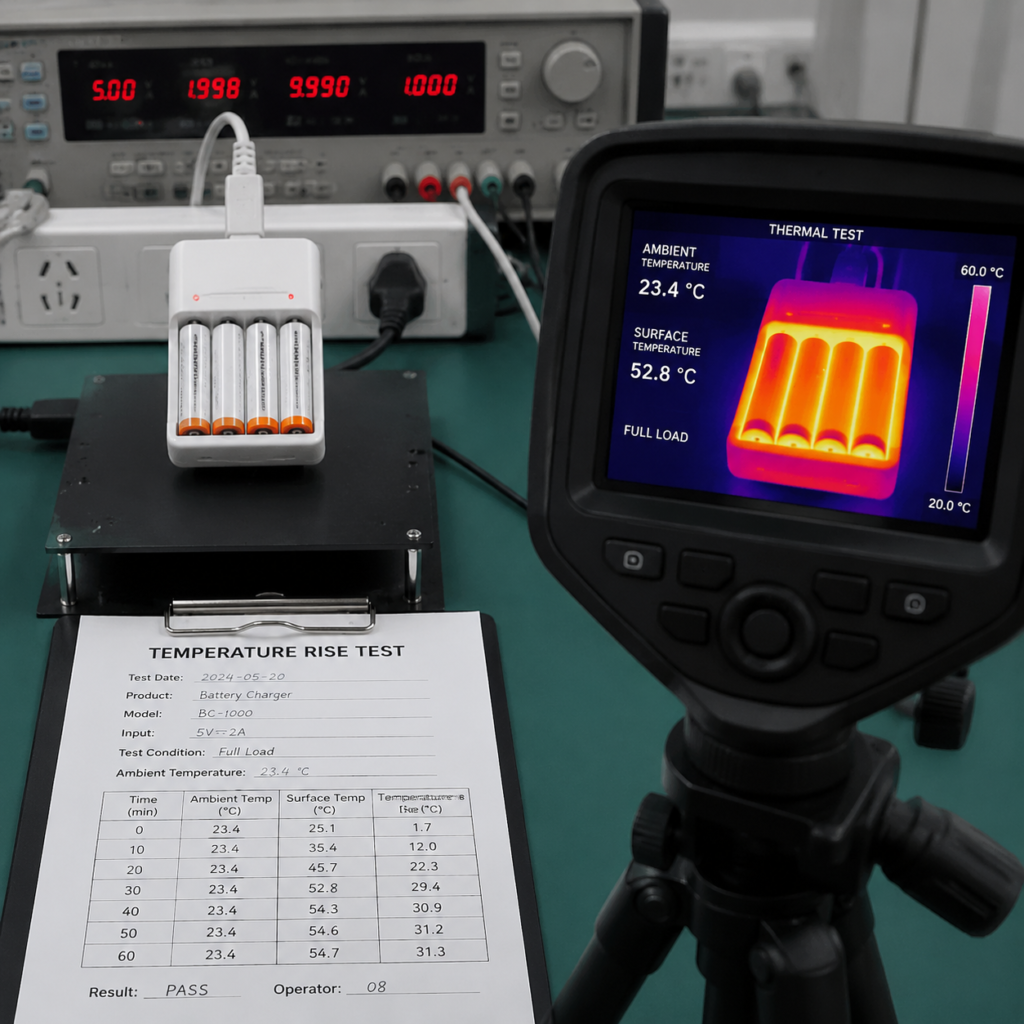
The second core requirement is temperature and fire protection, which users can also directly feel in daily life.
During normal use, the temperature of parts that human hands can touch must not be too high, that is, “temperature rise does not exceed the limit” — the temperature rise here refers to how much the product temperature is higher than the ambient temperature. The limits are different for different parts, different materials, and different working conditions, and there is no unified value. Many merchants will say “full power test temperature XX degrees at 25℃ ambient”, which is just a common test environment, not all products must be tested under this condition, don’t apply this to all scenarios.
The requirements under abnormal conditions are stricter: for example, in case of output short circuit, overload, or blocked heat dissipation, there must be no unacceptable hazards such as flame spread and molten material dripping. Relevant plastic parts must also meet applicable heat resistance, fire resistance, and flame retardant test requirements according to their position, function, and risk, which is not necessarily equivalent to all parts having to pass the same “self-extinguishing after burning” test.
Corresponding tests include normal temperature rise test, abnormal operating condition test (simulating short circuit, overload, blocked heat dissipation, etc.), and applicable heat resistance, fire resistance, glow wire or needle flame related tests according to parts and structure.
Mechanical Strength: Won’t Break After Dropping or Tugging
Daily use of chargers will inevitably involve dropping, tugging cables, and repeated plugging and unplugging. The mechanical strength requirement is to ensure that the safety protection of the product will not fail after these daily operations.
Specifically, after being subjected to daily stresses such as dropping, plugging/unplugging, tugging, and bending, the enclosure must not crack, live internal parts must not be exposed, and insulation and isolation protection must not fail.
Many merchants will publicize “1m drop meets IEC 60335”, but in fact this is just an example — test parameters vary for different categories and structures of products, there is no unified drop height requirement, don’t be fooled by such publicity.
Corresponding tests include drop test, pin/interface strength test, and power cord pull/bend test.
Abnormal Operating Condition Protection: No Danger Even If Something Goes Wrong
Even if the user has a small problem during use, the product must be able to enter a safe state on its own, which is the requirement of abnormal operating condition protection.
The product must undergo short circuit, overload, and other abnormal operation tests in accordance with applicable clauses, and must not produce unacceptable hazards under specified conditions. The way to achieve this goal is not necessarily to configure independent short-circuit, overcurrent, or overvoltage protection circuits with clear names, but may also be realized through current limiting, fusing, structural isolation, control strategies, or other designs. Therefore, “must be equipped with short-circuit, overcurrent, and overvoltage protection circuits” cannot be taken as a unified requirement for all products.
One exclusive test to note: the battery reverse polarity test is only conducted under applicable battery connection methods and specific clause conditions. Products with built-in batteries may not be subject to the reverse polarity test, but still need to assess abnormal charging and other fault conditions in accordance with applicable clauses for the complete appliance, charger, and battery system.
The judgment rule is simple: no matter what applicable abnormal situation occurs, the product must enter a safe state and must not have unacceptable hazards.
Safety Markings: Required Information Must Not Be Missing
The last item is the safety marking requirement, that is, the information that must be provided on the product and in the manual. This information can help us initially understand the rated conditions and use restrictions of the product.
Applicable rated values, manufacturer or responsible party, model or type, and other information shall be marked in accordance with the provisions of IEC 60335-1 and the corresponding Part 2, and warnings and instructions required by the standard shall be provided. You cannot generalize “rated input/output parameters, manufacturer information, basic safety warnings” as a fixed list identical for all charging products, because specific marking items vary with product category and structure, and some warnings may also need to be placed in the manual or in the particular requirements for specific products.
There is also the protection class marking: Class II products (products with double insulation that do not require grounding) must be marked with the double-square (回) symbol; Class I products (products that require grounding) must be marked with the grounding symbol. It should be noted here that not all products need to be marked with the double-square symbol, only Class II products do. Don’t say a product is unqualified just because you don’t see the double-square mark.
In addition, applicable markings and instructions must be clear and durable, and must not easily fall off or become blurred after normal use.
Standard System and Regional Compliance: What to Look for When Shopping Overseas
Many people think that IEC 60335 is a single standard, but in fact it is a layered system, and the versions and compliance paths vary by region, which is especially important to pay attention to when shopping overseas.
Two-Tier Structure of IEC 60335
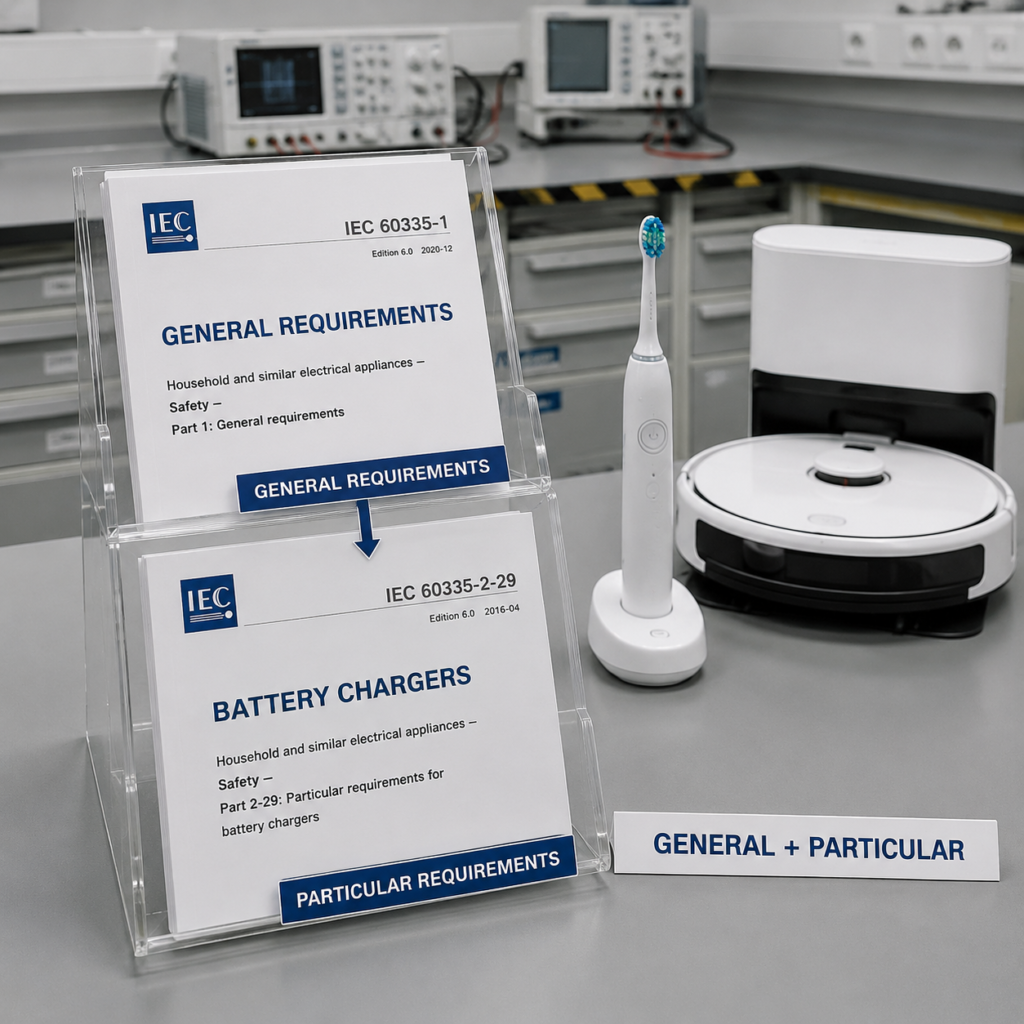
IEC 60335 adopts a two-tier structure of “general requirements + particular requirements”:
- Base layer: IEC 60335-1, that is, general safety requirements. Products within the scope of this standard usually need to comply with this part of the requirements.
- Supplementary layer: IEC 60335-2-XX, that is, particular requirements for specific products. Different categories of products correspond to different XX numbers. For example, applicable household battery chargers usually need to refer to Part 2-29.
Particular requirements are supplements or modifications to general requirements. A product must meet both the general requirements and the applicable product particular requirements before it can be fully judged whether it complies with the corresponding IEC 60335 standard.
It should also be added that IEC publishes standard texts. For a product to actually be sold in a certain region, it is also necessary to consider the locally adopted standard version, national deviations, and other regulations such as EMC (electromagnetic compatibility), energy efficiency, and RoHS (Restriction of Hazardous Substances). It is not enough to just comply with 60335.
How to Check Standard Versions
Standards are not static; they are constantly revised as product forms change. Specific requirements shall be subject to the official text, corrigenda, amendments of the corresponding version, and the adoption status of the target market.
There are often rumors online that “a certain version adds USB-C and multi-port fast charging requirements”. Don’t believe such statements without official basis — standard revisions shall be subject to officially published texts.
The standard version should be checked first from test reports, certification certificates, technical documents, or compliance declarations. You cannot assume that the product nameplate will definitely mark the standard number and version year, nor can you take the standard number on the nameplate as proof of compliance. Even if you see “IEC 60335-1:2020”, you cannot conclude just from the nameplate that the complete product has completed conformity assessment according to that version.
Compliance Paths in Major Regions
Different regions adopt IEC 60335 in different ways, and the compliance paths are also different. We have compiled several regions most commonly contacted by overseas users:
- European Union: Relevant products may adopt the EN 60335 series. The CE mark involves the manufacturer’s declaration of conformity with applicable EU regulations. The safety part may be self-declared by the manufacturer when meeting corresponding regulatory conditions, or may involve third-party institution assessment, depending on the product and regulatory requirements.
- United States: The version with local deviations is called UL 60335. Certifications from third-party institutions such as UL and ETL are common compliance paths, but not all products are uniformly mandated under the same certification path.
- Australia/New Zealand: Australia and New Zealand may adopt the AS/NZS 60335 series, but specific market access requirements depend on local regulations, equipment classification, and supplier obligations. Third-party certifications such as SAA are one of the common compliance paths, not a uniformly mandatory certification name for all products.
- CB Scheme: The CB Scheme is operated by participating national certification bodies and laboratories. CB test reports or certificates can serve as an important basis for applying for local certifications in multiple markets, but they cannot automatically replace national certifications or registrations. National deviations, documents, samples, and other compliance matters still need to be handled in accordance with the requirements of the target country, and the final decision on whether to issue a certificate is made by the target country’s authority.
Clause Matching Logic for Charging Products
Different charging products need to match different clauses:
- Household-specific battery chargers: It shall be judged whether IEC 60335-1 and IEC 60335-2-29 apply based on intended use and structure, and cannot be directly determined solely by the name “single-port charger”.
- Multi-port household charging power strips: May simultaneously involve different product standards for the power strip body, extension cord, power conversion module, and overcurrent protection. Applicable standards for each part shall be identified separately, and simultaneous output, overload, and protection requirements shall be assessed in accordance with specific standards.
- Other charging products: Match according to the actually applicable safety standard system, no need to force-fit 60335.
Practical Judgment Methods: Quickly Check Product Compliance
After talking about so much theory, it ultimately comes down to how to use it. We have compiled several zero-cost and low-cost methods to help you quickly judge whether the household charging products in your hand meet safety requirements.
Zero-Cost Inspection: Check the Product’s Own Markings
The simplest method is to look at the markings on the product, no disassembly or testing needed, a glance can give a preliminary judgment:
First, check the applicable product information: whether there are clear rated parameters, manufacturer or responsible party information, model, as well as corresponding protection class symbols and use warnings. The specific content to be marked needs to be determined in combination with the product category and target market requirements.
Pitfall to avoid: “three-no” products without any markings usually lack basic traceability information; products with obviously unreasonable parameters (for example, very small size but marked with hundreds of watts of power) should also be treated with caution, and cannot be judged solely by publicity.
Certification Mark Verification: Core Method for Overseas Purchases
When buying charging products overseas, certification marks are important clues for compliance judgment. Common marks include: CE (EU market conformity mark), UKCA (UK market conformity mark), UL/ETL (common third-party certification marks in the US market), GS (common voluntary third-party safety mark in Germany), and the certificate or report system related to the CB Scheme.
Here we emphasize the pitfall again: there is no “IEC official certification”. If the product is printed with the words “IEC certified”, you should verify whether it corresponds to a real, qualified third-party institution, specific certificate, and test scope, and cannot directly take it as IEC official certification.
In terms of credibility, you should distinguish between manufacturer declaration marks and third-party certification marks. CE and UKCA are mainly conformity declarations or market marks made by the manufacturer for applicable regulations, and are not usually equivalent to third-party certification; UL, ETL, GS, etc. are common in third-party certification paths. Specific credibility still depends on the authenticity of the mark, certificate status, product model, and report scope.
If you want to further verify, you can use this “five-point verification method”:
- Model match: The product model on the certification must be consistent with the product you bought, don’t just look at the same series name.
- Version and scope correspondence: Check the currently applicable standard version, transition arrangements, certificate validity scope, and national deviations in the target market; validity cannot be judged solely by “whether it is the latest published version”.
- Formal institution: The issuing institution is a qualified formal institution, not issued by any random small company.
- Full report coverage: The certification report should cover applicable standard requirements and the current product scope, not just test one or two items.
- Clear change status: Verify whether the certification certificate covers the current product and its key components and versions, and confirm that any major changes have completed change assessment or certificate update in accordance with the certification body’s rules. It cannot be generally asserted that all unreported changes will automatically invalidate an old certificate.
Quick Inspection During Daily Use
You can also check for hidden dangers during use, just pay attention to these phenomena:
- When there is abnormal high temperature, burning smell, or enclosure deformation, stop using immediately. The perceived temperature of the enclosure cannot directly determine whether the temperature rise exceeds the limit; whether it exceeds the standard limit needs to be measured in accordance with specified methods.
- When the plug pins inserted into the wall are very loose and fall off with a slight touch, first check whether the wall socket is worn, whether the plug specification matches, and whether the contact state is normal; you cannot认定 that the charger has unqualified mechanical strength solely based on this phenomenon.
- If you feel a tingling sensation when touching the enclosure or interface, stop using immediately and disconnect the power supply, and have qualified personnel check the equipment, socket, and grounding. Whether it violates the standard needs to be determined through specified contact current and insulation test methods; do not continue to try it in consumer use scenarios.
- If there is a burning smell, abnormal noise during charging, or the enclosure is deformed, stop using immediately, don’t try again.
Semi-Proficient Pitfall Avoidance Guide
If you want to be more cautious, remember these pitfall avoidance points:
First, regardless of power level, you should choose products with verifiable sources, matching models, and meeting target market requirements. High-power products usually have higher requirements for heat dissipation, components, and protection design, but you cannot infer accident risk solely based on rated power.
Second, don’t use chargers or charging bases under bedding or clothes, which will block heat dissipation and cause excessive temperature, even qualified products may have problems.
Third, don’t disassemble or modify charging products by yourself — the original insulation and structural design have been tested, and disassembly and modification can easily damage protection and cause danger.
Fourth, when buying charging products from overseas, be sure to check whether the plug shape and rated voltage match the local power grid. For example, the US is 120V 60Hz, and the EU is 230V 50Hz. Buying the wrong one not only can’t be used, but may also have safety risks.
Common Misconceptions and Standard Boundaries: Don’t Deify or Misuse
Many people’s understanding of safety standards tends to go to extremes, either thinking “passing the standard means absolute safety” or thinking “the standard is useless”. In fact, it has clear boundaries. Let’s sort out the common misconceptions.
Distinction Between Easily Confused Charging-Related Standards
There are many standards in the charging field, and many people easily mix them up. We have compiled several of the most common ones to help you distinguish:
| Standard Name | Core Governing Scope | Common Applicable Products |
|---|---|---|
| IEC 62133-2 | Safety assessment of portable sealed secondary lithium cells and battery packs within the applicable scope | Batteries or battery packs for some portable devices; for power banks and complete household appliances with batteries, other applicable standards also need to be determined based on the complete product’s function, structure, and target market |
| IEC 62368-1 | Safety of IT/audio-visual equipment | Mobile phone fast chargers, laptop power adapters, some desktop wireless chargers |
| USB-IF Certification and USB Power Delivery Specification | Interoperability of USB interfaces and PD protocol and related specification requirements | Chargers, charging cables, devices supporting PD fast charging |
| EMC-related regulations and standards | Electromagnetic emission, immunity, and related requirements for different products and environments | Many electronic products, but specific requirements depend on product category and target market |
It should be noted here that USB-IF certification mainly verifies the interoperability of USB interfaces and PD protocol and related specification requirements, and cannot replace product-level electrical safety, fire resistance, insulation, and EMC compliance assessment. EMC is not a single standard either; many electronic products need to meet EMC requirements of the target market, but cannot be covered by a general term. EMC requirements and product safety requirements are independent of each other; passing one does not mean automatically passing the other.
These Issues Are Not Covered by It
IEC 60335 only covers safety issues within its scope, and it is not responsible for these situations:
First, performance issues such as charging speed, interface compatibility, and false power marking are not covered by it.
Second, the material, durability, and fast charging support of ordinary passive charging cables are not covered by it.
Third, problems caused by human disassembly or improper use, such as wrong voltage connection, water ingress, and continued use after dropping, are not its responsibility.
Fourth, it only ensures that the charger itself meets corresponding requirements within the applicable scope, and does not guarantee that the matching batteries, sockets, and other accessories also meet safety requirements.
Identification of Common Publicity Tricks
Many merchants take advantage of consumers’ lack of understanding of standards to make misleading publicity. Common tricks are these:
- Publicize “passing a certain test” as “meeting all safety standards” — for example, only passing the temperature rise test, then claiming to meet IEC 60335, when actually it is far from it.
- Present fast charging protocol certifications (such as PD certification, QC certification) as complete product safety certifications — fast charging certifications mainly focus on interface and protocol specifications, and cannot replace product safety assessment.
- Different products must use applicable product safety standards. A 62368-1 certificate cannot automatically replace a 60335 series conformity certificate, but it is still necessary to determine whether the actual product classification and target market apply; you cannot generally认为 that any 62368 certificate is a fake.
- Only marking “compliant with international standards” without writing the specific standard number, version, product model, and verifiable report or certificate means the information is insufficient. When encountering such publicity, you should ask the merchant to supplement specific information; you cannot judge whether the product has passed the test solely based on this sentence.
Standards Are Not Omnipotent
Finally, it should be noted that IEC 60335 is only part of safety requirements, not an omnipotent safety guarantee:
It only covers specified risks within the applicable product scope under specified test conditions, and cannot replace factory mass production quality control, aging assessment, misuse protection, and recall management — that is, design compliance with standards does not mean that every mass-produced product must comply, it also depends on how well the factory’s quality control is done.
New product qualification does not mean permanent qualification. Aging after long-term use, dropping, and modification may cause the product to no longer meet standard requirements.
In addition, if matching accessories are unqualified, or the use environment exceeds the scope specified by the standard, even if the product itself meets the standard, it may cause safety risks.
Final Summary: 5 Abilities You Can Master
After reading this article, you don’t need to remember all standard clauses. Just master these 5 things, which is enough for daily purchase and use:
First, be able to quickly distinguish the standard attribution of products such as household chargers, universal adapters, and wireless chargers, and judge when to refer to IEC 60335.
Second, be able to initially screen household charging products that meet safety requirements through product markings, certification marks, and verifiable documents.
Third, be able to inspect charging equipment with safety hazards through phenomena in daily use (such as abnormal temperature, burning smell, tingling sensation, and abnormal plug contact).
Fourth, be able to distinguish the core functions of common charging-related standards such as IEC 60335, IEC 62368, and IEC 62133, without mixing them up.
Fifth, be able to avoid common compliance publicity tricks when buying charging products overseas, and not mistake protocol certifications, manufacturer declarations, or vague “international standard” publicity for complete product safety certifications.
Safety is always the first bottom line for charging. Choosing formal products and using them as required is more reliable than any publicity slogan. I hope this article can help you choose safer household charging products overseas.