
When shopping for chargers, USB-C fast charging cables, or docking stations with charging ports overseas, have you seen the characters “IEC 62368-1” on the bottom of the product or its packaging? Many people mistake it for a fast charging performance certification, but in fact, it is a product safety standard applicable to specific audio/video, information technology, and communication technology equipment, and is directly related to whether the charging products you use every day will cause electric shock, fire, or scalding. It should be noted first: a product marked “IEC 62368-1” does not mean it has passed certification, nor can it alone prove that the product meets all regulatory requirements of the place of sale. Whether it is mandatory to adopt, which version to use, and whether third-party certification is required must be judged according to the regulations of the place of sale and the intended use of the product. In this article, we will explain this standard clearly from the perspective of daily use, from beginner-level understanding to being able to judge compliance by yourself, to help you avoid charging safety pitfalls.
Basic Understanding: The Safety Bottom Line for Consumer Charging Electronics
Let’s first position this standard: it is a product safety standard for specific audio/video, information technology, and communication technology equipment, issued by the International Electrotechnical Commission (IEC, a globally recognized electrical standard-setting organization), not a fast charging performance standard — a product adopting or marking this standard does not mean it charges fast, nor can the standard number alone prove that it has passed certification. Its core protection goal is to assess hazards under normal operation, abnormal operation, foreseeable misuse, and specified fault conditions, and require corresponding protective measures to reduce the risks of user electric shock, equipment fire, skin scalding, and injury caused by mechanical structures. Specific test conditions and applicable faults must be determined according to standard clauses, equipment structure, and risk analysis; absolute safety cannot be guaranteed under all fault and damage states. Its scope of application covers equipment with a rated voltage not exceeding 600V. Many household charging products we use daily are basically within this range, but whether the standard applies still needs to be judged in combination with the product category and intended use.
Many people don’t know that this standard actually comes from a “merger and upgrade”. In the early years, there were two separate old standards: IEC 60065 covered audio/video equipment (such as power supplies for speakers and players), and IEC 60950 covered IT equipment (such as chargers for computers and mobile phones). But later, there were more and more cross-category products — for example, smart speakers with charging functions, tablet chargers with video output, which standard should they be tested against? Rule conflicts often occurred. So the IEC merged the two standards into IEC 62368-1. More importantly, the logic changed: from the original “setting requirements by product category” to “matching protection according to the hazardous energy level contained in the product”, which is more scientific and more adaptable to the growing number of cross-category charging products today.
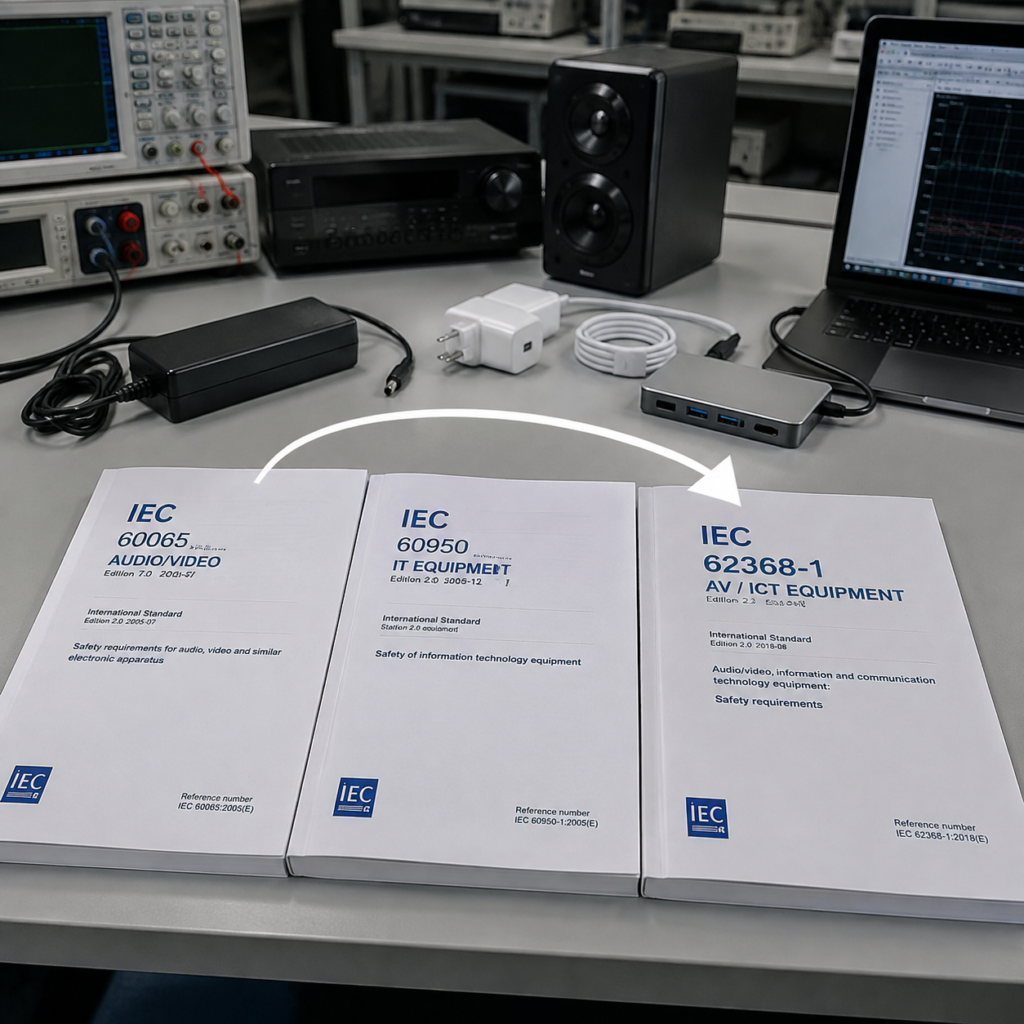
For ordinary users, the practical significance of this standard is very straightforward: the wall-plug chargers, laptop power adapters, USB-C cables with electronic marker chips, and docking stations with charging ports you use daily may adopt IEC 62368-1 or its national/regional adopted versions. However, whether it is mandatory, which version to use, and whether third-party certification is required must be judged according to the regulations of the place of sale and the intended use of the product. Understanding this standard will help you better screen the basic safety information of charging products, so you don’t have to wait for a problem to fall into a pit.
Applicability Judgment: Which Charging Products Are Covered by This Standard?
What many people care about most is: does the charging product I have fall under the jurisdiction of this standard? We have sorted out the common situations, so you can directly compare them.
First, the common charging products that may be involved: the first category is the most common wall-plug mobile phone chargers and desktop laptop power adapters; the second category is USB/USB-C cables with electronic components such as E-Markers — such cables need to meet the requirements of USB Type-C and related USB specifications, and standalone cables may also be subject to local regulations on cables, plug connectors, and flame retardancy in the place of sale. Whether they are evaluated together with the charger or the complete device depends on the specific certification scope and cannot be generalized; the third category is docking stations with charging ports and USB charging hubs; the fourth category is supporting power supplies for audio/video, IT, or communication equipment such as mobile phones, tablets, and speakers.
There are also many products that may be subject to other special requirements, so don’t confuse them: medical equipment, electric vehicle supply equipment, household appliances, and specific industrial equipment usually have special standards, but the final applicable standard depends on the intended use, structure, power supply relationship of the equipment, and regulations of the place of sale. IEC 62368-1 cannot be excluded or confirmed solely by labels such as “industrial” or “household appliance”. For example, medical equipment usually involves IEC 60601-1, household appliances usually may involve the IEC 60335 series, and electric vehicle supply equipment usually involves the IEC 61851 series; but externally sold external power supplies still need to be judged in combination with specific uses and certification scopes. Ordinary USB data cables without electronic components usually need to be evaluated in accordance with USB specifications and applicable cable and connector standards, and cannot simply be regarded as general objects of IEC 62368-1.
It is necessary to particularly clarify the boundary between charging cables and interfaces here: the core control objects of IEC 62368-1 are the safety of equipment and power supplies, not a general product standard for independently sold charging cables. Charging cables sold separately need to comply with USB-IF specifications and local cable safety standards in the place of sale, and cannot only use this standard as a justification. There is also a very common misunderstanding: a charger that meets this standard does not mean that any third-party charging cable you buy can safely support high-power fast charging — if the quality of the cable is not up to standard, it will still overheat, short circuit, or even catch fire.
To judge whether a product is applicable to this standard, there are two core points: first, whether it is a charging product supporting audio/video, IT, or communication equipment; second, it must be comprehensively judged in combination with its intended use, power, and the standard version adopted by the sales region, and cannot be judged only by the product’s appearance.
Core Safety Logic: Matching Protection to Hazardous Energy
The core idea of this standard, put simply, is: the greater the hazard, the thicker the protection. The professional name of this logic is “Hazard-Based Safety Engineering (HBSE)”. You don’t need to memorize the term, just understand three steps: first, find all hazardous energy sources inside the product that may hurt people; second, assess how likely users are to be exposed to these energies and how severe the injury would be; finally, match corresponding levels of protective measures. It is not a one-size-fits-all approach for all products.
There are three common types of hazardous energy in charging products, all of which you may encounter in daily life: the first is electrical energy, such as live prongs or abnormal voltage rise at USB ports, which may cause electric shock, short circuit, or arcing; the second is thermal energy, such as a charger getting hot under full load or a cable catching fire due to short circuit, which may cause scalding or fire; the third is mechanical energy, such as physical injury caused by sharp edges, cracked casings, loose parts, etc. A broken charging cable with exposed copper mainly poses electrical and fire hazards, and may also indicate that the mechanical strength has failed; loose prongs may involve both electrical connection and mechanical hazards.
To match corresponding protection, the standard classifies hazardous energy sources. ES and PS here are not fixed labels simply divided according to a certain nominal voltage or power, but must be determined in combination with voltage, current, energy, power, duration, accessibility, material conditions, and normal and abnormal states. 5V, 20V, or 65W in charging scenarios can only be used as examples of product parameters, and cannot alone determine the level.
| Energy Type | Classification | Examples in Charging Scenarios | Core Protection Requirements |
|---|---|---|---|
| Electrical Energy (ES) | ES1, ES2, ES3 | May include different energy sources such as USB output terminals, internal equipment circuits, and mains input sides | Determined according to conditions such as voltage, current, energy, duration, and accessibility, and configured with corresponding protection |
| Power Source (PS) | PS1, PS2, PS3 | May involve low-power output, high-power charging circuits, and power sources under fault conditions | Evaluate hazards such as fire and burns according to power, duration, accessibility, and material conditions |
Of course, the levels are not fixed. Voltage, current, power, usage environment (for example, safety risks increase in humid environments), and whether there is a fault (judgment under normal conditions may be different from that under fault conditions) will all affect the hazard level. Actual evaluation needs to be calculated or measured in accordance with the classification conditions and tables specified in IEC 62368-1. You cannot take “5V is ES1, 20V is ES2, mains connection is ES3” or “above 65W is PS2” as general rules.
Based on this logic, the standard proposes multi-layer protection to reduce risks from product design to usage environment: the most core is the product’s own protection, such as using an insulating casing, leaving a sufficient safety distance between internal live parts and the casing, and adopting current-limiting components or other protective measures — this is the foundation of safety; the second layer is environmental protection, that is, users should maintain ventilation and heat dissipation during use, do not use it in humid or dusty environments, and do not tuck the charger under a pillow to charge; the third layer is user behavior protection: do not disassemble the charger, do not block the heat dissipation holes, and do not use it beyond the rated range marked on the product, for example, using a 5W low-power charger to charge a gaming laptop at full speed.
Core Safety Requirements: Check if Your Charging Product Meets the Standards by Component
After talking about the logic, let’s move to specific components to see what safety requirements apply to chargers, charging cables, interfaces, and plugs that you come into contact with daily. You can compare them with the products you have.
First are chargers and power adapters, which are the most core components. The electric shock protection requirement is: under normal, abnormal, and fault conditions specified in the standard, users shall be prevented from contacting hazardous live parts that should not be accessible through casing, insulation, and structural design; the electrical isolation requirement is: the high-voltage side connected to the mains and the low-voltage side that charges the device must have reliable insulation and corresponding protection, and dangerous cross-voltage must not occur; temperature rise limits must be determined according to the specific limits in the standard for accessible surfaces, materials, ambient temperature, contact time, and working conditions, and 60°C to 80°C cannot be used to generalize all plastic casings. A user feeling obvious heat can only be a prompt to stop using or inspect, and cannot replace standard testing.
The fire protection requirement is: the casing and internal key materials and structures shall adopt corresponding protection against possible fire hazards, and the spread caused by flames and high temperatures shall be limited in case of faults. Products must also adopt standard-compliant protective measures against applicable hazards such as overload, short circuit, overheating, and overvoltage, but the specific measures do not necessarily have to adopt four specific protection circuits: overcurrent, overvoltage, overtemperature, and short circuit. They may also be realized through current-limiting components, insulation, structure, control software, or other safety measures.
Next are charging cables. First, the insulation and wire diameter must meet the standards: the outer insulation of the cable must be sufficient, and the thickness of the internal copper wire must match the rated current it marks, otherwise it will heat up when high current passes through, and even melt the insulation layer causing a short circuit; the mechanical strength requirement is: the root of the connection between the interface and the cable (that is, the place that is most easily bent in daily use) must be durable. After applicable tension, bending, or durability tests, there must be no exposed copper or broken cores. Cables shall also provide necessary rated parameters, manufacturer or model identification, and other required markings in accordance with applicable USB specifications, cable standards, and local regulations. You cannot directly judge that a cable is non-compliant just because the rated current, rated voltage, model, and certification marks are not all printed on the cable; but products that only print the words “fast charging cable” without even specific parameters and manufacturer information are indeed not conducive to verification, so be cautious when purchasing.
Next are USB/USB-C interfaces. The electric shock protection requirement is: under applicable normal and abnormal working conditions, users shall be prevented from contacting hazardous energy through interface structure, insulation, and equipment-level protection; the contact temperature rise requirement is: during high-current fast charging, the temperature of the interface and related parts shall comply with applicable USB specifications, connector rated requirements, and equipment safety limits. If the interface becomes abnormally hot during charging, unplug it immediately; the mechanical reliability requirement is: after applicable plug-in and durability tests, the interface must not have looseness, deformation, or damage that affects safety.
USB-C products shall also meet applicable USB Type-C, USB Power Delivery, and connector rating and test requirements at the same time. IEC 62368-1 mainly conducts equipment-level evaluation based on safety principles such as hazardous energy, accessibility, insulation, and fire protection, and cannot be simply summarized as “the higher the voltage, the higher the contact resistance or insulation level must be adopted”.
Finally, plugs and prongs. The dimensions must be compliant, meeting the applicable national or regional plug standards of the place of sale. There are differences in plug forms among European countries, and there is no completely unified “EU plug”; the commonly used plug in the UK is a three-rectangular-prong plug that complies with BS 1363. Incorrect dimensions or loose connections are prone to poor contact, leading to overheating or even fire; the mechanical strength requirement is that the prongs must be firm and not loose, and the related structure must not affect safety after applicable mechanical tests; the electric shock protection requirement is that when the plug is inserted into the socket, the exposed metal parts cannot be touched by fingers, that is, the length, position, and insulation structure of the prongs must comply with applicable specifications.
Common Safety Tests: What Exactly Does This Standard Test?
You may be curious, how are these requirements tested? We will explain the common test directions in plain language. You don’t have to test them yourself, but knowing what is tested will help you understand where inferior products fall short.
The first category is electric shock risk testing: testers will inspect and measure the product according to the probes, accessible parts, and normal and abnormal working conditions specified in the standard. Whether it is qualified depends on whether the hazardous energy exceeds the corresponding ES limit, and whether insulation, isolation, and other protective measures meet the requirements. It is not enough just that “live parts cannot be touched” or the voltage is below a general safety value. Slight cracking of the casing is also not a test scenario uniformly applicable to all products. The most common non-conformities may include hazardous live states at accessible parts, insufficient insulation and isolation, and non-compliant prong or interface structures with applicable requirements.
The second category is temperature rise and abnormal operation testing: test laboratories will select conditions such as normal operation, abnormal operation, overload, short circuit, and limited heat dissipation according to applicable clauses, and make judgments based on temperature, fire, and electrical safety limits. Conditions such as long-term full-load operation, output short circuit, and limited ventilation may be part of the abnormal operation or misuse evaluation for some devices, but they are not uniformly conducted for all products and all items; input overvoltage and blocked ventilation vents also cannot be regarded as a fixed test list of IEC 62368-1 for all chargers. Common reasons for non-conformity are insufficient protection and current-limiting measures, poor heat dissipation design, or temperature and fire risks exceeding limits under abnormal conditions.
The third category is fire protection and flame retardant testing: according to the product structure and applicable clauses, evaluate whether materials, components, and structures will cause flame spread, molten material dripping, or sustained combustion under fault or fire source conditions. Qualification judgment depends on specific materials, fire hazard levels, and test conditions specified in the standard, and cannot be simply summarized as “all materials must self-extinguish as soon as they are ignited”. Many cheap chargers are unqualified because of insufficient materials, structure, or fault protection, which easily leads to flame spread.
The fourth category is mechanical strength testing: mechanical strength, impact, plug fixation, cable bending, and connector durability shall be tested separately in accordance with applicable IEC, USB-IF, national or regional product standards and certification schemes, and cannot be summarized as a unified test of this standard for all related components. The test items and severity for chargers, plugs, standalone USB cables, and interfaces depend on the device type and structure. The most common non-conformities are that the root of the charging cable is easy to break, the prongs are not firmly fixed, or live parts are exposed after the interface is damaged.
The fifth category is marking and manual inspection: check whether the parameters on the product nameplate are clear, whether the marks and warning information required by regulations are correct and complete, and confirm whether ordinary users can understand the rated parameters and usage restrictions. The specific marking content depends on the regulations of the place of sale, product category, and certification scheme. A common problem with many ‘three-no’ products is the lack of manufacturer information, unclear model numbers, missing input and output parameters, or falsely marked output power.
Standard Versions and Regional Certifications: Don’t Be Fooled by “Global Certification”
When many people buy charging products, they will see various certification marks printed on the packaging, as well as different standard versions. There are quite a few tricks here, let’s sort them out.
First is the version difference of the standard: currently, the common versions of IEC 62368-1 on the market are the 2018 version and the 2023 version. The 2023 version is a new international standard that includes multiple technical and editorial changes, and cannot be simply summarized as only refining the requirements for USB-C fast charging or new materials. The specific change content, transition period, and acceptable versions shall be subject to the version adopted by the place of sale, local regulations, and the rules of certification bodies; there is no need to blindly pursue the newest version.
Then it is necessary to clarify the relationship between international standards and regional certifications: IEC standards are only internationally accepted standard texts, and are not equivalent to the mandatory regulations of each country. Various countries and regions may adopt national or regional versions of IEC 62368-1, but the standard numbers, mandatory regulations, accredited testing bodies, and certification or supplier declaration procedures vary. The United States and Canada involve national standard systems such as UL and CSA respectively; Japan’s PSE is a system under the Electrical Appliance and Material Safety Law, and marking “JIS C 62368-1” does not automatically correspond to PSE; South Korea usually uses the KS system and KC compliance procedures; Australia and New Zealand use the RCM regulatory compliance mark. PSE, KC, and RCM cannot be directly regarded as synonymous certifications of the IEC version.
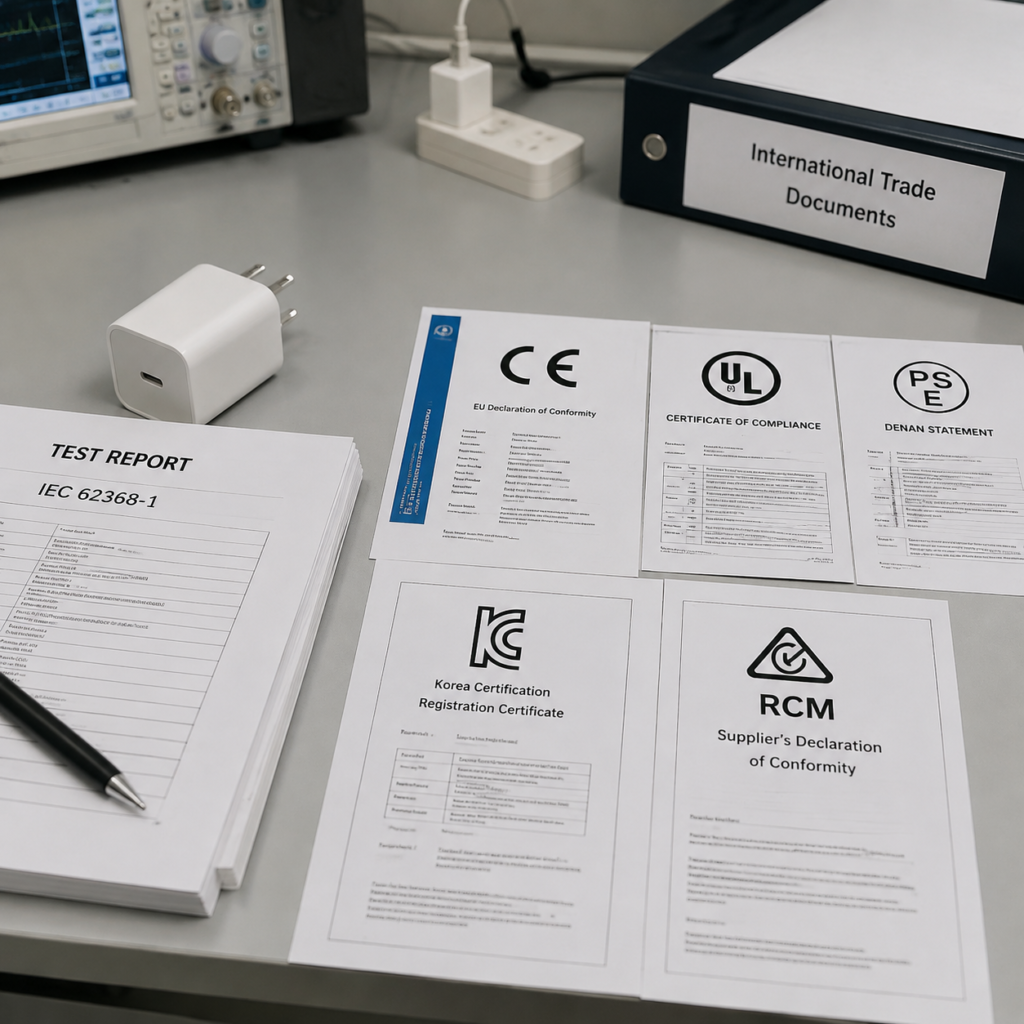
Safety certificates or compliance documents are also not globally valid. Whichever region a product is sold in, it must meet the local version and certification requirements; a certification from one region cannot be directly used in another region.
Common certification marks have different meanings, so don’t confuse them:
- CE mark (EU): It is usually a manufacturer’s declaration of conformity with applicable EU requirements, not a safety certificate uniformly issued by a third-party body. Manufacturers need to prepare corresponding technical documents and, where applicable, complete procedures involving notified bodies. The CE mark alone is not sufficient to fully prove the electrical safety compliance of a product.
- UL, cUL, and some TÜV certifications usually involve third-party evaluation; GS is a German safety mark issued by accredited bodies, while TÜV is a body or certification brand. The two cannot be simply regarded as the same type of issuing mark.
- The evaluation methods for PSE, KC, and RCM vary by product category and local regulations, and may include third-party certification, registration inspection, or supplier declaration of conformity. RCM is usually a mark where the supplier undertakes the declaration of conformity and completes the responsible supplier registration, not a mark uniformly issued by a third-party body.
- Special reminder: The RoHS mark regulates the restriction of hazardous substances and is not the same thing as electrical safety. Therefore, a product marked only with CE and RoHS does not mean it has passed the applicable electrical safety assessment.
Practical Judgment Methods: Compliance Checking Tips You Can Do Yourself
At this point, you already have a sufficient knowledge base. Below are several practical methods you can use to judge whether the charging product you have is compliant, from beginner level to proficient judgment.
The first is quick preliminary judgment via the nameplate. Pick up the product and look at the nameplate on the bottom, looking for three things: First, check whether the product has the manufacturer’s name, product model, input and output parameters, and applicable compliance marks required by regulations. The product nameplate does not necessarily have to be printed with “IEC 62368-1” or the complete national standard number; specific requirements depend on the regulations of the place of sale, product category, and certification scheme. Only writing “complies with international standards” cannot be used as sufficient proof, but you also cannot judge that a product is non-compliant solely because the standard number is not printed on the nameplate; second, check whether the certification marks match the sales region and product category. Do not simply regard CE as a third-party safety certification, nor regard a mark from one region as a globally valid proof; third, combine supplier documents or certification databases to verify the actual applicable standards and certification scope of the product, to avoid only looking at the promotional language on the packaging.
The second is the certification verification method. If you have doubts about a product, you can ask the merchant for the certification number, certification file, or compliance documents required by regulations, and then verify them in the official database of the corresponding regulatory body or certification body. For example, UL Product iQ is mainly used to query UL certification information and files, but not all certification reports can be publicly queried through a unified number. When verifying, pay attention to: whether the product model and factory information on the file are consistent with the product you bought; whether the adopted standard number matches the sales region; whether the current status is valid; whether the certification or test scope covers the relevant charging functions. Whether there is a unified validity period and whether annual supervision is required shall be judged according to the specific certification scheme. Test reports cannot replace certificates or compliance documents required by regulations. Also remember: documents and certification files are usually for the marked model, factory, and applicable scope, and you cannot directly apply the materials of other products of the same brand.
The third is daily use self-inspection, which can be done without tools: if there is abnormal overheating, continuous temperature rise, peculiar smell, discoloration, or abnormal protection action, stop using and inspect. Human perception of temperature is affected by contact time, contact area, and environment. 60°C cannot be used as the safety or hazard dividing line for all charger casings; formal temperature compliance must be judged according to the environment, load, contact time, and measurement parts specified in applicable standards. During appearance self-inspection, if you find loose prongs, exposed copper on the charging cable, cracked casing, or deformed interface, stop using immediately; during abnormal condition self-inspection, if there is peculiar smell, abnormal noise, or casing discoloration during charging, cut off the power and unplug immediately.
The fourth is rapid identification of high-risk products. Avoid these four types directly: First, ‘three-no’ products with no nameplate, no manufacturer, no model number, and no key parameters; second, products with an extremely high nominal power, but whose volume and weight are obviously much smaller than regular products of the same power, and with no reasonable heat dissipation design visible — for example, a charger marked 100W that is the same size as an old 5W charger is most likely something to be wary of; third, products with rough workmanship, such as loose prongs, uneven casing seams, or skewed interfaces; fourth, products that claim “global certification” but cannot produce verifiable certification files or compliance documents — basically, you cannot trust them solely based on promotional language.
Common Misconceptions and Applicable Boundaries: Don’t Treat the Standard as Omnipotent
Finally, let’s talk about several common cognitive misconceptions and the boundaries of this standard, to prevent you from overinterpreting it or using it incorrectly.
First misconception: Meeting this standard means absolute safety and no breakdowns. The truth is, this standard is only part of the safety assessment for specific equipment. It puts forward protection requirements for specified normal, abnormal, foreseeable misuse, and fault conditions. If you use it beyond the rated power, get it wet, drop it, or disassemble/modify it yourself, these situations may exceed the original assessment conditions, and problems may still occur.
Second misconception: Having a certification mark means it must be compliant. The truth is, there are cases of forged certification marks on the market, and CE is usually a manufacturer’s declaration of conformity, which does not require unified third-party issuance; the evaluation methods for marks such as PSE, KC, and RCM are also not completely the same. Even for third-party certification, you must verify the specific model, factory, standard, certification scope, and current status, and cannot draw a conclusion just by looking at a mark.
Third misconception: All charging products are applicable to this standard. The truth is, household appliances, medical, industrial, and automotive charging products may have their own professional safety standards, but the final applicable standard still needs to be judged according to the product’s intended use, structure, power supply relationship, and regulations of the place of sale; independently sold charging cables also have additional USB specification and cable standard requirements, so you cannot only look at this standard.
Fourth misconception: The higher the power, the more dangerous it is; the newer the standard version, the better. The truth is, the degree of hazard depends on whether the product’s design and protection are matched. For regular high-power products, the protection and heat dissipation design may be more complete than that of inferior low-power products; as for versions, although the 2023 version is a new international standard, the specific changes, transition period, and acceptable versions shall be subject to the adoption rules of the local region, and there is no need to blindly pursue the newest version.
Fifth misconception: A USB port outputting 5V is absolutely safe. The truth is, inferior products may have abnormal voltage rise, short circuit, or insulation breakdown. Even if it is nominally 5V, it is not necessarily safe. Safety depends on the overall design of the product, not a single nominal voltage.
It should also be clear that this standard has its coverage boundaries. IEC 62368-1 does not replace specialized standards for batteries, EMC, electrical connectors, IP protection, weather resistance, transportation, and recycling, but it may still put forward requirements for batteries inside equipment and some electrical, fire, and other safety hazards they may cause. Electromagnetic compatibility performance is usually evaluated in accordance with independent standards such as IEC/CISPR; whether waterproof, dustproof, and weather resistance tests are required shall be determined according to specific product types, regulations, and certification schemes. Special scenarios such as child misuse may also need to be judged in combination with other regulations or product standards.
At this point, your understanding of IEC 62368-1 has progressed from beginner level to being able to make independent judgments: you can quickly distinguish which daily charging products may need to adopt this standard, can tell the difference between international standards, regional versions, third-party certifications, and self-declarations, can preliminarily verify the basic compliance of products through nameplates, official databases, and supplier documents, can also identify safety hazards of chargers, charging cables, and interfaces in daily use, avoid common cognitive misconceptions, and quickly identify four types of high-risk inferior products. The safety of charging products can never be fully guaranteed by a single mark, but understanding this core safety standard can help you pass the first checkpoint — after all, for things you use every day, safety always comes first.