
For friends who sell charging products overseas, you will most likely come across the term “MIC certification” when expanding into the Vietnamese market. Many people’s first reaction is: Do all the chargers and charging cables I sell need this certification? Isn’t FCC and CE enough? If you get it wrong, at best you’ll waste tens of thousands of yuan in certification fees, and at worst your goods will be detained during customs clearance and your products will be removed from e-commerce platforms, resulting in significant losses.
Today we will thoroughly explain the scope of application of Vietnam’s MIC certification, focusing on the charging products that everyone is most concerned about (chargers, charging cables, wireless chargers, power banks, etc.). From basic concepts to judgment methods, and then to common pitfalls, after reading this you will be able to make a preliminary judgment on your own.
First, Understand: What Exactly is MIC Certification
MIC is the English abbreviation for the Ministry of Information and Communications of Vietnam. MIC-related compliance requirements apply to radio, communications, and some information technology products that are included in the regulated product catalog announced by the Vietnamese competent authority and are subject to the corresponding QCVN technical regulations. QCVN here can be simply understood as Vietnam’s national technical regulations formulated for a certain category of products.
Therefore, whether it is necessary to apply for a Certification of Conformity or a Declaration of Conformity cannot be determined solely by whether the product is a “wireless product” or “IT product”, but must be judged in combination with the specific product category, applicable QCVN, and the current regulatory catalog.
For charging products, there is a very important premise: Ordinary chargers and charging cables without wireless or communication functions generally do not fall within the scope of MIC radio compliance, but you should still check the latest catalog and confirm whether there are electrical safety, energy efficiency, and other requirements from other departments. For products with communication, networking, or information technology functions, the applicability of MIC cannot be excluded simply because “it is a charger”.
Many people think that “needing to meet MIC requirements” is equivalent to “needing to obtain an MIC certificate”, but this is not necessarily the case. Regulated products may need to apply for a Certification of Conformity and affix the CR mark, or they may only need to submit a Declaration of Conformity. Which procedure applies to a specific product should be confirmed based on the current regulatory catalog and the corresponding QCVN, and cannot be generalized by the so-called “Type A high-risk products, Type B low-risk products”.
Why is it necessary to clarify the scope of application of MIC? To put it bluntly, it boils down to two key points: saving money and avoiding pitfalls. If your product is not within the regulatory scope, you don’t need to spend time and money on inapplicable MIC procedures at all, which can save a lot of costs. If you misjudge – if you don’t do what you should – your goods are likely to be detained during customs clearance, e-commerce platforms (such as Shopee and Lazada Vietnam) may directly remove your products, and in serious cases, there will be fines. After all, Vietnam is now one of the core export markets for charging products in Southeast Asia, and compliance is an important threshold for entry.
Many people also confuse MIC with other common certifications for charging products, so let’s clarify them directly here:
• CR conformity mark and related systems: CR is not a single “safety certification” that covers all chargers. Whether a charger needs CR should be confirmed according to the applicable electrical safety technical regulations and the current product catalog.
• Energy efficiency requirements (MOIT): Energy efficiency testing or energy efficiency labels only apply to products included in the energy efficiency management catalog of the Ministry of Industry and Trade (MOIT) of Vietnam. It cannot be deduced from this that all ordinary switching power supplies must undergo MOIT energy efficiency certification.
• EMC (Electromagnetic Compatibility): This governs whether devices interfere with each other when operating, and their ability to resist external interference under certain conditions. Whether it applies specifically depends on the product category and corresponding requirements.
MIC mainly handles the compliance of radio frequency, communication, network, and some information technology products in its catalog. These requirements may coexist with the above requirements, and none can automatically replace the other. Also, a reminder: overseas certifications such as CE, FCC, and CCC cannot directly replace Vietnam’s MIC requirements, but if existing test reports meet the technical requirements of Vietnam’s relevant QCVN, they may have reference or reuse value when applying for corresponding compliance procedures. Whether they are accepted still needs to be confirmed by the specific procedure and authority.
To Determine Whether MIC is Required, Focus on 4 Dimensions
After understanding the basic concepts, you can make a preliminary judgment on whether your product needs to go through MIC-related compliance procedures from the following four dimensions. The final conclusion should still be based on the specific catalog, QCVN, and import method.
Dimension 1: Whether it has active wireless/communication functions
This is an important starting point for judgment. Simply put, it is whether the product can actively send or receive wireless communication signals. For example, common Wi-Fi, Bluetooth, 4G/5G cellular, NFC, Zigbee, LoRa, etc., may all be wireless or communication functions that require further evaluation.
Here, special attention should be paid to several easily confusing items for charging products: fast charging protocols such as PD/QC, Qi wireless charging, and ordinary USB data transmission cannot be directly identified as MIC radio equipment just because the names contain “wireless”, “protocol”, or “data”. Whether they fall within the scope of MIC also depends on whether the device includes other wireless functions, operating frequency, power, product composition, and the current catalog.
Dimension 2: Whether it connects to public communication networks
Whether it connects to a public communication network cannot be used as the sole determining condition for MIC applicability.
If the product uses a SIM card or eSIM and has cellular communication functions, it of course needs key evaluation; short-range wireless devices such as Wi-Fi and Bluetooth may fall within the scope of the corresponding QCVN due to their wireless transmission function, operating frequency band, and power, even if they only connect to a home LAN or other devices. On the other hand, an Ethernet interface itself is a wired interface, which does not mean that the product necessarily requires MIC certification.
Similarly, if a product only connects to a computer via USB, you cannot exclude all information technology or communication product compliance requirements just because it “does not connect to a public network”. The correct approach is to first identify the product’s wireless transmission, wireless reception, cellular communication, short-range wireless, and wired communication functions, and then compare them with the corresponding QCVN and the latest catalog.
Functions such as remote control, data upload, and remote firmware upgrade, although they cannot alone replace product classification judgment, can help you discover that the product may include communication or networking functions that require further verification.
Dimension 3: How the product is sold and used
The sales and usage form of the product will affect the judgment of import, market placement, and compliance documents, but being in the same package or being a gift does not automatically grant a general exemption of “compliance following the whole machine”.
If the product is independently retailed to ordinary consumers, or circulated in the market as a gift, it must be judged in combination with whether the product itself is in the regulated catalog and what technical regulations apply.
If charging accessories are imported or sold in the same package as a whole machine that has already gone through relevant compliance procedures, you cannot assume that the charger does not need to be handled separately just because they are “in the same package”. Whether it can be handled together with the whole machine and whether separate documents need to be submitted depends on whether the charger itself is a regulated product, whether the compliance scope of the whole machine covers the accessory, and the specific import declaration documents.
If they are charging accessories dedicated to industrial use or supporting large equipment, they cannot be judged directly according to the rules for ordinary civilian products, and should be further checked based on the product’s technical characteristics, purpose, and regulatory catalog.
Dimension 4: Whether it is in the latest regulatory catalog
MIC-related regulatory lists and technical regulations will be adjusted along with regulatory revisions and changes in product classification. You cannot judge directly based on old materials from a few years ago, offhand remarks from suppliers, or certification requirements of other countries. You must be guided by the latest catalogs, Circulars, QCVNs, and revision announcements issued by the Vietnamese competent authority.
For borderline products that you are really unsure about, you can verify with the MIC competent authority, designated conformity certification bodies, or professional consultants familiar with Vietnam’s import compliance. Institutional opinions can help understand product classification, but they cannot replace formal Certification of Conformity, Declaration of Conformity, import inspection, or other legal procedures.
MIC Requirements for Common Charging Products: Check at a Glance
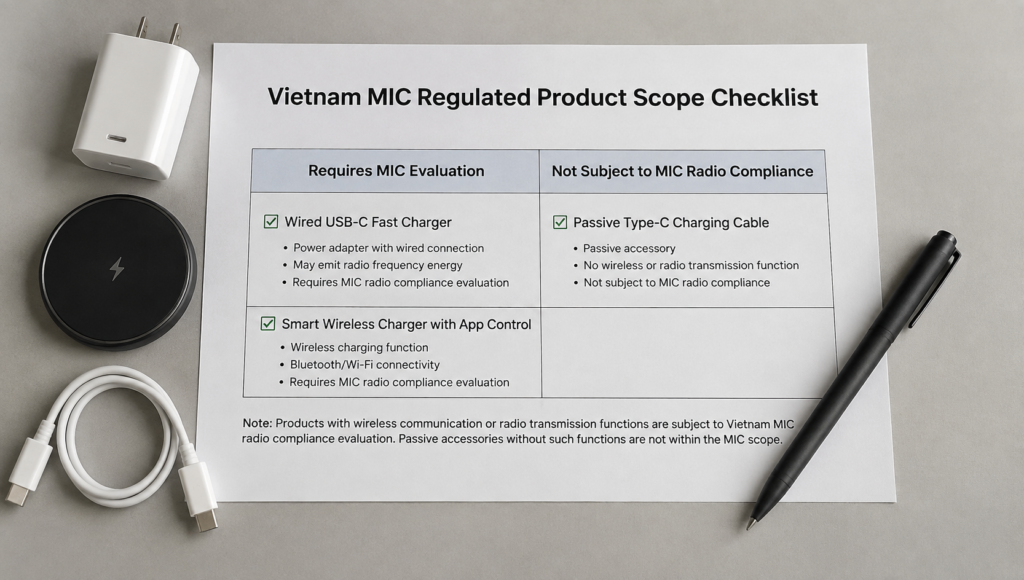
If you are still a bit confused after reading the four dimensions above, we have compiled the most common charging products into a comparison table below, so you can directly match your product. “Needs evaluation” in the table does not mean that certification is necessarily required, but rather that a conclusion cannot be drawn solely based on the interface or product name.
| Product Category | Usually Requires Key MIC Evaluation | Usually Not Handled as MIC Radio Compliance | Borderline Cases Require Verification |
| Chargers/Power Adapters | Smart chargers with Wi-Fi/Bluetooth and APP control; remote management power adapters with cellular communication; charging devices with integrated router/gateway functions | Ordinary wall/desktop chargers with only AC-DC conversion (including fast charging models such as PD/QC); passive power adapters for power supply only; car chargers without wireless functions (cigarette lighter to USB/USB-C) | Multi-function power adapters with Ethernet interfaces; power modules for industrial-specific supporting communication equipment should be checked according to specific models, network functions, and the latest catalog |
| Charging Cables/Adapters/Docking Stations | Smart charging cables with built-in wireless modules; adapters with integrated wireless functions such as Bluetooth/NFC | Ordinary passive charging cables (USB-A/USB-C/Micro-USB, for power/data transmission only); fast charging cables with e-Marker chips (for power negotiation only); ordinary adapters with pure physical conversion; docking stations that only expand USB/video, without network ports or wireless modules | USB-C adapters with cellular or Ethernet conversion functions, USB-C docking stations with Ethernet interfaces, and long cables with signal amplification or active data processing should be checked according to specific product categories, network functions, and the current MIC catalog; having only a wired network interface does not mean that MIC is necessarily required |
| Plugs/Power Strips/Charging Port Accessories | Smart power strips/smart conversion plugs with Wi-Fi/Bluetooth; smart charging port modules supporting remote control or power statistics | Ordinary power plugs/conversion plugs without communication functions; ordinary power strips with only physical expansion; separately sold passive charging port female/male connectors | Smart conversion plugs with protocol conversion chips but no wireless functions should be judged based on their specific functions, product classification, and applicable technical regulations |
| Wireless Chargers/Power Banks/Car Chargers | Wireless chargers with Bluetooth/Wi-Fi and APP control; smart power banks with cellular/Bluetooth; car chargers/charging bases with networking functions | Ordinary wireless chargers without communication wireless modules are usually not handled as communication devices such as Wi-Fi and Bluetooth; ordinary power banks (only for charging and discharging, no wireless modules); ordinary car chargers without networking functions | The operating frequency, transmission power, device composition of wireless charging equipment, or whether it has functions such as NFC, Bluetooth, Wi-Fi, etc., may affect the judgment, and should be verified against the latest QCVN and regulatory catalog |
| Supporting Terminals with Charging Functions | Smart charging terminals/networked charging piles with cellular/Wi-Fi; complete wireless communication devices with charging ports (such as smart speakers, smart door locks) | Ordinary small charging appliances without wireless/communication functions (such as rechargeable desk lamps, rechargeable fans) | Complete products with built-in charging modules should be judged based on the whole machine category, wireless functions, and corresponding technical regulations |
These Special Situations May Have Exceptions, But Cannot Be Self-Identified
In addition to conventional product judgments, there are some special situations such as personal carrying, exhibition testing, maintenance and replacement, and circulation in bonded zones, which may involve different import or compliance exceptions.
For example, a small number of charging products carried for personal use, temporarily imported exhibition or test samples, original charging accessories imported with whole machine maintenance, and products only circulated in bonded zones cannot simply apply the same conclusion. Whether to be exempted from Certification of Conformity or Declaration of Conformity needs to be confirmed on a case-by-case basis according to the specific purpose, quantity, import method, customs documents, whether they enter the Vietnamese market, and current MIC regulations.
“1-2 pieces” is not a universally applicable MIC exemption quantity. Exhibition, testing, maintenance import, and bonded zone businesses may also involve requirements such as customs declaration, temporary import, supervised warehouse, filing, or prohibition of market placement. You cannot assume that all MIC obligations are automatically exempted just because you have reported in advance, the product quantity is small, or the product is in a bonded zone.
Regarding the special situation of bundled sales, many sellers are prone to misjudgment. If charging accessories are imported or sold in the same package as a whole machine that has completed relevant compliance procedures, whether they can be handled together with the whole machine and whether separate documents are required should be confirmed by the specific product catalog, technical regulations, whole machine certification scope, and import documents. “Same package” cannot be used as a general exemption condition.
If charging accessories are retailed separately, even if they were originally part of a set, they must be re-judged as independent products. Independent packaging, independent models, separate import, or separate sales all require separate verification of the product’s compliance scope. If there are several charging accessories in a set and you plan to sell them separately later, you cannot default that all of them are compliant with the whole machine.
We also want to remind everyone that MIC-related catalogs and technical regulations may be adjusted along with regulatory revisions. When it comes to charging products, the focus usually includes wireless functions, operating frequency bands, transmission power, and product classification. Do not vaguely cite statements such as “new low-power wireless device category”, but should look for specific Circulars, QCVNs, or catalog revision announcements. Products that have already gone through relevant procedures should also be re-checked after rule changes to see if new compliance obligations arise.
4-Step Quick Self-Check: You Can Make a Preliminary Judgment Yourself
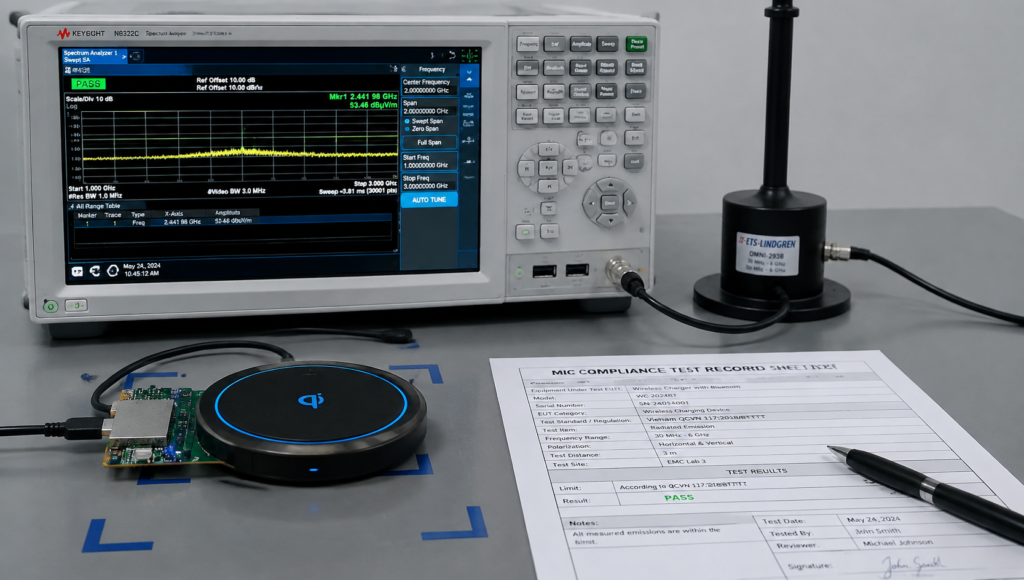
Having said so much, when you get a new charging product, how do you quickly judge whether MIC is needed? Just follow these four steps, which are simple and easy to operate:
Step 1: First sort out the core functions of the product. List all wireless, communication, and networking-related functions, such as whether it has Wi-Fi, whether it can connect to Bluetooth, whether it supports cellular communication, whether it can be remotely controlled, whether it can use a SIM card or eSIM. At the same time, distinguish between pure charging, pure power supply functions and communication functions. Ordinary charging products without wireless or communication functions can usually be preliminarily excluded from the scope of MIC radio compliance, but do not skip the check of the latest catalog and other regulations because of this.
Step 2: Confirm the sales and import form of the product. You need to figure out: Is this product sold independently to consumers, or sold bundled with other whole machines? Is it for the ordinary civilian market, or for industrial use and supporting large equipment? Is it to be sold in the Vietnamese local market, or just temporarily imported for exhibition, testing, or circulated in a bonded zone? These situations will affect the final import and compliance judgment.
Step 3: Check the parameters and the latest regulatory catalog. If the product has a wireless module, be sure to find out its operating frequency band, transmission power, wireless technology, and module model, then compare with the latest catalog issued by MIC and the corresponding QCVN to confirm the corresponding product category and compliance procedure. If the product only has ordinary power supply functions, you also need to confirm whether safety, energy efficiency, or labeling requirements from other departments apply.
Step 4: Borderline products must be verified in advance. If your product is a borderline case – for example, with an Ethernet port, cellular module, NFC function, or with multiple network and data processing functions at the same time – do not judge by feeling when you are unsure, and do not just listen to the supplier say “no need”. You can submit the product specification, wireless module model, operating frequency band, power, and function description to the MIC competent authority, designated conformity certification body, or Vietnam import compliance consultant for confirmation. Institutional opinions cannot replace formal procedures, so you should import or put on sale after confirming the product classification and legal requirements.
6 Most Common MIC Certification Misconceptions to Avoid
Finally, we have compiled the 6 most common misconceptions about MIC certification. Avoiding these pitfalls can help you save a lot of unnecessary money and avoid many detours:
1. Misconception: All chargers and charging cables require MIC certification
Correction: Ordinary chargers and charging cables without wireless or communication functions generally do not fall within the scope of MIC radio compliance, but the final check should still be made against the latest regulatory catalog and other applicable regulations. For charging products with wireless, communication, or information technology functions, MIC requirements cannot be excluded solely based on the product name. When judging, it depends on whether there is a wireless module, cellular communication, short-range wireless function, and whether the product is included in the corresponding QCVN catalog.
2. Misconception: Having a USB-C interface and supporting fast charging protocols requires MIC
Correction: USB-C is just a physical interface, and fast charging protocols such as PD and QC are mainly used to negotiate power supply, and will not trigger MIC radio requirements solely based on these features. USB-C devices with wireless modules or other communication functions require further evaluation; docking stations with Ethernet interfaces or network conversion functions cannot be directly judged by the interface name alone, and should be checked according to specific product categories and the latest catalog.
3. Misconception: Wireless charging definitely requires MIC certification
Correction: Ordinary wireless chargers without communication wireless modules are usually not handled for MIC as communication devices such as Wi-Fi and Bluetooth, but this is not an absolute exemption. It still needs to be confirmed against the latest QCVN and regulatory catalog in combination with operating frequency, transmission power, device composition, and whether it includes other wireless functions such as NFC, Bluetooth, Wi-Fi, etc. The name “Qi” itself cannot be used as a basis for Vietnam MIC exemption.
4. Misconception: Having CE/FCC/CCC certification can replace MIC
Correction: MIC is Vietnam’s local market access compliance requirement, and overseas certifications cannot directly replace it. However, if the product has a test report that meets the technical requirements of Vietnam’s relevant QCVN, it may have reference or reuse value when handling Vietnam’s corresponding conformity procedures. Whether it is accepted shall be confirmed by the specific procedure and authority.
5. Misconception: Products given as gifts or sold online do not need MIC
Correction: Products included in the MIC regulated catalog and placed on the Vietnamese market usually need to go through corresponding conformity procedures. Gifts or e-commerce sales will not automatically change the regulatory scope of the product itself, but situations such as cross-border direct mail, personal use, and small-batch samples need to be confirmed in combination with the specific import method, product category, and applicable exemption rules. There is no unified “commercial quantity” threshold applicable to all products in the current system.
6. Misconception: MIC is a safety certification for charging products
Correction: MIC mainly handles compliance of communications, radio, and information technology in its catalog, and is not equivalent to electrical safety certification for all charging products. The electrical safety, energy efficiency, and labeling requirements of chargers may be managed by different technical regulations, competent department catalogs, and mandatory systems respectively. Whether ordinary chargers need CR, energy efficiency testing, or energy efficiency labels must be judged according to specific models, rated parameters, and product catalogs, and cannot be generalized as all ordinary chargers “only need CR and energy efficiency”.
In general, to judge whether a charging product needs to go through Vietnam MIC-related compliance procedures, you cannot just look at whether it is a charger, nor just look at whether it is connected to a public network. A more reliable approach is to first identify whether the product has wireless transmission, wireless reception, cellular communication, short-range wireless, or other communication functions, and then confirm in combination with the operating frequency band, transmission power, device category, latest MIC catalog, and corresponding QCVN.
Mastering the above judgment methods and pit avoidance skills, you can conduct preliminary screening of common charging products, reduce unnecessary certification costs, and avoid the risk of goods detention and removal due to misjudgment. If you encounter borderline products such as wireless chargers, network docking stations, smart power modules, or supporting terminals, you should check Vietnam’s current regulations and import requirements in advance. The earlier you confirm the product classification, the more you can avoid remedial measures after entering the market.