
Friends who do business in charging products in Southeast Asia, as long as they have dealt with the Vietnamese market, have most likely heard of the term “MIC certification”. Some say all charging products need it, some say FCC/CE is sufficient, and others say wireless chargers must obtain it. There are all kinds of statements, and many people have fallen into pitfalls. Today we will thoroughly explain Vietnam MIC wireless certification, from the most basic definition to how to judge, how to apply, and how to avoid pitfalls. After reading it, you can handle most related problems by yourself.
Must-Know for Beginners: Basic Understanding of MIC Wireless Certification
Simply put, the “Vietnam MIC wireless certification” that people often refer to usually refers to the conformity assessment requirements involved when radio and telecommunications equipment enter the Vietnamese market. Relevant regulations and historical documents were previously mainly under the responsibility of the Ministry of Information and Communications of Vietnam, so the term “MIC” is still commonly used in the industry. After the institutional adjustment in 2025, relevant functions have been taken over by the Ministry of Science and Technology of Vietnam and its competent authorities. In actual applications, the current competent authorities and the latest regulations shall prevail.
It is not a universal certificate that can cover all wireless products. For wireless equipment included in Vietnam’s current regulated list and subject to the corresponding QCVN technical regulations, it is usually necessary to complete the specified type approval, declaration of conformity, or other conformity assessment procedures before import, sale, or use. Specific requirements cannot be judged solely based on the condition of “having wireless functions”.
The main purpose of these requirements is to ensure that equipment meets Vietnam’s radio requirements such as frequency band, power, emission characteristics, anti-interference, and electromagnetic compatibility. When human electromagnetic exposure is involved, applicable special requirements must also be complied with. Not all charging wireless devices uniformly take human radiation safety as the core item of conformity assessment.
A very important boundary must be drawn first: this type of radio compliance requirement mainly governs radio frequency and related electromagnetic compatibility parts, and does not mean that the product has completed compliance in aspects such as electrical safety, energy efficiency, general quality, and plug specifications. These requirements may still be managed by other Vietnamese regulations and competent authorities, so don’t confuse them.
Why should charging products pay special attention?
Some people may say, I sell chargers and charging cables, what does that have to do with wireless? Today’s charging products are no longer just pure wired products: smart chargers with App control, wireless chargers that can connect to Bluetooth, USB-C charging stations with Wi-Fi, shared power bank cabinets with 4G… These products may all be subject to radio regulation.
If regulated equipment for commercial import and sale does not complete the corresponding procedures, it may face risks such as customs clearance obstruction, administrative penalties, or removal from e-commerce platforms. It should be noted that different exemption or simplified regulations may apply to situations such as personal use, samples, and exhibition display. Whether it is necessary to submit conformity assessment documents depends on the purpose of import, quantity, equipment category, and requirements of customs and special regulations. It cannot be assumed that relevant documents must or must not be provided just because personal small parcels or e-commerce direct mail are used.
Of course, it must be emphasized again: this type of radio compliance is only one of the basic compliance items for the Vietnamese market, not all. Safety, energy efficiency, product quality, import procedures and other required items still need to be completed.
Three Most Common Beginner Misconceptions
People who are new to this are easy to fall into three common pitfalls. Let’s clarify them here first to avoid wasting money.
First misconception: All charging products need MIC. This is inaccurate. Pure wired products usually do not involve radio type approval, but having wireless functions does not mean that the same procedure must be adopted. Ultimately, it still depends on whether the product is included in Vietnam’s current regulated list and which QCVN technical regulation applies. For example, ordinary USB-C chargers usually do not involve radio conformity assessment, but other applicable regulations still need to be checked.
Second misconception: Having CE or FCC wireless certification can be used directly. This is wrong. Vietnam will not automatically exempt local conformity assessment requirements just because the product already has EU or US certification. Whether CE and FCC reports can be used as part of technical materials needs to be confirmed in advance; if necessary, additional tests or local procedures may still be required in accordance with Vietnamese requirements.
Third misconception: Having MIC certification means the product is fully compliant. This is wrong. Radio conformity assessment only addresses wireless and electromagnetic compatibility requirements within the corresponding scope. Electrical safety, energy efficiency, plug specifications, etc., must also comply with other corresponding Vietnamese regulations.
Core Judgment: Whether Your Charging Product Needs MIC-Related Compliance
After clarifying the basic concepts, the question everyone is most concerned about must be: does the charging product I have need to go through MIC-related procedures?
When judging, you cannot only look at the product name, nor can you take “whether there is active wireless communication function” as the only standard. A more prudent approach is: first confirm the equipment category according to Vietnam’s current regulated product list and applicable QCVN, and then judge whether type approval, declaration of conformity, or other radio, EMC or safety requirements are needed.
First Check Whether the Product Involves Regulated Wireless Functions
Wi-Fi, Bluetooth, NFC, Zigbee, radio frequency remote control, and 4G/5G cellular communication usually belong to wireless functions that need to be checked emphatically. They actively transmit or receive wireless signals for data transmission, device control, or network communication.
However, which Vietnamese procedure the product ultimately needs to go through must be judged in combination with frequency band, power, equipment purpose, product category, and the current list. The name of the wireless function can only be used as a clue for preliminary judgment, and cannot replace regulatory classification.
Wireless power transmission equipment cannot be simply excluded either. Some inductive wireless charging devices may involve applicable radio, EMC or other technical requirements. Therefore, Qi is only a wireless charging interoperability standard and cannot be used alone as a basis for exemption from Vietnamese regulations.
For your convenience in comparison, the following classification can only be used as a preliminary screening, and the final result shall still be subject to the applicable QCVN and Vietnam’s current product list:
| Usually require further verification of MIC/current radio compliance requirements | Usually do not involve radio type approval, but other regulations still need to be checked |
| Smart chargers and power adapters with Bluetooth, Wi-Fi or App control | Pure wired USB-A/USB-C chargers, power adapters, charging cables |
| Desktop/car wireless chargers with Bluetooth pairing, NFC or other communication functions | Ordinary power banks and desktop charging stations without wireless communication functions |
| USB-C charging stations, multi-port charging docks, and smart charging power strips with built-in wireless modules | USB-C charging accessories only with e-Marker chips |
| Shared power banks and smart charging cabinets with 4G/5G modules | Charging plugs and adapters only with LED indicators and no radio frequency function |
| Charging cables, charging plugs, and USB-C docks with Bluetooth or radio frequency remote control | — |
Products on the left usually need further confirmation of whether they are regulated equipment, which QCVN applies, and which procedure to go through. Pure wired products on the right usually do not involve radio type approval, but may still be subject to requirements such as electrical safety, energy efficiency, EMC, product quality, and import.
Boundary Products That Are Most Prone to Pitfalls
In addition to these clear categories above, there are several types of boundary products that are particularly easy to misjudge, so everyone should pay special attention.
The first type is pure inductive Qi wireless chargers, which are products that can only be placed on for charging, without App or Bluetooth pairing function. It should not be directly assumed that no procedures under the MIC system are needed just because there is no Bluetooth or App. First, confirm its wireless power transmission method, operating frequency, emission characteristics, and applicable QCVN, and then judge whether radio conformity assessment is required, or whether other requirements such as EMC and electrical safety are mainly applicable.
The second type is adapters sold together with the complete machine. Bundled sales do not automatically expand the scope of the certificate. It should be checked whether the certificate clearly covers the adapter or combined product, including product model, equipment composition, and application scope. Adapters without wireless functions usually do not involve radio certification, but electrical safety, energy efficiency, and other import requirements must still be checked separately; if the adapter is sold or imported separately, its compliance scope must also be reconfirmed.
The third type is wireless charging receiver stickers, which are stickers attached to the back of mobile phones to receive wireless charging. If they only have the function of receiving electric energy, they usually do not involve active wireless communication; however, it should still be confirmed whether other wireless power transmission or EMC requirements apply according to the actual working method and current regulations. If communication functions such as NFC and Bluetooth are integrated, the corresponding radio requirements need to be further checked.
There is another very easy pitfall: smart chargers without exposed antennas. Many people think that if they can’t see the antenna, there is no wireless function. In fact, many products now have the antenna built into the casing. As long as there is a radio frequency module inside that actively transmits or receives wireless signals, it must be judged according to the applicable product category and QCVN, which has no direct relationship with whether the antenna is exposed or not.
1-Minute Quick Judgment Steps
If you are still unsure, you can do a quick self-check in these four steps:
Step 1: First check the product specification to see if there are keywords such as Wi-Fi, Bluetooth, NFC, RF, 4G or 5G.
Step 2: Check the hardware configuration to see if there are wireless modules, radio frequency chips, antennas—even built-in ones count.
Step 3: Compare with actual functions to confirm whether there are functions such as remote control, App connection, data transmission, cellular communication, or wireless power transmission.
Step 4: Combined with the product purpose and model, check Vietnam’s current regulated product list and applicable QCVN. If you are still unsure, you can apply for a product pre-assessment from a laboratory or compliance agency that has the corresponding Vietnamese accreditation or designated qualification and is familiar with the applicable QCVN; whether there is a charge shall be subject to the agency’s quotation.
Special Exemption Situations
Equipment for R&D, testing, exhibition display, and personal use may be eligible for exemption or simplified procedures when conditions such as purpose, quantity, no sale, and import declaration are met. But this does not automatically apply just by writing “non-commercial sale”, nor are all samples, exhibits, and personally carried equipment automatically exempt.
Rules for different product categories may vary. In actual operation, judgments should be made on a case-by-case basis based on current regulations, customs requirements, and the confirmation results of the competent authority or handling agency.
Two Compliance Procedures: How to Judge for Charging Products
After confirming that the product may be subject to Vietnamese radio regulation, the next question is: which procedure should be followed?
Vietnam may apply type approval, declaration of conformity, or other specified procedures to regulated wireless equipment. Enterprises cannot choose by themselves only based on price, and must determine based on the current product list, applicable QCVN, and regulations of the competent authority.
Core Differences Between Type Approval and Declaration of Conformity
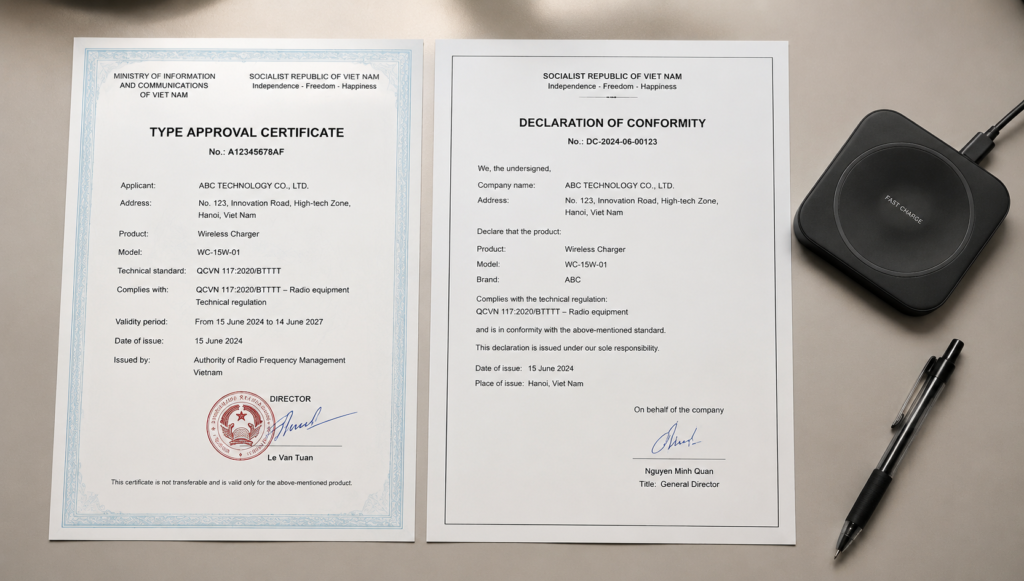
Type approval is usually a procedure for conducting technical evaluation on a specific equipment model and obtaining the corresponding certificate. The scope of the certificate is limited by the product model, wireless parameters, hardware configuration, and applicable regulations.
Declaration of conformity is a procedure where an enterprise makes a conformity commitment for the product in accordance with applicable regulations, and completes testing, data preparation, and submission and filing with the designated authority or system as required. It is not equivalent to a type approval certificate. Whether a test report is required, who submits it, whether filing is required, and the submission method depend on the current procedure and applicable product category.
Many people will ask, can I choose the cheaper declaration of conformity by myself? No. The procedure cannot be simply chosen based on cost; you must first determine which category of regulated equipment the product belongs to.
Reference for Procedure Selection of Charging Products
The applicable procedure of DoC or type approval shall be determined according to equipment category, frequency band, power, applicable QCVN, and the current regulated list. The names of wireless functions such as Bluetooth, NFC, Wi-Fi, 4G/5G, and the high or low power of the product can only be used as preliminary judgment information, and cannot directly infer the final procedure.
Therefore, ordinary low-power products do not necessarily automatically go through DoC, and products with Wi-Fi or cellular modules do not necessarily have to go through type approval just based on the function name. Before applying, a laboratory or compliance agency familiar with Vietnamese regulations should confirm the procedure based on the actual model and technical data.
Relationship Between Module Certification and Complete Machine Certification
There is another point that many people get wrong: the relationship between module certification and complete machine certification.
When choosing wireless modules, some sellers will choose products that have completed relevant Vietnamese conformity assessment, which is helpful. But note: module certificates cannot automatically cover the complete machine. The complete machine should still confirm whether separate conformity assessment is required based on its own product category, wireless functions, and integration conditions.
If the module model, firmware, antenna, installation method, radio frequency parameters, and host usage conditions all comply with Vietnamese rules, and the confirmed configuration is strictly adopted, some test items may be reduced. But this does not mean that the complete machine is definitely exempt from all tests or procedures, and the final result shall be subject to the confirmation of the certification body and the competent authority.
Validity Period and Change Rules
The validity period of the type approval certificate is usually 3 years, and the specific period shall be subject to the certificate and current regulations. The declaration of conformity should not be simply described as a fixed 5-year certificate the same as type approval; its ongoing obligations, applicable period, and filing requirements shall be confirmed according to the current procedure.
If the product has the following changes, it should be confirmed in advance whether re-testing, re-certification, or change of declaration is required:
• Replacement of wireless modules, antennas, or radio frequency chips;
• Adjustment of frequency band, transmit power, or other wireless parameters;
• Modification of wireless function configuration, firmware, or communication method;
• Change of the internal structure of the host, resulting in changes in antenna position, housing shielding, or radio frequency performance.
If only the appearance color, packaging, or some wired charging parameters are changed, it may not affect the radio compliance scope, but it is still recommended to confirm with the handling agency in advance, and cannot be judged only by experience.
Beginner Process: How to Apply for Relevant Vietnamese Compliance for Charging Products
After clarifying the procedures, let’s take a look at the general application process, so that you have a clear idea and will not be led by the agency.
Preparations Before Application
Before the formal application, there are several things to do first:
First, confirm whether the product is included in Vietnam’s current regulated list, which QCVN applies, and whether type approval, declaration of conformity, or other procedures are required.
Second, prepare basic materials, including product specifications, wireless module parameters, operating frequency band and power, model list, appearance drawings, nameplate drawings, antenna information, and necessary user instruction materials.
Third, select a laboratory, certification body, or compliance service agency with the corresponding Vietnamese accreditation or designated qualification, and confirm that it can cover relevant products and QCVN. It is best to choose an agency with experience in testing charging products, otherwise it is easy to take detours.
Fourth, confirm the applicant entity and the responsible entity within Vietnam according to the specific procedure. Foreign manufacturers usually need to complete the corresponding declaration, quality responsibility, and document retention through Vietnamese importers or legally recognized local responsible entities, but it cannot be generally stated that they must set up a Vietnamese branch or designate an authorized representative. Specific requirements shall be subject to current regulations and the confirmation results of the handling agency.
3 Core Application Steps
After the preparations are done, the core process can be summarized into three steps:
Step 1: Prepare final mass production prototypes of the specified quantity and configuration according to the requirements of the laboratory and applicable QCVN. The number of samples is not uniformly 1-2 units; some tests may also require supporting antennas, power supplies, cables, software, or other accessories.
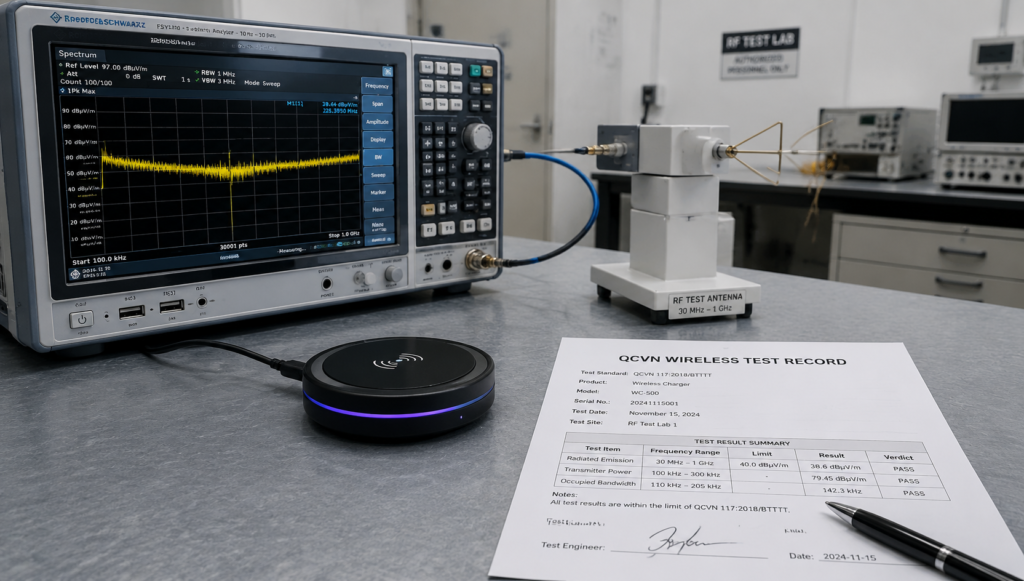
Step 2: Complete applicable testing and data preparation. Type approval is usually handled with a qualified certification body or competent authority as required; the declaration of conformity is completed by the enterprise in accordance with regulations, and submitted and filed with the designated authority or system. The submission object, document format, and whether a number is generated shall be subject to the current procedure.
Step 3: Complete review, certification, or filing. Type approval may result in a corresponding certificate; declaration of conformity usually results in an enterprise declaration and specified submission or filing records, and the two are not the same type of document.
Reference for Cycle and Cost
The cycle and cost that everyone is most concerned about actually vary greatly.
Regulations usually do not stipulate a unified “2-4 weeks” or “4-8 weeks” processing period for all wireless chargers, charging heads, or smart charging devices. The actual time depends on the applicable procedure, laboratory schedule, whether the sample passes, data review, rectification and re-testing, and the filing or certification process, and shall be subject to the written plan provided by the specific agency.
In terms of cost, common quotations may range from hundreds of dollars to thousands of dollars, but this is not the official unified price of Vietnam. Factors affecting the price include:
• Applicable conformity assessment procedure;
• Number of wireless functions and operating frequency bands;
• Test items and sample configuration;
• Whether re-testing or rectification is required;
• Whether local documents, translation, filing, or agency services are required.
The final cost shall be subject to the official quotation of the selected agency.
Semi-Proficient: Certification Mark, Document Verification and Compliance Inspection
After getting the relevant documents, it’s not over yet. How to use the mark, how to check the documents, and whether the original materials can continue to be used after product changes are also content that must be understood when doing business in the Vietnamese market.
Correct Use of Conformity Mark
Relevant products in Vietnam usually involve the technical regulation conformity mark, which is the common ICT/CR mark, as well as certificates, filings, or product information required by applicable procedures. It is not uniformly composed of “MIC official mark plus unique certification number”.
The form, size, position of the mark, whether a number needs to be marked, and whether it should be marked on the product, packaging, or manual depend on the applicable technical regulations and conformity assessment procedures. You cannot combine the MIC word, official mark, and any number by yourself.
When actually marking, it should be ensured that:
• The conformity mark required by current rules is used;
• The product model is consistent with the certificate or filing document;
• Key configurations such as wireless module, antenna, frequency band, and power are consistent with the actual product;
• The mark is clear, durable, and placed in the specified or allowed position;
• After the product is changed or the document becomes invalid, the original mark and materials are no longer used.
How to Verify the Authenticity of Documents
It cannot be unconditionally assumed that there is a unified public database in Vietnam that covers all relevant certificates and can be queried for free by product model or number. Different types of certificates, declarations of conformity, and filings may be stored by different institutions or systems, and the public fields and query methods may also be different.
A more prudent approach is to verify the documents with the current competent authority, the issuing or certification body, or its official system. Focus on checking the following information:
• Product model and variants;
• Applicant, manufacturer, or responsible entity;
• Applicable QCVN;
• Wireless module, antenna, frequency band, and power configuration;
• Scope of application of the certificate or declaration;
• Validity period of the type approval certificate;
• Whether the actually imported and sold products are consistent with the documents.
Whether a document can be found online cannot be used as the sole basis for judging authenticity.
Common Violation Errors in Mark Use
There are several common errors when using marks, which everyone should avoid:
The first is mixing other Vietnamese certification or quality marks, and casually putting marks of different systems together, which is likely to cause misleading.
The second is that the type approval certificate has expired, or the product parameters have changed and the original document is no longer applicable, but the original mark is still used.
The third is that the actual product model is different from the model on the document. For example, the certificate is for model A, but the mark and document are used for model B.
Semi-Proficient: Common Pitfalls in Vietnamese Wireless Compliance for Charging Products
There are many pitfalls in relevant compliance, from product design to application, to sales and customs clearance, there are points to pay attention to at each stage.
Pitfalls in the Product Design Stage
Avoiding pitfalls at this stage can save the most money and time.
The first pitfall is thinking that using the Qi standard automatically meets Vietnamese requirements. Qi mainly solves the interoperability problem of wireless charging, and cannot replace Vietnamese radio and EMC compliance. The way to avoid the pit is to confirm the actual operating frequency, emission characteristics, EMC performance, and applicable QCVN of the product, and conduct tests or go through corresponding procedures in accordance with Vietnamese requirements.
The second pitfall is that Bluetooth or Wi-Fi modules use no-name modules without relevant Vietnamese compliance materials, leading to increased test items, costs, and cycles. When avoiding pitfalls, you can give priority to modules with complete materials, reliable sources, and existing Vietnamese compliance records, but even if the module already has a certificate, you must confirm whether its model, firmware, antenna, and installation conditions are consistent with the complete machine.
The third pitfall is mistakenly believing that pure Qi wireless chargers definitely do not need any procedures under the MIC system, or conversely believing that all wireless chargers must go through the same certification. The correct approach is to first confirm whether the product belongs to Vietnam’s current regulated wireless power transmission equipment, and then judge the specific requirements according to the applicable QCVN.
Pitfalls in the Application Stage
The first pitfall is thinking that all wireless chargers can go through the declaration of conformity, or that products with Wi-Fi, 4G/5G must only go through type approval. In fact, the procedure shall be determined according to equipment category, frequency band, power, QCVN, and the current regulated list. Before applying, you should find a professional agency to make a preliminary judgment on the procedure, and don’t apply rules by yourself based on assumptions.
The second pitfall is directly applying with CE or FCC test reports, only to find that the report content, test methods, or applicable frequency bands do not meet Vietnamese requirements. The way to avoid the pit is to let the handling agency confirm in advance whether the existing report can be used as part of the technical materials, and if necessary, make up the difference tests required by Vietnam.
The third pitfall is that the submitted sample is inconsistent with the final mass production version, such as replacing the coil, module, antenna, firmware, or housing structure. In this way, even if documents are obtained, they may not cover mass-produced products. The submitted samples should be as consistent as possible with the final sales version, and any key changes must be confirmed for impact in advance.
Pitfalls in the Sales and Customs Clearance Stage
Falling into pitfalls at this stage often results in direct financial loss.
The first pitfall is that when the product is being sold, the wireless charging coil, module, antenna, or software configuration is replaced, without confirming whether re-testing, re-certification, or change of declaration is required. As long as the wireless parameters or key radio frequency components change, the handling agency should be asked to evaluate first, and do not continue to use the original documents by yourself.
The second pitfall is that the mark on the packaging, product model, and information on the document are inconsistent, which is discovered by customs or market supervision departments. The way to avoid the pit is to check the product, packaging, manual, certificate, and filing materials one by one before shipment to ensure that the model and configuration correspond.
The third pitfall is filling in the wrong compliance number, certificate information, or product model when listing on e-commerce platforms, resulting in removal from the platform. Before listing, you should check the actual sales model and the scope of the document to ensure that the certification or declaration information corresponds one by one.
Apply What You Learn: Judgment of 5 Common Charging Product Scenarios
Having said so much, let’s practice with 5 common charging product scenarios. The following conclusions are preliminary judgments, and the final confirmation should still be combined with Vietnam’s current list and applicable QCVN.
First: Ordinary wired USB-C power adapter.
Judgment: Usually does not involve radio type approval.
Reason: It does not have wireless functions such as Wi-Fi, Bluetooth, or cellular communication. USB PD fast charging and high-power output are wired functions.
Supplement: It still needs to check other Vietnamese regulations such as electrical safety, energy efficiency, plug specifications, EMC, product quality, and import.
Second: Pure Qi wireless charging base, no App, no Bluetooth.
Judgment: It cannot be assumed to be fully exempt just because it is “pure Qi” or “has no App or Bluetooth”.
Reason: Qi is a wireless charging interoperability standard, not equivalent to a Vietnamese regulatory exemption certificate. Its operating frequency, emission characteristics, EMC performance, and whether it falls within the regulated scope of Vietnamese wireless power transmission equipment should be confirmed.
Supplement: Even if radio type approval is not required, it may still need to comply with EMC, electrical safety, or other applicable requirements.
Third: Smart wireless charger with Bluetooth pairing.
Judgment: Further verification of Vietnamese radio compliance requirements is needed.
Reason: It has Bluetooth active wireless communication function for network pairing and App connection, and usually belongs to wireless equipment that needs key verification.
Supplement: Whether to go through type approval, declaration of conformity, or other procedures depends on the equipment category, operating frequency band, power, applicable QCVN, and current list, and cannot be directly judged just by “Bluetooth product”.
Fourth: Shared power bank cabinet with 4G module.
Judgment: It is necessary to check the applicable QCVN and conformity assessment procedures in Vietnam according to cellular communication equipment and complete machine functions.
Reason: It has 4G cellular communication function and usually belongs to regulated communication equipment that requires key attention.
Supplement: It cannot be directly concluded that type approval is required just based on the 4G function. It also depends on the purpose of the complete machine, network functions, module integration method, frequency band, and current product list.
Fifth: Charging case sold in the same package as wireless earphones.
Judgment: It cannot be directly assumed that “certification with the complete machine is enough”.
Reason: It should be checked whether the wireless earphone certificate clearly covers the charging case, specific model, configuration, and sales combination. If the charging case itself has no wireless function, it usually does not involve radio type approval, but this conclusion is not because it is automatically covered by the complete machine certificate.
Supplement: If the charging case is imported or sold separately, or if it itself has wireless functions such as Bluetooth and NFC, its compliance scope must be reconfirmed, and electrical safety, energy efficiency, and other product regulations must be checked.
Summary
At this point, the core content of Vietnam MIC wireless certification is finished. After learning, you should be able to quickly handle four things:
First, judge whether a charging product needs to go through Vietnamese radio-related procedures. You cannot only look at the product name, nor only look at whether there is an App; you should first check Vietnam’s current regulated product list and applicable QCVN, and then judge type approval, declaration of conformity, or other requirements.
Second, preliminarily judge the compliance procedure, cycle, and cost range. DoC and type approval are not two packages that enterprises can freely choose according to price. The specific procedure shall be determined based on equipment category, frequency band, power, QCVN, and current regulations. There is no unified 2-4 week or 4-8 week period applicable to all products in regulations. The actual time and cost shall be subject to the written plan and official quotation of the handling agency.
Third, verify the compliance of documents and marks. The specified conformity marks such as ICT/CR should be used in accordance with current rules, and the model, applicant entity, QCVN, wireless parameters, scope of application, and validity period should be checked with the competent authority, issuing agency, or official system.
Fourth, identify common wrong statements. For example, “CE/FCC can directly replace Vietnamese requirements”, “no exposed antenna means no need to do it”, “if the module has a certificate, the complete machine automatically doesn’t need to do it”, “all pure Qi wireless chargers are automatically exempt”, these statements are all too absolute.
When doing charging product business in the Vietnamese market, Vietnamese radio compliance is a hurdle that needs to be planned in advance. As long as you first confirm the competent authority, current regulations, regulated list, and applicable QCVN, and then go through the corresponding procedures according to the actual product, you can avoid confusing certifications, wireless functions, and complete machine responsibilities of different countries.