
If you have bought chargers, fast charging adapters, or USB-equipped power strips in the UK, you have most likely encountered conflicting claims: some say products must have an A-G energy efficiency label to be compliant, others say passing UKCA certification is enough, and some merchants even promote “fast charging” directly as “high energy efficiency”, making it more confusing the more you look. In fact, the UK’s energy efficiency system is not a single labelling rule, but a complete set of requirements divided by product category and region. The parts related to charging products are not complicated; after reading this article, you will be able to judge compliance by yourself and avoid promotional pitfalls.
Basic Knowledge: Three Easily Confused Core Rules
The confusion many people have about UK energy efficiency essentially stems from mixing several completely different rules. Let’s clarify the core concepts all at once first, so we won’t repeatedly fall into pitfalls later.
What is the Narrow Sense A-G Energy Efficiency Label
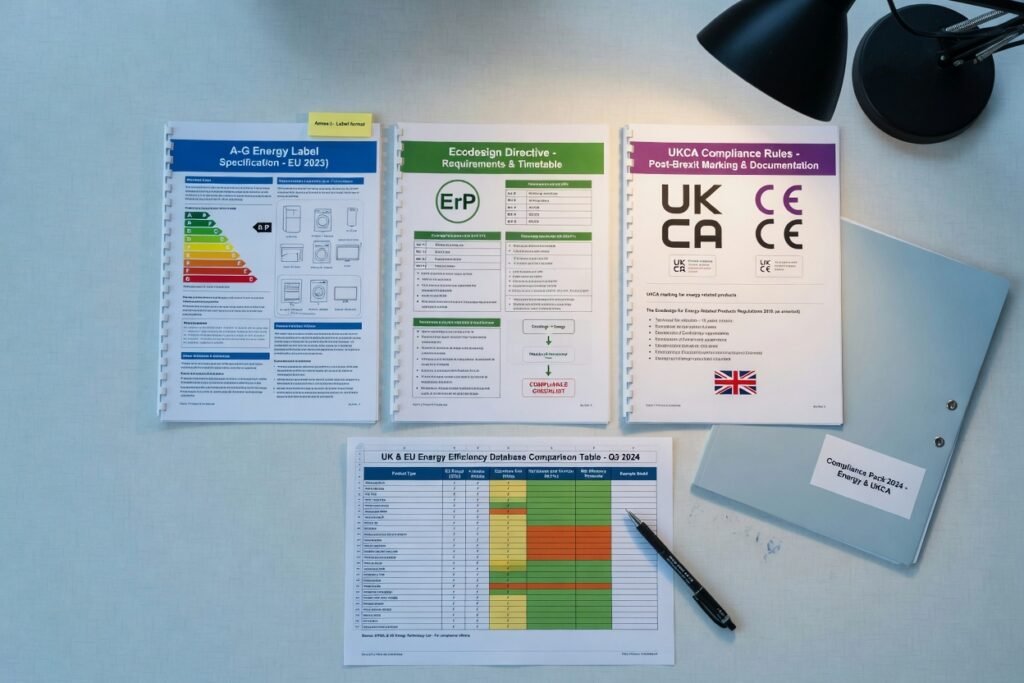
The colored A-G energy efficiency label we often refer to is a grade marking required by the UK government for specific product categories. It uses a colored scale from green A to red G, allowing consumers to intuitively compare the power consumption levels of similar products. Its core function is to unify energy efficiency evaluation standards and prevent manufacturers from arbitrarily claiming their products are “the most power-saving”. But note: this label only applies to categories explicitly listed in regulations; not all charging products need to be affixed with it.
Ecodesign Regulations
The Ecodesign Regulations, often mentioned together with the A-G label, are a set of independent mandatory energy efficiency rules. Their core is to set a minimum energy efficiency threshold for products — products that fail to meet the threshold cannot be placed on the market, but they do not require products to be affixed with the A-G colored label. This is the most mainstream energy efficiency rule for charging products; most chargers and power adapters we come into contact with daily comply with this set of rules.
It should be specially noted that Ecodesign is an independent regulatory category. Whether a product needs to use the UKCA mark and what conformity assessment procedure to adopt must be checked separately according to the specific requirements of the corresponding GB regulations and the stage of product placement on the market. Ecodesign cannot be directly equated with the UKCA mark.
UKCA/CE Conformity Marks
UKCA and CE are product conformity marks for their respective markets, used to indicate that products meet the basic requirements of relevant regulations. It should be noted that the specific path of conformity assessment (for example, whether it can be self-declared by the manufacturer, whether a third-party notified body is required to participate) varies depending on the product category and applicable regulations, and cannot be generalized. The scope of application of the CE mark in the UK GB market also needs to be confirmed in combination with specific product regulations and current policies; it cannot be assumed that CE can directly replace UKCA for all products sold in the GB market.
More importantly: electrical safety, electromagnetic compatibility (EMC), and energy efficiency are mutually independent compliance dimensions. Even if a product has the UKCA or CE mark, it is necessary to separately check compliance with energy efficiency requirements, and the two cannot replace each other — many merchants will swap concepts, using safety certification as proof of energy efficiency, which essentially confuses different compliance requirements.
The Three Most Common Beginner Misconceptions
Misconception 1: All charging products in the UK need to be affixed with the A-G energy efficiency label.
In fact, the A-G label only applies to specific categories listed in regulations. The vast majority of ordinary chargers and power adapters only need to meet Ecodesign requirements and do not need the A-G label. The claim that “no label means non-compliance” is completely wrong.
Misconception 2: High energy efficiency grade = fast charging / high power.
Energy efficiency measures the “degree of electricity waste” and has no direct relationship with charging speed or output power. For example, for two 65W USB-C fast charging adapters, the one with higher energy efficiency only wastes less electricity during the process of converting alternating current to direct current; it does not charge faster than the other, nor does it mean its power is higher.
Misconception 3: Charging cables have energy efficiency grades.
Passive USB/USB-C cables themselves do not perform AC-DC conversion, and do not belong to the external power supplies or labelled categories regulated by energy efficiency rules. There are no A-G energy efficiency labels or Ecodesign requirements for them, and the so-called “energy efficiency cables” are false advertising.
Scope of Application: Which Set of Rules Applies to Your Charging Product?
After clarifying the basic concepts, you may ask: which set of rules actually applies to the charging product I have? To facilitate ordinary consumers in quick initial screening, we can roughly divide the energy efficiency rules for charging-related products into three types of reference frameworks — note that this is only a classification for initial screening convenience, not a strict legal classification. The final applicability of a certain type of rule must be based on the legal definition of the product, the coverage scope and exclusions of the corresponding regulations.
Three Types of Initial Screening Reference Frameworks
Type 1: Products requiring mandatory A-G labelling
Such products account for an extremely low proportion of charging-related categories. Only specific categories explicitly listed in regulations require labelling, such as electronic displays and specific household energy storage devices listed in regulations (the specific list shall be subject to the officially released list of labelled products).
Special attention should be paid: whether a product needs the A-G label depends on whether it fully meets the legal definition of the corresponding regulatory category, and cannot be judged solely by whether it has a USB charging port or a display screen — for example, a display with a USB port is labelled based on it belonging to the “electronic display” category, which has nothing to do with the USB port; whether a household energy storage power supply needs to be labelled depends on whether it belongs to the specific energy storage category listed in regulations, not solely on whether it has a display screen. Ordinary USB chargers and laptop power adapters we usually buy are not within this mandatory labelling scope.
Type 2: Products that need to meet Ecodesign requirements
This is the most mainstream rule for charging products — they must meet the minimum energy efficiency standard, but do not need to be affixed with the A-G colored label. Common products that meet the legal definition of “external AC power supply / independent battery charger”, such as independent USB chargers, USB-C PD fast charging adapters, and laptop power adapters, mostly belong to this category.
But note: not all products called “chargers” are subject to this set of rules. For example, for UK-standard power strips with USB output, only when the built-in USB power module meets the definition of a regulated external power supply does the module need to be checked against Ecodesign requirements; it is not mandatory for the entire category of power strips. The applicable rules for wireless charging transmitters, matching power supplies for dedicated equipment, and low-power AC chargers also need to be checked separately against the product definitions, exclusions, and power thresholds of the corresponding regulations, and cannot be judged solely by the product name. Low-power AC chargers cannot be automatically exempted just because of “low power”; the power thresholds and explicit exclusions of the corresponding regulations must be checked, and self-judgment is not allowed.
Type 3: Products that usually do not apply to AC-input energy efficiency rules
Such products usually do not apply to A-G labels and AC-input Ecodesign rules, but still need to meet other compliance requirements such as electrical safety, EMC, and RoHS, specifically including:
• Passive USB/USB-C charging cables: They do not perform AC-DC conversion themselves, and do not belong to the category of external power supplies or labelled products, even for USB-C cables with e-marker smart chips. The chip is only used for power level identification and protocol negotiation, and does not change the passive attribute of the cable.
• Car cigarette lighter chargers (DC input): Since they draw power from a DC power supply, they usually do not apply to AC-input energy efficiency labels and Ecodesign rules. However, whether they are subject to other energy efficiency requirements needs to be confirmed in combination with the legal definition of the product and corresponding regulations.
Regional Differences After Brexit
After the UK’s Brexit, energy efficiency rules in different regions are not unified, which is the most easily misunderstood point:
• The UK mainland (GB, i.e., England, Scotland, Wales) uses an independent A-G energy efficiency system, with labels bearing UK-exclusive markings, corresponding to the UK Energy Efficiency Product Registration Database — this is a local registration system completely independent of the EU system. There is no such thing as “UK EPREL”, and the data is completely incompatible with the EU database.
• Northern Ireland (NI), due to the arrangements of the Brexit Protocol, maintains consistent product rules with the EU, so it can directly use the EU energy efficiency label and apply the EU EPREL (European Product Registry for Energy Labelling) system, without needing a separate UK label.
• The rules of the EU market are completely independent. EU energy efficiency labels cannot be directly used in the UK GB market, and the filing databases on both sides are not interchangeable.
3-Step Quick Initial Judgment of Applicable Rules
When you get a charging product, you don’t need to flip through thick regulations; you can quickly classify it by following these three steps (the final conclusion shall be subject to the regulations):
Step 1: First identify the power supply form: is it a passive cable, DC input (such as a car charger), or an AC-input charger / power supply / product with a power supply? If it is a passive cable or DC input, it is usually first classified as Type 3 for confirmation.
Step 2: Confirm the sales region: is it GB, Northern Ireland, or the EU, corresponding to different energy efficiency systems.
Step 3: If it is an AC-input product, first check whether it belongs to the A-G labelled categories listed in regulations — if yes, it belongs to Type 1; if not, then check whether it falls within the scope of external power supplies / chargers covered by Ecodesign regulations — if yes, it belongs to Type 2; if it belongs to neither, judge according to other product rules.
Understanding the A-G Energy Efficiency Label: Appearance, Reading Method, and True/False Identification
For Type 1 products that require labelling, understanding the UK version of the energy efficiency label can not only help you choose more power-saving products, but also identify fake labels. Note: It is normal for ordinary chargers not to have this label; there is no need to deliberately look for it.
Core Elements of the UK Version Label
The core components of the current UK A-G energy efficiency label: the specific energy consumption fields vary with product categories, and there is no unified “charging category label template”:
First is the A-G colored scale, from green Grade A (most power-saving) at the top to red Grade G (most power-consuming) at the bottom, totaling seven grades.
It should be noted here: for regulated product categories that have completed label rescaling and whose transition period has ended, products newly placed on the GB market adopt the A-G seven-grade classification. The old version of A+++/A++/A+ graded labels can only be used for newly placed products within the regulatory transition period of the corresponding category; after the transition period ends, they cannot be used for newly launched products. For stock products already in circulation in the market, whether they can continue to be sold must be judged according to the transition arrangements of the corresponding regulations, and cannot be generalized. When ordinary consumers purchase new products in the GB market, they can prioritize recognizing the current A-G seven-grade label.
Second is energy consumption parameters, the fields of which are stipulated by the label regulations of the corresponding category: for example, electronic displays usually mark annual power consumption (unit kWh, which is what is commonly referred to as a “unit” of electricity). Different categories have different parameter types; do not apply fields from other categories to charging products.
Third is regional marking and QR code: labels for the GB market bear the UK flag or the words “GB”, and some labelled categories required by regulations to be registered will have a QR code that redirects to the UK Energy Efficiency Product Registration Database. It should be noted that whether the label has a QR code and whether it can be publicly queried after scanning depends on the regulatory requirements of the specific product category. Not all labelled products have publicly queryable filing information, and authenticity cannot be judged solely by the appearance of the QR code.
Correct Logic for Understanding A-G Grades
When looking at energy efficiency grades, remember three prerequisites, otherwise it is easy to make wrong comparisons:
First, comparisons can only be made between products of the same category and same specification grade. For example, you cannot compare the energy efficiency of a 65W charger with a 10W one, nor can you compare a charger with a display. The testing standards for different categories are completely different.
Second, the grades are measured according to the unified test methods stipulated by regulations, not set by manufacturers themselves. As long as the label is compliant, the grade is referential.
Third, a higher grade means less electricity waste under the same functions; it does not mean the product has stronger functions, higher power, or faster charging.
3-Step Method for Quickly Reading Labels
When you get a label, you don’t need to stare at all the parameters; just follow these three steps:
Step 1: First look for the UK flag or “GB” marking to confirm that this is a current compliant label for the UK GB market, not an EU label or an old version graded label.
Step 2: Look at the A-G grade. For products of the same category and same specification grade, prioritize choosing models with higher energy efficiency grades and better energy consumption parameters. The grade distribution varies greatly across different categories, so there is no need to rigidly stick to a fixed grade. You can judge whether it is cost-effective by combining the product price, your usage frequency, and the energy consumption difference between different grades.
Step 3: If the category requires official registration, scan the QR code on the label to redirect to the corresponding database for verification, confirming that the product model, energy efficiency grade, and parameters are consistent with the filing information, to avoid merchants affixing fake labels.
Quick Distinction Between UK and EU Labels
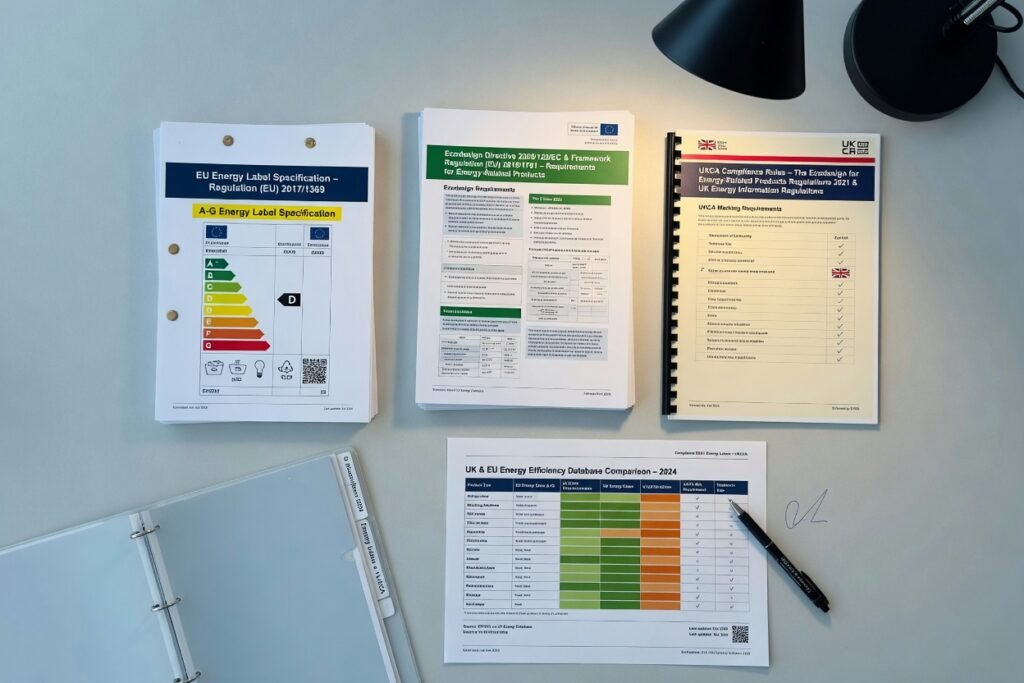
Many people can’t tell the difference between UK and EU labels. Here we have organized the core differences in a table for easy identification at a glance:
| Comparison Dimension | UK (GB) Energy Efficiency Label | EU Energy Efficiency Label |
| Marking Elements | Bears the UK flag or the words “GB” | Bears the EU flag |
| Current Grading | For categories that have completed label rescaling and whose transition period has ended, newly placed products use the A-G seven-grade system; the validity of old version grading is judged according to the transition arrangements of the corresponding category | For categories that have completed label rescaling and whose transition period has ended, newly placed products use the A-G seven-grade system; the transition rules for old version grading are implemented in accordance with relevant EU requirements |
| Corresponding Registration System | UK Energy Efficiency Product Registration Database (independent of the EU system) | EU EPREL (European Product Registry for Energy Labelling) |
| Applicable Regions | England, Scotland, Wales | EU member states, UK Northern Ireland region |
For ordinary consumers, when buying new products in the GB market, they only need to recognize the A-G seven-grade label with UK markings, and do not need to dwell on the transition details of old EU labels.
Ecodesign Requirements: The Mainstream Energy Efficiency Rule for Charging Products
The vast majority of charging products belong to Type 2, which do not need the A-G label and only need to meet Ecodesign requirements — this part is most relevant to our daily purchase of chargers and power adapters, and is also an area where many merchants tend to cut corners.
Core Function and Core Assessment Indicators
The core function of Ecodesign is to set a minimum energy efficiency threshold and eliminate high-consumption inferior products, focusing on two scenarios: first, electricity waste during the charging process, and second, “standby power theft” when the product is plugged in but not in use.
For products subject to external power supply Ecodesign regulations, average conversion efficiency and no-load (standby) power consumption are two core assessment indicators, which usually need to meet the limit requirements of the corresponding regulations at the same time. However, the specific limits, test methods, and whether there are other additional assessment items vary depending on the product’s power segment, single-voltage/multi-voltage output type, and applicable regulation version, and there is no unified universal value. If you want to know the specific indicators of a certain product, you can ask the merchant for the energy efficiency test report or declaration of conformity under the corresponding regulation version.
The first core indicator is average conversion efficiency, which is the effective ratio of alternating current converted to direct current — for example, if you draw 100W of electricity from the grid and the charger outputs 87W to the phone, the conversion efficiency is 87%, and the remaining 13W is wasted as heat. Currently, most consumer-grade external power adapters on the market have an average conversion efficiency in the range of 80%-90%, and the specific compliance value must be checked against the regulatory requirements of the corresponding power segment.
The second is no-load (standby) power consumption, which is the electricity consumed by the charger when it is plugged into the wall but not connected to a device. Many people are used to leaving fast charging adapters plugged in by the bedside all year round, and in this case, the impact of standby power consumption will accumulate over time. The legal limit for no-load power consumption must be determined jointly by combining the rated output power range of the product, product type (single-voltage/multi-voltage output), and applicable regulation version, and there is no universal unified value. Taking the current external power supply Ecodesign regulations as an example, for single-voltage output external power supplies with rated output power ≤51W, the no-load power consumption limit is usually 0.1W; for products in higher power segments or with multi-voltage output, the specific limits must be confirmed against the power segmentation table of the corresponding regulations.
Reasons for Energy Efficiency Differences Among Products of the Same Power
Chargers with the same rated power may have different actual energy efficiency, which is mainly related to design and materials:
First, circuit design and materials: for example, using gallium nitride (GaN) semiconductor materials may reduce losses during the switching process, and also help reduce volume and improve heat dissipation. However, the final energy efficiency level depends on the overall solution such as circuit topology, control strategy, and heat dissipation design, and it cannot be judged that energy efficiency is higher solely based on “using GaN”.
Second, whether standby optimization is done: products specially designed with low standby power consumption circuits usually have lower no-load power consumption.
Third, internal materials: high-quality components such as transformers and capacitors can reduce electricity loss during the conversion process.
Easily Overlooked Related Influencing Factors
In addition to the two core indicators of the charger itself, there are several easily overlooked factors that affect the overall energy efficiency in actual use:
The first is low-load efficiency. For example, if you use a 100W laptop fast charging adapter to charge low-power devices such as wireless earphones and smart watches, it is in a trickle charging state. For some chargers without low-load optimization, efficiency may drop significantly. The specific magnitude of the drop must be based on actual measured data, and not all high-power chargers have this problem. If you often need to charge small devices, you can prioritize products marked with low-load optimization.
Second is charging cable loss: if the cable is too thin, too long, or has insufficient current carrying capacity, additional loss will occur due to cable resistance when current passes through, indirectly reducing overall efficiency. For high-power scenarios, prioritize USB-C cables with e-marker smart chips to ensure matching power carrying capacity and reduce unnecessary cable loss.
Third is fast charging protocol: fast charging protocols such as USB-C PD and PPS only adjust the output voltage and current levels, and do not necessarily consume more power by themselves. Whether it consumes more power still depends on the conversion efficiency of the charger.
Purchasing Pitfall Avoidance: How to Choose Compliant and Power-Saving Charging Products
Now that we understand the rules and indicators, let’s talk about how to avoid pitfalls when actually buying charging products, and how to choose products that are both compliant and suitable for you.
Key Purchasing Points for Different Products
For different categories of products, the purchasing logic is completely different:
For products with the A-G label, among products of the same category and specification, prioritize those with higher energy efficiency grades and better energy consumption parameters, then judge based on your usage frequency — if you use it every day, spending a little more money on a higher grade is more cost-effective; if you use it occasionally, you don’t need to dwell too much on the grade difference.
For ordinary chargers and power adapters, there is no need to dwell on whether there is an A-G label. You can ask the merchant for the energy efficiency test report of the corresponding regulation version, check whether the average conversion efficiency and no-load power consumption meet the standards, and then choose according to your own usage scenarios. For common ≤51W single-voltage output consumer-grade chargers, a no-load power consumption of 0.1W or below is a relatively good level and can be prioritized.
If you are buying charging cables or USB-C interface accessories, prioritize compliant cables to reduce cable resistance loss. For high-power scenarios, prioritize USB-C cables with e-marker smart chips to ensure matching power carrying capacity.
Four Common Types of False Advertising
When buying, pay attention to identifying four typical types of false advertising:
Pitfall 1: Ordinary chargers affixed with A-G energy efficiency labels. The vast majority of ordinary chargers do not need the A-G label at all. If a merchant uses “has A-G label” as a core selling point, it is most likely a fake label.
Pitfall 2: Promoting “fast charging” and “high power” as “high energy efficiency”. Fast charging speed, output power, and energy efficiency are completely different indicators with no direct correlation. Judging energy efficiency requires looking at conversion efficiency and standby power consumption parameters.
Pitfall 3: Using old EU version A+++ labels to impersonate UK-compliant new product labels. For categories that have completed label rescaling and whose transition period has ended, old version graded labels must not be used for products newly placed on the GB market. When seeing new products promoted with A+++ labels as “high energy efficiency”, you should carefully check the regulatory requirements of the corresponding category.
Pitfall 4: Directly using UKCA/CE conformity marks as proof of energy efficiency compliance. UKCA/CE are conformity marks covering multi-dimensional compliance, and safety-related requirements cannot replace energy efficiency compliance. Energy efficiency parameters or filing information need to be checked separately.
Advanced: Estimating the Actual Electricity Bill Impact of Energy Efficiency Differences
If you want to know how much electricity bill a high-energy-efficiency product can actually save, you can make a simple estimate yourself:
The core logic is to multiply the difference in standby power consumption and the efficiency difference during use by the annual usage time, then multiply by the local electricity price, to calculate how much money can be saved in a year. Here is an example for reference only: for a single-voltage charger with rated power ≤51W, comparing a model with 0.3W standby power to one with 0.1W standby power, if plugged in 24 hours a day all year round, it will consume about 1.7 more units of electricity per year. Based on the UK average electricity price of 30 pence per unit, it costs about 50 pence more per year — it doesn’t seem like much, but if you have three or four chargers plugged in all year round at home, the accumulated amount can be several pounds.
For products with A-G labels, it’s even simpler: if the category has annual power consumption filed in the official registration database, directly multiply the annual power consumption difference between two products of the same specification by the electricity price, which is the annual electricity bill difference.
For ordinary users, there is a very practical conclusion: if it is a charger that is plugged into the wall all year round (such as a fast charging adapter by the bedside or on a desk), choosing one with better energy efficiency is more cost-effective, and the electricity bill saved over several years can make up for the price difference; if it is a backup charger that is used only a few times a year, the energy efficiency difference can basically be ignored, and there is no need to spend extra money.
How to Verify Whether a Product is Compliant
When buying, you can confirm whether a product is truly compliant through the following methods:
For products with A-G labels, first confirm whether the category falls within the scope of mandatory registration required by regulations. If yes, scan the QR code on the label to check the corresponding official registration database (check the UK Energy Efficiency Product Registration Database for the GB market, and EU EPREL for NI/EU) to verify whether the sales region, product model, brand, and responsible entity information are consistent. If it cannot be queried, first rule out situations such as the category not requiring registration, regional mismatch, or incorrect information input. If verification is still not possible, you can require the merchant to provide supporting materials such as a declaration of conformity and energy efficiency test report. If you still have doubts, you can keep the evidence and consult the regulatory authority.
For ordinary chargers and power adapters, you can require the merchant to provide an energy efficiency test report or declaration of conformity to confirm that both conversion efficiency and standby power consumption meet the requirements of the corresponding regulations.
When purchasing online, note: for products requiring mandatory A-G labelling, remote sales channels such as e-commerce product detail pages and live streams must display the complete corresponding energy efficiency label; for ordinary chargers, regulations do not mandate the display of energy efficiency parameters on the detail page, and consumers can actively request materials from the merchant.
Regulation and Rights Protection: What to Do When Encountering Non-Compliant Products
If you buy a non-compliant product, there’s no need to panic. The UK has clear regulatory and rights protection channels.
Regulatory System and Responsible Entities
UK energy efficiency regulation is divided among different departments, and responsibilities are clearly divided according to supply chain roles:
• Policy lead: the UK Department for Energy Security and Net Zero (DESNZ, formerly the Department for Business, Energy and Industrial Strategy (BEIS), renamed after restructuring in 2023), responsible for formulating energy efficiency policies and regulations.
• Market regulation: the UK Office for Product Safety and Standards (OPSS) is the national market regulatory authority, coordinating local Trading Standards to carry out specific market spot checks and enforcement work.
Compliance obligations are allocated to different responsible entities according to the requirements of corresponding regulations, and there is no universal “fully responsible party”:
• Manufacturer: responsible for the product meeting energy efficiency standards, and preparing complete technical documentation and declaration of conformity.
• UK-based importer/supplier: required to undertake obligations such as verifying the compliance of imported products, retaining relevant technical documents, and ensuring product markings meet requirements, in accordance with the corresponding regulatory requirements.
• Only for product categories explicitly required by regulations to be registered, the corresponding responsible entity (usually a UK-based supplier or importer) completes the filing in the UK Energy Efficiency Product Registration Database.
• Distributor/seller: including e-commerce platform sellers, responsible for ensuring that the markings and online display of sold products meet regulatory requirements, and must not sell obviously non-compliant products.
Handling Steps for Non-Compliant Products
When encountering a suspected non-compliant product, just follow these four steps:
Step 1: First confirm the product category, whether it falls within the scope of mandatory labelling or has energy efficiency requirements — for example, if you bought a USB charging cable, there is no A-G label requirement in the first place, so don’t make a mistake and make a fool of yourself.
Step 2: Save evidence properly, including order screenshots, photos of the product nameplate, photos of the label, screenshots of the product detail page, communication records with the merchant, etc., to facilitate subsequent communication or reporting.
Step 3: First communicate with the merchant and require them to provide proof of compliance. If they cannot provide it, you can apply for return, exchange, or refund.
Step 4: If it is confirmed that the product is indeed non-compliant, you can report it to the local Trading Standards, submit relevant evidence, and the regulatory authority will conduct verification and handling.
Compliance Tips for Online Sales
From the perspective of consumers, energy efficiency compliance requirements for online sales can be divided into two categories; don’t confuse them:
For commercial remote sales targeting the UK GB market (including e-commerce product detail pages, live streams, and short video sales), as long as the product belongs to the category requiring mandatory A-G labelling, the complete UK energy efficiency label and relevant product information required by regulations must be displayed on the product page.
For products such as ordinary chargers that only need to meet Ecodesign requirements, regulations do not mandate the display of energy efficiency parameters on the sales page, but merchants must be able to provide corresponding conformity materials, and consumers can actively request them.
Regarding the boundary of personal resale: non-commercial, occasional transfer of personal owned idle items usually does not trigger mandatory energy efficiency compliance obligations; however, continuous, profit-oriented personal resale, second-hand sales by commercial entities, and import of products for resale still need to comply with the energy efficiency rules of the corresponding market. The above is only a reference for common situations at the consumer level. Whether compliance obligations are specifically triggered shall be subject to the legal definitions of “placing on the market” and “commercial supply” in relevant regulations, and exemption cannot be directly judged solely based on the seller being an individual.
Final Summary
The UK’s energy efficiency system may seem to have many entries, but its core logic is actually very clear. Ordinary consumers can avoid the vast majority of pitfalls by mastering these 5 action points:
1. Distinguish the three types of core rules: the A-G energy efficiency label is a comparison mark required only for specific categories; Ecodesign is the minimum energy efficiency threshold that most charging products must comply with; UKCA/CE are conformity marks covering multiple dimensions, and safety and energy efficiency cannot replace each other.
2. 3-step quick initial screening of applicable rules: first check whether the product is AC input, DC input, or a passive cable; then confirm the sales region (GB / Northern Ireland / EU); finally check whether it belongs to the labelled categories listed in regulations — most ordinary chargers belong to Type 2 covered by Ecodesign, and it is normal for them not to have the A-G label.
3. Recognize core information when reading labels: when buying new products in the GB market, prioritize A-G seven-grade labels with UK markings; for categories requiring registration, you can scan the code to check the filing in the UK Energy Efficiency Product Registration Database; for new products with old A+++ type labels, you need to check the transition period requirements of the corresponding category, and do not blindly believe “super high grade” promotions.
4. Focus on core parameters when purchasing: for products with A-G labels, choose the one with higher grade among the same specification; for ordinary chargers, look at the conversion efficiency and standby power consumption in the energy efficiency test report; for cables, choose compliant models with matching specifications to reduce cable loss.
5. Follow the steps for rights protection: first confirm the product category to avoid misjudgment, communicate with the merchant after retaining evidence, and if confirmed non-compliant, report to the local Trading Standards.
The essence of energy efficiency rules is to help us reduce unnecessary electricity waste and choose more worry-free products — there’s no need to memorize regulatory provisions by rote; grasping the judgment logic for the products you commonly use is enough.