
Overseas users who sell fast chargers and power adapters to the Chinese mainland via cross-border e-commerce, or who frequently carry electronic devices across borders, have mostly heard of the “3C certification” — if products are non-compliant, they may face consequences such as cargo detention, fines, and even impacts on subsequent operations. This article explains one by one the enforcement boundaries, regulatory authorities, trigger scenarios, penalty rules of CCC certification, and practical compliance key points for overseas users.
I. Core Enforcement Boundaries
CCC, the full name of which is China Compulsory Certification (commonly known as 3C), is a mandatory market access system established by China for high-risk electrical products. CCC enforcement refers to the act of relevant Chinese regulatory authorities conducting regulatory inspections and imposing penalties on products included in the mandatory certification catalog in accordance with the law, with the core purpose of preventing safety risks such as electric shock and fire caused by inferior power adapters, fast chargers and other products. Certifications from other countries or regions such as CE, FCC, and UL overseas cannot replace CCC certification, and cannot be used as a compliance basis for selling catalog products within the territory of China.
Jurisdiction Principles
The core jurisdiction logic of CCC supervision is “products enter the business circulation within the territory of China + are included in the mandatory certification catalog”: it covers catalog products produced, sold, imported, or used in business activities within the territory of China; products produced only overseas and sold only overseas are not subject to China’s CCC mandatory certification requirements.
Special attention should be paid: catalog products carried or mailed into the country by individuals for reasonable personal use are subject to special customs supervision and exemption rules (see the Legal Exceptions chapter later for details), and are not mandatory to obtain CCC certification, but shall not be used for sales, distribution or business activities; if used for business activities, they must meet CCC requirements. Overseas entities that sell catalog products to the territory of China are also subject to supervision, and may be held accountable through importers or e-commerce platforms, and relevant records may also affect subsequent product customs clearance and platform entry qualifications.
2-Step Judgment Method for Whether a Product is Subject to Supervision
To judge whether a product is subject to CCC enforcement constraints, you can confirm step by step according to the following two steps, and the final result shall be subject to the current Mandatory Product Certification Catalog and corresponding product certification implementation rules issued by the State Administration for Market Regulation of China:
Step 1: Confirm whether the product is within the scope of the CCC catalog
It cannot be directly judged only by “with mains plug” or “with power conversion function”, and a comprehensive judgment shall be made based on the product’s name, purpose, structure, and rated parameters:
- Common products usually included in the catalog: chargers for mobile phones and tablet computers, GaN fast chargers, power adapters, power banks; multi-port desktop charging stations are usually also included in the scope of supervision because they have the power conversion function of converting mains electricity to low voltage.
- Common products usually not included in the catalog: separately sold USB-A/USB-C charging cables (no power conversion function, no mains plug, such as ordinary C to C data cables), non-civilian industrial special power supplies.
- Key points for easily confused judgments: power adapters given as gifts in set sales also need to meet CCC requirements as long as they enter the circulation link within the territory of China; charging cable assemblies with national standard plugs shall be judged according to the complete product form — if they are only wires with plugs (no power conversion circuits such as voltage transformation and rectification), they shall be separately judged against relevant categories such as wires and cables in the catalog; if the whole integrates a power conversion module, they belong to power adapter category catalog products.
Step 2: Confirm whether the product flow involves business circulation within the territory of China
Only when products enter the territory of China for production, sale, import, or use in business activities will they be subject to CCC enforcement supervision. Products sold only to overseas markets do not need to meet CCC requirements.
Core Applicable Scenarios for Overseas Users
For overseas users, three types of CCC enforcement scenarios need to be focused on:
- Selling catalog products to consumers within the territory of China via cross-border e-commerce;
- Mailing/carrying catalog products into the country for business purposes, or the carried/mailed products exceed the reasonable quantity for personal use;
- Imported catalog products sold, distributed, rented or used in business activities within the territory of China (imported products for personal use in reasonable quantities are subject to exemption exceptions and are not within the regular scope of enforcement penalties).
II. Regulatory Authorities and Division of Powers and Responsibilities
CCC enforcement has a clear division of powers and responsibilities, with different entities responsible for different links, and not all institutions participating in supervision have the right to impose penalties:
Market regulatory authorities: main force of enforcement in production and circulation links
- National level: responsible for coordinating national CCC certification enforcement and supervision and management work, participating in the formulation and adjustment of CCC catalog and certification rules, and supervising and managing the practice behaviors of certification bodies and testing institutions.
- Local market supervision bureaus at all levels: responsible for daily inspection, supervision and random inspection, and administrative penalties within their jurisdiction, and the supervision objects include domestic production enterprises, offline stores, e-commerce platforms, warehousing business entities, etc. The focus of enforcement often covers high-risk categories such as fast chargers and power adapters during nodes such as e-commerce promotions and back-to-school seasons.
Customs: supervision of import links
The customs is responsible for supervising catalog products in the import link, and applies corresponding supervision procedures according to different entry channels:
- For products imported by way of goods trade, valid CCC certificates or exemption certificates shall be provided as required by the customs during customs declaration, and the specific supervision requirements shall be determined according to the product catalog attributes, declared purposes, etc.; those that do not meet the requirements may be refused release or returned; if there are circumstances violating customs supervision regulations such as false declaration or concealment, the customs may impose penalties such as fines and confiscation in accordance with the law, or transfer them to the market regulatory department for handling according to the nature of the case.
- For items brought into the country by post or by passengers, supervision shall be limited to the reasonable quantity for personal use; if the quantity exceeds the reasonable quantity for personal use, CCC certificates or exemption certificates shall be provided as required for goods, and those that do not meet the requirements may be returned or transferred to relevant departments for handling.
Power adapters and battery-powered charging devices are common key categories inspected by the customs.
Relevant Auxiliary Entities (non-law enforcement entities, no direct penalty power)
- Certification bodies (such as China Quality Certification Center, CQC): responsible for the status management of CCC certificates such as issuance, suspension, revocation, and cancellation, and cooperate with law enforcement departments to provide certificate information, and do not have the power of administrative penalties themselves. CCC certificates are not permanently valid once obtained, and need to continuously meet the requirements of post-certification supervision, change management, etc., otherwise their status may be adjusted.
- Designated laboratories: only responsible for the safety performance testing of law enforcement samples, issuing test reports, and do not make penalty decisions.
- E-commerce platforms: shall perform the obligation of qualification verification of operators on the platform in accordance with the law, and cooperate with regulatory authorities to remove illegal products from shelves, but penalty decisions are made by regulatory authorities; if the platform fails to perform its statutory obligations, it shall bear corresponding responsibilities in accordance with the law.
III. Common Enforcement Trigger Scenarios
The trigger scenarios of CCC enforcement include two categories: routine supervision and passive trigger, and it is not only when reported that an inspection will be conducted:
Import Customs Clearance Inspection
Trigger reason: The customs checks the consistency of the declared product name, model, parameters with the CCC certificate/exemption certificate at the entry link.
High-risk situations: the declared product name is vague (such as declaring chargers as “electronic accessories” or “data cables”), the actual product model is inconsistent with the certificate, and valid compliance documents cannot be provided.
Common disposal: according to the entry channel and illegal circumstances, supplementary materials may be required, release may be refused, or return may be required; if there is a clear customs violation fact, penalties and confiscation may be imposed in accordance with the law, or the case may be transferred to the market regulatory department for further investigation.
Market Supervision Random Inspection (routine/special)
Trigger reason: market regulatory departments at the national, provincial, and municipal levels carry out regular random inspections as planned. Fast chargers and power adapters have long been listed as key random inspection categories due to their high safety risks.
Inspection channels: covering e-commerce platforms, offline digital stores, supermarkets, shops around campuses, etc.
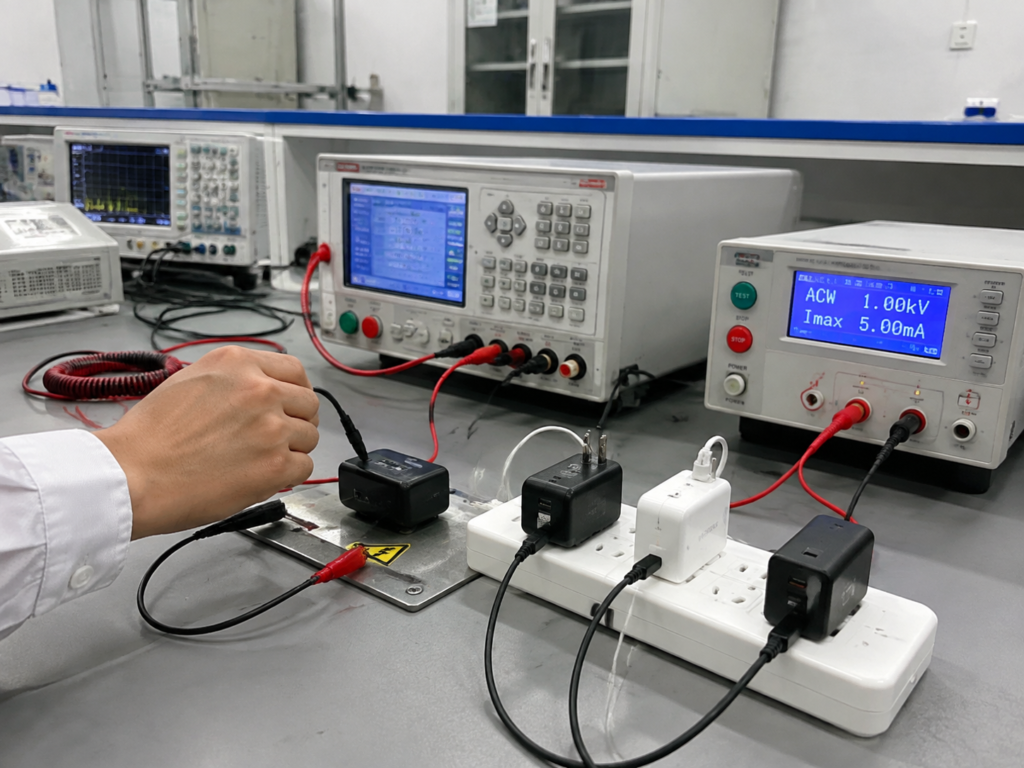
Inspection process: usually first check the CCC mark and certificate validity of the product; for products suspected of not meeting the requirements, samples are sent to designated laboratories in accordance with legal procedures to test safety items such as electric shock protection, overheating, and insulation.
Complaint Reporting and Accident Trigger
Trigger reason: consumers report problems such as product smoking, device damage during charging, fire, etc., or the public and peers report situations such as no CCC mark, false parameter labeling, and forged certificates.
If the product has caused personal injury or major property loss, a special investigation will be launched, and heavier handling will be given in accordance with the law.
Post-certification Supervision and Certificate Status Change
Trigger reason: certification bodies carry out regular or irregular post-certification supervision in accordance with the corresponding product certification implementation rules, including factory inspection, sampling testing, document review, etc., and find that the certified product is inconsistent with the certification sample, or the enterprise fails to go through the change procedures as required.
Direct consequences: may lead to the suspension, revocation or cancellation of the CCC certificate; those who continue to produce, sell or import corresponding products after the certificate is in invalid status will trigger enforcement.
Common incentives: changes in key safety components such as internal transformers and safety capacitors of fast chargers, or addition of fast charging gears, adjustment of output power, etc., without applying for change, filing or re-conducting safety evaluation to the certification body in accordance with the certification implementation rules. For changes involving key safety parameters or core configurations, enterprises should first check the requirements of certification rules to confirm whether a formal change process is required, rather than simply notifying the certification body.
The validity period and maintenance requirements of certificates shall be subject to the specific certification implementation rules and the contents stated in the certificates, and not all certificates are of a fixed-term expiration system.
IV. 4 Key Steps in the Whole Enforcement Process
CCC enforcement has clear legal procedures, and each stage corresponds to corresponding rights and obligations, and penalties are not directly imposed:
Case Filing Stage
After law enforcement departments obtain clues through channels such as unqualified random inspections, reports, customs seizures, and special inspections, they will first verify the authenticity of the clues. If there is preliminary evidence that the product is suspected of violating CCC-related regulations, a case will be filed in accordance with the law. For example, if a catalog product on sale has no CCC mark and the operator cannot provide a valid CCC certificate, a case may be filed. Those with only irregular mark posting but able to provide valid certificates are usually first ordered to rectify, and a case is not directly filed.
Investigation Stage
Law enforcement personnel will retrieve materials such as sales records, purchase vouchers, CCC certificate authenticity certificates, and product labels in accordance with the law, and fix relevant evidence. For products suspected of not meeting safety requirements, samples will be sent to designated laboratories for testing in accordance with legal procedures, and the testing items usually include safety indicators such as insulation performance, leakage current, and overheat protection.
If the party concerned has objections to the test results, it may apply for re-inspection in accordance with legal procedures within the specified time limit.
Determination Stage
Law enforcement departments will combine the investigation results to determine the violation from three core dimensions: “whether the product is within the scope of the CCC mandatory certification catalog, whether a valid CCC certificate has been obtained, and whether the actual product is consistent with the information stated in the certificate”.
Before making a penalty decision, the law enforcement department will inform the party concerned of the illegal facts, the basis for the penalty, and the rights of the party to state, defend and request a hearing in accordance with the law. For example, products with forged CCC marks are usually identified as serious illegal situations.
Execution Stage
After the law enforcement department makes a penalty decision in accordance with the law, it will serve the administrative penalty decision to the party concerned, which states the illegal facts, penalty type, fine amount, payment deadline and other contents.
The party concerned shall perform the penalty decision within the specified time limit, including paying the fine, removing illegal products from shelves, and completing rectification; if it fails to perform within the time limit and does not apply for relief, the law enforcement department may impose an additional fine, enforce administrative compulsory execution, or apply to the people’s court for compulsory execution in accordance with legal procedures.
For overseas entities, if they fail to perform the effective penalty decision, it may have adverse impacts on subsequent business activities such as product entry customs clearance and e-commerce platform entry due to credit records, customs supervision requirements or platform rules.
V. High-frequency Illegal Situations and Penalty Standards
The main legal basis for CCC-related penalties includes the Regulations of the People’s Republic of China on Certification and Accreditation, Product Quality Law of the People’s Republic of China, Administrative Penalty Law of the People’s Republic of China, Customs Law of the People’s Republic of China, etc. The specific penalty range shall be determined in combination with the illegal circumstances and local discretion standards. In addition to statutory penalties, relevant illegal records will also be included in the credit file, which may affect the entity’s subsequent platform entry, customs clearance convenience, qualification application, etc.
Common illegal situations can be divided into the following five categories, with different illegal compositions, penalty bases and competent authorities for different situations:
1. Illegal without certification
Illegal composition: The product is within the scope of the CCC catalog, has not obtained valid CCC certification, and is produced, sold, imported or used in other business activities within the territory of China (except for legal exceptions such as personal use and reasonable quantity).
Common situations: 20W fast chargers without CCC certification, and adapters given as gifts in sets are put on the market for sale without obtaining CCC certification.
Legal basis: Regulations of the People’s Republic of China on Certification and Accreditation
Competent authorities: market regulatory departments (responsible for production, circulation, and business links after import), customs (responsible for import customs clearance links)
Common penalties: for acts of leaving the factory, selling, importing or using in other business activities without certification, order to rectify, impose a fine of not less than 50,000 yuan but not more than 200,000 yuan, and confiscate illegal gains; if the circumstances are serious, order to suspend business for rectification until the business license is revoked. Those who meet the statutory conditions for lighter, mitigated or no punishment may adjust the penalty range in accordance with the law.
Note: If the illegal act of not obtaining certification in the import link also involves declaration violations, the customs may handle it separately in accordance with relevant customs supervision regulations.
2. Forgery of CCC marks or certificates
Illegal composition: including forging, altering, fraudulently using CCC marks, using forged or altered CCC certificates, misappropriating others’ CCC certificates and other acts, usually with obvious subjective intent. It should be noted that if it is only the irregular posting position of the mark, the use of the mark beyond the coverage of the certificate, etc., it shall be comprehensively determined in combination with the degree of fault of the actor and specific evidence, and it does not necessarily constitute intentional forgery.
Common situations: printing fake CCC marks on fast chargers without CCC, and using PS fake certificates to muddle through platform qualification review.
Legal basis: Regulations of the People’s Republic of China on Certification and Accreditation, Product Quality Law of the People’s Republic of China, Measures for the Administration of Mandatory Product Certification Marks, etc.
Competent authorities: market regulatory departments, customs (determined according to the link where the violation occurs)
Common penalties: the legal basis applicable to such acts varies due to specific situations. The penalties all include ordering rectification, confiscating illegal products and illegal gains. The fine amount and other penalty measures shall be subject to the regulatory provisions corresponding to the specific acts and local discretion standards; if the circumstances are serious, the business license may be revoked.
3. Inconsistency between goods and certificates of certified products
Illegal composition: For products that have obtained CCC certificates, the actually produced and sold products are inconsistent with the certification samples and the information stated in the certificate, and the changes involve safety performance or core certification requirements, and the change procedures have not been completed as required. Not all product parameter adjustments constitute violations; if the circumstances are minor and no safety risks are caused, they may first be ordered to rectify within a time limit.
Common situations: arbitrarily adding PD fast charging gears, mixing different power versions with the same shell using the same certificate, and replacing key safety components without going through the change process. The core parameters to be checked include output power, fast charging protocol, number of interfaces, plug specifications, etc., all of which need to be within the coverage of the certificate to meet compliance requirements.
Legal basis: Regulations of the People’s Republic of China on Certification and Accreditation and corresponding product certification implementation rules
Competent authorities: market regulatory departments, certification bodies (responsible for certificate status adjustment, no penalty power)
Common penalties: if the circumstances are minor and no safety risks are caused, first order to rectify within a time limit; if it involves core safety requirements, it shall be handled with reference to the relevant provisions on illegal acts without certification.
4. Still producing/selling/importing after the certificate becomes invalid
Illegal composition: After the CCC certificate is suspended, revoked, cancelled or fails to maintain a valid status in accordance with the rules, the corresponding catalog products are still produced, sold or imported.
Common situations: still selling fast chargers on e-commerce platforms after the certificate is revoked, and still clearing and importing power adapters after the certificate becomes invalid.
Legal basis: Regulations of the People’s Republic of China on Certification and Accreditation
Competent authorities: market regulatory departments, customs
Common penalties: handled with reference to the relevant provisions on illegal acts without certification, and comprehensively discretionary in combination with the reasons for the invalidation of the certificate, whether the party concerned is aware of it and other circumstances.
5. Evading supervision through illegal import declaration
Illegal composition: evading CCC supervision in the import link through false declaration, false reporting of product names, splitting goods, etc.
Common situations: declaring chargers as “USB cables” or “electronic accessories” to avoid CCC verification, and splitting and mailing small batches of fast chargers for sale multiple times.
Legal basis: Customs Law of the People’s Republic of China, Regulations of the People’s Republic of China on Certification and Accreditation, etc.
Competent authority: Customs
Common penalties: the customs shall impose penalties in accordance with relevant customs supervision regulations, including fines, confiscation of illegal gains, etc., and at the same time may transfer the involved products to the market regulatory department for handling in accordance with CCC-related regulations.
Logic of Fine Amount Calculation
The calculation basis for all CCC-related fines is usually two items:
- Value of goods: the total value of illegal products, calculated according to the actual sales price or the average price of similar products in the market;
- Illegal gains: the profits obtained from illegally producing and selling the product.
The specific fine amount will be comprehensively determined in combination with factors such as subjective fault, safety risk, scale of goods value, rectification attitude, and harmful consequences. There are clear administrative penalty discretion standards in various regions, and there is no unified fixed value nationwide.
Boundary of Criminal Liability
CCC-related illegal acts themselves do not necessarily constitute criminal crimes. Only when the illegal acts simultaneously meet the constituent elements of specific charges such as the crime of producing and selling shoddy products and the crime of counterfeiting registered trademarks in the Criminal Law of the People’s Republic of China and reach the statutory prosecution standards, will criminal responsibility be investigated. Whether a crime is constituted shall be comprehensively determined by the judicial organ in combination with product quality problems, the causal relationship between safety consequences and acts, sales amount, subjective intent, etc. For example, long-term production and sale of inferior fast chargers without CCC with sales amount reaching the criminal prosecution standard, or fire caused by product quality problems causing heavy casualties with direct causal relationship, may trigger criminal investigation.
VI. Discretion Rules and Legal Exceptions
The severity of penalties is not fixed and shall be determined in accordance with the law in combination with the specific circumstances of the case. At the same time, there are statutory exceptions that can be exempted from CCC certification.
5 Key Factors Affecting the Severity of Penalties
Penalty discretion shall be comprehensively determined in accordance with the Administrative Penalty Law and the administrative penalty discretion standards of local market regulatory departments. Common influencing factors include:
- Degree of subjective fault: whether it is unintentional irregular labeling, or intentional forgery, or selling even when knowing there is no certificate;
- Degree of safety risk: whether the product has actual safety hazards, for example, the risk difference between only label position deviation and unqualified insulation is large;
- Value of goods and sales scale: the higher the value of goods, the longer the sales time, and the wider the scope involved, the heavier the penalty is usually;
- Rectification and cooperation situation: those who take the initiative to remove problematic products from shelves, recall them, and cooperate with the investigation may be given a lighter or mitigated penalty in accordance with the law;
- Harmful consequences: those that have caused consequences such as user electric shock, equipment damage, fire, etc., will be given a heavier penalty in accordance with the law.
Consideration Situations for Lighter, Mitigated or No Penalty
The following situations may be used as consideration factors for lighter, mitigated or no penalty. The final determination shall be made comprehensively by the law enforcement organ in combination with the Administrative Penalty Law, specific illegal basis and local administrative penalty discretion standards. It is not that meeting any of the situations will necessarily result in lighter treatment:
- First-time violation with minor harmful consequences and timely correction;
- The product itself meets safety standards, and only the use of the mark is irregular and can be corrected immediately;
- Has fulfilled the reasonable inspection obligation, has sufficient evidence to prove that it is not aware of the situation and has a legal purchase source;
- Took the initiative to recall all problematic products without causing harmful consequences.
Legal Exceptions That Do Not Require CCC Certification
Some catalog products can be exempted from mandatory product certification in accordance with the law due to their special purposes, but usually they still need to apply for CCC exemption certificates or go through corresponding filing and supervision procedures as required. They are not completely free from supervision, and their purposes shall not be changed without authorization. Specifically include:
- Reasonable quantity for personal use: catalog products carried or mailed into the country by passengers that are within the reasonable quantity for personal use do not need to apply for CCC certification. The reasonable quantity for personal use shall be determined by the customs and regulatory departments according to the actual situation, and this exception does not apply to those used for sales or business activities. It is not allowed to evade supervision by “breaking up the whole into parts” such as splitting mails and carrying in batches. If they are actually used for business activities, CCC certificates or exemption certificates shall be provided as required for commercial imports.
- Scientific research and test samples: products such as special power adapters used for scientific research and testing, with small quantity and not for external sale, need to apply for a CCC exemption certificate as required before entering the country, and shall not be converted to domestic sales or business use.
- Temporarily imported and re-exported products: approved temporarily imported products used for exhibition, testing, etc., may be used within the approved purpose scope; shall not be sold, transferred or have their approved purposes changed within the territory, and shall be re-exported within the time limit specified by the customs.
- Products exclusively for export: products produced domestically and all used for export and not sold within the territory of China do not need to apply for CCC certification.
Common Misconceptions Related to Exemption
- Exemption does not mean “no need to meet safety requirements”: it only exempts from the certification issuance process of mandatory product certification. The product still needs to meet relevant safety standards, and shall not be changed in purpose, sold or transferred within the territory without authorization.
- Samples cannot be sold at will: products imported with exemption applied in the name of samples, scientific research, etc., if resold or used for business activities, will be punished as illegal without certification.
- Personal use cannot “break up the whole into parts”: multiple mailings of small batches of products for sale will be identified as commercial imports, and CCC certificates or exemption certificates need to be provided as required.
VII. Practical Pitfall Avoidance Guide for Overseas Users
3-Step Checklist for Pre-event Compliance Verification
You can quickly complete the preliminary compliance verification according to the following 3 steps. For detailed rules, please refer to the corresponding chapters above:
- Catalog judgment: check against the current CCC catalog and corresponding implementation rules to confirm whether the product is within the scope of mandatory certification;
- Flow judgment: those sold only to overseas markets do not need to be processed, and those entering the territory of China for production, sale, import or use in business activities need to meet the requirements (except for legal exceptions such as reasonable quantity for personal use);
- Certificate verification: through the “National Certification and Accreditation Information Public Service Platform”, enter the certificate number or product model to query, confirm that the certificate is within the validity period, and the model and core parameters are within the coverage range, to ensure that the goods and certificates are consistent. Third-party test reports cannot replace CCC certificates. CCC is a complete certification system including factory inspection and post-certification supervision, and test reports alone do not have the effect of CCC certification.
Key Points of Supplier and Product Compliance Audit (must-read for sellers)
When purchasing catalog products from suppliers for sale within the territory of China, the following audits shall be done well:
- Required documents to check: valid CCC certificate, list of models covered by the certificate, authorization documents from the brand owner and the manufacturer;
- Key verification: whether key parameters such as output power, fast charging protocol, number of interfaces, plug specifications are all within the coverage of the certificate (for specific verification logic, please refer to the key points for determining inconsistency between goods and certificates above);
- Pitfall avoidance reminder: do not easily believe the statement of “universal certificate for the same series”. You must check the specific models stated in the certificate to avoid inconsistency between goods and certificates due to different power and different configurations with the same shell.
Daily Compliance Checklist for E-commerce Sales
When operating a store on an e-commerce platform within the territory of China, attention should be paid to:
- The parameter description in the product title and detail page shall not exceed the coverage of the certificate;
- For product links with multiple specifications combined, it is necessary to ensure that each specification corresponds to a valid CCC certificate;
- The CCC mark displayed on the page shall be consistent with the physical object, and the CCC mark shall not be affixed to the product page that has not obtained certification;
- Regularly check the certificate status of products on sale, and stop selling immediately if the certificate status is abnormal.
Correct Response When Subject to Law Enforcement Investigation
If you encounter a CCC enforcement investigation, you should pay attention to:
- Cooperate with the work of law enforcement personnel, truthfully provide materials such as purchase vouchers, CCC certificates, sales records, etc., and shall not conceal or transfer the involved products;
- If you have objections to the investigation determination, you may submit relevant evidence within the statutory time limit to make statements and defenses;
- If it is inconvenient for overseas entities to handle directly, they may entrust agents or compliance institutions within the territory of China to assist in handling.
Relief Channels for Dissatisfaction with Penalties
If you are not satisfied with the penalty decision, you can seek relief through the following statutory channels:
- Administrative reconsideration: apply for administrative reconsideration to the statutory administrative reconsideration organ within 60 days from the date of knowing the specific administrative act;
- Administrative litigation: within six months from the date of knowing or should have known the administrative act, file an administrative lawsuit with the people’s court with jurisdiction.
If you fail to apply for relief or perform the penalty decision within the time limit, the law enforcement department may enforce it in accordance with the law.
The core goal of CCC enforcement is to ensure the safety of high-risk electrical products entering the circulation within the territory of China. As long as overseas users make compliance judgments in advance and implement certificate verification and daily management, they can effectively avoid enforcement risks; if they encounter regulatory problems, they can also protect their legitimate rights and interests through statutory channels.