
Cross-border sellers selling electrical and electronic products in the UK have most likely heard of the term WEEE, but many either confuse it with RoHS, or are unsure whether they need to register and what to do after registration. After all, the UK has formed an independent regulatory system after Brexit, so the old experience from the EU cannot be directly applied, and it is easy to run into pitfalls if you are not careful.
This article is compiled based on the current public regulatory rules of England, Scotland, and Wales (collectively referred to as GB). Northern Ireland applies independent rules due to its special trade status, which will be separately marked and explained; subsequent fee standards, declaration deadlines, platform policies, and regulatory details may be adjusted, please refer to the latest official guidelines of each competent authority for specifics.
1. Essential Basics: Core Logic and Geographical Boundaries
Plain-Language Definition and Core Rules
Simply put, UK WEEE is a mandatory recycling regulation in the UK for waste electrical and electronic equipment, with the core logic of extended producer responsibility — whoever first places a product on the UK market for commercial purposes is responsible for the statutory recycling and treatment costs of the product after it is scrapped, neither the consumer nor the government bears the cost.
It should be particularly noted that GB and the EU have mutually independent WEEE registration systems, and an EU WEEE registration number cannot directly replace GB registration; this article explains the rules for the GB region by default, and relevant requirements for Northern Ireland will be separately marked.
Applicable Regions and Competent Authorities
The regulation of the three regions in GB is handled by different departments: England is the Environment Agency (EA), Scotland is the Scottish Environment Protection Agency (SEPA), and Wales is Natural Resources Wales (NRW). The core rules of the three regions are basically the same, but the competent authority for producer registration cannot be chosen arbitrarily; it is usually determined based on one’s statutory place of establishment in GB, main business location, and the chosen registration path — for example, small producers generally apply directly to the competent authority at their place of establishment in GB, while ordinary producers complete registration with the corresponding regulatory authority through a contracted PCS (Producer Responsibility Organisation).
Many sellers wonder “do I need to register three times if I sell across all three GB regions?” In fact, as long as the scope of application of the registration document covers the sales areas, there is no need to apply for three independent registration numbers just because sales cover the three regions; the specific coverage is subject to the rules of the competent authority or the contracted PCS.
Northern Ireland is under the supervision of the Northern Ireland Environment Agency (NIEA) and applies independent rules related to local and EU regulations. A GB WEEE registration number cannot be directly used in Northern Ireland, and separate compliance is required.
Here, three types of common compliance documents should be distinguished: the producer registration certificate issued by the competent authority, the member performance certificate issued by the PCS, and the GB authorised representative document for overseas producers. The three have different functions and cannot replace each other.
Core Differences from Similar Regulations
Many people confuse WEEE with other environmental regulations, but in fact their regulated stages are completely different:
• Difference from UK RoHS: WEEE regulates “recycling after product scrapping” (post-use responsibility), while RoHS regulates “hazardous substance restrictions for new products” (pre-market requirements). The two are completely independent regulations and cannot replace each other.
• Difference from battery and packaging regulations: Batteries and packaging have their own independent extended producer responsibility requirements, which are not within the scope of WEEE regulation. Electronic products with batteries need to comply with the corresponding regulations separately.
Possible Consequences of Non-Compliance
WEEE compliance requirements are statutory, but the enforcement intensity at different links will be dynamically adjusted, and there is no absolute “must be fined” or “will not be fined”:
• Platform side: Most mainstream e-commerce platforms have included WEEE in their compliance review scope, and non-compliant products may be removed from shelves; specifics are subject to the current rules of the platform.
• Customs clearance side: In some cases, customs will check compliance documents, and if missing, goods may be temporarily detained; specifics depend on the current inspection requirements of customs.
• Regulatory side: Regulatory authorities may take measures such as warnings, fines, and confiscation of non-compliant products according to the violation situation, and serious violations may also involve criminal penalties.
2. Scope of Application Judgment: Whether Your Product Requires Compliance
To determine whether a product is subject to UK WEEE regulation, you can verify step by step from the core judgment criteria, classification rules, and exemption scope.
3 Core Judgment Criteria for Regulated Products
As long as the following three conditions are met simultaneously, the product falls within the scope of WEEE regulation:
1. Core function relies on electricity, electromagnetic fields, or electronic control: For example, hair dryers work with motors and electric heating, which are clearly regulated products. For boundary products such as insulated cups with electronic displays, comprehensive judgment is needed based on factors such as whether the electronic function has become the core use of the product, whether the electronic module can be sold separately, and whether it is promoted and sold as an electronic device; when it cannot be clarified by core use alone, it should be checked against the classification list published by the competent authority, or confirmed by consulting the PCS or the competent authority.
2. Designed operating voltage meets the threshold: AC ≤ 1000V, DC ≤ 1500V; the vast majority of civil and commercial electrical and electronic products meet this condition.
3. First placed on the GB market for commercial purposes: “First placement” here refers to the act of first commercial supply or self-use within GB that formally brings the product into the GB market. It cannot be judged solely by the location of the final buyer, but must be considered in conjunction with the specific transaction facts:
• Products imported from overseas to GB for sale constitute first placement at the time of import;
• Products produced and sold within GB constitute first placement at the time of first external supply;
• Large electronic equipment produced domestically for self-use also constitutes first placement when put into self-use;
• Products returned to the original owner after repair, and items imported in reasonable quantities for personal use, usually do not constitute first placement;
• Samples temporarily imported for exhibition and taken out of GB as required after the exhibition do not constitute first placement; but if the exhibits are sold within GB, producer responsibility must be borne.
In judgment, specific transaction facts take priority. Conclusions cannot be drawn solely based on logistics form (such as direct mail/overseas warehouse), but must be comprehensively checked in combination with transfer of goods ownership, import records, and sales purpose.
In addition, end products with non-removable core electronic components, independently sold electronic spare parts (such as separately sold mobile phone motherboards), electronic products with built-in batteries, and software-controlled electronic devices also fall within the scope of regulation.
Current Declaration Classifications (6 Categories, with Size Thresholds)
All regulated products are divided into 6 major categories. Classification directly determines the declaration caliber, recycling costs, and corresponding collection targets, and cannot be randomly classified. When classifying, first check the three categories with special functional definitions: temperature exchange equipment, equipment with a screen area > 100 cm², and lighting equipment. After confirming that they do not fall into these, then check the classification conditions of large equipment, small equipment, and small IT and telecommunications equipment based on the maximum external size and core function. Boundary products cannot be classified based on the seller’s subjective judgment of “main function”, and must be subject to the official classification guidelines issued by the competent authority.
Size measurement rules: The maximum external size is calculated based on the equipment body, excluding packaging and additional protruding parts of detachable accessories; the screen area is calculated based on the effective display area, and the specific measurement method for boundary values is subject to the current classification guidelines of the competent authority.
| Product Category | Core Judgment Criteria | Common Examples |
| Temperature exchange equipment | No size threshold, core function is temperature regulation | Air conditioners, refrigerators, freezers, heat pumps |
| Large screen equipment | Screen area > 100 cm² | Televisions, monitors, tablet computers |
| Lighting equipment | No size threshold, core function is lighting | LED lights, chandeliers, table lamps, stage lights |
| Large equipment | Maximum external size > 50 cm, and does not belong to the first three categories | Washing machines, ovens, treadmills |
| Small equipment | Maximum external size ≤ 50 cm, and does not belong to other categories | Hair dryers, electric toothbrushes, power banks, smart door locks |
| Small IT and telecommunications equipment | Maximum external size ≤ 50 cm, core function is information transmission/processing | Mobile phones, routers, wireless earphones, smart watches |
Judgment of Household/Non-Household WEEE
In addition to classification by product category, it is also necessary to judge whether it is household or non-household WEEE. The two have different recycling responsibility allocation and distributor obligation rules:
• Household WEEE: Products that can be normally used by ordinary households, even if sold for commercial scenarios (for example, office laptops that can also be normally used by households belong to household WEEE).
• Non-household WEEE: Products specially designed for industrial and commercial scenarios that cannot be used in households, such as control panels of large industrial machine tools, and factory-specific automatic control equipment.
Exemption Scope and Boundary Scenario Judgment
Several types of products are explicitly exempt from WEEE requirements:
• Exempt products: Military/national security equipment, active implantable medical devices (such as pacemakers), large fixed industrial tools/installation equipment, and purely mechanical products without electronic functions. The exemption for “large fixed industrial tools/installation equipment” must meet multiple statutory conditions at the same time, including but not limited to: installed in fixed places by professionals, designed for permanent or long-term fixed use, only serving specific industrial or commercial scenarios, and cannot be easily moved to operate independently. Not all large-volume industrial equipment is automatically exempt, and must be checked one by one against the exemption list published by the competent authority.
The following scenarios usually do not constitute “first placement for commercial purposes” and do not require compliance as newly placed products, but relevant evidence must be retained to prove the scenario attributes:
• Entry of items in reasonable quantities for personal use;
• Private second-hand transfer for non-commercial purposes (such as personal idle resale without regular profit-making);
• Temporary exhibition samples (must be taken out of GB as required after the exhibition; if the exhibits are sold domestically, it constitutes first placement and producer responsibility must be borne).
It should be noted that commercial second-hand wholesale and products that are refurbished and re-placed on the market under their own brand are not exempt, and must perform compliance obligations as newly placed products.
3. Responsible Subject Judgment: Who Must Register
Many people think that “producer” refers to factories, but in fact, the “producer” in WEEE has nothing to do with whether you produce or not. The core is judged based on the principle of “first placement on the GB market” — whoever leads this action is the responsible party.
Core Judgment Criteria for “Producer”
Any entity that first places electrical and electronic products on the GB market for commercial purposes is the responsible party for WEEE registration. The core basis for judgment is whether you lead the first placement action, which has nothing to do with whether you are a brand owner, importer, or overseas seller, nor does it have anything to do with whether you have your own factory.
Identifying Responsible Subjects Along the Transaction Chain
We can quickly judge which entities need to register and which do not along the transaction chain, but the final judgment must be comprehensively considered in combination with contracts, import declarations, brand presentation, goods ownership transfer records, and the complete sales chain, and cannot be based solely on the agreement of a single link.
Scenarios requiring registration:
• Own brand owners: Those who sell products under their own brand are considered producers, regardless of whether they find a foundry to produce them.
• GB importers: Local enterprises that purchase products from overseas and place them on the GB market in their own name (subject to records of import declarations and purchase and sales contracts).
• Overseas distance selling producers: Overseas sellers who sell directly to GB end users, and no GB local importer bears the responsibility for first placement, the seller itself is the responsible party.
• Refurbishers: Entities that refurbish old equipment and re-place it on the market under their own brand.
Scenarios not requiring registration:
• Pure foundries: Only responsible for production, do not hold goods ownership, and are not responsible for the action of placing products on the market.
• Pure logistics/warehousing service providers: Only provide transportation and warehousing services, and do not participate in sales and placement.
• Pure transaction matching platforms: Platforms that only provide trading venues, do not hold goods ownership, and do not sell products under their own brand (for example, Amazon itself does not need to register WEEE for products of third-party sellers).
Take a common example for cross-border sellers: A 3C brand in Shenzhen, China sells wireless earphones through Amazon UK. The goods are cleared with the brand owner as the import consignee and then stored in the UK FBA warehouse. In this scenario, the brand owner first places the product on the GB market in its own name and is a statutory producer; if the brand sells all the goods to a local UK importer, who clears customs and places them on the market in its own name, the importer is the producer and the brand owner does not need to register.
Note: The VAT registration number is only a tax voucher and cannot alone prove the identity of the importer or producer. The core is to check the consignee on the import declaration, the agreement on transfer of goods ownership, and the brand sales arrangement.
Producer Classification: 5 Ton Weight Threshold
After confirming that you are a producer, you are divided into two categories based on annual placement volume, and the registration paths of the two are completely different:
• Small producers: Total net weight of electrical and electronic products placed on the GB market per year < 5 tons; note that it is calculated by weight, not sales volume.
• Ordinary producers: Total net weight placed per year ≥ 5 tons.
This 5-ton threshold is the rule for the GB region. The threshold and rules for Northern Ireland are different and need to be checked separately.
Supplementary Obligations of Distributors
First of all, it needs to be clarified: “distributors do not need to register” here only refers to pure distributors — that is, entities that do not import products from overseas, do not sell under their own brand, and only purchase and resell from compliant producers within GB. If a distributor is also a GB importer or sells products under its own brand, it falls into the category of producers and needs to bear registration obligations.
Although pure distributors do not need to register, they need to perform statutory supplementary obligations. Different types of distributors have different requirements, and the specific thresholds and acceptance scope are subject to the current GB distributor recycling rules:
• Small WEEE recycling in physical stores: Only large physical retailers that meet the statutory sales area threshold need to provide in-store recycling services for small WEEE; the specific area threshold and the scope of accepted products (whether they are required to be of the same type as the sold goods) are subject to current rules; retailers can choose to join the Distributor Take-back Scheme (DTS), and a third party will coordinate performance.
• Recycling of similar old products for large household appliances: Retailers selling large household electrical and electronic products may provide services in accordance with local rules and merchant commitments when consumers purchase new products and request recycling of similar old products; the specific mandatory application thresholds, covered categories, and fee rules are subject to current statutory requirements.
• Notification of recycling channels for online sellers: Online retailers need to clearly inform consumers of the official local free recycling channels for waste electrical and electronic equipment in a prominent position in the store; within the scope of statutory free recycling services, basic recycling fees shall not be charged to consumers; value-added services such as door-to-door handling and special disassembly can be charged separately by agreement, but shall not be forcibly bundled.
4. Registration Practice: Paths, Materials and Annual Maintenance
The registration paths for small producers and ordinary producers are quite different, and the corresponding process must be selected according to their own type:
Differences in Registration Paths for Two Types of Producers
• Small producers: You can directly submit an application to the competent authority of the corresponding region, and there is no mandatory requirement to join a Producer Responsibility Organisation (PCS for short, which is an officially recognized institution that specifically helps producers coordinate recycling, declaration, and performance).
The statutory obligations of small producers are divided into three categories with clear boundaries:
① Core obligations that must be performed by themselves: Complete entity registration, declare the previous year’s placement data on time every year, ensure product labeling compliance, and establish and retain complete placement and compliance ledgers.
② Recycling performance can be independently selected: You can join an approved PCS to coordinate recycling performance; you can also directly sign an agreement with a qualified WEEE treatment provider to implement recycling responsibilities; you can also perform in other ways required by the competent authority.
③ No matter which performance method is chosen, the small producer is still the statutory responsible subject, and needs to retain all performance certification documents to ensure that the recycling obligation is implemented.
• Ordinary producers: Must first join an officially recognized PCS, which is responsible for registration, declaration and recycling performance in a coordinated manner, and cannot directly apply to the competent authority by themselves.
It should be noted that PCS is a third-party service institution recognized by the competent authority, not equal to the regulatory authority; the producer is still the statutory responsible subject, and is responsible for the authenticity of placement data, the timeliness of fee payment, and compliance results, and cannot exempt itself from statutory responsibilities by entrusting a PCS.
The core basis for choosing a path is the annual estimated placement weight, product category complexity, and internal compliance capabilities. Small producers with small volume and few categories can apply by themselves, and those with large volume and many categories will find it more worry-free to find a PCS to coordinate.
Registration Material Requirements for Different Entities
Producers with different identities need to prepare different materials. It is recommended to sort out relevant data fields in advance: SKU code, product name, corresponding WEEE classification, net weight per unit, estimated annual sales volume, sales destination, B2C/B2B attribute.
• Small producers: Company entity information, product category list, estimated annual placement weight, UK contact information (overseas entities need to provide authorised representative information).
• Ordinary producers (PCS members): Company entity information, product categories and estimated placement volume, PCS service agreement.
• Overseas distance selling producers (without GB importer): Need to first appoint an authorised representative within GB, and submit authorisation documents, entity information and product information.
If there is already a GB importer, then the importer is the statutory producer, and the overseas brand owner does not need to separately appoint an authorised representative or register by itself.
Handling Channels, Cycle and Cost Description
• Handling channels: Small producers apply through the official website of the competent authority of the corresponding region, and ordinary producers handle it through the contracted PCS.
• Handling cycle: There is no unified fixed time limit, which mainly depends on whether the materials are complete and the processing efficiency of the competent authority or PCS. Do not easily believe the absolute promise of “getting the certificate in a few days”.
• Cost description: The annual fee for small producers is subject to the fee schedule announced by the regulatory authority that year; the fee for ordinary producers is charged by the PCS according to the placement weight and category, and the specifics are subject to the contract quotation, and there is no unified price.
Validity Period, Renewal and Information Change Rules
UK WEEE registration is managed by natural year. The validity period of the registration certificate, the deadline for renewal application, and the annual declaration period are all subject to the official rules announced by the corresponding competent authority or contracted PCS in the current year. Time nodes may vary in different regions and with different registration paths, and shall be subject to the actually received registration documents or official notices.
• Small producers: Submit the next year’s application and relevant data according to the deadline announced by the competent authority of the corresponding region in the current year.
• Ordinary producers: Submit the next year’s information according to the time agreed in the PCS contract, and the PCS will complete the renewal uniformly.
If core information changes (such as entity change, new product categories, significant adjustment of placement volume), it needs to be updated within the specified time limit: small producers report to the competent authority, and ordinary producers report to the PCS.
5. Core Obligations After Registration: Labeling, Recycling and Evidence Chain
Getting the registration number is only the first step. There are still many daily obligations to be fulfilled later, otherwise even with a registration number, it is non-compliant.
WEEE Labeling Compliance Requirements
All electrical and electronic products placed on the GB market after August 13, 2005 need to be labeled with the WEEE mark as required, which has two core components:
1. Crossed-out wheeled bin symbol: Reminds consumers that they cannot throw the product into domestic waste at will.
2. Product placement time mark: Products placed after August 13, 2005 must be marked. The specific placement date can be printed, or a wheeled bin symbol with a horizontal bar can be used (the horizontal bar means the product was placed after that date).
The priority of labeling is: product body → product packaging → product manual/warranty document. Only when the product size is too small or the functional characteristics make it impossible to print clearly on the body, can it be transferred to the packaging or manual, and it must be ensured that consumers can easily see it when purchasing or using.
The size of the mark must comply with the clear and legible principle of current regulations and EN 50419 standard. The minimum height of the mark for conventional products is usually not less than 7mm; for very small volume products, it must be premised on being clearly identifiable by ordinary consumers, and cannot be reduced at will. When in doubt, it is recommended to check the official technical guidelines.
Common mistakes include: only printing the general three-arrow recycling symbol, the mark being blocked by stickers or packaging, and missing the placement time mark. These should all be avoided.
Household WEEE Recycling Rules
The statutory basic recycling service for household WEEE shall not charge consumers fees. Consumers can return waste products for free through various channels:
1. Municipal recycling points: Public recycling sites operated by local authorities;
2. Retail channel recycling: In-store recycling services provided by retailers that meet regulatory conditions;
3. New product replacement recycling: Eligible similar old product recycling service when purchasing new home appliances;
4. Online distance recycling guidance: Online sellers need to clearly inform consumers of local free recycling channels.
From the perspective of responsibility division:
• Producer side: The statutory recycling and treatment cost of household WEEE is borne by the producer. After ordinary producers join the PCS, the PCS will coordinate with the recycling network and share the treatment costs; small producers shall implement their responsibilities and retain certificates according to the performance method they choose.
• Distributor side: Specific obligations of retailers such as acceptance and notification shall be implemented in accordance with the current distributor recycling rules.
Note that “free for consumers” only refers to statutory basic recycling services. Value-added services such as door-to-door handling and special disassembly can be charged according to agreement, but shall not be forcibly bundled.
B2B (Non-Household) WEEE Recycling Responsibility Judgment
The recycling responsibility for non-household WEEE is not always borne by the producer, and can be judged sequentially in the following four steps:
Step 1: First confirm the product attributes — if it actually belongs to household WEEE (even if sold to enterprise customers), the household recycling rules in the previous section apply directly, and the producer bears all statutory recycling costs.
Step 2: Determine the time when the equipment was first placed on the GB market:
• First placed after August 13, 2005 (new WEEE): By default, the producer bears the recycling responsibility;
• First placed before August 13, 2005 (historical WEEE): By default, the current equipment owner bears the recycling responsibility.
Step 3: Determine whether it belongs to the “similar new equipment replacement” scenario:
• When selling new non-household WEEE, if the buyer’s similar old equipment is replaced, regardless of whether the old equipment is new WEEE or historical WEEE, the producer of the new equipment shall bear the recycling responsibility for the old equipment.
Step 4: Check the written contract agreement between the two parties:
• The buyer and seller can adjust the allocation of recycling responsibility through a written contract, but the agreement shall not violate the statutory minimum requirements (for example, it cannot be agreed to completely exempt the producer from statutory recycling responsibility, nor can the responsibility be transferred to an entity without performance capability).
For ease of understanding, here are two common examples of cross-border scenarios:
Example 1: A Chinese seller sells a dedicated industrial control panel to a UK factory (first placed in 2020, belonging to new WEEE). The contract does not stipulate recycling responsibility, and it does not belong to the similar replacement scenario, then the seller (producer) shall bear the recycling responsibility.
Example 2: A UK factory purchases an industrial machine tool control panel produced in 2023 to replace its old panel put into use in 2002 (historical WEEE). Then the producer of the new panel shall bear the recycling responsibility for the old panel, regardless of the placement time of the old panel.
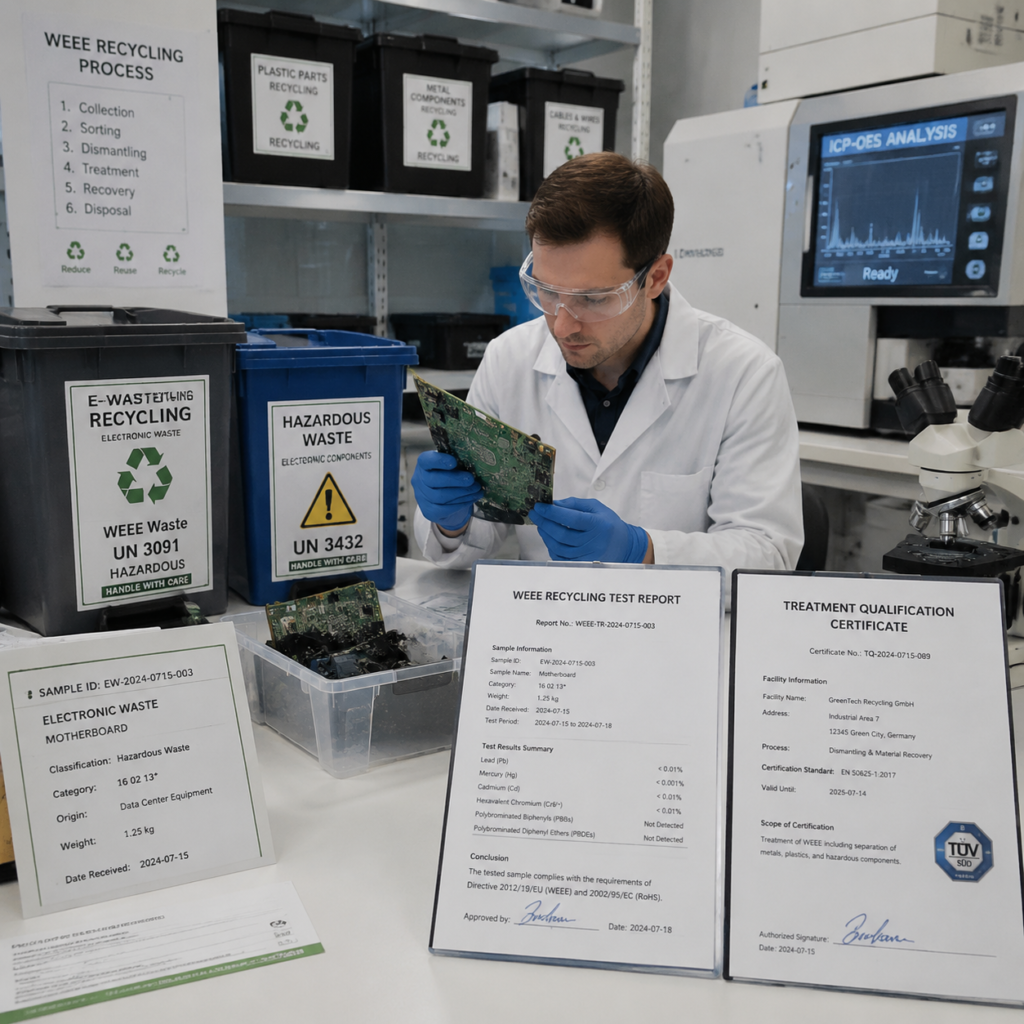
In any case, WEEE that has not been properly treated shall not be directly landfilled or incinerated as general waste. It must be handed over to operators with corresponding waste treatment permits and qualified requirements, and a complete evidence chain such as transfer notes and treatment certificates must be retained.
Data Ledger and Evidence Chain Requirements
The core of compliance is to leave a complete evidence chain. When regulatory authorities inspect, they mainly check whether the records are complete:
• Ledger records: It is necessary to record the placement volume by SKU, product category, unit net weight, first placement date, sales destination, and B2C/B2B attribute.
• Evidence retention: Import declarations, sales records, PCS statements, recycling treatment certificates, label layout documents, etc. must be properly preserved, and the retention period is subject to the regulatory requirements of the corresponding region.
• Annual declaration: Small producers shall submit the previous year’s placement data within the time limit specified by the competent authority; ordinary producers shall submit data according to PCS requirements, and the PCS shall uniformly declare to the regulatory authority.
At the GB level, there is an overall annual target for WEEE collection and treatment, which is implemented by the competent authorities of each region according to the rules of the year. For producers who join the PCS, the PCS shall organize recycling performance and collect relevant fees in a coordinated manner based on official targets, product categories, member placement data and contract agreements; producers do not need to bear a fixed proportion of recycling rate indicators directly to the regulatory authority, but must submit accurate placement data on time, pay fees according to the contract, and regularly check the PCS’s performance certificates to ensure that the recycling obligations corresponding to their own placement volume have been implemented. The specific targets and allocation methods are subject to the rules officially announced that year and the PCS contract.
6. Exclusive for Cross-Border E-Commerce: Key Points of Compliance Verification
For cross-border sellers, there are several exclusive issues that require special attention to avoid pitfalls due to shipping modes and platform filling issues.
Platform Compliance Requirements Verification
Important reminder: Platform review requirements ≠ statutory compliance obligations
The platform only verifies whether the seller has submitted compliance documents according to its own rules, and does not bear the seller’s statutory WEEE responsibility; even if the platform review is passed, if the statutory requirements are not actually met, the seller still needs to bear all compliance responsibilities.
Platforms such as Amazon UK have included WEEE in the EPR compliance review scope, requiring sellers to upload the corresponding registration number or compliance certificate; whether other platforms such as eBay and AliExpress require it, the types of documents to be uploaded, and the implementation time are all subject to the latest official notice in the backstage of the corresponding site.
Responsibility Verification for Different Shipping Modes
Many sellers are confused about who is the responsible party under different shipping modes. The core judgment still follows the first placement principle mentioned above. Incoterms (trade terms) and VAT registration information can only be used as auxiliary clues and cannot alone determine the identity of the producer. The final judgment must be comprehensively considered in combination with import declarations, goods ownership transfer agreements, and brand sales arrangements. The following is a reference for responsibility judgment corresponding to the four common shipping modes in cross-border business:
| Shipping Mode | Selling Entity | Common Import Arrangement | Brand Ownership | Inventory Location | Reference for Responsible Producer Judgment | Core Evidence to Retain |
| Direct mail from China (self-shipping) | Overseas seller | No fixed local importer (consumers clear customs by themselves / the seller handles customs clearance but no local entity bears placement responsibility) | Overseas seller | China | Usually an overseas distance selling producer | Sales records, authorised representative documents, registration certificate |
| FBA/third-party overseas warehouse (seller arranges customs clearance by itself) | Overseas seller | Import declaration shows the seller or its designated entity as the import consignee | Overseas seller | UK | Usually an overseas seller (producer) | Import customs clearance records, sales records, registration certificate |
| UK importer buys out inventory | UK importer | Import declaration shows the UK importer as the consignee | UK importer / overseas brand | UK | Usually the UK importer | Purchase and sales contract, import records, importer’s compliance certificate |
| Third-party entity as importer | Overseas seller | Contract and declaration show the third-party entity imports and places in its own name | Overseas seller | UK | Need to be comprehensively judged based on contract, declaration, and brand agreement; platforms that only provide warehousing/matching services do not automatically become producers | Cooperation agreement, importer’s compliance certificate, goods ownership transfer record |
Customs Clearance and Document Preparation
WEEE registration is not a statutory mandatory pre-document for all customs clearance scenarios: whether it is required to be submitted at the customs link is subject to the current customs inspection requirements; the platform’s requirement to upload compliance certificates belongs to the platform’s own compliance review rules, subject to the notice in the platform’s backstage; some logistics providers and warehousing service providers require relevant documents, which belongs to their commercial risk control category and does not constitute a statutory customs clearance requirement.
Sellers should prepare registration certificates, authorised representative documents (if any), product classification descriptions, import records and other materials before shipment to avoid affecting the flow of goods due to lack of compliance documents. Do not easily believe the absolute statements that “without WEEE, customs clearance will definitely fail” or “customs clearance does not require WEEE at all”.
Precautions for Platform Filling
When uploading the registration number on the platform, there are several details that are prone to errors:
1. The entity of the registration number must be consistent with the responsible entity (or authorised representative) of the store, and the registration number of other companies cannot be used.
2. The product categories filled in on the platform must be consistent with the category scope registered at the time of registration, and cannot exceed the registration scope.
3. There is no need to register separately by category. The registration number of the same producer can cover all registered categories, so there is no need to waste money on repeated registration.
7. Pitfall Avoidance and Self-Inspection: High-Frequency Misconceptions + Compliance Checklist
Methods for Verifying the Validity of Compliance Certificates
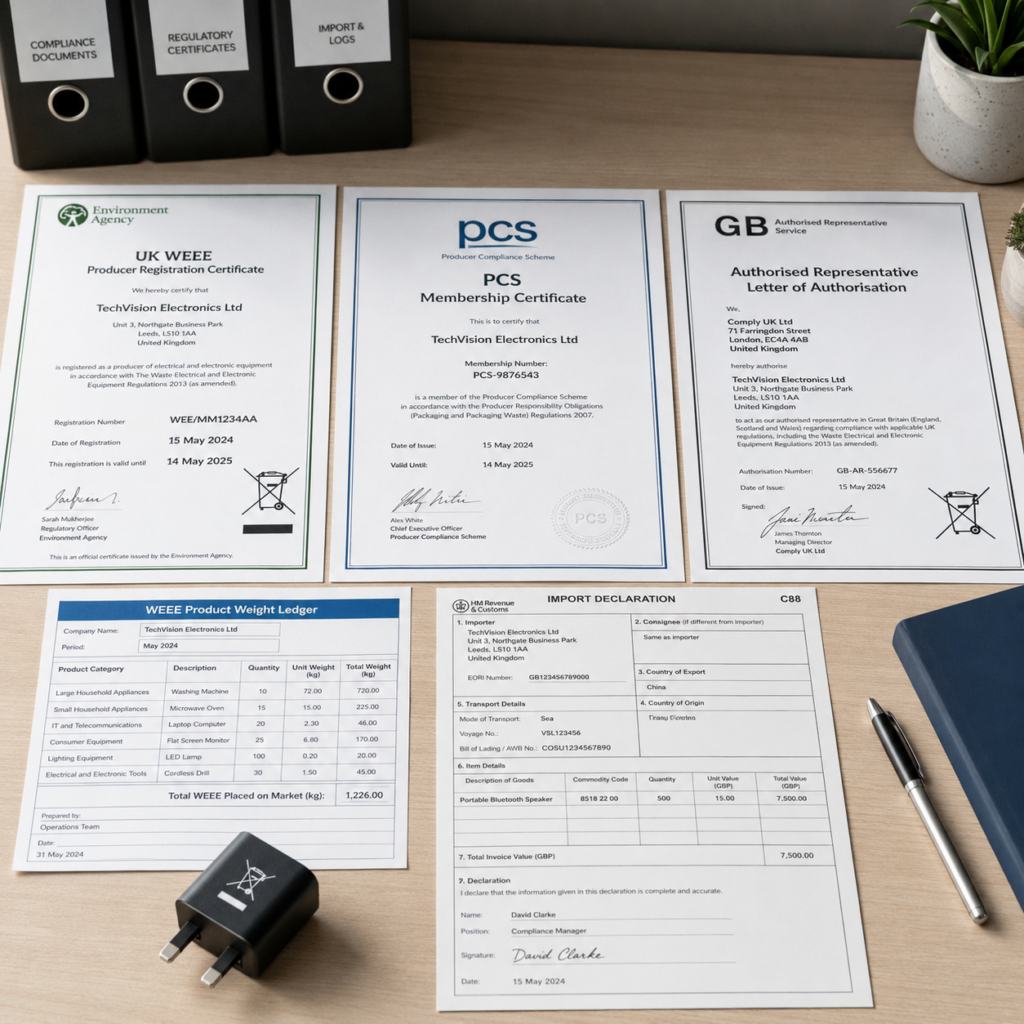
If you find a service provider to handle the registration on your behalf, it is best to verify the validity of the compliance certificate yourself to avoid using an invalid registration number:
1. Verification through official public channels: The EA in England and SEPA in Scotland have publicly queryable producer registration databases, where you can enter the entity name or registration number to check information such as valid years and covered categories; the public query methods for NRW in Wales and NIEA in Northern Ireland are subject to their current official guidelines.
2. Cross-verification of documents: Require the service provider to provide the registration certificate issued by the competent authority, PCS membership certificate (if applicable), and authorised representative letter of authorisation (if applicable), focusing on checking the following information:
• The name of the responsible entity (or the name of the authorised representative) is consistent with the actual operating entity;
• The registration year is within the validity period;
• The covered product categories include the actually sold categories;
• The applicable region is GB or the corresponding sales region.
Note: Only compliance certificates that apply to the corresponding sales region, match the actual producer entity, and can be verified by the competent authority or approved PCS are valid. Registration numbers from the EU or other regions are not applicable to the GB market.
Correction of High-Frequency Cognitive Misconceptions
Cross-border sellers are easily misled by some misinformation. Here are the 5 most common misconceptions:
1. “Small size/low value products do not need registration”: Wrong. As long as electrical and electronic products are commercially placed in GB, regardless of size and value, they need to be compliant, which has nothing to do with size and price.
2. “One registration is valid for life”: Wrong. Registration is managed by natural year, and renewal and declaration of the previous year’s placement data are required every year. The specific time is subject to official rules.
3. “Only doing B2B means you don’t need to care about WEEE”: Wrong. B2B scenarios also need to be compliant, but the allocation method of recycling responsibility is different from that of household use, not that you don’t need to care about it at all.
4. “EU WEEE number / supplier’s WEEE number can be used universally”: Wrong. Cross-entity and cross-region registration numbers are invalid. Only the registration number of your own entity and corresponding to the GB region is useful.
5. “The rules of Northern Ireland are the same as those of GB”: Wrong. Northern Ireland applies independent rules, and the GB registration number cannot be directly used in Northern Ireland, requiring separate compliance.
Description of Violation Impacts and Risks
Many sellers ask “will there only be a warning for violations” and “how much is the fine”. For the types of specific law enforcement consequences, please refer to the regulatory side description in the first section. It should be noted that there is no fixed standard for regulatory discretion, and the specific handling result will be comprehensively judged based on factors such as the violation facts, duration, degree of intent, and rectification cooperation. There is no unified rule of “only warning for first violation” or “fixed fine amount”, and everything is subject to the final decision of the competent authority.
Compliance Validity Self-Inspection Checklist
If you have already registered, you can quickly check whether you are compliant according to the following list:
• Registration side: The registration number is within the validity period, and the entity and categories are consistent with the actual operation situation.
• Product side: The product or packaging has been labeled with the WEEE mark (including placement time mark) as required.
• Data side: A complete placement volume ledger and compliance evidence chain have been established.
• Maintenance side: Renewal and annual data declaration are completed on time every year.
8. Compliance Steps and Frequently Asked Questions
5-Step UK WEEE Compliance
If you haven’t started yet, you can follow these 5 steps step by step to build a basic compliance framework:
Step 1: Self-judgment. First confirm whether the product is within the applicable scope, estimate the annual placement weight, determine whether you are a small producer or an ordinary producer, and clarify the identity of the responsible entity.
Step 2: Choose a path. Small producers apply directly to the competent authority (simultaneously determine the recycling performance method), ordinary producers sign a contract with a PCS, and for overseas distance sales without an importer, first appoint an authorised representative within GB.
Step 3: Submit an application. After getting the registration number or compliance certificate, check whether the entity, category, and validity period are correct to avoid information errors.
Step 4: Implement rectification. Print compliant WEEE marks, clearly inform consumers of recycling channels in online stores, and establish a placement data ledger.
Step 5: Daily maintenance. Regularly record placement data, complete renewal and annual declaration on time, and check the update of regulatory rules every year.
Frequently Asked Questions
Do small sellers with an annual placement volume of less than 5 tons also need to register for UK WEEE?
Yes. As long as the product falls within the scope of UK WEEE regulation and is first placed on the GB market for commercial purposes, compliance obligations must be performed regardless of the placement volume. Only producers with a total annual net weight of less than 5 tons can take the small producer registration path, and the threshold is calculated by product weight rather than sales volume.
Can the UK WEEE registration number be used for multiple stores?
As long as the responsible entity (or authorised representative) of these stores is consistent with the entity of the registration number, it can be shared. If the stores are of different operating entities, the same registration number cannot be shared.
Do products with batteries need to register for both WEEE and battery regulations?
Yes. The body of electrical and electronic products is subject to UK WEEE rules, while built-in or supporting batteries are subject to the UK Battery EPR regulations. The two are independent regulatory requirements, cannot replace each other, and need to be complied with separately.
Do orders from Northern Ireland need separate WEEE registration?
Yes. The WEEE registration number for the GB region is not applicable to Northern Ireland. Northern Ireland applies the independent rules of the local Environment Agency (NIEA) and needs to complete compliance separately.
Must the WEEE mark be printed on the product body?
It is preferred to label on the product body; if the product size is too small or cannot be clearly printed on the body due to functional characteristics, it can be transferred to the packaging or manual, and must include the placement time mark.
Can products sold in B2B not be labeled with the WEEE mark?
No. As long as electrical and electronic products are placed on the GB market after August 13, 2005, whether in B2C or B2B scenarios, they need to be labeled with the WEEE mark as required.
Is it necessary to have a UK company to register for UK WEEE?
Not necessarily. If an overseas producer directly sells to GB users remotely and no GB local importer bears producer responsibility, it only needs to appoint an authorised representative within GB, and there is no need to register a UK company by itself; if there is a GB importer, the importer will complete the registration as the producer, and the overseas brand owner does not need additional registration.
After sorting out the foregoing content, you should be able to quickly judge whether you need to perform UK WEEE registration obligations, distinguish the different compliance requirements of small producers and ordinary producers, complete the implementation of registration and recycling obligations step by step, and avoid common compliance pitfalls in cross-border scenarios through self-inspection. In actual operation, continuous verification is required based on changes in product classification, sales chain adjustments, and annual updates of regulatory requirements to ensure compliance effectiveness.