
Cross-border sellers targeting the Australian market are most likely to be confused by terms like RCM and supplier declaration when they first encounter compliance. Some think they can list products just by buying an “RCM certificate” from an agency, others sign a random statement and affix the label, only to end up with goods detained by customs or removed from platforms, before realizing they don’t even understand the most basic rules. This guide clarifies all key issues of RCM supplier declarations from introductory concepts to practical steps, so even beginners can follow the entire process and avoid common compliance pitfalls.
Must-Know Basics: Fundamental Knowledge of RCM Supplier Declarations
Plain-Language Explanation of Core Concepts
First, clarify the two most common core concepts and their relationship, so that the subsequent process will not be chaotic:
- RCM (Regulatory Compliance Mark): A mandatory compliance mark for electrical and electronic products entering the Australian market, similar to China’s 3C and the EU’s CE. It is a visual indicator that the product meets corresponding regulatory requirements, affixed directly to the product or its packaging, and is not a “certificate” issued by any institution. Although New Zealand also adopts the RCM mark framework, specific rules such as registration and responsible entities differ from those in Australia and need to be verified separately; all content in this article applies only to the Australian market.
- SDoC (Supplier Declaration of Conformity): A legal document signed by a qualified local Australian responsible supplier, used to self-certify that the product meets all regulatory requirements corresponding to the RCM. It is a self-declaration, not a certificate issued by an official authority. Note that for some products with higher risk levels, pre-procedures such as third-party certification and regulatory registration may need to be completed first before a valid declaration can be issued.
- Relationship between the two: The RCM mark is the visual result of completing the compliance declaration, and the SDoC supplier declaration is a necessary prerequisite for legally affixing the RCM mark — affixing the mark without a valid declaration is a clear violation.
Actual Consequences of Failing to Make a Declaration
Many beginners’ understanding of the consequences of violations only stops at “possible detention of goods”. In fact, compliance requirements cover the entire chain of import, circulation, and sales. The consequences of violations vary depending on the type of illegal act (such as failure to make a declaration, false declaration, failure to register, illegal labeling, etc.), the law enforcement authority (ACMA or state electrical safety regulatory authorities), applicable laws, and rules of the relevant state/territory. Common consequences fall into three categories:
- Entry and circulation restrictions: Products that have not completed compliance as required may be detained during customs entry or market circulation, requiring supplementary compliance materials or being subject to return/destruction, and cannot be legally sold in Australia.
- Regulatory penalties: If a violation is determined by the regulatory authority, the amount of the fine will be adjusted according to the circumstances of the violation, penalty provisions, and regulatory updates. In cases of serious violations, individuals may be fined up to approximately AUD 100,000 and companies up to approximately AUD 500,000. The specific amount shall be subject to the latest regulatory provisions and the determination of the law enforcement authority.
- Platform and recall risks: E-commerce platforms such as Amazon Australia and eBay Australia will remove non-compliant products and restrict sales permissions. Serious violations may trigger official mandatory recalls, resulting in additional costs.
3 Most Easily Confused Sets of Core Concepts
The cognitive pitfalls that beginners most easily fall into basically come from the confusion of these three sets of concepts. Clarifying them in advance can save a lot of detours:
- Self-declaration (SDoC) vs third-party certification: For products within the scope of RCM application and commercially supplied to the Australian market, self-declaration is a necessary legal document; this requirement does not apply to exempt products or products subject to special regulations. Third-party certification is only an additional requirement for high-risk products (such as EESS Level 3), and the two cannot replace each other — even if third-party certification is completed, an SDoC still needs to be signed.
- RCM mark vs compliance certificate: The RCM is a mark affixed to the product, not a certificate issued by an institution. The presence of the RCM mark on a product does not mean it is necessarily compliant; the core depends on whether the underlying declaration documents and supporting evidence are valid.
- Overseas reports vs Australian standard compliance evidence: Overseas test reports such as CE, FCC, and CB can be used as technical references, but cannot be directly used as legal evidence of Australian standard compliance. It is necessary to verify whether the standard version, sample configuration, and test items fully meet the requirements of Australian AS/NZS standards.
Scope of Application of This Guide
To avoid misunderstanding, first clarify the coverage of this article:
- Applicable groups and scenarios: Overseas sellers, importers, and entry-level compliance operators who plan to sell electrical and electronic products in Australia. The guide focuses on entry-level practical guidance, while also covering basic risk assessment.
- Non-applicable scope: Compliance rules for New Zealand need to be confirmed separately and are not covered in this article; products subject to special regulations such as medical devices and auto parts need to comply with corresponding special requirements, and the general process of this guide does not apply.
Quick Judgment: Whether Your Product Needs a Declaration
After clarifying the basic concepts, you can first quickly judge whether your product needs an RCM supplier declaration, instead of waiting until you prepare materials to find that the product is not within the regulatory scope. Many people think that “as long as it is electric, it needs an RCM declaration”, which is actually wrong — whether a declaration is needed needs to be judged layer by layer in combination with the nature of supply, product attributes, regulatory scope, and territorial rules, and conclusions cannot be drawn solely based on simple characteristics such as “plug-in/battery-powered”.
Scope of Products Requiring a Declaration
Only products that meet both prerequisites of “commercial supply purpose” and “falling within the statutory regulatory scope” need to complete the declaration and affix the RCM mark.
Commercial supply purpose is easy to understand: as long as it is for commercial sale or gifting in the Australian market, even free samples and promotional gifts, as long as they have the nature of commercial promotion, they fall within the scope requiring compliance.
From the perspective of regulatory areas, RCM-related compliance requirements mainly cover two major sectors:
First, products under the jurisdiction of ACMA (Australian Communications and Media Authority), including electromagnetic compatibility (EMC) equipment, radio equipment, and telecommunications terminal equipment that meet the statutory scope of application; not all electric products are within its jurisdiction.
Second, products under the jurisdiction of EESS (Australian Electrical Equipment Safety System), that is, “in-scope electrical equipment” as defined by regulations, mainly products connected to rated mains voltage with electrical safety risks. The specific classification and registration obligations are also affected by the rules of the state/territory where the products are sold.
Common products requiring declaration include home appliances, power adapters, lighting fixtures, smart devices, wireless remote controls, computer peripherals, etc. The above are only common examples, and the specific situation shall be subject to official classification.
Scenarios Where the General Process May Not Apply
There are also some scenarios where this general RCM declaration process may not apply. Whether the exemption conditions are truly met shall be subject to the official instructions of ACMA and EESS and the actual attributes of the product. Do not expand the scope of exemption on your own:
The first type is products imported for personal use and non-commercial purposes, such as personal electronic devices brought by individuals when traveling to Australia. These do not fall into the category of commercial supply and usually do not require a declaration;
The second type is temporarily imported products, such as exhibition samples and repair parts that stay for no more than 12 months and are shipped out of Australia after use. Exemption is only available if they meet the requirements of the corresponding temporary import system;
The third type is very low-risk products or products subject to special regulations, such as purely manual tools (need to confirm that they do not contain any regulated electrical/wireless components), medical devices, auto parts, etc. — these products either do not fall into the general electrical and electronic regulatory category, or have a special compliance system. However, if they contain components covered by RCM rules, corresponding assessment is still required, and they cannot be fully exempted directly.
Three-Layer Quick Screening Method
If you are unsure whether your product needs a declaration, you can follow these three layers of logic for quick screening, which can cover the vast majority of conventional scenarios:
First layer: Confirm the nature of supply first. Is it for commercial sale or gifting in the Australian market? As long as it is a supply with commercial purpose, whether for sale or gifting, proceed to the next layer of judgment; if it is purely for personal use and non-commercial import, it can basically be excluded from the scope of mandatory declaration.
Second layer: Verify regulatory jurisdiction. It cannot be judged solely by “electric/plug-in/battery-powered”. It is necessary to combine information such as the product’s function, rated input voltage, wireless/communication interfaces, and accompanying power supply to respectively verify whether it falls within the scope of EMC, radio, or telecommunications terminal equipment under ACMA jurisdiction, and whether it is “in-scope electrical equipment” as defined by EESS, and complies with the EESS implementation rules of the state/territory where the product is sold. As long as it falls within any one of the regulatory scopes, a declaration corresponding to the requirements needs to be completed; if it falls within both, the requirements of both sides need to be met simultaneously.
Third layer: Confirm exemptions and risk levels. If the product appears to be within the regulatory scope, then verify whether it meets the officially clarified exemption conditions; if unsure, the safest way is to log on to the official website of ACMA or EESS, enter the product category and parameters to query the corresponding regulatory requirements and risk levels.
Examples of Common Product Scenario Judgments
For more intuitiveness, we list several most common product scenarios in cross-border e-commerce, which are only for preliminary reference. The specific situation shall be subject to official classification and actual product parameters:
The first type is products such as plug-in home appliances and power adapters: because they are directly connected to the mains, they usually fall within the electrical safety jurisdiction of EESS, and most also need to meet the EMC requirements of ACMA. They are subject to dual jurisdiction and need to meet the compliance requirements of both sides simultaneously.
The second type is smart devices with Wi-Fi and Bluetooth: such as smart speakers and Bluetooth headsets. Because they have wireless functions, they are usually regulated by ACMA for radio and EMC; if such devices are powered by mains electricity, additional assessment of EESS electrical safety requirements is needed; if they are only battery-powered, they usually do not involve EESS jurisdiction, but ACMA requirements still need to be confirmed.
The third type is small electronic products powered only by USB or battery: such as ordinary wired mice and power banks. Because these products are not directly connected to the mains, they usually do not belong to EESS in-scope electrical equipment, but as long as they fall within the category of EMC or wireless equipment under ACMA jurisdiction, they still need to meet corresponding requirements; if such products are accompanied by a mains-powered charger, the charger itself needs to be judged separately according to the rules, and cannot be confused with the main device.
Advanced Judgment: Regulatory Path and Risk Level
After confirming that the product needs a declaration, you can first understand the corresponding regulatory path to facilitate the subsequent process:
For EMC, radio, and telecommunications requirements under ACMA jurisdiction, the core for products within the applicable scope is self-declaration and document retention, and there is no mandatory unified product registration requirement.
The electrical safety requirements under EESS jurisdiction are divided into 3 levels according to product risk: Level 1 is low-risk products, which can be sold after completing testing and declaration; Level 2 is medium-risk products, which require product registration in the EESS system in addition to the declaration; Level 3 is high-risk products, which must first obtain third-party certification documents issued by an accredited body before completing registration and declaration. Note that the specific implementation rules of EESS risk classification and registration obligations may vary slightly depending on the state/territory where the product is sold, and shall be subject to territorial requirements.
If the product is subject to both ACMA and EESS jurisdiction, the compliance evidence from both sides can be organized into the same set of documents, and the declaration can also be merged into one, but the legal obligations of the two sides cannot replace each other — you cannot say that completing EESS registration means you don’t need to worry about ACMA’s EMC requirements, and vice versa.
Qualifications and Responsibilities: Who Can Make a Declaration and Who Is Liable
After confirming that the product needs a declaration, the next step is to figure out who is qualified to make the declaration and what responsibilities different roles bear. If there is an error in this step, the declaration made will be directly invalid.
Necessary Entity Qualifications for Making a Declaration
The responsible entity of the RCM supplier declaration must meet the requirements of “responsible supplier” under the corresponding regulatory path. Usually, it must be a locally registered entity in Australia, holding registration information such as ABN (Australian Business Number) or ACN (Australian Company Number), and a traceable local contact address. Specific qualifications need to be confirmed according to the respective rules of ACMA and EESS, and there is no unified absolute standard. However, overseas sellers and factories usually cannot directly sign the declaration as responsible suppliers, and need to entrust a qualified local Australian entity to bear the responsibility, otherwise the signed declaration will have no legal effect.
To facilitate quick judgment, we have sorted out the responsibility possibilities of common roles:
| Role Type | Can Be a Responsible Supplier | Key Notes |
|---|---|---|
| Locally registered importer in Australia | Yes, in most cases, importing in one’s own name makes one the responsible party | Must bear the final compliance responsibility; private agreements with upstream parties cannot exempt legal obligations |
| Locally registered sales entity in Australia | Yes, entities that supply products in Australia in their own name are responsible | Includes brand owners and local distributors; specifics depend on responsibility agreements in the supply chain and legal requirements |
| Local authorized agent in Australia | Yes, local agent entrusted by overseas entities to bear responsibility | Must have formal authorization documents clarifying the division of responsibilities |
| Overseas seller/factory | Usually cannot directly serve as a responsible supplier | Must entrust a qualified local Australian entity to bear responsibility; self-signed declarations are invalid |
Division of Responsibilities for Different Roles
In the entire compliance chain, the responsibilities of different roles are statutory and cannot be transferred through private agreements:
- Responsible supplier: Bears the final legal responsibility, responsible for ensuring product compliance, preserving all compliance documents, responding to regulatory spot checks, and implementing rectifications when problems occur.
- Overseas manufacturer: Responsible for product design compliance and production consistency, and provides complete technical document support to the responsible supplier.
- Importer/distributor: If an importer imports products in its own name, it usually becomes the responsible supplier and bears full responsibility; distributors must confirm that the products are compliant before reselling them. Even if they sign an agreement with the upstream party stating that “compliance responsibility belongs to the upstream party”, they cannot be exempted from legal responsibilities.
Responsibility Judgment for Different Sales Models
For different sales models, the judgment of the responsible entity is also different. Here are several common situations:
- Cross-border direct mail and local warehouse delivery: Whether you ship directly from China or use an Australian local warehouse, as long as the product is commercially supplied in the Australian market, a qualified local Australian responsible supplier is required. The compliance requirements are exactly the same as those for products sold locally in Australia. Do not mistakenly think that the direct mail model does not need to meet compliance requirements.
- OEM/private label sales: If the brand or product model is changed, it is necessary to first evaluate the product identity, responsible entity, and technical differences — if the responsible entity changes, or the key compliance characteristics of the product are modified, a new declaration needs to be made; the factory’s test report does not automatically cover all private label brands, and the holder of the report, authorization scope, and product consistency need to be confirmed.
- Wholesale to local distributors: The distributor can act as the responsible supplier to make the declaration, or the brand owner can make the declaration and then authorize the distributor to use it, provided that the responsible entity is clear, the documents meet statutory requirements, and the coverage of the declaration includes the corresponding product models being sold.
Preparations: Conditions and Materials Required Before Making a Declaration
After confirming the responsible entity, you can start preparing the prerequisites and materials required for the declaration. Preparing them in advance can avoid repeated delays in the process.
Core Prerequisites for Product Compliance
First of all, the product itself must be truly compliant, which is the foundation:
First, the product must meet the applicable Australian and New Zealand standards (i.e., standards starting with AS/NZS) for the corresponding regulatory path. Note that regulations may have transitional arrangements, and the latest version is not necessarily mandatory. The specific applicable version shall be subject to the officially clarified version, and standards from other regions cannot be used as a substitute.
Second, there must be matching test evidence: For test evidence of low-risk products, regulations do not mandate that it must be issued by a third-party laboratory, but it is necessary to ensure that the test process is traceable and the results are reproducible, which can prove that the product meets the standard requirements; for medium and high-risk products with wireless functions, to reduce the risk of spot checks, it is recommended to prioritize laboratories with ISO/IEC 17025 accreditation to issue test reports; for EESS Level 3 high-risk products, certification documents issued by an accredited body must be used as compliance evidence.
Third, the product’s nameplate and packaging information must be complete, including model, parameters, brand, responsible supplier information, etc., with no missing items.
List of Documents to Prepare
The specific materials to be prepared can be divided into three categories:
The first category is product identity materials: including model/series list, nameplate photos, product specifications, and key configuration descriptions (such as parameters of wireless modules).
The second category is compliance evidence materials: including test reports/certificates, applicable standard list, and EESS registration certificate (provided as needed).
The third category is entity qualification materials: that is, the Australian registration information of the responsible supplier and the certification documents of the authorized signatory.
Corresponding Rules Between SDoC and Evidence
All declaration documents and supporting materials must meet the “traceable” requirement, and each sales model can be mapped from the SDoC to specific compliance evidence. The core corresponding relationships include:
- Product/series model and configuration: The models listed in the SDoC must be completely consistent with those in the test report, on the nameplate, and of the actual sold products;
- Applicable regulatory path and standards: It is necessary to clarify which type of ACMA/EESS requirements correspond, and the cited standards are the applicable AS/NZS standard versions;
- Test/certification/registration evidence: The number of the test report, certification certificate, or registration certificate corresponding to each standard must be clear and verifiable;
- Responsible supplier and signing information: Clarify the identity of the responsible entity, the authorized signatory, and the signing date.
There are two special cases of document rules that many people are confused about:
The first is shared documents for series models: If the differences between different models of the same series do not affect compliance after written assessment (such as only differences in color and packaging language), they can share the same test report and declaration document, but all covered models and the basis for the differences not affecting compliance must be listed in the document.
The second is use of overseas reports: Overseas reports such as CE, FCC, and CB can be used as technical references, but it is necessary to carefully verify whether the standard version, sample configuration, and test items fully meet Australian requirements. If necessary, difference tests must be supplemented, and they cannot be directly used as legal evidence of Australian standard compliance.
Practical Steps: Complete Process from Judgment to Labeling
After preparing the materials, you can follow the steps below to complete the entire process. Each step is followed by a checkpoint to avoid errors.
Step 1: Confirm Regulatory Requirements and Risk Level
The first step in officially launching the process is to recheck the corresponding regulatory path, risk level, and applicable standards of the product to avoid errors in previous judgments. For products subject to dual jurisdiction, the requirements of both sides must be covered, and they cannot replace each other.
[Checkpoint]: Incorrect risk level judgment will directly lead to invalid declaration. For example, treating a Level 2 product as Level 1 is useless no matter how well the declaration document is made.
Step 2: Organize and Verify All Supporting Documents
Organize all materials according to the previous document list, and check one by one whether the product models, parameters, and configurations in all documents are completely consistent, with no contradictions.
Core compliance documents (such as SDoC, test reports, registration certificates) are recommended to be in English. If there are non-English materials, verifiable translations or explanatory documents must be provided; document information must be clear and legible. If key information is revised, there must be formal revision marks, and arbitrary alteration is prohibited.
[Checkpoint]: The cited standard version must meet the requirements of the corresponding regulations. It is not necessarily the latest version, and shall be subject to the officially clarified applicable version.
Step 3: Prepare the Declaration Document (SDoC)
Prepare the supplier declaration document according to requirements. There is no mandatory unified official template, but it must contain sufficient minimum identification information to ensure that regulatory authorities can quickly correspond to the product and the responsible entity.
If the product is subject to both ACMA and EESS jurisdiction, the declaration can be merged into one, provided that the document clearly covers all applicable requirements and evidence from both sides.
The core mandatory content of the SDoC includes:
- Product identification information: model, series, key configuration (such as wireless module model), nameplate information;
- Applicable regulatory requirements and standards: Clearly correspond to ACMA’s EMC/radio/telecommunications requirements, EESS’s electrical safety requirements, and the corresponding AS/NZS standard numbers and versions;
- Compliance evidence list: The number and issuing authority of the corresponding test report/certificate/registration certificate;
- Responsible supplier information: Name of the local Australian entity, ABN/ACN, contact address;
- Authorized signing information: Name, position, signature and date of the authorized signatory of the responsible supplier, as well as the statement that “this document certifies that the product meets the corresponding regulatory requirements”.
[Checkpoint]: The standard numbers in the document must be applicable AS/NZS standards, and cannot be replaced by standards from other regions.
Step 4: Complete Required Registrations (If Applicable)
For products under EESS jurisdiction, two types of registration need to be completed as required: first, responsible supplier registration, which all Australian responsible suppliers of EESS-regulated products must complete; second, product registration, which is only required for products with Level 2 and Level 3 risk levels. Products under ACMA jurisdiction have no mandatory product registration requirements, and only need to complete the declaration and archive it as required.
Note that EESS registration requirements may vary slightly depending on the state/territory where the product is sold, and shall be subject to territorial rules.
[Checkpoint]: EESS Level 2/3 products cannot be sold without completing the corresponding product registration; although Level 1 products do not require product registration, they still need to retain complete compliance evidence and SDoC documents.
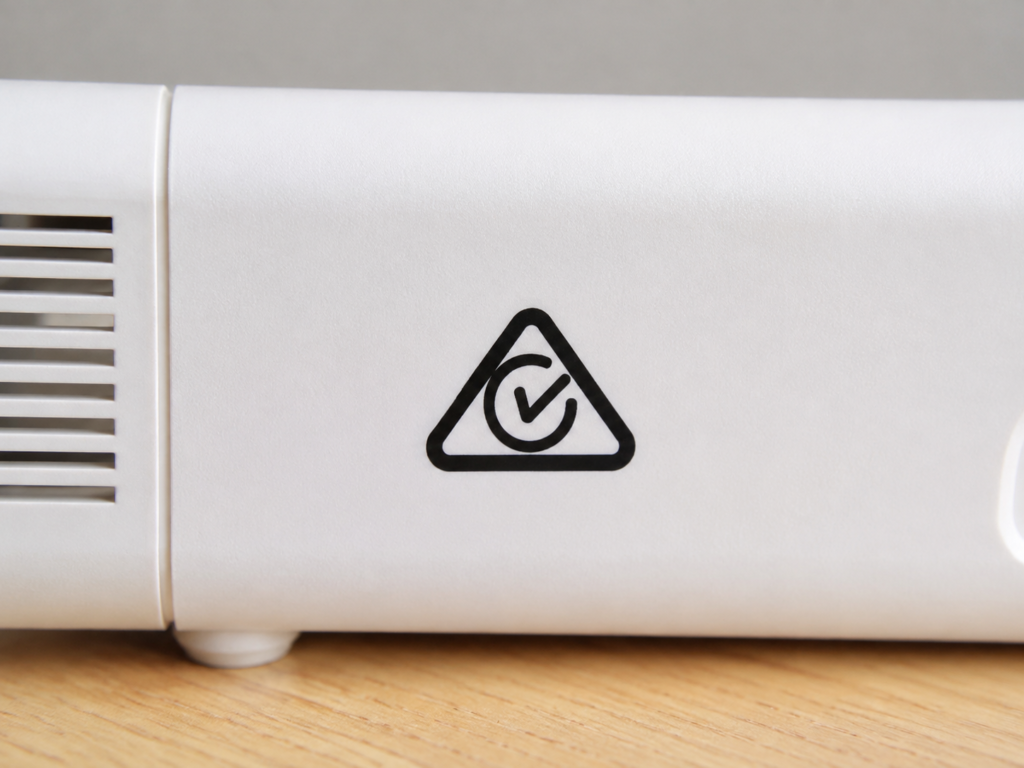
Step 5: Affix the RCM Mark
Affix the RCM mark in accordance with regulatory requirements. The prescribed shape, proportion, and recognizability of the mark must not be altered. The color of the mark must have sufficient contrast with the background, remain clear and durable, and must not be mixed with other marks to cause misleading.
Under normal circumstances, the minimum size of the mark is 3mm, and it should be preferentially affixed to a position on the product body that is easy to view; only when the product is too small to make marking on the product impractical, can the mark be printed on the packaging or manual. The marking requirements cannot be arbitrarily lowered.
[Checkpoint]: The position of the mark must be convenient for consumers to view. For very small products that use alternative marking methods, it is necessary to ensure that consumers can easily find the relevant marks.
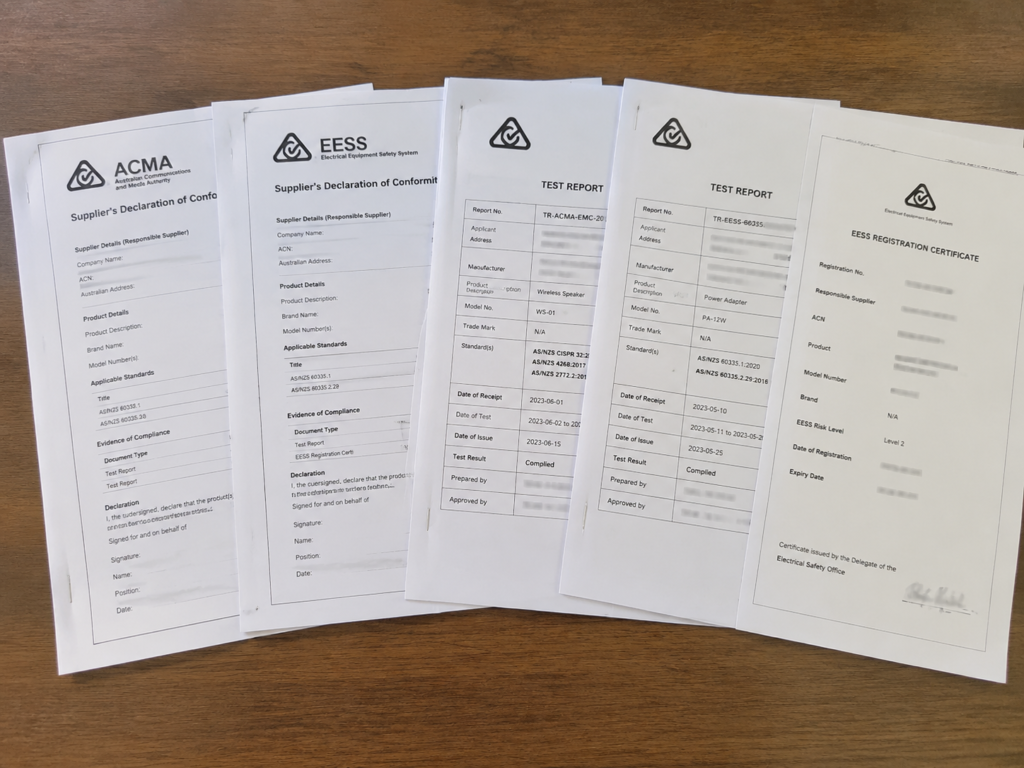
Step 6: Archive Documents for Inspection
Organize and archive the full set of compliance materials. The retention period and spot check response requirements shall be implemented in accordance with the respective rules of ACMA and EESS. Usually, they are required to be retained for at least 5 years (the starting time may be the date of the last supply/import, and the specific shall be subject to applicable rules); in case of regulatory spot checks, complete documents must be provided within the time limit required by the law enforcement authority, and the common requirement is about 10 working days.
Electronic or physical copies are both acceptable. It is recommended to store them separately by product model to ensure that they can be retrieved immediately when needed, and do not wait for a spot check to look for documents everywhere.
[Checkpoint]: Documents must be archived by model classification, and key evidence can be quickly retrieved to avoid affecting spot check response due to messy materials.
Post-Marketing Obligations: Compliance Management and Spot Check Response After Declaration
Many people think that everything is fine after making the declaration and affixing the mark, but that’s not the case. There are ongoing compliance obligations after the declaration.
Change Management for Ongoing Compliance
First of all, it must be clarified that the supplier declaration has no fixed validity period. As long as the product identity, responsible entity, and applicable regulations remain unchanged, and the product continues to meet the requirements, the declaration is valid for a long time.
But if changes occur, they need to be evaluated according to the following closed-loop process, and the original declaration cannot be directly assumed to continue to be valid:
- Trigger of change: Product modification, change of key components/firmware/production location, or update of Australian/New Zealand standards/regulations, or change of responsible supplier/brand/model;
- Impact assessment: Judge whether the change affects product identity, or changes key compliance-related characteristics (such as electrical safety performance, EMC performance, wireless parameters);
- Coverage verification: Confirm whether the original test reports, certifications, and registration documents can still cover the changed product;
- Update and retention: If they no longer cover, it is necessary to update the test, certification, or registration documents, re-prepare or revise the declaration, and adjust the label if necessary; if they still cover, written assessment records must be retained for spot checks.
It should be noted that a change in production location itself does not necessarily invalidate compliance. The key is whether the key compliance characteristics of the product after the change are consistent with the original test sample.
Response Methods for Regulatory Spot Checks
If you encounter a regulatory spot check, don’t panic. First, clarify the law enforcement entity: ACMA is responsible for spot checks in the fields of EMC, radio, and telecommunications, and state electrical safety authorities are responsible for spot checks in the field of EESS electrical safety.
When responding, note: provide complete materials immediately, do not conceal or falsify; if materials are incomplete, supplement them within the time limit required by the regulator.
If there is indeed non-compliance, it is best to proactively stop sales, implement rectification or recall, to avoid higher fines due to delay.
Notes on Uploading Qualifications to E-Commerce Platforms
For e-commerce sellers, it is often necessary to upload compliance qualifications to the platform. Here are some notes:
The compliance upload entrances and required material requirements of different e-commerce platforms vary greatly. It may be necessary to upload combined materials such as declaration documents, test reports, responsible supplier information, and registration certificates. The specific requirements shall be subject to the latest requirements on the platform’s current compliance page. Do not assume that all platforms only need SDoC.
There are several common reasons for rejection: incomplete document information, inconsistent product model with the one filled in the backend, lack of Australian responsible supplier information, and lack of signature of the authorized signatory. When uploading, ensure that the documents are clear and legible, and submit all necessary materials as required by the platform to avoid rejection.
Pitfall Avoidance Guide: Common Misconceptions and Advanced Judgment
Finally, we have sorted out the compliance pitfalls that beginners most easily fall into, and how to judge whether to seek professional help, to help you avoid detours.
6 High-Frequency Compliance Pitfalls
These pitfalls have been encountered by many sellers, and each has clear violation risks. Be sure to avoid them:
- Overseas entities making declarations on their own: Declarations signed by entities that do not have the qualification of a local Australian responsible supplier have no legal effect, which is equivalent to failing to fulfill the declaration obligation, and will be treated as violations once discovered.
- Directly replacing Australian standard tests with CE/FCC reports: Overseas reports can only be used as technical references. If standard differences are not checked and supplementary tests are not carried out in accordance with Australian standard requirements, they cannot be used as legal evidence of compliance, and will most likely not be recognized during spot checks. The penalties for medium and high-risk products are even more severe.
- Selling high-risk products without certification/registration: Selling high-risk products such as EESS Level 3 directly without completing third-party certification and EESS registration is a clear violation of the law, and may face penalties such as detention of goods and fines.
- Only doing testing but not making a declaration: Test reports are only technical evidence and cannot replace legal declaration documents. The lack of a valid SDoC is a violation.
- Inconsistency between test samples and actual sold products: If the test sample and the actual sold product are inconsistent in key compliance characteristics such as model, key components, wireless module, and nameplate parameters, the original test evidence cannot support product compliance, and the declaration will also become invalid.
- Failure to re-evaluate after product changes: After changes to the product or regulations, continuing to use the original declaration without assessing the impact on compliance may result in the declaration no longer covering the changed product, and will be treated as a violation during spot checks.
Selection of Third-Party Service Providers and Judgment on Seeking Professional Help
If you can’t handle it yourself and need to find a third-party service provider for help, how to judge whether it is reliable? You can look at these criteria: they have local Australian responsible supplier resources or registered entity support, can connect with laboratories with corresponding accreditation qualifications, will first conduct risk assessment for you before quoting, and clearly inform you of the attribution of legal responsibilities — service providers who claim “full package, no need for merchants to participate in any compliance links” require careful assessment of their service compliance.
There are several situations where it is recommended to directly find a professional institution to handle, instead of trying on your own: Level 3 high-risk products, complex wireless devices, no suitable local Australian responsible supplier, and having received a non-compliance notice from the regulator or platform.
Quick Self-Check List Before Declaration
Before formal submission or labeling, you can quickly self-check against these 4 items, which can reduce most of the risks of platform rejection or regulatory spot checks caused by entity qualifications, model matching, missing registration, and non-standard labeling:
- Responsible entity: A qualified local Australian responsible supplier has been confirmed, with consistent qualification information.
- Product documents: Product model, configuration, and test report are completely consistent, and applicable standards meet official requirements.
- Registration: EESS medium and high-risk products have completed corresponding registration, and relevant ACMA requirements have been met.
- Labeling and archiving: The affixing of the RCM mark meets the requirements, and the full set of documents has been organized and archived as required.
In general, the core logic of the RCM supplier declaration is “clear responsible entity, traceable evidence, and provable compliance”. For most medium and low-risk conventional products, as long as you clarify the regulatory boundaries and prepare materials as required, you can complete basic compliance independently; if you encounter high-risk products, complex wireless devices, or have received a non-compliance notice from the regulator/platform, it is recommended to seek assistance from a professional institution as soon as possible to avoid unnecessary losses.