
If you often buy electronic products via overseas shopping, or sell to California, USA through cross-border e-commerce, you have most likely seen the label with a yellow triangle and the capitalized “WARNING” on the packaging. Many people’s first reaction is “Is this product toxic? Is it unqualified?” In fact, this is a mandatory warning label under California Proposition 65 (Prop 65 for short), and it has no direct relation to the quality of the product.
As a California-specific right-to-know regulation, the core of Prop 65 is not to prohibit the sale of products containing specific substances, but to let consumers know the risks in advance and make independent purchase decisions. For electronic product practitioners and ordinary consumers, understanding the format, content, and placement requirements of this label can not only avoid being misled by false claims, but also avoid compliance risks. This article breaks down the relevant rules from the perspective of electronic products, which can be understood without professional background.
1. First, Understand: What Exactly Is the California Prop 65 Warning Label?
1.1 It Is Not “Unqualified”, Just a Statutory Notification
Prop 65 is a mandatory right-to-know regulation passed by California in 1986, which only applies to products entering the California market — including offline sales and e-commerce orders directly mailed to California, and is not a unified requirement for the entire United States.
Its core logic is simple: if a product contains ingredients listed in the officially published California list of carcinogenic or reproductive toxic substances, and the amount that consumers can be exposed to during normal daily use exceeds the officially set “safe harbor threshold” (that is, the upper limit that is presumed not to pose a significant health risk), merchants must notify consumers in advance.
Warning labels are the most common notification method, but they are only a statutory reminder, and do not mean the product is “toxic” or “unqualified”, let alone a sales ban mark — just like the health warning on cigarette packs, it does not mean cigarettes cannot be sold, but that the risks must be clearly stated.
1.2 Why Do Electronic Products Easily Trigger This Label?
Many people think that “as long as there are harmful substances in the product, a label must be affixed”, but that is not the case. The core trigger for Prop 65 is accessible exposure level, not “containment” — even if a product contains substances on the list, as long as they cannot be touched, inhaled, or ingested during normal use, and the exposure level is far below the safe threshold, no label is required.
For example, lead in solder sealed inside a mobile phone motherboard is completely inaccessible during normal use, so it will not trigger the requirement; but if it is an exposed solder joint, or phthalates in soft plastic headphone cables that are touched by hands every day or even chewed by children, and the exposure level exceeds the threshold, a label is required.
Common regulated substances in electronic products and their corresponding components are sorted out below for quick reference:
| Common Regulated Substances | Corresponding Electronic Product Components | Common Exposure Routes |
|---|---|---|
| Lead | Solder joints, battery electrodes, some plating layers | Exposed solder joints, accessible plating layers, skin contact during reasonably foreseeable repair/part replacement |
| Cadmium | Nickel-cadmium batteries, plating layers of some metal components | Battery leakage, skin contact with accessible plating layers |
| Phthalates | Soft plastic cables, headphone cables, soft rubber sheaths, phone cases | Long-term daily skin contact, chewing by children |
| Brominated flame retardants | Plastic housing coatings, circuit board flame retardant layers | Trace volatilization under high temperature during normal equipment operation, skin contact after housing damage |
A boundary to note here: only reasonably foreseeable exposure under normal use counts; exposure caused by intentional disassembly or malicious damage to the product does not count. For example, exposure to internal solder joints after disassembling a mobile phone by oneself is an extreme situation not considered under Prop 65.
1.3 3 Common Facts That 90% of People Get Wrong
Before continuing with the rules, let’s clarify the three most common misconceptions to avoid reading on with wrong understanding:
- Labeling ≠ product is toxic: The label is only a statutory risk notification, and cannot directly indicate the level of risk by itself — the actual risk needs to be judged based on the comparison of specific substances, exposure routes, exposure levels, and the safe harbor threshold. It cannot be concluded that normal use will cause actual harm solely based on the label.
- No label ≠ product is safe: If a product clearly requires a label but does not have one, it is most likely that the merchant is in violation, not that there is really no risk — especially for consumer electronics clearly sold to California, the absence of a label should raise more vigilance.
- It is not the same as RoHS/CE/FCC: RoHS is the EU’s access standard for restricting hazardous substances in electronics, CE is the EU’s safety conformity mark, and FCC is the US electromagnetic compatibility certification. These are all access rules where “you cannot sell if you do not meet the requirements”; while Prop 65 is a right-to-know rule where “even if there is a risk, you can sell as long as you inform consumers”, with completely different logic.
2. Trigger Judgment: Whether Electronic Products Need a Prop 65 Label
2.1 Labeling Is Required Only If Two Prerequisites Are Met Simultaneously
There are two necessary prerequisites for Prop 65 labeling requirements, which must be met simultaneously to fulfill the notification obligation:
- The product actually contains carcinogenic or reproductive toxic substances on the official California list;
- The exposure level of the substance that consumers can access during normal daily use exceeds the safe harbor threshold set by California.
If either prerequisite is missing, there is usually no need to fulfill the warning notification obligation, and the final conclusion shall be subject to professional assessment and current regulations. For example, if the product contains no listed substances at all, of course no label is needed; if it does but the exposure level is far below the threshold, no label is needed either.
2.2 Which Electronic Products Are Most Likely to Trigger the Requirement?
From actual compliance cases, consumer electronic products with soft plastic components, batteries, and solder are high-risk categories that trigger Prop 65 labeling. Common ones include: mobile phones, headphones, chargers, data cables, power banks, smart watches, accessories with soft rubber housings, etc.
The high-exposure risk parts of these products are mainly concentrated in: cable sheaths, batteries, exposed solder joints, soft rubber sheaths, plastic housing coatings — these are places that users frequently contact in daily use, and the exposure level is more likely to exceed the threshold.
2.3 These Situations Do Not Require On-product Labeling, or Even Notification
Prop 65 has no “naturally exempt” categories, but there are several scenarios where the notification method can be simplified, or even no notification obligation is required:
- Exposure level below the safe harbor threshold: If professional assessment proves that the exposure level during normal use is below the safety line, no notification is required regardless of whether the substance is contained. This is the most fundamental exemption reason.
- Sold only outside California: If the product sales scope does not cover California, and the logistics process does not enter California at all, there is no need to comply with Prop 65.
- Small businesses meeting the definition under California law: The employee count threshold shall be calculated according to the caliber specified by California OEHHA (usually referring to the total number of employees including affiliated enterprises, subject to the latest official rules), and may be exempted from part of the Prop 65 warning obligations; however, this exemption only applies to the enterprise’s own statutory notification responsibility. If the product is sold through large platforms, importers, brand owners, or retailers, it still needs to meet the compliance requirements of partners, platform rules, and other statutory obligations in the sales chain, and does not mean no relevant responsibility needs to be borne at all.
- Non-consumer electronics: Electronic products not intended for ordinary consumers, such as B2B, industrial, and medical products, do not need consumer-grade warning labels, but need to provide occupational warnings or accompanying safety documents for practitioners in combination with exposure scenarios, and cannot be directly exempted.
- Fully sealed structure products: If professional assessment confirms that there is no foreseeable exposure under normal use, or the exposure level is below the safe harbor threshold, there is usually no need to fulfill Prop 65 warning obligations; if the product is assessed to require notification, but is not suitable for on-product labeling due to its fully sealed structure (such as sealed industrial power modules), clear and reasonable notification can be completed through outer packaging, manuals, accompanying documents, or occupational warnings for corresponding scenarios, and mandatory on-product labeling is not required.
2.4 Who Is Responsible? How to Make a Quick Judgment?
The responsibility chain of Prop 65 is: manufacturers, brand owners, and importers are the primary responsible parties, and distributors, retailers, and e-commerce platforms also need to ensure that the products sold meet the requirements — if products on the platform are in violation, the platform may also be held accountable.
Many people think that “you can judge whether to label by getting a test report to measure the substance content”, but that is wrong. A test report can only detect whether a certain substance is present in the product and its content, but the core of judging whether to label is exposure assessment — that is, calculating whether the actual exposure level exceeds the threshold by combining consumers’ exposure routes, contact duration, and use frequency.
For beginners, a three-step method can be used for quick preliminary judgment:
- First check the sales scope: if the product does not enter California at all, there is no need to consider it directly;
- Check the product type: consumer electronics with batteries, soft plastics, and exposed solder are high-risk categories that require key assessment;
- The final conclusion shall be subject to the exposure assessment report of a third-party professional institution, and cannot rely solely on content testing or subjective judgment.
2.5 Several Real Cases to Help You Understand the Boundary
The rules are relatively abstract when spoken of. Combining several common cases in the electronic product field, we can understand the boundary of the rules more clearly:
- Excessive phthalates in the PVC sheath of data cables: frequent skin contact during daily handling and carrying in pockets leads to exposure level exceeding the threshold, triggering a warning and requiring a label.
- Lead solder joints inside sealed industrial power supplies: completely sealed by the housing during normal use, inaccessible to users, no exposure, no warning triggered, no on-product label required.
- Cadmium in power bank batteries: a warning is triggered only if the cadmium exposure level exceeds the safe harbor threshold under normal use or reasonably foreseeable minor damage (such as housing cracking, leakage) to the battery housing and accessible components; if the battery cell is fully sealed and there is no accessible route during normal use, it cannot be directly concluded that labeling is mandatory. Power banks are a high-risk consumer electronics category and usually require a special exposure assessment for confirmation.
- Refurbished mobile phones sold to California consumers: cannot be exempted from Prop 65 obligations due to their used/refurbished status, and need to verify listed substances and normal use exposure levels just like new consumer electronics; if the safe harbor threshold is exceeded, warnings must be provided on packaging or e-commerce pages.
- Headphones directly mailed to California via cross-border e-commerce: even if the warehouse is not in California, as long as the order is delivered to California consumers, a warning must be displayed on the product detail page.
3. Content Requirements: Statutory Elements and Text Specifications of Labels
Prop 65 has a set of safe harbor rules — simply put, as long as all requirements of the safe harbor rules, such as content, format, placement, and applicable scenarios, are fully met, the law will usually presume that the clear and reasonable notification obligation has been fulfilled, which can greatly reduce the compliance risk arising from the label content itself.
3.1 5 Mandatory Required Elements Under the Safe Harbor Rules
A long-form label that meets safe harbor requirements must include these 5 core elements, none of which can be missing:
- Warning word: Must start with the capitalized English word “WARNING”. This is a statutory mandatory mark, cannot be changed to another word, and cannot be in lowercase.
- Warning symbol: A yellow equilateral triangle with a black exclamation mark inside. For black-and-white printing scenarios (such as black-and-white manuals), a black-and-white version of the symbol can also be used, and color is not mandatory.
- Risk type: Must clearly indicate whether it is cancer risk, reproductive harm risk, or both, and cannot be vague.
- Related substance: The long-form label must list at least one listed substance that triggers the warning and matches the exposure route — cannot just say “contains harmful substances”, but must clearly state which specific one it is.
- Official guidance: Must mark the official California warning website “www.P65Warnings.ca.gov” to facilitate consumers to check more information.
3.2 Commonly Used Long-form Text Templates for Electronic Products
For different risk types, California OEHHA has recommended safe harbor standard text structures. There are three commonly used ones for electronic products, and enterprises need to replace the corresponding content according to the actual triggering substances and exposure routes:
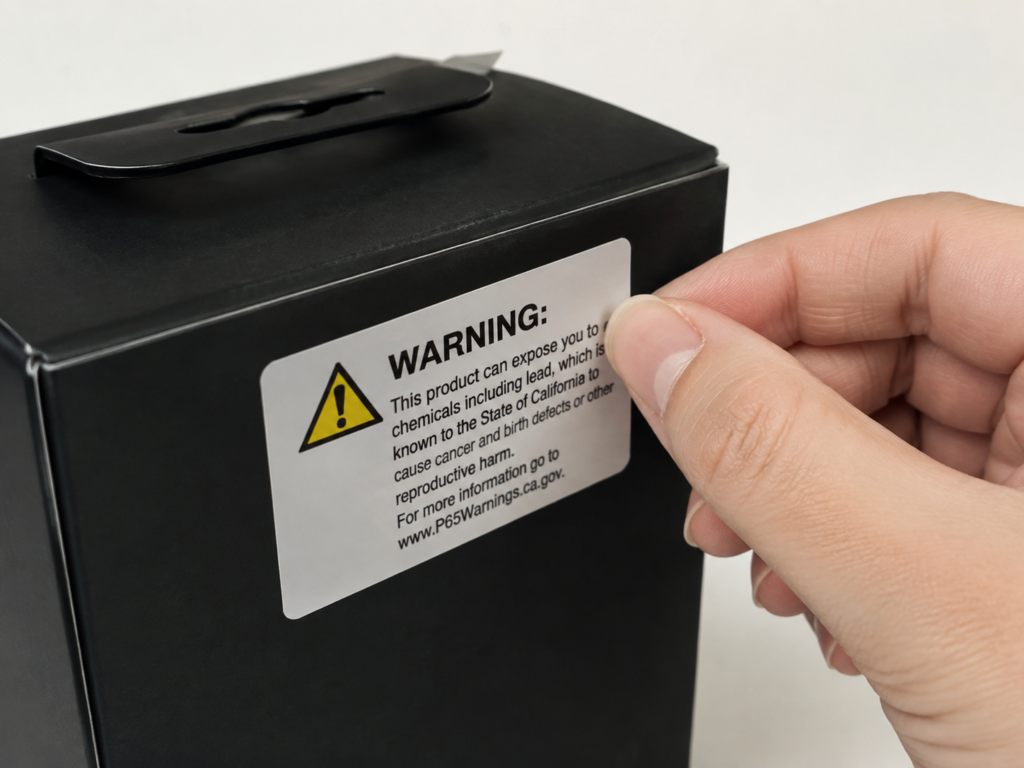
- Cancer risk template: Suitable for products containing carcinogenic substances such as lead and brominated flame retardants. The standard expression structure is: “WARNING: This product can expose you to chemicals including [specific substance name, e.g. lead], which is known to the State of California to cause cancer. For more information go to www.P65Warnings.ca.gov.”
- Reproductive harm risk template: Suitable for products containing reproductive toxic substances such as phthalates and cadmium. The standard expression structure is: “WARNING: This product can expose you to chemicals including [specific substance name, e.g. phthalates], which is known to the State of California to cause birth defects or other reproductive harm. For more information go to www.P65Warnings.ca.gov.”
- Dual risk template: Suitable for substances involving both carcinogenic and reproductive toxicity, such as lead. It is the most commonly used template for electronic products. The expression structure is: “WARNING: This product can expose you to chemicals including [specific substance name, e.g. lead], which is known to the State of California to cause cancer and birth defects or other reproductive harm. For more information go to www.P65Warnings.ca.gov.”
A statutory requirement that cannot be forgotten here: all long-form labels must include the phrase “known to the State of California”, which cannot be omitted — this is the statutory wording of Prop 65, and missing it will not meet the safe harbor requirements.
3.3 Can Short-form Labels Be Used? There Are Transitional Arrangements in the Rules
Sometimes the product is very small, such as adapters and earplugs, and the long-form label cannot fit on the product body or small packaging. In this case, short-form labels can be used, but there are strict restrictions.
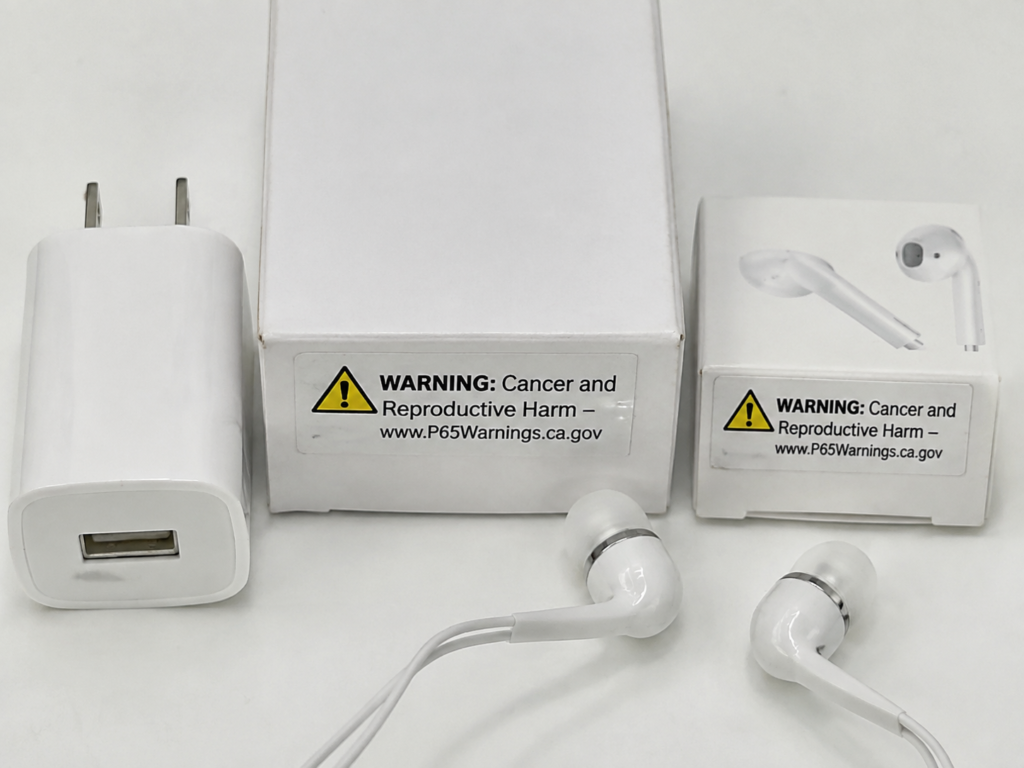
First is the applicable scenario: short-form labels are only applicable to scenarios where the packaging or product space is extremely small and indeed cannot accommodate the long-form label — if there is sufficient space, long-form labels should be used first, and arbitrary use of short-form labels may not meet compliance requirements.
Second is the version rule: California OEHHA has revised the short-form warning rules (the 2025 relevant revisions have set transitional arrangements). Old-style short-form labels that do not list specific substances can only be temporarily used on products that meet the applicable conditions during the transition period, and will no longer meet the safe harbor requirements after the transition period ends.
To judge whether the old version of the short-form label can still be used, check in the following order:
- First check the product manufacturing date / time of first entry into sales channels: only inventory products produced before the start of the transition period and within the allowed sales period can apply the transition rules;
- Then check the current sales time: if the transition period deadline has been exceeded, the old version of the short-form label without substances shall not continue to be used;
- Then check the special rules of the sales platform: some e-commerce platforms may require the use of the new version of the short-form label in advance, and platform requirements must be met first;
- The final shall be subject to the currently effective regulatory text published by California OEHHA.
At present, the reliable short-form labels that meet the latest rules usually include a warning word, warning symbol, risk type, at least one triggering substance, and the official website, with more guaranteed compliance.
To facilitate quick distinction, the comparison table of long-form and short-form labels is sorted out below:
| Comparison Item | Long-form Label (Recommended for Priority Use) | Short-form Label (For Special Scenarios Only) |
|---|---|---|
| Applicable scenarios | Carriers with sufficient space such as packaging, manuals, and e-commerce detail pages | Scenarios where the product body is extremely small and the packaging space is insufficient to accommodate the long-form label |
| Core elements | WARNING, warning symbol, risk type, at least 1 triggering substance, official website, “known to the State of California” phrase | WARNING, warning symbol, risk type, at least 1 triggering substance (requirement of current reliable version, specific subject to OEHHA’s current regulations), official website |
| Compliance risk | Fully complies with safe harbor rules, lowest risk | Must strictly meet applicable conditions, misuse easily triggers compliance issues |
Note: The specific element requirements and transition period arrangements for short-form labels may be adjusted with regulatory revisions. Before use, it is recommended to check the validity in the order of “product manufacturing/market entry time → current sales time → platform rules → OEHHA current text”.
In general, as long as the carrier has sufficient space, long-form labels are preferred, with relatively lower compliance risks; if short-form labels are really needed, be sure to use a version that meets the currently effective rules, and avoid using outdated old-style text.
3.4 Multilingual Requirements and Absolute Expression Red Lines
If your product, packaging, or e-commerce page provides information in languages other than English, you must simultaneously provide the Prop 65 warning in the corresponding language — for example, if there is a Spanish manual, a Spanish warning must be provided; if it is a Chinese-English bilingual e-commerce detail page, a Chinese-English bilingual warning must be provided.
But there is a principle: the English warning cannot be weakened. Its font size and placement cannot be inferior to warnings in other languages, and there cannot be only a Chinese warning without an English one.
In addition, there are several absolute expression red lines that cannot be touched, and touching them counts as a violation:
- Vague expressions are prohibited: Cannot just write “toxic”, “environmental protection reminder”, or “Prop 65”. Must clearly state whether it is a cancer or reproductive harm risk.
- Misleading offsetting is prohibited: Cannot add expressions next to the warning that would offset the warning effect, such as “meets all standards”, “safe and non-toxic”, “very low risk” — a warning is a warning, and you cannot say there is a risk while saying it is completely fine.
- Alternative logic is prohibited: Cannot only use warnings in other languages to replace the English warning; English is mandatory.
4. Format Specifications: Readability, Font Size, and Visual Requirements
Compliant label content is only the foundation. Format and readability are also mandatory requirements of the safe harbor rules, with the core principle that ordinary consumers can clearly identify it without effort.
4.1 The Core Requirement: Ordinary People Can See It Clearly at a Glance
Readability is a mandatory requirement in the safe harbor rules. To put it simply, it means “you can understand it without a magnifying glass or leaning close to your nose”. There are three specific hard standards:
- Ordinary consumers can clearly read the label content without the aid of a magnifying glass or leaning close.
- The font size of the warning content cannot be smaller than the minimum font size of other consumer information on the same carrier — for example, if the minimum size of other explanatory text on the packaging is 8-point, the warning cannot be smaller than 8-point.
- The minimum font size of short-form labels or on-product labels usually cannot be lower than 6-point (varies slightly with different fonts, subject to clear legibility).
4.2 Specifications for Color, Font, and Symbol
In addition to font size, there are several appearance requirements:
- Color: The warning word and symbol must have obvious contrast with the background. The most commonly used are black or red text on a light background, or white text on a dark background — cannot use a color similar to the background, such as light gray text on a white background, as unclear visibility counts as a violation.
- Font: Must use a clear and legible font. The font of the warning word “WARNING” must be larger and more prominent than the main text. Cannot use hard-to-read fonts such as artistic fonts, deformed fonts, or handwritten fonts.
- Warning symbol: For color printing, the default is an equilateral triangle with a yellow background and black exclamation mark. For black-and-white printing, a black-and-white version can be used. The symbol cannot be deformed, blocked by other patterns, or shrunk too small to be seen clearly.
4.3 Firm Affixation Counts: Durability Requirements
Labels are not just for sticking on; they must also be sturdy enough:
- The label must be firmly affixed, not easy to fall off or wear, and cannot be peeled off with a scratch of the hand.
- The label must remain clearly visible when the consumer receives the product and uses it for the first time — if the label is already worn out when the consumer opens the package, or is torn off because it is stuck on the express box, it is non-compliant.
- Never affix the label on carriers that tear off easily, such as sealing stickers, temporary packaging films, or express waybills — labels in these places are equivalent to not being affixed.
5. Placement Requirements: Placement Rules for Different Sales Scenarios
The core requirement for label placement is: consumers can see it without struggling to find it.
5.1 Labeling Rules for Physical Products and Packaging
Different physical products have different placement requirements:
- Packaged products: The label must be affixed to a prominent position such as the front or side of the packaging that consumers can clearly notice without opening the package before purchase; should not be affixed to the bottom of the back, folded edges, near the seal, areas easily blocked by price tags, or positions that can only be seen after opening, such as the inside of the packaging box.
- Products sold unpackaged: such as demo units in experience stores and bulk data cable accessories, must be labeled on a prominent part of the product body, or have a matching display sign next to them to clearly show the warning content.
- Multi-component sets: such as a set of mobile phone + charger + data cable, the label can be uniformly affixed to the outer packaging; if there are high-risk components inside, such as a separate battery, a supplementary label can be added to the battery, but this is not mandatory.
5.2 E-commerce Sales Display Rules
For cross-border e-commerce, there are also requirements for the display of Prop 65 warnings, the core of which is must be visible before consumers complete their purchase:
The warning cannot be hidden in the footer at the very bottom of the detail page, or in deep links that require clicking “view more” or “specifications” to see — it is only qualified if consumers can see it without specifically looking for it when browsing the product.
Recommended display positions are near the parameter area of the product detail page, or on the shopping cart page and checkout page, to ensure that consumers can see it before placing an order. In addition, the warning content on the e-commerce page must be consistent with the label content on the physical packaging. It cannot be that the physical packaging says dual risk while the e-commerce page only says cancer risk. Both brand owners and settled sellers have the responsibility to ensure the visibility of warning information, and cannot shirk responsibility to each other.
5.3 Flexible Adjustments for Special Electronic Products
Some special electronic products can adjust the label position according to the actual situation, without rigidly adhering to on-product labeling:
- Products with batteries: In addition to the label on the outer packaging, a supplementary warning can be added to the battery body or the inside of the battery compartment, but this is not a mandatory requirement, just a more reliable practice.
- Ultra-small accessories: such as adapters, earplug tips, and small button batteries, which are too small to be labeled, can only be labeled on the outer packaging, without forcing a label on the product body.
- Industrial-grade electronic products: not sold to ordinary consumers, can be accompanied by written warning documents with the goods, without labeling on the product body.
6. Advanced Pitfall Avoidance: Non-compliance Identification and Risks
The following advanced content is suitable for small sellers, purchasers, and readers who want to understand in depth, and can help you identify common non-compliant operations and avoid cognitive misunderstandings.
6.1 4 Most Common Non-compliant Operations by Merchants
In actual compliance scenarios, there are four types of most common non-compliant operations, and you should be more vigilant when encountering them:
- Concealed labeling: Hiding the label inside the packaging, on the last page of the manual, or in the footer at the very bottom of the e-commerce detail page, so that consumers cannot see it at all without specifically looking for it — this is the most common violation and the most likely point of complaint.
- Content violation: Only mentioning “Prop 65” without specifying the risk, or using vague expressions such as “environmental protection reminder” or “pay attention to safety” to replace specific substances and risk types, is equivalent to no notification.
- Misuse of short-form labels: Obviously there is enough space on large packaging and detail pages for long-form labels, but insisting on using short-form labels, or using old-style short-form labels without substances that no longer meet current rules.
- Channel inconsistency: There is a label on the physical packaging but not on the e-commerce page; or the warning content is different on different platforms, some say cancer, some say reproductive harm, which is contradictory.
6.2 4 Advanced Cognitive Pitfalls That Are Easy to Fall Into
In addition to the three basic misconceptions, there are several advanced cognitive pitfalls that many people who have done compliance for a long time are prone to fall into:
- More listed substances = more dangerous product: Wrong. The number of substances listed on the label is just the merchant’s labeling choice. Some merchants only list 1 main triggering substance, while others list all relevant substances. The risk level is only determined by the actual exposure level, and has no direct relation to the number of labeled substances.
- All electronic products have the same label requirements: Wrong. Industrial-grade, medical-grade electronics, and B2B parts have different applicable notification methods due to different usage scenarios and contact groups, and the labeling rules for consumer electronics cannot be directly applied.
- Having a test report means no need for labeling: Wrong. A test report can only verify the substance content. The core of judging whether labeling is required is exposure assessment — as long as the exposure level exceeds the threshold, no matter how many content test reports there are, the notification obligation must be fulfilled.
- Used and refurbished electronic products do not need labels: Wrong. As long as they are used or refurbished products sold to ordinary California consumers, they need to fulfill the notification obligation just like new products, and cannot be exempted just because they are used.
6.3 4 Steps to Judge Whether a Label Is Compliant
Here is a 4-step judgment method. Whether you are shopping or doing compliance audits, following it can quickly judge whether a label is compliant:
- Check core elements: See if there is a capitalized “WARNING”, warning symbol, clear risk type, at least 1 specific substance (check short-form labels according to current rules), and official website. Missing any one means non-compliance.
- Check format readability: See if the text is clear and can be read without a magnifying glass, if the font size is not smaller than other consumer information on the same carrier, and if the color contrast is sufficient.
- Check content matching: See if the labeled substance matches the product components — for example, a pure metal adapter labeled with phthalate risk is very strange, because phthalates are usually in soft plastics, which is most likely a random label.
- Check version validity: Verify whether the safe harbor text applicable after the 2018 revision is used. Short-form labels must comply with the 2025 revised rules and transition arrangements, and meet the latest requirements of the sales platform, to avoid using outdated old-style text without substances or missing elements.
6.4 What Happens If You Violate the Rules?
Many people care about the consequences of violations. In fact, Prop 65 mainly adopts a private enforcement model, that is, individuals or environmental organizations can file lawsuits against violating merchants, rather than the California government directly conducting daily inspections.
The common enforcement process is: the plaintiff first sends a 60-day violation rectification notice to the defendant. This notice provides a window for enterprises to assess, rectify, and communicate. Timely rectification helps reduce the scope of disputes and potential losses, but does not guarantee exemption from litigation, settlement liability, or civil fines. If the two parties do not reach an agreement within the notice period, the plaintiff can formally file a lawsuit. Most cases will eventually end in settlement, and merchants usually need to pay settlement funds and complete product compliance rectification. In serious cases, they may face consequences such as product removal and higher fines.
The responsible subjects are brand owners, importers, and sellers. Ordinary consumers do not need to bear any responsibility — if you buy a product without a label, you will not be fined, but can instead complain to the merchant or platform.
7. Practical Tools: Self-check List and Implementation Process
7.1 Ordinary Consumers: 10-second Quick Self-check
If you just buy electronic products and want to quickly eliminate the most obvious non-compliance problems, just look at three points, which can be done in 10 seconds:
- Is there a warning word starting with capitalized “WARNING”?
- Is there a clear mention of cancer or reproductive harm risk?
- Can it be seen without opening the package or scrolling to the footer?
If all three points are met, the most obvious non-compliance problems can be preliminarily eliminated; if you need to confirm full compliance, you need to further check details such as substance matching, version validity, and multilingual requirements.
7.2 Small Sellers/Purchasers: 30-second Advanced Self-check
If you are a small seller or purchaser and need to quickly audit whether the supplier’s label has core compliance elements, you can use the 30-second advanced version and look at four points:
- Is there a warning symbol, at least 1 specific substance, and the official California website?
- Is the “WARNING” word larger and more prominent than the main text?
- Does the labeled substance correspond to the product type, for example, does the data cable have phthalate labeling, does the power bank have lead/cadmium labeling?
- Is the text clear and readable without a magnifying glass?
If all four points are met, it can be used as a basis for quick screening before entering detailed compliance audits; the final compliance still needs to be comprehensively confirmed by combining factors such as exposure assessment conclusions, short-form applicable conditions, multilingual requirements, and omni-channel content consistency.
7.3 Signals to Recognize Non-compliant Labels at a Glance
If you don’t want to check item by item, remember these typical non-compliance signals, and you can recognize them at a glance:
- Content category: No “WARNING” mark, only mentions “Prop 65” without specific risks, no specific substances at all;
- Placement category: Hidden in concealed places such as the battery compartment, inside the packaging, or the e-commerce page footer;
- Format category: Blurred text, color similar to the background, blocked by other things, easily torn off.
As long as one of them is present, it is most likely non-compliant.
7.4 Complete Process for Electronic Product Enterprises to Make Labels
If you are an electronic product enterprise that needs to implement Prop 65 labels, you can follow this seven-step process, which is relatively reliable:
- BOM screening: That is, product bill of materials screening, go through the materials of all product parts to see if there are regulated substances on the California list.
- Supplier confirmation: Request chemical substance declarations from suppliers to preliminarily assess the exposure risk of each component.
- Professional assessment: For high-risk products, find a third-party professional institution to conduct exposure assessment or testing to determine whether labeling is required.
- Text selection: Prioritize long-form labels. If there is indeed insufficient space, use compliant short-form labels according to current rules.
- Design review: Check the label’s format, placement, and multilingual requirements to ensure compliance with safe harbor rules.
- Omni-channel synchronization: Synchronously update the warning content on all channels such as physical packaging, e-commerce pages, and manuals to maintain consistency.
- Filing and review: Keep documents such as exposure assessment reports, label design drafts, and supplier declarations for future reference — if enforcement is encountered, these are evidence to prove your compliance.
Final Summary
After reading this content, you should have mastered the following core abilities:
First, you can accurately understand that the essence of the Prop 65 warning label is statutory right-to-know notification, and will not be misled by false claims of “toxic” or “unqualified”;
Second, you can quickly preliminarily judge whether a Prop 65 label for electronic products is compliant from the three dimensions of content, format, and placement;
Third, you can preliminarily estimate whether an electronic product needs a Prop 65 label based on the sales scope and product type;
Fourth, you can identify common non-compliant operations of merchants and avoid advanced cognitive misunderstandings;
Fifth, you can clearly distinguish the different logics and functions of Prop 65 from other compliance labels such as RoHS, FCC, and CE;
Sixth, you understand the basic process for electronic product enterprises to implement Prop 65 labels, from BOM screening to filing and review.
In general, the core logic of Prop 65 is “consumers’ right to know” — it is neither a product quality judgment standard nor a sales ban rule, but just allows consumers to make independent choices on the premise of fully understanding potential risks. For ordinary consumers, there is no need to be overly nervous when seeing the label; for practitioners, as long as they provide sufficient notification according to the rules and retain compliance evidence, they can effectively control relevant risks.