
For those doing business in the UK market, you have most likely heard of “UKCA certification”. Many people immediately ask “where to get a UKCA certificate” and “what materials to prepare”, but in fact, many people have not even figured out whether their products actually need UKCA certification — either they waste money on unnecessary documents, or they are short of materials when they really need them, getting stuck at customs clearance or platform review. In this article, we will thoroughly explain the document requirements related to UKCA: first, we will help you quickly determine whether you need to do it, then explain what to prepare for different situations, and finally attach a directly applicable self-checklist and common pitfall avoidance tips.
First, Confirm Whether UKCA Is Actually Required
Many people make a mistake in the first step of preparing documents: they do not figure out whether their products fall within the jurisdiction of UKCA, and waste their efforts. You can quickly check according to the following content first.
Applicable Markets and Scope of This Article
First of all, it should be clear that the core applicable region of the UKCA mark is Great Britain, which is the collective name of the three regions: England, Scotland and Wales.
The market access rules for Northern Ireland are different from those of Great Britain: under normal circumstances, Northern Ireland applies the EU CE mark rules; if a product requires mandatory third-party conformity assessment completed by a UK accredited body, the CE + UKNI mark must be used. In addition, goods that meet the compliance requirements of Northern Ireland have a dedicated access path to enter the Great Britain market, with relatively special rules.
This article only focuses on the requirements of UKCA conformity assessment documents for the Great Britain region. The access rules for Northern Ireland need to be checked separately against the official announcements of the UK government.
Explanation of the CE Continued Recognition Policy
The UK government currently continues to recognize the CE mark within the scope of 18 product regulations. Eligible CE products can be directly placed on the Great Britain market without immediately preparing UKCA documents.
It should be noted that the applicable scope, product conditions and validity period of the CE continued recognition are all dynamically adjusted policies. You cannot directly determine applicability solely based on “having a CE certificate”. All details are subject to the latest announcement published on the UK government’s GOV.UK official website.
Three-Step Quick Decision Method
You can use these three steps to quickly determine whether you need to prepare UKCA documents:
Step 1: Confirm the UK region where the product will be finally placed — Great Britain or Northern Ireland;
Step 2: If the target market is Great Britain, check whether the product is within the current scope of CE continued recognition by the UK government;
Step 3: Only when the product is placed on the Great Britain market, falls under the mandatory UKCA control category, and is not eligible for the CE continued recognition policy, do you need to prepare UKCA compliance documents.
Basic Knowledge: What UKCA Documents Are and Who Is Responsible
Core Definition and Function of UKCA Documents
Many people think that UKCA is a “certificate” uniformly issued by an institution, but it is not. The “UKCA certification” we often talk about is a habitual term for ordinary users. Its official full name is UK Conformity Assessed mark, which corresponds to a complete set of “compliance evidence package”, including two situations:
• Where regulations allow manufacturers to complete conformity assessment on their own, the manufacturer only needs to sign a declaration of conformity by itself, without the involvement of a third-party institution;
• Where regulations mandate third-party assessment, an official UK-accredited third-party institution (UK Approved Body, referred to as Approved Body for short) is required to issue a formal assessment certificate.
In short, UKCA is a mark of compliance results. There is no nationally unified “UKCA certificate”. Whether a third-party institution is required to participate depends entirely on the regulatory requirements corresponding to the product.
This compliance document package has three core functions:
1. Prove that the product meets the UK’s safety, health and environmental protection requirements;
2. Respond to random inspections by market supervision departments, and is the core material that supervision departments prioritize to retrieve;
3. Meet the compliance requirements for customs clearance and online platform review.
Principles for the Division of Compliance Responsibilities
UKCA compliance responsibility is not a single “whoever places the product bears all responsibility”, but has clear statutory division of labor according to supply chain roles:
• The core responsibility of the manufacturer is to ensure that the product completes conformity assessment in accordance with applicable regulations, establish complete technical documents, and bear fundamental responsibility for the product’s compliance;
• Importers and distributors respectively bear obligations such as verifying the completeness of product labels and documents, retaining necessary materials, and cooperating with regulatory investigations and recalls;
• The specific responsibility boundary is subject to the applicable product regulations and actual supply chain arrangements. Commercial contract agreements cannot replace statutory compliance obligations. Even if the product is first placed on the market by the importer, the manufacturer cannot automatically be exempted from the compliance responsibilities it should bear.
Applicable and Excluded Scope
• Applicable objects: All products sold or imported (including online sales products) that are subject to mandatory control by UK regulations and are not eligible for CE continued recognition. For specific judgment, please refer to the three-step quick decision method above;
• Excluded objects: Products not subject to mandatory UKCA control, products eligible for CE continued recognition, and products only sold in Northern Ireland.
3 Steps to Lock Down Exactly Which UKCA Documents You Need to Prepare
Different products and different supply chain roles require different documents. There is no need to blindly collect materials. Follow these 3 steps to accurately lock the scope.
Step 1: Find the Applicable Regulations and Confirm the Assessment Path
UKCA document requirements all follow the regulations, so the first step is to figure out which UK regulation your product is subject to, and whether the corresponding assessment path is self-declaration or third-party assessment.
• Identification logic: According to the function and intended use of the product, find the corresponding UK regulation, then correspond from the basic requirements of the regulation to the designated standards officially specified by the UK, and finally confirm the conformity assessment procedure.
• Authoritative query path: Prioritize checking the product regulation section on GOV.UK, then refer to official guidelines and public opinions of UK accreditation bodies. If you are unsure, you can consult a professional compliance advisor. Do not trust old posts online.
A special reminder here: products of the same daily category may have completely different assessment paths due to different functions, intended uses, and applicable regulatory modules. For example, for hair dryers, ordinary household models and models declared by the manufacturer to have medical uses such as treating hair loss and relieving scalp diseases are subject to completely different regulations — if the latter meets the definition of a medical device, the assessment path must be separately determined in accordance with medical device regulations and classification rules, and cannot be simply divided by “low risk/high risk”.
Step 2: Confirm Document Responsibilities According to Your Supply Chain Role
Not everyone needs to prepare a full set of documents. The responsibility boundaries of different roles are very clear:
• Manufacturers/private label brand owners: Responsible for preparing a full set of compliance documents, signing the UKCA Declaration of Conformity, and bearing ultimate compliance responsibility;
• Manufacturers outside the UK: Only special regulations such as those for medical devices explicitly mandate the appointment of a UK Responsible Person (UKRP for short). For other categories, it cannot be assumed by default that appointment is required, and it must be confirmed in accordance with applicable product regulations and supply chain arrangements; UKRP is a legal representative appointed by the manufacturer and responsible for liaising with UK regulators. Its responsibilities are different from those of importers and cannot replace each other;
• UK importers: Bear statutory verification obligations in the import stage, including verifying the completeness of product compliance marks and documents, retaining copies of core documents, and cooperating with regulatory investigations. Specific obligations are subject to applicable regulations; the statutory duties of importers are not equivalent to UKRP, and cannot be assumed to replace the role of UKRP by default;
• Distributors: Responsible for verifying whether the labels of products on sale are compliant, retaining necessary documents, cooperating with supervision and recalls, and cannot sell products known to be non-compliant.
Step 3: Confirm Whether Documents Need to Be Stacked According to the Number of Regulations
The same product may be subject to multiple regulations at the same time. For example, an electric toy with Bluetooth must meet not only toy safety requirements, but also electronic safety, electromagnetic compatibility, and radio equipment requirements. In this case, documents corresponding to the requirements of the applicable regulations need to be stacked, and you cannot just do one set and be done.
You can use a simple method to quickly check: deduce the regulation list based on the core attributes of the product — for example, whether it has power supply, whether it has wireless function, whether it is for children, whether it is a protective product, whether it is for industrial use, which can basically cover most common regulations. Ultimately, the applicable scope still needs to be confirmed against official regulations.
General Core Documents: Mandatory for All UKCA-Mandatory Products
No matter what category or what assessment path is used, as long as the product is mandatorily required to have UKCA, there are 3 types of core documents that are required.
Technical Documents: The Core of Compliance Files
Technical documents are a complete set of technical evidence that proves the product meets the requirements of applicable regulations. They are the basis of all other compliance documents, equivalent to the “compliance file bag” of the product. They must contain at least the following content:
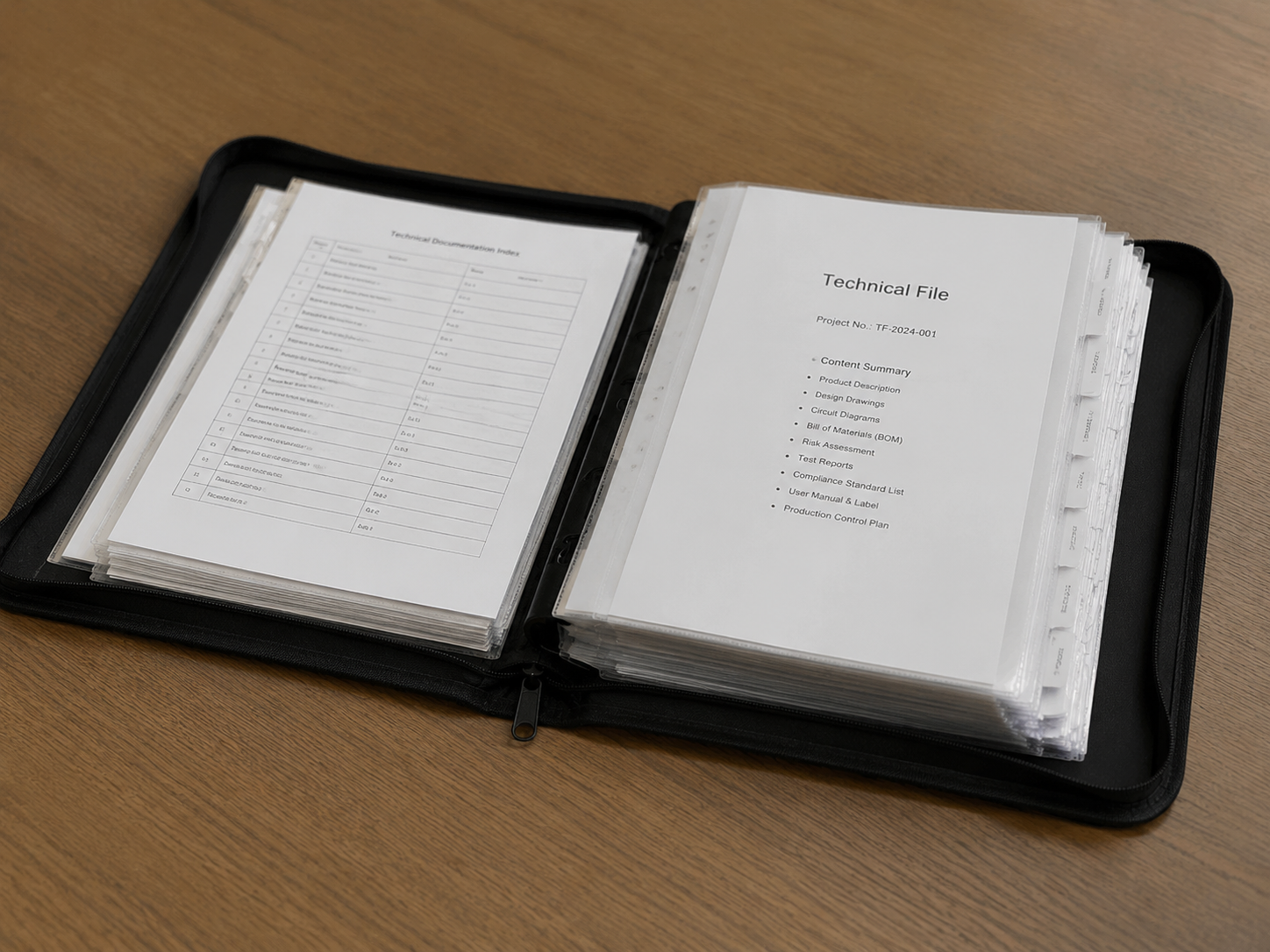
• Basic product information: Product name, model, specification, appearance and structure description, intended use, and reasonably foreseeable misuse description (for example, a child may put a small toy in their mouth, this situation must also be considered);
• Design and production materials: Design and manufacturing drawings, circuit diagrams, bill of materials (BOM) for key components, and compliance evidence of suppliers of key components;
• Compliance basis list: Applicable UK regulations and UK designated standards (the version number must be clearly stated). If there are places where the standards are not fully implemented, the deviation description and compliance reasons must be clearly stated;
• Risk and verification materials: Risk assessment records (including identified hazards, rectification measures, residual risk descriptions), as well as evidence verifying product compliance such as test reports, calculation documents, and simulation records;
• Production control materials: Consistency control measures during mass production, control procedures for design changes. For multi-model products, there must also be a model coverage matrix, clarifying the differences between different models and why compliance documents can be shared;
• Labeling and after-sales materials: Drafts of product labels and instructions. If required by applicable regulations, there must also be relevant records of complaint handling, non-conforming product management, and product recall.
UKCA Declaration of Conformity (UK DoC): The Compliance Guarantee Letter of the Responsible Party
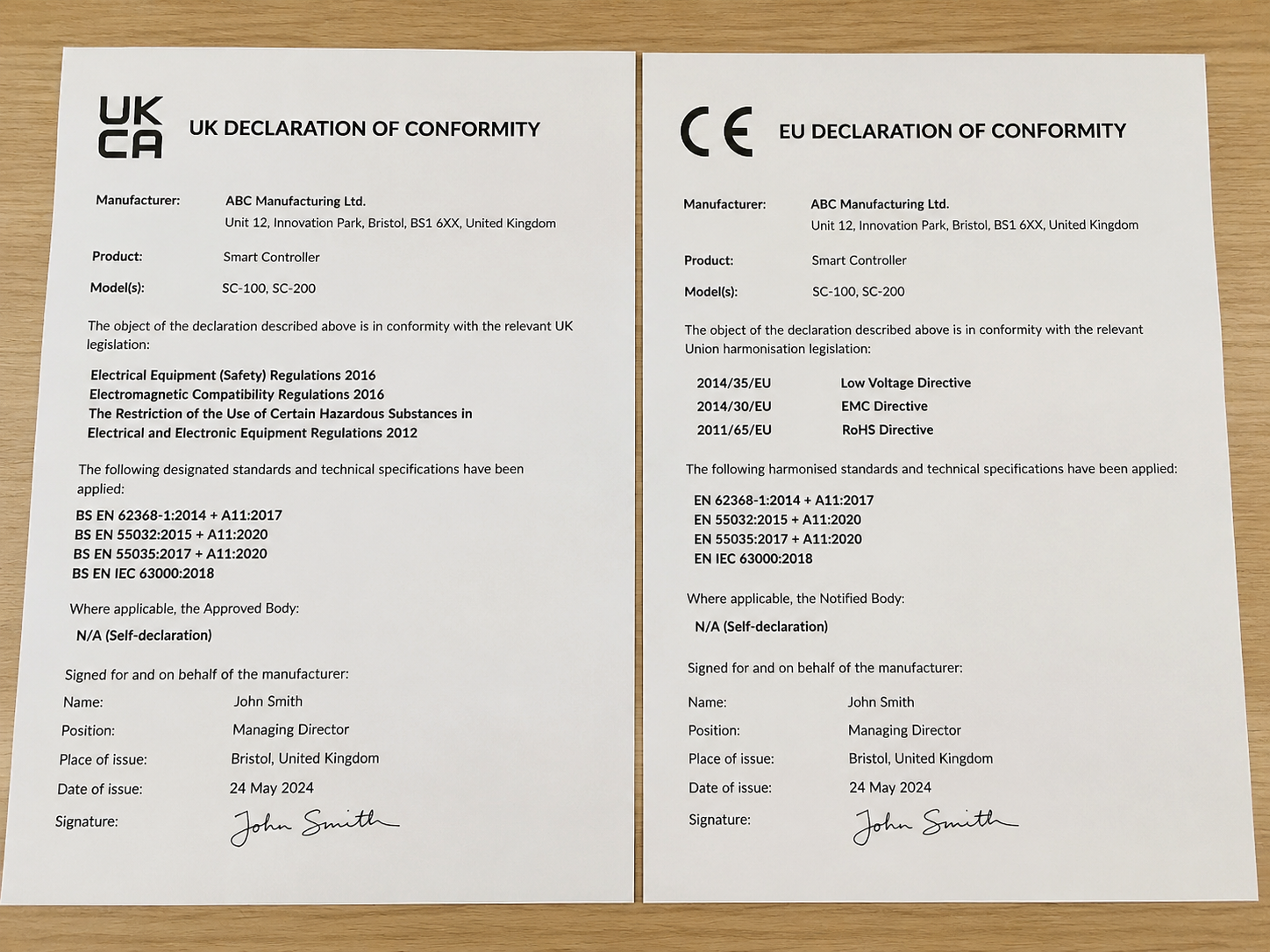
The UKCA Declaration of Conformity (UK Declaration of Conformity, referred to as UK DoC for short), to put it bluntly, is a “compliance commitment letter” signed by the responsible party, and is a document prioritized for retrieval during regulatory random inspections.
• Signing subject: It can only be signed by the manufacturer or its legal responsible subject. Unauthorized third-party institutions cannot sign on behalf;
• Required information: The UK DoC shall list relevant content in accordance with the requirements of applicable regulations, usually including: the name and contact address of the manufacturer (if regulations require the appointment of a UK responsible person or authorized representative, supplement the identity and UK address of the corresponding subject), product model or batch, itemized list of applicable UK regulations and designated standards, information of the authorized signatory, and date of issuance;
• Special requirements: If it is a category that requires the involvement of an Approved Body, the number of the corresponding institution and the scope of participation must be listed in accordance with regulatory requirements; one DoC can cover multiple regulations, but must clearly identify the corresponding products;
• Retention requirements: It is retained by the responsible party itself, does not need to be attached to the goods, nor does it need to be made public, but must be provided within the specified time limit when required by the regulatory authority.
Product Labeling and Accompanying Documents: Compliance Information Publicized with the Product
This part is the information pasted on the product, packaging, or placed in the product packaging for users to see, and must meet regulatory requirements:
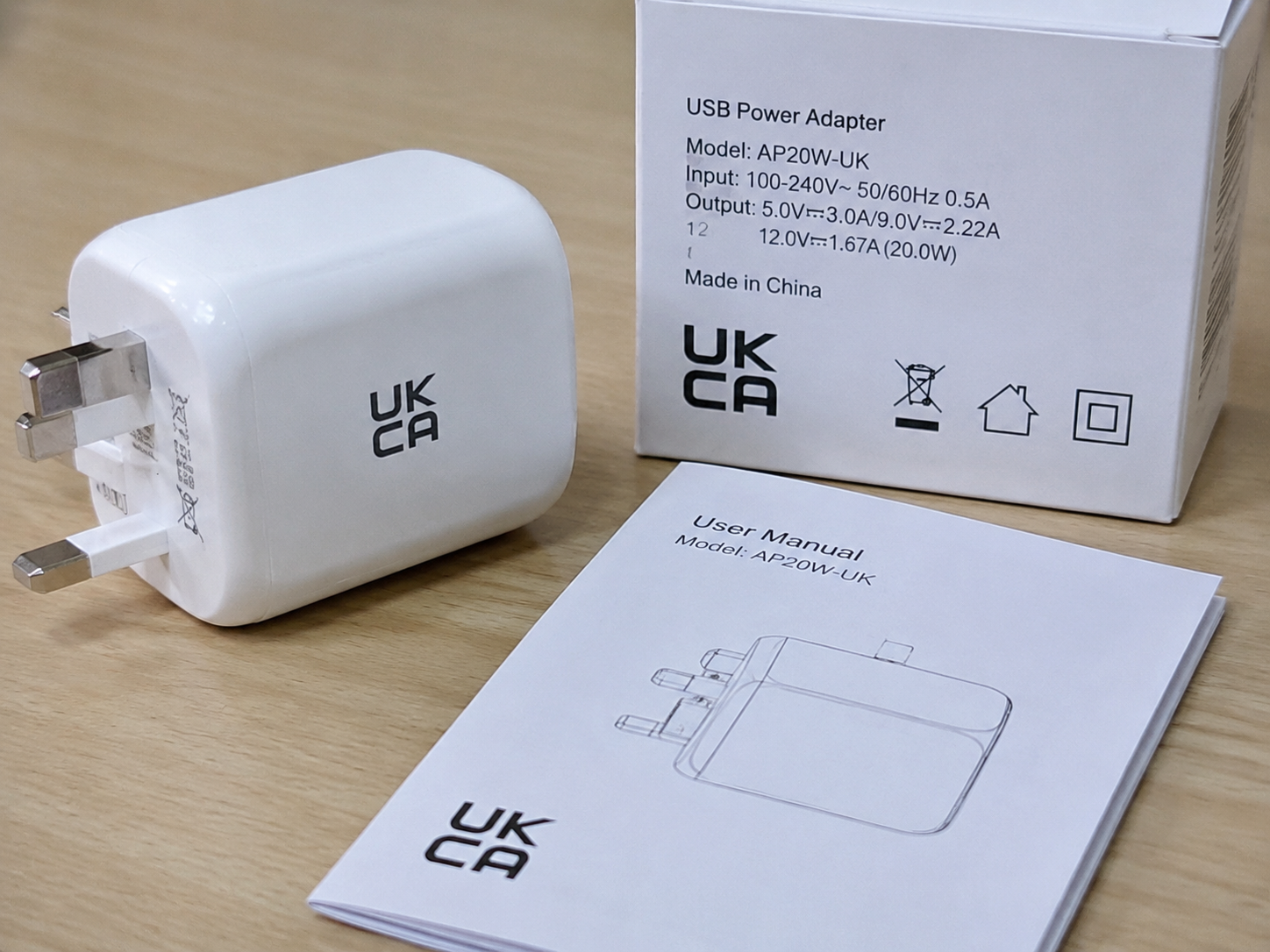
• UKCA mark requirements: Usually the minimum height is 5mm, it must be clear, permanent, and in a prominent position, and should be marked on the product body first; if the product is too small in size, special in nature, or explicitly allowed by applicable regulations, it can also be marked on the packaging or accompanying documents. Whether the Approved Body number needs to be marked and the marking method must be checked according to the specific applicable regulations; the mark can only be affixed after all conformity assessments are completed.
• Required information on product labels: Mark the name and contact address of the responsible subject (manufacturer/importer/UK responsible person), product model or traceable code, and necessary safety warning information in accordance with applicable regulatory requirements;
• Instruction manual requirements: Safety information for UK users is usually provided in English. The specific language requirements shall be confirmed in accordance with applicable regulations, and other official language versions such as Welsh shall be supplemented when necessary;
• A misunderstanding needs to be clarified here: there is no unified “mandatory all-English document” requirement for all categories, and the specific requirements are subject to the provisions of the corresponding regulations; if your technical evidence is in a non-English language, you need to prepare an English translation acceptable to the regulator.
Differentiated Supplementary Documents: Prepare as Needed According to Actual Scenarios
In addition to the general core documents above, different assessment paths, supply chain roles, product categories, and usage scenarios also require different supplementary documents. You don’t need to prepare all of them, just correspond as needed.
Supplementary by Conformity Assessment Path
• Third-party assessment path (requires Approved Body involvement): In addition to general documents, there must also be a conformity assessment certificate issued by the Approved Body, and factory quality system audit documents required by regulations;
• Self-declaration path: If the test is completed by yourself, you must retain the original data records of the self-test, as well as the compliance evidence of suppliers of key components.
Supplementary by Supply Chain Role
• Categories where regulations require the appointment of a UK responsible person: A UK responsible person authorization letter is required, clarifying the authorization scope, responsibility boundary and contact information;
• UK importers: Need to have purchase verification records and product traceability ledgers;
• Cross-border e-commerce sellers: Review materials required by the platform (note: the platform’s material requirements are commercial review rules, not equivalent to statutory UKCA documents. Do not treat platform requirements as legal requirements).
Supplementary by Common Product Categories
The special requirements of different categories vary greatly. The table below is only used to help you quickly identify the regulations and evidence directions that need further verification. It does not constitute a complete list automatically applicable by category. Specific requirements must be confirmed in combination with the intended use of the product, applicable regulations and the latest official rules.
| Product Category | Typical Applicable Regulations | Core Supplementary Document Direction | Special Reminder |
| Ordinary electrical and electronic equipment (non-wireless) | Electrical Equipment (Safety) Regulations 2016, Electromagnetic Compatibility Regulations 2016, RoHS Regulations 2012 | Test reports corresponding to applicable regulations (such as electrical safety, EMC, hazardous substance testing, prepared according to actual applicable regulations) | WEEE (Waste Electrical and Electronic Equipment recycling) is a producer responsibility registration obligation, not part of UKCA conformity assessment documents, and needs to be handled separately; the three regulations have their own scope of application, which need to be checked one by one in combination with product characteristics, and should not be mechanically stacked |
| Wireless equipment | Radio Equipment Regulations 2017 | RF/EMC/safety test reports, frequency band and power parameter descriptions | The Radio Equipment Regulations already cover core requirements such as safety, EMC, and spectrum. There is no need to mechanically split the list of independent regulations. Specific evidence shall be determined according to the type and parameters of the equipment; part of the spectrum use requires a separate license from the UK Office of Communications (Ofcom), which is unrelated to UKCA assessment |
| Toys | Toy Safety Regulations 2011 | Special test reports for physical/chemical/flammability, age warning label drafts | Stricter requirements for toys for children under 36 months (such as small parts, chemical substance restrictions) need to be judged in combination with the intended age grading, use and corresponding designated standards of the product. Not all low-age toys automatically apply all restrictions |
| Machinery | Supply of Machinery (Safety) Regulations 2008 | Machinery safety risk assessment report, noise/vibration emission data (when required by regulations) | Some high-hazard machinery requires the involvement of an Approved Body, and cannot rely solely on self-declaration. The specific list is subject to official regulations |
| Personal Protective Equipment (PPE) | Personal Protective Equipment (Enforcement etc.) Regulations 2018 | Protection performance test reports, PPE classification corresponding assessment documents | PPE is divided into Category I/II/III according to risk level. Different categories correspond to different conformity assessment procedures. Category II and above usually require the involvement of an Approved Body. The specific classification and requirements are subject to the official catalog and applicable regulations |
| Medical devices | Medical Devices Regulations 2002 | Clinical evaluation materials, quality management system documents, conformity assessment documents corresponding to the classification | Medical device classification rules are complex, and the appointment of a UK responsible person is mandatory. It needs to be checked separately in accordance with special regulations and the latest official transition policies |
| Construction products | Construction Products Regulations 2013 | Performance test reports, factory production control documents | UK designated standards (usually BS EN versions with designated marks) must be used. Relevant transition policies need to be checked against the latest official requirements. The specific assessment procedure is determined according to the product category and applicable standards |
Supplementary by Usage Scenario
• Customs clearance scenario: Just provide necessary materials according to the requirements of the carrier, customs and transaction contract. Technical documents and complete test reports are usually materials for market supervision and inspection, and do not need to be attached to the goods by default. Pay attention to protecting commercial secrets;
• Online sales scenario: According to platform rules, distance selling regulations and product regulatory requirements, just publicize product safety information, warning content, and responsible subject information on the detail page. There is no general rule requiring all categories to publicize the complete DoC on the detail page.
Practical Process of Document Preparation and Management: Get Compliance Files Done from Scratch
Now that you know what documents are needed, how to implement them specifically? We break them down according to practical steps, with clear actions, deliverables and responsible persons for each step.
Step 1: Define the Scope and Clarify Compliance Requirements
• Core actions: Confirm the UK regulations applicable to the product and the conformity assessment path; clarify the document responsibilities corresponding to your own supply chain role;
• Deliverables: , listing applicable regulations, standard versions, and assessment paths;
• Responsible person: Compliance officer or product manager.
Step 2: Inventory Gaps and Formulate a Completion Plan
• Core actions: Take stock of existing basic materials such as technical data and test reports; check the model coverage scope; formulate a supplementary plan for missing documents (such as risk assessment, special tests);
• Deliverables: , ;
• Responsible person: Compliance specialist or R&D leader.
Step 3: Conduct Verification to Ensure Consistent Information
This step is easily overlooked, but it is the most prone to problems during regulatory random inspections:
• Core actions: Check whether the product models and responsible subject information in all documents are unified; check whether the regulations and standards cited in the DoC are consistent with the technical documents; check whether the content of labels and instructions is consistent with the conclusions of test reports and risk assessments (for example, if the test report says the product cannot be used in the bathroom, the instructions cannot promote waterproofing);
• Deliverables: , ;
• Responsible person: Compliance specialist or quality leader.
Step 4: Sign and Archive, Clarify Retention Rules
• Core actions: Complete the signing of the DoC; confirm the final release version of labels and instructions; archive all documents as required;
• Deliverables: , , ;
• Retention requirements: Multiple UKCA-related product regulations require the responsible subject to keep technical documents and UK DoC for at least 10 years from the date the product is last placed on the Great Britain market. However, the starting point of this period, the applicable retention subject, the scope of documents to be retained, and exceptions must be confirmed in accordance with specific applicable regulations. Documents can be stored digitally, but must be retrievable at any time; the manufacturer or applicable legal responsible subject keeps the full set of originals, and importers and distributors only need to keep copies of core documents within the scope of their statutory obligations;
• Responsible person: Authorized signatory or file administrator.
Step 5: Update Regularly and Reassess When Triggered
UKCA documents are not done once and for all. When these situations occur, the effectiveness must be reassessed and updated in a timely manner: product modification, update of regulations or designated standards, change of responsible subject;
• Deliverables: , ;
• Responsible person: Compliance officer or R&D leader.
Common Misconceptions and Pitfall Avoidance Judgment
Many people step on pitfalls when preparing documents because their basic knowledge is wrong. We have sorted out the most easily confused concepts and high-frequency misconceptions to help you avoid detours.
3 Groups of Most Easily Confused Concepts
1. UKCA Declaration of Conformity vs CE Declaration of Conformity: The applicable regulations, standards, and responsible subjects of the two are different; if the product is within the scope of CE continued recognition, the CE DoC can be used directly, and there is no mandatory requirement to replace it with a UKCA one. For details, you can check against the CE continued recognition verification steps at the beginning of this article.
2. Technical documents vs test reports: Test reports are only a component of technical documents. A separate test report cannot be used as a full set of compliance evidence, and must be matched with other materials such as risk assessment and production control.
3. UK responsible person authorization letter vs importer certificate: The roles and responsibility boundaries of the two are completely different and cannot replace each other: the UK responsible person is a legal representative appointed by the manufacturer and responsible for liaising with UK regulators, and is only required to be set up under specific regulatory requirements; the importer is a market entity that bears verification obligations in the import stage, and its statutory duties are unrelated to the UK responsible person, and cannot be assumed to replace the role of the UK responsible person by default.
6 High-Frequency Misconceptions and Judgment Methods
1. Misconception: CE documents can be directly used as UKCA documents
Judgment method: First, according to the three-step quick decision method at the beginning of this article, check whether the product is within the scope of the UK government’s CE continued recognition; if it is not within the scope, CE documents can be used as a technical basis, but need to be replaced with UK-applicable regulations and standards, supplemented with corresponding responsible subject information, and completed UKCA conformity assessment before use.
2. Misconception: All products must have a third-party “UKCA certificate”
Judgment method: First check the conformity assessment requirements of applicable regulations; products following the self-declaration path do not need mandatory third-party assessment certificates. Platforms often refer to test reports, DoC, etc. collectively as “certification”, but whether third-party involvement is required is subject to statutory requirements.
3. Misconception: Products of the same series can share a set of documents
Judgment method: There must be a clear model coverage matrix. If the circuit, material, software, core structure and other parts that affect compliance are different, they cannot be shared. For example, for hair dryers of the same series, the circuit design of 1000W and 2000W is different, so they cannot share one test report.
4. Misconception: Test reports are valid for life
Judgment method: Test reports are not automatically permanently applicable. Reassessment is required when these situations occur: product/BOM/software changes, update of applicable regulations or designated standards, inconsistency between test samples and actually sold products, existing evidence is insufficient to prove compliance.
5. Misconception: All test reports provided by suppliers can be used
Judgment method: Under the self-declaration path, testing does not need to be compulsorily completed by an accredited laboratory, but must meet 4 conditions at the same time: ① The test is based on the current valid designated standards of the UK; ② The samples can cover the actually sold models and configurations; ③ The product design and production process have not undergone changes that affect compliance; ④ The evidence fully proves that the product meets the basic requirements. If regulations require third-party assessment, the supplier’s test report cannot replace the statutory conformity assessment document issued by the Approved Body, but can still be used as auxiliary supporting evidence in the technical documents.
6. Misconception: Sellers outside the UK must appoint a UK responsible person
Judgment method: Only special regulations such as those for medical devices explicitly mandate the appointment of a UK responsible person. For other categories, it needs to be confirmed in accordance with applicable regulations and supply chain arrangements, and it cannot be assumed by default that all products require it; the importer bears statutory duties in the import stage, which cannot be equated with or replace the role of the UK responsible person.
Common Consequences of Missing Documents
Don’t think that “as long as the product quality is fine”, incomplete documents also constitute compliance risks:
• Mild: Required to submit supplementary documents within a time limit, rectify labels or instructions, fail platform review;
• Severe: Products detained, sales suspended, recalled, fined, or even market access prohibited.
UKCA Document Quick Checklist (Directly Applicable)
After completing the documents, you can quickly self-check against this list to ensure there are no omissions:
Pre-Judgment Items (First Confirm Whether UKCA Is Actually Required)
• ▢ Confirmed that the sales market is the Great Britain region of the UK
• ▢ Checked that the product is not within the current scope of CE continued recognition by the UK government
• ▢ Confirmed that the product falls under the mandatory UKCA control category
Basic Mandatory Items (All UKCA-Mandatory Products Must Meet)
• ▢ Have complete technical documents (including product information, design and production materials, regulation and standard list, risk assessment, test evidence, production control materials)
• ▢ Have a UK DoC with a compliant signing subject and accurate information (itemized list of applicable regulations/standards)
• ▢ The position, size and institution number of the UKCA mark meet the requirements of applicable regulations
• ▢ Product labels include responsible subject information, traceable codes and safety warnings required by applicable regulations
• ▢ User-oriented safety information meets the language specifications required by regulations
Scenario Matching Items (Check as Needed)
• ▢ Products with third-party assessment path: Have a conformity assessment certificate issued by the corresponding Approved Body, and the mark is marked with the institution number (when required by regulations)
• ▢ Categories where regulations require the appointment of a UK responsible person: Have a legal and valid UK responsible person authorization letter
• ▢ UK importers: Have purchase verification records and product traceability ledgers
• ▢ Specific categories: Have met the document requirements of corresponding special regulations (such as PPE classification assessment, medical device clinical materials)
• ▢ Cross-border sales: Have met the commercial review requirements of the platform (not equivalent to statutory UKCA obligations)
Detail Compliance Items
• ▢ The product models and responsible subject information in all documents are completely consistent
• ▢ The UK regulations and designated standards cited in the DoC are current valid versions
• ▢ Multi-model products have a clear model coverage matrix, and the compliance of the different parts has been verified
• ▢ The document retention method and period meet the requirements of applicable regulations
• ▢ The product information and warning content on the online sales page are consistent with the physical labels
• ▢ Compliance reassessment has been completed after product changes
Finally, it should be reminded that all policies, regulations and checklists are subject to the product regulation section, CE recognition scope announcements, designated standard database, Approved Body directory, and special competent department guidelines on the UK government’s GOV.UK official website. This article is a general learning guide and does not constitute legal advice. The specific compliance requirements of a product must be determined after checking the latest official rules in combination with the actual use of the product, applicable regulations and supply chain roles.