
Routers, security cameras, and smart speakers at home are plugged in all year round. Have you ever wondered that their power adapters are quietly consuming power even when the devices are in sleep mode? If you leave a fast-charging phone charger plugged in all night, will it waste power itself besides charging the phone?
In the United States, when it comes to energy-saving appliances, many people think of the Energy Star label, but most people do not know the specific energy efficiency requirements for external power supplies — even many people confuse it with safety certifications and mandatory standards.
First, Get the Basics Right: What Is an External Power Supply? What Does Energy Star Regulate?
The charging heads, power bricks, and adapters we often talk about mostly belong to External Power Supplies (EPS for short) — simply put, they are pluggable devices that are plugged into wall sockets, independent of the electrical equipment, independently complete voltage conversion, and can be seen and unplugged without disassembling the equipment casing.
Common external power supplies include fast-charging phone chargers, laptop power supplies, adapters for routers/monitors/home security cameras, etc.
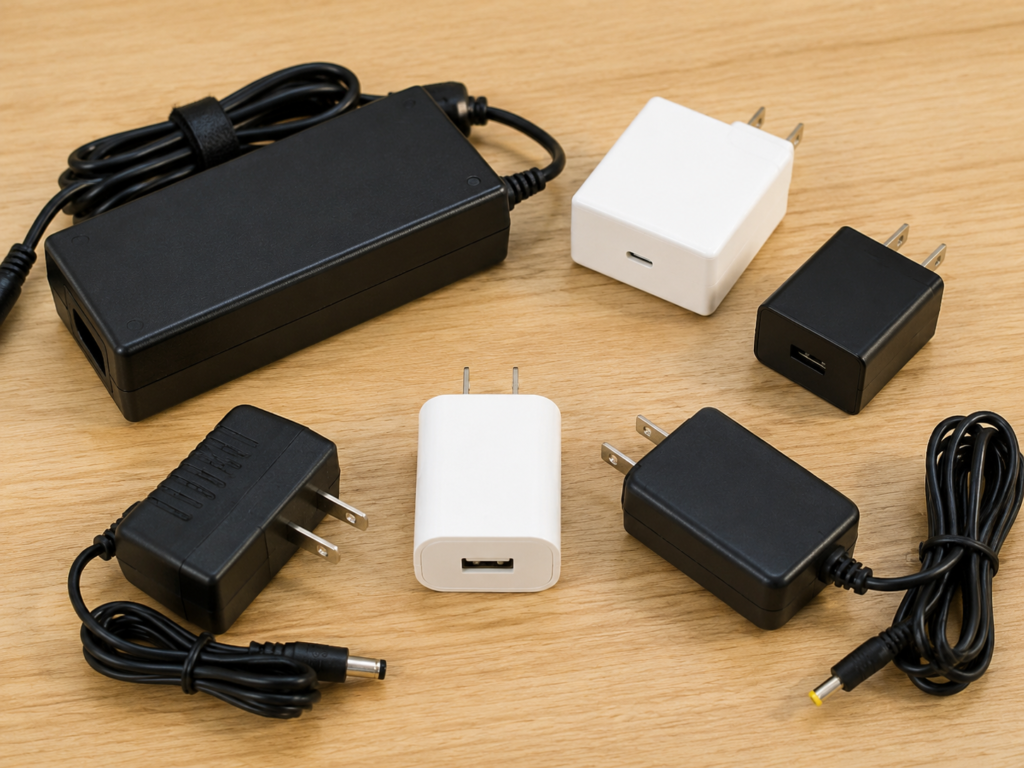
Many people confuse several similar types of power supplies. Here is a clear clarification of the boundaries at once:
- It is not an internal power supply: Power supplies inside desktop computer cases or TV bodies, which can only be seen by disassembling the casing, are internal power supplies and are not within the scope of assessment;
- It is not a mobile power supply (power bank): A power bank has a built-in battery, is an energy storage device, does not directly plug into the wall to convert voltage in real time, and is not counted;
- It is not a pure battery charger: For example, camera battery dock chargers and AA battery chargers, which are products specifically for charging independent batteries, follow separate specifications and do not belong to the category of external power supplies here.
What Exactly Is the Positioning of Energy Star?
Energy Star is a voluntary energy efficiency certification launched by the U.S. Environmental Protection Agency (EPA for short). In essence, it is an “excellence line” for energy efficiency, not a pass line. The program is continuously operated by the EPA, and the specifications are regularly revised with technological progress. The limit caliber involved in this article refers to the public general requirements of the EPA Energy Star external power supply specification. The specific effective version, effective date, and detailed clauses shall be subject to the official documents currently published on the EPA official website.
Products without this label can be sold legally as long as they meet U.S. mandatory energy efficiency standards. When federal agencies purchase applicable energy-consuming products, they are usually bound by relevant procurement rules, and specific procurement clauses, exemption situations, and product categories shall be checked; whether enterprise bulk procurement requires Energy Star depends on the agreement in the procurement contract.
Its core purpose is to reduce unnecessary power waste and help users reduce long-term electricity bills. Here is the most easily misunderstood point that should be clarified in advance: Energy Star only assesses energy efficiency levels, and does not involve other indicators such as safety performance, charging speed, durability, ripple, power factor, etc. Do not confuse it with safety certification.
Which Power Supplies Are Within the Scope of Assessment?
Not all external power supplies can apply the unified Energy Star limits. We can understand them by dividing them into several categories according to product type:
The most common products that can directly apply the unified single-output AC-DC limits: Single-output fixed-output AC-DC external power supplies with 100-240V/50-60Hz household single-phase AC input, low-voltage DC output, and rated output power of 1W to 250W, that is, the vast majority of ordinary round-hole adapters and fixed-output charging heads we come into contact with daily belong to this category.
Products covered by the specification but subject to exclusive clauses:
- AC-AC type external power supplies (such as old-fashioned linear transformers, whose output is still alternating current, common in old-fashioned audio systems and table lamps): They also fall within the scope of the Energy Star EPS specification, but only apply to AC-AC exclusive clauses, with fewer assessment indicators and slightly looser limits than AC-DC power supplies, and cannot apply AC-DC requirements;
- Low-voltage high-current single-output AC-DC power supplies: They need to meet two conditions at the same time: single-output voltage ≤ 6V and rated output current reaching the threshold specified in the specification. They are common in high-current low-voltage fast-charging products. Due to technical characteristics, the average efficiency limit is slightly lower than that of ordinary single-output AC-DC power supplies of the same power.
Special products that require separate verification of official clauses: - Power supplies supporting multi-level variable output such as USB Power Delivery (USB PD for short) and Quick Charge (QC for short): Their energy efficiency testing and classification may involve requirements such as maximum rated output power, separate testing of each output level, or combined load. They cannot be judged only by a single fixed output level, nor can they be classified as ordinary single-output power supplies just because they have a USB interface. The specific situation shall be subject to official specification clauses and product certification listing information;
- Multi-output power supplies (adapters with two or more independent outputs): They do not apply the unified limits for single-output power supplies, and need to be calculated according to the exclusive clauses for multi-output in the specification.
Products explicitly not covered: Industrial power supplies with power exceeding 250W, medical/military special-purpose power supplies, internal power supplies, power banks, and pure battery chargers do not apply to this set of requirements.
Two Core Indicators: What Exactly Does Energy Star Assess?
The core of Energy Star’s assessment of external power supplies is only two types of indicators, which ordinary people can easily understand.
Before looking at the specific limits, first clarify two basic definitions:
- Rated output power (nameplate power): The output voltage (V) marked on the power supply nameplate multiplied by the rated output current (A), that is, the maximum power that the power supply can continuously output. It is only used for preliminary judgment of the applicable power range, and the actual energy efficiency shall be subject to official test results.
- Low-voltage high-current power supply: Refers to a single-output AC-DC external power supply that meets both single-output voltage ≤ 6V and rated output current reaching the specification threshold, common in low-voltage level products of high-current fast charging.
No-Load Power Consumption: “Phantom Power Drain” When Plugged In But Not in Use
The first indicator is called no-load power consumption, which is commonly known as “phantom power drain” — the “no-load” here is the test state defined by the specification: the power consumption when the input end of the power supply is connected to the rated voltage and the output end is completely open (no load connected).
Many people think that the power supply does not consume power if it is not connected to a device, but this is not the case: as long as the internal circuit is energized, there will be losses. Energy Star sets an upper limit for this loss, not requiring it to be completely zero, but stipulating the maximum allowable value.
It should be noted that if the power supply is connected to a device, even if the device is turned off, as long as the device’s standby circuit is still drawing power, it does not belong to the no-load state defined by the specification. The power consumption at this time is the combined loss of the power supply and the device’s standby, and cannot be directly equated with no-load power consumption.
This indicator is most meaningful for scenarios where the power supply is plugged into the wall for a long time and the output end is completely unloaded: for example, when the charger is plugged in but not connected to the device, or the power supply is close to open circuit after the device is completely powered off, the level of no-load power consumption has a significant impact on long-term power consumption.
Average Active Mode Efficiency: The Power Conversion Ratio
The second core indicator is average active mode efficiency. Simply put, it is the ratio of the power supply converting alternating current from the wall into electricity usable by the device — the higher the ratio, the less power is wasted, and the more electricity bills are saved. For example, a power supply with 88% efficiency means that for 100W of electricity taken from the wall, 88W can be delivered to the device, and the remaining 12W is lost in the form of heat, etc.
It should be noted here that this efficiency is not only measured at full load, but measured at four points of 25%, 50%, 75%, and 100% rated load respectively, and then the average is taken, which is more in line with the situation where the load changes constantly in actual use.
In addition to average efficiency, the specification also sets low-load efficiency requirements at 10% rated load for single-output AC-DC power supplies. 10% rated load is a unified test point specified in the specification, which can be used for horizontal comparison of low-load energy efficiency performance of different products; the actual load of household equipment during standby and sleep may be higher or lower than 10%, and the specific situation shall be subject to the actual measured power consumption of the equipment. Therefore, this indicator is mainly used to reference the energy efficiency level under light load conditions. The compliance value of low-load efficiency is adjusted with the power range. For common 10-49W ordinary single-output AC-DC power supplies, the compliance value of low-load efficiency is mostly in the range of 75%-80%, and the specific situation shall be subject to the specification clauses of the corresponding power range.
As mentioned above, the scope of Energy Star’s assessment is limited to the above energy efficiency-related indicators, and other performances are not involved.
Reference Limits for Core Energy Efficiency of Single-Output AC-DC External Power Supplies
| Product Type | Rated Power Range | No-Load Power Consumption Limit | Lower Limit of Average Active Mode Efficiency | Low-Load Efficiency Requirement |
|---|---|---|---|---|
| Standard single-output AC-DC | 1W (inclusive) – 49W (inclusive) | ≤0.1W | Gradually increases with power, no unified fixed value | Applicable, adjusted by power range |
| Standard single-output AC-DC | Above 49W – 250W (inclusive) | ≤0.21W | ≥88% | Applicable, adjusted by power range |
| Low-voltage high-current single-output AC-DC | 1W (inclusive) – 49W (inclusive) | ≤0.1W | Gradually increases with power, slightly lower than standard single-output models at the same power | Applicable, adjusted by power range |
| Low-voltage high-current single-output AC-DC | Above 49W – 250W (inclusive) | ≤0.21W | ≥87% | Applicable, adjusted by power range |
Notes:
- This table only applies to single-output AC-DC power supplies with 100-240V/50-60Hz household AC input; AC-AC power supplies, multi-output power supplies, and variable-output power supplies shall refer to the corresponding exclusive clauses in the official specification.
- The efficiency requirements for the 1W-49W power range increase with rated power according to official rules. The specific values shall be subject to the official EPA specification or product certification data, and cannot be directly calculated only from the nameplate power.
- Nameplate power is only used for preliminary judgment of the applicable power range. The actual energy efficiency shall be subject to official laboratory test results and cannot replace certification.
Why Are the Requirements Different? Three Key Influencing Factors
Many people wonder: Why do some power supplies have a no-load requirement of 0.1W, while others have 0.21W? Why do some have an efficiency requirement of 88%, while others are lower? In fact, the Energy Star limits are not unified, and are mainly determined by three factors.
1. Rated Power Segmentation: The Lower the Power, the Stricter the No-Load Requirement
The first is the rated power of the power supply, which is what we often call “how many watts”. The requirements for different power ranges are different, and the overall rule is: the lower the power, the stricter the no-load power consumption requirement; the higher the power, the higher the efficiency requirement.
- Low power range (1W-49W, such as phone chargers, Bluetooth headset chargers): Because the power itself is small, the proportion of no-load loss in total loss is high, so the no-load requirement is the strictest, while the efficiency requirement gradually increases with power;
- Medium and high power range (50W-250W, such as laptop power supplies, all-in-one computer power supplies): Because the load is large, the absolute value of conversion loss is higher, so the efficiency requirement is higher, while the no-load requirement is slightly relaxed.
It should be noted that different power ranges correspond to different limits, there is no unified percentage, and the efficiency requirements for high power cannot be applied to low-power products.
2. Power Supply Type: AC-DC Has the Strictest Requirements
The second influencing factor is the conversion method and structure of the power supply:
- AC to DC power supply: That is, a power supply that converts alternating current into direct current, which is the most mainstream type now. For example, phone chargers and laptop adapters belong to this category. This type of power supply is assessed for all core indicators and has the strictest requirements;
- AC to AC power supply: That is, old-fashioned linear transformers, whose output is still alternating current, such as power bricks for old-fashioned audio systems and old-fashioned table lamps. This type of power supply is only assessed for some indicators, and the requirements are slightly looser;
- Special type power supplies: Such as low-voltage high-current, multi-output, and variable-output power supplies, due to different technical characteristics or structures, do not apply the unified limits of ordinary single-output power supplies, and need to be checked against the corresponding exclusive clauses.
3. Specification Version: The Newer the Version, the Stricter the Requirements
The third factor is the specification version of Energy Star. Its requirements are not static, but continue to tighten with technological progress. Since its launch, the Energy Star specification for external power supplies has been revised many times, and the requirements have been gradually tightened.
Two rules should be noted here: First, products certified with the old version cannot be promoted according to the new version requirements, and the compliance lines are different for different versions; second, whether a product meets the current version of the specification cannot be judged only by the production year, and must be subject to the certification records in the EPA official database.
Don’t Confuse: Energy Star Is Not a U.S. Mandatory Standard
Many people think that Energy Star is a mandatory certification in the United States, but it is not — it is just a voluntary “excellence line”. The energy efficiency requirements for external power supplies in the United States are layered, and the scope of application and mandatory nature of different levels are different.
Three Tiers of Energy Efficiency Rules for U.S. External Power Supplies
The energy efficiency requirements for external power supplies in the United States are roughly divided into three tiers. Their respective positioning and applicable scenarios shall be judged in combination with product type, sales region, and procurement nature:
| Rule Type | Issuing Body | Mandatory Nature and Scope of Application | Positioning |
|---|---|---|---|
| DOE Federal Mandatory Standard | U.S. Department of Energy (DOE) | Mandatory nationwide, applicable to external power supplies meeting the definition in 10 CFR Part 430, excluding exempt products such as medical, military, and industrial special-purpose products; specific applicability shall be subject to the EPS definition, exemption scope, and test procedures in this regulation | Pass line |
| Energy Star | U.S. Environmental Protection Agency (EPA) | Voluntary certification. When federal agencies purchase applicable energy-consuming products, they are usually bound by relevant procurement rules, and procurement clauses, exemption situations, and product categories shall be checked; enterprise procurement depends on contract agreements | Excellence line |
| State-level Requirements | Corresponding state government | Mandatory only within the corresponding state. Applicable products sold or delivered to the state must meet local requirements, and current regulations must be checked state by state (e.g., applicable product scope, registration/test requirements, and effective dates of the California Energy Commission (CEC)) | Local stricter standard |
Simply put: Power supplies purchased and used by ordinary consumers are legally sold products as long as they meet the DOE federal mandatory standards; if participating in federal government procurement projects, it is usually necessary to provide Energy Star certification; if products are to be sold to states with additional requirements, they must also meet the local state-level standards, and cannot only look at Energy Star.
Three Most Common Confusion Pitfalls
Here are three most common confusion points clarified to avoid pitfalls:
First, DOE standard ≠ Energy Star: Meeting DOE mandatory requirements only reaches the pass line for market access. Energy Star has stricter requirements and requires separate application for certification. Therefore, “meeting DOE” is not equal to “having Energy Star certification”; conversely, products that have passed Energy Star certification usually meet the DOE mandatory requirements of the same period, but the corresponding relationship between specification versions should also be confirmed.
Second, Roman numeral efficiency marks (Level I-VII) ≠ Energy Star: Many power supplies are printed with Roman numeral efficiency grades, such as “Level VI” and “Level VII”. These are internationally used efficiency grade marks, which can only be used as a reference, and are not equivalent to official Energy Star certification. Do not confuse the two.
Third, terminal equipment with Energy Star ≠ matching power supply with Energy Star: For example, if your laptop has the Energy Star label, it does not mean that the power supply it is equipped with has also passed Energy Star certification — the power supply is an independent product and needs to be certified separately. To verify, you have to check the model of the power supply separately.
Compliance Verification: 3 Methods to Determine Whether a Product Truly Meets the Requirements
Some products on the market are marked with the Energy Star label, but they may not have actually passed the certification. To verify the authenticity of the certification, you can gradually verify it according to the following three methods, with priority from low to high:
Method 1: Conduct Preliminary Screening by Checking Product Markings
First, you can check the Energy Star label on the power supply body, packaging, or manual. The official label is a blue star with the words “ENERGY STAR”, printed clearly with neat edges.
Note: The label can only be used as a preliminary clue. Only products that have passed official certification can legally use the label, and self-printed labels are invalid; conversely, the absence of a label does not directly mean that the product is not certified, and some compliant products may not be labeled.
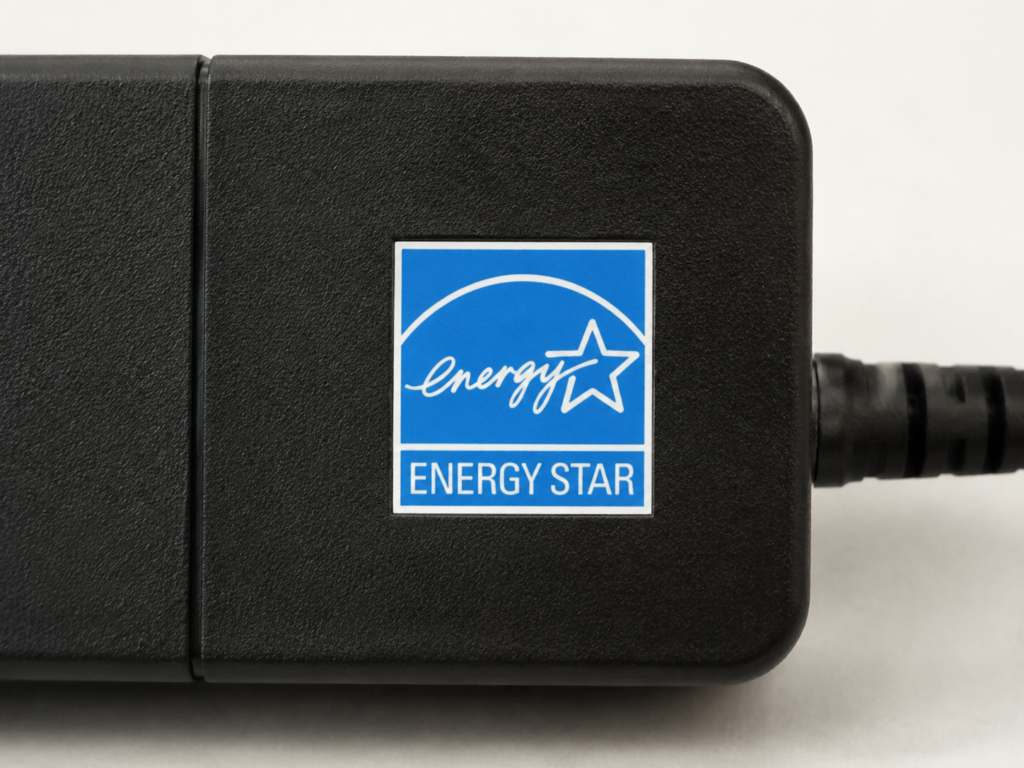
Method 2: Conduct Authoritative Verification by Checking the EPA Official Database
This is the most reliable verification method: log in to the qualified product public database on the official U.S. Energy Star website, select the “External Power Supplies” category, and enter the accurate full name of the manufacturer (brand owner) and complete product model (you cannot only enter the series name, for example, you cannot just remember “a certain brand 65W fast charger”, you need to remember the complete model such as “ABC-65W-2023”) to query.
Only when the brand, complete model, and output specifications displayed in the database are completely consistent with the product nameplate can it be confirmed that the product has obtained valid Energy Star certification.
If no result is found, do not immediately conclude that the physical product must be fake. There may be the following reasonable reasons: the model input format does not match (such as missing suffix, misspelled brand name), the product certification is applied for by the foundry, resulting in inconsistent brand ownership with the entered brand name, the product has been discontinued and removed from the current valid database, or the certification has just been applied for and has not been updated into the database.
But it should be clear that: before obtaining a match in the current valid database or a certified listing certificate of authorization, it cannot be confirmed as an Energy Star certified product, nor should it be promoted as Energy Star certified.
If it cannot be found in the database, you can first investigate the above reasons one by one, adjust the search keywords and try again; if it still cannot be matched, you can request the certification listing certificate for the corresponding model (issued by an authorized third-party certification body) from the seller or manufacturer, and if necessary, directly submit the product information to the Energy Star program for verification.
Method 3: Conduct Preliminary Reverse Verification by Checking Nameplate Parameters
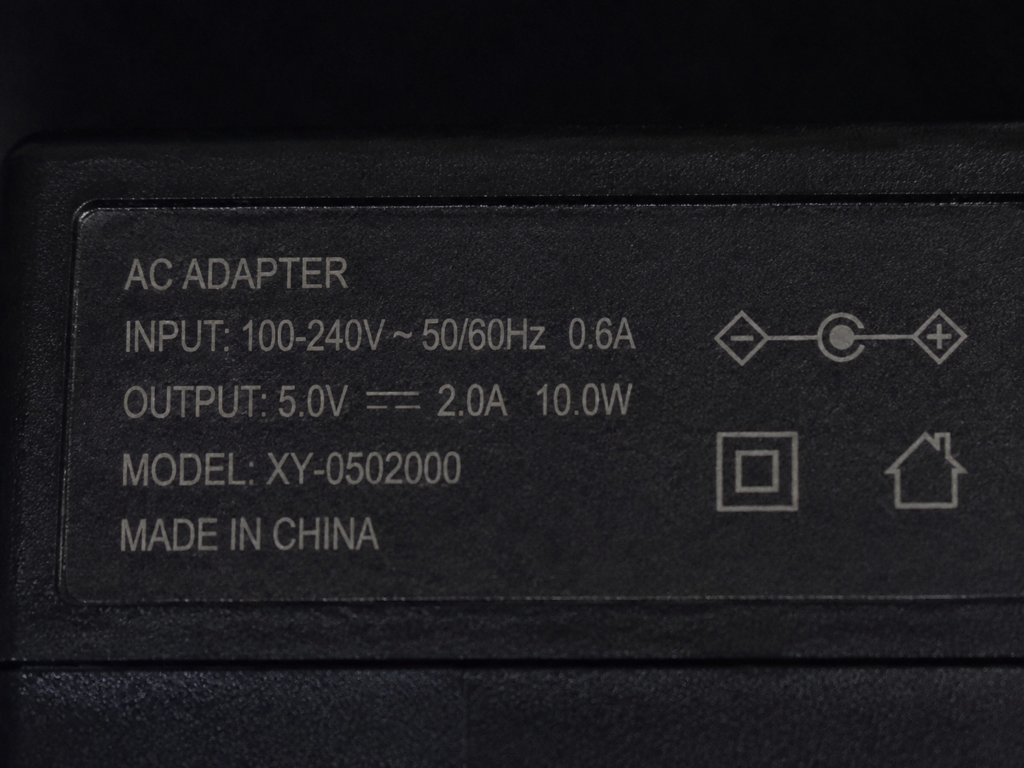
If it is inconvenient to check the database for the time being, you can first conduct a preliminary reverse check through the nameplate parameters: first find the output voltage and rated output current from the power supply nameplate, multiply the two to get the nameplate power, and then make a preliminary judgment against the energy efficiency reference limits of the corresponding power range. For example, a 10W charger with 5V/2A output belongs to the 1W-49W power range. If its nominal no-load power consumption is higher than 0.1W, it is very likely that it does not meet the Energy Star requirements.
Note: This method can only be used for preliminary reverse checking, and cannot be used as proof of compliance. The final validity shall still be subject to the results of the EPA official database.
Practical Purchasing Guide: How to Choose a Suitable Compliant Power Supply
After understanding the requirements, how to choose when actually purchasing? Here are some practical suggestions for you.
First Principle of Purchasing: Compatibility First, Then Energy Efficiency
No matter how high the energy efficiency of a power supply is, it is useless if it is not compatible with your device. Therefore, the first principle of purchasing is always compatibility. Different types of power supplies have different compatibility requirements:
- Fixed-output DC head adapters (such as round-hole power supplies for routers and monitors): The output voltage must be completely consistent with the original power supply. Incorrect voltage may burn the device; the rated value of the output current must be ≥ the rated current of the original one to avoid overload that cannot drive the device; at the same time, the size and polarity of the interface must be consistent with the original one to avoid failure to plug in or reverse connection that damages the device.
- Protocol-negotiated charging heads (such as phone/laptop chargers supporting USB PD and QC): The output voltage and current will be matched through protocol negotiation between the device and the charger, but the device, charger, and charging cable must all support the protocol level and current rating corresponding to the target power to achieve the expected charging effect. Under the premise of meeting protocol matching, a charger with higher rated power will not damage the device, nor will it consume extra power.
After meeting the compatibility requirements, then check whether there is an Energy Star label, and finally focus on the corresponding indicators according to the usage scenario.
For fixed-output DC head adapters, try not to choose models with rated power much higher than the device’s demand — for example, if the device only needs 10W, there is no need to buy a 100W adapter, which not only increases the cost, but also may slightly reduce the conversion efficiency when some products are in a light load state for a long time. For protocol-type fast charging heads, due to the demand for universal use with multiple devices, it is more practical to choose a compliant model with slightly higher power, and the efficiency difference under normal use can be ignored.
How Much Can You Save in a Year? A Simple Calculation
Many people care: How much money can you save by buying a compliant power supply? Power saving mainly comes from two parts: no-load and active mode. You can calculate according to your own usage.
No-Load Power Saving Calculation Formula (Can Be Used Directly)
Annual no-load power saving amount = (no-load power consumption of standard model – no-load power consumption of compliant model) × daily plug-in duration (hours) × 365 days ÷ 1000 × local electricity price (USD per kWh)
Note: ÷1000 converts watt-hours (Wh) to kilowatt-hours (kWh), and units must be unified before calculating the amount.
Take a transparent and recalculable example: a certain old or non-compliant ordinary 10W fixed-output adapter has a measured no-load power consumption of 0.5W (this value is only an example and does not represent the limit of the current DOE mandatory standard), and the no-load power consumption of the Energy Star compliant model is 0.1W. If it is plugged in for 20 hours a day, taking the average residential electricity price of about 0.15 USD per kWh announced by the U.S. Energy Information Administration (EIA) as an example (the specific situation shall be subject to the local actual retail electricity price):
Annual no-load power saving amount = (0.5 – 0.1) × 20 × 365 ÷ 1000 × 0.15 ≈ 0.44 USD
If it is a charger that is plugged in 24 hours a day and often in a no-load state, the annual no-load power saving is about 0.53 USD.
The claim that a single charger can save 3-5 USD per year mentioned in some promotions is usually based on extreme scenarios of old high-loss power supplies (no-load power consumption is much higher than current mandatory standards), 24-hour uninterrupted plug-in and long load time, or the cumulative power saving result of multiple power supplies, and cannot be directly applied to a single 10W charger that meets current mandatory standards.
Active Mode Power Saving Calculation
The power saving in active mode depends on the actual output power consumed by the device and the efficiency difference between the two power supplies. The formula is:
Annual active power saving amount = annual output power consumption of the device (kWh) × (1/efficiency of standard model – 1/efficiency of compliant model) × local electricity price (USD per kWh)
For example, a laptop consumes 100 kWh of output electricity in a year (that is, 100 kWh of output energy), the efficiency of an ordinary adapter is 85%, and the efficiency of an Energy Star compliant model is 88%, then the annual active power saving amount is:
100 × (1/0.85 – 1/0.88) × 0.15 ≈ 0.6 USD
The total power saving amount is the sum of no-load and active mode. The specific value depends on your usage habits: the shorter the plug-in time, the smaller the difference in no-load power saving; when the device is in a high-load state for a long time, the difference in active mode efficiency has a greater impact, but if the efficiency difference between the two power supplies is not large, the actual electricity bill saving amount is still relatively limited.
Different Scenarios Focus on Different Indicators
Different usage scenarios have different focuses. You can match them according to your situation:
- 24-hour continuous load scenario: For example, power supplies for routers, set-top boxes, home security cameras, and smart speakers. The equipment is in working condition all year round, and the power supply continues to carry load. At this time, the average active mode efficiency and low-load efficiency have a greater impact. Priority is given to Energy Star compliant models. The higher the conversion efficiency, the more power is saved;
- Long-term plug-in but often no-load scenario: For example, phone chargers by the bed and adapters for backup equipment, which are often plugged in but rarely connected to devices. At this time, no-load power consumption has a greater impact. Priority is given to compliant models with low no-load power consumption;
- Frequent plug-in and plug-out scenario: For example, chargers for phones and tablets. If you unplug them after use, the impact of no-load is very small. You can choose according to your needs. Of course, choosing a compliant model is more worry-free, and even if you forget to unplug it, it will not waste much power;
- High-power equipment scenario: For example, power supplies for laptops, all-in-one computers, and monitors. Because of the high power, the difference in conversion efficiency during use is more obvious. Compliant models save more electricity bills, and have higher cost-effectiveness in the long run.
Pitfall Avoidance Reminder: Common Cognitive Misconceptions and Compliance Risks
Finally, we have sorted out several high-frequency cognitive misconceptions and easily overlooked compliance risks to avoid pitfalls.
Four Most Common Cognitive Misconceptions
- Misconception 1: Having Energy Star = Safe
Clarification: This is the most common cognitive bias. Energy Star only assesses energy efficiency and does not involve safety performance. To judge whether a power supply is safe, it depends on whether there are third-party safety certifications such as UL (Underwriters Laboratories, a common third-party safety certification mark in North America) and ETL (a safety certification mark under Intertek Group, which is also a mainstream safety certification in North America like UL). - Misconception 2: The higher the power, the more power it consumes
Clarification: The actual power consumption of the power supply is mainly determined by the connected device — if you use a 65W compliant charger to charge a 10W tablet, the actual output is only 10W, and it will not run at full load. Moreover, high-power compliant power supplies often have higher conversion efficiency than low-power no-name brands, and may instead save more power. - Misconception 3: Energy Star is a mandatory certification
Clarification: Energy Star is a voluntary certification, not a U.S. federal mandatory requirement. Products without the Energy Star label can be legally sold in the United States as long as they meet the DOE federal mandatory standards, but they cannot use the Energy Star label for promotion. - Misconception 4: The smaller and lighter the power supply, the higher the energy efficiency
Clarification: The level of energy efficiency is tested by official laboratories, and there is no inevitable connection with the volume and weight of the power supply. Some small-volume high-power power supplies have limited heat dissipation design in order to fit more components, and the efficiency may instead be lower.
Preliminary Screening Clues for Fake Certifications
Although the final validity of certification shall be subject to the official database, you can initially screen high-risk products through two clues during daily purchase:
First, the Energy Star label is blurry printed, has obvious color deviation, and rough edges, which is most likely a self-printed fake label;
Second, unbranded or no-name products whose prices are much lower than similar compliant products of regular brands and cannot provide complete product models have a higher risk of fake certification.
Easily Overlooked Compliance Risks
Especially for friends who are engaged in sales or procurement, pay attention to two compliance pitfalls that are easy to step into:
First, for models of the same series with different powers, or products after hardware revision, the original certification may not be applicable, and the official listing status of the corresponding model needs to be verified separately.
Second, do not believe unofficial promotions such as “self-tested energy efficiency”, “energy-saving design”, and “environmentally friendly power supply”. These are not equivalent to Energy Star certification and have no official effect.
Summary
Generally speaking, Energy Star for external power supplies is a voluntary energy efficiency “excellence line” launched by the U.S. EPA, targeting external power supplies such as charging heads and adapters that are common in our daily lives. The core assessment is two indicators: no-load power consumption and average active mode efficiency. The specific limits vary according to the power, type, and specification version of the power supply.
When purchasing a power supply, always put compatibility and safety first, and then choose products with corresponding energy efficiency performance in combination with the usage scenario; if you need to verify the validity of the certification, the most authoritative way is to query the complete product model through the EPA official database, or request the authorized certification listing certificate for the corresponding model.