
Foreign trade sellers, purchasers, or product managers targeting the U.S. market have most likely heard of the three marks UL, ETL, and CSA. Many people feel confused when they first encounter them: Is only UL officially recognized by the U.S.? Is ETL a “watered-down certification”? Isn’t CSA Canadian, can it be used to enter the U.S. market? The core of these questions is actually a lack of understanding of the NRTL system behind the three marks — once you sort out the logic of this system, all doubts will be easily resolved.
Prerequisite for Beginners: First Understand the Core Basics of the NRTL System
Before discussing the relationship between the three, we must first thoroughly explain what NRTL is, otherwise it is easy to get confused by various claims.
Plain-Language Definition and Core Attributes of NRTL
You can think of NRTL as a “safety testing practice qualification certificate” issued by the U.S. Occupational Safety and Health Administration (OSHA) to third-party testing organizations; its official name is Nationally Recognized Testing Laboratory. Many people directly call NRTL “U.S. safety certification”, but strictly speaking, this is incorrect — NRTL is an institutional qualification, not a specific product certificate, nor a certification mark. Only organizations that have obtained NRTL qualification are eligible to issue safety compliance certificates recognized by the U.S. market for products.
Regulatory Boundaries and Role of NRTL
Many people think NRTL governs all product compliance, but in fact its boundaries are very clear: it is only responsible for product safety risks, such as electric shock, fire, mechanical injury, and other issues that directly threaten personal safety. As for requirements such as electromagnetic compatibility and radio frequency, they are under the jurisdiction of the FCC; energy efficiency requirements are under the jurisdiction of the DOE (U.S. Department of Energy) or California’s CEC. These are completely different compliance dimensions and cannot replace each other. Moreover, NRTL is a U.S.-exclusive system that only has legal effect within the United States and is useless in other countries and regions. Its core role is to prove that products meet U.S. safety standards and can be legally sold and used in the U.S. market and workplaces.
Why It Is Important to Understand the Relationship Between the Three
Understanding the relationship between the three has direct value for different groups: for sellers and foreign trade practitioners, it directly affects the cost, cycle, and compliance risk of entering the market; choosing the wrong one may cost tens of thousands of yuan extra, or delay the launch time; for purchasers and consumers, it allows quick judgment of whether products with different marks truly meet U.S. safety requirements, so they will not be misled by claims like “only UL is real”. The most common initial misunderstanding is that “only UL certification can enter the U.S. market” — we will specifically clarify this claim later.
Basic Identities of the Three: Three Mainstream Certification Bodies Under the NRTL System
UL, ETL, and CSA are currently the three organizations with the highest market share in the NRTL system and the most commonly contacted by people, and their respective backgrounds and positioning differ considerably.
UL: The World’s Most Well-Known Established Safety Organization
UL’s full name is Underwriters Laboratories, founded in 1894. It is one of the oldest safety testing organizations in the world and was among the first batch of organizations to obtain NRTL qualification. Its special feature lies in its dual identity: it is the main formulator of many UL-series safety standards — most of which have been adopted as official U.S. national standards by the American National Standards Institute (ANSI) — and it is also a third-party organization providing testing and certification services. Due to its early establishment, strong say in standards, and extensive brand promotion, many people mistakenly think UL is an official U.S. certification body, but in fact, like other NRTLs, it is a market entity regulated by OSHA.
ETL: A Cost-Effective Certification Brand Under Intertek
ETL is affiliated with the world-renowned testing organization Intertek (Tianxiang Group). Its predecessor was the Edison Testing Laboratory founded personally by Thomas Edison, and it itself has a history of over a hundred years. Compared with UL, ETL’s market positioning leans more toward cost-effectiveness and high efficiency, and it is UL’s main market competitor. It does not lead the formulation of U.S. national standards, but conducts testing based on already published U.S.-recognized safety standards such as UL, ANSI, and IEC, and issues certificates as long as the products meet the standards.
CSA: A North American Dual-Qualification Organization Founded in Canada
CSA’s full name is CSA Group (Canadian Standards Association), the largest standard-setting and certification body in Canada, equivalent to the Canadian version of “UL”. Its core advantage is dual qualification: it is both a local official certification body in Canada and has passed OSHA’s audit to hold U.S. NRTL qualification. For merchants targeting both the U.S. and Canadian markets, getting certification from CSA allows them to obtain compliance certificates for both markets at once, without having to do it twice separately, which is more efficient. Especially in categories such as industrial equipment, gas equipment, and building materials, CSA has very rich industry experience.
Core Commonality: Completely Equal Legal Status Under the NRTL Framework
The question many people care about most is: which of the certificates issued by these three organizations has higher validity? The answer is very clear: under the NRTL framework, the three have completely equal legal status, with no hierarchy or superior-subordinate relationship — this is the core rule of the entire system, and also the most easily misunderstood point.
Completely Unified Regulatory Rules and Access Standards
First, the access standards and regulatory rules for all NRTL organizations are uniformly formulated by OSHA, with no exceptions. To obtain NRTL qualification, one must pass OSHA’s extremely strict audit, and can only issue certificates within their recognized category scope; certificates beyond the scope are invalid. After obtaining the qualification, OSHA will also conduct regular re-examinations. If any violations are found, such as issuing certificates with lowered standards, the qualification will be directly revoked, even for UL. Many people think UL is the manager of the NRTL system, but that is completely not the case — UL, like other organizations, is a third-party body regulated by OSHA and has no special privileges.
Identical Legal Effect at the Federal Level
Second, at the U.S. federal level, the NRTL certificates issued by the three have exactly the same legal effect. That is to say, as long as the certificate is issued by a formal NRTL, whether it is UL, ETL, or CSA, the product can be legally sold in the U.S. market and legally used in workplaces. Local law enforcement authorities (such as fire departments and safety inspection departments, abbreviated as AHJ) will also recognize all NRTL marks, and will not deliberately make things difficult because it is ETL or CSA, nor is there any difference in priority. Only a very small number of places may have special local requirements, but this situation is very rare, and it is enough to verify in advance.
Completely Consistent Core Certification Rules
Finally, the core certification rules of the three are also completely unified. The formal NRTL certification process is the same: first send samples to the organization for testing, and after passing the test, a factory audit is conducted to confirm that the production process can stably produce products that meet the standards, before the certificate is issued. Obtaining the certificate is not a one-and-done matter; annual supervision audits are required to ensure that products always meet the requirements. Moreover, all NRTL certificates have clear specificity: they only correspond to specific product models, specific production factories, and specific safety standards. Different models of the same brand cannot be used universally; if the OEM is changed or the product design is modified, a new report must be submitted, otherwise the certificate will be directly invalidated.
Core Differences: Differences in Service and Positioning Brought by Market Competition
Since their legal status is exactly the same, why do people still choose different organizations in the market? Because the three are in a market-oriented competitive relationship, with differences in brand positioning, covered categories, service efficiency, and cost — these differences are all the result of commercial choices and have nothing to do with the legal effect of the certification.
| Organization | Brand Positioning | Core Strengths | Cost Ranking Under the Same Conditions | Cycle Reference Under the Same Conditions |
|---|---|---|---|---|
| UL | Century-old established brand, highest global recognition | Full category coverage, strong say in standards | 1 (highest) | 8-12 weeks (slowest) |
| ETL | Cost-effective and efficient choice | Consumer electronics, lighting, home appliances and other civilian products | 3 (lowest) | 4-6 weeks (fastest) |
| CSA | North American dual-qualification expert | U.S.-Canada dual market, industrial, gas, building materials | 2 (medium) | 6-8 weeks (medium) |
Note: The above comparison is an industry reference under the conditions of the same category, same safety standard, no rectification, and ordinary process. Actual cost and cycle will be affected by factors such as product complexity, rectification situation, and whether expedited service is used. The actual evaluation of the organization shall prevail.
Differences in Brand Awareness and Market Recognition
The difference in brand awareness is the most intuitive. Due to its early establishment and participation in formulating a large number of U.S. national standards, UL has the highest global recognition. Many large retailers, international brands, and project owners will default to specifying the UL mark, believing it to be more credible. ETL has very wide acceptance in the U.S. mainland, but its recognition in the international market is slightly lower than UL. CSA has the highest recognition in the Canadian market, almost synonymous with Canadian safety certification, and its recognition in the U.S. mainland is slightly lower than the first two. But it must be remembered: the level of recognition is a market and commercial choice, and in no way represents a difference in legal effect.
Differences in Covered Categories and Standard Discourse Power
Second is the difference in covered categories and standard discourse power. Because UL leads the formulation of a large number of UL standards, it covers the most complete range of categories, from consumer electronics, home appliances, lighting, to industrial equipment, medical equipment, building materials, almost all involved. ETL mainly conducts testing based on already published standards such as UL, ANSI, and IEC, focusing on civilian fast-moving consumer categories such as consumer electronics, lighting, and home appliances. CSA has its own CSA standards — which are Canadian national standards. Its strengths lie in categories such as industrial equipment, gas equipment, and building materials, and it can cover the standards of both the U.S. and Canadian markets at the same time. However, it should be noted that whether a specific category can be certified cannot be judged solely by impression; it must be based on the NRTL recognition scope list officially released by OSHA. Even UL does not have qualifications for all categories.
Differences in Certification Cost and Cycle
The difference in cost and cycle is what many merchants care about most. The reference values in the table are all levels under ideal conditions, and there are many influencing factors in actual operation: for example, the more complex the product, the more test items, the higher the cost and the longer the cycle; if the sample fails the test and requires rectification, additional rectification fees and retesting time will be added; if expedited processing is required, additional expedited fees will also be incurred. Moreover, different organizations have different quotation methods: some quote all-inclusive prices, while others only quote basic testing fees. Therefore, when comparing, you must ask clearly what services are included, and not just look at the surface numbers.
Mark Styles and Basic Classifications
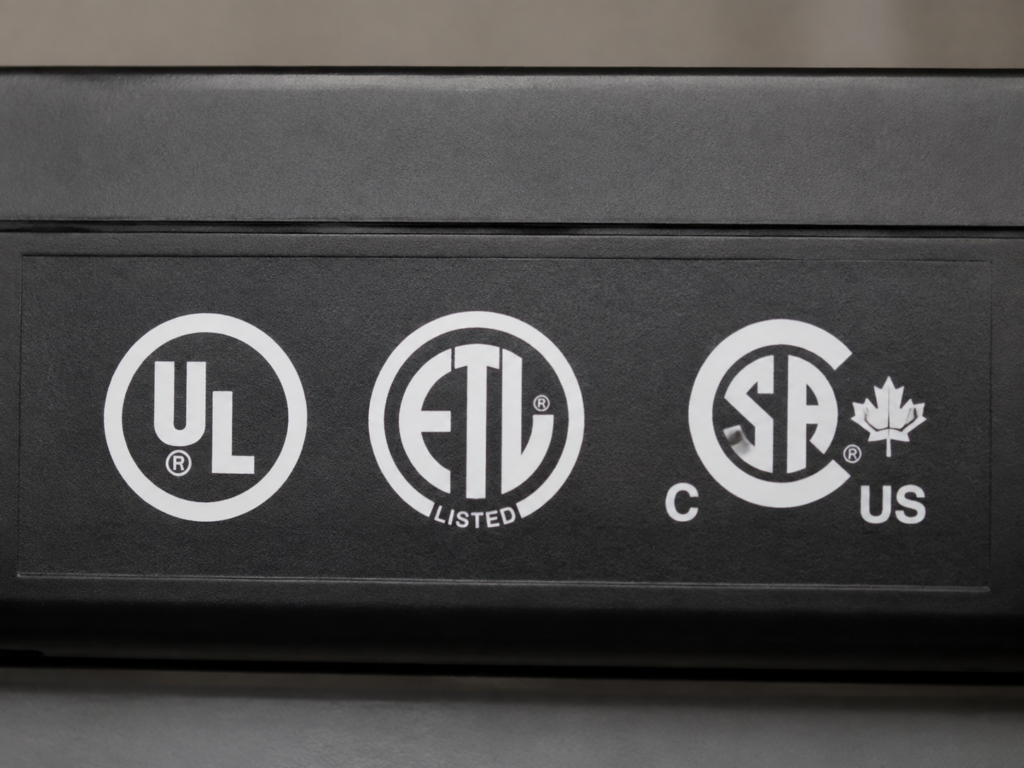
Finally, there is the difference in mark styles and basic classifications. The marks of UL and ETL are both circular letter marks, and the CSA mark usually has a maple leaf logo, which is easy to recognize. If the mark has the prefix “c us”, it means that the certification meets the safety standards of both the United States and Canada, and can be used in both places. No matter which organization it is, certification marks have basic classifications. The most common are finished product certification (called Listed in the industry) and component certification (called Recognized in the industry). Different classifications have different uses, and we will explain the specific judgment methods in detail later.
Business Relevance: Judgment Rules for Mutual Recognition, Certificate Transfer, and Substitution
After understanding the commonalities and differences, many people will ask: I already have certification from one of them, can I transfer it to another? Or the client wants UL, can I use ETL as a substitute? These questions all fall into the category of business relevance between the three, and we will explain them clearly by situation.
Mutual Recognition Rules for Test Reports
First is the mutual recognition of test reports. Many people think that reports between NRTLs are universal, but that is not the case — there is no mandatory mutual recognition obligation between NRTLs, and each organization has its own audit standards. But if your product already has a qualified test report issued by a certain NRTL, and the test data meets the requirements of the target organization, you can usually apply for exemption of some test items, without having to redo all of them, which can save some money and time. If the target organization has its own exclusive testing requirements, then the corresponding items still need to be supplemented for testing.
Conditions and Costs of Certificate Transfer
Second is certificate transfer. If you want to replace a certificate from Organization A with one from Organization B, it is feasible, but there are several prerequisites: the original certificate must be within the validity period, the product has not been remodeled, the key components have not changed, and the original test data meets the requirements of the target organization. If these prerequisites are met and no supplementary testing is required, the cost of certificate transfer is usually 30%-60% lower than applying for a new certification, depending on the product category and the organization’s policy. But it should be noted that you must never directly replace the mark on the product yourself. You must go through the audit of the target organization and obtain a new certificate before you can use the corresponding mark, otherwise it is a violation.
Can They Substitute Each Other: Judge by 3 Scenarios
Finally, there is the question that everyone cares about most: “can they substitute each other”. There is no absolute answer to this, and it must be judged by three scenarios:
The first is legal compliance scenario: at the U.S. federal level, the certificates of the three can completely substitute each other, and all are legal and valid. Only a very small number of places may have special local regulatory requirements, but this situation is very rare, and it is enough to verify with the local law enforcement department in advance.
The second is customer requirement scenario: if your customer, sales channel, or e-commerce platform clearly specifies the mark of a certain organization, then you cannot use another one as a substitute. For example, some large retailers only accept UL, and some Amazon categories require UL certificates. This is a commercial requirement, not a legal requirement, but you must comply if you want to enter this channel.
The third is Canadian market scenario: if it is CSA’s U.S.-Canada dual certification, it can be used directly in Canada; if it is a U.S. certification from UL or ETL, you need to additionally apply for the corresponding Canadian qualification (such as cULus, cETLus) before you can legally sell in Canada.
Practical Verification: 5 Steps to Judge Whether an NRTL Certificate/Mark Is Valid
Whether you are purchasing products or doing certification yourself, learning to judge the validity of NRTL certificates and marks is a core skill to avoid pitfalls. You don’t need to memorize complex rules; just follow these 5 steps, and you can basically judge whether the certificate is compliant.
Step 1: Check the Matching Between Product and Certificate
The first step is to check the matching between the product and the certificate. Many people think that as long as the products are of the same brand, one certificate is enough, but that is completely not the case. NRTL certificates are bound to specific product models, series, and key configurations. Even for the same brand, products of different models cannot share one certificate. In addition to the model, you also need to check the name and address of the production factory. The product can only be produced by the factory registered on the certificate. If the OEM is changed, even if the product is exactly the same, the certificate will be invalid if a new report is not submitted.
Step 2: Check Applicable Standards and Versions
The second step is to check the applicable standards and versions on the certificate. A formal NRTL certificate will definitely be marked with a specific U.S. safety standard number, such as UL 62368 commonly used for audio-visual products, and UL 508 commonly used for industrial control equipment. If a certificate does not even have a standard number, it must be fake. Also pay attention to the version number of the standard. U.S. safety standards are updated regularly, and old version certificates have a transition period. After the transition period, old version certificates no longer meet the latest compliance requirements, so you must confirm that the currently valid standard version is used.
Step 3: Check Mark Type and Usage
The third step is to check the type and usage of the mark. The two most common marks are finished product certification (Listed) and component certification (Recognized): finished product certification is for complete products ultimately intended for consumers, and products with this mark can be directly marketed and sold; component certification is for components such as power supplies and switches, which can only be installed in final products and cannot be sold separately. There is also a special Classified classification, which is a certification only for a specific performance, such as only fire resistance performance, which cannot be used as a full safety certification, let alone expand the scope of use.
Step 4: Check Certificate Restrictions
The fourth step is to check the restriction conditions on the certificate. Many certificates have clear parameter or scenario restrictions, such as voltage range, maximum current, applicable ambient temperature, installation method, etc. Using beyond these parameter ranges is non-compliant. Some certificates also restrict usage scenarios, such as only for indoor use, only for industrial environments. If used outdoors or in residential buildings, you will be responsible for any problems that arise.
Step 5: Verify Authenticity and Institutional Qualification
The fifth step, and also the most critical one, is to verify the qualification of the organization and the authenticity of the certificate. First, confirm whether the issuing organization has NRTL qualification for the corresponding category. It is not that just because it is called UL, it can do all products. You need to go to OSHA’s official website to check whether your category is within the NRTL recognition scope of this organization. Then check the authenticity of the certificate. All three organizations have their own official query systems: UL certificates can be checked on UL Product iQ, ETL certificates on Intertek’s ETL Certification Directory, and CSA certificates on CSA Group’s official website. Enter the file number or product model on the certificate, and you can find the corresponding certificate information; if you can’t find it, it is fake.
Decision Guide: How to Choose the Right NRTL Certification for You
If you are preparing to do NRTL certification and don’t know which one to choose, you can follow the steps below to choose, which can not only meet compliance requirements but also control cost and cycle.
Step 1: First Confirm Hard Requirements (Highest Priority)
The first step is to confirm all hard requirements first, which have the highest priority and cannot be compromised. First, check whether your customer, sales channel, or e-commerce platform has specified the mark of a certain organization. If there is a clear requirement, just choose according to the requirement, no need to hesitate. Then look at your target market: if you only target the U.S. market, all three can be chosen; if you only target the Canadian market, CSA is the most convenient; if you target both the U.S. and Canadian markets, CSA or UL/ETL with dual marks are all acceptable. Finally, confirm whether the target organization has the qualification for your product category, especially for relatively niche categories. You must first check OSHA’s recognition list, or directly ask the organization whether they can do it, to avoid wasting time.
Step 2: Choose by Demand Priority (When There Are No Hard Requirements)
If there are no hard requirements, you can choose according to your own demand priority. If you are doing high-end products, or your customer group has high requirements for brand recognition, or UL is the default in the industry, then choose UL. Although it is more expensive, it has stronger brand endorsement and is easier to gain customer trust. If you pursue cost-effectiveness, or your products iterate quickly and need to enter the market quickly, such as consumer electronics and fast-moving consumer products, then choose ETL, which has lower cost and shorter cycle, helping you seize time. If you target both the U.S. and Canadian markets, or you are engaged in products such as industrial equipment, gas equipment, and building materials, choosing CSA will be more appropriate, as you can get dual certificates at once and it has category experience.
Step 3: Pitfall Avoidance Reminders (Don’t Just Look at Surface Quotations)
Finally, there are a few pitfall avoidance reminders, don’t step into them. First, don’t just look at the surface quotation, calculate the total cost. Many organizations quote very low basic testing fees, but rectification fees, retesting fees, factory audit fees, and annual audit fees are not included, and the final total cost is even higher. Therefore, when inquiring about prices, you must ask clearly about all fees, including subsequent annual audit fees. Second, don’t believe illegal promises, such as “issue certificate directly without testing”, “guaranteed pass”, etc. Formal NRTLs will never say such things. If illegally issued certificates are found by OSHA, they will be directly revoked, and by then the products will be detained and removed from shelves, causing greater losses. Third, be sure to confirm that the latest valid version of the standard is used, otherwise, just after getting the certificate, the standard is updated, and you have to redo it after the transition period, wasting money and time.
Clarification of Common Misconceptions
Finally, let’s clarify a few of the most common misconceptions. Many people can’t figure out the relationship between the three because of these wrong perceptions.
Misconception 1: UL is an official U.S. certification, and ETL/CSA have lower legal effect
Many people think UL is official U.S. certification, while ETL and CSA are private and have lower validity. In fact, this is completely not the case. All three are NRTL organizations officially recognized by OSHA, and their legal status at the U.S. federal level is completely equal. The reason for this illusion is that UL was established early, participated in formulating many U.S. national standards, and has a lot of brand promotion, giving people an “official” feeling, but in essence it is still a third-party commercial organization, regulated by OSHA like other NRTLs.
Misconception 2: ETL certification is looser than UL, and product safety is worse
Some people think ETL is cheaper and faster because its standards are looser and products are less safe. This is also a misunderstanding. All NRTL organizations use the same set of U.S. national safety standards for testing, the passing line is exactly the same, and there is no difference in strictness. The reason ETL is faster and cheaper is because its service process is more efficient and its market positioning is cost-effective, not because it lowers standards. It’s like the same exam, proctored at different test sites, the passing line is 60 points, it won’t change because of the test site.
Misconception 3: CSA can only be used in Canada and cannot enter the U.S. market
Many people think CSA is a Canadian organization that can only be used in Canada and cannot enter the U.S. In fact, CSA has long passed OSHA’s audit and is a formal U.S. NRTL organization. The NRTL certificates it issues for the U.S. scope are completely legal and valid in the U.S. It’s just because CSA is a local Canadian organization that it has greater influence in Canada, and people have a deeper impression of its Canadian identity.
Misconception 4: Having an NRTL mark means the product is fully compliant and can be used globally
Some people think that having an NRTL mark on a product means all compliance has been done and it can be used globally. In fact, NRTL only covers U.S. product safety requirements. Electromagnetic compatibility, radio frequency, energy efficiency, etc., all require separate corresponding certifications, such as FCC, DOE/CEC, etc., which cannot replace each other. Moreover, NRTL is a U.S.-exclusive system that is only valid within the United States. For the EU, you need CE certification; for China, you need 3C certification. Each country and region has different compliance requirements.
Misconception 5: If components have NRTL certification, the whole machine does not need to be certified
Many merchants who make integrated products will fall into this pit: the power supplies and switches I use all have NRTL certification, so does the whole machine not need to be certified? No. Component certification can only prove that the component itself is safe, but after combining multiple components into a whole machine, new safety risks may arise, such as poor heat dissipation, unreasonable circuit layout leading to short circuits, etc. Therefore, the whole machine must be separately certified by NRTL. Especially for highly integrated products such as power distribution cabinets and custom industrial equipment, this mistake is most easily made.
Misconception 6: NRTL certificates are valid for life
The last common misconception is that once you get an NRTL certificate, it is valid for life. In fact, this is not the case. NRTL certificates require annual supervision and audit by the organization to ensure that products always meet the standards. If the product is remodeled, key components are replaced, or the production factory is changed, you must report to the issuing organization in advance, and you can continue to use the certificate only after passing the audit. Otherwise, the certificate will automatically become invalid, which is equivalent to doing it for nothing.
Core Summary
In general, the essence of the relationship between UL, ETL, and CSA is: they are all third-party testing and certification organizations under the U.S. NRTL system, with completely equal legal status, and they are in a market competitive relationship with each other, with no hierarchy or distinction of superiority or inferiority. The differences in awareness, cost, cycle, and category that people feel are all the result of market competition and have nothing to do with the legal effect of the certification.
After reading this article, you should already be able to judge whether products with these three marks meet U.S. federal safety requirements, know how to use the 5-step method to check the authenticity and scope of application of certificates, be able to choose the appropriate certification organization according to your own needs, and also be able to judge whether the three can substitute each other and how to transfer certificates more cost-effectively by scenario. As long as you grasp the core of “equal in law, differences are commercial”, you will no longer be confused by various claims.