
Many cross-border sellers who are new to the Japanese market are often confused when they first hear about “METI filing”: either they receive a notice from Amazon Japan stating that the chargers they sell are missing METI filing and will be removed from the shelves; or the freight forwarder informs them that the goods have been detained by Japanese customs and METI filing documents are required. What is even more confusing is that some people say METI filing is for power companies, some say it is for electrical appliance sellers, and others claim that PSE-related testing eliminates the need for filing. Most of these confusions stem from mixing up the essence, applicable scope and supporting compliance requirements of METI filing. Below, we will sort them out one by one from basic definitions to pitfall avoidance methods.
I. First Get the Basics Straight: What Exactly is METI Filing?
1. Plain Language Definition: It is Not a Certification, But a Notification for Business Operators
METI is the abbreviation of the Ministry of Economy, Trade and Industry of Japan, the core government department in charge of industrial development, trade and product safety in Japan. The commonly mentioned “METI filing” is essentially 「届出」 (todokede) in Japanese, which translates to “notification, declaration” in plain terms — it is not a government approval of your business operations, nor a product certification certificate. Instead, it requires companies that manufacture or import regulated electrical products locally in Japan to report their entity information and the product categories they intend to deal in to the government for registration. This is one of the mandatory obligations for regulated electrical products to enter the Japanese market for sale, as explicitly stipulated in Japan’s (DENAN for short in English).
2. Don’t Confuse Them: Two Completely Different Types of “METI Filing”
Many people’s misunderstandings about METI filing come from the fact that Japan has two completely independent systems both supervised by METI, both commonly known as “METI filing”, but they are entirely unrelated:
• This article discusses the business notification for electrical products entering the market, which governs the market entry safety of consumer electrical products, applies to Japanese manufacturers and importers of electrical products, and focuses on “whether the company selling electrical appliances has completed compliance registration”.
• The other system is power business operation filing under the , which governs power-related businesses such as power generation, power sales, and power facility operation, applies to power operation enterprises, and focuses on “the qualification for running a power company”.
The two have no connection except that they are both under the management of METI. Before handling relevant business, you must first clarify which category you belong to, so as not to go in the wrong direction.
3. Core Framework: Four Compliance Obligations of the DENAN
The superior law of METI filing is Japan’s (DENAN), which governs the safety of electrical products listed in the regulatory catalog, and does not cover all electrical or consumer electrical products. To achieve DENAN compliance, a total of four obligations must be fulfilled, and METI filing is only the first one:
1. Business notification: That is the commonly referred to METI filing, a registration requirement for the operating entity;
2. Compliance with technical standards: Products must meet the safety technical standards stipulated in the DENAN;
3. Inspection record keeping: Enterprises shall retain product testing and compliance-related documents;
4. PSE marking: Products shall be marked with the corresponding PSE mark as required.
Two key terms should be remembered here, as they will be used repeatedly later:
• Specified/Non-specified electrical products: The DENAN divides regulated products into two categories by risk level. High-risk products are called “specified electrical products”, which require the diamond-shaped PSE mark; low-risk products are called “non-specified electrical products”, which require the round PSE mark.
• Notifying business operator: Refers to the local Japanese manufacturer or importer that bears DENAN compliance responsibility, that is, the applicant entity for METI filing.
4. What are the Consequences of Non-compliance?
The consequences of failing to fulfill METI filing obligations are usually triggered by specific scenarios, and there is no unified “fixed penalty”:
• Import stage: If compliance documents cannot be provided, goods may be detained by Japanese customs and prohibited from entry;
• Platform stage: E-commerce platforms (such as Amazon Japan) may require products to be removed from the shelves due to insufficient compliance materials, and specific rules are subject to the policies of each platform;
• Supervision stage: If a violation of the DENAN is found in a Japanese market spot check, administrative orders, fines, etc. will be imposed according to the circumstances, and specific provisions are subject to the latest regulations.
II. Quick Judgment: Does Your Business Need METI Filing?
After figuring out what METI filing is, what you care about most is certainly whether your business needs to handle it. In fact, you can make a preliminary judgment in just two steps, plus a 3-question method for quick verification at the end.
1. Step 1: First Check Whether the Product is Within the Regulatory Scope
The DENAN only regulates electrical products in its catalog, not all electrical products require filing.
• Classification logic: According to product safety risk levels, products are divided into specified electrical products (high risk, diamond-shaped PSE) and non-specified electrical products (low risk, round PSE).
• Judgment method: Judgment shall be made comprehensively against the officially released by METI, combined with factors such as product use, rated voltage, power supply method, internal structure, finished product/part attributes, and whether it is for industrial use only. It cannot be judged solely by product name.
• Common reference categories: Mobile phone chargers, power strips, hair dryers, electric kettles, and power adapters are all common regulated categories, but this is only for reference. The final classification must be based on the official catalog and the actual specifications of the product.
• Boundary reminder: The regulatory scope applies to the whole of Japan; the same product may have different classifications if its specifications and uses differ — for example, power supplies dedicated to industrial equipment may not be included in the consumer regulatory catalog. If the product attribute is relatively vague, it is recommended to conduct a special classification confirmation first to avoid wrong compliance direction.
A common misunderstanding should also be corrected here: METI filing is not for a single product, but for Japanese business operators (companies) by product category. If the same business operator has already filed for a certain category, there is no need to repeat the filing when adding new products of the same type under this category, but the product’s own obligations such as PSE compliance still need to be fulfilled.
2. Step 2: Confirm Who is the Legal Responsible Entity
The applicant for METI filing must be a locally registered business operator in Japan; overseas entities cannot submit applications directly:
• Local Japanese manufacturers: If regulated electrical products are produced in Japan, the manufacturer itself is the notifying business operator and can declare directly;
• Local Japanese importers: If regulated electrical products are imported from overseas for sale in Japan, the Japanese importer is the legal notifying responsible entity;
• Overseas sellers/factories: Cannot submit notifications directly to METI, and must entrust a qualified locally registered business operator in Japan to handle the procedures.
Also note the responsibility consistency requirement: The nominal importer, platform store operating entity, actual cargo flow, and notifying business operator marked on the product label must either be the same entity, or have a legally traceable supply chain relationship. You cannot arbitrarily use other people’s filing information.
3. These Situations Do Not Require Filing
If the following scenarios are met, there is no need to handle METI business notification:
• Completely non-electrical products, which are naturally not within the jurisdiction of the DENAN;
• Electrical products not listed in the DENAN catalog, such as industrial dedicated equipment, complete radio equipment (subject to TELEC certification), medical devices, etc., which have their own corresponding regulatory regulations;
• Products for personal use in reasonable quantities, carried with you upon entry, and not entering the sales and circulation link;
• Products for temporary exhibition and testing, not for sale to the public, which can be exempted if they meet the conditions.
4. 3 Questions for 10-Second Quick Preliminary Judgment
If you don’t want to check step by step, just answer three questions to make a quick preliminary judgment:
1. Is your product connected to Japan’s commercial power supply and belongs to electrical products regulated by the DENAN?
2. Does the product enter the Japanese market for sale by way of manufacturing or import?
3. Is there a qualified local Japanese business operator to bear the notification obligation?
If the answers to all three questions are “yes”, you need to handle METI business notification.
III. Compliance Closed Loop: The Relationship Between METI Filing, PSE and Other Compliance Requirements
Many people confuse METI filing with PSE compliance requirements — the commonly mentioned “PSE certification” in the market is a colloquial general term. Strictly speaking, specified electrical products need to obtain a conformity inspection certificate issued by a qualified third-party organization, while non-specified electrical products are usually self-confirmed by the business operator to meet technical standards with test records retained. PSE itself is a safety mark that products must be labeled with as required. The two are not an either-or relationship, but supporting obligations, both are indispensable.
1. It is Not an Either-or Choice with PSE, But Supporting Obligations
Let’s give a clear conclusion first: As long as the product is within the DENAN regulatory scope, both METI filing and PSE marking are mandatory obligations, and compliance is only achieved when both are met at the same time.
• Nature difference: METI filing is an entity-level requirement, governing “which Japanese company is operating such regulated electrical products”; PSE is a product-level requirement, governing “whether this product itself meets safety standards”.
• Compliance logic: The law does not stipulate a fixed order for the two, but in actual business, product classification judgment and technical preparation are generally completed first, then filing and PSE compliance are promoted simultaneously.
• Classification requirements: Specified electrical products (high risk) must obtain a conformity inspection certificate issued by a qualified third-party organization before they can be marked with the diamond-shaped PSE mark; for non-specified electrical products, the business operator shall confirm by itself that they meet technical standards, and mark them with the round PSE mark.
• Binding rules: Regulated products sold by the notifying business operator must belong to the product categories that the operator has already notified, and the corresponding PSE compliance documents must be true and valid. Operation beyond the scope is not allowed.
2. Boundaries with Other Japanese Compliance Certifications
Japan’s product compliance regulations are divided into different jurisdiction areas. METI filing only manages the safety of electrical products under the DENAN, and has a parallel relationship with other certifications:
• For example, PSC certification governs general consumer product safety, and TELEC certification governs wireless product compliance. Each has its own applicable scenarios and cannot replace the other.
• If a product has multiple attributes, it needs to meet the requirements of multiple regulations at the same time — for example, a charger with wireless charging function is both an electrical product regulated by the DENAN and has wireless functions, so it needs to handle both METI filing and TELEC certification.
• The judgment logic is very simple: first judge whether METI filing is required according to the product’s electrical attributes, then judge whether additional certification is required according to other functions of the product (such as wireless, consumer product safety, etc.).
IV. Processing Logic: What to Prepare for METI Filing and How to Handle It
The processing entity of METI filing is a local Japanese business operator. Overseas sellers do not need to operate it themselves, but they should understand the overall logic and core requirements to avoid being misled by agents.
1. 3 Core Preparations Before Processing
Before officially submitting the filing, three preparations must be completed first, otherwise it is easy to take detours:
• Product classification confirmation: First clarify whether the product is within the regulatory scope, and whether it corresponds to the specified or non-specified category. This is the basis of all compliance. If the classification is wrong, all subsequent work will be in vain;
• Determine the notifying business operator: Find a qualified locally registered entity in Japan, and clarify that it will bear compliance responsibility. This entity must be genuinely operating and able to bear legal responsibility;
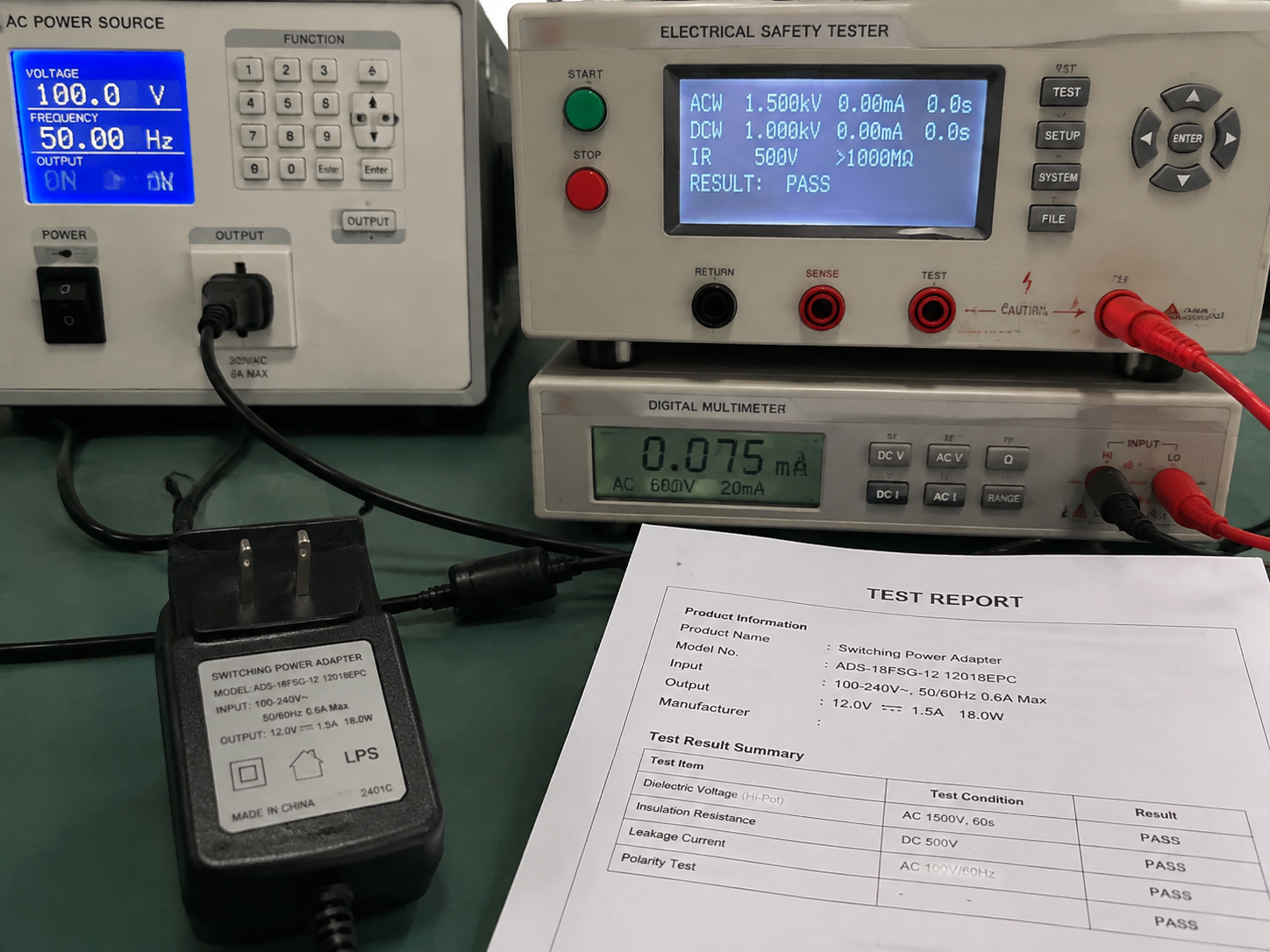
• Product technical preparation: Complete PSE compliance verification for the corresponding category. For specified products, obtain the conformity inspection certificate from a third-party organization; for non-specified products, complete testing and retain the report.
2. Simplified Processing Flow
The processing logic of METI business notification is not complicated, and the core process can be summarized into several steps (this is the logical process, not the specific operation SOP. Actual submission can be done online or offline, and is operated by the notifying business operator):
1. Complete product classification judgment and confirm the corresponding regulatory category;
2. Determine the Japanese notifying business operator, and sort out the entity’s qualification documents;
3. The notifying business operator submits the business notification to METI or the local Bureau of Economy, Trade and Industry. If modifying information of an existing filing, submit a change notification;
4. Simultaneously complete product technical standard confirmation. For specified products, obtain the conformity inspection certificate from a third-party organization;
5. Retain the full set of inspection records and compliance documents, and keep them in accordance with regulatory requirements;
6. Mark the product nameplate and packaging with the PSE mark, the name of the notifying business operator and other information as required.
If notification matters or products change in the future, change management shall be carried out in time to update filing or compliance documents.
3. Core Material List
It should be specially noted that the core submission materials for METI business notification itself mainly focus on the entity qualification of the Japanese notifying business operator, the proposed regulated product categories and other information; the table below also lists supporting documents commonly used in product compliance, import customs clearance and platform verification links, to avoid mixing up material requirements of different links.
| Material Name | Specific Description |
| Registration certificate of the Japanese notifying business operator | Legal registration qualification document of the local Japanese company, proving the entity is real and valid, which is a core submission material for business notification |
| Product classification description and regulatory category basis | Explains the specific category of the product corresponding to the DENAN catalog and the judgment basis, which is a core submission material for business notification |
| PSE compliance documents | Specified electrical products: conformity inspection certificate + test report issued by a third-party organization; non-specified electrical products: product test report + self-declaration of the business operator, which are core supporting documents for product compliance and verification |
| Japanese version of product instruction manual and safety warning | Necessary materials for product launch and compliance verification, which must be in Japanese and meet DENAN requirements for product descriptions, mostly used for import customs clearance, platform review and consumer notification |
| Details of product models, specifications and manufacturers | Information of all notified products’ models, parameters, production entities, which must be consistent with compliance documents, used for notification information verification and subsequent supervision and traceability |
4. Validity Period and Maintenance Rules
Many people care about the validity period of METI filing. Here, we need to distinguish between “the validity period of the notification itself” and “the validity period of product compliance”, which are not the same thing:
• Business notification itself: There is no fixed validity period like a product certificate. As long as the notified matters (such as entity information, business scope) do not change and the business continues to operate, it remains valid.
• Situations requiring change notification: If the entity information (name, address, etc.) of the notifying business operator changes, the business scope (regulated product categories) is adjusted, or the business stops and such products are no longer dealt with, a change notification shall be submitted in time.
• Product compliance validity period: For the third-party conformity inspection certificate of specified electrical products, the validity period varies by category, subject to the date on the certificate and provisions of the corresponding category; non-specified electrical products do not have a unified certificate validity period, but need to continuously meet technical standards and retain valid test records.
• Document retention requirements: Enterprises must keep compliance technical documents in accordance with regulations. The retention years for specified and non-specified products are different, and specific provisions are subject to the latest regulations.
V. Advanced Skills: How to Verify the Authenticity and Validity of METI Compliance
If you find a third-party agent to handle the filing, or a supplier provides you with filing documents, how do you confirm it is real and valid? This part is a practical intermediate-level skill to help you avoid the pit of fake filings.
1. There is No Single “Filing Number Query”, Combined Verification is Required
First, a common cognition should be corrected: There is no public query channel for METI business notification where you can “enter the filing number to check all information”. Verification needs to be done through a combination of three methods:
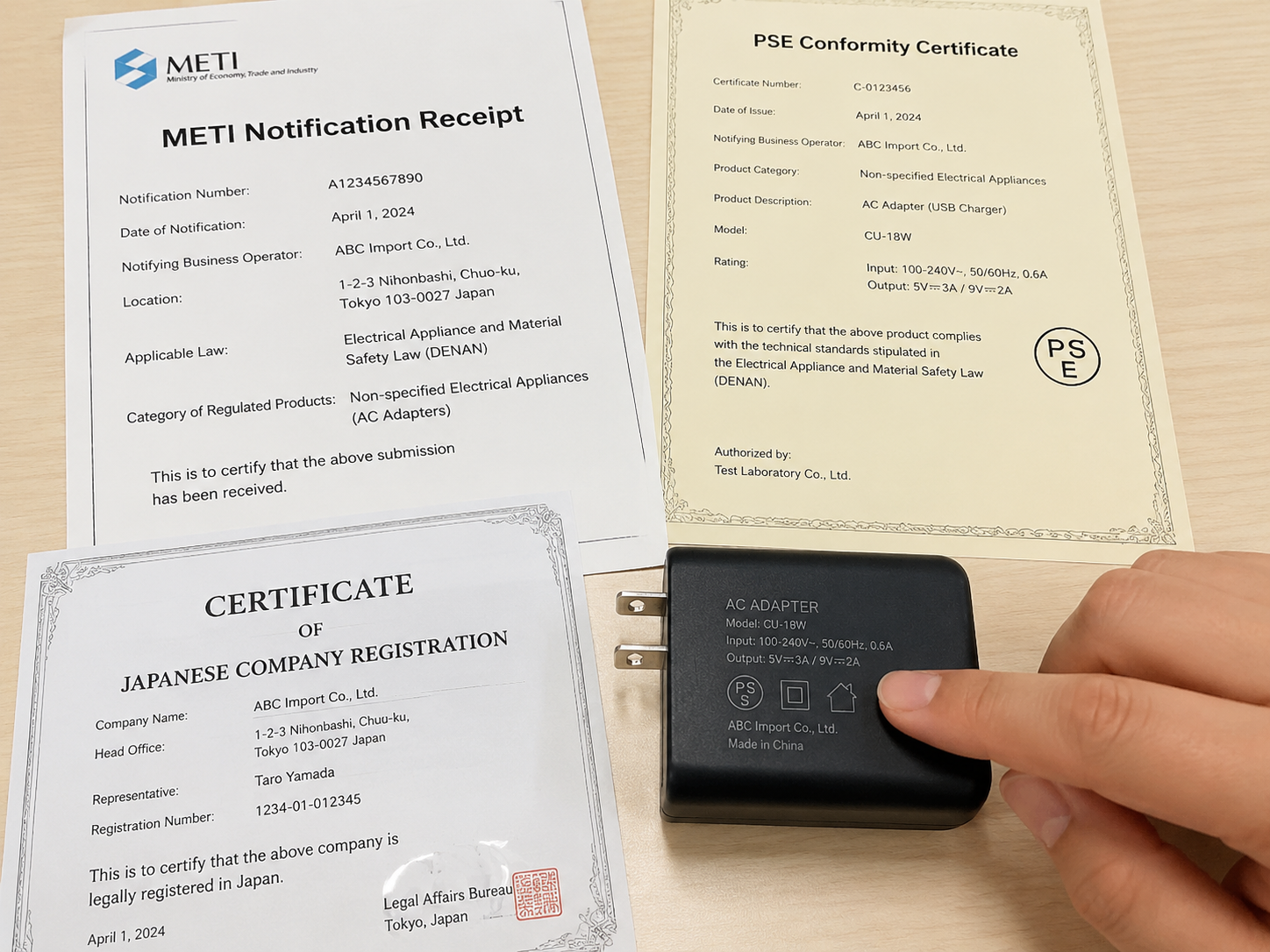
• Document verification: Check the consistency of three core documents — the notification receipt (that is, the declaration receipt issued by the government after submitting the declaration), the PSE compliance document, and the importer’s qualification document, to see if the business operator name, product category, and model on them correspond to each other.
• Cross-verification of public information: You can use the published by METI and public information of local Bureaus of Economy, Trade and Industry to assist in checking whether the entity and filing category of the notifying business operator really exist.
• Label consistency verification: Check whether the name of the notifying business operator, PSE mark, and product specifications printed on the product nameplate and packaging completely match the information on the compliance documents.
2. 3 Steps to Judge Whether Compliance is Valid
After obtaining the materials, you can judge whether the compliance is really valid from three dimensions:
• Consistent entity: The notifying business operator and the responsible entity on the product label and in the sales chain must either be the same entity or have a legal supply chain relationship; misattribution of the responsible entity is not allowed.
• Product matching: The category, model, and specification of the product must be within the notified business scope, and also fully correspond to the PSE compliance documents. You cannot notify Category A but sell Category B.
• Valid status: The third-party conformity inspection certificate for specified products is within the validity period, the technical documents for non-specified products are continuously valid, and there are no notification matters that should be changed but have not been updated.
3. Common Reasons for Failed Verification
If the verification does not match, it is usually one of the following situations:
• The submission has not been completed, or the notification receipt (declaration receipt) after acceptance has not been obtained, which cannot be used as a basis for compliance for the time being;
• The submitted documents are fake, and no actual declaration has been made to METI or the local Bureau of Economy, Trade and Industry;
• Incorrect information is entered during verification, such as wrong product model, wrong category selection, inaccurate entity name input, resulting in mismatch;
• The notification matters have been changed but not updated in time, or the PSE compliance documents have expired.
VI. Pitfall Avoidance Guide: 8 Most Common METI Filing Misconceptions
Most of the pitfalls of METI filing come from information asymmetry. Many unscrupulous agents will use information asymmetry to mislead sellers. The following 8 are the most common misconceptions, which must be avoided.
Misconception 1: With PSE-related certificates/reports, there is no need for METI filing
This is the most common misunderstanding. Some agents will deliberately conceal the notification requirement and only conduct PSE testing for customers to earn the price difference. In fact, both are mandatory obligations stipulated in the DENAN. As long as the product is in the regulatory catalog, both must be met at the same time; neither is dispensable for compliance. The consequences of falling into this pit range from platform delisting and customs detention to regulatory penalties. The judgment method is very simple: as long as the product is within the DENAN regulatory scope, both obligations must be fulfilled.
Misconception 2: You can buy a universal filing number to cover your own products
Some sellers, in order to save money, buy so-called “universal METI filing numbers”, which is very dangerous. METI notification is bound to a specific business operator and a specific regulated product category, and cannot be used across entities or categories. Using other people’s notification information, once found by the platform, will be directly judged as fraud, leading to product removal or even store closure, and you may also face penalties from Japanese regulatory authorities. Judgment method: Check whether the name of the business operator and product category on the notification document completely match your own products and sales entity.
Misconception 3: Small batch/direct mail orders do not need filing
Many people think that sending only a few small parcels via direct mail or small batch FBA means no one will check and no filing is needed. In fact, as long as it is a regulated electrical product for sale, regardless of batch size, even a single piece of direct mail, needs to fulfill the notification obligation. Exemption only applies to products for non-sales purposes, such as personal use, testing and exhibition use. There is only one judgment standard: whether the product enters the circulation and sales link of the Japanese market.
Misconception 4: Filing is valid for life once done
Some sellers think that handling a filing once means it’s done once and for all, but that’s not the case. The business notification itself does not have a fixed validity period, but if the notified matters change, such as the company renaming, changing address, increasing or decreasing product categories, you must handle the change notification in time. In addition, after the third-party conformity inspection certificate for specified electrical products expires, the expired certificate cannot continue to be used as the compliance basis for subsequent manufacturing, import or PSE marking; the handling rules for products that have entered the circulation link need to be judged in combination with the specific category, certificate status and latest regulatory requirements. If the product category changes, key components are changed, or the notifying business operator is replaced, compliance needs to be re-evaluated. When judging, first check whether the notification matters have changed, and then verify whether the product’s PSE compliance documents are continuously valid.
Misconception 5: All products with “electricity” need METI filing
Not all electrical products need filing; only electrical products in the DENAN catalog require it. For example, industrial dedicated equipment, complete radio equipment (subject to TELEC certification), medical devices, etc., all have their own regulatory regulations and are not under the jurisdiction of the DENAN. For products with relatively vague boundaries, such as combination sets and equipment with built-in power supplies, it is recommended to confirm the classification first to avoid wasting effort due to wrong compliance direction.
Misconception 6: METI filing is an exclusive document required by Amazon
Many sellers first come into contact with METI filing because of Amazon’s notice, so they think this is a rule set by the platform itself, and passing the platform review is enough. In fact, METI notification is an obligation stipulated by Japanese law, not an exclusive requirement of the platform. The platform only requires sellers to provide compliance materials in accordance with regulatory requirements. If you only collect materials to pass the platform review, and the actual product does not meet full-chain compliance requirements, once spotted by Japanese regulatory authorities in a spot check, the penalty will be more severe. When judging, the four obligations stipulated in the DENAN shall be used as the standard, rather than only meeting the temporary requirements of the platform.
Misconception 7: Using the agent company’s universal notification can cover all sellers’ products
Some agents will say “just use our filing, all sellers can use it”, which is wrong. The agent company’s notification only applies to products for which the agent company acts as the importer and bears compliance responsibility. If products of different sellers have different sales entities and importers, they cannot share the same filing. The risk of doing so is unclear supply chain responsibility. Once a product has a safety problem, the responsibility cannot be traced, and the seller may also bear joint and several liability. The judgment method is very simple: confirm whether the notifying business operator is the legal importer of your product and whether it bears the corresponding compliance responsibility.
Misconception 8: Only changing the packaging/label without changing the product does not require re-evaluation of compliance
Some sellers think that just changing the packaging and label while the product remains unchanged means no need to worry about compliance. This depends on the situation: if it is only the text or design adjustment of the packaging and label, and the product specifications, key components, and classification attributes have not changed, then there is really no need to re-handle the notification. But if the product itself has changed, such as changing the internal circuit design, changing key power supply components, then you need to re-evaluate PSE compliance, and may even need to adjust the notification scope. Many sellers have fallen into this pit: they secretly changed the internal technical solution of the product, did not update the test report, and were found to not meet technical standards in a spot check, resulting in great losses. The core judgment standard is: whether the product has undergone changes that affect safety performance.
Summary
Generally speaking, after reading this content, you should be able to distinguish the two easily confused METI filing systems, quickly judge whether your own business needs to handle filing through “product classification + entity identity + 3-question method”, clarify the supporting compliance logic between METI notification and PSE, master the combined verification method of “documents + public information + labels”, and identify 8 types of common compliance misconceptions. Products with vague boundaries should complete classification confirmation before shipment or listing, to avoid inconsistency in filing direction, PSE compliance documents or label responsible entities.