
If you often live or shop in EU countries, or have purchased European-version electronic products via cross-border e-commerce, you may have recently heard terms like “common charger” and “mandatory USB-C”. Some say all electrical appliances will have to use USB-C in the future, some say this is a rule specifically targeting a certain brand, and others say old phones will soon become unusable — in fact, most of these are misunderstandings.
In this article, we will break down the EU Common Charger Directive thoroughly: what it actually is, which devices must comply, when it takes effect for different products, what practical impact it has on ordinary users, how you can judge whether a product is compliant, and whether your existing chargers are compatible.
Plain Language Introduction: What Exactly Is This Directive?
First, let’s give the most accessible definition: this is a rule under which the EU mandates that portable electronic devices uniformly use USB-C wired charging ports, with the core goal of solving the inconvenience of incompatible ports across different brands and repeated purchases of chargers. For devices within the applicable scope that support wired charging, USB-C chargers with corresponding output capabilities can usually be shared; whether the fastest charging speed can be achieved still depends on the specific specifications of the device, charger, and cable.
Many people think this is an initiative from industry associations, but that is not the case — it is an official directive of the EU. Simply put, it is a unified rule that the EU requires all member states to incorporate into their local laws, with mandatory binding force, not a voluntary standard that enterprises can choose to participate in or not. Its official number is (EU) 2022/2380, which ordinary users do not need to remember at all; you only need to know that it is an amendment to the EU’s Radio Equipment Directive (RED, the EU’s basic regulation governing all devices with radio functions such as Bluetooth and Wi-Fi), and is part of the EU’s product compliance requirements.
There is also a very important premise to clarify first: this rule applies to manufacturers, importers, and distributors that sell products to the EU market, not to ordinary consumers. Your old devices and old chargers, even those with old Micro-USB or Lightning ports, can be used completely normally, and no one requires you to replace them. The only changes you will notice are the ports of newly launched products and the information labeling on their packaging.
Overall, the core of this rule only unifies three things: unifying the wired charging port as USB-C, unifying the basic compatibility rules for fast charging (USB PD, a universal fast charging negotiation standard, the specific principle of which will be explained in detail later), and unifying the requirements for charging information labeling on packaging. All complex clauses revolve around these three points.
Background of Introduction: Solving Three Real User Pain Points
Some may ask, why does the EU go to such great lengths to unify charging ports? In fact, it is not regulating for the sake of regulating, but solving three real problems that have existed for more than a decade.
The first pain point is the well-known “charging cable hell”: devices from different brands have mixed ports — phones use one type, earphones use another, and tablets use yet another. When going out or on business trips, you have to bring three or four cables and several chargers, making your bag bulging. When you switch to a new device, your previous chargers and cables will most likely be left unused; it’s a pity to throw them away, but useless to keep them.
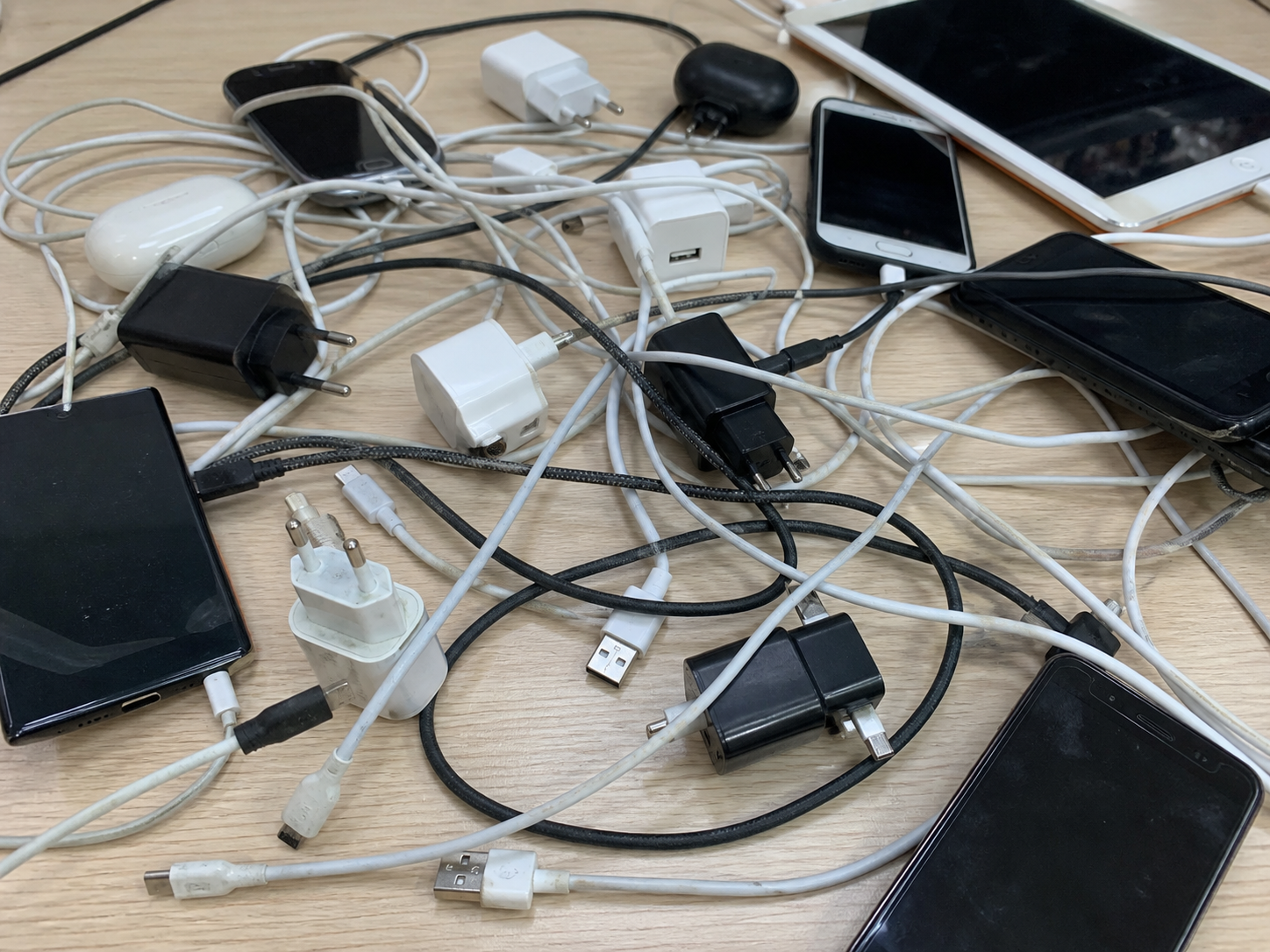
The second pain point is e-waste and resource waste. According to estimates from the impact assessment report on the common charger directive released by the European Commission in 2022, the EU generates about 11,000 tons of discarded charger waste every year. Inconsistent ports and repeated purchases of charging accessories by consumers are one of the important factors causing e-waste and resource waste, which is not in line with the direction of a circular economy.
The third pain point is high consumption costs and opaque information. EU institutions estimated in the same period that after unifying ports, consumers can save about 250 million euros per year in repeated purchase costs, without having to buy a dedicated charger every time they switch devices. Moreover, in the past, many product packages did not clearly state whether a charger was included, and users only found out they had to buy it extra after taking the product home, resulting in a very poor experience.
Applicable Scope: Which Devices, When, and Which Regions Must Comply
What many people are most likely to get wrong is “which devices exactly need to switch to USB-C”. In fact, you can figure it out by applying the three dimensions of “device type → compliance effective date → sales region”. Let’s clarify first: the directive itself officially took effect in 2022. The dates of 2024 and 2026 mentioned below are the compliance dates when different categories of devices begin to be subject to the requirements for USB-C ports, fast charging compatibility, and packaging labeling, not the effective date of the directive itself.
Which Devices Need to Comply? Rolled Out in Two Batches
First of all, it must be clear that only portable radio devices that support wired charging need to comply, not all electrical appliances. Specifically, it is rolled out in two batches:
| Compliance Effective Date | Applicable Device Categories |
| From December 28, 2024 | Mobile phones, tablets, earphones (including over-ear/in-ear models and charging cases), portable speakers, e-book readers, handheld game consoles, portable navigation devices, digital cameras, rechargeable keyboards/mice with radio function support |
| From April 28, 2026 | Laptops |
Note a few easily confusing details: for example, for keyboards and mice, only rechargeable models with Bluetooth/wireless functions need to comply; purely wired models without radio functions are not included. The reason laptops are subject to the requirement more than a year later is that their charging power range is too wide, from about 30W for thin and light laptops to over 200W for gaming laptops. Unifying compatibility with universal fast charging standards is much more technically difficult than for mobile phones, so manufacturers are given more time for adaptation.
Which Devices Do Not Need to Comply? Four Clear Exceptions
Of course, not all devices need to meet the requirements; there are four clear exceptions:
The first category is non-radio ordinary small household appliances, such as electric toothbrushes, shavers, purely wired keyboards and mice, etc. These devices are not regulated by the RED, so they do not need to comply with this directive;
The second category is professional/medical devices excluded by specific regulations. When judging, verification must be carried out layer by layer in order: first confirm whether the product is a device with radio functions covered by the RED, then check whether it is on the list of consumer portable devices specified in this directive, and finally verify whether there are exclusion clauses in specialized regulations such as industrial and medical ones. Products cannot be automatically exempted just because they are used in industrial or medical scenarios — for example, a professional handheld terminal with Bluetooth function still needs to comply if it belongs to the specified device category and has no special exclusion clauses;
The third category is digital cameras. If there are objective and verifiable technical reasons that make it truly impossible to equip a USB-C port that supports charging, the responsible entity must retain corresponding compliance evidence before the corresponding exception can apply;
The fourth category is pure wireless charging devices that have no wired charging function at all, which also do not need to comply with this rule.
Which Regions Must Comply? Only Depends on the Place of First Placement on the Market
The core criterion for determining the applicable region is the place of first placement on the market — that is, the place where the product is first officially put on the market for sale in a certain region, which has nothing to do with the place of production or the location of the brand’s headquarters. For example, mobile phones sold by Chinese brands to the EU must meet the requirements, while mobile phones sold by EU brands to Asia do not.
Specifically for different regions, the rules are divided into four levels:
First, all 27 EU member states directly apply this directive, which is the core scope of application.
Second, countries in the European Economic Area (EEA, including Norway, Iceland, and Liechtenstein) shall be subject to the regulations incorporated and implemented locally, and this EU directive does not apply automatically.
Third, after Brexit, the UK does not automatically apply this EU directive; the region of Great Britain (including England, Scotland, and Wales) shall refer to local separate product compliance rules.
Fourth, due to the application of special goods market arrangements in Northern Ireland, UK, relevant requirements need to be separately checked against local current regulations.
Exact Meaning of the Time Nodes: Not “All Old Models Will Be Removed From Shelves When the Date Arrives”
Many people think that when the compliance effective date arrives, all devices with old ports can no longer be sold, but that is completely not the case. This rule only binds product units first placed on the EU market after the compliance effective date — the “product unit” here refers to a single product that can be sold independently, and has no direct correspondence with the product model or production date.
Stock products that were first placed on the EU market before the compliance effective date can continue to be sold regardless of port type, and no rectification is required.
Conversely, product units first placed on the EU market after the compliance effective date must meet the requirements even if their model is the same as the old model, or even if they were produced before the effective date; they cannot be exempted solely on the grounds of “earlier production” or “already sold in other countries”.
The time for each member state to transpose the directive into local law may vary, but the compliance effective date that enterprises must abide by is unified at the EU level and is not affected by the progress of domestic transposition in member states.
Core Compliance Requirements: What Exactly Does the Regulation Cover?
Now that we have clarified who must comply and when, let’s talk about the specific requirements — in fact, they all revolve around “reducing user inconvenience”.
First, applicable devices must be equipped with a USB-C port that can charge. Note that it is a “USB-C port that supports charging function”, not just a decorative port added casually. Manufacturers can also retain other ports at the same time, such as magnetic charging ports, headphone jacks, etc., which is all fine, as long as the USB-C port can charge normally.
Second, fast charging must be compatible with the universal USB PD standard. There is a clear trigger condition here: when the wired charging voltage of the device is higher than 5V, or the current is higher than 3A, or the power is higher than 15W, it must support the USB PD universal fast charging protocol. Brands can retain their own proprietary fast charging protocols, but proprietary protocols cannot be the only high-power charging method; they must first be compatible with the universal USB PD standard, and cannot use proprietary protocols to completely lock out fast charging from third-party chargers.
Third, chargers are not mandatory to be included with the device. Many people think the EU requires a charger to be included, but in fact the opposite is true: manufacturers can choose whether to include one or not, completely voluntarily, but they must clearly tell consumers whether it is included in the package, and cannot use vague terms like “subject to actual receipt” or “optional accessory” to mislead people.
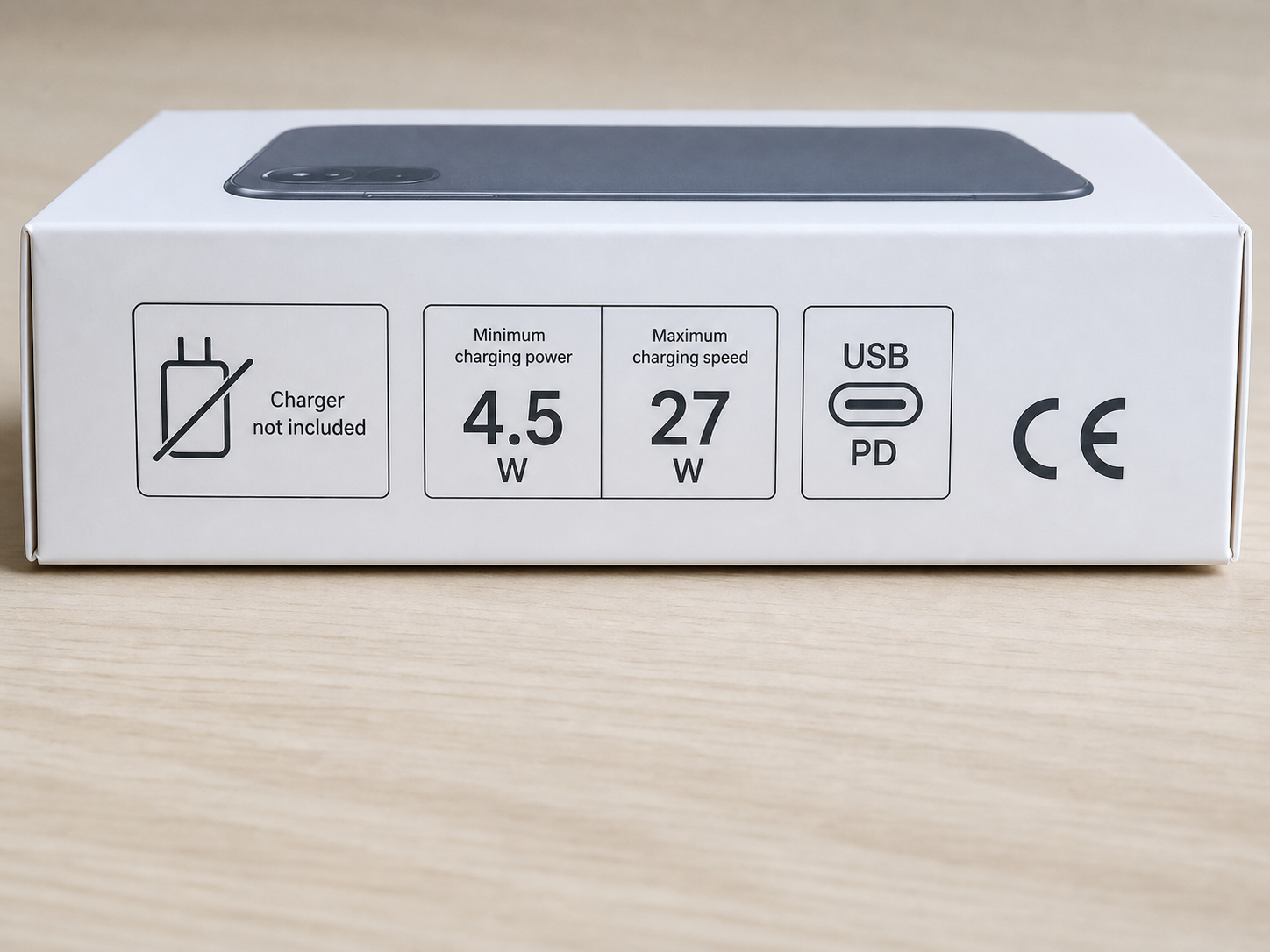
Fourth, four pieces of charging-related information must be clearly marked on the packaging, with strict format requirements:
• The first item is the “charger included/not included” label: it must use the graphic label designated by the EU, not just a line of small text;
• The second item is the minimum charging power of the device: that is, the minimum wattage that allows the device to start charging normally; below this value, it may not charge or charge extremely slowly;
• The third item is the power required to reach the device’s maximum charging speed: that is, the charger power needed to achieve the device’s fastest charging speed, which is usually higher than the minimum charging power;
• The fourth item is the universal charging standard label: only when the device reaches the above voltage/current/power thresholds and needs to be compatible with USB PD must the USB PD wording or corresponding official icon be marked on the packaging; slow-charging devices that do not reach the thresholds are not required to be marked.
Finally, it should also be clarified that this regulation does not cover everything:
• It does not unify the battery capacity of devices, nor does it stipulate the fastest charging speed of the device itself;
• It does not prohibit wireless charging, nor does it regulate the additional functions of brands’ proprietary fast charging;
• It does not even regulate the shape of the wall plug pins of chargers — for example, the EU uses European standard two-pin round plugs locally, and you still need a charger with British standard pins when going to the UK; this still follows each country’s own plug standards and is not unified.
Compliance Responsibilities and Market Supervision
Some may ask, what if manufacturers do not comply? The compliance responsibilities of this rule are divided by role:
• Manufacturers are responsible for ensuring product design meets the requirements, and preparing technical documentation and declarations of conformity;
• Importers must check strictly to confirm that the product has the CE mark and is accompanied by complete compliance documents — the CE mark is a label by which the manufacturer declares that the product meets the requirements of applicable EU regulations, and is not a pre-approval or official quality certification by the EU for each product;
• Distributors must check whether the product’s labeling meets the requirements before selling, and cannot sell products that they know are non-compliant.
All compliant products must bear the CE mark, and manufacturers must also retain technical test documents and declarations of conformity for spot checks by regulatory authorities. If non-compliance is found, the market supervision departments of each member state can require the product to be removed from shelves and recalled, and relevant enterprises may also be fined — the specific amount of the fine varies from member state to member state, but the overall supervision intensity is relatively strict.
Analysis of Key Concepts: The Relationship Between USB-C, USB PD, and Fast Charging
Speaking of this, many people may equate USB-C with fast charging, but in fact these are two completely different concepts, and this is also the place where it is easiest to make mistakes, so we will specifically explain it clearly.
| Concept | Plain Language Explanation | Core Function | Relationship with Fast Charging |
| USB-C | Oval-shaped port that can be plugged in either way up | Solves the problem of “whether the cable can be plugged in” | It is just a physical port and does not mean fast charging is supported |
| USB PD | Fast charging negotiation rule between devices and chargers | Solves the problem of “whether safe fast charging is possible” | It is a universal fast charging standard and one of the prerequisites for fast charging |
Simply put, USB-C is “the shape of the port”, and USB PD is “the rule of charging”. Having a USB-C port only means the cable can be plugged in, but whether fast charging is possible and how fast it can charge depends on whether the device, charger, and cable support PD, and whether the power and voltage levels are sufficient.
There is also a very important short board effect (also called the barrel effect): the final speed of fast charging is determined by the weakest of the three factors: the device’s own maximum input power, the charger’s output power, and the charging cable’s rated power. For example: your phone supports up to 65W PD fast charging, the charger is a 100W PD charger, but the cable you use only supports 30W, then the final charging speed will be at most 30W, limited by the cable. Conversely, if the cable supports 100W but the charger only has 20W, then the speed will be 20W, limited by the charger. So buying a high-power charger does not necessarily mean you can get fast charging; all three must match.
Practical Impact on Ordinary Consumers
After talking about so many rules, what you may care about most is: what impact does this have on my daily use of electronic products? In fact, most of it is good.
First and most directly, daily use is more convenient. In the future, new portable radio devices within the applicable scope purchased in the EU will basically be equipped with USB-C ports that support charging, and you can usually share compliant USB-C chargers and cables when going out, without having to carry multiple sets of exclusive accessories. Of course, note that this rule does not regulate the shape of the charger’s plug pins; if you travel to different European countries, for example from the EU to the UK, you may still need to bring a wall plug adapter.
Second, you can save some money. If you already have a USB-C PD charger at home, you can choose the version without a charger when buying new devices in the future, which is usually a bit cheaper. Moreover, when you switch devices, your old USB-C chargers and cables will most likely still be usable, so you don’t have to leave a bunch of them unused.
Third, shopping is more transparent. In the past, when buying a mobile phone or tablet, you often had to scroll through the detail page for a long time to find out if a charger was included. Now it is clearly marked on the packaging, with graphic labels, so you can see it at a glance. Moreover, choosing a third-party charger is also simpler; as long as it is a regular product that meets the requirements, you don’t have to worry about whether you must buy the original one.
Last and most critically: old devices are completely unaffected. Old port devices you are already using, such as old Lightning phones and old Micro-USB earphones, can be used as usual, and no one requires you to replace them. Even after the compliance effective date, as long as they are old stock that was first placed on the market before the effective date, you can buy and use them normally, with no problem at all.
Practical Judgment Methods
After talking about the impact, let’s talk about something practical — how you can quickly judge whether a product is compliant and whether your existing charger can be used with a new device, without having to look through thick regulations.
Four Steps to Judge Whether New Products Sold in the EU Are Compliant
First step, check the sales market first: is it a version sold in the EU or EEA region? If it is sold to other regions, such as the US version or Chinese mainland version, it does not need to comply with this rule;
Second step, check the product category: is it on the list of applicable devices we mentioned earlier, and does it meet the premise of “supporting wired charging and being a portable radio device”;
Third step, check the placement time: is it a product unit first placed on the EU market after the compliance effective date? If it is stock from before, no changes are needed;
Fourth step, check the packaging labeling: does it have a USB-C charging port, and does the packaging have all four pieces of charging information we mentioned — the graphic label of whether a charger is included, the minimum charging power, the power required for full speed, and the USB PD label for devices that meet the PD threshold.
After completing these four steps, you can basically make a fairly accurate judgment.
Judging Whether Existing USB-C Chargers Are Compatible With New Devices
To judge whether charging is possible and whether fast charging is possible, you need to check one by one in the order from device to charger to cable, not just look at the wattage:
1. First check the charging specifications of the device: if the device only supports 5V slow charging (does not reach the PD trigger threshold), as long as the port matches, the charger’s rated power is not lower than the device’s minimum charging requirement, and the cable specifications meet the standard, it can usually charge normally; if the device supports PD fast charging, first confirm the PD voltage levels it requires (for example, 9V is commonly used for mobile phones, 20V for laptops) and the maximum charging power.
2. Then check the charger: in fast charging scenarios, the charger must support the USB PD protocol, include the voltage levels required by the device, and have an output power not lower than the device’s maximum charging power. Note here: a higher charger power will not force high power into the device (the two parties will automatically negotiate to a suitable level), but if the voltage levels do not match, even if the wattage is sufficient, the fast charging speed may not be achieved, or even only slow charging is possible.
3. Finally check the cable: it must be able to carry the corresponding power and current. In high-power (usually above 65W) scenarios, a USB-C cable of corresponding specifications is required, otherwise the speed may be limited.
Here is a simplified 10-second judgment method: on the premise that both the device and the charger support PD and the voltage levels match, choose a regular PD charger with power not lower than the device’s maximum charging power, paired with a cable of corresponding specifications, and it can usually be adapted normally. If you are really unsure, follow the requirements of the device manual, and do not use chargers that obviously do not meet the specifications.
Judging Whether Packaging Charging Information Is Compliant
After receiving the product, consumers can quickly check whether the packaging charging information is compliant through three points: first, whether there is an officially designated “charger included/not included” graphic label, not just vague text; second, whether both values of the minimum charging power and the power required to reach the maximum charging speed are marked; third, if the device supports high-power fast charging (reaches the PD trigger threshold), whether the USB PD compatibility label is marked.
How to Judge in Special Scenarios
If it is an old or second-hand device you purchased via cross-border e-commerce for personal use, you don’t need to care about compliance at all, as long as it works normally; this rule does not regulate personal use by consumers;
If it is a brand-new parallel imported device, that is, a new product imported into the EU market for sale through unofficial channels, as long as it is placed on the EU market, it must meet the requirements of the directive;
If it is a pure wireless charging device that does not have a wired charging port itself, then it does not need to meet the USB-C port requirements, and can be judged according to other rules for the corresponding product.
Guide to Avoiding Common Misconceptions
Finally, let’s debunk a few of the most widely spread rumors to help you avoid common pitfalls.
❌ Misconception 1: All electrical appliances sold in the EU must use USB-C
✅ Only the specified portable radio electronic devices need to comply. Large household appliances, professional equipment, and most ordinary small household appliances are not yet included, such as refrigerators, washing machines, and electric toothbrushes, which do not need to change.
❌ Misconception 2: Some brands have special exemptions and do not need to comply
✅ There are no brand exceptions to this rule. Whether it is an international big brand or a niche brand, as long as they sell applicable devices to the EU market, they must comply.
❌ Misconception 3: Wireless charging has been banned by the EU
✅ This directive only regulates the port and compatibility of wired charging. Wireless charging is completely unrestricted, and manufacturers can normally develop related technologies. If there are unified rules in the future, they will be issued separately.
❌ Misconception 4: Having a USB-C port equals fast charging
✅ USB-C is just the shape of the port. Fast charging requires the device, charger, and cable to simultaneously support PD and the corresponding power, none of which can be missing. For the specific principle, refer to the short board effect in the previous “Analysis of Key Concepts” section.
❌ Misconception 5: All compliant devices have the same charging speed
✅ The regulation only requires basic PD compatibility. The upper limit of the actual charging speed is determined by the device itself, and manufacturers can independently set fast charging speeds ranging from 25W to 120W, as long as they are compatible with PD.
❌ Misconception 6: A device must come with a charger to be compliant
✅ Manufacturers can completely choose not to include a charger, as long as they clearly inform consumers with the designated graphic label on the packaging. Not including a charger does not mean non-compliance.
❌ Misconception 7: You must use the original charger to be compliant, and using a third-party one will definitely affect the warranty
✅ This directive only requires devices to be compatible with the universal USB PD standard, and does not mandate the use of the original charger. Compliant third-party USB-C PD chargers can be used normally. As for warranty liability, it needs to be judged in combination with the cause of the product failure, the mandatory consumer protection rules of the country of sale, and the specific warranty terms. Warranty cannot be directly refused just because non-original accessories are used, but if the damage is indeed caused by unqualified third-party accessories, the division of responsibilities will be different.
Frequently Asked Questions
Is this directive only targeting Apple?
No, all brands selling applicable devices in the EU market must comply, with no brand exceptions or targeted clauses.
Can old Lightning port devices still be sold in the EU?
Old stock that was first placed on the EU market before the compliance effective date can continue to be sold; applicable devices newly placed on the market after the effective date must be replaced with USB-C ports.
Will wireless charging be banned by the EU?
No, this directive only regulates the port and compatibility requirements for wired charging, and wireless charging is completely unrestricted.
Must a mobile phone come with a charger to meet the requirements of the directive?
No, manufacturers can independently decide whether to include a charger with the device, as long as they clearly inform consumers with the designated graphic label on the packaging.
Are all USB-C cables the same?
No. Different USB-C cables may support very different power and data transmission speeds. For example, some cables only support 15W slow charging, some can support 240W fast charging, and some can only charge but not transmit data. High-power fast charging must be matched with cables of corresponding specifications, otherwise the speed will be limited or there will even be safety hazards.
Overall, the core of the EU Common Charger Directive is to reduce consumer inconvenience and resource waste by unifying the wired charging ports, basic fast charging compatibility standards, and packaging information labeling of portable radio devices. After reading this article, you should be able to master these practical judgment skills: distinguish which devices sold in the EU must be equipped with USB-C charging ports and their corresponding compliance effective dates, quickly judge whether new products on the EU market meet the requirements of the directive, avoid common rumors and purchase misconceptions about the directive, independently judge whether existing USB-C chargers and cables are compatible with new devices, understand the charging information on product packaging and choose suitable charging accessories, and distinguish the rule differences in different scenarios such as personal cross-border purchases for self-use, second-hand products, and parallel imports.