
If you are in the business of EU wireless products, you have most likely heard of the terms “RED label” and “RED certification”. Many people’s first reaction is to look for an exclusive logo called RED that should be affixed to the product side by side with the CE mark. As a result, they either get tricked by agencies into spending extra money, or have their goods detained during customs clearance due to non-compliant labeling. In fact, regarding the RED label, the first core common sense to remember is: the EU does not have a separate “official RED mark” at all — all wireless products that meet RED requirements uniformly use the CE mark. The “RED label” mentioned in the industry is actually a common name for the entire CE compliance labeling system that meets RED regulatory requirements.
The full name of RED is the EU Radio Equipment Directive, which is the core access regulation governing all wireless products sold in the EU market. The CE mark is the unified product compliance pass of the EU, meaning “this product complies with all applicable EU mandatory regulations”. It is not a quality grade certification, does not represent how good the product quality is, but only reaches the bottom line of access to the EU market.
Do not underestimate this label. It is a hard threshold for EU customs clearance and listing on e-commerce platforms such as Amazon. If market supervision spot checks find non-compliance, the light consequence is removal from shelves and rectification, and the heavy consequence is fines or even EU-wide recall. For ordinary consumers, the CE mark is also the most intuitive basis for judging whether wireless products can be legally used in the EU.
Here we also need to clarify one of the most common misconceptions: many people think that RED has an independent official mark that should be posted side by side with CE. In fact, the EU has never issued a separate RED logo. Conversely, having a CE mark does not equal compliance with RED — CE can correspond to many different EU directives (such as the Toy Directive, the Machinery Directive). The CE mark of wireless products must be supported by compliance documents corresponding to RED to be truly compliant with wireless requirements.
First Things First: Does Your Product Need to Comply with RED Labeling Rules
Many people ask when they first get in touch: Does my product fall under RED control? Do I need to affix CE according to RED requirements? In fact, the judgment criteria are very clear, and the core depends on two points: whether the product intentionally emits or receives radio waves, and whether it is intended to be placed on the EU market for sale.
Products Required to Comply with RED Labeling
There are only two core criteria for judgment: the product intentionally emits or receives radio waves for purposes such as communication, positioning, remote control, sensing, etc., and is planned to be placed on the EU market for sale.
Typical applicable products are easy to identify: Bluetooth headsets, WiFi routers, smart watches, 5G mobile phones, wireless mice, walkie-talkies and other products with clear wireless functions all fall within the jurisdiction of RED.
What is easily missed in judgment is “complete devices with wireless modules”: for example, smart refrigerators with WiFi, children’s toys with Bluetooth, and robot vacuums with wireless remote control. Even if the wireless function is only an additional attribute, as long as the complete device has wireless transceiving capability, it must comply with RED labeling rules, and cannot evade the requirements on the grounds that “it’s just an added module”.
There are also categories that are easily misjudged, such as wireless chargers: not all products with the word “wireless” fall under RED. Wireless chargers that use pure inductive charging and have no data communication function are not within the scope of RED; but if they have communication functions such as Bluetooth and WiFi (for example, they can link with a mobile phone to display charging status), they need to comply with RED requirements.
Devices Explicitly Not Applicable to RED
There are also some products that, even with wireless functions, are not under the control of RED, so naturally they do not need to be labeled according to RED rules:
The first category is products that are purely wired and have no wireless transceiving function at all, such as wired headsets, ordinary plug-in desk lamps, and the pure inductive wireless chargers mentioned just now. These definitely have nothing to do with RED.
The second category is equipment covered by special regulations, such as marine radio equipment governed by the Maritime Equipment Directive (MED), aircraft parts governed by aviation regulations, and radio equipment dedicated to public safety or national defense/national security. These are governed by special regulations and do not need to go through the RED process.
The third category is non-commercial self-made equipment, for example, an amateur radio enthusiast makes a radio station by themselves, uses it themselves and does not sell it, so they do not need to comply with RED labeling requirements.
There is also a category of pure broadcast receiving equipment, such as ordinary FM radios — whether such products are subject to RED needs to be judged in combination with the current RED definition, specific product functions, and the latest official EU documents. It cannot be directly excluded solely based on the characteristic of “only receiving, not transmitting” or the common name of the product. The specific scope shall be subject to the official statement.
Scenarios Within RED Scope But Temporarily No Labeling Required
There are also two situations where, although the product itself falls within the jurisdiction of RED, it is temporarily not required to affix the CE mark:
One is prototypes used only for R&D testing and not placed on the EU market, such as new products still being调试 in the laboratory that will not be sold, so there is no need to affix labels in advance;
The other is products sold only in regions outside the EU, so naturally there is no need to comply with EU labeling rules.
What is the Official Basis for These Rules
You may ask: Are these rules officially confirmed? Will different agencies say different things? Let’s first clarify the core regulatory sources. You don’t need to memorize them, just know the source. If you encounter disputes, you can directly check official documents. This article only explains the compliance requirements for CE marking under RED, and does not involve any certification marketing话术.
There are four core regulatory bases, explained in plain language:
- RED Directive (2014/53/EU): The fundamental source of radio equipment labeling rules, all RED-related requirements come from here;
- Basic CE Mark Regulation (EC 765/2008): General labeling specifications for all CE-class products. Whether it is wireless products or mechanical products, the basic requirements for the CE mark must comply with this regulation;
- Market Surveillance Regulation (EU 2019/1020): Rules specifically governing market surveillance, which explicitly requires that CE products from non-EU manufacturers must have an economic operator within the EU as the contact point;
- General Conformity Assessment Framework Decision (768/2008/EC): The basic rules for all EU product conformity assessment procedures, equivalent to the general guidance on “how to prove product compliance”.
If you need to check specific clauses, entry-level users do not need to memorize them, just know a few key corresponding positions: Articles 10 and 12 of RED mainly correspond to the obligations of manufacturers and importers and labeling information requirements; Articles 17 and 19 correspond to conformity assessment procedures, CE marking and NB number rules; Annex V and Annex VI correspond to the specific requirements of conformity assessment modules, technical documents and DoC.
Prerequisite for Labeling: Compliance Procedures Must Be Completed Before Affixing the CE Mark
Many people think that as long as they know how and where to affix the CE mark, it is enough. This is completely wrong — the premise of affixing the CE mark is that the product has completed all RED compliance procedures and meets all legal requirements. Affixing the mark without completing the process is an illegal act of forging compliance labels.
First Meet the Three Core Requirements of RED
To affix the CE mark, a product must first meet the three core requirements of RED, which in plain language are:
First is the health and safety requirement: the product must not have electric leakage, electromagnetic radiation must not exceed the limit, and will not cause harm to the health of users or surrounding personnel;
Second is the electromagnetic compatibility requirement: the product will not interfere with the normal operation of other electronic equipment when working, and at the same time can resist external electromagnetic interference, and will not easily experience functional abnormalities;
Third is the spectrum compliance requirement: the product must use radio frequency bands allowed by the EU, the transmission power must not exceed the limits specified by the EU, and must not illegally occupy public spectrum resources.
Choose the Correct Conformity Assessment Path and Clarify NB Number Rules
After meeting the three major requirements, you also need to select the corresponding conformity assessment path. The core judgment standard is: whether the product fully applies the RED harmonized standards issued by the EU official — that is, the technical standards recognized by the EU official used to prove that the product meets RED requirements.
If all wireless performance of the product can fully correspond to the harmonized standards published by the EU, the manufacturer can take the “internal production control” path: complete testing on their own, organize a full set of technical materials, take full responsibility for product compliance, and there is no mandatory requirement to involve a third-party agency.
If the product does not fully apply harmonized standards, or there is no corresponding harmonized standard at all (for example, using a custom radio frequency band), then an EU Notified Body (abbreviated as NB, a third-party conformity assessment body recognized by the EU official) is required to participate in the assessment.
Special attention should be paid to the labeling rules of the NB number here: only when the NB participates in the production control stage (that is, the quality assurance module, which controls the compliance of the entire production process), is it necessary to mark the 4-digit number of the NB next to the CE mark; if the NB only performs type testing (only testing the performance of the submitted samples), there is no need to mark the NB number.
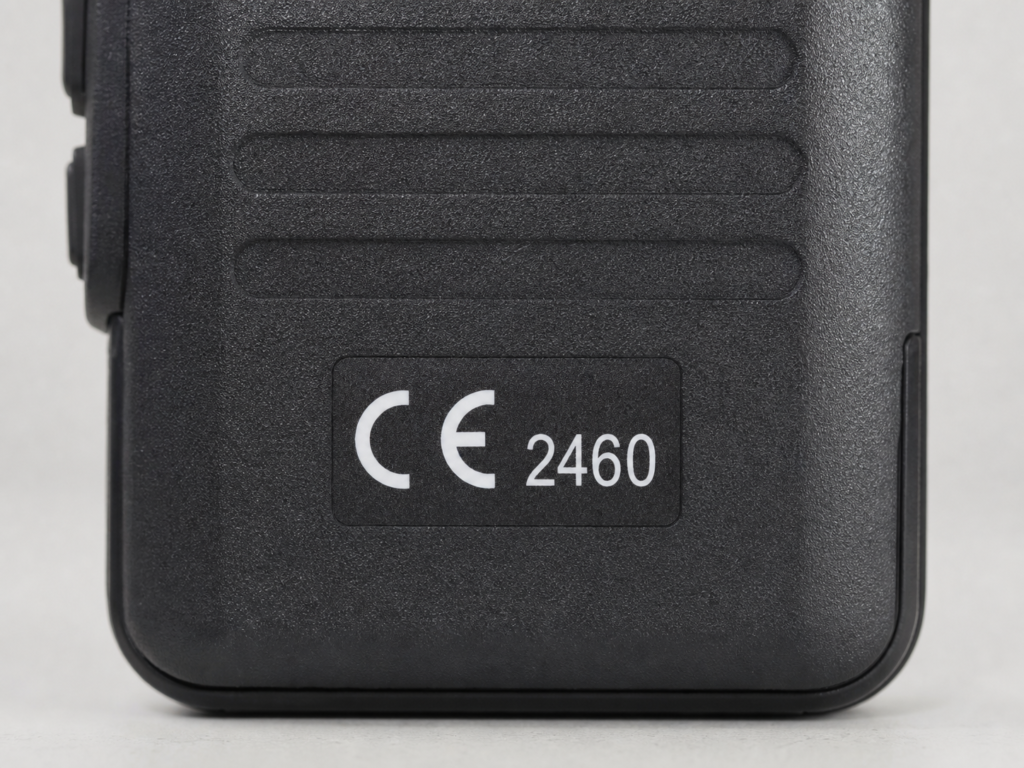
Take two common examples: if ordinary Bluetooth headsets fully apply the corresponding Bluetooth and WiFi harmonized standards, they can usually take the internal production control path. Even if the manufacturer finds a third-party agency to do the test, there is no need to affix the NB number; if it is a special wireless device using a custom frequency band, without complete harmonized standard support, it may require NB participation in the assessment, but ultimately whether to mark the NB number depends on whether the NB participates in the production control link.
Indispensable Required Compliance Documents
Before affixing the CE mark, a full set of compliance documents must be prepared, mainly including three categories:
The first category is technical files: that is, all technical materials that can prove the product meets RED requirements, such as test reports, design drawings, production process descriptions, etc. This set of documents needs to be kept for 10 years after the product is placed on the EU market, and is available for regulatory authorities to access at any time.
The second category is the EU Declaration of Conformity (abbreviated as EU DoC): this is not a test report, but an official compliance commitment letter signed by the manufacturer, which is a necessary prerequisite for affixing the CE mark, and must be signed before labeling. A simplified version of the DoC can be attached to the product, but a publicly accessible URL for the full version must be provided in the manual or accompanying documents to facilitate inquiries by regulators or consumers.
The third category is EU economic operator information: non-EU manufacturers must ensure that the product has an economic operator within the EU to undertake compliance liaison obligations. This entity can be an importer, authorized representative, fulfillment service provider, etc., and it is not necessary to separately designate an authorized representative.
Labeling Time and Responsibility Boundaries
All compliance procedures must be completed before the product is placed on the EU market (including offline sales and listing on e-commerce platforms), and the label must also be affixed in place in advance.
Importers and e-commerce sellers must verify whether the product’s labeling and full set of compliance documents are complete before purchasing or listing, and cannot sell non-compliant products.
The behavior of “labeling first and supplementing materials later” is absolutely prohibited. Unauthorized affixing of the CE mark is an illegal act, and will face severe penalties such as customs detention of goods, fines, and recalls.
Basic Labeling Specifications: Content, Carriers, and Presentation Requirements
After completing all compliance procedures, you can finally officially label the product. What exactly needs to be affixed, where to affix it, and what are the format requirements? Let’s first talk about the basic rules that most conventional products must follow.
Mandatory Content Division for Different Carriers
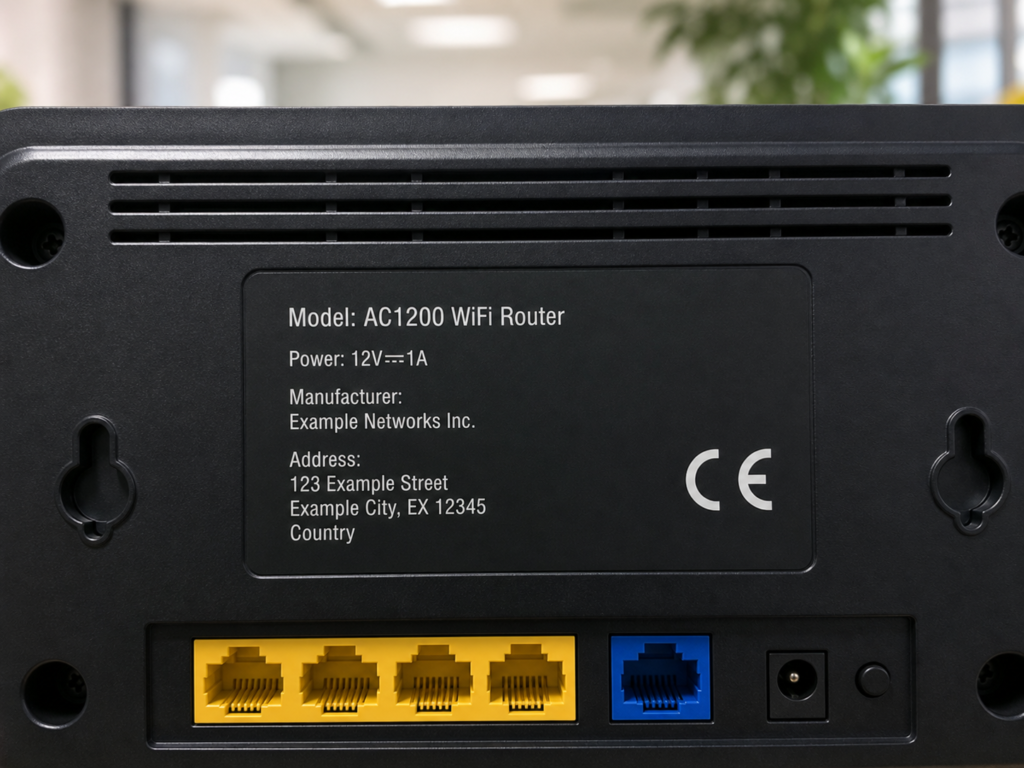
Labels can be affixed in three places, but there are priorities and content division, with priority given to affixing on the product body:
- Product body: The CE mark, product model/batch/serial number, manufacturer’s name and contact address must be affixed; if the product has enough space, the information of the EU economic operator should also be added. The position should be conspicuous and cannot be blocked by accessories or protective film.
- Product packaging: If the product is too small to fit all information on the body, put the remaining traceability information on the packaging. In addition, the restriction information for wireless use must be placed on the packaging, so that consumers can see it before purchasing, and cannot be found only after opening the package.
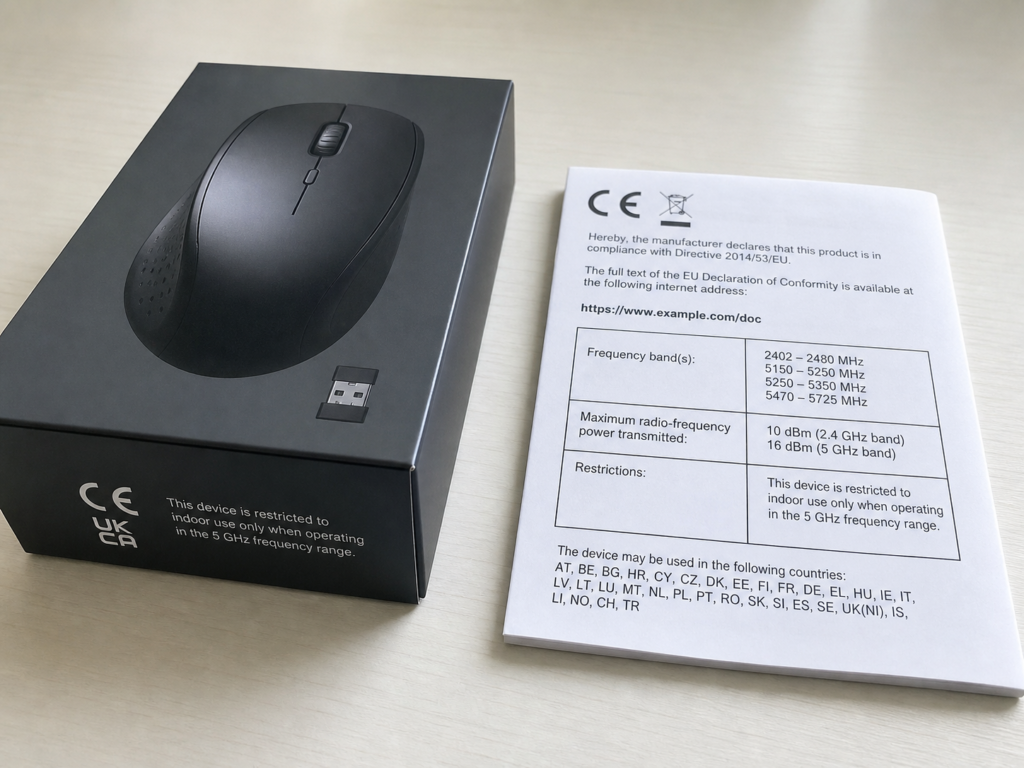
- Accompanying documents (manuals, etc.): Complete compliance instructions, applicable frequency bands of the product, maximum transmission power, safety warnings, and the way to obtain the full DoC must be included. The manual must be in a language that consumers in the target sales member state can understand, and cannot only be in English — for example, if sold to France, it must be in French, and if sold to Germany, it must be in German.
There is a hard prohibition rule here: information on e-commerce product detail pages cannot replace the mandatory labeling on the product body, packaging, and accompanying documents. You cannot say “I wrote CE on the detail page so I don’t need to affix it on the product”.
Label Presentation Standards
The format of the CE mark has clear requirements and cannot be changed arbitrarily:
- Size: Under normal circumstances, the minimum height is 5mm; if the product is particularly small, it can be scaled down proportionally, but must be clearly visible to the naked eye.
- Graphic: The CE mark with official proportions must be used, cannot be flattened or stretched, and the spacing of the letters cannot be changed.
- Durability: The label must be clear and not easy to erase, and temporary stickers that come off as soon as they are torn cannot be used.
- Color: There is no mandatory requirement that it must be black, as long as there is obvious contrast with the background. Generally, black is the safest choice.
- Fake CE identification: The “China Export CE” circulating on the Internet is a folk rumor, and the EU official has no such statement at all. Any CE mark with incorrect proportions that is inconsistent with the official CE pattern is a non-compliant fake CE. Do not believe the so-called “Chinese export version CE”.
Explicitly Prohibited Labeling Behaviors
The following behaviors are clearly violations, and you must never commit them:
- Affixing the CE mark on detachable non-core accessories, such as the detachable protective case of a headphone charging case. Such accessories that users can replace at will do not count;
- Adding irrelevant patterns or text next to the CE mark, affecting the recognizability of the label;
- Using misleading words that imply official approval such as “CE Approved” and “EU Certified” — CE is a compliance mark self-declared by the manufacturer, not an officially issued certification, and writing this way is misleading to consumers;
- Passing off test report numbers as official certification numbers for labeling or promotion;
- Using certification marks from other countries or regions such as FCC and CCC to replace the CE mark;
- Only displaying the CE mark on e-commerce web pages, with no mark on the product body or packaging at all.
Adjustment Rules for Special Scenarios
The above are the requirements for conventional products, but in actual operation, there will be many special situations, such as the product is too small to fit text, or complies with several EU directives at the same time. These situations have room for flexible adjustment, but all have clear preconditions, and cannot be changed arbitrarily.
Label Adjustment for Small-Sized Products
If the product is indeed too small to fit all information, it can be adjusted by size grade, but “for aesthetics” is not a reasonable reason for adjustment:
- Micro products (such as TWS earbuds, smart bracelets, small wireless sensors): Only the CE mark can be affixed on the body, and the remaining model, manufacturer information, etc. are placed on the packaging and in the manual;
- Ultra-small products (such as micro Bluetooth modules, implantable medical devices): If even the CE mark cannot be affixed on the body, the body labeling can be completely exempted, and all information is placed on the packaging and in accompanying documents.
Labeling Rules for Multi-Directive Compliance
Many products comply with multiple EU directives at the same time. For example, a children’s toy with Bluetooth must comply with both RED and the Toy Directive. In this case, there is no need to affix multiple CE marks; one is sufficient. However, note that the compliance documents behind the CE mark must cover all applicable mandatory directives. Covering only RED but not the Toy Directive is still non-compliant.
Special Labeling Requirements for Wireless Restriction Information
If the frequency band used by the product has regional restrictions in some EU member states, requires authorization, or is only for indoor or specific scenario use, restriction information must be labeled:
- Labeling requirements: Must be clearly marked on the packaging to ensure that consumers can see it before purchasing, and at the same time explain the specific restrictions in detail in the manual;
- Common example: Some 5GHz WiFi frequency bands are only for indoor use in some EU countries, so they must be clearly marked on the packaging;
- Precautions: SKUs of different hardware versions and different regions should be labeled corresponding to the actual frequency bands and restrictions. All products cannot use the same general template, otherwise they may not meet the requirements of specific countries.
Labeling Rules for Special Products
There are two types of special products whose rules need to be mentioned separately:
- Customized/small-batch professional equipment: Small batch itself is not a reason for exemption from labeling. It is still necessary to judge whether it can be labeled and where it should be labeled according to the size and nature of the product. Compliance responsibilities can be clarified in the sales contract, but contractual agreements cannot replace statutory labeling requirements, and the accompanying compliance documents must also be complete.
- Used/refurbished equipment: If the original compliance label is still valid, it can continue to be used; if the modification affects wireless performance, compliance must be re-evaluated, and the corresponding labels and documents must be updated.
Pitfall Avoidance Self-Inspection: Common Misconceptions, Violation Risks, and Inspection Methods
To help you quickly check common problems, we have sorted out high-frequency cognitive misconceptions, violation risks, and usable self-inspection methods.
High-Frequency Cognitive Misconception Comparison Table
| Common Misconception | Correct Judgment | Verification Method |
|---|---|---|
| RED has an independent official mark that needs to be affixed side by side with CE | Wireless compliance uniformly uses the CE mark; the EU has no separate RED logo | Check the publicly available official EU labeling specifications |
| Having a CE mark equals compliance with RED | CE can correspond to multiple EU directives; wireless products need RED supporting documents | Check whether the DoC lists the RED Directive (2014/53/EU) |
| All electronic products need to be labeled per RED | Only products that intentionally have wireless transceiving and are placed on the EU market are required | Confirm whether the product has wireless communication/positioning/remote control functions, and whether it is sold in the EU |
| You can affix CE once you get a test report | The test report is only one of the pieces of evidence; you also need a DoC and complete technical file, and the manufacturer is responsible | Check whether there is a signed DoC and a full set of technical files |
| If an NB participates, the NB number must be affixed | It only needs to be marked if the NB participates in the production control stage; no need to affix if only type testing is done | Check whether the NB certificate covers the production control link |
| The CE mark is globally applicable | CE is an EU compliance mark; some frequency bands within the EU also have usage restrictions | Confirm the product’s sales region and verify the frequency band restriction instructions |
Common Violations and Corresponding Risks
Different violations have different degrees of severity of consequences:
- Blurred, easily peelable, or proportionally incorrect labels: regulatory authorities will require rectification within a time limit;
- Lack of traceability information of the manufacturer or EU economic operator: customs will directly detain the goods and prohibit the product from being marketed;
- Randomly affixing/omitting the NB number, using misleading labels: directly judged as non-compliant, forced to be removed from shelves and recalled;
- Missing or too general wireless restriction information (for example, only writing “complies with EU requirements”): e-commerce platform review fails, or regulatory authorities impose penalties;
- The product body can obviously be affixed with CE, but it is only affixed on the packaging: required to rectify within a time limit, “for aesthetics” is not a reasonable reason.
3-Step Quick Self-Inspection Method (Suitable for Beginners)
If you are new to this, you don’t need to memorize complex checklists. Check according to these three steps, and you can find 80% of obvious violations:
- Check the CE mark: Is it affixed? Is it clear? Is it deformed? Is it firmly affixed? Is its position conspicuous?
- Check traceability information: Is there product model/batch information? Is there information of the manufacturer and EU economic operator?
- Check special requirements: If the NB participates in the production control/quality assurance module during conformity assessment, is the 4-digit NB number marked next to the CE mark? If the NB only participates in type examination, the NB number should not be affixed arbitrarily (for cellular and satellite communication products, since the assessment process is usually more complex, this item can be checked with focus). In addition, confirm whether there is any wireless usage restriction information that needs to be labeled.
Complete Compliance Inspection Checklist (For Advanced Users)
If you are a compliance specialist or seller who needs a more comprehensive inspection, you can compare against this checklist:
- Product body: The CE mark meets the requirements of size, proportion, and durability; if there is enough space, basic traceability information is complete;
- Packaging: Information that is too small to fit on the product is all on the packaging, and wireless restriction information is visible before purchase;
- Manual: Available in the language of the corresponding sales country, marked with applicable frequency bands, maximum transmission power, safety warnings, and the way to obtain the full DoC;
- Documents: Technical files, DoC, and EU economic operator information are complete, and technical files are kept for 10 years as required.
Label Update Rules: How to Adjust When Products or Regulations Change
Finally, there is a common question: when the product is revised, or EU regulations are updated, do the original labels need to be changed? Let’s clarify it in two situations.
Update Judgment When Product Changes
Whether to update the label depends on whether the change will affect wireless compliance:
- Situations that require updating: If the product model is changed, new wireless functions are added, or core wireless hardware is replaced (for example, replacing the Bluetooth chip, which affects compliance), in this case, not only the label needs to be updated, but also compliance needs to be re-evaluated, and corresponding documents need to be updated;
- Situations that do not require updating: Only the appearance color and packaging design are changed, which does not affect wireless performance, so there is no need to change the label.
There is another situation where the label is damaged during repair or refurbishment, you can re-apply content that is exactly the same as the original label, but you must never privately change key information such as model, NB number, etc.
Transition Rules When Regulations/Standards Are Updated
If the RED Directive is revised, harmonized standards are updated, or new mandatory requirements such as cybersecurity are added, the EU official will set a transition period according to the type of change. During the transition period, both old and new requirements can be used. There is no unified fixed standard for the length of the transition period. Everything shall be subject to the regulations, implementing rules, and harmonized standard lists published in the Official Journal of the European Union (OJ). Do not readily believe unofficial rumors.
Summary
By now, you have basically mastered the core rules of RED labeling. You should now be able to independently complete the following tasks: quickly judge whether an electronic device needs to be labeled per RED; clarify that RED labeling falls under the CE compliance system and that there is no separate official RED mark; quickly identify obvious labeling violations using the 3-step self-inspection method; determine special adjustment requirements based on product size and compliance type; recognize more than 6 common RED labeling misconceptions; know whether to update labels when products or regulations change; and understand the legal basis and responsibility boundaries of the CE mark under RED.
The core of RED labeling compliance is “compliance first, labeling later”. All labeling must be based on the actually completed compliance procedures. As long as you check item by item according to the rules, you can avoid the vast majority of risks and smoothly meet the market access requirements of the EU market.