
Most practitioners in the EU wireless product market have heard of concepts like EMF and SAR — many equate them to “radiation certification”, or confuse them with EMC, while others believe only high-power devices require such assessments. In fact, EMF assessment is a core health and safety requirement under the EU Radio Equipment Directive (RED), and a mandatory condition for products to bear the CE mark and enter the EU market.
This article starts from basic concepts, breaks down the scope of jurisdiction, judgment methods, core indicators, and key compliance pitfall avoidance points of RED EMF assessments, to help beginners establish a clear compliance understanding.
Beginner’s Understanding: What Exactly is a RED EMF Assessment?
Core Definition Explained in Plain Language
First, let’s talk about what EMF is — it is an electromagnetic field. When a radio device transmits signals, an invisible energy field forms around it, just like the magnetic field around a magnet, except we cannot feel it. When the human body is in this field, it absorbs part of the radio frequency (RF) energy, which may be converted into heat; in actual use, device heating may also come from heat conduction from the battery, chip, and casing. EMF assessment focuses on whether the absorption of RF energy is below the safety limit.
RED EMF assessment is a mandatory verification required by the EU: it proves that when ordinary people use radio equipment normally, the electromagnetic field energy they absorb does not exceed the safety threshold. It is a core item of the health and safety requirements under the RED Directive (2014/53/EU), and a mandatory condition for products to legally bear the CE mark and enter the EU market.
Here we first correct one of the most common cognitive biases: it is not a “zero radiation certification”, nor does it prove that the product has “no electromagnetic field at all”. Instead, it confirms that exposure under normal use is controllable and safe — just like hot water is not untouchable, as long as the temperature does not exceed the scalding threshold, it is fine.
Jurisdiction Boundaries: Which Devices Need It, Which Don’t
The scope of application of RED and EMF transmitted exposure assessment are not the same issue: receiving equipment may still be subject to other RED requirements, but when there is no active transmission, transmitted exposure assessment is usually not required. To determine the scope of application of RED EMF assessment, two steps are needed: first, confirm whether the product is a radio equipment as defined by RED (i.e., equipment that intentionally transmits/receives radio waves for radio communication or radio determination), then determine whether it generates human electromagnetic field exposure that requires assessment. “Whether there is active transmission” cannot be used as the sole judgment criterion.
- Devices that usually require RED EMF assessment: All products with active radio transmission functions, such as Bluetooth, WiFi, 4G/5G, RFID, walkie-talkies, wireless microphones, etc., are within the assessment scope. Wireless charging products with communication or radio determination transmission functions may fall within the scope of RED EMF assessment; wireless charging devices purely used for energy transmission without communication/determination transmission functions need to be judged separately according to their applicable regulations.
- Common situations where transmission-related EMF assessment is not required:
- Devices that only receive radio signals and have no active transmission function (such as ordinary radios): usually do not require assessment of human exposure caused by transmission, but it is necessary to confirm whether they need to meet other RED requirements in combination with whether they are radio equipment as defined by RED.
- Products covered by special regulations such as medical, automotive, and machinery: comprehensive judgment is required in combination with the requirements of special regulations, wireless function attributes, and the scope of application of RED — if the special regulations already cover the corresponding radio EMF requirements, implement according to the special regulations; if not covered, assessment is still required according to RED requirements.
- Boundary cases: For home appliances, toys, and industrial equipment with wireless functions, only the radio transmission part is under the jurisdiction of RED EMF, and other functions are still implemented in accordance with the regulations of the corresponding category. For example, for a rice cooker with Bluetooth, the heating part follows the Home Appliance Directive, and the Bluetooth part follows the RED Directive.
Easily Confused Concepts: EMF, EMC, and Radio Requirements Are Not the Same Thing
Many people confuse the three types of compliance matters required by RED. In fact, their core goals are completely different, and none of them can be missing. Here is a table to clarify:
| Compliance Requirement Category | Core Requirement Goal | Concerned Issue |
|---|---|---|
| EMF (Electromagnetic Field) | Ensure the health and safety of the human body exposed to electromagnetic fields | Will normal use of this device cause health risks to the human body? |
| EMC (Electromagnetic Compatibility) | Ensure that devices do not cause electromagnetic interference to each other | Will your home WiFi affect the operation of the microwave oven? |
| Radio | Ensure the effective use of the radio spectrum | Does the device occupy prohibited channels? Does the transmission power exceed the spectrum regulations? |
All three categories are basic compliance requirements under the RED Directive, but the specific evidence of conformity assessment is not necessarily an independent third-party test report — depending on product characteristics and applicable standards, it can also be in the form of calculations, technical demonstrations, low-power exclusion records, etc. It cannot be simply assumed that every product must issue three independent test reports. The three have different goals, and their assessment methods and indicators are completely independent; they cannot replace each other.
4 Most Common Cognitive Misconceptions for Beginners
Almost everyone who is new to this will fall into these pitfalls, so we will explain them clearly in advance:
- “EMF is a carcinogenic radiation assessment”: The harmonized standards under the RED framework are mainly formulated based on proven health effects recognized by international authoritative health institutions, with sufficient safety factors set. They do not make compliance judgments on long-term health hypotheses that have not been widely confirmed (such as claims that non-thermal effects cause cancer).
- “All electronic devices need RED EMF assessment”: Only devices that are within the jurisdiction of RED and have active radio transmission require human exposure assessment; ordinary wired electronic products have nothing to do with this requirement.
- “The lower the power, the less need for assessment”: The assessment must be combined with the usage distance. Small-power devices that are worn close to the body (such as Bluetooth earphones) may instead require a stricter assessment process because they are close to the human body.
- “A product with the CE mark must have undergone EMF testing”: RED adopts a manufacturer self-declaration system. The CE mark only represents the manufacturer’s declaration that the product is compliant, and does not mean that third-party testing has necessarily been conducted. Truly compliant products must retain complete technical documentation for inspection; failure to produce them during spot checks will result in direct penalties.
Quick Judgment: Does Your Device Need RED EMF Assessment?
After clarifying the basic concepts, you can use a four-step method to quickly determine which category your product falls into.
Step 1: Confirm Whether It Is Under RED Jurisdiction and Has Transmitted Exposure
First, return to the core judgment logic: first confirm whether the product is a radio equipment as defined by RED, then check whether it has active radio transmission function that may cause human exposure.
- Typical devices that require assessment: mobile phones, Bluetooth earphones, smart watches, routers, walkie-talkies, wireless modules, home appliances/toys with wireless functions.
- Common situations where transmitted exposure assessment is not required: devices without transmission function, receive-only devices (need to confirm other RED requirements), devices whose corresponding EMF requirements are already covered by special regulations (need to be judged in combination with specific product conditions).
If it is determined that EMF assessment is required, proceed to the second step.
Step 2: Determine Whether the Low-Power Exemption/Simplified Assessment Path Is Applicable
For some devices with particularly low power, the exposure impact on the human body can be ignored. Those that meet the conditions can take the low-power exemption path, without the need for complex testing, as long as written proof is retained.
- Core conditions for low-power exemption: parameters such as transmission power meet the exemption conditions specified in EU harmonized standards, and the impact on human exposure is negligible — note that exemption conditions vary with frequency, there is no unified fixed value, and they must also meet the requirements of corresponding standards such as usage distance and antenna characteristics.
- Common devices that can take this path: some extremely low-power Bluetooth sensors, ultra-low-power remote controls, etc.
- Special reminder: Low-power exemption is not self-determined. Written proof of product power compliance must be provided, recording information such as applicable standard clauses, parameter sources, and usage distance, and the proof must be included in the technical documentation; Bluetooth devices do not automatically meet the exemption conditions, it depends on the specific power, frequency, and usage scenario.
Step 3: Determine Common Assessment Types Based on Usage Scenarios
The specific assessment method to be used, whether SAR, power density, field strength, or others, must be confirmed based on the product’s operating frequency band, transmission power, antenna characteristics, usage posture, and applicable harmonized standards. 20 cm is a common empirical dividing line in the assessment of most consumer wireless devices, and the corresponding typical assessment paths are as follows:
- Close-fitting/short-distance scenarios (expected usage distance is usually <20cm, such as earphones, watches, mobile phones): usually adopt the SAR (Specific Absorption Rate) assessment path.
- Medium and long-distance scenarios (expected usage distance is usually >20cm, such as routers, set-top boxes): usually adopt the power density/field strength assessment path.
- Fixed installation and scenarios inaccessible to the public (such as base stations, industrial antennas): assessed in accordance with special industrial rules. It is necessary to distinguish between public exposure and occupational exposure scenarios, and determine the applicable limits based on the actual exposed population and access restrictions.
There is a special reminder here: for children’s products and wearable devices, foreseeable misuse scenarios such as closer distance and longer usage time must be given key consideration, and cannot be judged solely based on the normal usage habits of adults.
Step 4: Additional Judgment for Devices with Multiple Transmitters/Integrated Modules
If your device has multiple wireless functions, or uses off-the-shelf wireless modules, there is an additional layer to consider:
- Multi-mode devices (such as mobile phones with WiFi + Bluetooth + 4G at the same time): the cumulative effect of energy when multiple modes transmit simultaneously must be considered. It is not possible to test only a single function; they must be included in the worst-case scenario for unified assessment.
- Complete devices with integrated wireless modules: The EMF report provided by the module supplier cannot directly replace the complete device assessment. It is necessary to check item by item whether the applicable conditions of the original module report are consistent with the complete device, including: operating frequency band, maximum transmission power, antenna type and installation position, expected usage distance, multi-mode simultaneous transmission conditions, software power limits, etc. If all conditions are completely consistent, the module test data can be reused; if there are differences, a complete device applicability analysis must be supplemented, and additional testing shall be conducted if necessary.
Core Logic and Indicators: What Exactly Does EMF Assessment Evaluate?
Many people think EMF assessment is very complicated, but in fact the core logic is very simple: verify under the strictest conditions. As long as the full worst-case scenario is covered and safe, normal use will most likely be fine.
Core Principle: Worst-Case Scenario Judgment Method
All RED EMF assessments follow the “worst-case scenario” principle, which means selecting the most likely to exceed the limit situations for assessment:
- Take the operating state of the device’s maximum transmission power, not the daily low-power mode;
- Assess according to the foreseeable usage posture/distance closest to the human body. For example, for a smart watch, not only the situation of wearing it on the wrist must be tested, but also the situation of being held in the hand and pressed against the skin must be considered;
- Cover the most unfavorable operating modes, such as the state where multiple wireless functions are turned on at the same time.
It should be noted that the “worst-case scenario” here must be jointly defined by the product’s intended use instructions, risk analysis, and applicable harmonized standards, and must cover all foreseeable usage postures, distances, power levels, frequency band combinations, regional versions, and multi-transmission states. Only when the exposure under the full worst-case scenario meets the limits can the conclusion that the product meets the safety requirements within the intended use range be supported. Test results under a single specific condition cannot be generalized to uncovered usage scenarios.
Compliance Basis: Why Assess According to This Standard?
The compliance logic of RED EMF is layered:
- The top-level requirement comes from the health and safety requirements of Article 3.1a of the RED Directive (2014/53/EU), which is a mandatory legal provision.
- The responsible entity is the manufacturer, which bears ultimate responsibility for the compliance of the complete device; importers and distributors need to confirm that the product is consistent with the compliance documents, and cannot sell non-compliant goods.
- Implementation generally uses harmonized standards — that is, EU-wide unified assessment rules officially recognized by the EU. Assessments conducted using harmonized standards can directly presume compliance with RED requirements, which is much more convenient.
- It is also possible to comply without using harmonized standards, but you need to provide equivalent safety proof yourself, which is much more difficult and costly, and ordinary manufacturers generally do not choose this option.
When actually selecting applicable harmonized standards, you can follow 3 simple steps:
① First confirm the product’s operating frequency band, maximum transmission power, antenna type, intended use scenario, and exposed population;
② Check the latest RED harmonized standard list published in the Official Journal of the European Union (OJEU), and verify whether the standard’s scope of application, version validity, transition period, and applicable restrictions match;
③ If there is no directly applicable harmonized standard, prepare an equivalent technical demonstration by yourself, and all relevant records shall be included in the technical documentation.
There is no need to memorize standard numbers, because standard versions are updated regularly. As long as the version used when the product is launched is a valid version that meets the transition period requirements, it is fine.
Two Core Assessment Indicators
Here we first need to clarify the core difference between the two types of indicators: SAR (Specific Absorption Rate) describes the rate of radio frequency power absorbed by human tissues, and is a basic restriction indicator directly related to health effects; power density and field strength describe the intensity of the external electromagnetic environment in the space where the human body is located, and are mostly used as reference level indicators for easy measurement. The applicable scenarios of the two types of indicators cannot be mechanically switched only by distance, but must be comprehensively determined in combination with frequency, human body coupling degree, and applicable standard requirements.
1. SAR (Specific Absorption Rate)
Simply put, it is the rate at which radio frequency energy is absorbed by human tissue per unit mass, and the unit is watts per kilogram (W/kg).
- Applicable scenarios: devices used close to the body/at short distances (distance usually <20cm). Because the distance is close, the coupling effect between the electromagnetic field and the human body is strong, and it is necessary to directly assess the energy absorbed by human tissues.
- Key influencing factors: transmission power, frequency, antenna position, usage distance, working duty cycle (the proportion of time the device actually transmits signals. For example, a walkie-talkie is not always talking, so the duty cycle is low).
2. Power Density/Field Strength
Simply put, it is the amount of electromagnetic field energy per unit area or space, commonly used units are watts per square meter (W/m²) and volts per meter (V/m).
- Applicable scenarios: medium and long-distance/fixed installation devices (distance usually >20cm). At this time, the coupling effect between the human body and the antenna is weak, and the exposure level can be indirectly judged through the spatial field strength.
- Key influencing factors: transmission power, antenna gain, usage distance, beam direction (for example, if a directional antenna faces the direction of people, the energy will be more concentrated).
Basic Common Sense of Safety Limits
Regarding safety limits, you don’t need to memorize specific numbers, just knowing these common sense points is enough:
- The limits are formulated based on international authoritative health research, and usually corresponding safety factors are set for the general public, assessment uncertainties, etc., on the basis of confirmed health effect thresholds; specific safety factors, indicator values, and applicable scenarios shall be subject to applicable harmonized standards and the authoritative health guidelines they are based on.
- There are two types of limits: public exposure limits (used for ordinary consumer products, with stricter requirements) and occupational exposure limits (used for industrial-specific scenarios, with looser requirements). Consumer radio equipment must be assessed according to public exposure limits, and occupational standards must never be applied. For fixed installation/industrial devices, it is necessary to determine whether public or occupational exposure limits apply based on the actual exposed population, access restrictions, and usage scenarios.
- The public exposure limits themselves are already set for the general public (including foreseeable usage scenarios for sensitive groups); whether there are additional assessment requirements for children’s wireless devices and wearable products must be confirmed according to the product’s intended use, foreseeable misuse scenarios (such as children may hold the device closer and use it for longer), and applicable harmonized standards. It is not allowed to apply looser occupational exposure limits on your own.
- Specific limits vary with frequency, and limits for different frequency bands are different. There is no universal single value; just follow the applicable harmonized standards.
3 Common Assessment Methods and Selection Logic
Not all EMF assessments require paid actual testing. Depending on the product situation, there are three common assessment paths, with very different costs and cycles. It should be noted that the specific method that can be used must be determined by the applicable harmonized standards and device category, and you cannot choose a looser path on your own.
The costs and cycles mentioned below are only non-committal reference ranges for common consumer wireless products in the European market. Actual costs and durations are affected by factors such as laboratory location, qualifications, standard version, number of wireless functions, and complexity of multi-transmission combinations, and cannot replace standard applicability judgment.
Method 1: Low-Power Exemption/Simplified Assessment (No Actual Testing Required)
- Applicable scenarios: devices with extremely low transmission power that meet the low-power exemption conditions specified in EU harmonized standards, and other conditions such as usage distance also meet the requirements, with negligible impact on human exposure.
- Operation logic: Check the product parameters according to the low-power exemption conditions in Step 2 above, confirm that the exemption requirements are met, and no actual testing or complex calculations are required.
- Advantages: lowest cost (within a few hundred euros), fastest cycle (within 1 week).
- Note: This path does not exempt from RED compliance obligations, but eliminates the need for more complex exposure assessments. Complete written judgment records must be retained, and all records must be included in the technical documentation for inspection. Bluetooth devices do not automatically meet the exemption conditions, and standard requirements must be checked one by one.
Method 2: Calculation/Simulation Assessment
- Applicable scenarios: devices with medium power, fixed usage distance, simple structure, and for which applicable harmonized standards allow the use of calculation methods (such as some desktop routers and gateways).
- Operation logic: The laboratory uses the calculation method specified in the applicable harmonized standards, combined with the product’s transmission power, antenna gain, usage distance and other parameters, to calculate the exposure value.
- Advantages: medium cost (several hundred to more than one thousand euros), short cycle (1-2 weeks), usually no need to send samples (specifically depends on laboratory requirements).
- Note: The submitted parameters must be true and accurate. If the parameters are falsified, the calculation results will be directly invalid, and will be judged non-compliant during spot checks.
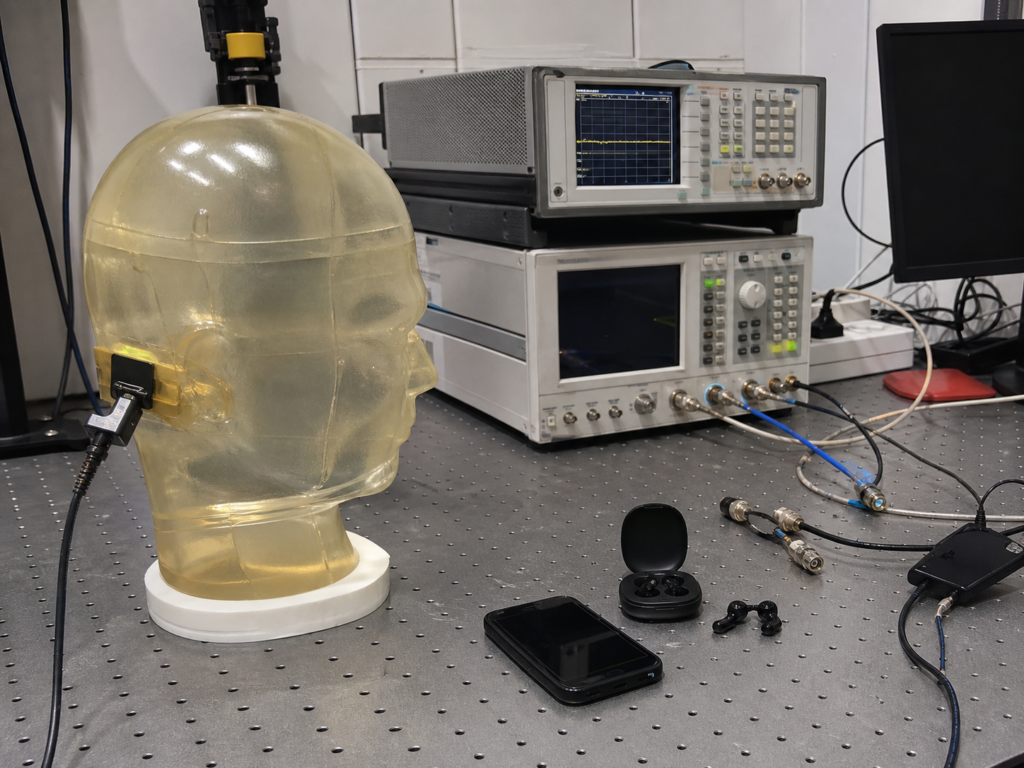
Method 3: Actual Testing Assessment (Sample Testing Required)
- Applicable scenarios: devices used close to the body, with higher power, and for which applicable harmonized standards require actual testing (such as mobile phones, Bluetooth earphones, smart watches).
- Operation logic: Use a mannequin model that simulates human tissue (filled with liquid whose electromagnetic properties are close to human tissue) to measure SAR, or measure spatial field strength/power density in a standard laboratory environment.
- Advantages: the most accurate results, and it is a common assessment method for most close-fitting high-risk devices.
- Cost and cycle: several thousand to tens of thousands of euros, cycle 2-4 weeks, depending on the number of wireless functions of the device and test complexity.
Selection Logic for Assessment Methods
You can choose according to this priority, which is both compliant and cost-saving:
- First check parameters such as power, frequency, and usage distance. If they meet the low-power exemption conditions, take the simplified assessment;
- If they do not meet the simplified conditions, if the usage distance is fixed, parameters are clear, structure is simple, and applicable standards allow calculation assessment, calculation assessment can be taken;
- For devices used close to the body, with higher power, or for which applicable standards require actual testing, actual testing assessment must be taken;
- Multi-mode devices with simultaneous transmission usually require a stricter assessment method;
- For models in the same series with minimal differences, some data can be reused by analogy, but the basis for difference assessment must be supplemented, and cannot be directly copied.
Assessment Focus for Typical Product Scenarios
Different product categories have different assessment focuses. Here we have sorted out the core concerns of several common types of products, which you can quickly compare.
Close-Fitting Wearable Category (Bluetooth Earphones, Smart Watches, Bands)
- Key focus: usage distance against skin/head, power differences in different working modes (call/music/data synchronization).
- Notes: Even if the power is very low, complete assessment basis must be retained; charging cases only require assessment if they have their own wireless transmission function (such as wireless charging communication signals, Bluetooth signals for finding earphones), and cases with purely wired charging do not.
- Special reminder: For children’s wearable devices, compliance with foreseeable misuse scenarios such as close proximity and prolonged use must be subject to key verification.
Handheld Category (Mobile Phones, Walkie-Talkies, Handheld Scanners)
- Key focus: different usage postures (ear-to-chest/chest-held/handheld), superposition of simultaneous transmission of multiple frequency bands, differences in power versions for different regions.
- Notes: For complete devices with integrated communication modules, the module report reuse rules are described in Step 4 above, and module reports cannot be directly applied.
Desktop/Fixed Placement Category (Routers, Gateways, Set-Top Boxes)
- Key focus: minimum usage distance, antenna gain, superposition of simultaneous transmission of multiple frequency bands.
- Notes: The user manual must indicate the minimum usage distance required for compliance; if the product supports users to replace external antennas by themselves, reassessment is required after replacing the antenna.
Fixed Installation/Industrial Category (Base Stations, Industrial Wireless Devices)
- Key focus: installation height, approach distance of maintenance personnel, beam coverage of directional antennas.
- Notes: Public exposure and occupational exposure scenarios must be distinguished. Installation instructions must specify compliance restrictions, such as minimum safety distance, restricted access areas, or maintenance conditions.
Complete Devices with Integrated Wireless Modules
- Key check items: complete device antenna layout and installation position, impact of casing material on signals, difference between expected usage distance and original module test conditions, whether software power limits are consistent with module declarations.
- Operation tip: After completing the verification according to the module applicability check rules in Step 4 above, then determine whether supplementary assessment is required.
Intermediate Advancement: Report Validity Judgment and Compliance Pitfall Avoidance
If you have already obtained an EMF report, or are looking for an institution to do one, the following content can help you avoid the vast majority of compliance pitfalls.
How to Judge Whether an EMF Report Is Valid
You don’t need to understand all the professional data. Just check these four points to judge whether the report is useful:
- Standard compliance: Three conditions must be met — the adopted standard is included in the RED harmonized standard list of the Official Journal of the European Union (OJEU); the standard version is still valid when the product is placed on the market (attention must be paid to transition period and revocation date requirements); the report clearly states that the standard’s scope of application matches the product. If unsure, you can ask the institution to provide proof of standard validity, or check the latest OJEU list by yourself.
- Comprehensive coverage: It includes all wireless functions, all transmission modes, all sales versions, and has considered the cumulative effect of simultaneous multi-mode transmission.
- Reasonable scenario: Tested/calculated according to the worst-case scenario, not ideal conditions (for example, results obtained by lowering power or increasing distance are invalid).
- Clear conclusion: It clearly marks compliance with RED EMF related requirements, and has a comparison of specific test/calculated values and safety limits. It cannot just write the word “qualified”.
6 Most Common Compliance Pitfalls
These are the most common pitfalls in the industry, and they must be avoided:
- Directly replacing the complete device report with a module EMF report: For complete devices with integrated modules, the applicability is not checked according to the rules in Step 4 above, and the module report is directly used as the compliance basis. This risk is highest for close-fitting devices.
- Passing EMC/Radio testing equals passing EMF: The three are different basic requirements under RED, with completely independent assessment goals and methods. Conformity assessment must be conducted separately and evidence retained; they cannot replace each other.
- Low power means no need for SAR testing: Low power only triggers the low-power exemption judgment, and cannot automatically exempt from the SAR path. Specifically, evidence shall be retained according to the exemption conditions in Step 2 above; close-fitting devices need to be judged according to the short-distance scenario assessment path even if the power is low, due to the close distance.
- Assessment reports are valid for life: Product hardware changes, software power adjustments, and standard updates all require reassessment. It is not a one-time and forever solution.
- Must find a notified body for testing: RED allows manufacturers to adopt conformity assessment procedures such as internal production control when meeting corresponding requirements; a notified body is only required to be involved in accordance with regulations when harmonized standards are not fully adopted, or when the specific conformity assessment procedure requires the participation of a notified body. Do not default to having to find a notified body and spend unnecessary money just for the EMF project. When selecting a laboratory, it is necessary to separately verify its testing capability and qualifications for the corresponding standards, and cannot judge the validity of the report solely by the institution’s name.
- Inconsistency between the manual and assessment conditions: For example, if the report is assessed at a distance of 20 cm, but the manual allows close-fitting use, it will be directly judged as unqualified by market supervision — because the actual usage scenario exceeds the scope covered by the assessment, the report is effectively invalid.
Which Situations Require Re-doing the EMF Assessment
As long as the following three types of changes occur, reassessment is required, and the old report cannot be directly used:
- Hardware changes: Replacing wireless modules/RF chips/antennas, adjusting antenna position/casing structure, adding new wireless systems/frequency bands, increasing transmission power.
- Software changes: Firmware adjusts power control strategies, adds new multi-mode simultaneous transmission combinations, unlocks new frequency bands/power levels.
- Regulatory changes: EU harmonized standards are updated, original standards are no longer officially recognized, market supervision puts forward new requirements.
Beginner Compliance Operation Process and Self-Check List
If you are preparing for an EMF assessment, you can follow this process to avoid detours.
Key Points for Parameter Preparation Before Compliance
Before starting the assessment, organize these parameters first, which can save a lot of communication costs:
- Frequency range, maximum transmission power, antenna gain, and working duty cycle of all wireless functions;
- Intended use scenario of the product (minimum distance from the human body, wearing/installation method);
- Configuration differences of all sales models and regional versions;
- Distinguish between nominal power, software-limited power, and actual maximum transmission power.
Method for Selecting Assessment Institutions and Methods
- First, according to the four-step judgment method above, determine the applicable assessment type (simplified/calculation/actual testing). Do not immediately find an institution to do the most expensive actual testing.
- Just select a laboratory with corresponding EU EMF assessment qualifications and covering applicable standards. It is not mandatory to find a notified body. Specific requirements are determined according to the conformity assessment procedure.
- For products with multiple versions/models, you can prioritize the assessment plan that covers the worst configuration — for example, after testing the model with the highest power and closest distance to people in the same series, other models with small differences can reuse data by analogy to save costs.
Report Verification and Technical Documentation Archiving Requirements
After receiving the report, first check it according to the “four-step method for report validity” above, and archive it after confirming there are no problems:
- The EMF report needs to be uniformly included in the RED technical documentation together with Radio test reports, EMC reports, risk assessment and other documents;
- The EU Declaration of Conformity (DoC) shall cover the applicable basic requirements of RED, especially Article 3.1(a) health and safety requirements, and list the adopted harmonized standards or other technical specifications; documents related to EMF assessment are retained as part of the technical documentation, and the DoC does not necessarily need to be separately marked with the words “RED EMF”;
- Do not affix the CE mark just because you have passed the EMF assessment — RED also has other requirements such as health and safety, electromagnetic compatibility, and spectrum. All must be met before the CE mark can be affixed.
Common Reference Range for Cost and Cycle
The cost and cycle of different products vary greatly. Here is a rough reference range (non-committal, actual subject to laboratory quotation):
- Simplified assessment: within a few hundred euros, cycle within 1 week;
- Calculation assessment: several hundred to more than one thousand euros, cycle 1-2 weeks;
- Actual testing assessment: several thousand to tens of thousands of euros, cycle 2-4 weeks.
The main influencing factors are the number of wireless functions, test complexity, laboratory schedule, and number of versions. Specifically, you can ask several laboratories for comparison.
Beginner Quick Self-Check List
You can directly check against the list below to ensure nothing is missed:
Product Information
□ List all wireless systems/frequency bands
□ Confirm maximum power, antenna gain, and worst working mode
□ Clarify minimum usage distance and installation/wearing method
□ Cover all sales models and regional versions
Assessment Path
□ Select applicable EU harmonized standards
□ Clarify the basis for selecting the assessment method
□ The cumulative effect of simultaneous operation of multiple transmitters has been considered
□ No irrelevant reports are used to replace EMF assessment
Compliance Documents
□ EMF report has been included in the RED technical documentation
□ Declaration of Conformity (DoC) covers the applicable basic requirements of RED
□ User manual is consistent with the assessment conclusion
□ There are corresponding reassessment records when the product is changed
Summary
RED EMF assessment looks professional, but in fact the core logic is very simple: verify safety under the strictest usage scenarios. After mastering the above content, you can independently complete the following 5 basic judgments:
- Quickly judge whether a radio device needs RED EMF assessment;
- Distinguish the applicable scenarios and core differences between SAR and power density assessments;
- Understand the core conclusions of EMF assessment reports and identify invalid reports;
- Avoid the most common RED EMF compliance misconceptions;
- Complete basic EMF compliance preparation according to the process.
After completing the above information sorting and preliminary judgment, you can basically form an EMF compliance path suitable for your own products, avoiding unnecessary cost waste; the formal conformity conclusion still needs to be finally based on applicable harmonized standards, complete technical documentation of the finished device, declaration of conformity, and necessary test or calculation results.