
Practitioners in the EU electrical and electronic product market have certainly heard of RoHS, but many people’s understanding of it stops at “testing is required and the CE mark must be affixed”. When asked who conducts inspections, how inspections are carried out, how much the fine is for violations, or whether they themselves might be caught, they are completely confused. Many cross-border sellers also think “I’m in China, EU regulation can’t reach me”, and only panic when their stores are restricted or goods are detained. This article will systematically sort out the RoHS enforcement mechanism and penalty rules, covering core content from entry-level scope judgment to advanced risk assessment, to help practitioners establish a clear compliance awareness.
First Things First for Beginners: What RoHS Enforcement Covers and Whether It Applies to You
What Exactly Is RoHS Enforcement?
Many people think RoHS is a trade barrier specifically targeting imported products, but that is not the case. In essence, it is the EU’s routine market compliance supervision, following the same logic as domestic product quality inspections in China. Its core task is to verify whether hazardous substances in electrical and electronic products sold on the EU market exceed the specified limit values.
It is also not an independent voluntary certification, but a mandatory component of EU CE compliance. The CE mark is a symbol for manufacturers to self-declare that “the product complies with all relevant EU regulations”, and RoHS is one of the requirements that must be met. The core purpose of the entire rule is to reduce hazardous substance pollution in e-waste and protect consumer health and the environment.
Quick Judgment: Is Your Product Within the Enforcement Scope?
To judge whether a product needs to comply with RoHS, you cannot just look at “whether it uses electricity”. You need to check step by step, and the voltage threshold is only the first step of preliminary screening:
The first step is to check the basic conditions: whether the product relies on electric current or electromagnetic fields to achieve its core function, and the rated AC voltage does not exceed 1000V and DC voltage does not exceed 1500V. Only when these are met does the product fall into the preliminary category of electrical and electronic equipment (EEE).
The second step is to check the functional attribute of the product: it must conform to the equipment categories covered by the RoHS Directive. For example, only equipment whose core function is realized by electricity is within the scope; if electricity is only an auxiliary function (such as a purely mechanical gas stove with an electronic display screen, whose core function is gas combustion), it needs to be judged in combination with specific rules.
The third step is to check the product form: whether it is a complete machine, separately sold components (such as separately sold mobile phone batteries, power cords), or supporting electronic accessories, as long as they meet the definition of EEE, they are all within the enforcement scope.
The fourth step is to check exclusions and special rules: some categories, such as specific medical equipment and military/aerospace dedicated equipment, may be explicitly excluded from the directive, or apply to special exemption clauses and transitional arrangements. Ordinary RoHS rules cannot be directly applied, and they need to be checked one by one against specific regulatory provisions.
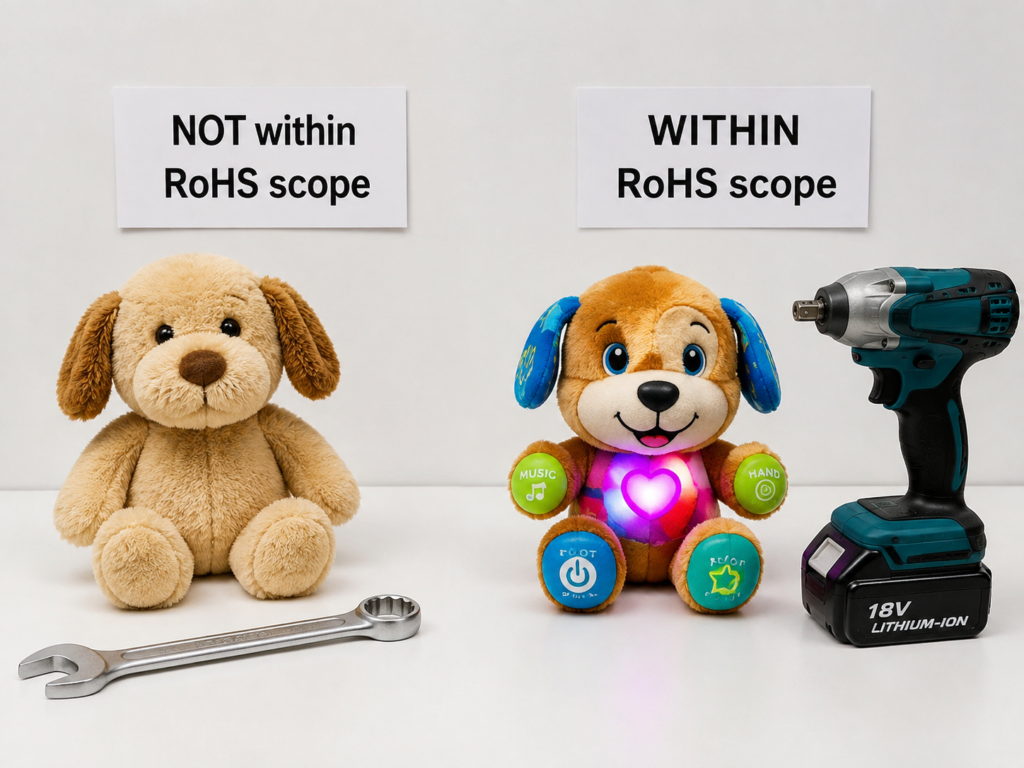
Here is a quick judgment tip: first check whether the core function of the product is realized by electricity. For example, ordinary plush toys are not included, but electric plush toys that can glow and sing with batteries have core functions including electronic parts, so they are included; another example is that purely mechanical wrenches are not included, but electric wrenches are included.
Which Entities May Be Held Accountable?
Don’t think that only local EU manufacturing enterprises will be inspected. As long as your products enter the EU market, relevant entities in the entire supply chain may bear corresponding obligations:
EU-based entities include manufacturers, authorized representatives, importers, and distributors, which are the objects that regulators can most easily contact directly.
Overseas entities cannot stay out of it: for example, cross-border e-commerce sellers, private label brand owners with their own brands (who will be deemed as manufacturers), and modifiers who make substantial modifications to products that affect compliance are all within the scope of accountability. Many Chinese cross-border sellers think “I’m in China, the EU can’t control me”, which is completely wrong. Once a violation is found, the platform will take measures such as store restrictions and product removal according to rules or regulatory requirements, and goods may also be detained. Actual impacts will occur even without finding you in person.
5 Must-Know Terms Explained in Plain Language
Before talking about enforcement details, let’s explain several commonly seen terms in plain language to avoid confusion later:
The first is homogeneous material: it is the smallest single material layer that a product can be disassembled into, such as plastic shells, copper wires, and electroplated layers. This is the basic unit for RoHS limit value judgment – it is not the average of the entire product mixed together for testing, but each individual material must meet the standard. For example, a mobile phone case has a plastic layer, a flocking layer, and metal buttons; these three must be tested separately, and as long as one exceeds the limit, it is a violation.
The second is limit value: it is the maximum allowable concentration of hazardous substances in homogeneous materials. The 10 restricted substances currently controlled by the RoHS Directive include lead, mercury, cadmium, hexavalent chromium, polybrominated biphenyls, polybrominated diphenyl ethers, bis(2-ethylhexyl) phthalate (DEHP), butyl benzyl phthalate (BBP), dibutyl phthalate (DBP), and diisobutyl phthalate (DIBP). Among them, the limit value for 9 substances is 0.1% by weight of the homogeneous material, and only cadmium has a stricter limit of 0.01%. The list of restricted substances and exemption clauses will be updated regularly through directive amendments, and enterprises need to check the latest applicable version.
The third is CE mark: many people think it is a quality certification issued by the EU official, but it is not. It is a mark for manufacturers to self-declare that “the product complies with relevant EU regulations”. It can be affixed by themselves in accordance with specifications, but enterprises are responsible for the authenticity of this declaration; affixing the mark does not mean everything is fine.
The fourth is DoC (Declaration of Conformity): it is a formal written document signed by the manufacturer to prove that the product meets the requirements of RoHS and other relevant regulations. It needs to be kept together with the product and must be produced when inspected by regulators.
The fifth is the distinction between easily confused regulations. Many people tend to confuse RoHS with two other EU regulations. Here is a table to clarify:
| Regulation Name | Core Regulated Object | Main Requirements |
|---|---|---|
| RoHS | Hazardous substances in electrical and electronic products themselves | The 10 hazardous substances in homogeneous materials do not exceed the limit values |
| REACH | Chemicals in all categories of products (not limited to electronics) | Registration, evaluation, authorization and restriction of chemicals, as well as information communication of substances of very high concern in articles, etc. |
| WEEE | Recycling and treatment of electrical and electronic waste | Producers bear recycling responsibilities, and fulfill obligations such as registration, fee payment, and affixing recycling marks |
It should be noted that these three sets of regulations may apply to the same electrical and electronic product at the same time. Meeting RoHS requirements does not mean automatically complying with REACH or WEEE obligations. The three have different regulatory directions and cannot replace each other.
Why RoHS Enforcement Should Not Be Taken Lightly
Many people think “I’m lucky and won’t be inspected”, but when they are actually caught, the consequences can be minor or severe:
In mild cases, goods may be detained, listing may be delayed, and time and money need to be spent on rectification, resulting in loss of time cost and orders.
In moderate cases, you will be required to remove products from all channels, face administrative fines, and old customers may be lost due to stockouts or violations, resulting in loss of market and reputation.
In severe cases, you may be prohibited from selling in the EU market, with high fines. In extremely few particularly serious cases, relevant responsible persons may also bear criminal liability, which is by no means a trivial matter.
Enforcement System: Who Inspects RoHS and What Are Their Responsibilities?
Many people think the European Commission directly comes to inspect goods, but that is not the case. RoHS enforcement is layered, with clear division of labor among different roles.
EU Level: Rule-Making and Action Coordination
EU-level institutions are mainly responsible for setting rules and cross-country coordination, and do not directly inspect specific goods:
The European Commission is responsible for unifying the basic rules of RoHS, such as updating the list of restricted substances and adjusting exemption clauses, and all member states must abide by this unified basic framework.
In addition, the European Commission and the market surveillance coordination mechanism will promote member states to carry out joint spot checks on high-risk electrical and electronic products through special coordination projects. The frequency of projects, participating countries, and key categories are subject to officially announced notices, and are not fixed annual EU-wide synchronous actions.
There is also a very important cooperation mechanism called Safety Gate (formerly known as the RAPEX Rapid Alert System), which is a platform for member states to share risk information on dangerous products and notify corrective measures. If a member state finds that RoHS non-compliant products pose health or environmental risks, it may upload relevant information to this system; whether other member states follow up with inspections and what kind of removal or sales ban measures they take shall be determined by the competent authorities of each country according to their own procedures and risk assessment results. A single notification will not automatically produce EU-wide unified penalties or sales bans, but it will significantly increase the probability of products being inspected in other EU countries.
Member State Level: The Main Force of Actual Enforcement
Specific enforcement work is carried out by the competent authorities responsible for market surveillance in each member state, who are the real “goods inspectors”.
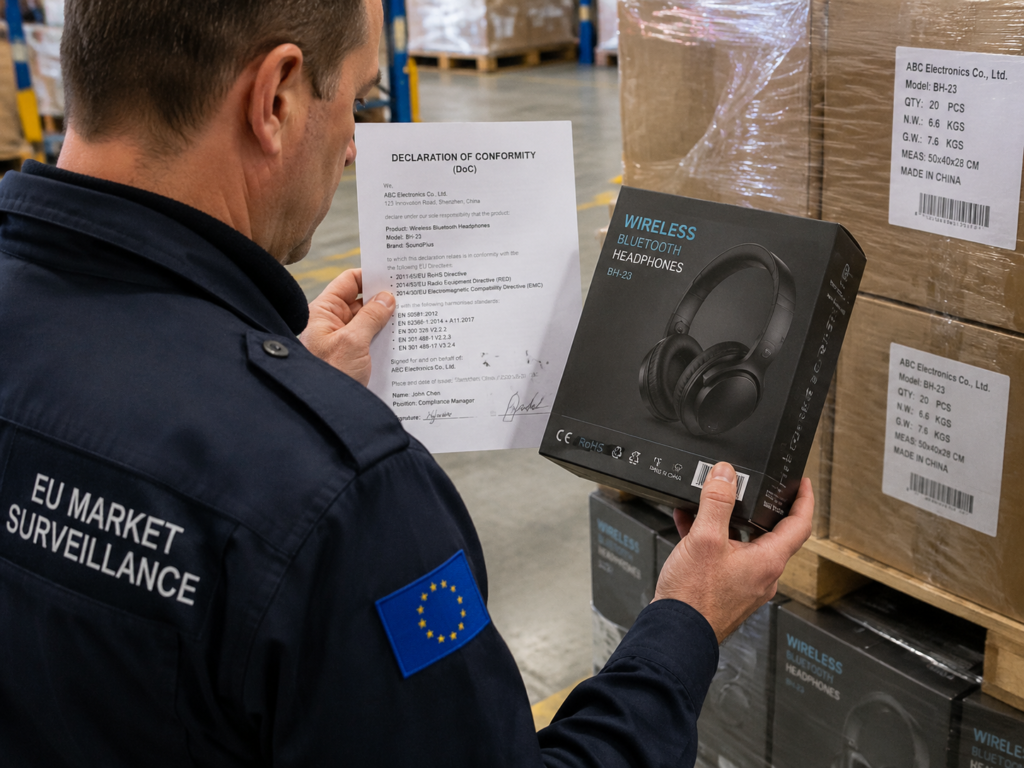
The powers of these institutions usually include: conducting spot checks on goods sold in stores, stored in warehouses, or just entering the country, requiring enterprises to submit a full set of RoHS compliance materials, and making violation determinations and penalty decisions according to law.
The allocation of regulatory resources, key spot check areas, and penalty procedures may vary among different member states, and the specific details shall be subject to the public rules of local competent authorities. For example, some member states focus more on spot checks of e-commerce platforms and overseas warehouses, while others take offline retail and import entry links as the focus of supervision. Enterprises need to make compliance preparations separately according to the rules of their main sales countries and warehouse countries.
Jurisdiction also needs to be determined in combination with the location of the product, the act of placing on the market, sales channels, and local procedures of member states: usually, the competent authorities of the warehouse country where the product is located, the sales country, and the member state where the product is first placed on the EU market may conduct inspections in accordance with their own national regulations. For example, many sellers store their goods in overseas warehouses in Poland. Even if they mainly sell to Germany, Polish regulators have the right to inspect the goods in the warehouse.
These Roles Are Not Enforcement Authorities: Don’t Confuse Their Powers
In addition to regulatory agencies, there are several roles that often deal with RoHS, and many people are unclear about their powers:
First, customs: customs are only responsible for preliminary risk screening at the time of entry. If they think the product may be non-compliant, they will hand it over to the market regulatory agency. Customs itself is not the main enforcement force of RoHS. Don’t think that passing customs clearance equals compliance.
Second, third-party testing institutions: these are institutions you entrust to conduct testing and issue reports at a cost. They only have testing power, no enforcement power, and cannot issue fines. Testing reports are only one of the evidences you use to prove your compliance.
Third, e-commerce platforms: first, the platform itself is not a RoHS enforcement authority and has no right to make RoHS administrative penalty decisions; second, when the platform receives a formal violation notice from the regulatory agency, or finds high-risk products through self-inspection, it shall take measures such as removal and restricted sales of non-compliant products in accordance with relevant EU regulations and platform rules, and may also take platform management measures against sellers such as restricting store permissions and temporarily withholding payment for goods; finally, if the platform fails to perform its review and cooperation obligations under EU platform governance, product safety or market surveillance cooperation rules, it may also face regulatory penalties, but this responsibility does not replace the RoHS compliance main responsibility that should be borne by manufacturers, importers, sellers and other entities.
Full Enforcement Process: How Many Steps From Inspection to Penalty?
Many people panic when they are inspected and don’t know what will happen next. In fact, the entire process is very clear, with only a few links.
Why Are You Inspected? 5 Common Trigger Reasons
It’s not just “bad luck” that gets you selected. There are many triggers for enforcement:
The most common is random spot checks, such as routine spot checks in stores, e-commerce warehouses, and entry ports, where whoever is selected is inspected.
Then there are special inspections, which are concentrated enforcement by the EU or member states targeting a certain category of high-risk products. For example, if there are many problems with children’s smart watches during a certain period, this category will be inspected intensively.
There are also complaints and reports: consumers, peers, and industry associations can all report. As long as there are clear clues, the regulator will launch targeted inspections.
Cross-border linkage is also a common trigger reason, which is the Safety Gate warning mentioned just now. If other countries find violations of the same type or same brand of products, your sales country may also follow up with re-inspections.
Finally, key re-inspections: if you have previous violation records, the probability of being selected later will be much higher than that of ordinary enterprises.
First Stage: Document and Marking Verification
Regulators will not disassemble your product to test hazardous substances right away. The first step is to check documents and markings, that is, “written compliance verification”.
There are three main things to check:
First is the DoC Declaration of Conformity, to check whether the content is complete, whether it is validly signed, and whether it corresponds to the correct product model, to avoid using the declaration of product A for product B.
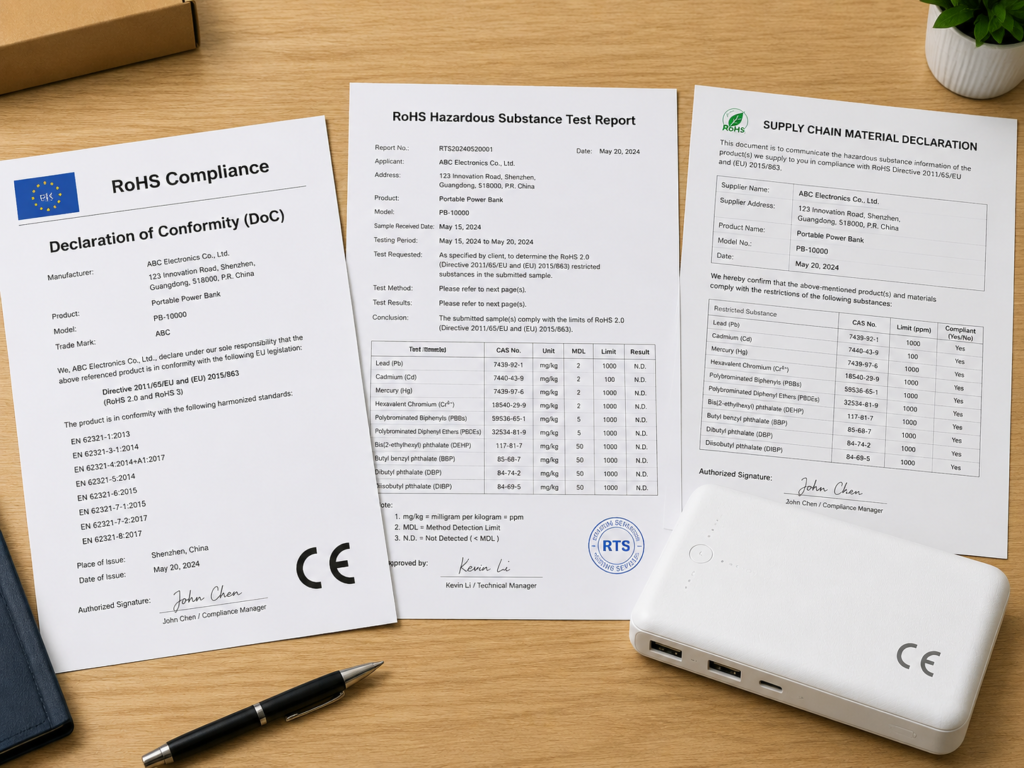
Second is the technical documentation, which should include test reports supporting the product’s compliance with RoHS requirements, material declarations from the supply chain, and if RoHS exemption clauses are used, corresponding applicable certification materials.
Third is product marking, to check whether the CE mark is affixed in compliance with regulations, and whether the name and address of the manufacturer and the EU-based economic operator are marked as required.
If documents are missing, information does not match, or there is suspicion of fraud, the competent authority may require the enterprise to make corrections within a time limit, or directly launch sampling testing for further verification; if there are clear cases of forged documents, false declarations, etc., the risk level of violation penalties will be significantly increased.
Second Stage: Sampling and Testing
If there are doubts about the documents, or it is a high-risk category, the regulator will launch the second stage: sampling and testing.
The quantity and method of sampling are determined by the competent authority according to the product risk level, batch size, and national sampling procedures. In practice, it is common to draw several samples: 2 to 3 units may be drawn for small batches, and 5 to 10 units for large or high-risk batches. This range is only an empirical reference for enterprises to retain samples and prepare materials, and does not constitute a legal sampling standard. Samples are usually drawn from finished products on sale and inventory, and core components may also be sampled when necessary.
Testing generally first uses X-ray Fluorescence Spectrometer (XRF) for rapid screening. If the screening finds that hazardous substances are suspected to exceed the limit, the samples will then be sent to a qualified laboratory for precise testing using standard chemical methods after being disassembled into homogeneous materials.
The final judgment is based on whether the concentration of hazardous substances in the homogeneous material exceeds the limit value. However, whether the test result of a single sample can cover the entire batch needs to be comprehensively judged by the competent authority in combination with sampling rules and batch consistency evidence.
Third Stage: Violation Determination and Defense Rules
If testing finds suspected violations, the competent authority will first verify and confirm: including verifying whether the product model and batch corresponding to the sample are correct, whether the exemption clause claimed by the enterprise is within the validity period and applicable to the product scenario, etc., to avoid mistakes.
After confirmation, a notice will be served to the relevant enterprise, explaining the problems found in the inspection, the proposed measures, and informing the enterprise of its right to statement and defense. After receiving the notice, the enterprise should first confirm the nature of the document: whether it is a request for document supplementation, a notice of statement of opinion, or a formal administrative penalty decision, and then submit relevant evidence or opinions according to the time limit and channel specified in the notice.
From a practical perspective, the statement and defense period given by most member states is about 1 to 2 weeks, and the specific duration is subject to the requirements stated in the notice and national legal procedures. The defense materials that enterprises can submit usually include supplementary test reports, retest applications, supplier material declarations, exemption clause applicability certificates, product batch consistency explanations, sales flow evidence, etc. If the defense evidence submitted by the enterprise is accepted by the competent authority, the proposed measures may be revoked or adjusted; if not accepted, the competent authority will make a formal decision according to law.
What Are the Differences Between Common Product Disposal Measures?
After a violation, products will be disposed of in different ways. Many people are confused about the differences between rectification, withdrawal, recall, and destruction. Here is a table to clarify:
| Disposal Method | Applicable Scenarios | Product Stage | Can It Be Re-listed Later? |
|---|---|---|---|
| Rectification | Document defects, minor problems that can be corrected | Not yet in the hands of consumers | Can be re-listed after rectification passes the competent authority’s verification |
| Withdrawal | Batch has compliance issues but has not been sold | Still in channels/warehouses | If rectification is completed and passes verification, it can be re-placed on the market; otherwise, it shall not be sold |
| Recall | Products have already been sold to consumers | Already flowed into the end market | Usually cannot be re-listed, and recall processing must be completed as required |
| Destruction | Serious violation, cannot be rectified | Any stage | Cannot be sold, must be destroyed as required, and the cost shall be borne by the enterprise |
The core difference between several types of disposal measures lies in whether the product has flowed into the hands of consumers and whether it can be re-placed on the market through rectification.
Penalty Severity: How Much Is the Fine If Caught?
This is the issue that everyone is most concerned about, but first of all, a core premise must be clarified: there is no unified RoHS fine standard in the EU.
First Clarification: There Is No Unified EU Fine Standard
The RoHS Directive only stipulates that penalties must follow the principles of “effective, proportionate and dissuasive”, and does not formulate a unified fine amount standard. The specific penalty types and amount calculation methods are determined by each member state after transposing the directive into national law, and there are great differences between different countries.
The calculation methods of fines also vary: some countries calculate according to the proportion of the value of the involved goods, some count by individual violations, and some calculate according to the duration of the violation. Moreover, for the same violation case, the competent authority may simultaneously impose product disposal measures and economic penalties, which do not replace each other. It is not that you don’t need to deal with the product after paying the fine, or you don’t need to pay the fine after dealing with the product.
Minor Violations: Rectification as the Main Approach
If it is a first violation, no subjective intent, and non-substantial defects in documents, it is generally a minor violation, mainly focusing on correction. There may be no fine, or only a small administrative fine. If it involves borderline testing disputes, and the enterprise can provide evidence of batch consistency, retest or exemption, it may also be mainly rectified within a time limit. However, it should be clarified that once it is confirmed that the homogeneous material exceeds the legal limit, it is a substantial violation. Only the penalty range can be appropriately reduced due to factors such as first violation, no subjective malice, product not entering the market, and cooperation with rectification, rather than not being recognized as a violation.
Common minor disposal measures include requiring completion of documents within a time limit, supplementary testing, removal of unqualified batches from shelves, and small-scale product withdrawal. After the rectification is passed, subsequent compliant products can still be sold normally without long-term impact. Fines are usually less than 10,000 euros, subject to the rules of the member state.
Moderate Violations: Fine + Market Restrictions
If it is unintentional but the product exceeds the limit obviously, or the rectification is not completed within the time limit, which has caused a certain range of market impact, it is a moderate violation.
In this case, the competent authority usually imposes administrative fines in addition to product disposal measures. The fine calculation method varies from country to country: in countries or cases where the fine is calculated according to the proportion of the value of the involved goods, the practical reference range is usually 1%-10% of the goods value, which refers to the total sales value of the violating products in the EU market, not the production cost; some countries also impose fines according to the number of individual violations or the duration of the violation. In addition to fines, there will be additional market restriction measures, such as prohibiting this batch of products from being sold in the domestic market and requiring removal from all channels.
Serious Violations: High Penalties + Criminal Liability Risks
If it is a deliberate violation, such as forging test reports, forging CE marks, selling products knowing they exceed the limit, or concealing violations, repeating offenses after being fined before, or causing health damage and significant market impact, it is a serious violation and the penalty will be very heavy.
In terms of fines, in scenarios where fines are calculated according to the proportion of goods value, the amount usually exceeds 10% of the goods value, and some member states have set a maximum fine limit of millions of euros. What is more serious is the risk of criminal liability: if the illegal act also violates the relevant provisions of the national criminal law (such as serious fraud, refusing to implement regulatory decisions, causing major environmental or health damage), in extremely rare cases, the relevant responsible persons of the enterprise may face criminal liability, which needs to be judged in combination with the charge, subjective fault, damage consequences and national law.
In addition, there are other additional penalties, such as confiscation of illegal gains, prohibition from participating in EU public procurement, and public disclosure of information on violating enterprises, which have a great impact on the reputation of the enterprise.
How Is Supply Chain Responsibility Divided? Different Entities Have Different Obligations
Many people will ask: if it is the problem of the upstream supplier, for example, the supplier gave a false material declaration, who is responsible?
The RoHS Directive clearly divides the obligations of different entities in the supply chain, and it is not a single entity that bears all responsibilities:
- Manufacturer: responsible for product design, conformity assessment, preparation of DoC Declaration of Conformity and technical documentation, and ensuring that the product meets RoHS requirements. It is the primary responsible entity for product compliance.
- EU-based authorized representative: entrusted by overseas manufacturers to undertake obligations such as liaison and document retention under corresponding regulations.
- Importer: responsible for verifying whether imported products have compliance documents and whether markings meet the requirements, and ensuring that the imported products have completed compliance assessment. For products entering the EU market, the importer is usually one of the economic operators that EU regulators directly hold accountable. Even if the violation problem originates from overseas manufacturers or upstream suppliers, the importer still needs to first perform obligations such as submitting materials, suspending sales, and withdrawing/recalling products to the regulatory authority, and cannot use third-party faults to confront regulation. Afterwards, the importer can seek recourse from the responsible party according to the contract.
- Distributor: responsible for verifying whether the markings and basic compliance documents of the sold products are complete, shall not sell products that obviously do not meet the requirements, and shall cooperate with the tracing and investigation work of the competent authority.
- Private label brand owners / substantial modifiers: if they sell products under their own brand, or make substantial modifications to the materials or structure of the product that affect RoHS compliance, they will be deemed as manufacturers and bear all compliance responsibilities of manufacturers.
- Cross-border direct sales sellers: if they sell products directly to EU consumers and have not designated an economic operator responsible for compliance in the EU, they may need to bear the corresponding obligations of manufacturers or importers on their own.
It should be noted that the material declarations or test reports provided by upstream suppliers can only be used as evidence for the enterprise’s compliance assessment, and cannot replace the enterprise’s own conformity responsibility; if the enterprise is penalized due to false materials provided by the supplier, the enterprise can seek recourse from the supplier through contractual or civil channels, but this cannot exempt itself from compliance responsibilities to EU regulators.
Intermediate Level: How to Judge the Severity of Penalties
After understanding the basic penalty rules, you can initially assess the risk level of a violation case in combination with the following common consideration factors, but the final penalty result shall be subject to the decision made by the competent authority in accordance with national law and the specific facts of the case, and there is no unified quantitative standard.
Core Factor 1: Degree of Subjective Fault
This is one of the core factors affecting the severity of penalties. If there are obvious deliberate violation circumstances (such as forging compliance documents, placing products on the market knowing they exceed the limit, destroying evidence to evade investigation), the penalty will usually be more severe; if the violation is caused by negligence (such as failing to update supply chain materials in time, unintentional omissions in documents) and the enterprise has no subjective malice, the penalty will be relatively lenient.
Core Factor 2: Harm and Impact Scope of the Violation
The competent authority usually assesses the degree of harm in combination with the following dimensions:
- Exceedance situation: the extent to which hazardous substances exceed the limit, and the number of homogeneous materials involved;
- Product audience: if the product is for children, household use or close contact scenarios, the penalty may be heavier due to the wide contact population and high health risk; for industrial-specific products with limited contact population, the assessment will be combined with the actual exposure risk;
- Circulation scale: the more sales of the involved products and the more member states covered, the larger the impact scope, and the heavier the penalty may be;
- Circulation stage: if the product is intercepted at the entry or storage link and has not yet flowed into the hands of consumers, the harm is relatively controllable; if it has flowed into the end market in large quantities, the disposal cost and harm are higher, and the penalty may be heavier.
Core Factor 3: Enterprise’s Attitude Towards Cooperation and Rectification
If the enterprise actively cooperates during the investigation, submits relevant materials in a timely manner, voluntarily stops selling problematic products, and voluntarily takes recall or corrective measures, the competent authority may酌情从轻处理 (handle with leniency as appropriate); if it conceals information, refuses to cooperate with the investigation, or refuses to rectify after the deadline, it may be given a heavier penalty.
Other Possible Influencing Factors
- Violation history: if the enterprise has previous similar violation records and is a repeat offender, the penalty may be increased, and the specific identification standard is subject to the law of the member state;
- Enforcement member state: different member states have different penalty scales and procedural rules, and regions with more sufficient regulatory resources and stricter enforcement may have higher overall penalty intensity;
- Violation type: penalties for substantial material exceedance in products are usually heavier than those for mere formal document defects; penalties for subjective fraud are usually heavier than those for violations caused by negligence.
8 Most Common Enforcement Misconceptions
Many people are fined not because their products actually have problems, but because they fall into cognitive misconceptions. The following are the 8 most common types of misconceptions, which you can check against to avoid pitfalls.
Misconceptions About Documents and Certification
First misconception: having a CE mark or test report means you won’t be fined.
The CE mark is the manufacturer’s self-declaration, and its validity depends on the consistency between the actual product and the compliance documents – the test report must correspond to the model, material, and production batch of the actual product, and be able to support the conformity conclusion to be valid. If the report corresponds to an old batch, other models, or the test items do not match the actual materials, even if the report itself is real, it may still be judged as a violation.
Second misconception: exemption clauses can be used casually.
Wrong. RoHS exemption clauses only apply to specific technical scenarios explicitly listed in the directive, and most exemptions have a validity period and will automatically expire after expiration. Enterprises need to check the applicable conditions against the latest exemption list and cannot expand the scope of exemption on their own.
Third misconception: one RoHS test is valid for life.
Wrong. If the product replaces raw materials, suppliers, production processes, or the list of restricted substances and exemption rules are updated, RoHS compliance needs to be re-evaluated. You cannot rely solely on a test report from many years ago to prove compliance for a long time.
Misconceptions About Products and Scope
Fourth misconception: only finished products are inspected, components are not.
Wrong. RoHS limit values are judged in units of homogeneous materials. Separately sold electrical and electronic components (such as wires, batteries, circuit boards) and accessories that meet the definition of EEE are also within the enforcement scope. As long as the homogeneous materials in them exceed the limit, they will be judged as violations.
Fifth misconception: passing customs clearance equals RoHS compliance.
Wrong. Customs are only responsible for preliminary risk screening at the entry link. Passing customs clearance does not mean that the product meets RoHS requirements. Subsequent market surveillance links may still conduct spot checks on products on sale and in warehouses. Many violation cases are found only months after the products enter the market.
Sixth misconception: the fine standard is the same across the EU.
Wrong. The specific penalty rules of RoHS are formulated by the national laws of each member state. The fine calculation methods, maximum limits, and procedural processes vary greatly, and the standards of one country cannot be applied to other countries.
Misconceptions About Responsibility and Entities
Seventh misconception: only manufacturers need to be responsible.
Wrong. Entities such as importers, distributors, authorized representatives, private label brand owners, and cross-border sellers in the supply chain all need to bear obligations under corresponding regulations, and it is not only manufacturers who are responsible for violations.
Eighth misconception: if the supplier says it is compliant, there is no problem.
Wrong. The supplier’s oral promise has no evidentiary effect. Enterprises must request traceable written material declarations or test reports for corresponding batches, and complete conformity assessment in combination with their own product conditions. Otherwise, in the event of a violation, the enterprise still needs to bear responsibility.
Practical Guide: Compliance Preparation and Response to Inspections
After talking so much about enforcement and penalties, finally, let’s talk about something practical: how to do compliance normally, and how to respond when you are actually inspected.
Basic Compliance Preparation Before Entering the Market
For novices who have just entered the EU market, first do the following basic compliance work well, which can effectively reduce most enforcement risks:
First, confirm whether the product is within the scope of RoHS application: check step by step according to voltage thresholds, product functions, and category exclusions. If it belongs to special categories such as medical and military products, you need to confirm against special rules, and do not directly apply the requirements of ordinary products.
Second, request traceable written material declarations or RoHS test reports for corresponding batches from suppliers as the basis for your own compliance assessment, and do not rely solely on oral promises.
Third, prepare complete compliance documents: manufacturers need to prepare DoC Declaration of Conformity and supporting technical documentation, and entities such as importers and distributors need to retain relevant documents as required by regulations; the document retention period is at least 10 years from the date when the product is last placed on the EU market, not from the date of production or testing.
Fourth, affix the CE mark as required, and mark the name and contact address of the manufacturer and the EU-based economic operator; if the product is too small or has a special shape to be directly marked, it can be marked on the packaging or accompanying documents according to the rules, and the specific requirements need to be checked against the provisions of the corresponding product regulations.
Key Points for Daily Ongoing Compliance
Compliance is not a one-time thing before entering the market that will be done once and for all. In daily operation, you also need to pay attention to:
- Re-evaluate product compliance in a timely manner when replacing materials, suppliers, production processes, or when RoHS rules are updated;
- Focus on the compliance of high-risk components: solder, plastic shells, electroplated layers, coatings, battery contacts, etc. are high-incidence parts where hazardous substances exceed the standard;
- Regularly pay attention to the update dynamics of the RoHS restricted substance list and exemption clauses, and adjust products or compliance documents in a timely manner;
- Properly keep all compliance documents and supply chain traceability materials to ensure that they can be provided within the time limit required by the regulator;
- Sellers selling through cross-border e-commerce platforms should upload or prepare materials such as CE marks, DoCs, RoHS test reports or supply chain material declarations in advance according to platform requirements, to ensure that platform product links, product models, batches, and brand information are consistent with compliance documents, so as to avoid temporary removal due to data mismatch during regulatory or platform spot checks.
Response Steps After Receiving an Inspection Notice
If you really receive an inspection notice from the competent authority, don’t panic, and handle it in an orderly manner according to the following steps:
First step, first confirm the basic information of the investigation: including the competent authority that issued the notice, the product model and batch involved, the deadline for reply, and whether the inspection is about document issues or product testing issues. First figure out the core information to avoid blind response.
Second step, sort out the corresponding evidence chain: retrieve the DoC, technical documentation, test reports, supplier material declarations, exemption applicability certificates and other materials of the involved products, and check one by one whether there are problems.
Third step, determine the response direction: if you think the product is compliant and there are doubts about the inspection, you need to submit evidence for defense within the time limit specified in the notice; if you confirm that there is a violation, you should actively propose feasible rectification or corrective plans, actively cooperate with the investigation, and strive for lenient treatment.
Fourth step, post-event review and rectification: after the incident is handled, timely review the root cause of the problem, optimize supply chain management and compliance assessment processes, to avoid the recurrence of similar problems.
When to Seek Professional Support
Not all situations require hiring professional compliance or legal personnel. Simple document supplementation and routine inspections can be handled by yourself, but it is recommended to seek professional support in the following situations:
- Inspections involving multiple member states, or large-scale product recalls are required;
- The competent authority has launched a formal administrative penalty procedure and may face high penalties;
- There is a major conflict between the regulatory test results and the enterprise’s own compliance documents;
- Uncertain whether the product is eligible for a certain exemption clause or transitional arrangement.
In general, RoHS enforcement is the routine compliance supervision of the EU electrical and electronic product market, with the core goal of controlling health and environmental risks brought by hazardous substances. For entry-level practitioners, after reading this article, they should be able to independently judge whether the product is within the jurisdiction of RoHS, whether there are exclusion or exemption situations, distinguish the power boundaries of the European Commission, member state market surveillance authorities, customs, third-party testing institutions and e-commerce platforms, avoid 8 types of common enforcement misconceptions, and complete basic compliance preparation before entering the market and basic response after inspection. For practitioners with certain experience, they can initially assess the risk level of violation penalties in combination with the degree of subjective fault, harm of exceedance, circulation scope, enterprise cooperation degree and member state regulatory differences, and reasonably judge whether they need to seek professional compliance or legal support. The core of compliance work lies in early implementation. Sorting out supply chain management and document systems in advance is far more reliable than dealing with problems temporarily when they arise.