
Many small and medium-sized sellers and startup brands that have just entered the EU market are always confused about “self-declaration” when they first encounter CE compliance: some consider it a “gray operation of randomly affixing marks”, some believe it is inferior to compliance paths with third-party participation, and others think that just signing a document is enough to pass inspections. All these perceptions are biased — CE self-declaration is a statutory compliance path in the EU, and there is no hierarchical difference between it and conformity assessment procedures involving notified bodies; they only differ in applicable scope and operation procedures.
1. Basic Understanding: Definition and Core Rules of CE Self-Declaration
1.1 Plain-Language Definition and Official Attribute
In plain terms, CE self-declaration means that the manufacturer independently assesses that the product meets EU safety, health, and environmental protection requirements, and after signing a Declaration of Conformity (DoC for short, a compliance guarantee issued by the enterprise), the product can be affixed with the CE mark and placed on the market for sale.
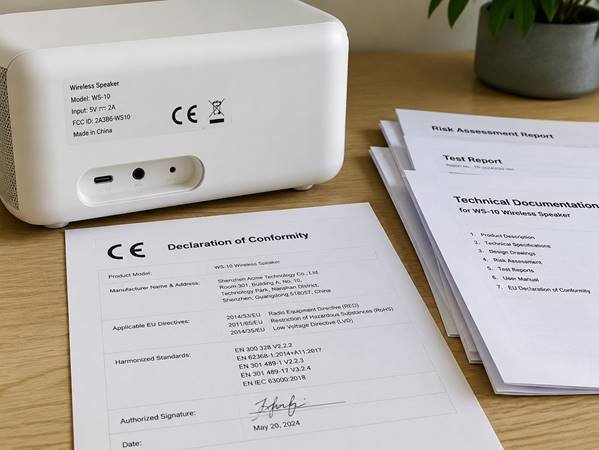
Its official corresponding path is “Conformity Assessment Module A (Internal Production Control)”, which is a legal compliance path explicitly stipulated by EU regulations. Its core feature is that it does not require mandatory participation of a Notified Body (NB for short, a third-party institution officially recognized by the EU with qualifications to carry out compliance assessment) in the assessment process, and the entire process is independently led by the manufacturer.
1.2 Legal Effect and Clarification of Common Perceptions
First, it needs to be clarified that: on the premise that relevant regulations allow the use of the internal production control module and the manufacturer fully performs all conformity assessment obligations, both self-declaration and conformity assessment with the participation of notified bodies are legal and effective compliance paths. There is no hierarchical difference between the two; the core differences lie in the assessment procedures, participating entities, and liability arrangements stipulated by regulations.
At the same time, several common misconceptions need to be corrected: the CE mark is not a quality certification and does not represent the quality grade of a product; it is not an official EU recommended mark, nor a certificate of origin; it only proves that the product meets the minimum statutory requirements for safety, health, and environmental protection stipulated by the EU. Self-declaration is by no means “randomly affixing marks” — all products must be supported by complete technical documentation and verification evidence, and in the event of compliance issues, the manufacturer shall bear full legal liability.
1.3 Basic Rules of the System
This article mainly discusses the market rules of EU member states and the European Economic Area (EEA, including Iceland, Liechtenstein, and Norway) where relevant CE regulations apply; some special product regulations, the Turkish Customs Union, or other markets that recognize the CE mark may have different requirements, which need to be checked in combination with the specific target market.
The EU’s regulatory logic is “independent compliance before listing, random market inspection after listing”: regulatory authorities do not review products one by one before they are placed on the market, but verify compliance after listing through random spot checks, targeted verification based on complaints, and other methods. The consequences of violations are clear: in minor cases, products are removed from shelves, fined, or recalled; in serious cases, all products are destroyed, and even criminal liability of relevant responsible persons is pursued.
2. Applicability Judgment: Methods and Boundaries for Whether a Product Can Adopt Self-Declaration
Many people are used to directly asking “Can product XX adopt self-declaration?” In fact, the answer is never determined by the product name, but must be judged based on two core dimensions, both of which must be met: first, the product falls within the scope of CE regulations; second, all applicable CE regulations allow the use of Conformity Assessment Module A (Internal Production Control). As long as one applicable regulation requires the participation of a notified body, the whole product cannot fully adopt the pure self-declaration path.
2.1 3-Step Practical Self-Judgment Method
You can confirm step by step in 3 steps, without guessing based solely on the product name:

Step 1: Clarify the complete boundaries of the product. Do not just describe the product category in general terms; sort out all its functions, intended use, user groups, use environment, risk level, and whether it includes special functions such as wireless, pressure, or gas. For example, for flashlights, the risk level of ordinary household models and explosion-proof models used in coal mines is vastly different, and the applicable rules are completely different.
Step 2: Query all CE regulations corresponding to the product. First check the scope of application and exclusion clauses of each regulation to confirm that the product does fall within the jurisdiction of the regulation, then check the conformity assessment module table in the regulation to confirm whether Module A is allowed. It should be noted here that a product may be subject to multiple regulations at the same time, and all regulations must allow self-declaration.
Step 3: Confirm the applicable compliance basis. Harmonized standards are technical standards formulated by European standardization bodies, approved by the European Commission, and published and cited in the Official Journal of the European Union, and they must be applicable to your product, related risks, and corresponding regulatory requirements. Compliance with such harmonized standards can presume that the product meets the essential requirements within the scope covered by the standard in the corresponding regulation; regulatory requirements not covered by the standard still need to be proven compliant through other technical evidence such as risk assessment, design calculation, and testing. If there is no fully corresponding harmonized standard, the self-declaration path can still be adopted, and specific requirements can refer to the “No harmonized standard” explanation in Section 2.3 of this chapter.
2.2 Reference of Typical Applicable/Non-Applicable Product Categories
To help you establish an intuitive understanding, common reference product categories are compiled below, but special attention should be paid: The premise of the following classifications is that the product has fallen within the jurisdiction of the corresponding CE regulations. Materials (such as plastics, textiles) or product names themselves do not trigger CE compliance requirements. The final confirmation still needs to be based on the above 3-step judgment method combined with the actual situation of the product, and cannot be classified solely by name.
| Common scenarios where self-declaration is applicable (falling within the scope of corresponding CE regulations and regulations allow internal production control) | Common scenarios where notified body participation may be required under specific categories, risk levels or functions (to be judged based on category, intended use and specific regulation module tables) |
| Ordinary household electronic and electrical appliances, plastic/textile products falling within the scope of specific regulations such as toys/personal protective equipment, manual hardware tools falling within the low-risk scope of the Machinery Directive, Category I/low-risk personal protective equipment (such as simple protective PPE defined by regulations), passive accessories, simple low-risk toys, etc. | Class II and above medical devices, Class I medical devices with measuring/sterile functions (determined according to the classification of medical device regulations); Category II/III personal protective equipment (determined according to the risk classification of PPE regulations); explosion-proof products (determined according to the equipment category and use environment of the ATEX Directive); medium and high voltage pressure equipment (determined according to the pressure level, medium, and volume of the Pressure Equipment Regulation); lifts (determined according to the equipment type and risk level of the Lift Regulation); active implantable devices |
2.3 Handling of Special Boundary Cases
In actual operation, vague boundary cases are often encountered, which need to be judged flexibly according to the rules:
• Multiple regulations overlapping: Overlapping of multiple regulations is the norm for CE compliance. A product may be subject to multiple CE regulations at the same time. For example, a household desk lamp with Bluetooth needs to comply with multiple regulations such as Electromagnetic Compatibility (EMC), Low Voltage (LVD), Restriction of Hazardous Substances (RoHS), and Radio Equipment (RED).
• To judge whether pure self-declaration is applicable, it is necessary to check the conformity assessment requirements of each regulation for the relevant risks of the product one by one — only when all applicable regulations allow the use of Module A can the pure self-declaration path be adopted.
• If a certain regulation requires a notified body to participate in a specific risk module, the whole product cannot be self-declared as a pure Module A product. For example, for a medical electrical device, its EMC and low voltage requirements can be completed through internal production control, but the risk assessment of the medical device part requires the participation of a notified body. In this case, the whole product can be compliant only after completing the assessment with NB participation as required.
• No harmonized standard: The absence of a corresponding harmonized standard does not mean that self-declaration is not possible, but the convenience of “compliance with harmonized standards presumes compliance with regulatory requirements” cannot be directly enjoyed. You need to prepare sufficient technical evidence through more rigorous risk assessment, design calculation, testing and verification, etc., to prove that the product meets the essential safety requirements of the regulations. The workload of compliance demonstration and the pressure of demonstration during market spot checks will increase significantly, and the probability of being spot-checked may also be higher.
• Combined/whole product: You cannot assume that the whole product is compliant just because the components have the CE mark. For example, if you purchase lithium batteries and plastic shells with CE marks and assemble them into power banks by yourself, the separate compliance of components does not mean that the assembled whole has no new risks; the compliance of the whole product must be re-evaluated.
• Transition period between old and new regulations: EU regulations are updated from time to time. When judging the applicable version, you cannot only look at the “day of listing”; you need to combine the time point when the product is placed on the market or made available on the market, check the effective date, transition clauses, and applicable rules for inventory products of the corresponding regulations, and confirm the final applicable regulation and standard versions. Different versions may lead to changes in conformity assessment modules, affecting whether self-declaration is applicable. Relevant judgment basis must be kept in the technical documentation for future reference.
3. Responsible Entities: Obligations and Liability Boundaries of Each Participant
CE compliance is not the sole responsibility of the manufacturer; each role in the supply chain has corresponding statutory obligations, and the liability boundaries must be clearly divided.
3.1 Manufacturer: The Primary Responsible Party
The manufacturer is the primary responsible party for CE compliance and is responsible for the compliance of the product throughout its entire life cycle. Specifically, this includes: ensuring that the design and production of the product comply with all applicable CE regulations; compiling complete technical documentation, signing the DoC, and affixing the CE mark in accordance with specifications; keeping all compliance documents, and handling issues such as consumer complaints and product recalls; in the event of compliance issues, bearing the ultimate legal liability.
3.2 EU Economic Operators and Authorized Representatives
Many novice sellers tend to confuse EU Authorized Representatives (EAR), importers, and EU economic operators. Here are three clear levels of logic:
First, regardless of whether third-party entities are involved, the manufacturer is always the primary responsible party for product compliance and bears ultimate responsibility for the compliance of product design and production.
Second, if the product is subject to the explicit requirements of the EU Market Surveillance Regulation 2019/1020 or corresponding product regulations, non-EU manufacturers must ensure that there is an economic operator in the EU that can be directly contacted by regulatory authorities, responsible for cooperating with regulatory liaison.
Third, the identity of this economic operator is not necessarily an “authorized representative” — it may be an importer, another qualified economic operator, or an authorized representative explicitly required by regulations to be designated. This must be judged in combination with applicable regulations and cannot be generalized.
If applicable regulations explicitly require the designation of an authorized representative, the EAR must be an identifiable economic operator with a valid registered address in the EU, and perform its duties in accordance with the written authorization signed with the manufacturer. Common statutory obligations include: keeping the Declaration of Conformity and technical documentation as required by regulations, providing compliance materials to regulatory authorities, cooperating with regulatory authorities to take corrective measures, etc. The specific scope of duties is subject to applicable regulations and authorization documents.
The liability boundary needs to be clarified: the EAR bears corresponding responsibilities within its statutory obligations and authorization scope, but does not replace the manufacturer’s ultimate primary responsibility for product design, production, and compliance; if the product itself has compliance defects, the core responsibility still lies with the manufacturer.
3.3 Importers and Distributors
Importers who import products into the EU and distributors who sell products within the EU must perform their respective compliance obligations:
Before placing products on the EU market, importers must verify the documents and information that regulations require them to check (such as CE marking, Declaration of Conformity, manufacturer and authorized representative information, etc.), and confirm that technical documentation can be accessed as required by regulations. They shall not import products that they know or should know are non-compliant.
Distributors before selling must check the integrity of the product’s CE marking and accompanying documents, and shall not sell products that they know or should know are non-compliant.
Neither shall they modify or cover the CE marking without authorization. When receiving a recall notice, they must cooperate in transmitting information and implementing the recall. If they violate their own statutory obligations, they shall bear corresponding legal liability.
4. Full Process Operation: From Compliance Pre-Judgment to Post-Marketing Maintenance
CE self-declaration is not just about signing a declaration casually; it must be promoted step by step according to the process, and each stage has clear completion standards to ensure there are no loopholes in compliance.
4.1 Compliance Pre-Judgment Stage
The core of this stage is to complete path confirmation according to the 3-step judgment method in Chapter 2, to avoid finding that the path is inconsistent after subsequent investment. You need to sort out all functions and risks of the product, list all applicable regulations and check the conformity assessment modules, and at the same time clarify the compliance basis (harmonized standards or alternative technical solutions).
Checkpoint: All applicable regulations allow Module A, there are no situations where notified body participation is mandatory, and the compliance basis is clear and implementable.
4.2 Compliance Verification Stage
After confirming that the self-declaration path can be adopted, it is necessary to truly verify whether the product meets the requirements of all applicable regulations. First, a complete risk list must be established based on the essential safety, health, and environmental protection requirements of applicable regulations, covering not only normal use scenarios but also reasonably foreseeable misuse.
For example, for children’s toys with sound and light effects, the risk assessment should not only cover the use scenarios of normal pressing and sound playback, but also consider reasonably foreseeable misuse such as dropping, biting, and pulling small parts, to ensure that all foreseeable risks are assessed and controlled within the scope of regulatory requirements.
Verification methods depend on regulations and product types, and may include laboratory testing, design calculation, structural inspection, risk assessment, etc. Not all products must undergo laboratory testing. If there is no corresponding harmonized standard, you can select appropriate verification methods to establish alternative evidence according to the requirements of Section 2.3 in Chapter 2. Verification work can be completed by internal laboratories or entrusted to external third-party laboratories; the institution does not need to have notified body qualifications, but it must be ensured that the laboratory has corresponding testing capabilities, test methods are traceable, and samples are representative. The test reports of ordinary third-party laboratories are only supporting materials for self-declaration and cannot replace the notified body assessment procedures required by regulations.
If non-conformities are found during verification, rectification must be carried out until they meet the requirements, and it must be ensured that the design, materials, and processes of mass-produced products are completely consistent with the verification samples. If key changes occur subsequently, such as replacement of core components, structural adjustment, software update, or change of production site, compliance must be re-evaluated, and it cannot be done once and for all.
Checkpoint: The requirements of all applicable regulations are covered, verification evidence can support the compliance conclusion, and the consistency between mass production and samples is guaranteed.
4.3 Technical Documentation Compilation Stage
After passing the verification, all compliance-supporting materials must be compiled into complete technical documentation. The documentation must have clear logic and directly correspond to specific product models, so that regulatory authorities can quickly understand “why this product is compliant” when reviewing it; it cannot be a patchwork of scattered documents.
The language requirements for documents must be judged separately according to document type, and ultimately subject to applicable regulations and target market requirements; there is no unified general rule:
• Materials such as instructions for end users and safety warnings usually need to be in the official language that consumers in the selling member state can clearly understand;
• The language requirements for the Declaration of Conformity (DoC) are determined according to the explicit provisions of specific regulations and target member states, and there is no unified mandatory standard;
• Technical documentation usually does not need to be fully translated into the target market language on its own initiative, but when regulatory authorities require translation, the manufacturer or EU economic operator must provide a compliant version within the specified time limit.
English can be used as a working language for internal enterprise collaboration or some cross-border business, but it does not automatically meet the statutory language requirements of all member states.
Checkpoint: The documentation is complete and traceable, can clearly support the compliance conclusion, and the language meets the requirements of the target market.
4.4 DoC Signing Stage
The DoC is the core legal document of self-declaration, and shall be prepared in accordance with the necessary content and declaration requirements stipulated by applicable regulations; if regulations explicitly provide a mandatory template, the corresponding template must be used. When multiple regulations overlap, all applicable regulations must be listed in full without omission.
The general mandatory information includes: product identification information (model, batch, serial number, or other identifiers sufficient to identify the product), manufacturer’s name and address, list of all applicable EU regulations/directives, cited harmonized standards (including version number) or other technical basis, and the name, position, signature and date of the authorized signatory.
The following two types of information are “filled in when applicable”: first, the name and address of the EU Authorized Representative (only filled in when required by regulations); second, the name, number and relevant assessment document information of the notified body (only filled in when the notified body has actually participated in the conformity assessment procedure required by regulations; pure self-declaration products do not have this item, and information of ordinary testing institutions shall not be filled in as notified body information).
Checkpoint: Information is complete and without omission, signature authorization is valid, and all applicable regulations are covered.
4.5 Mark Affixing and Listing Stage
After all compliance work is completed, the CE mark can be affixed and the product can be placed on the market; it is absolutely forbidden to affix the mark in advance. The affixing of the CE mark must meet three basic requirements, and specific details are subject to applicable regulations:
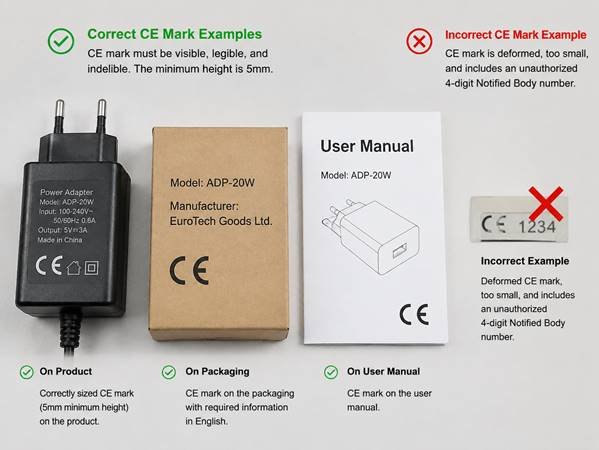
First is format requirement: The CE mark must be printed in the fixed proportion specified by the official, must not be deformed or distorted, and must be clearly distinguishable and not easy to fall off or be erased;
Second is size requirement: Most regulations require the minimum height of the mark to be 5 mm. For very small products (such as micro electronic components, small wearable accessories), the size can be appropriately reduced according to the exception clauses of corresponding regulations, but it must still be clearly distinguishable to the naked eye;
Third is affixing position: It is preferred to affix it on the product body or a permanently fixed nameplate. If the product is too small and its surface cannot be permanently marked, it needs to be transferred to the product packaging or accompanying instructions according to the requirements of specific regulations.
In addition to the CE mark, the product must also be marked with necessary information as required by applicable regulations, such as product model/batch, manufacturer’s name and address, and EU economic operator information required by regulations (including authorized representative or importer information when applicable). The specific entities to be marked, information content, and marking position (product, packaging, instructions, or accompanying documents) are all subject to the explicit requirements of the corresponding applicable regulations, and there is no unified general rule.
There is a high-frequency violation point here: only when the notified body has actually participated in the conformity assessment procedure required by regulations and the regulations explicitly require marking, can the four-digit number of the notified body be marked next to the CE mark; pure self-declaration products shall not illegally mark the NB number.
In addition, the product instructions and safety warnings must also meet the language requirements of the target market, and the specific requirements are subject to local regulatory requirements.
Checkpoint: The format and content of the mark meet the requirements of applicable regulations, and there is no advance marking or illegal marking.
4.6 Post-Marketing Maintenance Stage
Product listing is not the end of compliance, but the beginning of ongoing responsibility. You need to keep technical documentation and DoC as required by applicable regulations, establish internal mechanisms for change assessment, complaint handling, and recall response, and be able to cooperate in a timely manner and provide relevant materials in case of spot checks by regulatory authorities.
Checkpoint: Documents can be accessed as required, and change and complaint handling processes are complete.
5. Core Documents: Preparation Requirements for Technical Documentation and DoC
Technical documentation and DoC are the core vouchers of CE self-declaration, and are also mandatory items for market spot checks. They must be prepared in accordance with requirements.
5.1 Minimum Content Requirements for Technical Documentation
The specific requirements for technical documentation vary depending on applicable regulations. The following is a general compilation framework across product categories, not a unified closed list for all CE regulations — you need to compare item by item with the technical documentation clauses of each applicable regulation and supplement product-specific materials (such as production consistency control records, software verification reports, clinical evaluation data, etc., depending on the product type). From a general logic perspective, technical documentation must cover at least four types of core content:
First is basic product information, including product description, model, version, intended use, and list of key components, which must clearly correspond to the actually sold product.
Second is design and production materials, such as product drawings, circuit diagrams, software/firmware descriptions, and production process overviews, which can explain the design logic and production process of the product.
Third is compliance verification materials, including risk assessment reports, verification records or reports, and a list of applicable harmonized standards, which are the core basis for proving product compliance.
Fourth is marking and instruction materials, including samples of product labels, instructions, and safety warnings, which must be completely consistent with the actual listed version.
In addition to the above four types of basic content, the technical documentation must also establish a clear compliance correspondence logic: list item by item the essential safety requirements of applicable regulations, corresponding identified risks, adopted harmonized standards or alternative technical solutions, verification (test/calculation/design inspection) results and corresponding document locations, forming a traceable evidence chain, so that regulatory authorities can quickly find the compliance support for each requirement. Supplier compliance declarations or test reports for key components and core materials are included in the technical documentation only when they are used to support the compliance of the whole product, and such supplier materials cannot replace the manufacturer’s overall compliance assessment of the whole product.
5.2 Mandatory Information for the Declaration of Conformity (DoC)
The DoC is a legally effective declaration document. Its core mandatory information is consistent with the requirements of Section 4.4 in Chapter 4, and the specific requirements are subject to applicable regulations:
1. Product identification information: model, batch, serial number, or other identifiers sufficient to identify the product;
2. Manufacturer’s name and address;
3. List of all applicable EU regulations/directives;
4. Cited harmonized standards (including version number) or other technical basis;
5. Name, position, signature and date of the authorized signatory;
6. When applicable, list the name and address of the EU Authorized Representative as required by regulations;
7. Only when the notified body has actually participated in the conformity assessment procedure required by regulations, list its name, number and relevant assessment document information.
5.3 Document Storage and Access Rules
Storage period: Most CE product regulations require that technical documentation and DoC be kept for at least 10 years from the date when the last product is placed on the market; however, the specific period, starting point, and document access method must be subject to the explicit provisions of applicable regulations, and documents shall not be destroyed in advance.
Access requirements: It must be ensured that regulatory authorities can obtain documents as required by regulations. Non-EU manufacturers can usually entrust EU economic operators (such as authorized representatives, importers) to be responsible for document access liaison.
Response requirements: After receiving a document access notice from regulatory authorities, complete documents must be provided within the time limit explicitly stipulated by applicable regulations or regulatory notices; there is no unified response time limit applicable to all products; in practice, some regulatory scenarios may require provision within about 10 working days, and enterprises shall follow the specific time limit of the official notice.
5.4 Common Document Errors (High-Frequency Reasons for Failing Spot Checks)
In market spot checks, document problems are the hardest hit area for non-conformity. The most common errors are the following types: the cited harmonized standard version is expired, or the scope of application of the standard does not match the product; the product model description is vague and cannot correspond to the specific product actually sold; the risk assessment only has conclusions without process basis, or the product configuration in the verification report is different from the actually sold one; the DoC lacks signature, date, or does not cover all applicable regulations.
6. Pitfall Avoidance and Decision-Making: Common Misconceptions and Path Selection
Many people fall into pitfalls when doing CE self-declaration because of wrong perceptions or choosing the wrong compliance path.
6.1 5 Common Cognitive Misconceptions
1. Misconception: Self-declaration = no testing needed, randomly affix marks
Correct understanding: Self-declaration only exempts from the mandatory assessment procedure of notified bodies. Manufacturers still need to complete compliance verification and retain complete supporting evidence. The verification method is determined according to applicable regulations.
2. Misconception: Having a third-party test report means third-party CE certification
Correct understanding: CE is a compliance mark self-declared by the manufacturer, and there is no concept of “unified official EU CE certification”; ordinary third-party test reports are only supporting materials for self-declaration. Only conformity assessment documents issued by notified bodies in accordance with regulatory requirements belong to the compliance path with NB participation.
3. Misconception: Signing the DoC completes all compliance obligations
Correct understanding: CE compliance is an ongoing responsibility. When key changes occur to the product, regulations are updated, or core elements of the supply chain change, compliance must be re-evaluated.
4. Misconception: Small-batch and small sellers do not need to do CE compliance
Correct understanding: CE compliance is a mandatory requirement. As long as the product falls within the scope of CE regulations, regardless of the output volume or enterprise size, the compliance procedure must be completed.
5. Misconception: The CE mark represents excellent product quality and is an EU official recommendation/certificate of origin
Correct understanding: CE only proves compliance with the minimum statutory safety, health and environmental protection requirements, and is not a quality certification or official recommended mark.
6.2 Core Reasons for Failing Market Spot Checks
The reasons for failing market spot checks are mostly concentrated in five aspects, which can be checked one by one corresponding to the compliance requirements mentioned above:
1. Regulations and standards level: Incomplete identification of applicable regulations, wrong selection of regulations, or expired cited harmonized standard versions, or the scope of application does not match the product;
2. Document level: Missing content in technical documentation or DoC, information inconsistent with the actual product (see Section 5.4 of Chapter 5 for common errors);
3. Marking level: The format, size, or affixing of the CE mark does not meet requirements, or pure self-declaration products illegally mark the notified body number;
4. Economic operator level: Non-EU manufacturers have not designated a valid EU economic operator as required by regulations;
5. Mass production consistency level: Mass-produced products are inconsistent with verification samples, and there are no corresponding consistency guarantee measures.
6.3 When It Is Recommended to Choose a Compliance Path with Notified Body Participation
The primary criterion for choosing a compliance path is statutory requirements: if applicable regulations explicitly require the participation of a notified body, the path with NB participation must be followed, and pure self-declaration cannot be adopted.
If regulations allow Module A, you can choose whether to seek external assistance according to your own situation. In the following situations, you can consider entrusting a notified body or professional compliance institution for support:
• The product has high risks, and the enterprise hopes to reduce the compliance risk of subsequent spot checks through NB assessment;
• Customers or e-commerce platforms explicitly require conformity assessment documents issued by a notified body (note: this is a commercial requirement and is not equivalent to the unified statutory requirements of the EU);
• The product has no corresponding harmonized standard, and it is difficult to prepare alternative technical evidence; professional technical support can be sought within the scope permitted by regulations;
• The enterprise itself lacks compliance capabilities and cannot independently complete technical documentation compilation, risk assessment and other work.
It needs to be clarified that: the absence of harmonized standards does not necessarily require the participation of a notified body; self-declaration can still be completed by preparing sufficient technical evidence as required.
6.4 Precautions for Common Scenarios
The following are compliance tips for common sales scenarios. Specific requirements vary by platform, product category, member state, and applicable regulations, and are not unified CE statutory requirements:
• E-commerce entry: Most EU e-commerce platforms require sellers to provide DoC and verification reports. Some high-risk categories (such as specific categories of medical devices, children’s products) may require conformity assessment documents issued by a notified body, subject to platform rules.
• Customs clearance: EU customs may spot-check CE marking, DoC and EU economic operator information. Incomplete materials may lead to cargo detention or return. Specific requirements are subject to the current inspection rules of customs.
• Offline sales: The CE mark must be clearly visible. Some member states require instructions, safety warnings, and even DoC in local language versions. Specific requirements are subject to the regulatory requirements of the target member state.
7. Summary of Learning Outcomes
After reading this article, you can master different levels of CE self-declaration capabilities according to your own needs:
Entry-level Capability (Understand and Use)
• Understand the definition, legal effect and liability principles of CE self-declaration;
• Can use the 3-step judgment method to preliminarily judge whether a product is suitable for self-declaration;
• Can complete compliance preparation and core operations of self-declaration according to the process;
• Can identify the mandatory content of technical documentation and DoC.
Semi-Proficient Capability (Judge and Avoid Pitfalls)
• Can identify common cognitive misconceptions and avoid basic violation risks;
• Can preliminarily judge whether CE marking and compliance documents meet basic requirements;
• Can choose an appropriate CE compliance path according to product risks and customer needs;
• Can cope with the compliance requirements of common scenarios such as e-commerce entry, customs clearance, and offline sales.
CE self-declaration is a statutory compliance path when applicable regulations allow the use of internal production control (Module A). It is neither a “shortcut with lowered standards” nor needs to be overly mythologized. Enterprises only need to complete compliance verification, technical documentation compilation, DoC signing, standardized marking as required, and bear the ongoing compliance responsibility after listing. If regulations mandate the participation of a notified body, there are clear commercial needs, or the enterprise’s own compliance capabilities are insufficient, entrusting a professional institution for assistance is also a safe choice.